Data Dissemination
10/10/2019
Vikram Neerugatti, SVCET, Chittoor, Andhra
Pradesh.
1
• Data dissemination entails distributing and
pushing data generated by a set of computing
systems or broadcasting data from audio,
video, and data services.
• The output data is sent to the mobile devices.
• A mobile device can select, tune and cache
the required data items, which can be used for
application programs.
10/10/2019
Vikram Neerugatti, SVCET, Chittoor, Andhra
Pradesh.
2
Classification of Data-Delivery
Mechanisms
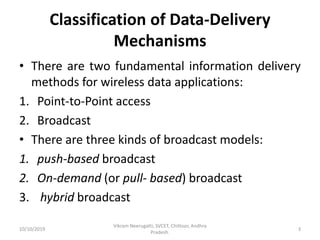
• There are two fundamental information delivery
methods for wireless data applications:
1. Point-to-Point access
2. Broadcast
• There are three kinds of broadcast models:
1. push-based broadcast
2. On-demand (or pull- based) broadcast
3. hybrid broadcast
10/10/2019
Vikram Neerugatti, SVCET, Chittoor, Andhra
Pradesh.
3
Push-based Mechanisms
10/10/2019
Vikram Neerugatti, SVCET, Chittoor, Andhra
Pradesh.
4
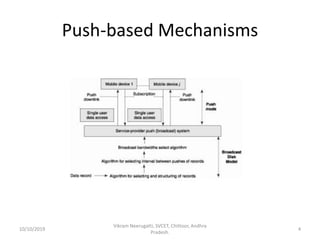
Push-based mechanisms function in the following manner:
1. A structure of data records to be pushed is selected. An
algorithm provides an adaptable multi-level mechanism that
permits data items to be pushed uniformly or non-uniformly
after structuring them according to their relative importance.
2. Data is pushed at selected time intervals using an adaptive
algorithm. Pushing only once saves bandwidth. However,
pushing at periodic intervals is important because it provides
the devices that were disconnected at the time of
previous push with a chance to cache the data when it is pushed
again.
3. Bandwidths are adapted for downlink (for pushes) using an
algorithm. Usually higher bandwidth is allocated to records
having higher number of subscribers or to those with
higher access probabilities.
4. A mechanism is also adopted to stop pushes when a device is
handed over to another cell.
10/10/2019
Vikram Neerugatti, SVCET, Chittoor, Andhra
Pradesh.
5
Advantages
• Push-based mechanisms enable broadcast of data
services to multiple devices.
• The server is not interrupted frequently by requests
from mobile devices.
• These mechanisms also prevent server overload,
which might be caused by flooding of device
requests
• Also, the user even gets the data he would have
otherwise ignored such as traffic congestion,
forthcoming weather reports etc
10/10/2019
Vikram Neerugatti, SVCET, Chittoor, Andhra
Pradesh.
6
Disadvantages
• Push-based mechanisms disseminate of
unsolicited, irrelevant, or out-of-context data,
which may cause inconvenience to the user.
10/10/2019
Vikram Neerugatti, SVCET, Chittoor, Andhra
Pradesh.
7
Pull based Mechanisms
10/10/2019
Vikram Neerugatti, SVCET, Chittoor, Andhra
Pradesh.
8
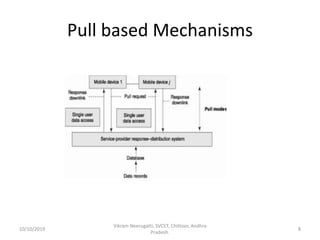
Pull-based mechanisms function in the following manner:
1. The bandwidth used for the uplink channel depends
upon the number of pull requests.
2. A pull threshold is selected. This threshold limits the
number of pull requests in a given period of time. This
controls the number of server interruptions.
3. A mechanism is adopted to prevent the device
from pulling from a cell, which has handed
over the concerned device to another cell. On
device handoff, the subscription is cancelled or
passed on to the new service provider cell
4. In pull-based mechanisms the user-device receives
data records sent by server on demand only.
10/10/2019
Vikram Neerugatti, SVCET, Chittoor, Andhra
Pradesh.
9
Advantages of Pull based mechanisms:
• With pull-based mechanisms, no unsolicited or
irrelevant data arrives at the device and the relevant
data is disseminated only when the user asks for it.
• Pull-based mechanisms are the best option when the
server has very little contention and is able to respond
to many device requests within expected time
intervals.
Disadvantages:
• The server faces frequent interruptions and queues of
requests at the server may cause congestion in cases of
sudden rise in demand for certain data record.
• In on-demand mode, another disadvantage is the
energy and bandwidth required for sending the
requests for hot items and temporal records
10/10/2019
Vikram Neerugatti, SVCET, Chittoor, Andhra
Pradesh.
10
Hybrid Mechanisms
10/10/2019
Vikram Neerugatti, SVCET, Chittoor, Andhra
Pradesh.
11
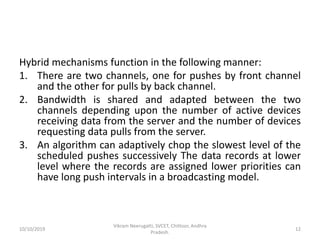
Hybrid mechanisms function in the following manner:
1. There are two channels, one for pushes by front channel
and the other for pulls by back channel.
2. Bandwidth is shared and adapted between the two
channels depending upon the number of active devices
receiving data from the server and the number of devices
requesting data pulls from the server.
3. An algorithm can adaptively chop the slowest level of the
scheduled pushes successively The data records at lower
level where the records are assigned lower priorities can
have long push intervals in a broadcasting model.
10/10/2019
Vikram Neerugatti, SVCET, Chittoor, Andhra
Pradesh.
12
Advantages of Hybrid mechanisms:
• The number of server interruptions and queued
requests are significantly reduced.
Disadvantages:
• PP does not eliminate the typical server problems of
too many interruptions and queued requests.
10/10/2019
Vikram Neerugatti, SVCET, Chittoor, Andhra
Pradesh.
13
Selective Tuning and Indexing
Technique
• Selective tuning is a process by which client device selects only the
required pushed buckets or records, tunes to them, and caches
them.
• Tuning means getting ready for caching at those instants and
intervals when a selected record of interest broadcasts.
• Broadcast data has a structure and overhead.
• Data broadcast from server, which is organized into buckets, is
interleaved.
• The server prefixes a directory, hash parameter (from which the
device finds the key), or index to the buckets.
• These prefixes form the basis of different methods of selective
tuning.
• Access time (taccess) is the time interval between pull request from
device and reception of response from broadcasting or data
pushing or responding server.
10/10/2019
Vikram Neerugatti, SVCET, Chittoor, Andhra
Pradesh.
14
• Indexing is another method for selective tuning. Indexes temporarily map
the location of the buckets.
• At each location, besides the bits for the bucket in record of interest data,
an offset value may also be specified there.
• While an index maps to the absolute location from the beginning of a
broadcast cycle, an offset index is a number which maps to the relative
location after the end of present bucket of interest.
• Offset means a value to be used by the device along with the present
location and calculate the wait period for tuning to the next bucket.
• All buckets have an offset to the beginning of the next indexed bucket or
item.
• Indexing is a technique in which each data bucket, record, or record block
of interest is assigned an index at the previous data bucket, record, or
record block of interest to enable the device to tune and cache the bucket
after the wait as per the offset value.
• The server transmits this index at the beginning of a broadcast cycle as
well as with each bucket corresponding to data of interest to the device.
• A disadvantage of using index is that it extends the broadcast cycle and
hence increases taccess.
10/10/2019
Vikram Neerugatti, SVCET, Chittoor, Andhra
Pradesh.
15

Data dissemination

  • 1.
    Data Dissemination 10/10/2019 Vikram Neerugatti,SVCET, Chittoor, Andhra Pradesh. 1
  • 2.
    • Data disseminationentails distributing and pushing data generated by a set of computing systems or broadcasting data from audio, video, and data services. • The output data is sent to the mobile devices. • A mobile device can select, tune and cache the required data items, which can be used for application programs. 10/10/2019 Vikram Neerugatti, SVCET, Chittoor, Andhra Pradesh. 2
  • 3.
    Classification of Data-Delivery Mechanisms •There are two fundamental information delivery methods for wireless data applications: 1. Point-to-Point access 2. Broadcast • There are three kinds of broadcast models: 1. push-based broadcast 2. On-demand (or pull- based) broadcast 3. hybrid broadcast 10/10/2019 Vikram Neerugatti, SVCET, Chittoor, Andhra Pradesh. 3
  • 4.
    Push-based Mechanisms 10/10/2019 Vikram Neerugatti,SVCET, Chittoor, Andhra Pradesh. 4
  • 5.
    Push-based mechanisms functionin the following manner: 1. A structure of data records to be pushed is selected. An algorithm provides an adaptable multi-level mechanism that permits data items to be pushed uniformly or non-uniformly after structuring them according to their relative importance. 2. Data is pushed at selected time intervals using an adaptive algorithm. Pushing only once saves bandwidth. However, pushing at periodic intervals is important because it provides the devices that were disconnected at the time of previous push with a chance to cache the data when it is pushed again. 3. Bandwidths are adapted for downlink (for pushes) using an algorithm. Usually higher bandwidth is allocated to records having higher number of subscribers or to those with higher access probabilities. 4. A mechanism is also adopted to stop pushes when a device is handed over to another cell. 10/10/2019 Vikram Neerugatti, SVCET, Chittoor, Andhra Pradesh. 5
  • 6.
    Advantages • Push-based mechanismsenable broadcast of data services to multiple devices. • The server is not interrupted frequently by requests from mobile devices. • These mechanisms also prevent server overload, which might be caused by flooding of device requests • Also, the user even gets the data he would have otherwise ignored such as traffic congestion, forthcoming weather reports etc 10/10/2019 Vikram Neerugatti, SVCET, Chittoor, Andhra Pradesh. 6
  • 7.
    Disadvantages • Push-based mechanismsdisseminate of unsolicited, irrelevant, or out-of-context data, which may cause inconvenience to the user. 10/10/2019 Vikram Neerugatti, SVCET, Chittoor, Andhra Pradesh. 7
  • 8.
    Pull based Mechanisms 10/10/2019 VikramNeerugatti, SVCET, Chittoor, Andhra Pradesh. 8
  • 9.
    Pull-based mechanisms functionin the following manner: 1. The bandwidth used for the uplink channel depends upon the number of pull requests. 2. A pull threshold is selected. This threshold limits the number of pull requests in a given period of time. This controls the number of server interruptions. 3. A mechanism is adopted to prevent the device from pulling from a cell, which has handed over the concerned device to another cell. On device handoff, the subscription is cancelled or passed on to the new service provider cell 4. In pull-based mechanisms the user-device receives data records sent by server on demand only. 10/10/2019 Vikram Neerugatti, SVCET, Chittoor, Andhra Pradesh. 9
  • 10.
    Advantages of Pullbased mechanisms: • With pull-based mechanisms, no unsolicited or irrelevant data arrives at the device and the relevant data is disseminated only when the user asks for it. • Pull-based mechanisms are the best option when the server has very little contention and is able to respond to many device requests within expected time intervals. Disadvantages: • The server faces frequent interruptions and queues of requests at the server may cause congestion in cases of sudden rise in demand for certain data record. • In on-demand mode, another disadvantage is the energy and bandwidth required for sending the requests for hot items and temporal records 10/10/2019 Vikram Neerugatti, SVCET, Chittoor, Andhra Pradesh. 10
  • 11.
    Hybrid Mechanisms 10/10/2019 Vikram Neerugatti,SVCET, Chittoor, Andhra Pradesh. 11
  • 12.
    Hybrid mechanisms functionin the following manner: 1. There are two channels, one for pushes by front channel and the other for pulls by back channel. 2. Bandwidth is shared and adapted between the two channels depending upon the number of active devices receiving data from the server and the number of devices requesting data pulls from the server. 3. An algorithm can adaptively chop the slowest level of the scheduled pushes successively The data records at lower level where the records are assigned lower priorities can have long push intervals in a broadcasting model. 10/10/2019 Vikram Neerugatti, SVCET, Chittoor, Andhra Pradesh. 12
  • 13.
    Advantages of Hybridmechanisms: • The number of server interruptions and queued requests are significantly reduced. Disadvantages: • PP does not eliminate the typical server problems of too many interruptions and queued requests. 10/10/2019 Vikram Neerugatti, SVCET, Chittoor, Andhra Pradesh. 13
  • 14.
    Selective Tuning andIndexing Technique • Selective tuning is a process by which client device selects only the required pushed buckets or records, tunes to them, and caches them. • Tuning means getting ready for caching at those instants and intervals when a selected record of interest broadcasts. • Broadcast data has a structure and overhead. • Data broadcast from server, which is organized into buckets, is interleaved. • The server prefixes a directory, hash parameter (from which the device finds the key), or index to the buckets. • These prefixes form the basis of different methods of selective tuning. • Access time (taccess) is the time interval between pull request from device and reception of response from broadcasting or data pushing or responding server. 10/10/2019 Vikram Neerugatti, SVCET, Chittoor, Andhra Pradesh. 14
  • 15.
    • Indexing isanother method for selective tuning. Indexes temporarily map the location of the buckets. • At each location, besides the bits for the bucket in record of interest data, an offset value may also be specified there. • While an index maps to the absolute location from the beginning of a broadcast cycle, an offset index is a number which maps to the relative location after the end of present bucket of interest. • Offset means a value to be used by the device along with the present location and calculate the wait period for tuning to the next bucket. • All buckets have an offset to the beginning of the next indexed bucket or item. • Indexing is a technique in which each data bucket, record, or record block of interest is assigned an index at the previous data bucket, record, or record block of interest to enable the device to tune and cache the bucket after the wait as per the offset value. • The server transmits this index at the beginning of a broadcast cycle as well as with each bucket corresponding to data of interest to the device. • A disadvantage of using index is that it extends the broadcast cycle and hence increases taccess. 10/10/2019 Vikram Neerugatti, SVCET, Chittoor, Andhra Pradesh. 15