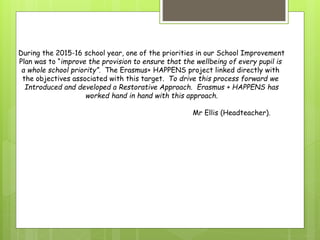
During the 2015-16 school year, one of the priorities in our School Improvement
Plan was to “improve the provision to ensure that the wellbeing of every pupil is
a whole school priority”. The Erasmus+ HAPPENS project linked directly with
the objectives associated with this target. To drive this process forward we
Introduced and developed a Restorative Approach. Erasmus + HAPPENS has
worked hand in hand with this approach.
Mr Ellis (Headteacher).
Erasmus
We first looked at the teachers well being.
 All teachers completed the computer survey to analyse our work/life
balance and discuss where we could improve.
 We incorporate Circle time sessions before staff meetings and every
Friday morning to discuss issues and also children .
 We have looked at ways to improve how much paper work we have to
complete when writing lesson plans and marking.
 Many of the teachers attend pilates sessions once a week in the hall
after school.
 We played a game together based on one we’d seen played in Greece!
Emotions.
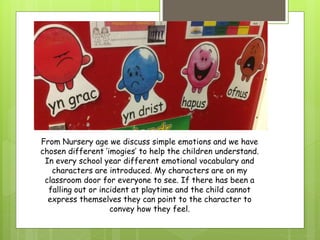
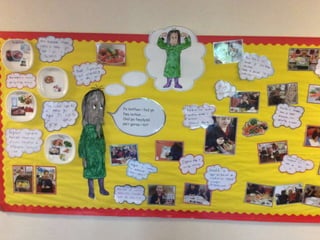
From Nursery age we discuss simple emotions and we have
chosen different ‘imogies’ to help the children understand.
In every school year different emotional vocabulary and
characters are introduced. My characters are on my
classroom door for everyone to see. If there has been a
falling out or incident at playtime and the child cannot
express themselves they can point to the character to
convey how they feel.
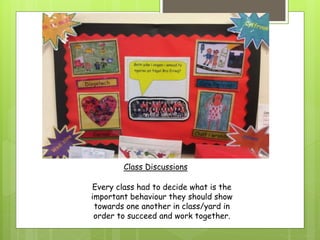
Class Discussions
Every class had to decide what is the
important behaviour they should show
towards one another in class/yard in
order to succeed and work together.
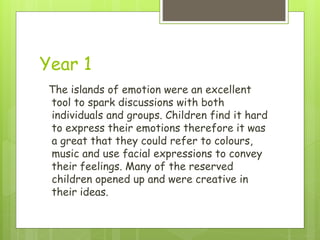
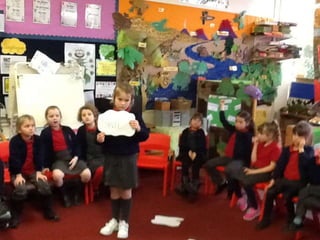
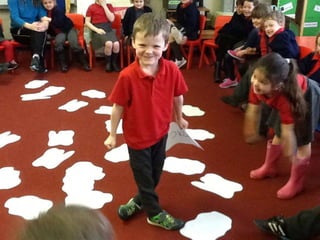
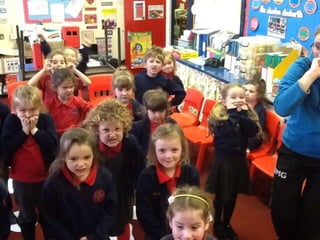
Year 1
The islands of emotion were an excellent
tool to spark discussions with both
individuals and groups. Children find it hard
to express their emotions therefore it was
a great that they could refer to colours,
music and use facial expressions to convey
their feelings. Many of the reserved
children opened up and were creative in
their ideas.
Year 2-Emotions
We took time to begin to discuss different
emotions. This was especially useful as
many of the children in the class were
experiencing many different problems. By
discussing different emotions , the children
slowly began to open up and become happy
discussing their feelings and the different
situations that could trigger different
feelings.
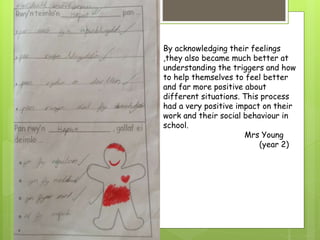
By acknowledging their feelings
,they also became much better at
understanding the triggers and how
to help themselves to feel better
and far more positive about
different situations. This process
had a very positive impact on their
work and their social behaviour in
school.
Mrs Young
(year 2)
Circle Time
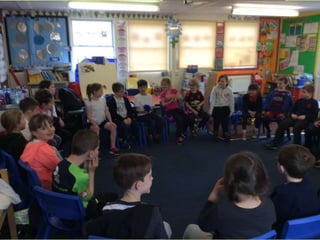
On Monday mornings we begin our week in a circle. During our
circle we greet each other, play mixer games and then each
child has an opportunity to share experiences from the
weekend with friends using the talking piece.
We repeat the circle at the end of the week, reflecting on
our work and activities in school during the week.
Circle time has given the children the confidence to express
themselves clearly using an expanding vocabulary and they
are far more comfortable sharing any anxieties. Children are
also eager to help each other and offer advice on how to deal
with different situations. Their listening skills have improved
and they have learnt how to respect other children’s
thoughts and feelings. They realise that everyone is entitled
to an opinion.
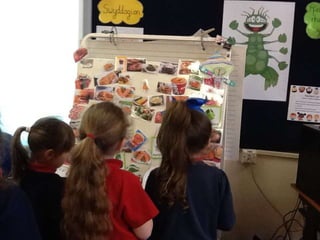
Diet
After one of the teachers came back from
Greece, the children took part in many healthy
eating activities. In groups, they enjoyed choosing
pictures of foods for their breakfast, lunch and
dinner and were encouraged to choose what they
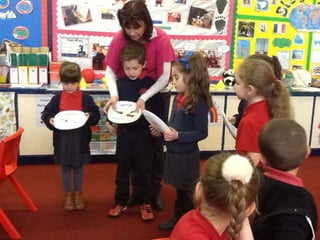
thought were healthy options. They then
discussed the different plates and decided
whether they were healthy or not. The children
also filled out a food diary over 5 days. This was
to ensure that parents became involved in
discussing healthy food.
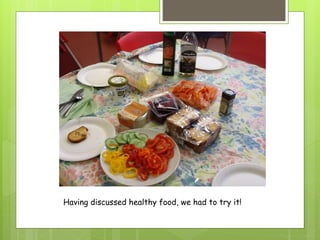
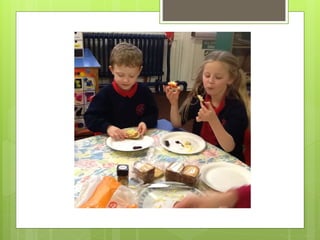
Having discussed healthy food, we had to try it!
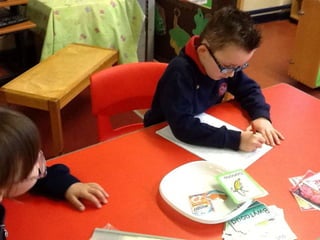
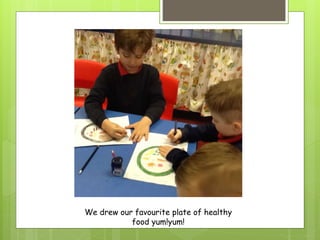
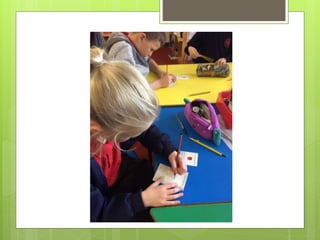
We drew our favourite plate of healthy
food yum!yum!
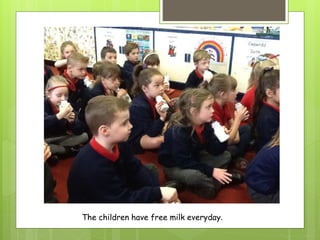
The children have free milk everyday.
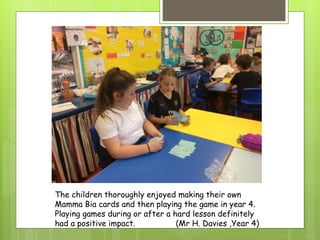
The children thoroughly enjoyed making their own
Mamma Bia cards and then playing the game in year 4.
Playing games during or after a hard lesson definitely
had a positive impact. (Mr H. Davies ,Year 4)
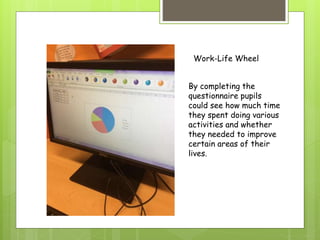
By completing the
questionnaire pupils
could see how much time
they spent doing various
activities and whether
they needed to improve
certain areas of their
lives.
Work-Life Wheel
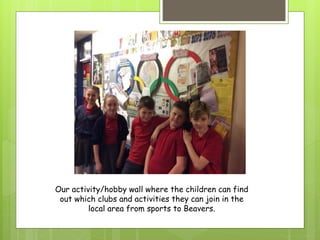
Our activity/hobby wall where the children can find
out which clubs and activities they can join in the
local area from sports to Beavers.
Physical Activity
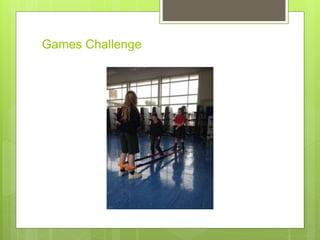
Games Challenge
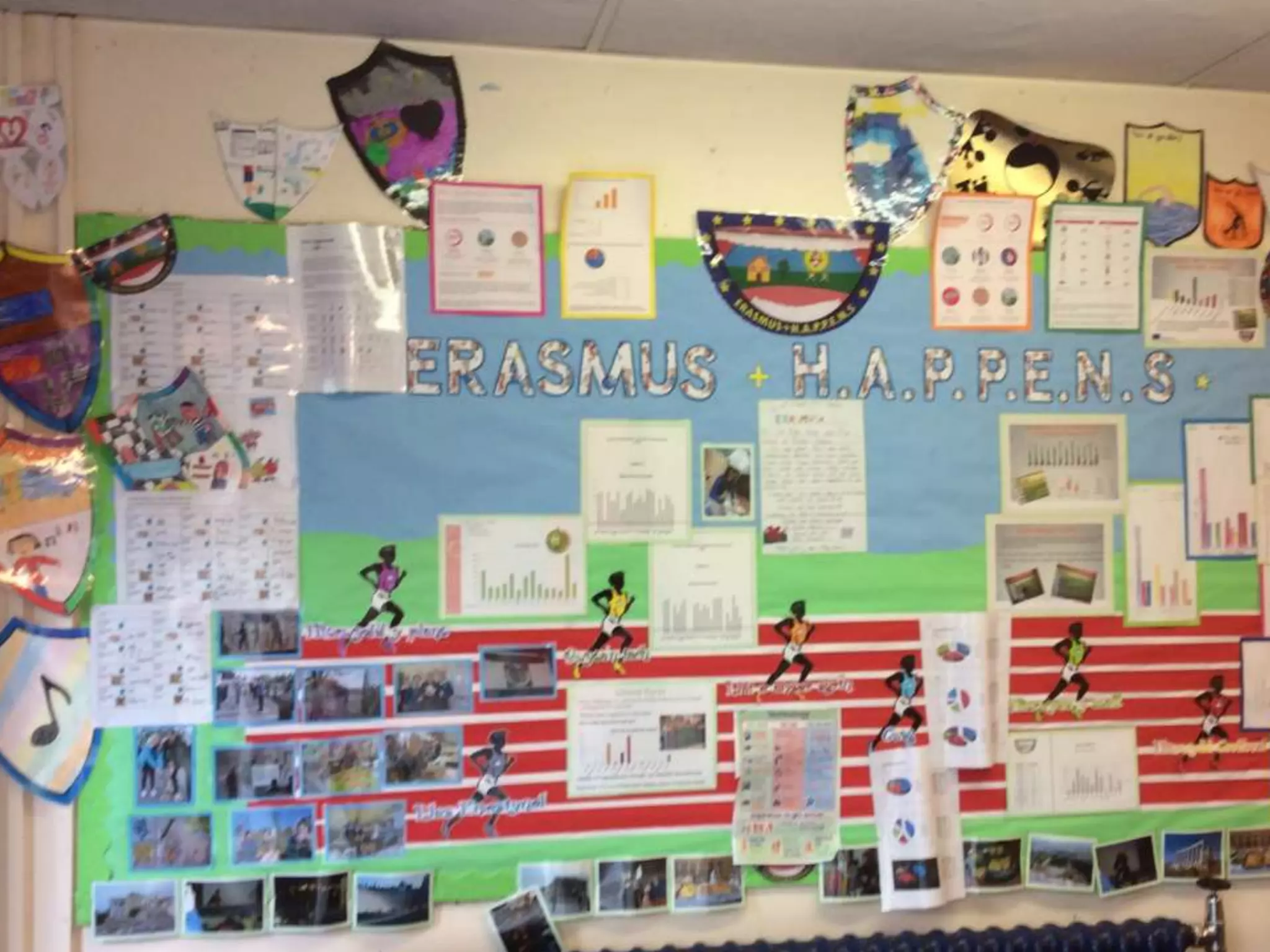
Bro Eirwg-Erasmus+ Happens Year 1

Bro Eirwg-Erasmus+ Happens Year 1

  • 2.
    During the 2015-16school year, one of the priorities in our School Improvement Plan was to “improve the provision to ensure that the wellbeing of every pupil is a whole school priority”. The Erasmus+ HAPPENS project linked directly with the objectives associated with this target. To drive this process forward we Introduced and developed a Restorative Approach. Erasmus + HAPPENS has worked hand in hand with this approach. Mr Ellis (Headteacher).
  • 3.
    Erasmus We first lookedat the teachers well being.  All teachers completed the computer survey to analyse our work/life balance and discuss where we could improve.  We incorporate Circle time sessions before staff meetings and every Friday morning to discuss issues and also children .  We have looked at ways to improve how much paper work we have to complete when writing lesson plans and marking.  Many of the teachers attend pilates sessions once a week in the hall after school.  We played a game together based on one we’d seen played in Greece!
  • 5.
  • 6.
    From Nursery agewe discuss simple emotions and we have chosen different ‘imogies’ to help the children understand. In every school year different emotional vocabulary and characters are introduced. My characters are on my classroom door for everyone to see. If there has been a falling out or incident at playtime and the child cannot express themselves they can point to the character to convey how they feel.
  • 8.
    Class Discussions Every classhad to decide what is the important behaviour they should show towards one another in class/yard in order to succeed and work together.
  • 9.
    Year 1 The islandsof emotion were an excellent tool to spark discussions with both individuals and groups. Children find it hard to express their emotions therefore it was a great that they could refer to colours, music and use facial expressions to convey their feelings. Many of the reserved children opened up and were creative in their ideas.
  • 13.
    Year 2-Emotions We tooktime to begin to discuss different emotions. This was especially useful as many of the children in the class were experiencing many different problems. By discussing different emotions , the children slowly began to open up and become happy discussing their feelings and the different situations that could trigger different feelings.
  • 14.
    By acknowledging theirfeelings ,they also became much better at understanding the triggers and how to help themselves to feel better and far more positive about different situations. This process had a very positive impact on their work and their social behaviour in school. Mrs Young (year 2)
  • 15.
    Circle Time On Mondaymornings we begin our week in a circle. During our circle we greet each other, play mixer games and then each child has an opportunity to share experiences from the weekend with friends using the talking piece. We repeat the circle at the end of the week, reflecting on our work and activities in school during the week. Circle time has given the children the confidence to express themselves clearly using an expanding vocabulary and they are far more comfortable sharing any anxieties. Children are also eager to help each other and offer advice on how to deal with different situations. Their listening skills have improved and they have learnt how to respect other children’s thoughts and feelings. They realise that everyone is entitled to an opinion.
  • 17.
    Diet After one ofthe teachers came back from Greece, the children took part in many healthy eating activities. In groups, they enjoyed choosing pictures of foods for their breakfast, lunch and dinner and were encouraged to choose what they thought were healthy options. They then discussed the different plates and decided whether they were healthy or not. The children also filled out a food diary over 5 days. This was to ensure that parents became involved in discussing healthy food.
  • 21.
    Having discussed healthyfood, we had to try it!
  • 23.
    We drew ourfavourite plate of healthy food yum!yum!
  • 25.
    The children havefree milk everyday.
  • 26.
    The children thoroughlyenjoyed making their own Mamma Bia cards and then playing the game in year 4. Playing games during or after a hard lesson definitely had a positive impact. (Mr H. Davies ,Year 4)
  • 28.
    By completing the questionnairepupils could see how much time they spent doing various activities and whether they needed to improve certain areas of their lives. Work-Life Wheel
  • 29.
    Our activity/hobby wallwhere the children can find out which clubs and activities they can join in the local area from sports to Beavers.
  • 30.
  • 31.