COLLEGE OF AGRICULTURAL TECHNOLOGY
(Affiliated to Tamil Nadu Agricultural University, Coimbatore-3)
Kullapuram (Po),ViaVaigai Dam, Theni-625 562
BRINJAL BACTERIAL WILT
Ralstonia solanacearum
Course teacher: Name:
Dr.Parthasarathy.S, Nainu Joseph
Asst. Professor (Plant Pathology) 2015021088
CONTENT
 OCCURRENCE
 LOSSES
 SYMPTOMS
 PATHOGEN
 SYSTEMATIC POSITION
 MODE OF SPREAD AND SURVIVAL
 FAVOURABLE CONDITIONS
 MANAGEMENT
OCCURRENCE
• It is endemic to the southern United States as
well as Africa, Asia and South America.
• Ralstonia spp. is prevalent in tropical and
subtropical regions of the world.
• It has recently become a recognized problem
in temperate regions as well.
OTHER HOSTS
• Plant hosts that R. solanacearum infects
include:
• Potato ,tomato , banana, ginger, tobacco, sweet
pepper ,olive ,rose ,soybean.
LOSSES
In India loss in yield in brinjal is upto 8.1 per
cent.
SYMPTOMS
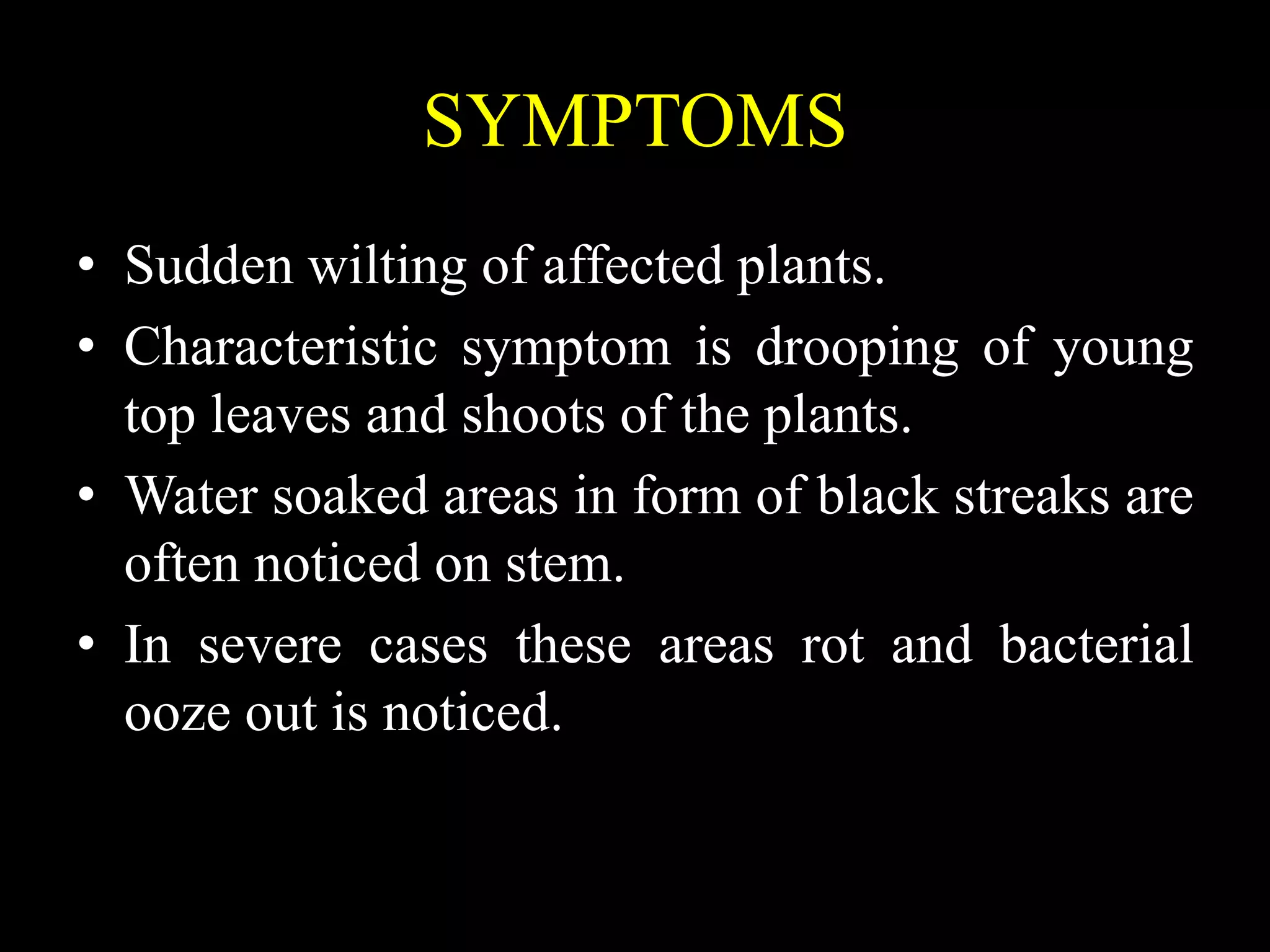
• Sudden wilting of affected plants.
• Characteristic symptom is drooping of young
top leaves and shoots of the plants.
• Water soaked areas in form of black streaks are
often noticed on stem.
• In severe cases these areas rot and bacterial
ooze out is noticed.
• Infected region of the stem or root shows
brown discolouration in vascular region and
bacterial ooze out in form of milky white
stream.
• The plants die within 3 to 5 days after
appearance of first symptom.
• The disease is severe during monsoon when
fields are waterlogged.
©mathirkatha.net
©the ecologist.org
PATHOGEN
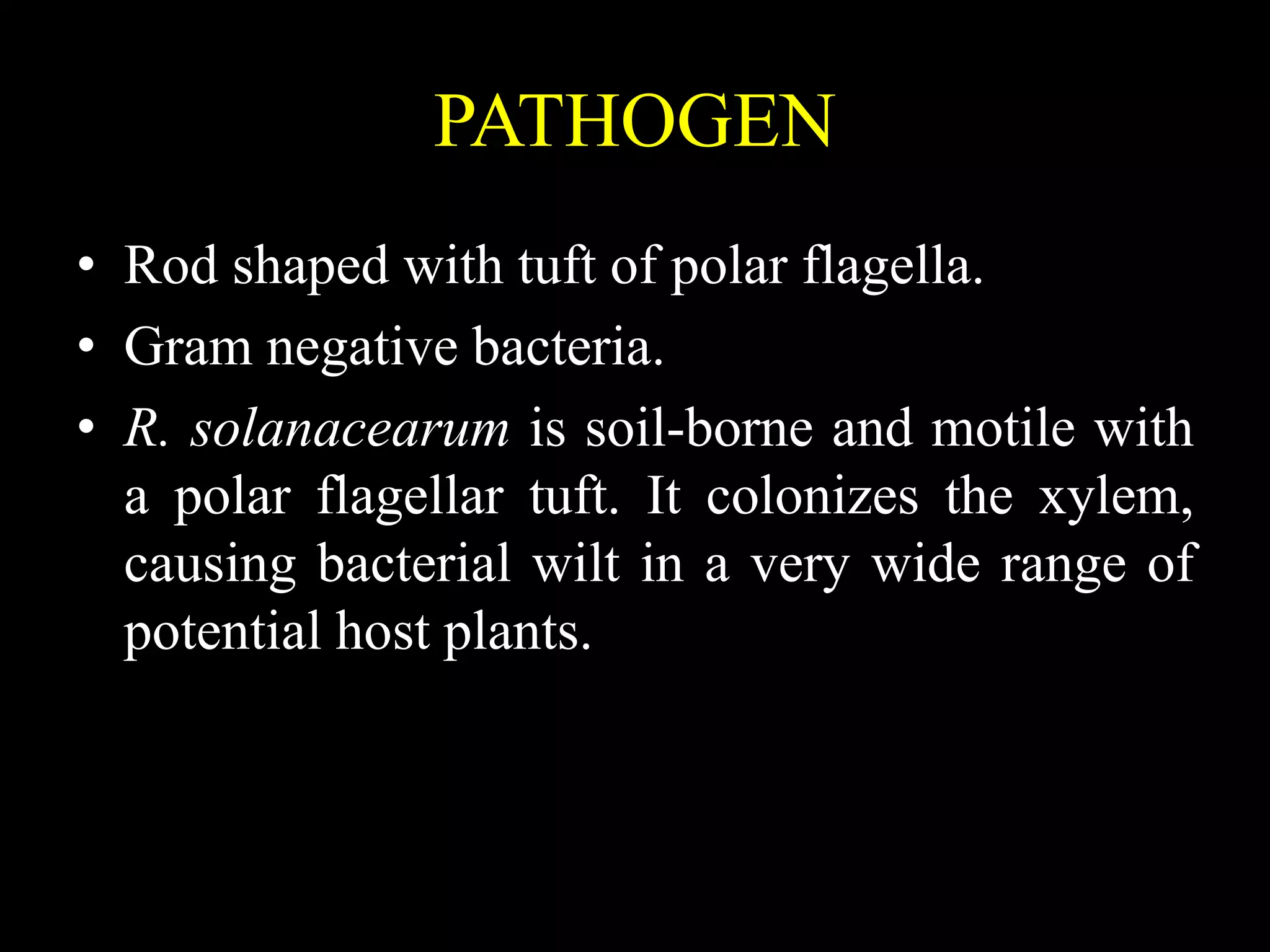
• Rod shaped with tuft of polar flagella.
• Gram negative bacteria.
• R. solanacearum is soil-borne and motile with
a polar flagellar tuft. It colonizes the xylem,
causing bacterial wilt in a very wide range of
potential host plants.
SYSTEMATIC POSITION
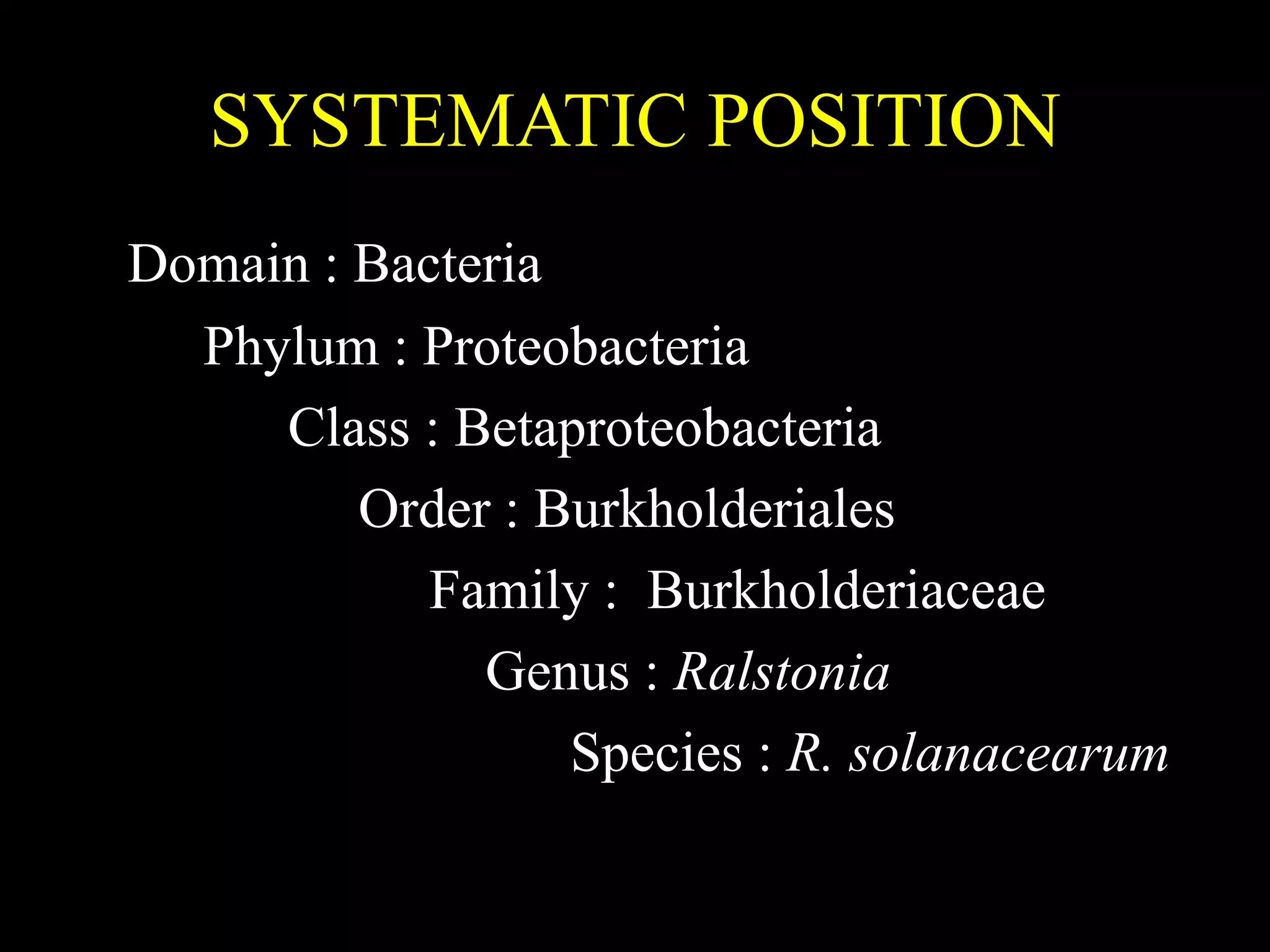
Domain : Bacteria
Phylum : Proteobacteria
Class : Betaproteobacteria
Order : Burkholderiales
Family : Burkholderiaceae
Genus : Ralstonia
Species : R. solanacearum
MODE OF SPREAD AND
SURVIVAL
• The bacterium though a non-spore former is
found to be alive and viable for more than 16
months in laboratory condition.
• It s found alive in infected plant debris for 10
months.
• Presence of Meloidogyne javanica increases
the wilt incidence.
FAVOURABLE CONDITIONS
• Symptom expression is favored by high
temperatures (30-35˚C) and symptoms of the
disease may progress rapidly after infection.
• High soil moisture and periods of wet weather
or rainy seasons are associated with high
disease incidence.
MANAGEMENT
• PHYSICAL METHODS
• Rouging of diseased plants and burn.
• Field sanitation by ensuring weed free field.
• RESISTANT VARIETY
• Use resistant variety namely Pant Samrat, Arka
Keshav, Arka Neelkant, Pusa Purple Cluster
and Pusa Purple Round, etc.
• Avoid susceptible varieties like Pusa Purple
Long.
CULTURAL METHODS
• Summer ploughing.
• Crop rotation with cereals or cruciferous
vegetables.
• Solarization of nursery beds.
• Keep land fallow for a season to destroy
harmful pathogens.
• Avoid water logging and provide drainage
facility.
BIOLOGICAL METHOD
• Apply neem cake @ 100 kg /acre to reduce
bacterial pathogen.
• Apply basally talc based Pseudomonas
fluorescens at 2.5 kg/ ha pre-colonized in farm
yard manure.
CHEMICAL METHOD
• Soil fumigation with Formalin at 7% before
sowing.
• Seed treatment with Streptocycline (150 ppm)
for 90 min.
• Spray copper fungicide to control disease
(2% Bordeaux mixture).
• Drench in and around diseased area with
copper hydroxide 77%WP @ 3 g/ litre.
REFERENCE
• V. K Gupta and Y. S Pacil. Diseases of vegetable
crops – published by Kalyani publishers, New
Delhi. Page no: 121-124
• T. S Thind, Diseases of fruits and vegetables and
their management- Kalyani publishers, New
Delhi. Page no: 373
• http://www.kisansuvidha.com/brinjal-diseases
• Plant pathology journal-Some Important Plant
Pathogenic Disease of Brinjal and their
Management.

Brinjal bacterial wilt

  • 1.
    COLLEGE OF AGRICULTURALTECHNOLOGY (Affiliated to Tamil Nadu Agricultural University, Coimbatore-3) Kullapuram (Po),ViaVaigai Dam, Theni-625 562 BRINJAL BACTERIAL WILT Ralstonia solanacearum Course teacher: Name: Dr.Parthasarathy.S, Nainu Joseph Asst. Professor (Plant Pathology) 2015021088
  • 2.
    CONTENT  OCCURRENCE  LOSSES SYMPTOMS  PATHOGEN  SYSTEMATIC POSITION  MODE OF SPREAD AND SURVIVAL  FAVOURABLE CONDITIONS  MANAGEMENT
  • 3.
    OCCURRENCE • It isendemic to the southern United States as well as Africa, Asia and South America. • Ralstonia spp. is prevalent in tropical and subtropical regions of the world. • It has recently become a recognized problem in temperate regions as well.
  • 4.
    OTHER HOSTS • Planthosts that R. solanacearum infects include: • Potato ,tomato , banana, ginger, tobacco, sweet pepper ,olive ,rose ,soybean. LOSSES In India loss in yield in brinjal is upto 8.1 per cent.
  • 5.
    SYMPTOMS • Sudden wiltingof affected plants. • Characteristic symptom is drooping of young top leaves and shoots of the plants. • Water soaked areas in form of black streaks are often noticed on stem. • In severe cases these areas rot and bacterial ooze out is noticed.
  • 6.
    • Infected regionof the stem or root shows brown discolouration in vascular region and bacterial ooze out in form of milky white stream. • The plants die within 3 to 5 days after appearance of first symptom. • The disease is severe during monsoon when fields are waterlogged.
  • 7.
  • 8.
  • 9.
    PATHOGEN • Rod shapedwith tuft of polar flagella. • Gram negative bacteria. • R. solanacearum is soil-borne and motile with a polar flagellar tuft. It colonizes the xylem, causing bacterial wilt in a very wide range of potential host plants.
  • 10.
    SYSTEMATIC POSITION Domain :Bacteria Phylum : Proteobacteria Class : Betaproteobacteria Order : Burkholderiales Family : Burkholderiaceae Genus : Ralstonia Species : R. solanacearum
  • 11.
    MODE OF SPREADAND SURVIVAL • The bacterium though a non-spore former is found to be alive and viable for more than 16 months in laboratory condition. • It s found alive in infected plant debris for 10 months. • Presence of Meloidogyne javanica increases the wilt incidence.
  • 12.
    FAVOURABLE CONDITIONS • Symptomexpression is favored by high temperatures (30-35˚C) and symptoms of the disease may progress rapidly after infection. • High soil moisture and periods of wet weather or rainy seasons are associated with high disease incidence.
  • 13.
    MANAGEMENT • PHYSICAL METHODS •Rouging of diseased plants and burn. • Field sanitation by ensuring weed free field. • RESISTANT VARIETY • Use resistant variety namely Pant Samrat, Arka Keshav, Arka Neelkant, Pusa Purple Cluster and Pusa Purple Round, etc. • Avoid susceptible varieties like Pusa Purple Long.
  • 14.
    CULTURAL METHODS • Summerploughing. • Crop rotation with cereals or cruciferous vegetables. • Solarization of nursery beds. • Keep land fallow for a season to destroy harmful pathogens. • Avoid water logging and provide drainage facility.
  • 15.
    BIOLOGICAL METHOD • Applyneem cake @ 100 kg /acre to reduce bacterial pathogen. • Apply basally talc based Pseudomonas fluorescens at 2.5 kg/ ha pre-colonized in farm yard manure.
  • 16.
    CHEMICAL METHOD • Soilfumigation with Formalin at 7% before sowing. • Seed treatment with Streptocycline (150 ppm) for 90 min. • Spray copper fungicide to control disease (2% Bordeaux mixture). • Drench in and around diseased area with copper hydroxide 77%WP @ 3 g/ litre.
  • 17.
    REFERENCE • V. KGupta and Y. S Pacil. Diseases of vegetable crops – published by Kalyani publishers, New Delhi. Page no: 121-124 • T. S Thind, Diseases of fruits and vegetables and their management- Kalyani publishers, New Delhi. Page no: 373 • http://www.kisansuvidha.com/brinjal-diseases • Plant pathology journal-Some Important Plant Pathogenic Disease of Brinjal and their Management.