PLANT
PATHOLOGY
ST. XAVIER’S COLLEGE, RANCHI
(Affliated to Ranchi University, Ranchi,
Jharkhand)
Aroma Aishwarya Barla
Department of Botany
WILT OF TOMATO • Causal Organism: Fusarium oxysporum f. sp.
lycopersici
• Spread through: Soil
• Favourable conditions: High soil moisture and
high temperature. Soil with high Nitrogen and
Low Potassium content is favoured.
• Symptoms:
• The first symptom of the disease is clearing of
the veinlets and chlorosis of the leaves.
• The younger leaves may die in succession and
the entire may wilt and die in a course of few
days. Soon the petiole and the leaves droop and
wilt.
• In young plants, symptom consists of clearing of
veinlet and dropping of petioles.
• In field, yellowing of the lower leaves first and
affected leaflets wilt and die.
• Growth is typically stunted, little to no fruit
development.
• The symptoms continue in subsequent leaves. At
later stage, browning of vascular system occurs.
Plants become stunted and die.
WILT OF TOMATO:
CONTROL
• Removal of infected leaves and Plants
• Crop-rotation with non-host crops like cereals
and other solanaceous crops for 4-5 years to
reduce the inoculum level in the soil.
• Solarization of Soil helps in eliminating pests,
fungi, nematodes, weeds etc.
• Avoid using Fusarium infected seeds. Instead,
use commercially tested seeds.
• Used of resistant varieties. These seed packets
have labels like F, FF, FFF – indicates
resistance to Fusarium varieties.
• Grafting: Graft can decrease susceptibility to
root diseases and increase growth vigor of
tomato. The most widely used for rootstock in
the greenhouse are ‘Maxifort’ and ‘Beaufort’.
Bacterial Wilt of Tomato:
• Characteristic symptoms of bacterial wilt are the rapid and complete
wilting of normal grown up plants.
• Lower leaves may drop before wilting. Pathogen is mostly confined to
vascular region; in advantage cases, it may invade the cortex and pith
and cause yellow brown discolouration of tissues.
• Infected plant parts when cut and immersed in clear water, a white
streak of bacterial ooze are seen coming out from cut ends.
CITRUS CANKER
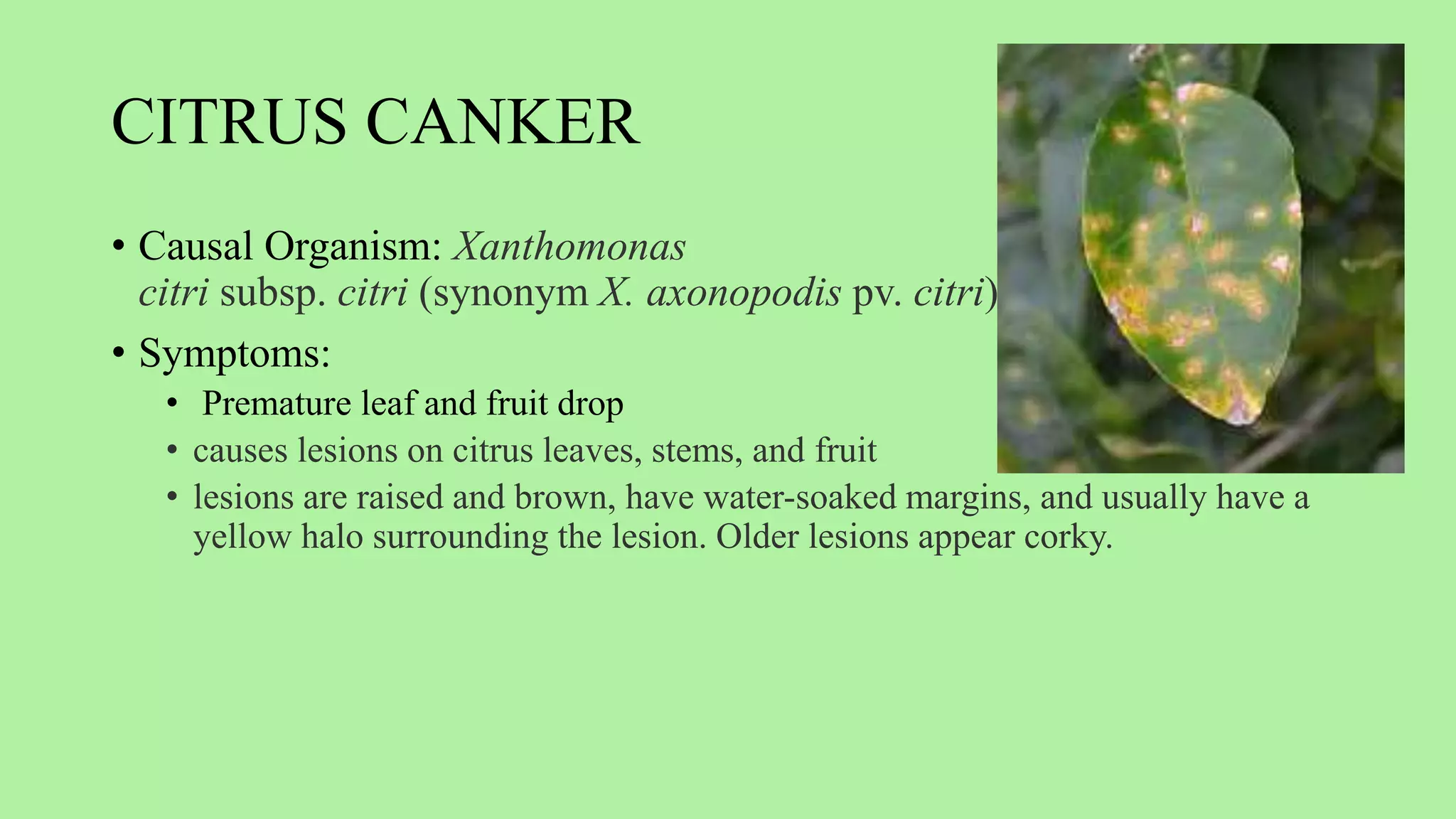
• Causal Organism: Xanthomonas
citri subsp. citri (synonym X. axonopodis pv. citri)
• Symptoms:
• Premature leaf and fruit drop
• causes lesions on citrus leaves, stems, and fruit
• lesions are raised and brown, have water-soaked margins, and usually have a
yellow halo surrounding the lesion. Older lesions appear corky.
CITRUS CANKER CONTROL:
• Use if citrus canker free
nursery plants
• Pruning and burning of infected
twigs
• Spray copper based pesticides
• Developing canker resistant
varieties
• Neem cake suspension on
infected twigs
• Streptomycin- antibiotic to
control the disease
YELLOW VEIN
MOSAIC OF
BHINDI
• Causal Organism: monopartite Begomovirus
• Symptoms:
• Yellowing of the entire network of veins in the
leaf blade is the characteristic symptom
• In severe infections the younger leaves turn
yellow, become reduced in size and the plant is
highly stunted.
• In a field, most of the plants may be diseased
and the infection may start at any stage of plant
growth.
• Flowering and fruiting restricted or formed
poorly.
• Fruits formed are yellowish-whitish
YELLOW VEIN MOSAIC
OF BHINDI CONTROL:
• Application of Chlorpyriphos 2.5 ml + neem
oil 2 ml lit of water.
• Seeds of disease free plants should be used.
• Sow disease free varieties such as Punjab-7,
Punjab-8 and Punjab Padmini.
• For the prevention of white fly make
solution of 560 ml of Malathion in 100-125
Lt water and spray it.
• Do not let the wild mint plants grow around
the farm.
LEAF CURL OF PAPAYA
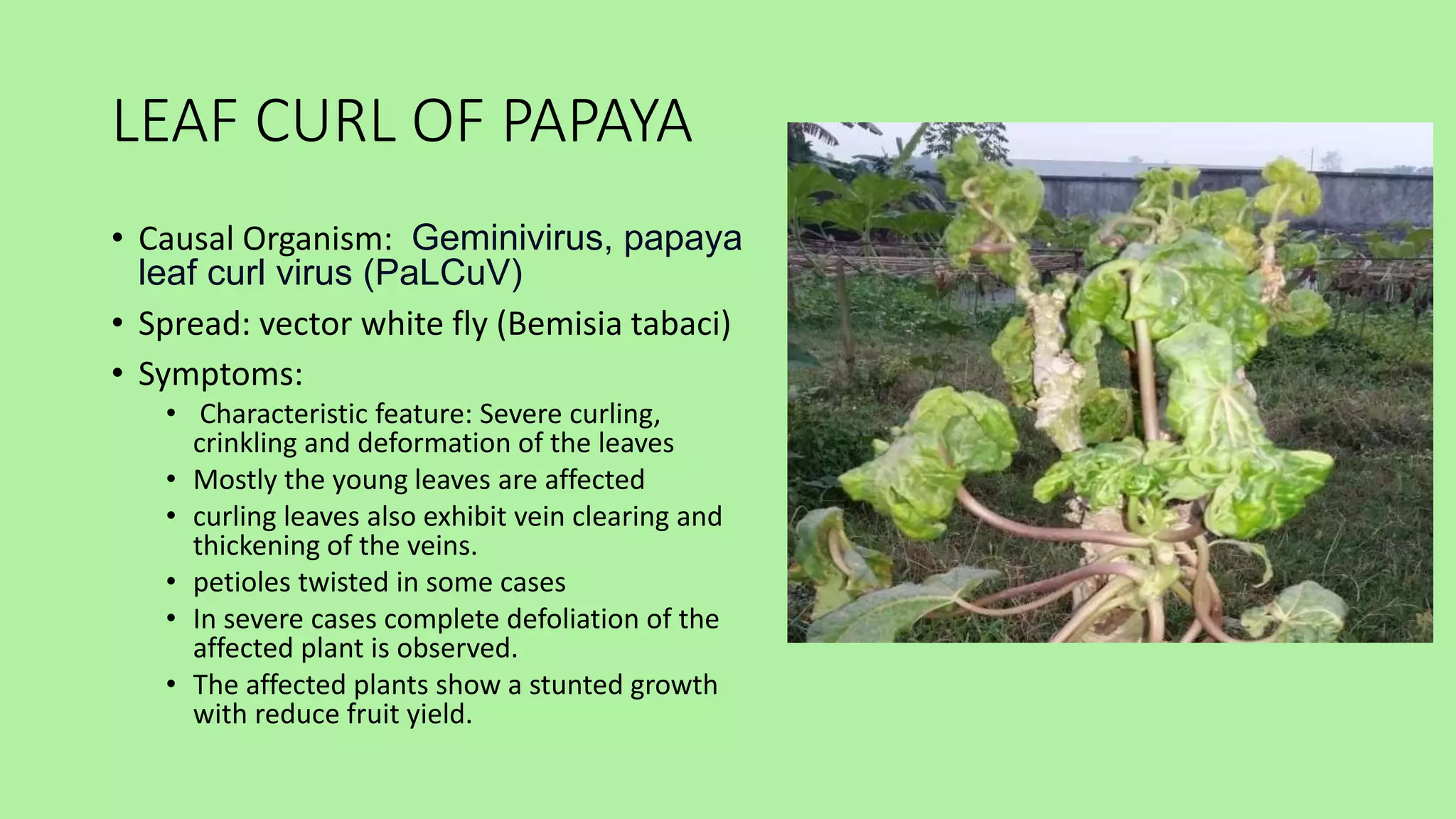
• Causal Organism: Geminivirus, papaya
leaf curl virus (PaLCuV)
• Spread: vector white fly (Bemisia tabaci)
• Symptoms:
• Characteristic feature: Severe curling,
crinkling and deformation of the leaves
• Mostly the young leaves are affected
• curling leaves also exhibit vein clearing and
thickening of the veins.
• petioles twisted in some cases
• In severe cases complete defoliation of the
affected plant is observed.
• The affected plants show a stunted growth
with reduce fruit yield.
LEAF CURL OF
PAPAYA CONTROL:
• Removal and destruction of the
affected plants is the only control
measure to reduce the spread of the
disease.
• Checking the population of white flies
also can reduce the infection severity.
• Soil application of Carbofuran (1 kg
a.i./ha) at the time of sowing and 4-5
foliar sprays of Dimethoate (0.05%) or
Metasystox (0.02%) or Nuvacron
(0.05% ) at an interval of 10 days
effectively controls the whitefly
population.
BLACK STEM RUST
OF WHEAT
• Causal Organism: Puccinia graminis
f.sp. Tritici (Pers.) Erikss. And Henn
• Symptoms:
• eruptions of black-brown pustules in
the stalk, leaf sheaths and leaf called
uredia, uredosori.
• Uredosori soon ruptures, exposing the
brown uredospores which then travel
via wind and infect other nearby
plants.
• Control:
• Use of fungicides like sulphur,
dichlone, zineb, maneb etc.
• New resistant varieties are not much
practical due to emergence of new
physiological races.
LOOSE SMUT OF WHEAT
• Causal Organism: Ustilago nuda var. tritici schaf
• Symptoms:
• Appears as characteristic dusty appearance of diseased
heads and complete destruction of spikelet
• Smutted head consists of deformed spikelets, filled
with black dry, powdery mass of spores known as
chlamydospores.
• Glumes and Kernels are completely disintegrated and
soon after emergence the wind blows bare rachis
which is not attacked by fungus.
• Control:
• growing resistant varieties
• Heat treatment of seeds
• Chemical treatment by: carboxin, marimol, carbathin
etc
• Field inspectionand removing infected heads at early
stage
• Using certified seeds

PLANT PATHOLOGY.pptx

  • 1.
    PLANT PATHOLOGY ST. XAVIER’S COLLEGE,RANCHI (Affliated to Ranchi University, Ranchi, Jharkhand) Aroma Aishwarya Barla Department of Botany
  • 2.
    WILT OF TOMATO• Causal Organism: Fusarium oxysporum f. sp. lycopersici • Spread through: Soil • Favourable conditions: High soil moisture and high temperature. Soil with high Nitrogen and Low Potassium content is favoured. • Symptoms: • The first symptom of the disease is clearing of the veinlets and chlorosis of the leaves. • The younger leaves may die in succession and the entire may wilt and die in a course of few days. Soon the petiole and the leaves droop and wilt. • In young plants, symptom consists of clearing of veinlet and dropping of petioles. • In field, yellowing of the lower leaves first and affected leaflets wilt and die. • Growth is typically stunted, little to no fruit development. • The symptoms continue in subsequent leaves. At later stage, browning of vascular system occurs. Plants become stunted and die.
  • 3.
    WILT OF TOMATO: CONTROL •Removal of infected leaves and Plants • Crop-rotation with non-host crops like cereals and other solanaceous crops for 4-5 years to reduce the inoculum level in the soil. • Solarization of Soil helps in eliminating pests, fungi, nematodes, weeds etc. • Avoid using Fusarium infected seeds. Instead, use commercially tested seeds. • Used of resistant varieties. These seed packets have labels like F, FF, FFF – indicates resistance to Fusarium varieties. • Grafting: Graft can decrease susceptibility to root diseases and increase growth vigor of tomato. The most widely used for rootstock in the greenhouse are ‘Maxifort’ and ‘Beaufort’.
  • 4.
    Bacterial Wilt ofTomato: • Characteristic symptoms of bacterial wilt are the rapid and complete wilting of normal grown up plants. • Lower leaves may drop before wilting. Pathogen is mostly confined to vascular region; in advantage cases, it may invade the cortex and pith and cause yellow brown discolouration of tissues. • Infected plant parts when cut and immersed in clear water, a white streak of bacterial ooze are seen coming out from cut ends.
  • 5.
    CITRUS CANKER • CausalOrganism: Xanthomonas citri subsp. citri (synonym X. axonopodis pv. citri) • Symptoms: • Premature leaf and fruit drop • causes lesions on citrus leaves, stems, and fruit • lesions are raised and brown, have water-soaked margins, and usually have a yellow halo surrounding the lesion. Older lesions appear corky.
  • 6.
    CITRUS CANKER CONTROL: •Use if citrus canker free nursery plants • Pruning and burning of infected twigs • Spray copper based pesticides • Developing canker resistant varieties • Neem cake suspension on infected twigs • Streptomycin- antibiotic to control the disease
  • 7.
    YELLOW VEIN MOSAIC OF BHINDI •Causal Organism: monopartite Begomovirus • Symptoms: • Yellowing of the entire network of veins in the leaf blade is the characteristic symptom • In severe infections the younger leaves turn yellow, become reduced in size and the plant is highly stunted. • In a field, most of the plants may be diseased and the infection may start at any stage of plant growth. • Flowering and fruiting restricted or formed poorly. • Fruits formed are yellowish-whitish
  • 8.
    YELLOW VEIN MOSAIC OFBHINDI CONTROL: • Application of Chlorpyriphos 2.5 ml + neem oil 2 ml lit of water. • Seeds of disease free plants should be used. • Sow disease free varieties such as Punjab-7, Punjab-8 and Punjab Padmini. • For the prevention of white fly make solution of 560 ml of Malathion in 100-125 Lt water and spray it. • Do not let the wild mint plants grow around the farm.
  • 9.
    LEAF CURL OFPAPAYA • Causal Organism: Geminivirus, papaya leaf curl virus (PaLCuV) • Spread: vector white fly (Bemisia tabaci) • Symptoms: • Characteristic feature: Severe curling, crinkling and deformation of the leaves • Mostly the young leaves are affected • curling leaves also exhibit vein clearing and thickening of the veins. • petioles twisted in some cases • In severe cases complete defoliation of the affected plant is observed. • The affected plants show a stunted growth with reduce fruit yield.
  • 10.
    LEAF CURL OF PAPAYACONTROL: • Removal and destruction of the affected plants is the only control measure to reduce the spread of the disease. • Checking the population of white flies also can reduce the infection severity. • Soil application of Carbofuran (1 kg a.i./ha) at the time of sowing and 4-5 foliar sprays of Dimethoate (0.05%) or Metasystox (0.02%) or Nuvacron (0.05% ) at an interval of 10 days effectively controls the whitefly population.
  • 11.
    BLACK STEM RUST OFWHEAT • Causal Organism: Puccinia graminis f.sp. Tritici (Pers.) Erikss. And Henn • Symptoms: • eruptions of black-brown pustules in the stalk, leaf sheaths and leaf called uredia, uredosori. • Uredosori soon ruptures, exposing the brown uredospores which then travel via wind and infect other nearby plants. • Control: • Use of fungicides like sulphur, dichlone, zineb, maneb etc. • New resistant varieties are not much practical due to emergence of new physiological races.
  • 12.
    LOOSE SMUT OFWHEAT • Causal Organism: Ustilago nuda var. tritici schaf • Symptoms: • Appears as characteristic dusty appearance of diseased heads and complete destruction of spikelet • Smutted head consists of deformed spikelets, filled with black dry, powdery mass of spores known as chlamydospores. • Glumes and Kernels are completely disintegrated and soon after emergence the wind blows bare rachis which is not attacked by fungus. • Control: • growing resistant varieties • Heat treatment of seeds • Chemical treatment by: carboxin, marimol, carbathin etc • Field inspectionand removing infected heads at early stage • Using certified seeds