Sensor
A sensor isa device that detects and responds to physical stimuli from the environment, converting one
form of energy or physical quantity into another form that can be measured or processed. Sensors detect
changes in physical parameters such as temperature, pressure, light, motion, or chemical composition.
Transducer
A transducer is a device that converts one form of energy into another. It transforms energy from one
domain to another, such as mechanical to electrical, thermal to electrical, or optical to electrical. All
sensors are transducers, but not all transducers are sensors.
Fundamental Definitions
3.
1. Based onPower Source
Active Sensors
Generate their own electrical signal without external power
Self-powered devices that produce output signal from the measurand
Examples: Thermocouples, piezoelectric sensors, photovoltaic cells
Characteristics: No external power required, generally have lower sensitivity
Passive Sensors
Require external power supply to operate
Modify electrical properties in response to physical changes
Examples: Thermistors, strain gauges, LDRs (Light Dependent Resistors)
Characteristics: Higher sensitivity, require excitation voltage
Classification of Sensors
4.
Based on OutputSignal
Analog Sensors
Produce continuous output signals proportional to input
Output varies smoothly over a range of values
Examples: Thermocouple, LVDT, potentiometer-based position sensors
Characteristics: Infinite resolution, susceptible to noise, require ADC for digital systems
Digital Sensors
Produce discrete output signals (binary or coded)
Output in digital format directly
Examples: Encoder, digital temperature sensors, proximity switches
Characteristics: High noise immunity, direct interface with digital systems, limited resolution
5.
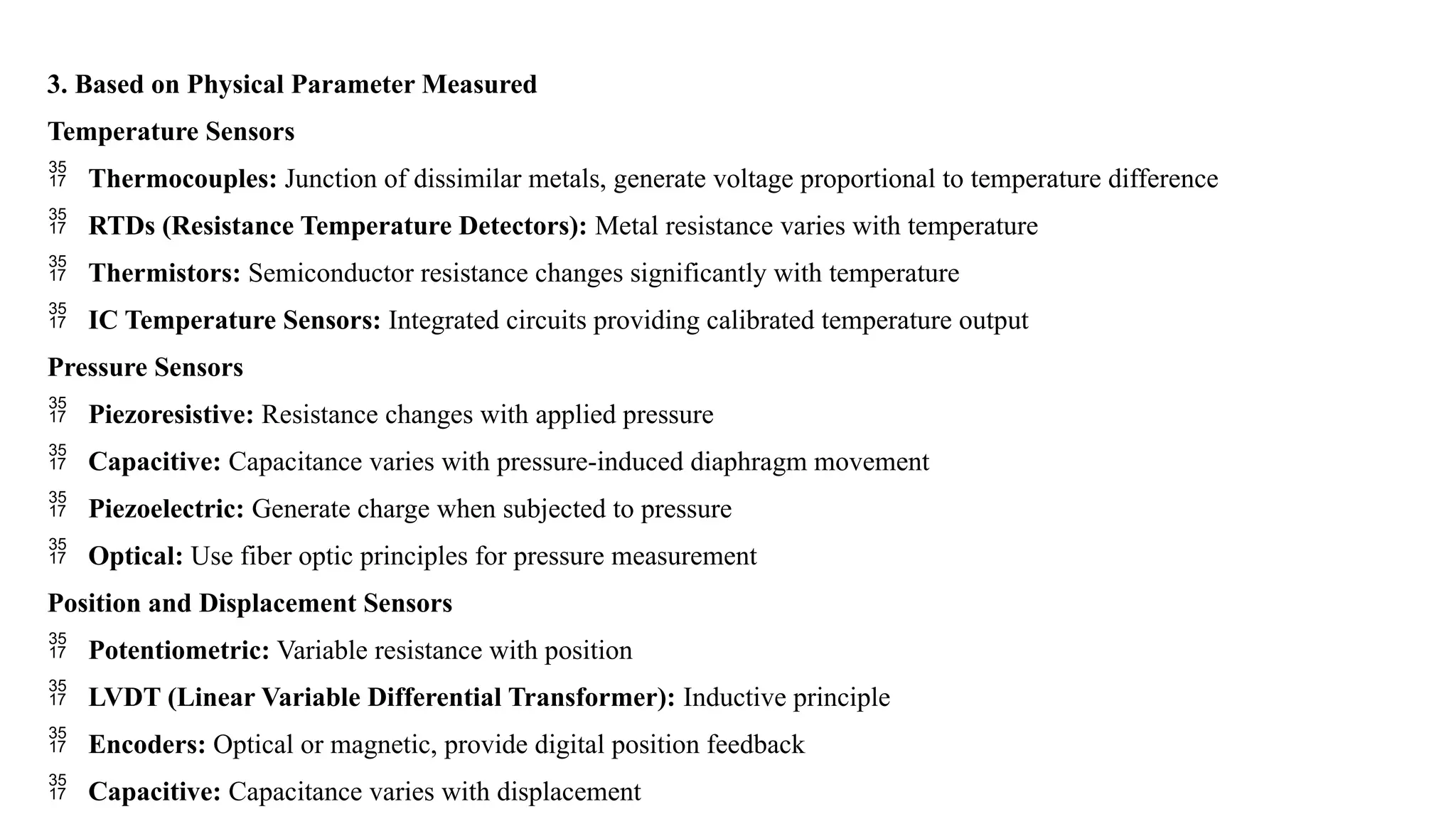
3. Based onPhysical Parameter Measured
Temperature Sensors
Thermocouples: Junction of dissimilar metals, generate voltage proportional to temperature difference
RTDs (Resistance Temperature Detectors): Metal resistance varies with temperature
Thermistors: Semiconductor resistance changes significantly with temperature
IC Temperature Sensors: Integrated circuits providing calibrated temperature output
Pressure Sensors
Piezoresistive: Resistance changes with applied pressure
Capacitive: Capacitance varies with pressure-induced diaphragm movement
Piezoelectric: Generate charge when subjected to pressure
Optical: Use fiber optic principles for pressure measurement
Position and Displacement Sensors
Potentiometric: Variable resistance with position
LVDT (Linear Variable Differential Transformer): Inductive principle
Encoders: Optical or magnetic, provide digital position feedback
Capacitive: Capacitance varies with displacement
6.
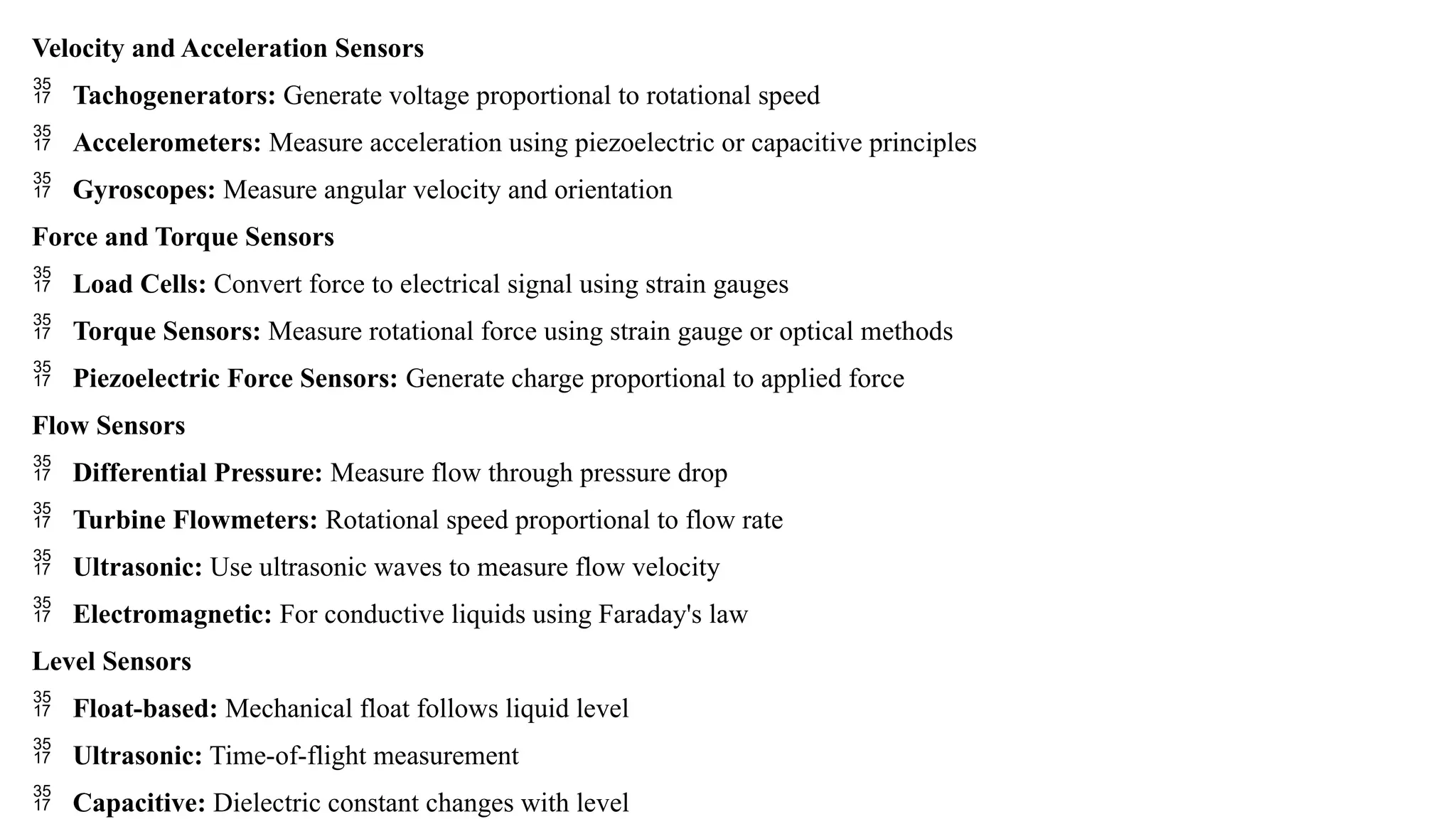
Velocity and AccelerationSensors
Tachogenerators: Generate voltage proportional to rotational speed
Accelerometers: Measure acceleration using piezoelectric or capacitive principles
Gyroscopes: Measure angular velocity and orientation
Force and Torque Sensors
Load Cells: Convert force to electrical signal using strain gauges
Torque Sensors: Measure rotational force using strain gauge or optical methods
Piezoelectric Force Sensors: Generate charge proportional to applied force
Flow Sensors
Differential Pressure: Measure flow through pressure drop
Turbine Flowmeters: Rotational speed proportional to flow rate
Ultrasonic: Use ultrasonic waves to measure flow velocity
Electromagnetic: For conductive liquids using Faraday's law
Level Sensors
Float-based: Mechanical float follows liquid level
Ultrasonic: Time-of-flight measurement
Capacitive: Dielectric constant changes with level