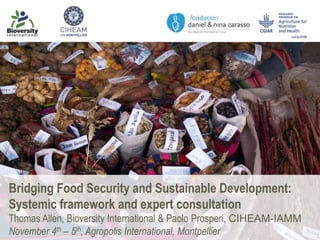
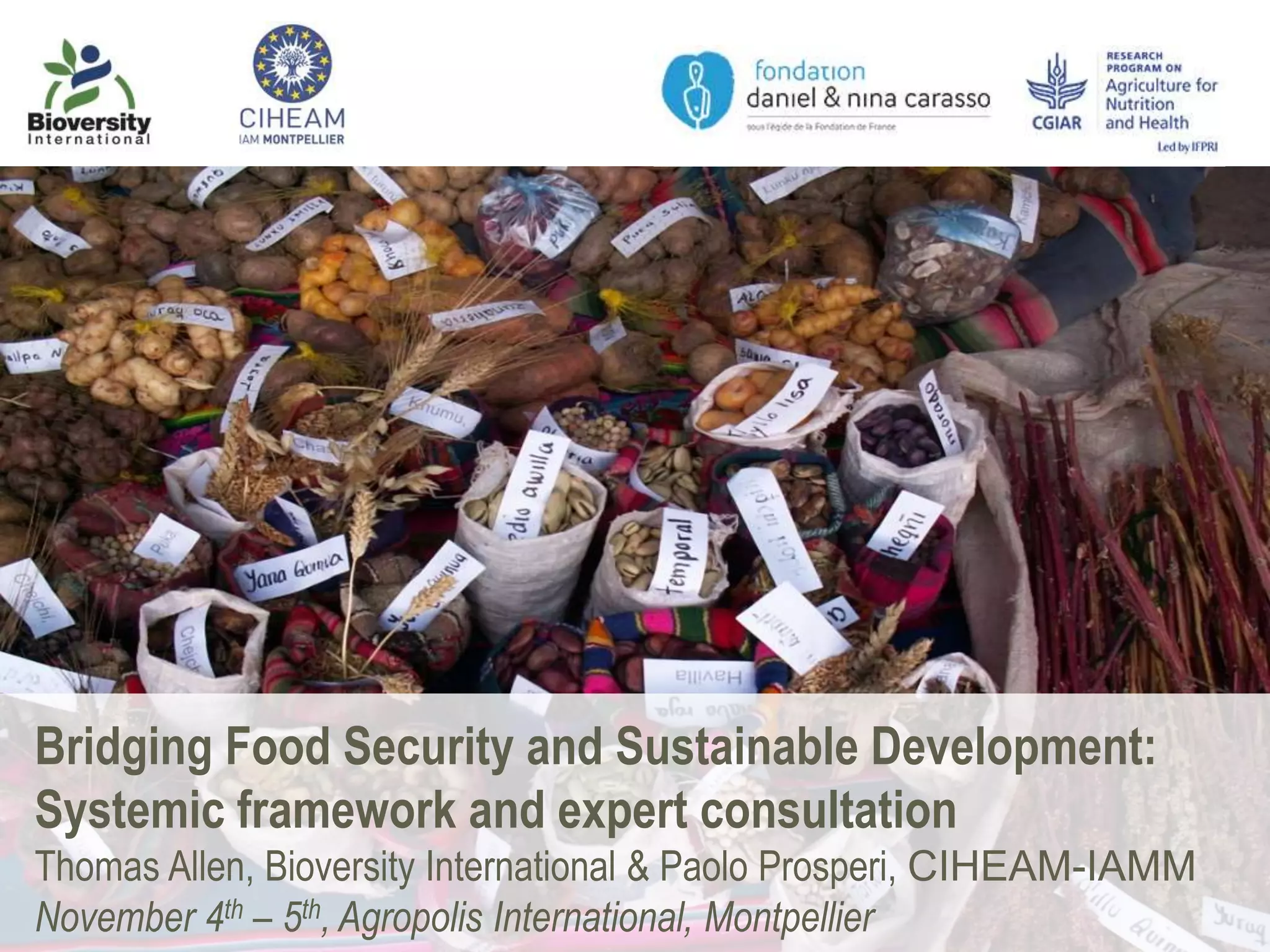
Bridging Food Security and Sustainable Development: 
Systemic framework and expert consultation 
Thomas Allen, Bioversity International & Paolo Prosperi, CIHEAM-IAMM 
November 4th – 5th, Agropolis International, Montpellier
2 
Objectives 
 Address gaps in our understanding of what constitutes a 
sustainable diet and how it relates to food systems 
 Help build a common language among the scientific 
community on sustainable diets and food systems 
 Identify a process for developing metrics and guidelines 
aimed at measuring the sustainability of diets and food 
systems
3 
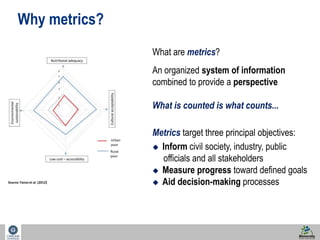
Why metrics? 
What are metrics? 
An organized system of information 
combined to provide a perspective 
What is counted is what counts... 
Metrics target three principal objectives: 
 Inform civil society, industry, public 
officials and all stakeholders 
 Measure progress toward defined goals 
Source: Fanzo et al. (2012)  Aid decision-making processes
4 
Constructing metrics 
Who are the users? 
A set of measurements for policy makers 
“What is badly defined is likely to be badly 
measured” 
Developing a theoretical framework 
 Defining the concepts 
 Structuring its elements 
 Identifying selection criteria 
The selection process should ideally be based on 
what is desirable to measure
5 
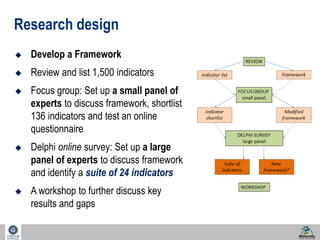
Research design 
 Develop a Framework 
 Review and list 1,500 indicators 
 Focus group: Set up a small panel of 
experts to discuss framework, shortlist 
136 indicators and test an online 
questionnaire 
 Delphi online survey: Set up a large 
panel of experts to discuss framework 
and identify a suite of 24 indicators 
 A workshop to further discuss key 
results and gaps
Framework
7 
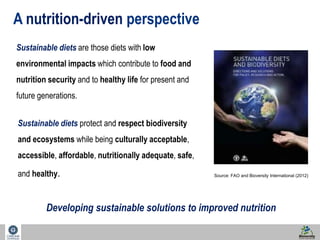
A nutrition-driven perspective 
Sustainable diets are those diets with low 
environmental impacts which contribute to food and 
nutrition security and to healthy life for present and 
future generations. 
Source: FAO and Bioversity International (2012) 
Sustainable diets protect and respect biodiversity 
and ecosystems while being culturally acceptable, 
accessible, affordable, nutritionally adequate, safe, 
and healthy. 
Developing sustainable solutions to improved nutrition
8 
A system-orientated approach 
 Diets – and related outcomes – are the results of complex 
interactions among interdependent components within food 
systems 
 The concept of sustainability evolved from an approach to 
agriculture to a system property (Hansen, 1996) 
Sustainability as the ability of a system 
to maintain or enhance its essential outcomes over time 
Promoting economically, socially and environmentally sustainable 
food systems that concurrently ensure food and nutrition security
9 
A Social-Ecological System 
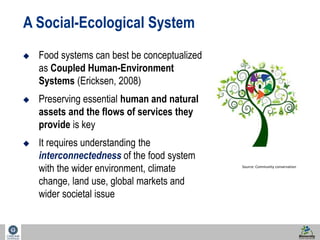
 Food systems can best be conceptualized 
as Coupled Human-Environment 
Systems (Ericksen, 2008) 
 Preserving essential human and natural 
assets and the flows of services they 
provide is key 
 It requires understanding the 
interconnectedness of the food system 
with the wider environment, climate 
change, land use, global markets and 
wider societal issue 
Source: Community conservation
10 
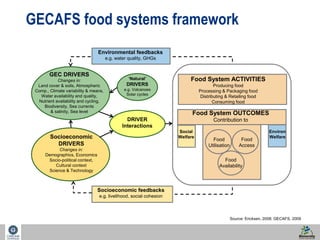
GECAFS food systems framework 
GEC DRIVERS 
Changes in: 
Environmental feedbacks 
Land cover & soils, Atmospheric 
Comp., Climate variability & means, 
Water availability and quality, 
Nutrient availability and cycling, 
Biodiversity, Sea currents 
& salinity, Sea level 
Socioeconomic 
DRIVERS 
Changes in: 
Demographics, Economics 
Socio-political context, 
Cultural context 
Science & Technology 
e.g. water quality, GHGs 
‘Natural’ 
DRIVERS 
e.g. Volcanoes 
Solar cycles 
DRIVER 
Interactions 
Socioeconomic feedbacks 
e.g. livelihood, social cohesion 
Food System ACTIVITIES 
Producing food 
Processing & Packaging food 
Distributing & Retailing food 
Consuming food 
Food System OUTCOMES 
Contribution to 
Social 
Welfare 
Environ 
Welfare 
Food 
Utilisation 
Food 
Access 
Food 
Availability 
Source: Ericksen, 2008; GECAFS, 2009
11 
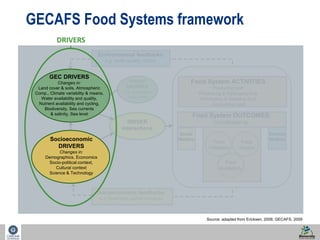
GECAFS Food Systems framework 
‘Natural’ 
DRIVERS 
e.g. Volcanoes 
Solar cycles 
DRIVER 
Interactions 
DRIVERS 
Land cover & soils, Atmospheric 
Comp., Climate variability & means, 
Water availability and quality, 
Nutrient availability and cycling, 
Socioeconomic feedbacks 
e.g. livelihood, social cohesion 
Food System ACTIVITIES 
Producing food 
Processing & Packaging food 
Distributing & Retailing food 
Consuming food 
Food System OUTCOMES 
Contribution to 
Social 
Welfare 
Environ 
Welfare 
Food 
Utilisation 
Food 
Access 
Food 
Availability 
Environmental feedbacks 
e.g. water quality, GHGs 
GEC DRIVERS 
Changes in: 
Biodiversity, Sea currents 
& salinity, Sea level 
Socioeconomic 
DRIVERS 
Changes in: 
Demographics, Economics 
Socio-political context, 
Cultural context 
Science & Technology 
Source: adapted from Ericksen, 2008; GECAFS, 2009
12 
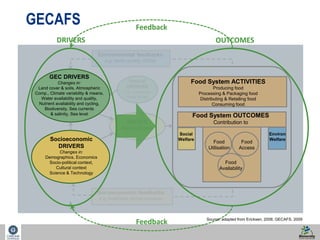
Feedback GECAFS 
DRIVERS OUTCOMES 
Environmental feedbacks 
e.g. water quality, GHGs 
‘Natural’ 
DRIVERS 
e.g. Volcanoes 
Solar cycles 
DRIVER 
Interactions 
Land cover & soils, Atmospheric 
Comp., Climate variability & means, 
Water availability and quality, 
Nutrient availability and cycling, 
Socioeconomic feedbacks 
e.g. livelihood, social cohesion 
GEC DRIVERS 
Changes in: 
Biodiversity, Sea currents 
& salinity, Sea level 
Socioeconomic 
DRIVERS 
Changes in: 
Demographics, Economics 
Socio-political context, 
Cultural context 
Science & Technology 
Food System ACTIVITIES 
Producing food 
Processing & Packaging food 
Distributing & Retailing food 
Consuming food 
Food System OUTCOMES 
Contribution to 
Social 
Welfare 
Environ 
Welfare 
Food 
Utilisation 
Food 
Access 
Food 
Availability 
Feedback 
Source: adapted from Ericksen, 2008; GECAFS, 2009
Environ 
Welfare 
Food 
Access 
Food 
Source: adapted from Rastoin and Ghersi, 2010; Ericksen, 2008; GECAFS, 2009 
13 
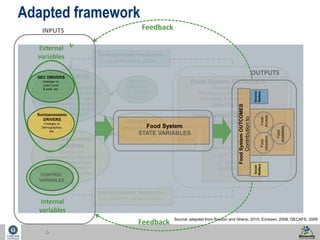
INPUTS Feedback 
‘Natural’ 
DRIVERS 
e.g. Volcanoes 
Solar cycles 
DRIVER 
Interactions 
External 
variables 
Land cover & soils, Atmospheric 
Comp., Climate variability & means, 
Water availability and quality, 
Nutrient availability and cycling, 
Socioeconomic feedbacks 
e.g. livelihood, social cohesion 
Food System ACTIVITIES 
Producing food 
Processing & Packaging food 
Distributing & Retailing food 
Consuming food 
Food System OUTCOMES 
Contribution to 
Social 
Welfare 
Environ 
Welfare 
Food 
Utilisation 
Food 
Access 
Food 
Availability 
Environmental feedbacks 
e.g. water quality, GHGs 
GEC DRIVERS 
Changes in: 
Biodiversity, Sea currents 
& salinity, Sea level 
Socioeconomic 
DRIVERS 
Changes in: 
Demographics, Economics 
Socio-political context, 
Cultural context 
Science & Technology 
Food System OUTCOMES 
Contribution to 
Social 
Welfare 
Utilisation 
Food 
Availability 
Internal 
variables 
Food System 
STATE VARIABLES 
Feedback 
OUTPUTS 
Adapted framework
14 
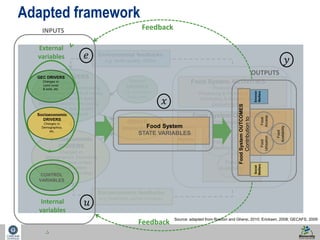
INPUTS Feedback 
‘Natural’ 
DRIVERS 
e.g. Volcanoes 
Solar cycles 
DRIVER 
Interactions 
External 
variables 
Land cover & soils, Atmospheric 
Comp., Climate variability & means, 
Water availability and quality, 
Nutrient availability and cycling, 
Socioeconomic feedbacks 
e.g. livelihood, social cohesion 
Food System ACTIVITIES 
Producing food 
Environ 
Welfare 
Processing & Packaging food 
Distributing & Retailing food 
Consuming food 
Food System OUTCOMES 
Contribution to 
Social 
Welfare 
Environ 
Welfare 
Food 
Utilisation 
Food 
Access 
Food 
Availability 
Environmental feedbacks 
e.g. water quality, GHGs 
GEC DRIVERS 
Changes in: 
Biodiversity, Sea currents 
& salinity, Sea level 
Socioeconomic 
DRIVERS 
Changes in: 
Demographics, Economics 
Socio-political context, 
Cultural context 
Science & Technology 
Food System OUTCOMES 
Contribution to 
Food 
Access 
Food 
Social 
Welfare 
Utilisation 
Food 
Availability 
Internal 
variables 
Food System 
STATE VARIABLES 
Feedback 
OUTPUTS 
Adapted framework 
Source: adapted from Rastoin and Ghersi, 2010; Ericksen, 2008; GECAFS, 2009
15 
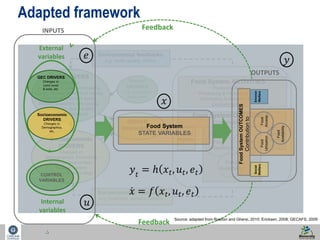
INPUTS Feedback 
‘Natural’ 
DRIVERS 
e.g. Volcanoes 
Solar cycles 
DRIVER 
Interactions 
External 
variables 
Land cover & soils, Atmospheric 
Comp., Climate variability & means, 
Water availability and quality, 
Nutrient availability and cycling, 
Socioeconomic feedbacks 
e.g. livelihood, social cohesion 
Food System ACTIVITIES 
Producing food 
Environ 
Welfare 
Processing & Packaging food 
Distributing & Retailing food 
Consuming food 
Food System OUTCOMES 
Contribution to 
Social 
Welfare 
Environ 
Welfare 
Food 
Utilisation 
Food 
Access 
Food 
Availability 
Environmental feedbacks 
e.g. water quality, GHGs 
GEC DRIVERS 
Changes in: 
Biodiversity, Sea currents 
& salinity, Sea level 
Socioeconomic 
DRIVERS 
Changes in: 
Demographics, Economics 
Socio-political context, 
Cultural context 
Science & Technology 
Food System OUTCOMES 
Contribution to 
Food 
Access 
Food 
Social 
Welfare 
Utilisation 
Food 
Availability 
Internal 
variables 
Food System 
STATE VARIABLES 
Feedback 
OUTPUTS 
Source: adapted from Rastoin and Ghersi, 2010; Ericksen, 2008; GECAFS, 2009 
Adapted framework
16 
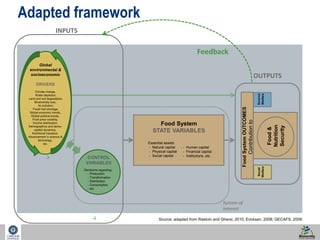
Food System OUTCOMES 
Contribution to 
Environ 
Welfare 
Social 
Welfare 
Food & 
Nutrition 
Security 
Food System 
Feedback 
STATE VARIABLES 
Essential assets: 
- Natural capital 
- Physical capital 
- Social capital 
INPUTS 
OUTPUTS 
System of 
interest 
Adapted framework 
- Human capital 
- Financial capital 
- Institutions, etc. 
Source: adapted from Rastoin and Ghersi, 2010; Ericksen, 2008; GECAFS, 2009
17 
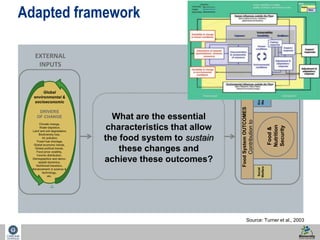
What are the essential 
characteristics that allow 
the food system to sustain 
these changes and 
achieve these outcomes? 
EXTERNAL 
INPUTS 
OUTPUTS 
Environ 
Welfare 
Source: Turner et al., 2003 
Adapted framework 
Food System OUTCOMES 
Contribution to 
Social 
Welfare 
Food & 
Nutrition 
Security
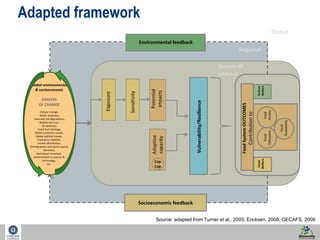
Vulnerability & 
Resilience
19 
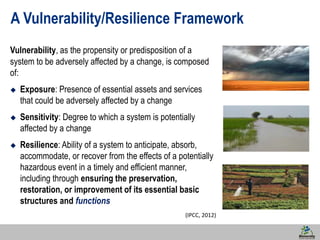
A Vulnerability/Resilience Framework 
Vulnerability, as the propensity or predisposition of a 
system to be adversely affected by a change, is composed 
of: 
 Exposure: Presence of essential assets and services 
that could be adversely affected by a change 
 Sensitivity: Degree to which a system is potentially 
affected by a change 
 Resilience: Ability of a system to anticipate, absorb, 
accommodate, or recover from the effects of a potentially 
hazardous event in a timely and efficient manner, 
including through ensuring the preservation, 
restoration, or improvement of its essential basic 
structures and functions 
(IPCC, 2012)
20 
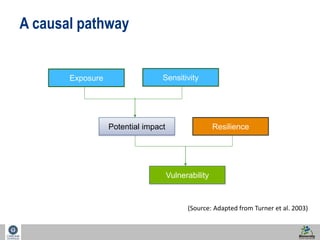
A causal pathway 
Sensitivity 
(Source: Adapted from Turner et al. 2003) 
Exposure 
Potential impact Resilience 
Vulnerability
21 
Food System OUTCOMES 
Contribution to 
Global 
Food 
Access 
Food 
Social 
Welfare 
Utilisation 
Food 
Availability 
Regional 
System of 
interest 
Environmental feedback 
Cop. 
Cap. 
Socioeconomic feedback 
Environ 
Welfare 
Source: adapted from Turner et al., 2003; Ericksen, 2008; GECAFS, 2009 
Adapted framework
22 
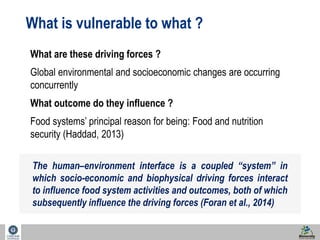
What is vulnerable to what ? 
What are these driving forces ? 
Global environmental and socioeconomic changes are occurring 
concurrently 
What outcome do they influence ? 
Food systems’ principal reason for being: Food and nutrition 
security (Haddad, 2013) 
The human–environment interface is a coupled “system” in 
which socio-economic and biophysical driving forces interact 
to influence food system activities and outcomes, both of which 
subsequently influence the driving forces (Foran et al., 2014)
23 
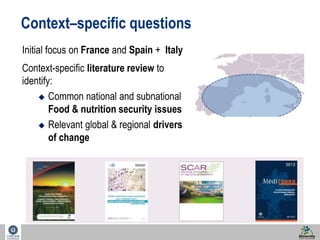
Context–specific questions 
Initial focus on France and Spain + Italy 
Context-specific literature review to 
identify: 
 Common national and subnational 
Food & nutrition security issues 
 Relevant global & regional drivers 
of change
24 
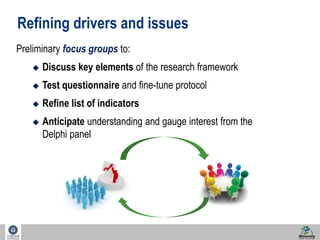
Refining drivers and issues 
Preliminary focus groups to: 
 Discuss key elements of the research framework 
 Test questionnaire and fine-tune protocol 
 Refine list of indicators 
 Anticipate understanding and gauge interest from the 
Delphi panel
25 
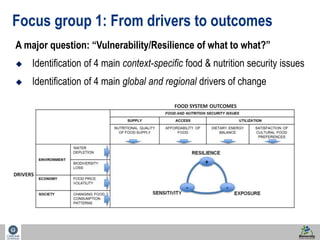
Focus group 1: From drivers to outcomes 
A major question: “Vulnerability/Resilience of what to what?” 
 Identification of 4 main context-specific food & nutrition security issues 
 Identification of 4 main global and regional drivers of change
Indicators
27 
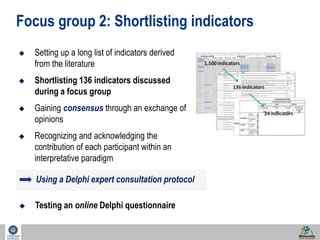
Focus group 2: Shortlisting indicators 
 Setting up a long list of indicators derived 
from the literature 
 Shortlisting 136 indicators discussed 
during a focus group 
 Gaining consensus through an exchange of 
opinions 
 Recognizing and acknowledging the 
contribution of each participant within an 
interpretative paradigm 
Using a Delphi expert consultation protocol 
 Testing an online Delphi questionnaire
28 
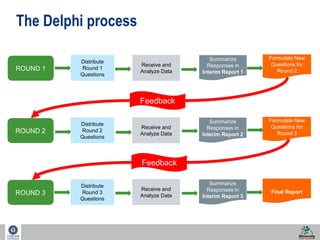
The Delphi technique 
An iterative survey of experts: 
 A Delphi technique is a structured group interaction process 
that is directed in "rounds" of opinion collection and 
feedback 
 Opinion collection is achieved by conducting a series of 
surveys using questionnaires 
 The result of each survey are presented to the group – 
feedback – and the questionnaire used in the next round is 
built upon the result of the previous round
29 
ROUND 1 
Distribute 
Round 1 
Questions 
Receive and 
Analyze Data 
Summarize 
Responses in 
Interim Report 1 
Formulate New 
Questions for 
Round 2 
ROUND 2 
Distribute 
Round 2 
Questions 
Receive and 
Analyze Data 
Summarize 
Responses in 
Interim Report 2 
Formulate New 
Questions for 
Round 3 
ROUND 3 
Distribute 
Round 3 
Questions 
Receive and 
Analyze Data 
Summarize 
Responses in 
Interim Report 3 
Final Report 
Feedback 
Feedback 
The Delphi process
30 
Participation 
Participation: 51 part. [round 1]; 39 part. [round 2]; 36 part. [round 3] 
A balanced panel: 
 Gender 
 Academic disciplines
31 
Evolution of the consensus 
Increase in agreement 
15 indicators [out 24] with 60% or more consensus 
Rounds 
Indicators 
March May July
32 
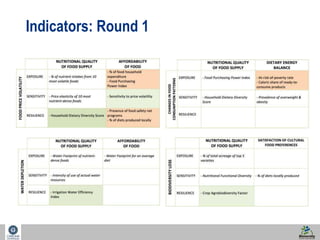
Indicators: Round 1
33 
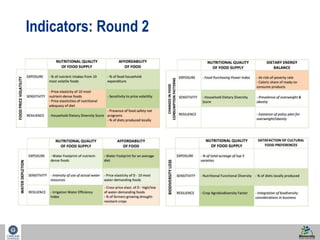
Indicators: Round 2
34 
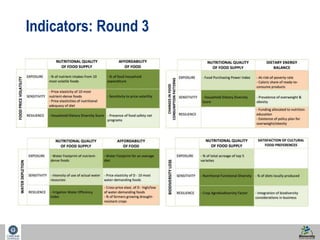
Indicators: Round 3
35 
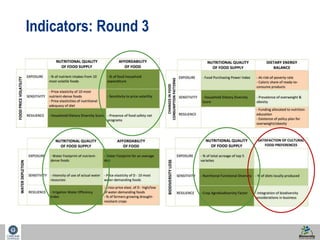
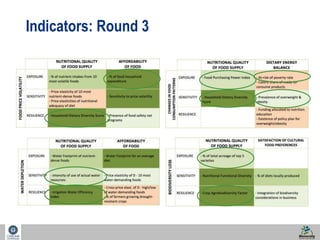
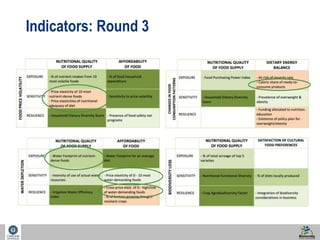
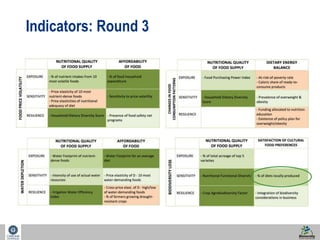
Indicators: Round 3
36 
Indicators: Round 3
37 
Indicators: Round 3
38 
Indicators: Round 3
Views on 
sustainability 
assessment
40 
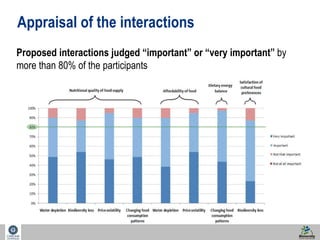
Appraisal of the interactions 
Proposed interactions judged “important” or “very important” by 
more than 80% of the participants
41 
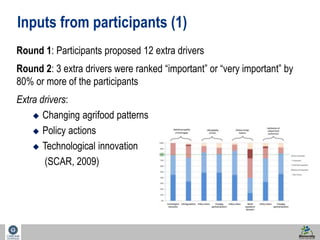
Inputs from participants (1) 
Round 1: Participants proposed 12 extra drivers 
Round 2: 3 extra drivers were ranked “important” or “very important” by 
80% or more of the participants 
Extra drivers: 
 Changing agrifood patterns 
 Policy actions 
 Technological innovation 
(SCAR, 2009)
42 
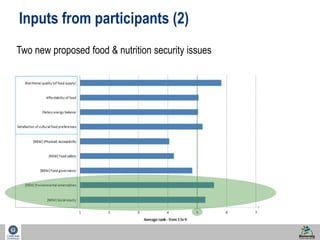
Inputs from participants (2) 
Two new proposed food & nutrition security issues
Views on 
sustainability
44 
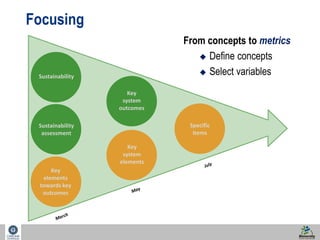
Focusing 
Sustainability 
Sustainability 
assessment 
Key 
system 
elements 
Specific 
items 
Key 
system 
outcomes 
Key 
elements 
towards key 
outcomes 
From concepts to metrics 
 Define concepts 
 Select variables
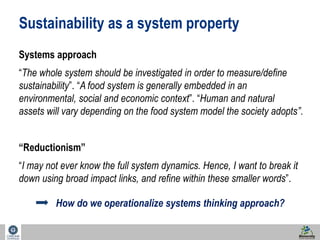
Sustainability as a system property 
Systems approach 
“The whole system should be investigated in order to measure/define 
sustainability”. “A food system is generally embedded in an 
environmental, social and economic context”. “Human and natural 
assets will vary depending on the food system model the society adopts”. 
45 
“Reductionism” 
“I may not ever know the full system dynamics. Hence, I want to break it 
down using broad impact links, and refine within these smaller words”. 
How do we operationalize systems thinking approach?
46 
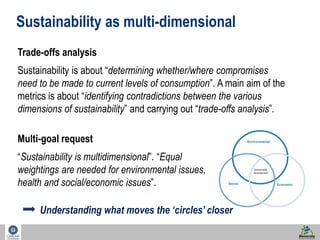
Sustainability as multi-dimensional 
Trade-offs analysis 
Sustainability is about “determining whether/where compromises 
need to be made to current levels of consumption”. A main aim of the 
metrics is about “identifying contradictions between the various 
dimensions of sustainability” and carrying out “trade-offs analysis”. 
Multi-goal request 
“Sustainability is multidimensional”. “Equal 
weightings are needed for environmental issues, 
health and social/economic issues”. 
Understanding what moves the ‘circles’ closer
47 
Generic vs context-specific 
Context-specific 
“A key characteristic of sustainability is that it is time and location 
specific”. “What works in some contexts can be completely inappropriate 
in another context”. “There are many possible metrics and the ‘final’ 
choice will depend on the nature of the Q/stakeholder interest”. 
Generic 
“Having a set of indicators for comparing sustainability between 
countries and through time [would be] very useful”. “There should be 
some comparison of the indicator[s] for the nation or subnation 
compared to the world average”. 
Does it depend on who the users are?
Conclusion
49 
Summary results 
Consensus is reached for 15 of the 24 desired indicators 
 High threshold consensus criteria [80%]: 8 indicators 
 Medium threshold consensus criteria [70%]: 3 indicators 
 Low threshold consensus criteria [60%]: 4 indicators 
Majority [50%]: 3 indicators* 
Bipolarity [2 x 35%]: 5 indicators* 
Low degree of agreement [+ High “Don’t know” rate] : 3 indicators* 
Stability of the consensus: Favorite indicators in the second round 
confirmed by 93% of the experts in the third round
50 
Important 
 Increasing societal demand for sustainable food 
systems 
 Substantial need for improved decision-making 
support 
 Metrics define what is important 
 It is the responsibility of the scientific community to 
provide such support… 
 …an important responsibility 
Joint effort is key
Thank you 
For more info: 
www.bioversityinternational.org 
www.iamm.fr 
Supported by:
Thank you 
Supported by the Daniel and Nina Carasso 
Foundation, CRP A4NH and CIHEAM-IAMM 
For more info: 
www.bioversityinternational.org 
www.iamm.fr
53 
References 
Ericksen, P. J. (2008). Conceptualizing food systems for global environmental change research. Global Environmental 
Change, 18(1), 234-245. 
Fanzo, J., Cogill, B., & F. Mattei (2012). Metrics of Sustainable Diets and Food Systems. Bioversity International, 
Rome, Italy. 
FAO/Bioversity International (2012). Sustainable Diets and Biodiversity. Directions and solutions for policy, research 
and actions. FAO, Rome, Italy. 
GECAFS (2009). A Food Systems Approach to Food Security and Global Environmental Change Research. Global 
Environmental Change and Food Systems, Oxford, UK. 
Hansen, J. W. (1996). Is agricultural sustainability a useful concept?. Agricultural systems, 50(2), 117-143. 
Prosperi, P., Allen, T., Padilla, M., Peri, I. & B. Cogill (2014). Sustainability and Food & Nutrition Security: A 
Vulnerability Assessment Framework for the Mediterranean Region. Sage Open, 4(2), 1-15. 
Rastoin, J-L. and Ghersi, G. (2010). Le système alimentaire mondial. Concepts et méthodes, analyses et 
dynamiques. Versailles, Éditions Quæ, p. 565. 
Turner, B. L., Kasperson, R. E., Matson, P. A., McCarthy, J. J., Corell, R. W., Christensen, L., ... & Schiller, A. (2003). 
A framework for vulnerability analysis in sustainability science. Proceedings of the national academy of sciences, 
100(14), 8074-8079. 
IPCC (2012). Summary for Policymakers. In: Managing the Risks of Extreme Events and Disasters to Advance 
Climate Change Adaptation. A Special Report of Working Groups I and II of the Intergovernmental Panel on Climate 
Change. Cambridge University Press, Cambridge, UK, and New York, NY, USA, 1-19.

Bridging food security_allen_prosperi

  • 1.
    Bridging Food Securityand Sustainable Development: Systemic framework and expert consultation Thomas Allen, Bioversity International & Paolo Prosperi, CIHEAM-IAMM November 4th – 5th, Agropolis International, Montpellier
  • 2.
    2 Objectives Address gaps in our understanding of what constitutes a sustainable diet and how it relates to food systems  Help build a common language among the scientific community on sustainable diets and food systems  Identify a process for developing metrics and guidelines aimed at measuring the sustainability of diets and food systems
  • 3.
    3 Why metrics? What are metrics? An organized system of information combined to provide a perspective What is counted is what counts... Metrics target three principal objectives:  Inform civil society, industry, public officials and all stakeholders  Measure progress toward defined goals Source: Fanzo et al. (2012)  Aid decision-making processes
  • 4.
    4 Constructing metrics Who are the users? A set of measurements for policy makers “What is badly defined is likely to be badly measured” Developing a theoretical framework  Defining the concepts  Structuring its elements  Identifying selection criteria The selection process should ideally be based on what is desirable to measure
  • 5.
    5 Research design  Develop a Framework  Review and list 1,500 indicators  Focus group: Set up a small panel of experts to discuss framework, shortlist 136 indicators and test an online questionnaire  Delphi online survey: Set up a large panel of experts to discuss framework and identify a suite of 24 indicators  A workshop to further discuss key results and gaps
  • 6.
  • 7.
    7 A nutrition-drivenperspective Sustainable diets are those diets with low environmental impacts which contribute to food and nutrition security and to healthy life for present and future generations. Source: FAO and Bioversity International (2012) Sustainable diets protect and respect biodiversity and ecosystems while being culturally acceptable, accessible, affordable, nutritionally adequate, safe, and healthy. Developing sustainable solutions to improved nutrition
  • 8.
    8 A system-orientatedapproach  Diets – and related outcomes – are the results of complex interactions among interdependent components within food systems  The concept of sustainability evolved from an approach to agriculture to a system property (Hansen, 1996) Sustainability as the ability of a system to maintain or enhance its essential outcomes over time Promoting economically, socially and environmentally sustainable food systems that concurrently ensure food and nutrition security
  • 9.
    9 A Social-EcologicalSystem  Food systems can best be conceptualized as Coupled Human-Environment Systems (Ericksen, 2008)  Preserving essential human and natural assets and the flows of services they provide is key  It requires understanding the interconnectedness of the food system with the wider environment, climate change, land use, global markets and wider societal issue Source: Community conservation
  • 10.
    10 GECAFS foodsystems framework GEC DRIVERS Changes in: Environmental feedbacks Land cover & soils, Atmospheric Comp., Climate variability & means, Water availability and quality, Nutrient availability and cycling, Biodiversity, Sea currents & salinity, Sea level Socioeconomic DRIVERS Changes in: Demographics, Economics Socio-political context, Cultural context Science & Technology e.g. water quality, GHGs ‘Natural’ DRIVERS e.g. Volcanoes Solar cycles DRIVER Interactions Socioeconomic feedbacks e.g. livelihood, social cohesion Food System ACTIVITIES Producing food Processing & Packaging food Distributing & Retailing food Consuming food Food System OUTCOMES Contribution to Social Welfare Environ Welfare Food Utilisation Food Access Food Availability Source: Ericksen, 2008; GECAFS, 2009
  • 11.
    11 GECAFS FoodSystems framework ‘Natural’ DRIVERS e.g. Volcanoes Solar cycles DRIVER Interactions DRIVERS Land cover & soils, Atmospheric Comp., Climate variability & means, Water availability and quality, Nutrient availability and cycling, Socioeconomic feedbacks e.g. livelihood, social cohesion Food System ACTIVITIES Producing food Processing & Packaging food Distributing & Retailing food Consuming food Food System OUTCOMES Contribution to Social Welfare Environ Welfare Food Utilisation Food Access Food Availability Environmental feedbacks e.g. water quality, GHGs GEC DRIVERS Changes in: Biodiversity, Sea currents & salinity, Sea level Socioeconomic DRIVERS Changes in: Demographics, Economics Socio-political context, Cultural context Science & Technology Source: adapted from Ericksen, 2008; GECAFS, 2009
  • 12.
    12 Feedback GECAFS DRIVERS OUTCOMES Environmental feedbacks e.g. water quality, GHGs ‘Natural’ DRIVERS e.g. Volcanoes Solar cycles DRIVER Interactions Land cover & soils, Atmospheric Comp., Climate variability & means, Water availability and quality, Nutrient availability and cycling, Socioeconomic feedbacks e.g. livelihood, social cohesion GEC DRIVERS Changes in: Biodiversity, Sea currents & salinity, Sea level Socioeconomic DRIVERS Changes in: Demographics, Economics Socio-political context, Cultural context Science & Technology Food System ACTIVITIES Producing food Processing & Packaging food Distributing & Retailing food Consuming food Food System OUTCOMES Contribution to Social Welfare Environ Welfare Food Utilisation Food Access Food Availability Feedback Source: adapted from Ericksen, 2008; GECAFS, 2009
  • 13.
    Environ Welfare Food Access Food Source: adapted from Rastoin and Ghersi, 2010; Ericksen, 2008; GECAFS, 2009 13 INPUTS Feedback ‘Natural’ DRIVERS e.g. Volcanoes Solar cycles DRIVER Interactions External variables Land cover & soils, Atmospheric Comp., Climate variability & means, Water availability and quality, Nutrient availability and cycling, Socioeconomic feedbacks e.g. livelihood, social cohesion Food System ACTIVITIES Producing food Processing & Packaging food Distributing & Retailing food Consuming food Food System OUTCOMES Contribution to Social Welfare Environ Welfare Food Utilisation Food Access Food Availability Environmental feedbacks e.g. water quality, GHGs GEC DRIVERS Changes in: Biodiversity, Sea currents & salinity, Sea level Socioeconomic DRIVERS Changes in: Demographics, Economics Socio-political context, Cultural context Science & Technology Food System OUTCOMES Contribution to Social Welfare Utilisation Food Availability Internal variables Food System STATE VARIABLES Feedback OUTPUTS Adapted framework
  • 14.
    14 INPUTS Feedback ‘Natural’ DRIVERS e.g. Volcanoes Solar cycles DRIVER Interactions External variables Land cover & soils, Atmospheric Comp., Climate variability & means, Water availability and quality, Nutrient availability and cycling, Socioeconomic feedbacks e.g. livelihood, social cohesion Food System ACTIVITIES Producing food Environ Welfare Processing & Packaging food Distributing & Retailing food Consuming food Food System OUTCOMES Contribution to Social Welfare Environ Welfare Food Utilisation Food Access Food Availability Environmental feedbacks e.g. water quality, GHGs GEC DRIVERS Changes in: Biodiversity, Sea currents & salinity, Sea level Socioeconomic DRIVERS Changes in: Demographics, Economics Socio-political context, Cultural context Science & Technology Food System OUTCOMES Contribution to Food Access Food Social Welfare Utilisation Food Availability Internal variables Food System STATE VARIABLES Feedback OUTPUTS Adapted framework Source: adapted from Rastoin and Ghersi, 2010; Ericksen, 2008; GECAFS, 2009
  • 15.
    15 INPUTS Feedback ‘Natural’ DRIVERS e.g. Volcanoes Solar cycles DRIVER Interactions External variables Land cover & soils, Atmospheric Comp., Climate variability & means, Water availability and quality, Nutrient availability and cycling, Socioeconomic feedbacks e.g. livelihood, social cohesion Food System ACTIVITIES Producing food Environ Welfare Processing & Packaging food Distributing & Retailing food Consuming food Food System OUTCOMES Contribution to Social Welfare Environ Welfare Food Utilisation Food Access Food Availability Environmental feedbacks e.g. water quality, GHGs GEC DRIVERS Changes in: Biodiversity, Sea currents & salinity, Sea level Socioeconomic DRIVERS Changes in: Demographics, Economics Socio-political context, Cultural context Science & Technology Food System OUTCOMES Contribution to Food Access Food Social Welfare Utilisation Food Availability Internal variables Food System STATE VARIABLES Feedback OUTPUTS Source: adapted from Rastoin and Ghersi, 2010; Ericksen, 2008; GECAFS, 2009 Adapted framework
  • 16.
    16 Food SystemOUTCOMES Contribution to Environ Welfare Social Welfare Food & Nutrition Security Food System Feedback STATE VARIABLES Essential assets: - Natural capital - Physical capital - Social capital INPUTS OUTPUTS System of interest Adapted framework - Human capital - Financial capital - Institutions, etc. Source: adapted from Rastoin and Ghersi, 2010; Ericksen, 2008; GECAFS, 2009
  • 17.
    17 What arethe essential characteristics that allow the food system to sustain these changes and achieve these outcomes? EXTERNAL INPUTS OUTPUTS Environ Welfare Source: Turner et al., 2003 Adapted framework Food System OUTCOMES Contribution to Social Welfare Food & Nutrition Security
  • 18.
  • 19.
    19 A Vulnerability/ResilienceFramework Vulnerability, as the propensity or predisposition of a system to be adversely affected by a change, is composed of:  Exposure: Presence of essential assets and services that could be adversely affected by a change  Sensitivity: Degree to which a system is potentially affected by a change  Resilience: Ability of a system to anticipate, absorb, accommodate, or recover from the effects of a potentially hazardous event in a timely and efficient manner, including through ensuring the preservation, restoration, or improvement of its essential basic structures and functions (IPCC, 2012)
  • 20.
    20 A causalpathway Sensitivity (Source: Adapted from Turner et al. 2003) Exposure Potential impact Resilience Vulnerability
  • 21.
    21 Food SystemOUTCOMES Contribution to Global Food Access Food Social Welfare Utilisation Food Availability Regional System of interest Environmental feedback Cop. Cap. Socioeconomic feedback Environ Welfare Source: adapted from Turner et al., 2003; Ericksen, 2008; GECAFS, 2009 Adapted framework
  • 22.
    22 What isvulnerable to what ? What are these driving forces ? Global environmental and socioeconomic changes are occurring concurrently What outcome do they influence ? Food systems’ principal reason for being: Food and nutrition security (Haddad, 2013) The human–environment interface is a coupled “system” in which socio-economic and biophysical driving forces interact to influence food system activities and outcomes, both of which subsequently influence the driving forces (Foran et al., 2014)
  • 23.
    23 Context–specific questions Initial focus on France and Spain + Italy Context-specific literature review to identify:  Common national and subnational Food & nutrition security issues  Relevant global & regional drivers of change
  • 24.
    24 Refining driversand issues Preliminary focus groups to:  Discuss key elements of the research framework  Test questionnaire and fine-tune protocol  Refine list of indicators  Anticipate understanding and gauge interest from the Delphi panel
  • 25.
    25 Focus group1: From drivers to outcomes A major question: “Vulnerability/Resilience of what to what?”  Identification of 4 main context-specific food & nutrition security issues  Identification of 4 main global and regional drivers of change
  • 26.
  • 27.
    27 Focus group2: Shortlisting indicators  Setting up a long list of indicators derived from the literature  Shortlisting 136 indicators discussed during a focus group  Gaining consensus through an exchange of opinions  Recognizing and acknowledging the contribution of each participant within an interpretative paradigm Using a Delphi expert consultation protocol  Testing an online Delphi questionnaire
  • 28.
    28 The Delphitechnique An iterative survey of experts:  A Delphi technique is a structured group interaction process that is directed in "rounds" of opinion collection and feedback  Opinion collection is achieved by conducting a series of surveys using questionnaires  The result of each survey are presented to the group – feedback – and the questionnaire used in the next round is built upon the result of the previous round
  • 29.
    29 ROUND 1 Distribute Round 1 Questions Receive and Analyze Data Summarize Responses in Interim Report 1 Formulate New Questions for Round 2 ROUND 2 Distribute Round 2 Questions Receive and Analyze Data Summarize Responses in Interim Report 2 Formulate New Questions for Round 3 ROUND 3 Distribute Round 3 Questions Receive and Analyze Data Summarize Responses in Interim Report 3 Final Report Feedback Feedback The Delphi process
  • 30.
    30 Participation Participation:51 part. [round 1]; 39 part. [round 2]; 36 part. [round 3] A balanced panel:  Gender  Academic disciplines
  • 31.
    31 Evolution ofthe consensus Increase in agreement 15 indicators [out 24] with 60% or more consensus Rounds Indicators March May July
  • 32.
  • 33.
  • 34.
  • 35.
  • 36.
  • 37.
  • 38.
  • 39.
  • 40.
    40 Appraisal ofthe interactions Proposed interactions judged “important” or “very important” by more than 80% of the participants
  • 41.
    41 Inputs fromparticipants (1) Round 1: Participants proposed 12 extra drivers Round 2: 3 extra drivers were ranked “important” or “very important” by 80% or more of the participants Extra drivers:  Changing agrifood patterns  Policy actions  Technological innovation (SCAR, 2009)
  • 42.
    42 Inputs fromparticipants (2) Two new proposed food & nutrition security issues
  • 43.
  • 44.
    44 Focusing Sustainability Sustainability assessment Key system elements Specific items Key system outcomes Key elements towards key outcomes From concepts to metrics  Define concepts  Select variables
  • 45.
    Sustainability as asystem property Systems approach “The whole system should be investigated in order to measure/define sustainability”. “A food system is generally embedded in an environmental, social and economic context”. “Human and natural assets will vary depending on the food system model the society adopts”. 45 “Reductionism” “I may not ever know the full system dynamics. Hence, I want to break it down using broad impact links, and refine within these smaller words”. How do we operationalize systems thinking approach?
  • 46.
    46 Sustainability asmulti-dimensional Trade-offs analysis Sustainability is about “determining whether/where compromises need to be made to current levels of consumption”. A main aim of the metrics is about “identifying contradictions between the various dimensions of sustainability” and carrying out “trade-offs analysis”. Multi-goal request “Sustainability is multidimensional”. “Equal weightings are needed for environmental issues, health and social/economic issues”. Understanding what moves the ‘circles’ closer
  • 47.
    47 Generic vscontext-specific Context-specific “A key characteristic of sustainability is that it is time and location specific”. “What works in some contexts can be completely inappropriate in another context”. “There are many possible metrics and the ‘final’ choice will depend on the nature of the Q/stakeholder interest”. Generic “Having a set of indicators for comparing sustainability between countries and through time [would be] very useful”. “There should be some comparison of the indicator[s] for the nation or subnation compared to the world average”. Does it depend on who the users are?
  • 48.
  • 49.
    49 Summary results Consensus is reached for 15 of the 24 desired indicators  High threshold consensus criteria [80%]: 8 indicators  Medium threshold consensus criteria [70%]: 3 indicators  Low threshold consensus criteria [60%]: 4 indicators Majority [50%]: 3 indicators* Bipolarity [2 x 35%]: 5 indicators* Low degree of agreement [+ High “Don’t know” rate] : 3 indicators* Stability of the consensus: Favorite indicators in the second round confirmed by 93% of the experts in the third round
  • 50.
    50 Important Increasing societal demand for sustainable food systems  Substantial need for improved decision-making support  Metrics define what is important  It is the responsibility of the scientific community to provide such support…  …an important responsibility Joint effort is key
  • 51.
    Thank you Formore info: www.bioversityinternational.org www.iamm.fr Supported by:
  • 52.
    Thank you Supportedby the Daniel and Nina Carasso Foundation, CRP A4NH and CIHEAM-IAMM For more info: www.bioversityinternational.org www.iamm.fr
  • 53.
    53 References Ericksen,P. J. (2008). Conceptualizing food systems for global environmental change research. Global Environmental Change, 18(1), 234-245. Fanzo, J., Cogill, B., & F. Mattei (2012). Metrics of Sustainable Diets and Food Systems. Bioversity International, Rome, Italy. FAO/Bioversity International (2012). Sustainable Diets and Biodiversity. Directions and solutions for policy, research and actions. FAO, Rome, Italy. GECAFS (2009). A Food Systems Approach to Food Security and Global Environmental Change Research. Global Environmental Change and Food Systems, Oxford, UK. Hansen, J. W. (1996). Is agricultural sustainability a useful concept?. Agricultural systems, 50(2), 117-143. Prosperi, P., Allen, T., Padilla, M., Peri, I. & B. Cogill (2014). Sustainability and Food & Nutrition Security: A Vulnerability Assessment Framework for the Mediterranean Region. Sage Open, 4(2), 1-15. Rastoin, J-L. and Ghersi, G. (2010). Le système alimentaire mondial. Concepts et méthodes, analyses et dynamiques. Versailles, Éditions Quæ, p. 565. Turner, B. L., Kasperson, R. E., Matson, P. A., McCarthy, J. J., Corell, R. W., Christensen, L., ... & Schiller, A. (2003). A framework for vulnerability analysis in sustainability science. Proceedings of the national academy of sciences, 100(14), 8074-8079. IPCC (2012). Summary for Policymakers. In: Managing the Risks of Extreme Events and Disasters to Advance Climate Change Adaptation. A Special Report of Working Groups I and II of the Intergovernmental Panel on Climate Change. Cambridge University Press, Cambridge, UK, and New York, NY, USA, 1-19.

Editor's Notes

  • #2 COVER SLIDE To change the picture: Right click on the photo Click on change picture If you need a specific CRP logo, replace the general CGIAR logo at the upper right.
  • #25 Exploratory workshop to refine round one Delphi questions is essential that the implementation of “cascade” methodology (utilizing the personal contacts of researchers or members of existing policy networks) appears to increase response rates in subsequent Delphi rounds
  • #31 A two-stage sampling procedure
  • #32 The indicators were counted using the acceptability threshold (50% of consensus) in each round (4-11-18). Only the indicators that reached the acceptable consensus until the last round were considered.
  • #33 Many indicators reach 35% of consensus and several bipolarities and pending situations are observed. Still few majorities emerge.
  • #34 Several medium, low and majority consensus are observed. New bipolarities emerge and pending situations keep on unraveling.
  • #35 8 STRONG consensus 4 MAJORITIES 3 MEDIUM consensus 4 BIPOLARITIES 3 LOW consensus 2 PENDING
  • #36 8 STRONG consensus 4 MAJORITIES 3 MEDIUM consensus 4 BIPOLARITIES 3 LOW consensus 2 PENDING
  • #37 8 STRONG consensus 4 MAJORITIES 3 MEDIUM consensus 4 BIPOLARITIES 3 LOW consensus 2 PENDING
  • #38 8 STRONG consensus 4 MAJORITIES 3 MEDIUM consensus 4 BIPOLARITIES 3 LOW consensus 2 PENDING
  • #39 8 STRONG consensus 4 MAJORITIES 3 MEDIUM consensus 4 BIPOLARITIES 3 LOW consensus 2 PENDING
  • #46 Question of scale Policy makers/system thinker
  • #50 Question of scale Policy makers/system thinker
  • #51 Question of scale Policy makers/system thinker