Contactless media for urban
transport services

Brian Dobson
Future Ticketing Technology Manager
Transport for London
Oyster today

               • Complete multi-operator,
                 multi-mode smart integrated
                 ticketing system
               • 46m cards produced (20K
                 new per day)
               • Accepted on all TfL & TOC
                 rail services & all bus
                 services within London
               • Used for 83% of all trips –
                 main non-Oyster usage is
                 Train & Bus travellers from
                 outside London.
1
Big picture – where we have got to

• Contactless smart ticketing has
  delivered the business case
    – High gate throughput prevents bottlenecks
      constraining ridership growth on rail
    – Fast boarding time minimises bus fleet
      sizes and drives up appeal of bus vs. car
    – Fraud has been hammered
• But Oyster has issues:
    – Expense is uncomfortably high given TfL’s
      need to reduce operating expenditure
    – Customer experience is far from perfect
• Could we do this even better?

2
Majority of public transport fares come
from infrequent or irregular customers


                               “Commuters”
     “Non-commuters”


3
Oyster isn’t the perfect offering for these
customers – some things could be
better``
• ISO14443 standard contactless – fast & Keep
    intuitive
•   Pay As You Go travel with daily capping –
    intuitive product that eliminates ticket purchase   Keep
    as a barrier to travel & drives up ridership
•   Fare Data stored on the card – makes it
    difficult to maintain and offer new Products        Change
•   Stored value purse on card – “non-commuters”
    have to invest time in managing PAYG
    balances and weekly season tickets
                                                        Change
•   Oyster is London-specific – many visitors don’t
    have it                                             Change
4
Managing e-purses = changing
currency at the border


            Welcome to London! – Eurostar passengers
            switching to the Underground at St Pancras


5
There is a credible contactless
alternative emerging in the UK payments
market


• Use ISO14443 standards
• Funds held in debit or
  credit account, not on
  card
• Source of most
  customers’ funds, so no
  need for pre-loading
• Available UK-wide &
  internationally
6
But fare collection is different from retail
payments – can PAYG be made to work?


                         Canary Wharf

              25k people per hour
             @ <0.5 seconds each

7
But the industry’s CP transaction rules
won’t work for urban transport fare
collection
General CP rules        Challenges implicit in transport
                        PAYG
Price is known before   Price not known until rail journey is
the card is presented   completed (or end-of-day if
                        capped)
Use of card counters to • Throughput needs set maximum
manage risk &             acceptable transaction time of
occasionally fall-        500ms
forward to Chip & PIN • No PIN pads on transit
                          infrastructure
Terminal field is        Neither staff nor time to manually
activated manually by    activate terminal field for each
store staff
8                        customer
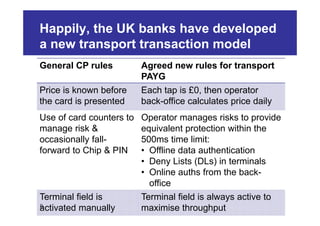
Happily, the UK banks have developed
a new transport transaction model
General CP rules          Agreed new rules for transport
                          PAYG
Price is known before     Each tap is £0, then operator
the card is presented     back-office calculates price daily
Use of card counters to   Operator manages risks to provide
manage risk &             equivalent protection within the
occasionally fall-        500ms time limit:
forward to Chip & PIN     • Offline data authentication
                          • Deny Lists (DLs) in terminals
                          • Online auths from the back-
                            office
Terminal field is         Terminal field is always active to
9
activated manually        maximise throughput
This new approach is being formalised
as a new set of rules for transport
transactions
                    Card – terminal         Merchant
Visa, MasterCard       interaction        intermediate
and American         (500ms Limit)      layer processing
Express are          Aggregation of
creating specific                        Merchant DL
                    journeys to daily
rule sets for                             processes
                        charges
transport
merchants that         Liabilities &
cover these six                           Mid-journey
                      frequency of
areas                                     inspections
                     authorisations

10
Principles under-pinning the new
transport transaction model
• Single model applicable for all urban transit
   operators
• Applicable to existing base of contactless cards
• Protect throughput of passengers at peak times
• Ensure Issuers can earn attractive volumes of
   additional contactless interchange
• Ensure Issuers take minimal additional risks
• Ensure that customer statements clearly show daily
   expenditures for each transit merchant
• Optimise role of transit merchants in providing
   customer service
• Maximise fare revenues received by transit
11
   operators
The model brings benefits for
customers and transport operators


Customers                                                     Transport Operators
• Save time – “currency                                       • Issue fewer smartcards
   exchange” eliminated                                       • Pay reduced commissions
• Save time – queues                                          • Enjoy reduced customer
   reduced                                                      service burden
• Save time – interoperability
12   &RSUJKW‹  7U
          L           DQVSRU I /RQGRQ $O UJKW HVHU
                            W RU        O L VU YHG 7KL QI P DWRQ L
                                                      VL RU L VFRQIGHQWDO
                                                                    L  L
Two pre-existing projects set the
conditions for contactless credit  debit
acceptance
              • Replacement of
                20,000 Oyster
                smartcard readers
                – Production versions
                  being installed
                                        Changes
              • Introduction of         make these
                wireless 3G             “EMV ready”
                communications for
                Oyster on 8,500
                buses
                – Implementation
                  underway

13
Oyster system will be enhanced to
accept contactless credit  debit cards
on all modes


                           +

14
Contactless credit  debit cards = inter-
urban interoperability for PAYG fare
payment
• Distributed by UK card issuers to
   customers across the country
• No city or regional distinctions
• Supported by UK-wide marketing
   and customer education
• Very attractive product for
   business or leisure travellers
   visiting other UK cities  towns on
   an occasional basis
• Importantly, requires transport
   operators to implement PAYG
   travel in a consistent manner to
15 avoid customer confusion
Is TfL Mobile NFC Ready?

• Validation Readers will accept ISO 14443 Card Emulation
  mode
• Support Contactless Credit and Debit applications
• Will not support Pin entry – TRANSIT not RETAIL readers
• MUST support high throughput – Response Target – 350ms
  in near future
• Need power for Exit after Entry – 3 hours
• Suggested NFC ON/OFF switch to GSMA
• 8,500 Buses ready in Spring 2012
• Olympics 2012
• Tube / TOC / Tram / Light Rail by end 2012
• Significant interest by other UK Operators
16
Broader uses of Mobile NFC

• Active contributor on NFC Forum White paper on NFC
  for Public Transport
• Covers Use Cases for Travel Information, Service
  Disruptions and Customer Services
• “I’m a Believer”
• Pioneered provision of Live Data Feeds to allow
  development of Mobile Apps on Tube service
• Launching Bus Stop Countdown feeds this year
• Looking at use of Smart Posters and secure Tags
• London Transport Museum
• We await Your NFC Handsets and Services
17
Mobile NFC for Public Transport

• Thank you for listening

• Open to Questions and Comments

• Email – Brian.Dobson@tube.tfl.gov.uk

• www.nfc-forum/resources/white_papers

• www.tfl.gov.uk/businessandpartners/syndication


18

Contactless media for urban transport services

  • 1.
    Contactless media forurban transport services Brian Dobson Future Ticketing Technology Manager Transport for London
  • 2.
    Oyster today • Complete multi-operator, multi-mode smart integrated ticketing system • 46m cards produced (20K new per day) • Accepted on all TfL & TOC rail services & all bus services within London • Used for 83% of all trips – main non-Oyster usage is Train & Bus travellers from outside London. 1
  • 3.
    Big picture –where we have got to • Contactless smart ticketing has delivered the business case – High gate throughput prevents bottlenecks constraining ridership growth on rail – Fast boarding time minimises bus fleet sizes and drives up appeal of bus vs. car – Fraud has been hammered • But Oyster has issues: – Expense is uncomfortably high given TfL’s need to reduce operating expenditure – Customer experience is far from perfect • Could we do this even better? 2
  • 4.
    Majority of publictransport fares come from infrequent or irregular customers “Commuters” “Non-commuters” 3
  • 5.
    Oyster isn’t theperfect offering for these customers – some things could be better`` • ISO14443 standard contactless – fast & Keep intuitive • Pay As You Go travel with daily capping – intuitive product that eliminates ticket purchase Keep as a barrier to travel & drives up ridership • Fare Data stored on the card – makes it difficult to maintain and offer new Products Change • Stored value purse on card – “non-commuters” have to invest time in managing PAYG balances and weekly season tickets Change • Oyster is London-specific – many visitors don’t have it Change 4
  • 6.
    Managing e-purses =changing currency at the border Welcome to London! – Eurostar passengers switching to the Underground at St Pancras 5
  • 7.
    There is acredible contactless alternative emerging in the UK payments market • Use ISO14443 standards • Funds held in debit or credit account, not on card • Source of most customers’ funds, so no need for pre-loading • Available UK-wide & internationally 6
  • 8.
    But fare collectionis different from retail payments – can PAYG be made to work? Canary Wharf 25k people per hour @ <0.5 seconds each 7
  • 9.
    But the industry’sCP transaction rules won’t work for urban transport fare collection General CP rules Challenges implicit in transport PAYG Price is known before Price not known until rail journey is the card is presented completed (or end-of-day if capped) Use of card counters to • Throughput needs set maximum manage risk & acceptable transaction time of occasionally fall- 500ms forward to Chip & PIN • No PIN pads on transit infrastructure Terminal field is Neither staff nor time to manually activated manually by activate terminal field for each store staff 8 customer
  • 10.
    Happily, the UKbanks have developed a new transport transaction model General CP rules Agreed new rules for transport PAYG Price is known before Each tap is £0, then operator the card is presented back-office calculates price daily Use of card counters to Operator manages risks to provide manage risk & equivalent protection within the occasionally fall- 500ms time limit: forward to Chip & PIN • Offline data authentication • Deny Lists (DLs) in terminals • Online auths from the back- office Terminal field is Terminal field is always active to 9 activated manually maximise throughput
  • 11.
    This new approachis being formalised as a new set of rules for transport transactions Card – terminal Merchant Visa, MasterCard interaction intermediate and American (500ms Limit) layer processing Express are Aggregation of creating specific Merchant DL journeys to daily rule sets for processes charges transport merchants that Liabilities & cover these six Mid-journey frequency of areas inspections authorisations 10
  • 12.
    Principles under-pinning thenew transport transaction model • Single model applicable for all urban transit operators • Applicable to existing base of contactless cards • Protect throughput of passengers at peak times • Ensure Issuers can earn attractive volumes of additional contactless interchange • Ensure Issuers take minimal additional risks • Ensure that customer statements clearly show daily expenditures for each transit merchant • Optimise role of transit merchants in providing customer service • Maximise fare revenues received by transit 11 operators
  • 13.
    The model bringsbenefits for customers and transport operators Customers Transport Operators • Save time – “currency • Issue fewer smartcards exchange” eliminated • Pay reduced commissions • Save time – queues • Enjoy reduced customer reduced service burden • Save time – interoperability 12 &RSUJKW‹ 7U L DQVSRU I /RQGRQ $O UJKW HVHU W RU O L VU YHG 7KL QI P DWRQ L VL RU L VFRQIGHQWDO L L
  • 14.
    Two pre-existing projectsset the conditions for contactless credit debit acceptance • Replacement of 20,000 Oyster smartcard readers – Production versions being installed Changes • Introduction of make these wireless 3G “EMV ready” communications for Oyster on 8,500 buses – Implementation underway 13
  • 15.
    Oyster system willbe enhanced to accept contactless credit debit cards on all modes + 14
  • 16.
    Contactless credit debit cards = inter- urban interoperability for PAYG fare payment • Distributed by UK card issuers to customers across the country • No city or regional distinctions • Supported by UK-wide marketing and customer education • Very attractive product for business or leisure travellers visiting other UK cities towns on an occasional basis • Importantly, requires transport operators to implement PAYG travel in a consistent manner to 15 avoid customer confusion
  • 17.
    Is TfL MobileNFC Ready? • Validation Readers will accept ISO 14443 Card Emulation mode • Support Contactless Credit and Debit applications • Will not support Pin entry – TRANSIT not RETAIL readers • MUST support high throughput – Response Target – 350ms in near future • Need power for Exit after Entry – 3 hours • Suggested NFC ON/OFF switch to GSMA • 8,500 Buses ready in Spring 2012 • Olympics 2012 • Tube / TOC / Tram / Light Rail by end 2012 • Significant interest by other UK Operators 16
  • 18.
    Broader uses ofMobile NFC • Active contributor on NFC Forum White paper on NFC for Public Transport • Covers Use Cases for Travel Information, Service Disruptions and Customer Services • “I’m a Believer” • Pioneered provision of Live Data Feeds to allow development of Mobile Apps on Tube service • Launching Bus Stop Countdown feeds this year • Looking at use of Smart Posters and secure Tags • London Transport Museum • We await Your NFC Handsets and Services 17
  • 19.
    Mobile NFC forPublic Transport • Thank you for listening • Open to Questions and Comments • Email – Brian.Dobson@tube.tfl.gov.uk • www.nfc-forum/resources/white_papers • www.tfl.gov.uk/businessandpartners/syndication 18