Expl aining intErnational it application lEadErship:


Contactless Mobile Payments
             Ste phe n E z e ll | No v e m b e r 2 0 0 9
Explaining International IT Application Leaderhip:


Contactless Mobile Payments

                 Stephen Ezell


                  ITIF
                   The Information Technology
                   & Innovation Foundation


               November 2009
T h E I N f o r m aT I o N T E c h N o l o g y & I N N o v aT I o N f o u N d aT I o N


                           Executive Summary:
                           Contactless Mobile Payments


                             M
                                          obile payments systems (e.g., using a cell phone as an elec-
                                          tronic “wallet”) promise significantly increased economic
Mobile payments will
                                          productivity and personal convenience. But unlike many
benefit the economy and
society by increasing
                             new applications that require only an enterprising firm to develop it,
productivity through         the widespread deployment and adoption of mobile payments systems
enhancing operational        requires action from a complex ecosystem of organizations (e.g., mo-
efficiencies, enabling a     bile phone service providers, banks, retailers and others) to create a
range of innovative new      mobile payments system. Because of this, only a few nations, notably
business models, and         Japan and South Korea, have been able to coordinate the complex eco-
pushing distributed
                             system required to extensively deploy a widely used mobile payments
computing intelligence
                             system. In contrast, most other nations, including the United States,
into the physical world.
                             lag far behind. For lagging nations to take full advantage of the op-
                             portunities of mobile payments, they will need to develop and adopt
                             national mobile payments strategies.

                             This study examines which countries                          quency identification (RFID) technol-
                             lead in deploying and adopting contact-                      ogy, which enables secure wireless data
                             less mobile payments, finding Japan and                      transmission over short ranges between
                             South Korea the world leaders; surveys                       electronic devices. In combination with
                             the development of contactless mobile                        an embedded electronic wallet on a mo-
                             payments in the United States; analyzes                      bile phone or smart card, NFC makes
                             the non-policy and policy factors that                       possible a wide range of transformative
                             explain how leading countries attained                       monetary and non-monetary transac-
                             their leadership position; and offers a set                  tions. An electronic wallet is a multi-
                             of recommendations to policymakers,                          functional device possessing cash,
                             targeted to those in the United States                       information storage and transaction,
                             but applicable globally, who wish to pro-                    identification and authentication, and
                             mote contactless mobile payments.                            communication functions. Electronic
                                                                                          wallets empower mobile phones and
                             Contactless payments leverage near                           smart cards to fully replicate physical
                             field communication (NFC) technol-                           wallets, with the ability to make con-
                             ogy, a specific standard of radio-fre-                       tactless payments; to capture and trans-
mit data like transit, movie, or parking tickets; to check   players—including mobile network operators (MNOs),
in to offices, schools, or airport gates; and to store and   handset manufacturers, financial institutions including
present identification credentials. Whereas a decade         major banks and credit card issuers, merchants, pub-
ago this technology was not quite ready—the contact-         lic transit authorities, government agencies, third party
less microchips and mobile phones were not adequate,         application providers, and consumers—whose success
lacking sufficient memory and processing power—the           is dependent on joint action by all the players together
technology has matured substantially over the past           at the same time. Everyone must act collaboratively in
decade in accordance with Moore’s Law to the point           the ecosystem simultaneously, but this is not something
where electronic wallets, NFC-capable phones, and            at which markets tend to be very good. As such, there
NFC-enabled point-of-sale (POS) terminals are now            are two central challenges: a chicken-or-egg terminal/
ready for full-scale implementation and use.                 handset adoption challenge and a business model chal-
                                                             lenge.
Mobile payments are about much more than mere
credit card substitution; rather, they represent a trans-    First, for consumers to demand electronic wallet-
formative digital application that will benefit con-         enabled mobile phones—and thus, critically, for the
sumers, merchants, and the economy and society               MNOs to require this feature from handset manufac-
at large. Mobile wallets will enhance consumer con-          turers (and pay for it, since MNOs subsidize consumer
venience through the potential to replace a litany of        handsets)—consumers must know that a sufficiently
artifacts of analog life designed to convey money or         deployed infrastructure exists at merchant point-of-sale
information—credit cards, loyalty cards, transit cards,      (POS) terminals; at fare readers in metro subways and
ID cards, keys, key fobs, tickets, passes, etc.—with a       buses; at airports, parking garages, and movie theatres;
single, more powerful digital device. Moreover, mobile       in automated devices such as vending machines; and in
payments will benefit the economy by driving a range         a host of other places where the feature can be used.
of productivity improvements through: 1) bringing            However, merchants, transit operators and others hav-
operational efficiencies to merchants, retailers, transit    ing to incur the costs of deploying the NFC-enabled
authorities and others engaged in routinized monetary        reader terminals are not likely to do so until a critical
or information transactions; 2) enabling a range of in-      mass of users gives them confidence that their invest-
novative new business models and service offerings;          ments will be repaid. This “chicken-or-egg” paradox
and 3) pushing distributed computing intelligence into       exacerbates a related challenge: Each party in the eco-
the physical world.                                          system wants a clearly articulated business model for
                                                             how it can monetize mobile payments investments
To ensure digital prosperity, nations need to support        before moving forward, meaning players will not act
the development of key digital platforms such as broad-      unless the financial incentives and value propositions
band, health IT, and a smart grid. Just like these digital   are clearly understood beforehand. These system inter-
platforms, a national mobile payments infrastructure         dependency challenges must be solved in each country
is a key platform from which a proliferation of cre-         wishing to realize contactless mobile payments, and
ative applications and uses will likely develop, many of     government can play a key role in helping to resolve
which are difficult to even imagine today, but which         them.
will continue to create new business opportunities, in-
crease productivity, and drive economic growth.              Japan and South Korea have had the most success solv-
                                                             ing these challenges; they clearly lead the world in terms
Notwithstanding the enormous potential, countries            of per-capita number of contactless-enabled mobile
can’t just snap their fingers and put a mobile payments      phones and POS terminals deployed, the total number
infrastructure in place or expect that because the tech-     of contactless transactions, and market value of con-
nology is now ready the private sector will simply de-       tactless payments. In Japan, 17 million citizens make
ploy it. The reason is that mobile payments are not like     contactless mobile payments from their cell phones,
other industries where a company need only acquire           with 65 million regularly using contactless smart cards,
requisite inputs, manufacture a product or design a ser-     and 73 percent of mobile phones having electronic wal-
vice, and sell it on the market. Mobile payments entail a    let capability. In South Korea, close to 4 million citizens
complex, system-interdependent ecosystem with many           use their mobile phones to make contactless payments,


thE information tEchnology & innovation foundation | novEmbEr 20 09                                                   page 2
with 12 million phones having the capability to do          tant roles in facilitating the collaborative development
so. Thirty-three million contactless transactions are       of their countries’ mobile payments ecosystems.
made daily using either smart cards or mobile phones
in South Korea. While the United States has made            Japan’s government played a vital, if behind-the-
some progress in fielding NFC-enabled credit cards          scenes, role in furnishing overall direction and moti-
and POS machines, virtually no mobile phones are            vating the activity of key actors in Japan’s mobile pay-
equipped with NFC-enabled electronic wallets.               ments marketplace, particularly in subtly pressuring
                                                            DOCOMO to lead a collaborative ecosystem in which
What explains why Japan and South Korea are so far          it “would not abuse its market power.” The govern-
ahead of the United States (and other countries)? Cer-      ment’s conscientious strategy to facilitate develop-
tainly some non-policy factors play a role. Both South      ment of a collaborative mobile payments ecosystem
Korea and Japan are countries with gadget-loving            was made easier by the fact that it owns or had owned
mobile cultures that enjoy being first movers in in-        two crucial players in that ecosystem, DOCOMO and
novative mobile technologies. Certainly, their densely      JR East. In South Korea, the government organized
packed urban populations, heavily reliant on mass           and hosted formal meetings between carriers and
transit, provided a critical mass of captive users across   banks to facilitate standards setting and itself became
which the research and development cost of contact-         an early adopter of mobile payments systems because
less electronic wallet technology could be amortized        it recognized that, “positive government commitment
and a market brought to scale. In both countries, the       to support mobile payments is required because many
dominant mobile operator stepped forward to lead a          technical issues are closely related to government poli-
vertically integrated mobile payments ecosystem—            cy and strategy.” Singapore’s Infocomm Development
NTT DOCOMO in Japan and SK Telecom in South                 Authority (the government’s information-technology
Korea—although unlike DOCOMO’s successful in-               promotion agency) formed a roundtable group of
troduction of the osaifu-keitai (mobile wallet) in 2004,    banks, mobile network operators, and transit compa-
SK Telecom’s Moneta service met with middling suc-          nies with the intent of developing a national plan for
cess, and seems to have been supplanted by T-Money,         the introduction of NFC-enabled commerce. Recog-
launched by the public-private partnership Korea            nizing that developing a fully interoperable NFC en-
Smart Card Company.                                         vironment would generate a market size eight times
                                                            larger than a non-interoperable environment, Sin-
But while non-policy factors are important, policy          gapore has elected to create a national trusted third
factors, including a conscious role for government to       party to ensure full interoperability between the NFC
guide mobile payments ecosystems and a corporate            services of all mobile operators and service providers.
business climate oriented towards longer-term invest-       Even the United Kingdom has recognized that gov-
ment strategy and receptive to collaborative public         ernment must become explicitly involved in advocat-
private partnerships, appear to play an indispensable       ing for and helping to foster mobile payments capabil-
role in explaining countries’ mobile payments leader-       ity. The UK Department of Transport’s 2009 Smart
ship.                                                       and Integrated Ticketing Strategy envisions universal
                                                            coverage of a smart ticketing infrastructure for all UK
Perhaps the single most important reason why Japan          public transport, finding that the use of contactless
and South Korea lead the world in mobile payments           ticketing technologies such as NFC could save the
is that transit authorities, card issuers, and mobile       country up to £2 billion annually.
operators in those countries came together to collab-
oratively create a common electronic wallet capability      Each of these countries has clearly demonstrated that
for smart cards and NFC-enabled smart phones. But           governments can play critical roles in facilitating de-
private sector actors did not just decide to do this on     velopment of their mobile payments ecosystems. Gov-
their own (and, by definition, the involvement of tran-     ernments can play the following roles: addressing the
sit authorities signals the participation of government     system interdependency challenge by facilitating devel-
agencies that either oversee or directly operate transit    opment of a national mobile payments infrastructure,
administration.) Rather, governments in Japan, South        particularly by ensuring that transit agencies, airports,
Korea, and up-and-comer Singapore played impor-             and other institutions with a public or quasi-public


thE information tEchnology & innovation foundation | novEmbEr 20 09                                                 page 3
mission are adopting open, interoperable contactless        than 500,000 NFC-capable POS readers (although
payment platforms; spurring demand for mobile pay-          that number represents a fraction of all POS readers in
ments, both by driving transit agencies to adopt con-       the United States). However, only a handful of NFC-
tactless payments and by making government facilities       capable mobile phones have been deployed (mostly in
and employees early adopters of contactless technolo-       trials), and a full-fledged, phone-based mobile pay-
gies; by establishing appropriate consumer protections;     ments ecosystem in the United States continues to be
and by promoting the importance of this technology          stymied by the chicken-or-egg problem and the inabil-
system to economic growth and quality of life.              ity of mobile network operators, financial institutions,
                                                            and merchants to mutually craft viable business mod-
While Japan deserves credit for leading the world in        els palatable to all players. Fully replacing the current
innovating and adopting contactless mobile payments,        POS terminal infrastructure in the United States with
in truth it did not implement them in the most optimal      NFC-capable devices (credit cards or mobile wallets)
fashion. As with its broader mobile phone industry, Ja-     could cost upwards of $10 billion, and a key challenge
pan has to some degree fielded a proprietary, closed        is determining which parties should bear the cost of
standard mobile payments model. While Sony’s FeliCa         deploying this infrastructure. Moreover, there is a real
contactless integrated circuit (IC) chip technology un-     risk that the United States will evolve into an NFC cul-
derpins the buyer and seller devices, the different elec-   de-sac whereby the system is optimized for payments
tronic money (digital cash) systems such as Suica, Edy,     only, but not for the much more functional and eco-
and Nanaco are not interoperable, requiring merchants       nomically important mobile wallet (e.g., a device that
to deploy proprietary POS reader terminals to accept        can store information other than money and process
the different electronic money systems; some conve-         transactions other than financial).
nience stores and retail merchants have as many as
four reader terminals at check-out stations to support      The challenge the United States and many other na-
the various types of electronic money customers may         tions face is that all actors in the mobile payments
use. This is akin to the state of email before Web-based    ecosystem are each pursuing their own interests and
email, when services like CompuServe, Prodigy, and          concentrating on maximizing their own return, thus
MCI Mail dominated, when it was only possible to ex-        making it more difficult for a true infrastructure plat-
change email if both the sender and receiver both used      form to emerge. For example, merchants and transit
the same email service provider. In other words, Japan      operators focus only on assessing their potential return
does not have a fully open, interoperable system where      on investment from deploying contactless infrastruc-
any electronic money service (whether pre-paid stored       ture, but each merchant or transit agency that installs
value or post-paid credit) operating on a smart card or     an NFC-enabled POS terminal benefits not only them-
mobile phone can interact with any reader terminal. In      selves but every other participant in the ecosystem.
this regard, a better model is Singapore’s, which seeks     In other words investments in any part of the mobile
to deploy a completely open, interoperable mobile pay-      payments ecosystem can create what economists call
ments system. The United States is making some prog-        a network externality, whereby the benefits of the in-
ress in this area because the NFC standard is interoper-    vestment do not accrue fully to the party making the
able. But it will be important for the United States to     investment.
ensure that the mobile wallet standard be interoperable
with the NFC reader standard, so that individuals can       Transit operators can play a key role in ensuring the
use their mobile phones and all the applications stored     evolution of an open, interoperable, multi-function
in them just like they can use their credit cards at any    system. In Japan and South Korea, transit authorities,
NFC-enabled reader in the United States.                    card issuers, and mobile operators came together to
                                                            collaboratively create a common electronic wallet capa-
As noted, the United States has made some progress          bility for smart cards and NFC-capable smart phones.
in deploying contactless mobile payments. As of Oc-         And by creating a large number of places where con-
tober 2009, more than 100 million branded contact-          sumers can use their mobile wallets early on, transit
less credit cards have been issued by U.S. card issuers     agencies in those countries helped build a market for
and 140,000 merchant locations have deployed more           NFC-enabled phones.


thE information tEchnology & innovation foundation | novEmbEr 20 09                                                page 4
Unfortunately, in many nations, including the United         storage and transaction, identification, and communi-
States, transit agencies tend to think like private sector   cation function. But having single purpose cards would
merchants trying to maximize their own return and            be equivalent to broadband service providers building
ignoring positive network externalities. But because         broadband pipes that only allowed their content to flow
they have a public function to them, they should also        on them. The risk of going down the contactless credit
focus on the externalities generated by deploying con-       card route (where most of the progress in contactless
tactless fare readers, for doing so dramatically expands     mobile payments in the United States has been made to
the range of venues where consumers can use their            date) is that it is a single purpose device, whereas what
NFC-enabled phones, spurring consumer demand for             is needed is a multipurpose device that can do more
the technology. But each of the metropolitan transit         than just process e-cash transactions.
agencies in the United States has been confronting de-
cisions about whether to implement contactless fare          To maximize the benefits to the American economy
payment systems on their own. The risk is that in the        and to American consumers, mobile payments needs
absence of federal leadership, transit agencies will ei-     to evolve in an open, interoperable, multi-purpose
ther choose not to deploy contactless fare payment sys-      fashion. The risk in the United States is that mobile
tems or will choose to deploy closed-loop, proprietary       payments will evolve in the direction of closed- and or
fare payment systems that are not interoperable with         single-purpose platforms. Thus, the government holds
those of other transit agencies (as with Boston’s Char-      a key role to ensure the marketplace evolves in this di-
lie Card) or with NFC reader standards in general, and       rection, because if a country goes down the path of a
the opportunity to realize network externalities from        limited and non-interoperable systems, it is very dif-
contactless mobile payments in U.S. mass transit will        ficult to change course.
be lost or delayed.
                                                             In summary, mobile payments represent a critical in-
Moreover, there has been a standoff between banks,           formation technology system for the U.S. economy to
which are migrating credit cards with customer in-           realize. It is not at all clear that market forces alone will
formation stored on a magnetic stripe to the new mi-         get the United States there, or produce the completely
croprocessor-based contactless NFC standard where            open, multifunctional system that we need, certainly
customer information is encrypted, and the mass tran-        not anytime soon. Therefore, applying lessons from
sit operators, who would like access to the memory           the leading countries, there appears to be a strategic
resources on NFC smart cards but who installed an            role for the federal government to play in facilitating
earlier, proprietary version of contactless technology.      and accelerating the arrival of mobile payments in the
Thus far, banks have resisted opening up smart card          United States. Accordingly, this report makes the fol-
microprocessor resources to meet transit operators’ re-      lowing recommendations:
quirements for scratch pad memory access on which
they can calculate passenger fare and manage custom-         	 reate
                                                               C
                                                               	        an inter-government mobile payments
ers’ outstanding transit subscription balances. Even            working group and private-sector advisory
successful implementations of an open-loop outside              council that would collaborate to introduce, by
network system, such as the Utah Transit Authority’s,           mid-2010, a strategy for spurring the deploy-
which allows passengers to use their regular credit             ment of an open, interoperable mobile wallet. In
cards for contactless fare payment on UTA’s buses and           the United States, this means that the Chief Tech-
light rail, required the system to be custom-engineered         nology Officer should create: 1) a mobile payments
between the credit card-issuing banks and the transit           working group, whose members would include the
authority.                                                      Federal Communications Commission, Federal
                                                                Trade Commission, Treasury Department, Depart-
This points to a central challenge for mobile payments          ment        of        Transportation,        National
in the United States: no party, neither the banks nor           Telecommunications and Information Administra-
the transit agencies, has an interest in creating a fully       tion, National Institute of Standards and Technology,
open, interoperable multi-function smart card or mo-            the General Services Administration, and other
bile wallet device that possesses a cash, information           agencies as appropriate, along with 2) an advisory


thE information tEchnology & innovation foundation | novEmbEr 20 09                                                     page 5
council from the private sector, which together          2. Provide funding for pilot programs deploy-
  would develop, by mid-2010, a U.S. strategy for             ing NFC infrastructure in public venues.
  spurring the deployment of an open, interoperable           The mobile wallet strategy roadmap should in-
  mobile wallet platform.                                     clude funding for pilot programs to implement
                                                              NFC infrastructure in the aforementioned pub-
  The government’s role should not be to take the lead        licly or semi-publicly operated or managed envi-
  in specifying NFC standards—private markets and             ronments.
  collaborative standards-setting consortium such as
  the NFC Forum are driving this and should con-           3. Ensure senior government leaders highlight
  tinue to do so. Rather, much as the Federal Com-            the benefits of contactless mobile payments.
  munications Commission’s National Broadband                 Senior leaders at the FCC, Departments of
  Taskforce is developing a comprehensive strategy            Commerce and Transportation, and other agen-
  for how the United States can achieve ubiquitous            cies should provide vision and leadership and
  broadband deployment, a national mobile wallet/             speak openly about the transformative potential
  mobile payments strategy would craft a roadmap              of contactless mobile payments in the United
  considering issues such as: how federal, state, and         States.
  local governments will go contactless; how contact-
  less payments can be enabled in all metropolitan         4. Deploy contactless payments infrastructure,
  transit authorities; how such payments can be im-           including NFC-enabled electronic wal-
  plemented in public and quasi-public venues such            let phones and NFC-enabled POS readers
  as airports, street parking meters, parking garages,        throughout government agencies:
  toll booths, and other locations throughout the
  country; and how mobile payments can be used for                		 General Services Administration
                                                                  The
  functions such as food stamps, funds through the                 should commit to installing contactless
  Women, Infants and Children program and other                    POS terminals in all cafeterias, parking ga-
  federal benefit programs.                                        rages, and other cash facilities it directly
                                                                   operates in federal agencies and facilities,
                                                                   including Department of Defense facili-
	 overnments
  G
  	                should assume a leadership role
                                                                   ties.
  in promoting and adopting mobile payments.
  Federal, state, and local governments should be cre-             Government identification programs such
                                                                  		
                                                                  


  ative in using systems and funding to spur                       as the Department of Defense’s Common
  deployment of contactless mobile payments. The                   Access Card and the Transportation Work-
  government should:                                               er Identification Credential (TWIC) should
                                                                   allow electronic wallet applications to be
 1. Require that mass transit agencies receiv-                     housed on the card.
    ing federal funding deploy open-loop out-
                                                                  		 and local governments using POS
                                                                  State
    side network payment systems. In the current
                                                                   terminals to process payments for servic-
    reauthorization of the Surface Transportation
                                                                   es—such as for obtaining marriage licenses,
    Act, Congress should require that any transit
                                                                   parking permits, drivers licenses, etc.—
    authority receiving federal public transporta-
                                                                   should deploy NFC-enabled POS
    tion funding that has a contactless fare payment
                                                                   terminals, enabling citizens to make con-
    system move to an open-loop outside payments
                                                                   tactless payments.
    network. That is, Congress should require tran-
    sit agencies receiving federal funding to deploy     	 rticulate
                                                           A
                                                           	            clear consumer protections for mo-
    NFC-enabled contactless fare payment systems           bile payments. For mobile payments to succeed,
    interoperable with those of other transit agen-        consumers must be assured they maintain the same
    cies throughout the country.                           level of recourse in case of disputes with merchants


thE information tEchnology & innovation foundation | novEmbEr 20 09                                          page 6
or digital theft. Consumer protections should be ex-      	 esist
                                                              R
                                                              	        the urge to regulate RFID technologies,
  tended to all providers of mobile payment services.         including near field communication. Given the
  The United States should actively engage in ongoing         importance of NFC technology and its inherent se-
  OECD discussions to harmonize consumer payment              curity, it is important that policymakers not give in
  protections amongst its OECD member countries.              to pressure to regulate NFC, in particular under the
                                                              broader guise of regulating RFID technologies,
	 ddress
  A
  	          legitimate security and privacy con-             which should not be regulated either.
  cerns, but recognize mobile wallets are likely to
  be more secure than physical wallets. Policymak-          	 ncourage
                                                              E
                                                              	             competition and do not favor en-
  ers should not be swayed by the claims of some              trenched interests. The rapid evolution of mobile
  privacy advocates who are likely both to question the       devices and applications as well as network and in-
  privacy and security of mobile payments and to ac-          formation technologies has engendered an incredibly
  tively denounce proactive government efforts to             fertile period of mobile payments innovation and
  develop a national payments strategy. NFC-enabled           activity. Many new firms with innovative business
  phones offer defenses not generally available to cards,     models and service propositions have emerged to
  including enabling consumers to keep applications           provide novel platforms for remote mobile pay-
  locked with a PIN or other passcode or with a fin-          ments, such as domestic money transfers,
  gerprint or other biometric tools. Moreover mobile          international remittances, and even targeted micro-
  operators can remotely shut down all applications on        lending. Regulators should not give in to incumbent
  an NFC phone should subscribers report their de-            business interests that oppose the emergence of in-
  vice lost or stolen.                                        novative new services.

  Policymakers should also recognize that contact-            Likewise, policymakers should not give in to en-
  less mobile transactions effected between a mobile          trenched interests who would resist new automated
  phone with a secure integrated circuit smart chip           or self service technologies that NFC makes pos-
  and an NFC-enabled payment terminal are likely              sible, even if it means certain service jobs may be
  to be much more secure than either swiping the              automated, for these technologies introduce effi-
  credit card through a magnetic card reader, or sim-         ciencies that redound to the benefit of consumers
  ply handing the credit card to a third party. This is       and the economy as a whole.
  because in a contactless transaction (whether origi-
  nated by a smart card or mobile phone) both the IC        	 ctively
                                                              A
                                                              	         work with international NFC standards
  chip and the payment terminal authenticate one an-          setting bodies. Federal bodies involved in trade
  other and, critically, a unique identifier is generated     policy, including the National Institute of Standards
  to validate each transaction. If that unique identifier     and Technology and the United States Trade Repre-
  is somehow stolen, it cannot be used to execute a           sentative should support the development of
  subsequent or future transaction. Moreover, no pub-         interoperable international standards for mobile
  licized real-world attacks on contactless bankcards         payments, which will inure to the benefit of both
  have emerged in the United States or elsewhere since        domestic device manufacturers looking to export to
  the payments industry has introduced the technol-           global markets and consumers seeking convenient
  ogy.                                                        payment experiences alike.


thE information tEchnology & innovation foundation | novEmbEr 20 09                                              page 7
T h E I N f o r m aT I o N T E c h N o l o g y & I N N o v aT I o N f o u N d aT I o N


                           Explaining International IT Leadership:
                           Contactless Mobile Payments


                             T
                                       he ever-expanding capabilities of mobile phones have made
Mobile payments will
                                       them increasingly powerful platforms for an impressively
benefit the economy and
                                       wide range of commercial and financial transactions. Mobile
society by increasing
productivity through         phones have evolved from simple personal communication devices
enhancing operational        to become both platforms for commerce and indispensable “lifestyle
efficiencies, enabling a     infrastructure” that enhances productivity, facilitates financial trans-
range of innovative new      actions, and makes life more convenient and efficient. In the most
business models, and         advanced countries, consumers use their phones as multifunctional
pushing distributed          electronic wallets to pay public transit or taxi fares; to make purchases
computing intelligence
                             from merchants, restaurants, convenience stores, and automated de-
into the physical world.
                             vices; and to check in at airports, hotels, and schools; and for a host of
                             other functions.

                             This report examines which countries                          Understanding Mobile
                             lead the world in deploying and adopt-                        payMents
                             ing contactless mobile payments sur-                          What are Mobile payments?
                             veys, finding Japan and South Korea                           Mobile payments are perhaps the most
                             in the lead; surveys the development                          important form of mobile commerce,
                             of contactless mobile payments in the                         a term defined broadly as “commer-
                             United States; and analyzes the non-                          cial or financial transactions mediated
                             policy and policy factors that explain                        through mobile phones or other hand-
                             how the leading countries attained                            held electronic devices.”1 Mobile com-
                             their leadership position in contact-                         merce is exploding worldwide, with
                             less payments. It concludes with a set                        research firm Juniper predicting that,
                             of recommendations to policymakers,                           by 2011, the global value of all com-
                             targeted to those in the United States                        mercial or financial transactions effect-
                             but applicable globally, wishing to pro-                      ed through mobile phones will exceed
                             mote contactless mobile payments in                           $587 billion.2 By 2013, Juniper predicts
                             their country.                                                that more than 2 billion mobile sub-
scribers worldwide will have used their mobile phones     Figure 1: Contactless Mobile payment
for contactless mobile payments, mobile banking, or
over-the-air person-to-person payments.3

The following taxonomy describes the broad universe
of commercial and financial transactions that mobile
phones enable:4

I. Mobile financial services, including: contactless
   mobile payments, peer-to-peer mobile
   payments, and mobile banking.5

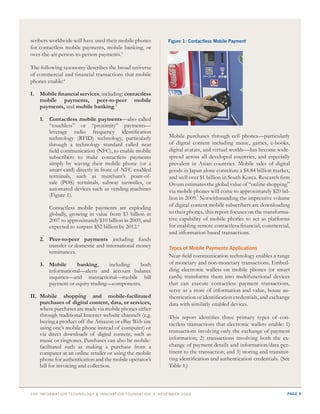
    1. Contactless mobile payments—also called
       “touchless” or “proximity” payments—
       leverage radio frequency identification
       technology (RFID) technology, particularly         Mobile purchases through cell phones—particularly
       through a technology standard called near          of digital content including music, games, e-books,
       field communication (NFC), to enable mobile        digital avatars, and virtual worlds—has become wide-
       subscribers to make contactless payments           spread across all developed countries, and especially
       simply by waving their mobile phone (or a          prevalent in Asian countries. Mobile sales of digital
       smart card) directly in front of NFC-enabled       goods in Japan alone constitute a $4.84 billion market,
       terminals, such as merchant’s point-of-            and well over $1 billion in South Korea. Research firm
       sale (POS) terminals, subway turnstiles, or        Ovum estimates the global value of “online shopping”
       automated devices such as vending machines         via mobile phones will come to approximately $20 bil-
       (Figure 1).
                                                          lion in 2009.7 Notwithstanding the impressive volume
        Contactless mobile payments are exploding         of digital content mobile subscribers are downloading
        globally, growing in value from $3 billion in     to their phones, this report focuses on the transforma-
        2007 to approximately $10 billion in 2009, and    tive capability of mobile phones to act as platforms
        expected to surpass $52 billion by 2012.6         for enabling remote contactless financial, commercial,
                                                          and information-based transactions.
    2. Peer-to-peer payments including funds
       transfer or domestic and international money       types of Mobile payments applications
       remittances.
                                                          Near-field communication technology enables a range
    3. Mobile      banking,     including   both          of monetary and non-monetary transactions. Embed-
       informational—alerts and account balance           ding electronic wallets on mobile phones (or smart
       inquiries—and transactional—mobile bill            cards) transforms them into multifunctional devices
       payment or equity trading—components.              that can execute contactless payment transactions,
                                                          serve as a store of information and value, house au-
II. Mobile shopping and mobile-facilitated                thentication or identification credentials, and exchange
    purchases of digital content, data, or services,      data with similarly enabled devices.
    where purchases are made via mobile phones either
    through traditional Internet website channels (e.g.   This report identifies three primary types of con-
    buying a product off the Amazon or eBay Web site      tactless transactions that electronic wallets enable: 1)
    using one’s mobile phone instead of computer) or
                                                          transactions involving only the exchange of payment
    via direct downloads of digital content, such as
    music or ringtones. Purchases can also be mobile-     information; 2) transactions involving both the ex-
    facilitated such as making a purchase from a          change of payment details and information/data per-
    computer at an online retailer or using the mobile    tinent to the transaction; and 3) storing and transmit-
    phone for authentication and the mobile operator’s    ting identification and authentication credentials. (See
    bill for invoicing and collection.                    Table 1.)


thE information tEchnology & innovation foundation | novEmbEr 20 09                                             page 9
The first category includes transactions where the mo-      to manage room access: the hotel sends an electronic
bile phone (or smart card) is simply used to transmit       code to the guest’s cell phone that permits access to a
payment details for purchases of stand-alone goods or       specific hotel room for the duration of the reservation,
services, such as buying a soda from a vending ma-          and the guest need simply touch his/her cell phone to
chine, or purchasing items from merchants such as           the door’s reader, obviating the need for physical keys
retailers, convenience stores, or fast-food restaurants.    or keys cards. Using electronic wallets for identification
There is not an information component to these trans-       purposes will further accelerate as biometric verifica-
actions required beyond the payment instructions.           tion is added to existing password authentication fea-
These types of contactless transactions will increas-       tures of mobile phones.
ingly replace cash for low-value micropayments (trans-
actions worth less than $25.)

Where electronic wallets (whether on mobile phones          Mobile payments represent a digital platform technolog y that
or smart cards) become far more powerful is their abil-     enables the creation of new and innovative applications limited
ity to store, process, and exchange transaction-related
                                                            only by the creativity of organizations seeking to use them.
information, enabling the mobile phone to replace a
litany of tickets, passes, keys, and cards. For example,
theater-goers in South Korea purchase movie tickets
via their mobile phones, receive the “tickets” elec-        And the important thing about this “platform” tech-
tronically, and swipe their phone across a reader at the    nology is that new and creative applications are only
theatre entrance, eliminating the need to hand a paper      limited by the creativity of the organizations that seek
ticket stub to a greeter. At parking garages in Japan,      to use them. For example, the Korean Salvation Army
drivers swipe their phones across readers as they enter     saw this technology platform and realized it could digi-
and exit the garage and an application in the electronic    tally transform the way it collected money at Christ-
wallet records duration of stay and transmits payment       mas. Now, next to the traditional red kettle and bell-
information at the exit gate, eliminating the need for      ringing Santa-costumed volunteers, the Korean Salva-
both paper tickets and attendants to process the trans-     tion Army has introduced digital donation screens, at
action. Likewise, airline passengers in Japan receive       which donors simply wave their mobile phone across
their reservation “tickets” electronically to the mobile    the screen and the specified amount is deducted from
phone and check in by tapping their phone to read-          one’s T-money account (a digital cash service popular in
ers at the flight gate (and at security check in). Taxi     South Korea) and paid to the Salvation Army—leaving
passengers can pay the fare and receive an electronic       donors with no excuse for not having change in their
receipt they can submit to their company’s account-         pockets, reducing the risk of money being siphoned
ing department for reimbursement. Critically, this in-      off by the volunteer, and reducing the cost of handling
formation storage and processing aspect of electronic       the cash.8 Another such application would be for the
wallets also allows transit agencies to issue contactless   government to deliver food stamps via mobile phones;
smart cards (or mobile phone applications) capable of       likely to be more convenient as many individuals who
both calculating passenger fare based on journey taken      lack bank accounts actually have mobile phones. It’s
and storing subscription account balances.                  likely that as this platform technology becomes more
                                                            widely available around the world, the number of in-
As an authentication application, electronic wallets can    novative applications will blossom.
store identification information, replacing the current
generation of key fobs and smart cards to allow indi-       Though not directly a mobile payments application, it
viduals to check in/sign in to schools, hotels, health      should be noted that NFC technology allows electronic
clubs, offices, and apartment buildings with one de-        devices to interconnect and exchange information with
vice, often a cell phone. For example, in South Ko-         one another over short distances, just as infrared or Blu-
rean, Japanese, and Swedish schools and universities,       etooth technology before it. For example, Apple is cur-
students effortlessly swipe their phones across readers     rently prototyping a next generation iPhone allowing
outside classroom doors to register their attendance.       customers to wirelessly sync their iPods and iPhones to
In New Zealand, hotels are using NFC technology             their iMac using RFID technology.9


thE information tEchnology & innovation foundation | novEmbEr 20 09                                                           page 10
table 1: Classifying Contactless Mobile payments applications

 payment transactions                     payment and information-based transactions     authentication/id
 	 obile
   M
   	         payments replace cash/       	 ransactions
                                            T
                                            	              involving exchange of both    	 uthentication/identifica-
                                                                                           A
                                                                                           	
    credit cards                             payment details and information pertain-       tion credentials are stored
                                             ing to the transaction. Data component is      in the mobile phone’s elec-
 	 o
   N
   	     information component re-
                                             stored on mobile phone’s electronic wal-       tronice wallet
    quired     beyond   exchanging
                                             let.
    payment details                                                                      	 lectronic
                                                                                           E
                                                                                           	            wallet can be
                                          	 nables
                                            E
                                            	          mobile phones to replace cards,      used as ID to check into:
 	ncludes
   I
   	       contactless payments for
                                             tickets, passes, etc.
    goods and services purchased                                                                Schools
                                                                                                		
    from:                                 	 nables
                                            E
                                            	         personalized merchandising and            Hotels
                                                                                                		
                                             advertising                                         Health Clubs
                                                                                                		
       		 Box Retailers
        Big
                                                                                               
      
                                                                                                	Office Complexes
        Quick Service Restaurants
       		                                 	 ses
                                            U
                                            	    mobile phone’s electronic wallet to
                                                                                               
      
                                                                                                 Apartment
                                                                                                		
        Convenience Stores
       		                                    manage, update, pay for, or check into:
                                                                                               
      
                                                                                                 Buildings
       	Taxis
                                                 Public Transit (Tickets)
                                                		
      
                                                
        Digital Donations
       		
                                                 A irport Check-in (Tickets)
                                                		
      
                                                
        Automated Devices
       		
                                                 Parking Garages (Tickets)
                                                		
      
                                                
              		Vending Machines
                                                	Movie Theatres (Tickets)
               
                                                
              	Parking Meters
                                                 Sporting Events (Tickets)
                                                		
               
                                                
              		Laundry Machines
                                                 Concerts/Museums/Parks
                                                		
               
                                                
       	Toll Booths
                                                 (Tickets)
      


                                                 Personalized Advertising or
                                                		
                                                


                                                 Merchandising
                                                	Loyalty cards
                                                


                                                		 cards
                                                Gift
                                                	Coupons
                                                


benefits of Contactless Mobile payments                          schools or libraries), credit cards, and cash with a sin-
Contactless mobile payments represent a transfor-                gle device capable of checking in to office complexes,
mative application that will bring a wide range of               apartment buildings, or health clubs; boarding planes
benefits to consumers, businesses, and the economy               and trains; and paying for everything from mass tran-
and society at large. Consumers will benefit from en-            sit and taxis to parking meters and vending machines.
hanced convenience and the ability to opt-in to per-             Indeed, much of daily life is consumed with the ex-
sonalized advertising or merchandising campaigns.                change of mundane information—key codes, dollars,
At a broader level, contactless payments will drive              time stamps, tickets, passes, ID credentials, etc.—all
increases in productivity, the central source of eco-            of which could be automated, streamlined, or even
nomic growth, through three channels: 1) bringing                obviated by leveraging mobile phones as a repository
operational efficiencies to merchants, retailers, and            for both information and money. Consumers will
transit authorities; 2) enabling a range of innovative           also enjoy faster transaction processing speeds in re-
new business models and service offerings; and 3)                tail and transit environments. Organizations will be
pushing distributed computing intelligence into the              able to automate these kinds of transactions, saving
physical world.                                                  significant amounts of money, which can be passed
                                                                 on to consumers. Finally, contactless transactions
Using mobile phones as electronic wallets will allow             reduce the burden—and security risk—of carrying
consumers to replace the multitude of keys, key fobs,            cash and having to fumble for loose change or bills to
loyalty cards, various types of ID cards (such as for            make small purchases.


thE information tEchnology & innovation foundation | novEmbEr 20 09                                                    page 11
For businesses, contactless payments enable increased       wallets make possible automated transactions that ei-
operational efficiency in retail and transit environ-       ther eliminate the need for personnel to manually pro-
ments, whether by accelerating transaction speeds,          cess tickets and cash or that empower employees to use
reducing the costs inherent in handling cash-based          their time more productively by automating routinized
transactions, or decreasing the need for ticketing or       activities. In fact, information technology (IT) is mov-
checkout agents at the point-of-sale (POS). Transac-        ing from a phase where many of the benefits of IT have
tions using contactless technology are as much as 40        come from “big boxes,” like servers or computers, to
percent faster than those made with credit or debit cards   a phase where the benefits come more from pushing
and 55 percent faster than those made with cash.10 In       distributed computing intelligence into the field. Pre-
mass transit environments, Japan’s JR East Railway re-      viously, most of the productivity gains from IT came
ports that moving from swiped magnetic stripe cards         from large IT implementations, such as enterprise
to contactless smart cards or mobile phones reduces         resource planning or automated order entry systems,
transaction processing time from 700 to 200 millisec-       which automated routinized activities employees had
onds. Japan’s All Nippon Airways found that using           performed in desktop or office environments.
mobile phones at check-in cuts transaction time per
passenger from 50 to 8 seconds.11 South Korea’s banks
have found that mobile transactions cost one-fifth          Electronic wallets have the potential to replace a litany of
of face-to-face transaction costs.12 And Washington,
D.C.’s transit authority found that migration to elec-      artifacts of analog life that consumers carry in their wallet to
tronic fare payments reduced staff by approximately         exchange money or information—credit cards, loyalty cards,
15 percent over a 5-year period.13
                                                            transit cards, ID cards, keys, key fobs, tickets, passes, etc.—
Contactless transactions open up entirely new chan-         with a single device.
nels for retailers to introduce opt-in personalized ad-
vertising or merchandising campaigns. For example,
customers entering a mall could swipe their mobile          But the next wave of IT will be about pushing mobile
phones across a NFC-enabled poster that would in-           computing, sensing, and intelligence out into the phys-
form them about sales or promotions at their favorite       ical world. Before, transactions in the field required
stores and even provide them with targeted coupons          people because there was little connectivity to technol-
or discounts. In Japan and South Korea, advertising         ogy platforms on the back-end (e.g., no “big box” in
posters (whether in subways or on the street) have          the field). But mobile phones bring computing into the
embedded chips allowing mobile subscribers to wave          field, acting as sensors that can connect physical infra-
their phones across the poster to learn more about—         structure to the virtual world. By enabling fully elec-
or directly purchase—the advertised good or service.        tronic transactions, contactless payments eliminate the
In those countries, one need simply walk up to a poster     need for cash or physical information exchange (e.g.,
pitching the latest Cirque de Soleil show, Harry Potter     tickets or passes) at the point-of-sale, removing the
movie, or Bruce Springsteen concert, wave the mobile        need for attendants to staff gates at parking garages,
phone across the poster, and purchase tickets imme-         movie theaters, tool booths, sporting venues, airports,
diately. In essence, NFC technology enables a world         etc. For example, if parking meters in the United
of secure end-to-end commerce and connectivity in           States were NFC-enabled, not only could drivers pay
which consumers can access and pay for physical and         electronically via their mobile phones, but because the
digital services anywhere, at any time, using any de-       meters would no longer be collecting coins, the need
vice.14 An NFC-based mobile transaction infrastruc-         for someone to physically go from parking meter to
ture will also spur the creation of more self-service       parking meter to collect them would be eliminated. If
opportunities and business models as transactions can       teachers didn’t have to spend two to three minutes of
increasingly be completed through automated devic-          class time taking attendance because students instead
es.                                                         signed in using their NFC-enabled phones, they could
                                                            save 30 hours or more a year on roll call, freeing them
The productivity story then is not simply about replac-     to focus on teaching and improving educational out-
ing credit cards with mobile phones; rather electronic      comes.15


thE information tEchnology & innovation foundation | novEmbEr 20 09                                                            page 12
box 1: Key Underlying Mobile payMents teChnologies and aCtors

Near Field Communication (NFC) Technology. Near field communication (NFC) is a short-range wireless connectivity technolo-
gy that provides intuitive, simple, and safe communication between electronic devices. NFC is a type of radio frequency identification
(RFID) technology, and the NFC standard is an extension of the ISO 14443 RFID proximity-card standard. NFC operates at 13.56
MHz and transfers data at up to 424 Kbits/second. Communication occurs when two NFC-compatible devices are brought within
four centimeters of one another. NFC communicates via magnetic field induction, where two loop antennas are located within each
other’s near field, effectively forming an air-core transformer. NFC can operate in one of two modes: passive or active.16

Mobile phones, contactless smart cards, and contactless credit (or debit) cards can communicate data via near field communication
technology to NFC-enabled payment terminals—including merchant’s point-of-sale terminals, vending machines, parking meters, rail
or subway turnstiles, airline check-in gates, etc.—to process contactless transactions. Importantly, NFC-based contactless transactions
clear (that is, they are settled financially) over existing credit card or bank payment networks, not over the wireless network on which
the phone operates.

Contactless payment technologies in Japan and South Korea also use RFID technology, but in the main, use RFID standards that are
not currently interoperable with NFC standards. Japan uses FeliCa, a proprietary standard. South Korea uses a passive, as opposed to
active, version of RFID that operates in card emulation mode only (no reader mode or peer-to-peer mode), and is not interoperable
with NFC.

FeliCa. Sony developed the FeliCa integrated circuit chip for contactless payments made via smart cards in 1988. In 2004, Sony
teamed with NTT DOCOMO (“DOCOMO”) to embed FeliCa chips into the electronic wallets of mobile phones, enabling contact-
less payments in Japan.

The NFC Forum. The NFC Forum, a standards-setting consortium founded in 2004 that includes 140 members from all areas of
the NFC ecosystem, drives the development of globally-interoperable NFC standards. As of Q4 2009, the NFC Forum has finalized
11 specifications enabling a basic level of device interoperability.17

Smart Cards. Smart cards—whether public transit fare cards, credit cards, or stored value (i.e., debit) cards—use embedded micro-
chips, also known as integrated circuits (IC) chips, to electronically store data. Smart card technology can be contact-based or contact-
less. In contact-based scenarios, customers insert or swipe cards through a card reader. Contactless smart cards have an embedded
antenna and short-range radio frequency identification (RFID) computer chip, which transfers data via radio waves, enabling contact-
less, or “touchless” remote transactions.

Electronic (or “Digital”) Wallets. An electronic wallet is a mobile phone feature that can centrally and simultaneously store multiple
applications managing customer account/transaction information with financial providers, public transit agencies, or third party enti-
ties such as health clubs, schools, and office or apartment buildings. For example, the electronic wallets of mobile phones in South
Korea can simultaneously manage up to 100 different applications, ranging from electronic money to personal IDs.

Electronic Money (or “Digital Cash”). Electronic money systems, such as Japan’s Edy or South Korea’s T-money, appear in the
form of either pre-paid, or “stored value,” smart cards or as an application in the electronic wallet of a mobile phone. For example,
with Edy, customers prepay (via a credit card or by debiting a bank account) to purchase Edy digital cash that is loaded onto their smart
card or mobile phone. When customers make purchases, in lieu of using cash, funds are deducted from the stored digital cash value
on the smart card or the mobile phone.

Trusted Service Manager (TSM). A trusted service manager is a third party intermediary that manages downloads of applications
to a phone’s electronic wallet. The TSM helps service providers securely distribute and manage contactless services for their customers
using the networks of mobile operators. However, the TSM does not participate in actual contactless transactions using NFC devices.18
The key functions of the TSMs include interconnecting with mobile network operators (MNOs) and application service providers,
enrolling new users, updating user interfaces, managing customer databases, managing application lifecycles, managing value-added
services such as ticket reloading and branding, and guaranteeing end-to-end security. Examples of TSMs include FeliCa Networks in
Japan and VivoTech in the United States. In Singapore, the government’s Information Development Authority has taken on the role
of setting up a national trusted service manager (there called a trusted third party.)

Peer-to-peer (or “person-to-person”) payments. Mobile peer-to-peer payments use the SMS (simplified messaging service) feature
of mobile phones to send text messages with payment instructions to third parties, such as the bank accounts of customers, suppliers,
or family members. Peer-to-peer payments have become incredibly popular in developing countries through service providers such as
M-Pesa in Kenya and Smart Communications in the Philippines.


thE information tEchnology & innovation foundation | novEmbEr 20 09                                                                   page 13
This all has the benefit of allowing organizations to de-   erators, handset manufacturers, financial institutions
ploy resources more productively, increasing customer       including major banks and credit card issuers, com-
convenience and generating cost savings for consum-         mercial retailers and merchant stores, public transit
ers and taxpayers, while eliminating routinized, mo-        authorities, government agencies, and, of course, the
notonous tasks or jobs, freeing the individuals who         customer. Mobile payments thus represent a complex
once staffed them to pursue more-rewarding, higher-         ecosystem with many players whose success depends
skilled, and higher-paying jobs. If the United States is    on joint action at the same time by all the players to-
to continue enhancing its productivity, thus generating     gether. All parties have to figure out a way to act col-
increases in growth, wages, and standards of living, it     laboratively at the same time, and this is something
must deploy technologies like mobile payments that          markets are not very good at, especially U.S. markets.
enhance productivity throughout the economy.

A national contactless payments infrastructure sup-         Mobile payments are characterized by a chicken-or-egg problem:
ports other social objectives, including more efficient
                                                            consumers won’t demand NFC-enabled phones until they know
governance and helping the environment by eliminat-
ing paper waste. A United Kingdom study found that          a sufficient number of POS terminals exist where they can use
going contactless in mass transit ticketing could save      them; merchants won’t deploy the infrastructure until a critical
the country £2 billion annually.19 Japan has found that
the amount of paper cash in circulation in the econo-       mass of users justifies the cost of doing so.
my has appreciably decreased since 2004, when mobile
phones with electronic wallets were introduced.20 Fi-
                                                            Mobile payments are marked by a system interde-
nally, eliminating the need for paper, whether of rail,
                                                            pendency (the classic “chicken-or-egg”) conundrum,
movie, or airline tickets (or even paper currency itself)
                                                            which each country must solve: For consumers to de-
saves money and benefits the environment.
                                                            mand cell phones with embedded electronic wallets—
In summary, a system whereby mobile payments and            and thus, critically, for the mobile network operators to
transactions leverage NFC technology is a critical          require this feature from the handset manufacturers—
emerging digital infrastructure technology platform         consumers must know that a sufficiently deployed mo-
that all countries will need to have. Once a country has    bile payments infrastructure exists at merchants’ POS
an open, interoperable mobile payments infrastructure       terminals, at fare readers in metro subways and buses,
in place, it is akin to having broadband, cellular net-     in toll booths along highways, at airports, in parking
works, or a smart grid installed. And like these digi-      garages, in automated devices like vending machines
tal infrastructure platforms, mobile payments exhibit       and parking meters, and in other places where the fea-
similar network effects: as additional NFC-enabled          ture can be used. Merchants and transit operators, for
mobile phones and devices come on the market, they          their part, are not likely to deploy NFC-enabled pay-
increase the value of other similarly enabled devices.      ment terminals until a critical mass of users gives them
Over time, a proliferation of creative applications are     confidence that their investments in such technology
likely to develop from the mobile payments technology       will be repaid. And indeed, determining who should
platform, many of which are difficult to even imagine       pay to finance the widespread deployment of the NFC
today, all of which will continue to create new busi-       mobile payments infrastructure (particularly reader
ness opportunities, increase productivity, and drive        terminals at merchants and mass transit facilities) is
economic growth.                                            one of the greatest challenges to mobile payments.
                                                            One industry observer estimated it could cost upwards
                                                            of $10 billion to fully replace the current POS terminal
the Mobile payments Challenge                               infrastructure in the United States (alone) with NFC-
Mobile payments are considerably different from the         capable devices.21
classic “widget” industry in which a company need
only acquire the requisite inputs, manufacture its prod-    The system interdependency challenge makes it ex-
ucts, and sell them on the open market. For a country       tremely difficult for all parties in a multi-sided market
to successfully deploy mobile payments it must engage       to craft profitable business models. Each party needs
a wide range of actors, including: mobile network op-       to know that incoming revenues (or value, from the


thE information tEchnology & innovation foundation | novEmbEr 20 09                                                            page 14
consumer perspective) will justify the costs of their in-   tions. Year-end 2008 (or most recently available) data
vestments. Therefore, each party must have clarity as       are cited wherever possible. Historical data are cited
to its role in the mobile payments value chain and how      in most cases, though the report also makes use of
it intends to monetize it. A key sticking point is the      forward-looking, anticipatory estimates of future mar-
issue of, “Who owns the customer in mobile transac-         ket sizes for countries’ mobile payments markets. The
tions?” Wireless network operators believe they own         study relies extensively on facts and figures provided
the mobile subscriber relationship, credit card issuing     by representatives or publications of foreign govern-
banks insist they own the financial relationship with       ments and thus on the implied accuracy and validity of
customers, and retailers contend that they own the          these resources.
customer relationship at the point of purchase. Each
entity desires to have the leading place in the mobile      The assessment of country leaders was also informed
payments ecosystem and dominant role in the value           by consultations with over two dozen experts in the
chain, and as a result the market has remained still-       mobile commerce and payments field, who were asked
born. As Pragnesh Shah, former CEO of mobile pay-           to rank the world leaders in mobile payments and
ments firm Mobilians, states, “The barriers to mobile       provide both context for and a historiography of the
payments, in the United States or elsewhere, are not        evolution of mobile payments ecosystems in leading
technological nor regulatory; rather they pertain to the    countries.
business model.”22 Of course, all countries looking to
deploy mobile payments must solve these complex sys-
tem interdependency and business model ecosystem            Mobile payments exhibit classic network externalities; adding an
challenges in their own way.
                                                            additional NFC-enabled phone or POS terminal device to the
And in analyzing the countries leading the world in         network amplifies the value of previously deployed devices and
mobile payments, it becomes apparent that some forc-
                                                            makes the case more compelling for further deployment.
ing function—such as government facilitating the
development of the mobile payments ecosystemt or
ensuring that transit agencies deploy interoperable         Mobile payment technologies—and countries’ deploy-
contactless fare payment systems—has intervened to          ments of them—are dynamic and rapidly evolving. As
either circumvent or resolve the system interdependen-      of November 2009, more than 100 trials or tests of
cy paradox, catalyzing the country’s mobile payments        RF-based contactless payment systems are occurring
ecosystem and causing contactless payments to arrive        in cities and countries worldwide. This report has iden-
sooner that the marketplace alone would have other-         tified world leaders as of Fall 2009; countries’ leader-
wise delivered it.                                          ship positions may subsequently shift.

Methodology                                                 Which Countries lead in Contactless Mobile
This report focuses on which countries are best leverag-    payments?
ing mobile phones (and, to a lesser degree, smart cards)    In its 2007 report, Mobile Commerce, the OECD noted
as platforms for contactless payments and transac-          that, “The level of development of the mobile com-
tions. The analysis examines quantitative data for each     merce industry varies widely across OECD member
country, principally the number of electronic-wallet        countries. But individuals, particularly in Japan and
capable mobile phones and point of sale terminal read-      South Korea, have started to own the Internet-con-
ers underpinning the country’s mobile payments infra-       nectable mobile phones that enable the development of
structure, along with the number and overall market         mobile commerce.”23 As Shri Kumar, a senior official
value of contactless payments in each country.              with India’s Ministry of Communications and Infor-
                                                            mation Technology (MCIT), observed in a presentation
Mobile payments statistics come from a variety of           to the Mobile Forum of India in February 2009, “The
sources, principally market research firms and gov-         Asia-Pacific region is the most advanced m-commerce
ernment agencies, that may use different classification     market in the world, and the test-bed for the major-
methodologies for defining mobile payments transac-         ity of m-commerce and m-payment trials.”24 Indeed,


thE information tEchnology & innovation foundation | novEmbEr 20 09                                                          page 15
table 2: Contactless Mobile payments activity in selected Countries
 Metric/statistic                  Japan                       south Korea                  United states
 Mobile phone penetration          87% (2008)   30
                                                               93% (2008)                   88% (2008)31

 Number of mobile wallet-capable   78 million                  12 million                   Only in trials
 phones deployed

 Number of citizens using mobile   17 million phones;          3.6 million phones;          Only in trials
 wallets                           68 million smart cards      18 million T-money smart
                                                               cards
 Number of merchants deploying     608,000 merchants           +500,000 total POS readers   140,000 merchants
 RF-capable POS readers/total      deploying/total number      deployed33                   deploying/+500,000 POS
 number POS readers deployed       POS readers deployed much                                readers deployed34
                                   larger32


almost 500 million mobile transactions will occur in             Internal Affairs and Communications (MIAC) esti-
Asia in 2009, versus only 34 million in North America,           mated that the overall value of “all business carried
according to research firm Gartner.25 By 2012, Gart-             out through” cell phones in Japan was worth as much
ner expects that mobile transactions will grow to 2.4            as $106 billion in 2007, up 23 percent from 2006.28 In
billion in Asia and 221 million in North America. Re-            South Korea, 63 percent of citizens have made pay-
search firm Juniper concurs, finding that, “The Far              ments through their mobile phones, at least 12 million
East and Western Europe will be the top two regions              subscribers have RF-capable mobile phones (about
for mobile commerce by 2013, accounting for 60 per-              one-quarter of mobile phones), more than 3.5 million
cent of the [anticipated] $300 billion global transaction        citizens use their mobile phones for contactless pay-
value.” Not surprisingly then, the two countries clearly         ments, and 9.15 million mobile subscribers use mobile
leading the world in mobile payments emerge from the             banking. South Koreans purchased $1.4 billion worth
Asia-Pacific region.                                             of digital content in 2008, and the value of South Ko-
                                                                 rea’s overall mobile commerce market is expected to
Japan and South Korea lead the word in mobile pay-               grow to 6.84 billion won ($5.9 billion) in 2010.29
ments based upon the aforementioned criteria. (See
Table 2.) As Kumar argues, “Japan is two years ahead             There are currently over 100 NFC projects, trials, or
of the rest of the world in contactless adoption.”26 In-         commercial deployments occurring worldwide, 47
dustry executive Pragnesh Shah, formerly with Sprint             in Asia alone.35 Although there are many NFC trials
and recently CEO of the U.S. division of South Ko-               ongoing, most of them are still in the nascent phase,
rean mobile payments firm Mobilians, concurs that,               and none have reached the level of critical mass of de-
“Japan and South Korea clearly lead the world in the             ployment and use that has been achieved in Japan and
deployment and adoption of phone-initiated contact-              South Korea. While Hong Kong, Singapore, Taiwan,
less mobile payments.”27                                         and Malaysia each make extensive use of contactless
                                                                 payments—there are more than 10 million contactless
In Japan, 78 million mobile subscribers (73 percent)             transactions each day in Hong Kong, for example—
own FeliCa-capable mobile phones, 17 million sub-                almost all these are initiated through smart cards. As
scribers use these phones for contactless transac-               consulting firm KPMG noted in a survey of mobile
tions in railways or stores on a regular basis, and over         payments in the Asia-Pacific region, “Somewhat sur-
600,000 affiliated merchant stores (and a greater num-           prisingly, the most mobile-penetrated territories on the
ber of terminals) accept contactless payments. The               planet—Hong Kong, Singapore, and Taipei—have
market value of contactless transactions alone in Japan          shown little comparable adoption of m-payments, ex-
was $8.4 billion in 2008, and the total value of mobile          cept in the use of contactless cards for transportation
commerce activity in the country, including mobile               and some limited retail usage.”36 Malaysia has recently
content downloads, fees for text messaging and Web               completed NFC trials and is beginning to deploy its
data plans, etc., was $32.4 billion. Japan’s Ministry of         mobile payments infrastructure, but the country has


thE information tEchnology & innovation foundation | novEmbEr 20 09                                                   page 16
nowhere near the level of deployment as Japan and           Figure 2: Mobile nFC payment at a Japan railway station42
South Korea.37 In June 2009, Singapore launched a
national “Digital Concierge” initiative, “to promote e-
payment adoption, particularly interoperable payments
enabled by near field communication,” but this has just
launched. In China, China Mobile, the world’s largest
mobile operator, has announced plans for a large scale
commercial rollout of mobile contactless payments, but
the rollout is not slated to start until 2010.38 A number
of European countries—notably Austria, France, Brit-
ain, Finland, and Germany—are conducting trials of
mobile-phone based NFC payment systems in major
cities, but most are still in the test phase. Even Rus-
sia is looking to launch a contactless mobile payments
system by 2011 or 2012.39 But no European country
has yet fielded a nationally deployed, ubiquitous mobile    Japanese citizens view mobile phones as indispensible
payments infrastructure rivaling those found in Japan       “lifestyle infrastructure” that serves “as the remote
or South Korea. But even compared to these coun-            control for all the transactions in our daily lives.”41 This
tries, the United States lags those with multiple ongo-     section describes the current state of the mobile pay-
ing trials or those putting together national strategies    ments market in Japan; a subsequent section explores
to ubiquitously deploy mobile payments. Meanwhile,          the sources of the country’s mobile payments leader-
contactless payments are evolving at a dynamic pace         ship.
worldwide; countries not planning to deploy such sys-
                                                            Eighty-seven percent of Japanese own mobile phones,
tems risk falling behind globally.
                                                            90 percent of which operate on 3G networks. As of
                                                            September 2008, 78 million mobile phones in Japan
Mobile payMents in Japan                                    had FeliCa-enabled electronic wallet capability, with 17
Japan leads the world in mobile payments consumer           million mobile phone subscribers using their mobile
adoption, technology infrastructure, and market val-        phones to make contactless transactions.43 Eighteen
ue. As Card Technolog y magazine writes, “Japan has the     percent of Japan’s mobile phone subscribers report
most advanced mobile payment and ticketing market           that they have at least tried out the electronic wallet
in the world.”40 Japanese consumers use their mobile        feature of their mobile phones for contactless transac-
devices as osaifu-keitai (mobile wallets) in lieu of cash   tions.44 As of August 2009, 82.8 percent of residents in
or credit cards to pay rail or subway fares (Figure 2);     the Tokyo metropolitan area used electronic money, up
to pay for taxi rides, movie tickets, and parking me-       from 78.9 percent in August 2008. Average transaction
ters; to make purchases from kiosks and vending ma-         amounts per month increased from ¥5,600 to ¥6,000
chines; to auction used items; to manage loyalty cards      ($61 to $65) over that time period, with users averaging
and programs; and even to check in at airports with         a total of seven transactions per month.45
their mobile phones acting as a boarding pass. Japa-
nese consumers purchase hundreds of thousands of            The value of mobile contactless transactions (whether
items—from tickets to groceries—with mobile phones          initiated from a smart card or mobile phone), reached
every day in Japan. Because they spend an estimated         ¥1.7 trillion ($17 billion) in 2008, and is expected to
¥60 trillion ($514 billion) each year on low-value pur-     grow to ¥2 trillion ($20 billion) by 2012, according
chases, the market is primed for cash to be replaced        to Nikkei BP, a major Japanese business publication.46
with electronic money.                                      The following categories accounted for proximity pay-
                                                            ments volume in 2008: actual payments at a physical
Japanese consumers also use the electronic wallets on       retail location, 35 percent; online shopping, 34.5 per-
their mobile phones to store identification information     cent; transportation (trains, taxis, buses, etc.), 14.3 per-
used to check into offices, apartment buildings, and        cent; auctions, 8.3 percent; mobile music purchases, 4
health clubs, and register their attendance at school.      percent; mobile game purchases, 1.6 percent; mobile


thE information tEchnology & innovation foundation | novEmbEr 20 09                                                  page 17
e-book purchases, 1.2 percent; mobile video purchas-         3) contactless transactions that use credit on a postpaid
es, 1.1 percent.47 Considering only the value of trans-      basis, such as the DCMX credit service provided by
actions executed when Japanese mobile subscribers            DOCOMO.
actually waved their FeliCa-enabled phones or smart
cards in front of a FeliCa-enabled terminal reader, this     The four largest electronic money services in Japan are
amounted to $8.4 billion in 2008. (The remainder,            Suica, iD (DOCOMO), Edy, and Nanaco. Suica, op-
$8.6 billion, is accounted for by transactions billed to     erated by JR East Railways, serves as electronic cash
electronic money accounts but that were not actually         (available either via smart card or mobile phone) that
made in a contactless fashion. For example, one made         can be used to pay railway fare or to make purchases
a purchase on the Internet, but billed the charge to         from affiliated kiosks and merchants. Over 27 million
one’s electronic money account.)                             Japanese use Suica in lieu of cash to pay railway fare.
                                                             Suica users alone make more than 200 million con-
the Contactless Mobile payments Market in Japan              tactless transactions per month in Japan.48 Nanaco is
Contactless mobile payments in Japan began with the          a contactless smart card and e-money service provided
FeliCa smart card platform and subsequently migrated         by Seven & I Holdings (7-Eleven stores), and Waon is
into cell phones. FeliCa is an RFID-based contactless        a contactless smart card and e-money service from the
payments standard developed by Sony; it is akin to but       AEON group (one of Japan’s largest retail chains).
not yet interoperable with NFC. There are three major
types of mobile FeliCa transactions—whether initiated        As of August 2008, Japanese citizens held 84.56 mil-
via a smart card or mobile phone—in Japan today: 1)          lion mobile FeliCa accounts in Japan, including 67.7
contactless payments for rail/mass transit using a pre-      million FeliCa-enabled smart cards, and 16.9 million
paid, stored value card, such Japan Railway (JR) East’s      FeliCa-enabled mobile phones. By service provider, JR
Suica card; 2) mobile payments debited from a prepaid        East had 25.9 million customers using the Suica smart
digital cash (electronic money) account operated by          card and an additional 1.22 million mobile customers;
service providers such as Edy, Nanaco, or Waon; and          Edy had 34.4 million smart card customers and an ad-

 Figure 3: growth of Mobile payments acceptance in Japan51


thE information tEchnology & innovation foundation | novEmbEr 20 09                                                page 18
ditional 8.3 million more mobile customers; Nanaco         In November 2001, this collaboration led JR East to
had 6.13 million customers of its prepaid service, with    launch the Suica (Super Urban Intelligent Card) con-
900,000 using the mobile phone service; and DO-            tactless smart card, based on Sony’s FeliCa technology,
COMO had 6.44 million customers using their mobile         concurrently deploying FeliCa-enabled readers at the
phones to make mobile purchases on a credit basis.49       turnstiles of the 424 stations in its commuter railroad
(By August 2009, subscribers of DOCOMO’s DCMX              network in the Tokyo area. Critically, Suica operated as
credit service had surpassed 10 million.)50 Over           an open-loop, transit-branded card, meaning that pas-
600,000 shops now accept mobile payments in Japan,         sengers could use value stored on the Suica card not
as Figure 3 shows.                                         just for transit fare, but also to make purchases at af-
                                                           filiated merchants and kiosks in railway stations (and
history and development of Contactless Mobile              elsewhere) that accepted the Suica card. By introducing
payments in Japan                                          an interoperable smart card system, Suica launched the
Japan’s expertise in contactless smart card technology     market for electronic money in Japan.
dates back to 1988, when Sony began work on contact-
less integrated circuit (IC) chips, culminating by 1995    Sony, looking to spur demand for its Mobile FeliCa
in the development of the FeliCa contactless IC card       technology, spearheaded in 2002 the creation of the
technology.52 That same year, Hong Kong authorities        joint venture BitWallet, Inc. which launched Edy, a
adopted FeliCa IC chip technology for the Octopus          contactless smart card-based, prepaid electronic mon-
contactless card used in their public transportation       ey service using the FeliCa chip. (Ownership of the
system (akin to today’s SmarTrip cards in Washington,      BitWallet joint venture is shared 33 percent by Sony,
D.C.), and in 1999 Sony began trial use of the FeliCa      15 percent by DOCOMO, 5 percent by All Nippon
card as an employee ID and “e-wallet” in a Tokyo           Airways, with the remainder accounted for by more
office and shopping complex. But by the end of the         than 50 other companies.) Customers can use Edy as
1990s, FeliCa was struggling to find uptake and pen-       digital cash to make purchases at am/pm, Circle K,
etration in the Japanese market,53 in large part due to    and Sunkus convenience stores, taxis, bookstores, and
the system interdependency problem described previ-        other venues. By 2007, Edy had attracted 23 million
ously.                                                     smart card subscribers and 4.5 million phone subscrib-
                                                           ers who generated 15 million transactions per month at
For its part, Japan Rail (renamed JR East after its 1987   over 50,000 participating stores. However, Edy is not
privatization), the country’s largest railway line, had    interoperable with Suica.57 Nanaco, Waon, and others
begun research and development into automated fare         also emerged as competing digital card services.
collection technology as early as 1987 and had intro-
duced magnetic stripe cards in 1992.54 JR East and         Encouraged by the success of Suica and Edy, Sony,
Sony worked collaboratively throughout the 1990s           JR East, and DOCOMO discussed the possibility of
on contactless payment systems, experimenting with         embedding FeliCa technology in DOCOMO’s phones,
microwaves and battery-operated cards in trials from       and by March 2003 the trio ascertained that it was tech-
1994 to 1997, finding that the advantages of moving        nologically feasible to do so.58 The greater challenge, of
from magnetic stripe cards to contactless cards are        course, lay in identifying a sustainable business model
accelerated transaction processing time—700 milli-         for all parties. Sony would profit directly from sales of
seconds for magnet stripe cards versus 200 millisec-       the FeliCa chip, but because DOCOMO earned rev-
onds for contactless cards—and enhanced reliability.55     enues primarily through voice and data services traf-
(Payment terminals commonly found in mass transit,         fic, and because contactless transactions settle over the
which take in and return a magnetic stripe card, con-      back-end of the financial payment network, contactless
tain moving parts that convey the card through the         mobile payments would not significantly increase tele-
reader and are far more prone to mechanical failure        communications traffic, and thus would not generate
than contactless fare systems.) JR East also recognized    a revenue stream DOCOMO could tap into.59 Take-
that, by deploying contactless ticketing, it could sub-    shi Natsuno, father of DOCOMO’s popular wireless
stantially reduce the number of employees it deployed      Internet service i-Mode and head of the DOCOMO
in railway stations to handle paper-based ticketing.56     team negotiating with Sony, advanced a plan to split


thE information tEchnology & innovation foundation | novEmbEr 20 09                                               page 19
profits from mobile FeliCa through a Sony-DOCOMO            card company) to preload JCB’s QuickPay service onto
joint venture that would generate revenues by licensing     its mobile phones. JCB reported that its registered users
and managing use of the mobile FeliCa technology.60         of credit services jumped threefold in the months fol-
In May 2003, the companies established the joint ven-       lowing its partnership with KDDI.
ture FeliCa Networks, with ¥5.8 billion ($65 million)
in capital and a 60/40 percent equity ownership and         Responding to competition, NTT DOCOMO launched
80/20 employee split between Sony and DOCOMO,               iD/DCMX, its platform for mobile credit card trans-
with Sony providing the bulk of the intellectual capi-      actions, in April 2006. By August 2009, over 420,000
tal.61 (JR East would subsequently acquire a 5 percent      installed reader/writer terminals at merchant locations
stake of the company in June 2004.)                         accepted iD. More than 60 credit-card issuing banks
                                                            have issued credit cards and/or mobile applications ca-
FeliCa Networks would act as the trusted service man-       pable of processing credit payments on the iD platform.
ager and generate revenue through three channels,           DOCOMO’s own credit service comes in three types:
each a form of transaction fee: 1) collecting license       DCMX mini offers the standard ¥10,000 ($95) per
fees from mobile operators (other than DOCOMO)              month credit line, which settles through the customer’s
that purchased mobile FeliCa chips; 2) providing plat-      mobile phone bill, requires no authentication, and is
form management services (since applications were not       available through the mobile phone only. DCMX of-
pre-installed on mobile FeliCa chips, the joint venture     fers a ¥200,000 ($2,200) permonth credit line, requires
would receive a fee every time a user downloaded and        authentication at the point of sale, and settles through
paid for an electronic wallet application); and 3) pro-     the customer’s credit card bill. A DCMX Gold service
viding a range of hosted services, such as managing the     with an even higher credit line is available as well.
servers used to download applications or to authenti-
cate users.62
                                                            Check-in through mobile phones in Japan can occur using
With the technology infrastructure and business mod-        one of two mechanisms: using mobile FelICa in a contactless
el in place, in 2004 DOCOMO began selling mobile
phones with pre-installed electronic wallets (the os-       transaction, or using the QR code via optical character
aifu-keitai), initially allowing customers to download      recognition.
¥10,000 ($95) per month in credits to a phone via the
company’s i-mode data service. BitWallet launched
a mobile version of Edy digital cash in 2004, which         JR East launched an electronic wallet version of Suica
received rapid adoption because it came pre-installed       for mobile phones in 2006, but take-up of the mobile
as an application on all DOCOMO FeliCa-capable              service got off to a very slow start because, at the time,
handsets.63 In the three years after DOCOMO debuted         JR East forced customers to also sign up for a JR View
mobile wallets using Sony’s FeliCa contactless system,      credit card.65 This largely explains why Suica had only
it sold more than 13.8 million mobile wallet–capable        1.22 mobile users, compared with about 26 million card
handsets, achieving a 27 percent market penetration         users as of August 2008.66 In addition to JR East ticket-
rate. By 2007, FeliCa became DOCOMO’s fastest               ing gates, lockers, and vending machines, about 40,000
growing business, with over 700,000 transactions per        participating retail outlets accept Suica payments.
month.64
                                                            Take-up among mobile subscribers for FeliCa services
Competing mobile operators quickly launched their           has been steadily growing. Eighteen percent of mobile
own mobile wallet–enabled phones. Although DO-              FeliCa users report they make contactless transactions
COMO’s original osaifu-keitai service was limited to        daily, 12 percent say they use mobile FeliCa at least four
¥10,000 ($95) in pre-purchased credits per month,           to five times per week, and 17 percent report using con-
wireless carriers innovated by adding credit as a feature   tactless transactions two to three times per week.67 (In
of their mobile wallets. When KDDI (DOCOMO’s                2007, only 12 percent reported using mobile FeliCa dai-
chief rival), launched EZ FeliCa as its mobile wallet       ly and 9 percent reported using the service 2 to 3 times
service, it partnered with JCB (Japan’s largest credit      per week.) One Sony official noted satisfaction with the


thE information tEchnology & innovation foundation | novEmbEr 20 09                                                       page 20
Figure 4: a Qr Code                                        Figure 6: Mobile Check in for airline Flight in Japan


steady increase in uptake, commenting, “We are trying
to change people’s behavior for something that really
hasn’t changed in 3,000 years.”68

other Forms of Contactless transactions in Japan
Quick Response (QR) codes, two-dimensional bar
codes invented by the Japanese firm Denso Wave that        Check-in through the mobile phone in Japan can occur
can be read by mobile phone cameras (as shown in           using one of two mechanisms: using mobile FeliCa in
Figure 4) have also been instrumental in driving m-        a contactless transaction, or using the QR code for-
commerce and m-payments in Japan.69 Magazine and           mat via optical character recognition. (Mobile phone
newspaper advertisements, movie posters, and even          check-in at U.S. airports uses barcode optical character
business cards use QR codes.                               recognition instead of contactless technology.)72 In late
                                                           2006, All Nippon Airways (ANA) made the readers
When a user scans the QR code with the mobile              at their check-in gates FeliCa-compliant, so that pas-
phone’s camera, barcode-reading software embedded          sengers could download an ANA Edy application to
in the phone processes the barcode and the cell phone      the electronic wallet of their mobile phone and simply
performs the task instructed by the code, such as dis-     touch their FeliCa-capable handset to the reader/writ-
playing an URL or text. QR codes are extremely popu-       er at both security and gate check-ins. In the alternate
lar amongst Japanese businesses as a response channel      format, ANA can send a QR code to the passenger’s
for advertising media, including print media and pack-     mobile phone, which is optically scanned by the read-
aging, as well as for mobile couponing. Even political     er/writer at the gate. Japan Airlines (JAL) launched a
parties are putting QR codes on posters and billboards     similar “Touch and Go” service (Figure 6) in Febru-
(Figure 5), allowing passersby to simply “click on the     ary 2008, which also allows passengers to pass security
poster and access the candidate’s Web site for more        and flight gates via contactless transactions.73 (ANA
details.” 70                                               and JAL applications are not interoperable. That is,
                                                           one must carry separate ANA and JAL applications in
Major airports and airlines in Japan allow passengers      the mobile phone’s osaifu-keitai to check in for trips
to both pass through security and to board at the flight   with the different airlines.)
gate using their mobile phone instead of a paper ticket.
                                                           Even laptops now ship with built-in FeliCa readers or
Figure 5: Qr Code in political Campaign71
                                                           FeliCa dongles connected via USB, so users can pur-
                                                           chase items online and pay for them simply by placing
                                                           their mobile phone or smart card near a computer.74
                                                           (The mobile phone can also automatically transmit ad-
                                                           dress and other order entry information.) Thus, even
                                                           when shopping from an actual computer online, Japa-
                                                           nese users can make payments through their mobile
                                                           phone. FeliCa Network’s Kazapon service lets users
                                                           transmit information such as mobile URLs, transpor-
                                                           tation timetables, etc., by touching their mobile hand-


thE information tEchnology & innovation foundation | novEmbEr 20 09                                                page 21
set to a computer with a USB-enabled FeliCa reader/        ments at SK Telecom concurs, noting that the goal is
writer. This allows data such as address books to be       to bring cash and credit to mobile phones, “thus mak-
contactlessly communicated between the computer            ing South Korea a walletless, cashless society.”82
and cell phone.
                                                           Monitoring the progress of mobile payments in South
                                                           Korea is especially important, because, as one analyst
soUth Korea                                                notes, “What happens in South Korea matters to mo-
After Japan, South Korea ranks as the second most          bile network operators and banks considering launch-
advanced country in the world in adoption and deploy-      ing m-payment schemes throughout the rest of the
ment of contactless mobile payments. South Korea           world because new mobile technologies often get their
boasts some of the world’s most sophisticated mobile       first large-scale tryouts in South Korea, before being
handsets, mobile broadband networks, and mobile            slowly adopted elsewhere.”83
users, and has a 93 percent mobile penetration rate.75
Over 80 percent of phones in South Korea operate
                                                           the evolution of contactless mobile payments in
on 3G networks.76 South Korea actually introduced
                                                           south Korea
mobile payments earlier than Japan did, in 2002, al-
                                                           The mobile payments ecosystem in South Korea devel-
though consumer uptake has come slower than in Ja-
                                                           oped quite differently from that in Japan.84 Moreover,
pan.77 Nevertheless, by year-end 2008, 63 percent of
                                                           the mobile payments ecosystem in South Korea is still
South Koreans had made mobile payments using their
                                                           rapidly evolving, with the market picture today look-
cellular phones.78 At least 12 million mobile phones
                                                           ing quite different from even just several years ago.85
in South Korea (about one-quarter of the country’s
                                                           The evolution of mobile payments in South Korean
mobile phones) have the ability to make contactless
                                                           can be said to have evolved through three phases: 1)
mobile payments.79 More than 1 million cell phone
                                                           early initiatives by mobile network operators to drive
subscribers use T-money, electronic cash stored and
                                                           the marketplace from 2002 to 2007 that have had dif-
refilled on SIM cards, to pay for public transit or make
                                                           ficulty sustaining traction; 2) the rise of the Internet
other contactless purchases in South Korea.80
                                                           payment gateway mobile payment providers from 2004
As with Japanese consumers, South Koreans view             to the present; and 3) the introduction of T-money as a
their cell phones as the “ultimate enabler,” using them    smart card platform for contactless transportation and
for a wide range of commercial, communications, and        e-money payments since 2004 (and on mobile phones
entertainment purposes, including: contactless pay-        since 2007).
ment of railway, subway, bus, taxi or limousine fare;
contactless payment for purchases in convenience,          Mobile network operator-led initiatives
fast food stores, and kiosks; and as personal ID to        As with NTT DOCOMO in Japan, South Korea’s larg-
check into workplaces or apartment buildings. South        est telecommunications company, SK Telecom, moved
Koreans also use their mobile phones as an Internet        early to advance a vertically integrated mobile payments
payment gateway; to buy movie tickets and enter the-       ecosystem in South Korea, including a comprehensive
atres; to power on and off home appliances such as         framework for mobile cash (Moneta Cash), mobile
air conditioners; to monitor diabetes and other dis-       payments (Moneta), and mobile banking (Mbank).86
eases remotely; and for entertainment purposes as a        SK Telecom launched Moneta in November 2002 as a
karaoke machine, camera, MP3 player, game device, or       mobile wallet application allowing customers to make
HD video recorder. Students even touch their mobile        proximity (in-store) contactless payments through sev-
phones to reader terminals outside classroom doors         eral mechanisms. Moneta initially supported a mobile
to mark their attendance at school, with the school’s      cash payment product (Moneta Cash) and subsequently
server logging attendance and tardiness. As SK Tele-       evolved toward a platform to support credit card pay-
com’s Shim Gi-tae explains, the intent is to, “Make the    ments through mobile phones.87
cell phone the center of life, bringing complex bits of
daily life—cash, credit cards, membership and student      SK Telecom sought to pioneer mobile payments in
ID cards, everything—into the mobile phone.”81 His         South Korea with a mobile cash product called NeMo
colleague, Ju Hae-Sang, Manager for Mobile Cash Pay-       (Network + Money), which was launched alongside


thE information tEchnology & innovation foundation | novEmbEr 20 09                                             page 22
nine major Korean banks in 2001.88 (NeMo was sub-           ing in rolling out new POS readers with merchants.95
sequently rebranded as Moneta Cash.) Moneta Cash            For those investments, SK Telecom received a share of
represented a fundamentally new payment instrument,         the revenue generated by transactions initiated by mo-
which SK Telecom hoped might eventually replace             bile phones, directly insinuating itself into the revenue
credit cards.89 This vision led to tensions with partici-   stream generated by contactless payments. SK Tele-
pating banks, who increasingly saw SK Telecom’s m-          com received 1.3 percent of the merchant processing
cash accounts as an invasion of an outsider into their      fee, payment networks 0.1 percent, and issuing banks
business domain. For example, the head of Kookmin           1.2 percent, which represented a concession from their
Bank reacted to Moneta Cash by “issuing a warning to        usual 2.5 percent merchant processing fee.96
his fellow bankers that the likes of SK Telecom were
out to steal their business.”90 While Moneta Cash gar-      As of February 2007, SK Telecom’s Moneta service
nered 3 million customers, continued in-fighting with       had over 2.6 million subscribers and had deployed
bank partners contributed to the service being discon-      500,000 POS readers.97 But as one 2007 report noted,
tinued in 2004.91                                           “actual Moneta usage is very low, and the future of
                                                            Moneta is uncertain”98; indeed over the past two years
Unlike Moneta Cash, which gave customers a new type         Moneta has continued to struggle. As Professor Suk-
of financial account, Moneta itself was not a payment       Gwon Chang of Hanyang University’s School of Busi-
instrument but rather a mobile wallet application that      ness and a leading expert on South Korea’s ICT in-
allowed customers to pay using their existing credit or     dustry, explains, “Moneta is an older mobile payments
debit account over mobile terminals. Moneta worked          business model from SK Telecom that appears to be
with a new type of chip-embedded Moneta Card                losing traction in the marketplace.”99 Moneta’s diffi-
(a credit card in a smart card format). Moneta cards        culty in gaining traction in the marketplace illustrates
were launched in September 2001; they were initially        the difficulties many countries have confronted in de-
co-branded by Visa and issued by five major domestic        veloping mobile payments ecosystems. Moneta’s chal-
credit card companies and banks. Over time, SK Tele-        lenges stemmed chiefly from ecosystem players fearing
com expanded its Moneta payment services from the           the risk of technology lock-in and continuing distrust
merchant proximity payment service (Moneta Card)            from financial institutions.100
to online payment services and mass transit payments
(Moneta Pass) in Seoul. In addition, it has used the        With regard to the threat of technology lock-in, in the
payment platform to offer mobile shopping, mobile           mid 2000s many players were positioning themselves
banking (Moneta Bank or MBank), and mobile stock            with their own technologies to enable credit card pay-
trading (Moneta Stock Trading) services.92 The Mon-         ments over mobile phones: SK Telecom and KTF were
eta service allows a mobile device to be used as an e-      each promoting their own standards, a start-up called
money account, credit card, transit ticket, membership      Harex Info Tech was offering its own infrared based
loyalty card, and mobile platform for equity trading.       m-payment service called ZOOP in parts of Seoul,
SK Telecom acts as the m-wallet owner, meaning that         and some established credit card companies wanted to
customers are able to hold multiple accounts from dif-      develop their own card-based m-payment solutions.101
ferent issuers under one mobile device serviced by SK       Moreover, the competing solutions required installing
Telecom.93                                                  proprietary merchant POS readers, which were not
                                                            interoperable among rival systems. Retailers faced the
Though SK Telecom clearly took the lead to create           need to deploy multiple card-accepting devices (which
and launch the Moneta service, Moneta represents a          would only add to the cost and complexity of opera-
collaborative operator/financial services mobile pay-       tions), and therefore retailers resisted investing in the
ments ecosystem model, with both parties making             new equipment necessary to process Moneta transac-
important contributions and concessions.94 Credit/ac-       tions before demand for the service was well prov-
count issuance is performed by the partnering banks         en.102 South Korean handset vendors were also slow
and payments are processed through existing Visa and        to respond in developing the special-purpose Moneta
Mastercard networks. SK Telecom took responsibility         capabilities until they felt the market had fully devel-
for developing new payment applications and invest-         oped.103


thE information tEchnology & innovation foundation | novEmbEr 20 09                                                page 23
Meanwhile, public bickering between banks, telecoms,       t-money
and the consortia they formed hampered develop-            In 2004, a new player burst on the scene to take cen-
ment of m-payments in South Korea. Despite trying,         ter stage in South Korea’s mobile payments market-
the players established little alignment in their busi-    place.105 T-money is a pre-paid radio frequency (RF)-
ness models. The banking and credit card industries        based smart card developed by the Korea Smart Card
were not very supportive because the mobile carriers       Company (KSCC) that is embedded with a central
were demanding such a large share of the transaction       processing unit (CPU) that enables calculation on the
revenue.104 Customer ownership issues also flared up.      card. One’s T-money card serves as both a transporta-
With the single Moneta chip housing both SK Telecom        tion card and electronic money card, meaning the same
subscriber data and the customer’s credit card (or even    T-money card is accepted for payment in public transit
bank account) information, banks were concerned that       and by affiliated merchants. T-money can be used on
SK Telecom’s control over the Moneta chip would al-        all public, and most private, transportation modes in
low it to control which services were proposed to their    Seoul, including bus, subway, and taxis, and in other
customers.                                                 venues like parking garages and toll booths. As an e-
                                                           money card, T-money can be used in lieu of cash or
With the mobile payment services put forward by the        credit cards to make payments at convenience stores,
mobile network operators failing floundering through-      movie theatres, theme parks, vending machines, muse-
out the mid-2000s, a series of innovative startups, in-    ums, kiosks, bookstores, and some merchants. Citizens
cluding Mobilians, Danal, Infohub, and Incis, began        can also use T-money to pay taxes and fines or to pay
offering Internet payment gateway services through         for other civic services. T-money can only be used on
mobile phones. The service found enthusiastic uptake       a pre-paid, debit basis, not on a post-paid credit basis.
in the marketplace. Customers purchasing cheap digi-       The “T” in T-money stands for travel, touch, traffic
tal goods (ranging from a few cents to $150, such as       and technology.
music, avatars, or video game enhancements) online
from their personal computers at checkout can enter        Customers purchase a T-money smart card from dis-
their cell phone number into the seller’s Web site. The    pensing terminals (“value loading machines”) in metro
merchant’s Web server then sends a code to the cus-        or railway stations and add value to it (“top it up”) by
tomer’s phone as a text message. The customer keys         linking it to a credit or debit account, or adding value
in the code on the checkout page of the Web site, re-      over the Internet. T-money can be seen as a cousin
ceives the digital purchase, and the purchase is added     of near field communication-based systems. Just like
to the subscriber’s cell phone bill. In 2006, 23 million   NFC and FeliCa, T-money uses radio frequency iden-
South Korean cell phone subscribers used this service,     tification technology. However, since T-money uses a
and 70 percent of all digital content—valued at more       passive, as opposed to active, version of RFID that op-
than $1 billion—sold in South Korea was charged di-        erates in card emulation mode only (no reader mode or
rectly to cell phone bills instead of traditional credit   peer-to-peer mode), T-money is a proprietary system
cards. Although the service was initially targeted to a    not interoperable with NFC.106 That is, a South Korean
younger generation of South Koreans who generally          mobile subscriber could not (at this moment) use the
lacked credit cards and thus a means to pay for digital    same mobile phone to effect contactless payments in
goods online, it has become so popular that 67 per-        Japan, South Korea, or European locations.
cent of South Korean online users prefer paying via
their mobile phone when purchasing PC-based online         The development of T-money resulted from the Seoul
digital content. By 2007, the Internet payment gateway     Public Transportation Reform launched in the early
services were processing hundreds of millions of trans-    2000s by the Seoul Metropolitan Government. With
actions annually, and the mobile operators were gener-     over 22 million residents, the Seoul metropolitan area
ating high profit margins, explaining why the service,     depends on mass transportation, with 765 bus routes,
which started out with small ticket items (less than $10   nine metro (subway) lines, and 391 subway stations.
digital goods), quickly grew to include purchases of       Due to a wide spectrum of origination-destination
physical items costing $150 or more.                       trip demands, the majority of trips in Seoul require


thE information tEchnology & innovation foundation | novEmbEr 20 09                                              page 24
intermodal transit. But because metro and bus ser-               While those achievements are impressive, the beauty of
vices were not adequately integrated, passengers had             T-money is that the government and KSCC designed
to contend with hassles, such as making multiple pay-            T-money from the beginning to be extensible for ap-
ments for a single journey or dealing with circuitous            plications beyond mass transit and to be adopted in
bus routes or inadequate extension facilities.107 As a           commercial environments. Thus, T-money can be used
consequence, transit ridership declined in the early             for commercial transactions in convenience and fast
part of the decade, raising the subsidy needs of the             food stores, universities, and theatres; with automatic
bus industry to a point of grave concern.108 The Seoul           devices such as vending machines, copy machines,
Metropolitan Government recognized that it needed                and automatic civil document issuers; and at public fa-
a unified public transit fare system that would charge           cilities, including public parking garages, toll booths,
customers consistently by distance travelled regardless          and amusement or theme parks. Beyond mass transit,
of modal use or operator providing the service.                  South Korean consumers make over 3 million e-money
                                                                 transactions per day using T-money, including 1.4 mil-
                                                                 lion T-money transactions at vending machines, over 1
The Korea Smart Card Company is a public private                 million transactions in convenience stores, and some
                                                                 400,000 transactions in public facilities.113 Within the
partnership spearheaded by the government to launch a combined   Seoul metropolitan area, 18 million T-money smart
transportation and electronic money contactless card.            cards have been issued, with T-money accepted at the
                                                                 reader terminals of 19,750 buses; over 8,000 subway
                                                                 terminals; 73,000 taxi cabs; 21,000 vending machines;
To oversee creation of the New Transportation System,            and 8,300 convenience stores, fast food stores, and
the government spearheaded the creation of the Korea             parking garages.114 Seoul government’s launch of the
Smart Card Company. KSCC represented a joint ven-                New Transportation System substantially catalyzed
ture through which the government could raise capital            momentum for mobile payments in South Korea.115
from the private sector.109 KSCC formed in 2003 with             As Gye Hun Park, President and CEO of KSCC com-
the investment of several shareholders including the             mented, “Our integration of the New Transportation
Seoul Metropolitan Government (the majority share-               System served as momentum for applying smart cards
holder), LG Group (an electronics company), credit               throughout Korea.”116
card companies, smaller telecommunication compa-
nies, and the Korean Teacher’s Mutual Fund.110 On                From its start with smart card based T-money in Seoul
July 1, 2004, KSCC launched Seoul’s New Transporta-              in July 2004, KSCC has moved to expand the range
tion System, with T-money as the electronic system for           of devices—and geographies—through and in which
unified fare collection and settlement for Seoul’s pub-          T-money can be used. In February 2007, SK Telecom
lic transport network. Under the fare structure, fare            launched a “Mobile T-Money” service, which enabled
is charged for a “transaction unit,” defined as a set of         users to have their T-money transportation cards pre-
sequential rides from an origin to an end destination.           installed onto the USIM (Universal Subscriber Identity
Different operators (such as private bus service provid-         Module) of their 3G cellular phone handsets (Figure
ers) collect fares not for themselves, but for the entire        7).117 Rivals LG Telecom and KT quickly followed
system. Since its launch in 2004, the New Transpor-              suit. In addition to mobile phones, KSCC has also in-
tation System has delivered impressive results: within           troduced T-money on innovative new media such as
two years of launch, average daily mass transit rider-           watches and USB keys.118 KSCC is working to imple-
ship in Seoul increased by 5.2 percent while average             ment T-money nationally throughout South Korea,
bus fare cost fell by 5 percent.111 Moreover, as Seoul’s         and now deploys T-money in 14 South Korean cities
subway system has moved from paper tickets to smart              beyond Seoul, including Incheon, Gyeonggi, and Je-
cards, it has eliminated the need for 450 million paper          Ju. Convenience stores, Internet cafes, discount stores,
magnetic stripe tickets at a savings of 3 billion won            and online shopping malls regularly accept either mo-
($2.4 million) per year.112 As of March 2009, customers          bile T-money or Moneta, but because banks and wire-
use T-money for 30 million public transit transactions           less companies continue to squabble over who should
per day (15.4 million bus and 14.6 million subway).              pay for the cost of installing reader terminals in those


thE information tEchnology & innovation foundation | novEmbEr 20 09                                                   page 25
Figure 7: Mobile Payments in South Korean Mass Transit121


venues, many restaurants and merchant shops cannot                taken place across the United States—in San Francisco,
yet accept these forms of payment.119 Most of the POS             New York, Dallas, Atlanta, and elsewhere—but no ef-
terminals initially deployed by merchants to work with            fort has moved beyond the trial phase. Only a small
the Moneta services have or are being updated to work             number of mobile phones equipped with NFC-mobile
with the T-Money service.120                                      wallet capability exist in the United States. However,
                                                                  the United States has made considerably more progress
Two applications of T-money that have become incred-              in beginning to deploy NFC-capable contactless smart
ibly popular are for personal remittances and gift giv-           cards and credit/debit cards and getting initial mer-
ing. Instead of giving children a cash allowance, par-            chant deployment of NFC-capable point of sale read-
ents often transfer money directly into their children’s          ers. This section examines: 1) the overall U.S. mobile
T-money account. SK Telecom launched a popular                    payments market; 2) efforts to get contactless payment
service, Gifticon, which combines barcode technol-                functionality on U.S. mobile phones; and 3) the use of
ogy with mobile payments to allow users to send gift              mobile payments in U.S. public transportation.
vouchers for over 130 items. For example, one can go
to a mobile carrier’s online shop, buy an icon depict-            The United States clearly trails its East Asian (and even
ing coffee and send it to, say, a girlfriend’s phone, who         European) peers in mobile commerce generally, and
can then go to the Starbucks, flash the icon from the             mobile payments specifically. A recent Nielsen survey
phone, and get the drink. The Gifticon service has at-            found that only 9 million Americans had made at least
tracted 2.5 million users and delivers 70,000 gifts daily.        one mobile commerce purchase, although 125 million
SK Telecom expects the service to generate $10 million            Americans said they were willing to make a mobile
in revenues in 2008.122                                           commerce purchase in the near future, a sign of the
                                                                  market’s immense potential.123 In-Stat’s David Cham-
                                                                  berlain estimates that the number of wireless custom-
Mobile payMents in the United states                              ers in the United States using their phones for mobile
The state of NFC-based mobile payments in the United              commerce transactions will reach 20 million by 2011.124
States can best be described as in the pre-market, trial          The total size of the U.S. mobile commerce market is
phase, with ecosystem relationships between mobile                expected to reach $2.6 billion by year-end 2009.125 The
network operators, financial institutions, and merchants          Tower Group has estimated that the total value of con-
just beginning to be established and the technology and           tactless micropayments (though made almost entirely
customer value propositions undergoing initial tests in           from contactless credit cards) in the United States will
pilot markets. Over the past five years, a number of              reach $11.5 billion by 2009, and that 10 percent of U.S.
limited field trials of NFC-based mobile payments have            payments will be contactless in 2010.126


thE information tEchnology & innovation foundation | novEmbEr 20 09                                                     page 26
box 2: Mobile payMents in the developing World

  Some of the most innovative deployments of mobile payments are actually happening in the developing world. There are two
  primary reasons for this: 1) mobile devices are the primary means of connectivity in the developing world; and 2) the financial and
  banking infrastructure in many developing countries is severely underdeveloped. In the context of the developing world, “mobile
  payments” refers to domestic funds transfer or international money remittances using primarily the SMS features of mobile
  phones to communicate money transfer instructions; it does not refer to contactless, NFC-based mobile payments.

  Mobile commerce has grown very rapidly in the developing world, in part because many developing countries skipped a
  technological generation in fixed-line phone networks and went directly to mobile communications. Thus, in many low-income
  countries, mobile phones represent substitutes for fixed-line phones, whereas in industrialized Western countries mobile phones
  began as a supplement to fixed-line phones.127 Three times as many individuals in developing countries connect to the Internet
  through mobile phones than through computers, with 32.4 percent of citizens in developing countries in 2006 having mobile
  connectivity and only 10.2 percent having Internet connectivity.128

  Whereas mobile commerce in the developed world has complemented generally well-established banking and financial
  infrastructure, in many developing countries, the mobile phone is stepping in to substitute for underdeveloped or nonexistent
  financial infrastructure. Services such as Kenya’s M-Pesa allow mobile subscribers to send text messages to make or transfer
  payments from phone to phone. Mobile technology thus extends financial services to people who otherwise might not have
  access to them. In some parts of the developing world, unused mobile phone minutes are actually treated as a form of currency
  that is bartered in exchange for goods or services. For many consumers in emerging markets, their first banking transactions will
  likely be made through cell phones.129 As The Economist notes, mobile phones have “the potential to give the ‘unbanked masses’
  access to financial services, and bring them into the formal economy.”130 Cost-effectively equipping millions more people with a
  mobile communications/computing device has the potential to lift the economic status of a significant number of people across
  the world.131

  Kenya and the Philippines lead the developing world in adopting mobile payments (m-payments). As of June 2009, there were
  7.2 million m-payment subscribers in the Philippines and over 6 million in Kenya. In the Philippines, the companies Smart
  Communications and Globe Telecom pioneered mobile payments through their SmartMoney and GCash services, respectively.
  Smart Money has just over 6 million users while GCash has 1.2 million.132 Since its launch by Kenya’s Safaricom in February 2007,
  M-Pesa has grown massively to reach 6.2 million registered users, accounting for 46 percent of Safaricom’s 13.4 million users by
  the end of March 2009, with the service enrolling 11,000 new subscribers per day.133 A total of Ksh 17.3 billion ($220 million) was
  transferred in March 2009 to a cumulative total of Ksh 135.4 billion ($1.73 billion) since the service’s launch. M-Pesa’s success
  in Kenya, and Smart Money’s in the Philippines, has prompted many emerging market service providers and banks to enter
  the marketplace. GSMA (a global association of mobile carriers using GSM technology) reports that over 100 mobile payment
  services have launched in emerging markets to date.134

  M-payments benefit mobile subscribers in developing countries in a variety of ways. They have played a significant role in
  expanding the availability of micro-finance to rural and underdeveloped communities.135 In the Philippines, millions actually
  receive their salaries paid directly into their phones’ mobile wallet, and then pay others through text messages, sending the funds
  directly from their phones. Filipinos find it faster and cheaper to get money from families overseas via text message than by using a
  bank transfer. As another example, many Filipino farmers have to commute for hours to their banks to pay interest on their loans,
  and their commuting cost alone often exceeds the interest they owe; sending m-payments provides them tremendous savings in
  both time and money.136 In Kenya, using mobile phones to transfer money is much cheaper than using traditional money transfer
  channels, with informal channels, such as bus or taxi drivers, costing up to 15 to 25 percent of the transferred amount, and formal
  money transfer channels (such as banks or Western Union Money Transfer) slightly cheaper at 10 to 15 percent, but requiring a
  trip to town to give instructions to an agent. With M-Pesa however, moving $5 costs only 7 percent of the funds transferred, $20
  costs 3 percent, and $100 costs 1 percent.

  The arrival of mobile payments has also transformed how rural communities consume essential utilities and services. Previously,
  these communities had to spend considerable funds upfront in order to get a modern well capable of providing clean drinking
  water. Now companies have emerged that will install wells for free, complete with an integrated cell phone payment system, so
  that when someone needs water, they can simply pay with their M-Pesa account. By integrating a payment system on the mobile
  platform with a utility, customers can not only pay as they go, but they are also empowered to manage their consumption of
  the utility or service according to cash available, a substantial benefit to individuals in emerging countries living on irregular or
  unpredictable income streams, and for whom standard billing cycles can be burdensome.137


thE information tEchnology & innovation foundation | novEmbEr 20 09                                                                       page 27
Indeed, the opportunity to use electronic wallets in                      puts it, “The endgame here is that we can replace the
mobile phones for micropayments in the United States                      physical wallet and all of the cash needs and the plastic
is vast, for micropayments (transactions valued at less                   that you’re using today.”143 And as experienced in South
than $25) represent at least a $2 trillion market oppor-                  Korea and Japan, the use of mobile wallets extends far
tunity, the largest components of which include: $153                     beyond payments.
billion at fast food restaurants, $14 billion at vending
machines, $7 billion in street-metered parking, $14 bil-                  But notwithstanding the enormous potential, the U.S.
lion at movie theaters, $7 billion at car washes, $7 bil-                 mobile payments have been stymied by the system in-
lion at tolls and bridges, $10 billion in metropolitan                    terdependency, business model, and chicken-or-egg
subway and bus traffic, $4 billion in laundry, and $3                     challenges introduced in the earlier “The Mobile Pay-
billion in taxis and limos (using 2007 data).142 Thus,                    ments Challenge” section of the paper.
the United States presents a ready-made market to
leverage the mobile phone as an electronic wallet for                     Industry players themselves lament the challenges.
convenient micropayments. As Doug Brown, Head of                          Thad Langford, Sprint VP of Innovation, notes, “A key
Mobile Product Development for Bank of America,                           consideration of moving NFC capabilities forward will


   box 2 (Continued)
   In addition to bringing financial services to individuals, the use of mobile phones has transformed small and individual businesses
   in developing countries by providing access to the real-time information that helps markets operate more efficiently. For example,
   farmers in remote areas of the Ivory Coast share mobile phones so they can follow hourly fluctuations in coffee and cocoa prices
   on world markets, allowing them to sell their crops at the most favorable prices.138 Fishermen in India use mobile phones to
   obtain information about the price of fish at various accessible ports before deciding where to land their catch.139 Similarly, Indian
   cereal farmers have traditionally received only 53 percent of the final sale price of their product, with middlemen taking as much
   as 31 percent, but those who check price quotes from their mobile phones and receive payment from cooperatives to the mobile
   phone realize substantially higher earnings. Research on such commodities markets in India has shown that using mobile phones
   can eliminate up to six middlemen per transaction.

   A growing body of economic research finds a direct linkage between rising mobile phone penetration and increased economic
   growth. One 2005 study found that a developing country with an average of ten more mobile phones per 100 inhabitants
   between 1996 and 2003 would have enjoyed per capita GDP growth that was 0.59 percent higher than an otherwise identical
   country.140 Updating this research in 2008, the World Bank found that a 10 percent increase in mobile phone penetration in low-
   and middle-income economies adds 0.81 percent to annual per-capita GDP growth (Figure 8).141

                  Figure 8: Effect of a 10 percent increase in technology penetration on per-capita GDP growth


thE information tEchnology & innovation foundation | novEmbEr 20 09                                                                         page 28
be timing and participation of the carriers, infrastruc-   Figure 9: nFC-Capable symbol
ture providers, and the retailers and banks that would
make this possible. Significant investment will be re-
quired by each of these groups and must be predicated
on the belief that customers will use and value the
technology. It will take some time as all parties build
out their business models.” Simon Pugh, Vice Chair-        To accept customers’ contactless credit cards, 140,000
man of the NFC Forum and Head of Mobile Pay-               merchant locations have deployed more than 500,000
ments at MasterCard, observes, “There’s no firm plan       NFC-capable POS readers in the United States (al-
about who would pay for the technology to be added         though that number represents a fraction of all POS
to phones and put into stores.”144 Spencer White, Di-      terminals).148 The NFC-capable readers being deployed
rector Mobile Financial Services, AT&T, states, “The       in the United States are equally capable of processing
current paradigm for payments does not hold a place        NFC-based transactions initiated either by NFC-en-
for entities like the wireless operator. For AT&T to       abled contactless credit cards or NFC-enabled mobile
get into the business, make and receive a return on        phones.
our investments, we have to find a revenue stream.
The challenge is that in the current ecosystem, the        Merchants are currently evaluating whether the op-
merchants have little to no tolerance for a more ex-       erational efficiencies and potential lift in spending jus-
pensive solution, and the existing financial industry is   tify investments in NFC-capable POS readers. Chase
reluctant to either lower prices for merchants or share    found that using contactless payments reduces time at
revenue with carriers.”145                                 the point of sale by 30 to 40 percent.149 Another study
                                                           reported that contactless transactions were 40 percent
Where the United States has made some progress in          faster than those made with credit or debit cards and
mobile payments is in the deployment of NFC-capa-          55 percent faster than those made with cash. Market
ble contactless credit cards and with early-adopting       research firm Tower Group estimates that contactless
retail merchants that have deployed them. Each of the      payment can reduce individual transaction times by 10
major U.S. credit card issuers offer contactless credit    to 15 seconds. Some research has found that consum-
cards: American Express with ExpressPay, Master-           ers spend more per transaction when they are not us-
Card with PayPass, Visa with Visa payWave, and Dis-        ing cash; Chase reported that the value of contactless
cover Network Zip. Thus, unlike in Japan and South         transactions was 20 to 30 percent greater than cash
Korea, where new forms of electronic money, such as        purchases (for transactions under $25).150 In a survey
Edy and Nanaco in Japan or T-Money in South Korea,         asking merchants who had done so why they deployed
were created to enable mobile electronic payments,         NFC-enabled POS readers, 51 percent cited faster
the strategy in the United States has been to add con-     checkout and increased throughput at the point of sale
tactless payment capability to customers’ existing fi-     and 46 percent cited the ability to support customer
nancial (primarily credit card) accounts. As of Octo-      preference for the contactless payment option.
ber 2009, more than 100 million branded contactless
credit cards have been issued by U.S. card issuers.146     A critical question is whether the increasing penetra-
Despite the fact that 100 million NFC-enabled con-         tion of contactless credit cards that serve only as pay-
tactless credit cards have been issued in the United       ment devices will act as a substitute, or gateway, for
States, consumer awareness remains a problem. Cus-         electronic wallets (defined as multipurpose devices
tomers often have to contact their card issuer directly    including not just payment, but also information stor-
to request a contactless credit card. Many cardholders     age, authentication, and communication features). The
remain unaware that they possess a contactless credit      United States already has a well-developed credit in-
card, unaware that merchants they frequent accept          frastructure; moving to a “tap and go” environment
contactless payments, or unfamiliar with how to use        that makes credit cards that much easier to use raises
them.147 Merchant POS terminals and credit cards dis-      the bar even higher on the value electronic wallets on
playing the symbol below (Figure 9) are enabled for        mobile phones will have to deliver to get customers to
NFC contactless transactions.                              shift to them.


thE information tEchnology & innovation foundation | novEmbEr 20 09                                                page 29
On the other hand, contactless credit cards in the Unit-        of progressing from contactless credit cards to phone-
ed States may serve as an invaluable gateway, an inter-         initiated mobile payments.
im step, towards the widespread realization of phone-
initiated mobile payments, for two reasons: 1) they ac-         While there is merit to both perspectives that contact-
climate consumers to the concept of making contact-             less credit cards may deter or abet the introduction of
less payments in the first place (whether by phones or          phone-based mobile payments in the United States,
cards); and 2) they can prove to merchants the value of,        what the propagation of contactless credit cards truly
and business case for, contactless payments. Certainly          represents is a statement from the card issuers that they
this was the case in Japan, as one observer notes, “Us-         will not be left out of the mobile payments game—
ing the physical form of the contactless smart card in          they are going to ensure that their brand remains “top
Japan’s rail stations made it much easier for custom-           of wallet,” whether the wallet is in one’s pocket or on
ers to accept that it [digital cash] could exist virtually      one’s phone. In other words, credit card issuers are
on the phone.”151 Moreover, once Edy was introduced             firmly ensconcing themselves in the U.S. mobile pay-
on DOCOMO’s FeliCa-enabled mobile phones, use of                ments value chain, suggesting that U.S. mobile net-
the Edy card increased 40 percent.152                           work operators will either have to collaborate with the
                                                                card issuers or develop new approaches to monetize
Indeed, in initial U.S. trials, Citibank found that con-        contactless mobile payments, perhaps by supporting
tactless users are twice as likely to use mobile wallet         retailers personalized merchandising or advertising
services as non-users, with 43 percent of contactless           campaigns.
users likely to use a mobile device to make payments
compared with 19 percent of non-users. MasterCard               Mobile payments in U.s. Mass transit (and parking
found that more than 25 percent of participants who             Meters)
used their PayPass card two to three times per month            Whereas consumers in Japan and South Korea (and
prior to the trial program increased their frequency of         Austria) can use their mobile phones to pay directly at
usage to more than three times per month after experi-          parking garages or meters, the lack of an NFC-imbued
encing MasterCard Mobile with PayPass. A Smart Card             mobile payments ecosystem means that making “mo-
Alliance study found that close to half of contactless          bile payments” at parking meters in the United States
payment users would switch mobile operators to gain             requires using workarounds or less-elegantly integrated
access to mobile payment services. This evidence sug-           solutions than in other countries. For example, several
gests that American consumers are likely to follow a            U.S. jurisdictions, including San Francisco, Califor-
similar path as Japanese and South Korean consumers             nia, Coral Gables, Florida, and Montgomery County,

 table 3: deployment of Contactless Fare payment in U.s. Mass transit158

       City                                  terminals              projected Users                  status
       Atlanta                                 1,500                     824,000              Fully Operational
       Boston                                  4,000                   1,800,000              Fully Operational
       Chicago                                 5,000                   3,500,000              Transitional
       Houston                                 1,500                     750,000              Fully Operational
       Los Angeles                             6,600                   3,600,000              Mid-Launch
       Miami                                   2,000                     900,000              Initial Launch
       Minneapolis                             1,200                     425,000              Fully Operational
       New York (PATH)                           350                     400,000              Fully Operational
       Phildelphia (PATCO)                       200                      35,000              Fully Operational
       San Diego                               1,200                     370,000              Initial Launch
       San Francisco                           4,500                   2,800,000              Mid-Launch
       Seattle                                 3,000                     947,000              Mid-Launch
       Washington/Baltimore                    4,500                   2,700,000              Fully Operational


thE information tEchnology & innovation foundation | novEmbEr 20 09                                                   page 30
Figure 10: transportation Contactless payments Matrix160

                                                           types oF payMents systeMs

                                                      Closed-Loop                        Open-Loop


                                                                  transit branded Card

                                 Transit
            types oF netWorKs


                                 Network
                                                                             Suica (Japan)
                                               Boston Charlie Card (U.S.)    T-money (South Korea)
                                               WMATA SmartTrip (U.S.)        Octopus Card (Hong Kong)


                                                    toll booth operators                 all stakeholders
                                 Outside
                                (E.g. Card)
                                 Network
                                               E-Z Pass, FAST Lane           Utah Transit Authority (U.S.)


Maryland, offer the option to pay for time at parking                           33 million trips made daily on public transportation
meters via cell phone. However, the user experience                             in the United States, public transit represents an ideal
entails identifying a telephone number on the park-                             venue to generate a critical mass of initial demand for
ing meter, dialing the number, manually keying in the                           mobile payments and acclimate customers to paying for
meter number and amount it costs to park, and then                              everyday retail purchases on a contactless basis. And
entering one’s credit card number.153 While this repre-                         indeed, over the past several years, the United States
sents progress, parking meters in the world’s leading                           has started to make much more progress in deploying
mobile payments countries feature embedded RFID                                 smart card–based (though not phone-based) contact-
chips, enabling the customer to simply wave their cell                          less payment systems in mass transit, with at least 15
phone across the face of the meter to effect payment                            major U.S. metropolitan areas now in the process of
instead of having to call a phone number and key in                             or having completed deployment of contactless smart
information.                                                                    cards.157 Washington, D.C.’s Washington Metropolitan
                                                                                Area Transit Authority (WMATA) was the first major
Japan and South Korea are also ahead of the United                              American city’s transit agency to deploy a system-wide
States when it comes to empowering their citizens to                            contactless smart card for mass transit (SmarTrip). Ta-
pay rail, subway, and bus transit fares with a seamless                         ble 3 displays progress in deploying smart card–based
touch of their mobile phone to the turnstile payment                            contactless payment systems in U.S. mass transit. Un-
reader. As Nasreen Quibria, a leading mobile pay-                               fortunately, most of these contactless systems are pro-
ments industry analyst with Aberdeen Research, notes,                           prietary to the issuing transit agency, meaning that one
the mass transit industry in many countries has been                            cannot use Boston’s CharlieCard on the Washington
at the vanguard of pioneering contactless payment sys-                          Metro, or vice versa.
tems.154 As Quibria explains, “Given a captive clientele
that must use a public transit agency’s preferred pay-                          With regard to contactless payments in transportation,
ment method to utilize its services, the mass transit                           there are two primary types of contactless payment
industry is better positioned than many industries to                           systems, closed-loop and open-loop, which utilize one
drive mass adoption of a new payment system.”155                                of two types of payment networks, a transit network or
                                                                                an outside network (as shown in Figure 10).159 Closed-
Historically, the United States has lagged behind lead-                         loop systems use a proprietary stored-value contactless
ing countries in implementing electronic payment                                card that is limited to payment for transportation ser-
methods for the mass transit market.156 But with nearly                         vices provided by the issuing mass transit agency only.


thE information tEchnology & innovation foundation | novEmbEr 20 09                                                                  page 31
Open-loop systems use a payment method that is also        In January 2009, the Utah Transit Authority (UTA)
accepted by businesses outside the transit agency that     became the first transit authority in the United States
issued the card. Public transit systems utilize one of     to launch a full-system rollout of an electronic fare
two types of payment networks. The first is a “transit     collection (EFC) system based on the open-loop, out-
network,” in which the transit operator independently      side network model. UTA’s system allows customers
sets up and operates its own payment network. Alter-       to make contactless payments using contactless credit
natively, transit authorities may use outside networks,    and debit cards such as Visa payWave, MasterCard Pay-
such as existing credit card networks, leveraging con-     Pass, and American Express ExpressPay on more than
tactless or magnetic swipe cards from major issuers,       600 buses and a fleet of light rail and commuter rail
such as American Express, MasterCard, Visa, JCB, or        trains.163 Washington, D.C., is currently weighing add-
other credit card issuers.                                 ing an open-loop element to its system that would al-
                                                           low riders to pay for rail, bus, and street parking using
Four potential payment mechanisms or business mod-         their regular credit or debit cards.164
els emerge from this matrix—closed-loop transit net-
works, closed-loop outside networks, open-loop tran-
sit networks, and open-loop outside networks.161 In
                                                           The mass transit industry in many countries has been at the
Washington, D.C., both WMATA’s magnetic stripe
cards and its newer contactless SmarTrip cards have        vanguard of pioneering contactless payment systems and driving
been deployed within the context of a closed-loop          early adoption of mobile payments through a critical mass of
transit model; WMATA set up its own payment system
and the WMATA card cannot be used for purchases at         users.
other merchant locations. (In essence, in a closed-loop
transit network environment, one must use cash or a
credit card to buy a new paper magnetic stripe ticket or   In determining which type of payment system to de-
contactless smart card for travel.) Most of the contact-   ploy, U.S. transit authorities face two major decision
less card deployments in the United States listed in Ta-   points: 1) Should they continue to operate proprietary,
ble 3 use the closed-loop transit network approach. In     closed-loop transit networks, or should they move to
contrast, an open-loop card network approach would         an open-loop system that leverages external payment
allow transit riders in the United States to simply use    infrastructure? and 2) Should they move from using
their existing contactless credit cards to pay at subway   traditional magnetic stripe cards (paper fare cards) to
turnstiles or buses, with the cost of the trip charged     using contactless smart cards (and ultimately payment
directly to one’s credit card.                             applications embedded in the wallets of NFC-enabled
                                                           mobile phones)? Both of these questions tend to get
In Hong Kong, the popular Octopus Card, which uses         answered in the context of transit agencies’ primary
the FeliCa IC chip and originally launched in Septem-      objectives: minimizing capital expenditures and reduc-
ber 1997, is an example of an open-loop transit net-       ing operational costs. Indeed, decisions by mass transit
work card, meaning the card can be used on both the        authorities to implement smart card systems have of-
city’s mass transit system and with participating mer-     ten been based on perceived operational benefits and
chants, who accept payments via the Octopus card.          cost-savings opportunities, rather than consumer de-
Based on acceptance, the Octopus card is one of the        mand.165 Moreover, each of the transit agencies in the
world’s most successful electronic cash systems, with      United States has been confronting these questions,
over 95 percent of Hong Kong residents between the         making decisions, and implementing systems indepen-
ages of 16 and 65 owning an Octopus smart card.162         dently, in the absence of federal leadership from the
(However, because Octopus has lagged in transition-        Department of Transportation. As discussed below,
ing from the smart card to the mobile phone platform       these questions should be answered in a way that re-
for contactless payments, and because Octopus is not       dounds to the national interest, rather than as one-off
emblematic of China’s capabilities in mobile payments      decisions made by regional transit authorities.
at a national level, this report has not cited Hong Kong
as one of the world leaders in contactless mobile pay-     An open-loop, outside network model can eliminate
ments.) Suica and T-Money are also examples of open-       the need for the transit operator to incur the expense
loop transit network cards.                                of owning and managing the entire card lifecycle. The


thE information tEchnology & innovation foundation | novEmbEr 20 09                                                       page 32
disadvantages to transit agencies of accepting credit              posed to lost paper cards, which are gone forever. One
card payments—and the reasons this has been so                     transit agency’s 2005 study found that eliminating or
scarce in the United States to date—include: 1) by ac-             substantially reducing the need to handle cash could
cepting credit card transactions, transit agencies, in             (by moving from cash- to electronic-based collections)
effect, become merchants that have to perform au-                  deliver up to a sixfold reduction in aggregate incre-
thorization for each transaction, be exposed to fraud,             mental operating costs.168
and meet compliance standards; and 2) transit agencies
incur an interchange (merchant account fee) on each                On an ongoing basis, contactless payments are less
transaction, losing 2 to 3 percent of each transaction             costly than other fare media because of their lower op-
they are otherwise able to retain for themselves by                erating and maintenance costs. In Washington, D.C.,
managing their own transit card network.                           migration to electronic payments reduced staff by ap-
                                                                   proximately 15 percent over a five-year period.169 An-
                                                                   other benefit comes from reducing the risk of loss due
In Japan and South Korea, transit authorities, card issuers, and   to fraud or fare evasion, which can represent from 5
                                                                   to 15 percent of a transit operator’s annual fare rev-
mobile operators came together to create a common electronic       enue.170 Another advantage of electronic payment sys-
wallet capability for smart cards and new NFC smart phones.        tems for transit authorities is the valuable information
                                                                   that smart card ticketing systems can generate; this
                                                                   data helps transit operators better understand con-
Thus, for transit agencies to accept credit or debit               sumer behavior and service customers more effec-
cards, they must perform external payment authoriza-               tively.171 The information can also be used for traffic
tion on each transaction. Further, they are exposed to             management and logistics, leading to better allocation
payment risks such as fraud and data breach, which                 of resources, efficient timetables, reduced delays, and
requires the agency to invest in risk (loss) mitigation            improved safety. Mobile electronic payments further
assets, and because they would be considered card                  enable transit agencies to better control, monitor, and
merchants, they must comply with PCI (Payment Card                 influence ridership patterns through measures such as
Industry) Data Security Standards.166 Pragnesh Shah                congestion pricing techniques.172
raises another challenge, “When U.S. mobile operators
went to pilot mobile payments at transit terminals or              Despite these potentially substantial benefits, the
other public venues, they found the stations and stadi-            adoption of contactless mobile payments—through
ums didn’t have adequate telephone line infrastructure             contactless smart cards (let alone mobile phones)—
at the turnstiles to process payments over the ACH                 has come slowly in the U.S. mass transit market. While
network, so new phone lines and equipment had to                   transit agencies cite the cost of deploying contact-
be funded, ordered and installed. That’s solvable, of              less systems as the biggest obstacle, a close second is
course, but the process of just getting expense authori-           that key stakeholders—transit agencies, municipali-
zation for the infrastructure and doing the work added             ties, card issuers, and technology vendors—have not
several months to the timeline of getting to mobile                agreed on a standardized, interoperable platform, as
payments in the U.S.” 167                                          both Japan and South Korea did.173 Standards are criti-
                                                                   cal for the success of contactless ticketing applications
The second decision point for U.S. transit agencies is             in mass transit systems. They set communication re-
whether to migrate from paper magnetic stripe fare                 quirements and protocols between the card and the
cards to contactless smart cards. The primary advan-               reader and provide a degree of interoperability to sup-
tages of contactless systems are lower maintenance and             port multiple applications, including transit, banking,
operating costs, speed and flexibility provided by the             retail, security, and building access. Moreover, stan-
smart card application, better security over payments,             dards enable operators to buy products from competi-
and increased ability to collect system usage statistics.          tive vendors that will work at multiple venues. Thus,
For consumers who have registered their smart transit              there is a role for governments to play in facilitating
cards online, lost cards can be frozen and new ones                development of nationally interoperable contactless
issued that retain the value already purchased, as op-             smart card standards.


thE information tEchnology & innovation foundation | novEmbEr 20 09                                                       page 33
Perhaps the central impediment for contactless pay-         What’s next for Contactless Mobile payments in the
ments in U.S. mass transit has been a standoff between      United states?
banks, which are migrating credit cards with customer       There appears to be latent consumer demand for mo-
information stored on a magnetic stripe to the new          bile payments in the United States, and several players
microprocessor-based contactless NFC passive RFID           are trying to develop stop-gap solutions until true elec-
ISO 14443 standard where customer information is            tronic wallet-enabled mobile phones appear on the U.S.
encrypted, and the mass transit operators, who would        market. Twitter founder Jack Dorsey recently secured
like access to the memory resources on NFC smart            venture capital funding for the Square iPhone Payment
cards but who installed earlier proprietary versions of     System, a plug-in attachment that would NFC-enable
NXP/Philips MIFARE contactless technology.174               iPhones.178 Apple itself is rumored to be currently de-
                                                            veloping prototypes of its next-generation iPhone that
The crux of the smart card interoperability issue is that   will have a built-in RFID reader.179 (That does not
transit operators want access to memory space on the        mean the phone will be fully NFC-capable, but that it
IC chip of the smart card where they can store informa-     could have the ability to, for example, touch an iPhone
tion, such as the traveler’s origination and destination    or iPod to an iMac and wirelessly sync iTunes songs.)
points and times of travel, so that the passenger’s fare
can be calculated based upon the distance and time          Another interim step would be stickers or memory
of day travelled. (Recall how South Korea’s T-money         cards with embedded NFC-capable IC chips that can
smart card had “an embedded CPU that enables cal-           be affixed to the back of mobile phones to mimic con-
culation.”) Thus far, banks have resisted opening up        tactless payment functionality.180 One such example is
smart card microprocessor resources to meet transit         First Data’s new GO-Tag. The GO-Tag is a pea-sized
operators’ requirements for “scratch pad” memory ac-        chip with an embedded radio transmitter that can be
cess on which to carry transit details (and outstand-       placed inside a mobile device or ID badge to complete
ing transit subscription balances).175 Even successful      purchases within one second—much faster than us-
implementations of an open-loop outside (e.g., card)        ing a traditional credit card or cash.181 Supporters ar-
network system, such as the Utah Transit Authority’s,       gue that affixing NFC capability onto the phone be-
required the system to be custom-engineered between         fore putting it inside the phone will prove out the NFC
the credit card-issuing banks and the transit authori-      value proposition to merchants and make customers
ty.176 As Stephen Miles, a Research Scientist at the        more comfortable using the technology.
Auto ID Labs at the Massachusetts Institute of Tech-
nology and a leading authority on contactless identi-       This activity shows there is market demand for mo-
fication and access systems, noted, “Japan and South        bile payments solutions. But while the marketplace is
Korea worked all this out up front, building on the         evolving, these are jerry-rigged, one-off solutions. The
precedent of the Hong Kong transit authorities’ 1997        risk is that such stop-gap solutions are not really in the
launch of the Octopus card (Hong Kong’s contactless         phone, are not ubiquitous, may not work well, and lack
stored-value smart card based on Sony’s FeliCa chip)        all the desired functionality. Unfortunately, these are
with transit operators, issuers, and mobile operators       patchwork solutions, not platform solutions. These
coming together to create a common electronic wal-          solutions are responding to demand, but through
let capability for smart cards and the new NFC smart        workarounds that do not require the network exter-
phones.”177                                                 nality to be solved, because these parties cannot solve
                                                            it themselves. Without a true platform solution, these
Clearly, the United States needs more collaboration         approaches will be inherently limited.
and incentives, both at metropolitan, regional, and
national levels to achieve deployment of interoperable      Why CoUntries are leaders
contactless smart card systems for mass public transit      Given the wide difference between nations in their de-
in the United States. The recommendations section of-       ployment and use of mobile payment systems, a key
fers suggestions for policies federal and state govern-     question is why? Why are a few nations so far ahead,
ments can adopt to accelerate the deployment of NFC-        while other similarly situated nations (at least with re-
based contactless payments in U.S. mass transit.            gard to per-capita GDP) are lagging behind?


thE information tEchnology & innovation foundation | novEmbEr 20 09                                                page 34
Both non-policy and policy factors explain these dif-       transit is centrally operated.”182 Indeed, JR East’s Suica
ferences. In Japan and South Korea, their dense urban       truly launched the smart card/digital cash market in Ja-
populations with heavy mass transit ridership, their        pan, and as demonstrated, T-money has redefined mo-
highly intense mobile cultures and lifestyles, and the      bile payments in South Korea. With this big installed
willingness of a dominant player to step forward and        base of e-cash readers, consumers in these nations had
catalyze their country’s mobile payments ecosystem          a compelling reason to want to buy a phone with mo-
have played important roles in positioning these coun-      bile payments capability. This, in turn, enabled other
tries as mobile payments leaders.                           businesses and organizations to feel confident in the
                                                            business case for installing readers, knowing that many
Yet both Japan and South Korea had a dominant play-         customers would already have a mobile payments-
er—DOCOMO and SK Telecom, respectively—that                 equipped device.
stepped forward to lead their country’s mobile pay-
ments ecosystem; what accounts for why DOCOMO’s             Consumer Culture and lifestyle Factors
vertically integrated approach succeeded, whereas SK
                                                            Certainly Japan and South Korea have distinctive con-
Telecom’s efforts met with middling success until T-
                                                            sumer cultures that have fervently embraced mobile
money catalyzed South Korea’s mobile payments mar-
                                                            phone technology. Nearly half of Japanese confess to
ket?
                                                            being “obsessed” with their mobile phones, and there
Non-policy factors are important, but it is policy fac-     is even an acknowledged “keitai culture” (“mobile cul-
tors, including a conscious role for government to          ture”) in Japan.183 Japanese and South Koreans alike
guide mobile payments ecosystems and a corporate            view the style, sophistication, and functional capabili-
business climate oriented towards longer-term invest-       ties of their mobile phones as social status symbols,
ment strategy and receptive to collaborative public pri-    which encourages rapid uptake of innovative mobile
vate partnerships, which appear to play the pivotal role    services like contactless payments. And as Japan and
in explaining countries’ mobile payments leadership.        South Korea boast some of the world’s most-demand-
                                                            ing customers for mobile services, mobile phone man-
                                                            ufacturers and network operators worldwide have long
non-policy Factors
                                                            viewed the countries as fertile resources for discover-
The most important non-policy factors explaining            ing the latest mobile consumer trends and as a test bed
countries leadership in mobile payments are: 1) urban       for piloting new mobile technologies.
population density and heavy mass transit ridership, 2)
cultures embracing a mobile lifestyle, and 3) the will-     One way in which Japanese and South Korean lifestyle
ingness of a dominant player to step forward and lead       is particularly conducive to mobile payments is their
a country’s mobile payment ecosystems. This section         propensity for low-value purchases in convenience en-
examines another non-policy factor—the role of com-         vironments. As Christopher Billich, Senior VP of Re-
petition—and finds it to be weak explanatory factor of      search and Strategy with Infinita, a leading Japanese
countries’ success in mobile payments.                      mobile telecommunications research and consulting
                                                            firm, notes: “Mobile payments actually make a lot of
density and Mass transit ridership                          sense in the context of the lifestyle of many Japanese,
In both Japan and South Korea, large populations liv-       for two reasons: Firstly, people in the big cities make
ing in very dense urban centers and relying heavily on      frequent purchases from convenience stores, vend-
public mass transit provided a critical mass of early-      ing machines or quick service restaurants during the
adopting users that allowed first electronic money pro-     course of their day. The need for frequent, low-value
viders and then mobile network operators to introduce       transactions is tied to how Japanese citizens live their
compelling contactless payment solutions that could         lives. And second, the mobile phone as a powerful
be quickly scaled up. 40 percent of the Japanese popu-      multi-purpose tool with lifestyle management capabili-
lation lives in the vicinity of Tokyo, and a similar per-   ties far beyond just voice calls and messaging that has
centage of South Koreans live in the vicinity of Seoul.     been around long enough in this country for people
As Carmen Franks of Sybase noted, contactless pay-          to accept and adopt extensions of functionality faster
ments have “happened first in countries where mass          than in other markets.”184


thE information tEchnology & innovation foundation | novEmbEr 20 09                                                page 35
There are other non-policy factors that have been         vertically integrated Mobile payments ecosystem
cited as drivers. But on closer examination, the case     approach
for these is actually quite weak. For example, some       In both Japan and South Korea, the dominant mobile
have attributed the success of mobile payments in Ja-     players—DOCOMO and SK Telecom, respectively—
pan to the fact that credit card usage has historically   stepped forward to lead their country’s mobile pay-
been very low in the country. However, Japan’s gov-       ments ecosystem, but with dramatically different re-
ernment had long placed restrictions prohibiting its      sults. What accounts for DOCOMO’s success and SK
banks from offering revolving credit lines, and thus      Telecom’s relative lack thereof? This section examines
Japanese “credit cards” were, in reality, debit cards     DOCOMO’s vertically integrated approach in depth,
where the money was automatically deducted from a         before turning to explain what accounts for the com-
client’s bank account at the end of the month. That       panies varying success levels.
credit card usage was so low in Japan was largely a
product of government restrictions, not a unique cul-     Japan would not lead the world in contactless mobile
tural phenomenon of aversion to credit.185 In 2006,       payments were it not for DOCOMO’s willingness to
Japan’s government relaxed credit regulations. Taking     play the central role in leading a vertically integrated
advantage of that relaxation, DOCOMO started of-          mobile payments ecosystem. While the motivations
fering DCMX that same year, and within just three         that led it to do so elicit varying analyses (as explored
years became one of Japan’s largest credit issuers.186    subsequently), few debate that DOCOMO played the
That consumers adopted mobile credit so quickly in        critical role in coalescing Japan’s mobile payments eco-
Japan demonstrates there is not a cultural aversion to    system by forging the partnership with Sony to get Fe-
credit. Moreover, Japanese consumers have demon-          liCa contactless chip technology into mobile phones,
strated a preference for payment instruments (wheth-      by directing handset manufacturers to introduce Fe-
er pre-paid or post-paid) on the mobile platform, as      liCa-capable phones, by enticing merchants to deploy
evidenced by the fact that usage of Edy digital cash      FeliCa-capable POS readers, by providing an attrac-
increased by 40 percent when it was introduced on         tive platform for third party applications, by becoming
mobile phones. The experience of Japanese consum-         in effect a financial institution offering its own credit
ers suggests American consumers will likewise em-         brand (iD DCMX), by keeping the mobile FeliCa plat-
brace the shift from using financial instruments on       form open for competition, and by using its market-
physical cards to mobile phones.                          ing muscle and deep pockets to promote FeliCa-based
                                                          mobile contactless payments with consumers. As Aki-
Overall, the mobile culture and lifestyle in Japan and    ra Sato, an analyst with E-Research, a Tokyo-based
South Korea certainly contributed to those countries’     mobile telecommunications consultancy, summarized
leadership in mobile payments. However, it is unclear     DOCOMO’s instrumental role in catalyzing contact-
that some inherent uniqueness of Japanese or South        less mobile payments in Japan, “NTT DOCOMO
Korean mobile culture contributes to their adopt-         realized the importance and potential of mobile pay-
ing mobile technologies whereas U.S. mobile culture       ments. We had a leader to develop this market.”187
does not. Most mobile technologies that emerged in
                                                          Convincing the handset manufacturers to produce
Asia before the United States and which pundits said
                                                          FeliCa-enabled phones was straightforward, as Japan’s
would never garner uptake in the U.S. market—SMS
                                                          wireless operators exercise very strong leverage over
text messaging, cameras on mobile phones, etc.—
                                                          handset manufacturers, with each wireless operator
were subsequently enthusiastically adopted by Ameri-
                                                          maintaining a vertically integrated relationship with
can mobile subscribers, just later. This suggests that
                                                          affiliated handset manufacturers in an arrangement
the U.S. mobile market is not inherently different, but
                                                          that has made handset manufacturers dependent on,
is rather behind Asian mobile technologies, and that
                                                          and thus responsive to, the key carriers.188 Japanese
American subscribers will ultimately embrace con-
                                                          wireless carriers are far more empowered to provide
tactless mobile payments when the service is available
                                                          precise specifications to handset manufacturers than
in the United States.
                                                          their Western counterparts.189


thE information tEchnology & innovation foundation | novEmbEr 20 09                                              page 36
Convincing a critical mass of Japanese merchants to de-      application providers affiliated with its 3G i-Mode
ploy FeliCa-capable reader terminals presented a much        network, leaving content providers to keep 90 percent
larger challenge. Knowing it would have to seed the          of their revenues. This caused a dramatic increase in
market, DOCOMO set aside ¥20 billion ($22 million)           content and applications available, driving preference
to subsidize small merchants’ installation of NFC-en-        for DOCOMO phones (and a corresponding jump in
abled readers/writers.190 In most instances, DOCOMO          mobile data traffic and thus revenue for DOCOMO).
subsidized 100 percent of the cost small merchants in-       It also established DOCOMO’s phones as a more open
curred to install FeliCa-capable reader writers.191 In ex-   application platform, setting the stage for the phone
change for the FeliCa-enabled readers, merchants paid        as a mobile wallet, and making subscribers comfort-
a small fee for each FeliCa transaction.192 DOCOMO           able with storing multiple accounts and applications
also acquired minor stakes in several convenience store      for purposes as varied as managing digital cash, paying
chains, investing $90 million each to acquire 2 percent      rail fare, checking in at airport gates, or as an ID to
of the Lawson convenience store chain and 3 percent          check-in to buildings.195
of the Family Mart chain, and deploying FeliCa-en-
abled POS systems in those stores.193                        A critical factor in the development of the mobile pay-
                                                             ments ecosystem in Japan was DOCOMO’s decision
DOCOMO also effectively took on the role of a cred-          not to seek exclusive rights for Mobile FeliCa. This
it-issuing financial institution in its effort to promote    made Sony’s FeliCa contactless chip available to all mo-
mobile payments. Specifically, it invested close to $1       bile network operators; indeed, each mobile carrier’s
billion to purchase a 33.4 percent interest in Sumito-       osaifu-keitai offering is based on FeliCa technology. As
mo Mitsui Card. The purchase enabled DOCOMO to               then-DOCOMO CEO Masao Nakamura observed in
extend credit to customers for mobile-phone initiated        2004, “We did not inhibit KDDI from participating in
purchases. DOCOMO assumed the traditional re-                FeliCa. Even if Softbank enters the mobile phone busi-
sponsibilities of a credit issuing institution, including    ness, we will not create any obstacles.” As Nakamura
assessing consumers’ risk profiles, authorizing finan-       elaborated:
cial transactions, and accepting credit risk for defaults
and charge backs. As Takeshi Natsuno discussed DO-                With support expected from JR East and other
COMO’s move into credit with the DCMX service:                    rail companies and eventually from all the mobile
                                                                  carriers, it is true that FeliCa could become a de
     The credit card business was interesting for DO-             facto standard. Given the rapid replacement rate
     COMO. Ninety-nine percent of mobile subscrib-                for mobile phones in Japan, FeliCa could soon
     ers in Japan were actually post-paid (people pay             be built into 80 million handsets. Since applica-
     their cell phone bill one month later in Japan) so           tions in those handsets must be activated through
     it actually wasn’t that much of an expansion for us          FeliCa Networks, and since our rivals must license
     to move into credit. (In three years, DOCOMO                 technology from FeliCa Networks, our joint ven-
     became one of the Japan’s top three credit issu-             ture may have considerable power, and it might
     ers.) While making money on the credit transac-              become very profitable. We welcome that success,
     tions was nice, the key for DOCOMO was that                  but to protect DOCOMO’s reputation, we must
     the service dramatically decreased our subscriber            never abuse our position.196
     churn rates.194
                                                             That a corporation in an intensely competitive mar-
Mobile operators’ willingness to share revenues with         ketplace would articulate a perspective that it “must
application and content providers also contributed           never abuse its position” clearly illustrates the collab-
to Japan’s mobile payments leadership. In contrast to        orative approach DOCOMO in specific and Japan in
mobile markets in Europe and North America, where            general has taken toward fostering its mobile payments
until only the last several years mobile operators took      ecosystem. For example, FeliCa Networks is a collab-
50 to 70 percent of revenue generated by third-party         orative joint venture of Sony, DOCOMO, and JR East.
content or application providers, DOCOMO revolu-             BitWallet, the joint venture that convened to launch
tionized the approach in 2004 by taking only 10 per-         Edy digital cash, is 55 percent owned by Sony, DO-
cent of revenue generated by third-party content and         COMO, and All Nippon Airways, with the remain-


thE information tEchnology & innovation foundation | novEmbEr 20 09                                                page 37
ing ownership interest accounted for by more than 50              vices, which will require a new business model.”
other companies, all working to collaborative effect.             Faced with these challenges, DOCOMO needed
Such collaborative approaches are rarely seen in West-            new revenue sources and a means to increase sub-
ern telecommunications markets and are an important               scriber attraction and retention.198
reason Japan has accelerated past the United States in
mobile payments. These collaborative approaches allow        In other words, Bradley et al. (echoing what might be
participants to share the significant risks and upfront      called the conventional academic view) argue that com-
capital requirements needed to invest in new technol-        petition drove DOCOMO to launch Mobile FeliCa.
ogy platforms whose potential for success are unclear        One other (though closely related) potential explana-
when the initial investments are made. They are also         tion for DOCOMO’s drive to introduce Mobile FeliCa
indicative of corporate business climates geared to-         is that it arose from the vision of a singular corporate
wards longer-term investment strategies.                     executive, Takeshi Natsuno, Senior Vice President of
                                                             DOCOMO’s Multimedia Services and father the com-
Yet the essential question remains: Clearly DOCOMO           pany’s i-Mode and osaifu-keitai services. In his book
was the central player, but what compelled DOCOMO to         Keitai-no-mirai (The Future of Mobile), Natsuno wrote that
incur the risk to take the central role in driving FeliCa-   it was his personal aspiration to introduce mobile wal-
based mobile phone payments in Japan? In their Har-          lets to Japan:
vard Business School case study, “NTT DOCOMO,
Inc.: Mobile FeliCa,” Bradley et al. offer the conven-            It has been my dream to put a wallet in the phone.
tional view (shared nearly unanimously by academics               DOCOMO used a three step approach: 1) First,
interviewed for this report) that DOCOMO’s promo-                 give subscribers an easy to use service, i-Mode, to
tion of Mobile FeliCa was the straightforward prod-               access the Web and send mobile messages; 2) Then
uct of a corporation acting on its own initiative in an           make it easy for subscribers to download applica-
intensely competitive marketplace. To paraphrase their            tions such as games (hence the favorable revenue
argument:                                                         share arrangements for i-Mode content providers)
                                                                  and get subscribers comfortable with the concept
     Though NTT DOCOMO was Japan’s dominant                       of downloading applications and installing them
     mobile carrier in the early 2000s—with a 56 per-             on their mobile phones; and 3) Finally, introduce
     cent market share and 49 million customers—it                an application that enables subscribers to make
     faced several strategic challenges. The mobile               purchases from their cell phones. We had a long
     market had become increasingly saturated, as two-            term plan to move from the i-Mode 3G mobile In-
     thirds of Japanese citizens owned a mobile phone             ternet service to introducing the osaifu-keitai.199
     by 2004. Rival KDDI, which had introduced a
     mobile music download service and flat rate pric-       But the notion that either market competition or a
     ing for data plans, was significantly cutting into      supremely talented corporate executive with a well-
     its market share, especially with the younger gen-      crafted strategic vision is sufficient to explain Japan’s
     eration, and for the first time ever, from April        mobile payments leadership is inadequate. There are
     2003 to March 2004, KDDI’s net increase in mo-          plenty of talented corporate visionaries in telecom-
     bile subscribers exceeded DOCOMO’s increase.            munications companies in U.S. and European mobile
     Finally, competition in the mobile phone indus-         firms whose visions of introducing mobile payments in
     try was expected to escalate with two regulatory        their countries have not come to fruition. And there is
     changes: the licensing of one or two new entrants       no less competition in North American or European
     and the introduction of number portability.197          mobile telecommunications markets than there is in Ja-
                                                             pan—in fact there is probably more—suggesting that
     As then-DOCOMO CEO Nakamura comment-                    if competition was in fact the key driving factor, Amer-
     ed in 2004, “If we sit back, we’re doomed. We           ica and European countries would already have mobile
     must continue to provide innovative services. The       payments. In fact, it can even be argued that it was the
     mobile commerce market is moving to the next            relative lack of competition that enabled DOCOMO to
     stage of retailing, distribution, and financial ser-    act as a facilitator of the mobile payments ecosystem,


thE information tEchnology & innovation foundation | novEmbEr 20 09                                                 page 38
because DOCOMO held such a dominant position in             regard to the purchase of mobile commerce readers.
Japan’s mobile market (commanding a 56 percent mar-         The installation helps the organization installing it, but
ket share in 2004) and possessed deep pockets, that it      because it creates a larger market for mobile payment
had the financial wherewithal to be able to invest in       devices, building a larger market, organizations do not
developing contactless mobile payment services. Not         reap all the benefits of their investments, especially if
only does a dominant market player’s size confer ample      they are early adopters. There is thus a compelling role
resources, but also because mobile payments represent       for government policy to spur demand for mobile pay-
a platform technology (a technology that other com-         ments that drives the market towards a tipping point
panies in an array of sectors can utilize), if a company    after which the private sector can take over.
commands a larger share of the market it can be en-
sured there will be more users on that platform.            government Facilitation of Countries’ Mobile
                                                            payments ecosystems
Competition is thus not a sufficiently explanatory vari-
                                                            in soUth Korea, singapore, and britain
able to explain either why DOCOMO moved to lead
a vertically integrated mobile payments ecosystem in        A number of governments, including those in South
Japan, or why it has proven successful. It also fails to    Korea and Singapore, both at a regional and national
explain why vertically integrated approaches in Japan       level, have become explicitly engaged in fostering the
and South Korea reached differing results. What the         development of a mobile payments ecosystem in their
conventional, market-based explanation leaves out en-       country. In South Korea, Seoul’s government clearly
tirely is any constructive role for government to play in   played a leading role in developing T-money and cata-
facilitating a country’s mobile payments ecosystem, the     lyzing the development of both the city’s and subse-
subject to which the report now turns.                      quently the country’s mobile payments infrastructure.

poliCy FaCtors
Governments can play critical roles in fostering devel-     One of the most important roles government can play to support
opment of their countries’ contactless mobile payments
platforms. Governments can address the system inter-        mobile payments is by encouraging demand by ensuring transit
dependency challenge by facilitating development of a       agencies deploy interoperable systems and by being an early adopt-
national mobile payments infrastructure, particularly
                                                            er of the service itself.
by ensuring that transit agencies, airports, and other
institutions with a public or semi-public mission are
adopting open, interoperable contactless payment plat-
forms by spurring demand for mobile payments, espe-         At a national level, South Korea’s government “orga-
cially by making government facilities and employees        nized and hosted formal meetings with carriers and
early adopters of contactless payments technologies, by     banks to discuss standards, and it proliferated mobile
establishing appropriate consumer protections, and by       commerce by developing public m-payment systems
promoting the importance of this technology system to       for taxes and other public charges.”200 South Korea
economic growth and quality of life.                        has also encouraged government personnel to use elec-
                                                            tronic wallet features on their mobile phones. Accord-
Within these roles, one of the most important govern-       ing to Dholakia et al., “The country recognized that
ments can play is fostering consumer demand for mo-         a positive government commitment to support mobile
bile payments, especially by ensuring mass transit agen-    commerce is required because many technical issues are
cies and airports deploy open, interoperable contactless    closely related to government policy and strategy.”201
payments infrastructure that will expand the range of       Moreover, the salient point about mobile payments
mobile payments use cases beyond commercial environ-        in South Korea is that they did not succeed until the
ments and into the public domain. The more venues in        government became actively involved in establishing
which consumers know they can use mobile payments           a public-private partnership approach that introduced
applications, the more likely they are to demand. But       an interoperable solution consumers could readily use
there is what economists call a network externality with    across commercial and public domains.


thE information tEchnology & innovation foundation | novEmbEr 20 09                                                        page 39
Singapore’s government is playing an even more pro-         In the United Kingdom, the Department of Transport
nounced role in fostering the country’s mobile payment      is preparing a detailed strategy for Smart and Integrat-
ecosystem. In January 2008, Singapore’s Infocomm            ed Ticketing (due out by year-end 2009) that paints a
Development Authority (IDA), the government’s               bold vision of universal coverage of smart ticketing in-
information-technology promotion agency, formed a           frastructure in all public transport, explicitly envision-
roundtable group of banks, mobile network operators         ing that “NFC mobile phones will replace smart cards
and transit companies with the intent of developing         as the dominant media for carrying ticket products,”
a national plan for the introduction of NFC-enabled         and preparing transit agencies for this transition.205
commerce.202 (Members of the roundtable included            The UK’s Transport Department notes that a national
Singapore’s leading mobile operators, application           ticketing project, which could use NFC for contact-
service providers, credit card issuers including Mas-       less payments, could save £2 billion per year. In es-
terCard and Visa, the Ministry of Finance, the Mon-         sence, the Department of Transport is articulating the
etary Authority of Singapore, and the Land Transport        benefits of deploying contactless mobile payments and
Authority.) In February 2009, IDA announced that            collaboratively building a roadmap for how the United
Singapore’s banks, telecoms, and transit operators          Kingdom can achieve deployment of a contactless mo-
had given the go-ahead for the creation of a national       bile payments infrastructure. The UK strategy stops
trusted third party (TTP) to ensure full interoperabil-     short of directly providing funding for deployment of
ity between the NFC services of all mobile operators        NFC readers, maintaining that, “Since many of the
and service providers.203 The trusted third party will      benefits of smart ticketing will be realized by operators
be tasked with the mission of ensuring that subscrib-       and local authorities, we do not believe it is a reason-
ers of any mobile network operator will have access to      able expectation that the Department will wholly and
the full range of NFC services offered by any service       directly fund all smart ticketing infrastructure and this
provider.                                                   will not be part of the final strategy.”206 However, by
                                                            funding the early adopters (e.g., the train and transit
As Near Field Communications World notes, “One of the       system), the UK government plans to seed the initial
key reasons for going ahead with a trusted third party      deployment of the ecosystem.
approach was the result of a consultancy study con-
ducted for IDA by Consult Hyperion in 2008 that con-        in Japan
cluded a fully interoperable NFC environment would          While some governments have played clearly visible
generate a market size approximately eight times that       roles, the role of Japan’s government in fostering the
of a non-interoperable environment.” The IDA noted          country’s mobile payments ecosystem elicits varying
that, once established, the TTP “will help eliminate        perspectives. The “conventional academic view” in-
the duplication of infrastructure and lay the founda-       sists that the development of contactless mobile pay-
tion for the development of innovative services in the      ments in Japan—starting with Sony’s development of
near future.”204 IDA CEO Ronnie Tay observes that           FeliCa and extending to JR East’s decisive move to de-
this effort is part of Singapore’s “Digital Concierge”      ploy contactless based smart cards and DOCOMO’s
program, whose objective is “the growth of a vibrant        drive to develop the osaifu-keitai by embedding con-
mobile ecosystem—by having key organizations such           tactless IC chips inside the mobile phone—were the
as the IDA collaborate with industry—to develop and         product of decisions made independently and solely by
deploy mobile commerce applications, location-based         commercial actors incurring the concomitant risks for
services and innovative mobile services.” By commit-        strategic reasons in a competitive marketplace.
ting to establish a fully open, interoperable mobile pay-
ments infrastructure, these developments have poised        There is evidence, however, which suggests that Ja-
Singapore to become perhaps the world leader in mo-         pan’s government played a subtle, yet instrumental,
bile payments over the next several years, particularly     role in encouraging key players to collaborate in con-
given that Japan and South Korea, for all their advanc-     vening Japan’s mobile payments ecosystem. As Chal-
es, do not have a fully open, interoperable system.         mers Johnson argued in MITI and the Japanese Miracle,


thE information tEchnology & innovation foundation | novEmbEr 20 09                                                page 40
“collaboration between the state and big business has                E-Japan Strategy I discussed how government and the
long been acknowledged as the defining characteristic                private sector would collaborate to lead in mobile com-
of the Japanese economic system.”207 Japan’s admin-                  munications technology, including the ability of “ter-
istrative guidance (or “capitalist guidance”) model                  minals” (i.e., NFC) to read data:
stresses the role of government in collaborating with
the private sector in defining the strategic direction of                 The United States is superior both in market share
the economy. The approach relies on institutional ar-                     and technological development in the area of the
rangements, defined as “formal and informal, explicit                     conventional PC-centered Internet and technolo-
and implicit social structures developed to coordinate                    gies of content production related to it…but the
activities within large formal organizations such as                      central technologies for ubiquitous networks will
corporations, government bodies and universities to                       be mobile communications technology for over-
link those organizations to one another.”208                              coming spatial and geographical restrictions, the
                                                                          terminal technology for overcoming restrictions
                                                                          of the receiving devices and terminals, and optical
                                                                          technologies to enhance communication perfor-
Japan’s government played a pivotal, if behind-the-scenes, role in
                                                                          mance. Here, Japan has been promoting farsight-
guiding key players to collaboratively develop Japan’s mobile             ed R&D of these technologies, under the joint
payments ecosystem.                                                       cooperation of the public and private sectors, so
                                                                          Japan has the edge in these fields.211

With regard to Japan’s information technology indus-                 E-Japan Strategy II specifically detailed the efforts to
try, the administrative guidance approach appears in                 support R&D towards developing mobile terminals
a series of strategy documents—e-Japan Strategy I                    and digital cash (electronic money):
(2001), e-Japan Strategy II (2003), U-Japan Strategy
(2004), and The New IT Reform Strategy (2006)—                            R&D on our world-class, cutting-edge technolo-
that explicitly lay out the Japanese government’s role                    gies, such as for mobile terminals, wireless Inter-
in promoting information technology and “creating                         net, optical technology, electronic devices, infor-
an environment necessary for realizing the advanced                       mation appliances, and robot technology that con-
information and telecommunications network society                        tributes to effective IT utilization will be stepped
[that] determines a nation’s world competitive leader-                    up. The development of application technology
ship in the 21st century.”209                                             based on the assumption that all electrical appli-
                                                                          ances and information devices inside and outside
E-Japan Strategy II unambiguously articulated the                         the home can be entirely connected will be pro-
roles of the government and the private sector in these                   moted. As a prerequisite for the development of
strategies:                                                               this network, R&D on security and authentication
                                                                          technology, as well as for the protection of indi-
      The policies are based on the concept that the                      vidual information, will be promoted. Taking user
      private sector has a leading role to play, with gov-                privacy into account, R&D on the development
      ernment support, in these reforms. The govern-                      of an online payment method (electronic money)
      ment in turn, defines—and limits—its roles to:                      which can be utilized by various kinds of elec-
      1) furnish overall direction; 2) implement regulatory               tronic terminals, will be promoted.212
      reforms and competition policies (focusing on
      market competition); 3) motivate activity of private           This report thus argues that Japan’s government played
      sector; 4) implement minimum investments and                   a pivotal (if behind-the-scenes role) in guiding key play-
      gap remedies, as well as guarantee security; and               ers to collaboratively develop Japan’s mobile payments
      5) promote more efficient government and the                   ecosystem. The government’s strategy was based (as E-
      efficient distribution of resources.210 (Emphasis              Japan II described) on a conscious decision to furnish
      added.)                                                        overall direction and motivate activity by the private


thE information tEchnology & innovation foundation | novEmbEr 20 09                                                         page 41
sector. Moreover, Japan’s government was clearly well         doing things for all stakeholders not to assemble and
positioned to influence the development of a collab-          create agreement first to ensure smooth execution.”216
orative mobile payments ecosystem in Japan due to the         It was not just Japan’s private sector working this all
fact that it owns or had owned key players. Indeed,           out; it was the private sector doing so under the guid-
Japan retains a 33.3 percent ownership interest in            ing direction of government to do so.
NTT213 (Japan’s incumbent landline telecommunica-
tions provider), and NTT in turn owns 66.6 percent of         One area Japan’s Ministry of Internal Affairs and
NTT DOCOMO214 (the wireless service provider) and             Communications (MIAC) has openly played a direct
the government effectively owned JR East (through             role is in working to promote FeliCa as a global stan-
the government-owned JNR Settlement Corporation)              dard for mobile wallets. In August 2008, the country
until its full privatization in 2002.                         began “an aggressive push to market abroad its mo-
                                                              bile technology, especially the nation’s popular wallet
For some practitioners, such as Ursula Österle, VP            phone.”217 The initiative was spearheaded by the gov-
of Innovation for Swisscom who heads a technology             ernment with an industry group of Japanese carriers
sensing outpost in Singapore closely monitoring and           and manufacturers. In addition to promoting FeliCa
looking for the latest trends and technologies in Asian       as a global mobile wallet standard, the effort sought to
mobile telecommunications, the role of governments            promote overseas other kinds of Japanese-developed
in Japan, South Korea, and Singapore in promoting             wireless technology, including 3G mobile phones with
their countries’ mobile payments ecosystem is quite           GSM, and 4G wireless. The ministry planned interna-
clear. As Österle elaborates:                                 tional missions and seminars to spread the word about
                                                              Japan’s technology.218 In 2009, MIAC announced the
     Japan, South Korea, and Singapore are very pro-          “Ubiquitous Alliance Project” which aims to introduce
     cess-oriented countries. Senior government lead-         Japanese technology into developing countries. The
     ers and C-level executives (often consulting in-         Ministry allocated approximately ¥1 billion ($10 mil-
     ternational experts) think and come together             lion) for implementing a mobile payments settlement
     to create a common vision, which everyone else           system in Thailand, another part of the effort to help
     executes. In Japan, the heads of Sony and DO-            Japanese technologies spread around the world.219
     COMO agreed to move forward with NFC, cre-
     ating the joint venture [FeliCa Networks]. Early         Taken together, it is clear that the actions of govern-
     involvement by the government made it easier to          ments in Japan, South Korea, and Singapore have
     get Japan Railway involved.                              played a decisive role in fostering and driving needed
                                                              collaboration between key ecosystem constituents to
     The ability to pull through well-conceived long          bring NFC-based contactless mobile payments to their
     term plans is the upside of a more paternalistic         countries.
     society. In each of these nations, the country has
     a vision, the top people take ownership of it, and
     the rest of the country goes and executes on the         poliCy reCoMMendations
     vision; decisions are made and activity gets go-         Mobile payments are a critical information technology
     ing. These countries heavily value economic and          system for the U.S. economy to achieve. It is not at
     political health and stability, and thus are more        all clear that market forces acting on their own will
     inclined to collaborate.215                              get the United States there, or produce the completely
                                                              open, interoperable system needed; certainly not any-
As Miles noted earlier, “Japan and South Korea worked         time soon. Therefore, taking lessons from countries
all this out up front, with transit operators, issuers, and   leading in mobile payments, there appears to be a stra-
mobile operators coming together to create a com-             tegic role the federal government can play. This report
mon electronic wallet capability for smart cards and          offers the following recommendations to policymakers
the new NFC smart phones.” And as industry analyst            looking to spur the realization of contactless mobile
Billich notes, “It would be a very ‘un-Japanese’ way of       payments.


thE information tEchnology & innovation foundation | novEmbEr 20 09                                                page 42
	 reate
  C
  	        an inter-government mobile payments              1. Require that mass transit agencies receiv-
  working group and private-sector advisory                    ing federal funding deploy open-loop out-
  council that would collaborate to introduce, by              side network payment systems. In the cur-
  mid-2010, a strategy for spurring the deploy-                rent reauthorization of the Surface Transpor-
  ment of an open, interoperable mobile wallet. In             tation Act, Congress should require that any
  the United States, this means that the Chief Tech-           transit authority receiving federal public trans-
  nology Officer should create: 1) a mobile payments           portation funding that has a contactless fare
  working group, whose members would include the               payment system move to an open-loop outside
  Federal Communications Commission, Federal                   payments network. That is, Congress should
  Trade Commission, Treasury Department, Depart-               require transit agencies receiving federal fund-
  ment of Transportation, National Institute for               ing to deploy NFC-enabled contactless fare
  Standards and Technology, National Telecommuni-              payment systems interoperable with those of
  cations and Information Administration, the                  other transit agencies throughout the country.
  General Services Administration, and other agen-
  cies as appropriate, and 2) an advisory council from      2. Provide funding for pilot programs deploy-
  the private sector, which together would develop, by         ing NFC infrastructure in public venues.
  mid-2010, a U.S. strategy for spurring the deploy-           The mobile wallet strategy roadmap should in-
  ment of an open, interoperable mobile wallet.                clude funding for pilot programs to implement
                                                               NFC infrastructure in the aforementioned pub-
  The government’s role should not be to take the              licly or semi-publicly operated or managed en-
  lead in specifying NFC standards; private markets            vironments.
  and collaborative standards-setting consortium
                                                            3. Ensure senior government leaders high-
  such as the NFC Forum are driving this and should
                                                               light the benefits of contactless mobile
  continue to do so. Rather, much as the Federal
                                                               payments. Senior leaders at the FCC, Depart-
  Communications Commission’s National Broad-
                                                               ments of Commerce Transportation, and other
  band Taskforce is developing a comprehensive
                                                               agencies should provide vision and leadership
  strategy for how the United States can achieve ubiq-
                                                               and speak openly about the transformative po-
  uitous broadband deployment, a national mobile
                                                               tential of contactless mobile payments in the
  wallet/mobile payments strategy would craft a road-
                                                               United States.
  map considering issues such as: how federal, state,
  and local governments will go contactless; how
                                                            4. Deploy contactless payments infrastruc-
  contactless payments can be enabled in all metro-
                                                               ture, including NFC-enabled electronic
  politan transit authorities; how such payments can
                                                               wallet phones and NFC-enabled POS read-
  be implemented in public and quasi-public venues
                                                               ers throughout government agencies:
  such as airports, street parking meters, parking ga-
  rages, toll booths, and other locations throughout
                                                                   		 General Services Administration
                                                                    The
  the country; and how mobile payments can be used
                                                                  


                                                                    should commit to installing contactless
  for functions such as food stamps, funds through
                                                                    POS terminals in all cafeterias, parking
  the Women, Infants and Children program and
                                                                    garages, and other cash facilities it directly
  other federal benefit programs.
                                                                    operates in government agencies and fa-
	 overnments
  G
  	                should take a leadership role in                 cilities, including in Department of
  promoting and adopting mobile payments.                           Defense facilities.
  Federal, state, and local governments should be cre-
  ative in using systems and funding to spur                       Contactless smart cards and readers
                                                                   		
  deployment of contactless mobile payments. The                    should be deployed across all military bas-
  government should:                                                es and installations.


thE information tEchnology & innovation foundation | novEmbEr 20 09                                            page 43
 Government identification programs such
         		                                                tending that, “If phones replace wallets, would-be
          as the Department of Defense’s Common            thieves will see every person walking down the
          Access Card and the Transportation               street talking on his or her phone as a target for rob-
          Worker Identification Credential (TWIC)          bery. It would be the ultimate forum of identity
          should allow electronic wallet applications      theft, that’s for sure.”221 Frankly, this stance is pre-
          to be housed on the card.                        posterous. First, it misses entirely that people
                                                           walking down streets carrying their wallets or purs-
        		 and local governments using POS
          State                                            es today are equally, if not more, at risk of theft,
          terminals to process payments for servic-        because they are almost certainly already carrying
          es—such as for obtaining marriage                cash, and, if they are carrying identification materi-
          licenses, parking permits, drivers licenses,     als with them they are ready targets for identity theft
          etc.—should deploy NFC-enabled POS               as well.
          terminals.
                                                            This perspective also ignores that mobile phones
	 rticulate
  A
  	            clear consumer protections for mo-           can be substantially more secure than purses or
  bile payments. For mobile payments to succeed,            wallets. In fact, NFC-enabled phones offer defenses
  clearly articulated consumer protections are essen-       not generally available to cards, including enabling
  tial. Consumers must have confidence that the             consumers to keep applications locked with a PIN
  money flowing through their mobile device during          or other passcode or with a fingerprint or other bio-
  transactions will be protected against digital theft.     metric tool. Moreover mobile operators could re-
  Consumers must also be assured that they maintain         motely shut down all applications on an NFC phone
  the same level of recourse in case of disputes with       should subscribers report their device lost or stolen.
  merchants when making mobile payments as they             For example, DOCOMO developed a remote lock-
  presently enjoy with credit card payments. Policies       ing system where the operator can lock the phone,
  must clearly define which parties are responsible         and even remotely wipe its content, if a customer
  should something go awry with, or a consumer con-         reports it lost or stolen, certainly not a feature a lost
  test, a mobile transaction. To address this concern,      or stolen wallet can provide.
  common consumer protections should be extended
  to all providers of mobile payment services. This         Contactless mobile transactions effected between
  could be achieved as part of a broad scale effort to      a mobile phone with a secure integrated circuit
  harmonize different consumer protection standards         smart chip and an NFC-enabled payment terminal
  in the United States. Internationally, the OECD is        are likely to be much more secure than swiping the
  working to harmonize mobile commerce protec-              credit card through a magnetic card reader—or sim-
  tions amongst its member countries, and the United        ply handing the credit card to a third party. This is
  States should actively engage in these discus-            because in a contactless transaction (whether origi-
  sions.220                                                 nated by a smart card or mobile phone) both the
                                                            IC chip and the payment terminal authenticate one
	 ddress
  A
  	         legitimate security and privacy con-            another and, critically, a unique identifier is gener-
  cerns, but recognize mobile wallets offer far             ated to validate each transaction.222 If that unique
  more security than physical wallets. Policymak-           identifier is somehow stolen, it cannot be used to
  ers should not be swayed by the claims of some            execute a subsequent or future transaction. More-
  privacy advocates who are likely to be reflexively op-    over, no publicized real-world attacks on contact-
  posed to mobile payments technology and actively          less bankcards have emerged in the United States
  denounce proactive government efforts to develop a        or elsewhere since the payments industry has intro-
  roadmap for a national payments strategy. Some            duced the technology.223
  anti-technology privacy advocates actively oppose
  phone-based proximity payment standards on a pri-         Merchants also have the option to implement “Chip
  ma facie basis. For example, Lillie Coney, Associate      and PIN” transactions, which offer the double pro-
  Director of the Electronic Privacy Information            tections of ensuring the card is in the physical pos-
  Center, sees mobile phones as a security risk, con-       session of its owner (who manually enters his/her


thE information tEchnology & innovation foundation | novEmbEr 20 09                                               page 44
PIN number at the point of the sale) and securing           As a result, policy makers should resist the urge to
  the transaction electronically via the generation of        regulate RFID technologies, including near field
  the unique identifier for each transaction. The sa-         communication. Given the importance of NFC
  lient point is that, far from being less secure, mobile     technology, and its inherent security, it is important
  transactions have the potential to be much more se-         that policymakers not give in to pressure to regu-
  cure than existing forms of credit or debit transac-        late NFC, in particular under the broader guise of
  tions.                                                      regulating RFID technologies, which should not be
                                                              regulated either. Industry deployment of NFC tech-
  Privacy advocates are likely to oppose non-monetary         nology in the United States has actually been held
  applications of NFC technology as well. Compare             up by some of the overly restrictive legislation per-
  the experience of one elementary school in the rural        taining to RFID technology. Policymakers should
  town of Sutter, California, against how effortlessly        leave the technology aspects of NFC specifically,
  South Korean students use their cell phones to regis-       and RFID technologies generally, unregulated.
  ter class attendance. In late 2004, Sutter Elementary
  issued badges to seventh- and eighth-graders as part      	 ncourage
                                                              E
                                                              	             competition and do not favor en-
  of a wireless attendance program.224 Students wore          trenched interests. The rapid evolution of mobile
  the badges around their necks and scanned them to           devices and applications as well as network and in-
  a reader upon entering class. The school hoped the          formation technologies has engendered an incredibly
  technology would reduce attendance tracking errors          fertile period of mobile payments innovation and
  and be a timesaver for teachers and administrators.         activity. Many new firms with innovative business
  The student badges employed the same technology             models and service propositions have emerged to
  used in building access badges that companies com-          provide novel platforms for remote mobile pay-
  monly issue to employees for security purposes.             ments, such as domestic money transfers,
                                                              international remittances, and even targeted micro-
  Some anti-technology privacy advocates reacted              lending. Telecommunications, banking, and
  violently to the system, with Cedric Laurant of the         financial services regulators should assure that the
  Electronic Privacy Information Center claiming              regulatory system allows the creation of innovative
  that, “It treats children like livestock or shipment        business models, even in they disrupt the business
  pallets, thereby breaching their right to dignity and       models of established industry players. Both new
  privacy they have as human beings.”225 Others spe-          and incumbent players should enjoy a level playing
  ciously asserted that the radio waves could pose a          field, and regulators should not give in to incumbent
  health risk to students. If privacy advocates object        business interests that oppose the emergence of in-
  to such a service with student badges, they are likely      novative new services.
  to also object to using mobile phones for contact-
  less transactions. It is unfortunate that such views        For example, when European banks and financial
  make it difficult to implement common-sense solu-           institutions recognized that mobile network opera-
  tions that both bring efficiencies to educators (al-        tors in Europe were starting to bring forward mo-
  lowing them to save administrative time and focus           bile financial payment services, they launched an ef-
  on education) and leverage a technology platform            fort with the European Union to make mobile op-
  students readily embrace. Other opponents have              erators subject to European banking regulations.227
  objected to a range of RFID-based contactless tech-         This would have had the effect of severely limiting
  nologies, such as Exxon Mobil’s Speedpass, espous-          the ability of European carriers to offer post-paid
  ing hypothetical objections about potential privacy         digital cash services on mobile phones. European
  harms while ignoring the very real consumer value           regulators wisely rejected such efforts by European
  consumer benefits contactless technologies make             financial institutions; American regulators should
  possible.226                                                similarly resist any such overtures that may appear.

  If the United States is going to make progress in           Likewise, policymakers should not give in to en-
  deploying mobile payment, policymakers must not             trenched interests who would resist new automated
  give into such Luddite anti-technology sentiments.          or self service technologies that NFC makes pos-


thE information tEchnology & innovation foundation | novEmbEr 20 09                                              page 45
sible, even if that means certain service jobs may        introduce efficiencies that redound to the benefit of
  be automated (while consumers receive lower prices        all consumers.
  and increased convenience. For example, legisla-
  tion was introduced in California Legislation (AB       	 ctively work with international NFC standards
                                                            A
                                                            	
  1060), introduced on behalf of the United Food and        setting bodies. Achieving global interoperability
  Commercial Workers (UFCW) union and its allies            of NFC devices—something desired by device
  that would restrict self-service check out in grocery     manufacturers to sell standard devices on interna-
  stores. The root of the union’s resistance is that        tional markets and also by consumers desiring to
  highly efficient self-checkout systems, while they        use their handsets on a global basis for contactless
  would increase front-end productivity to the benefit      payments—requires close collaboration between
  of both consumers and companies, could decrease           standards setting bodies. Federal bodies involved in
  employment of check-out workers.228 While self-           trade policy, including the National Institute of
  checkout systems in grocery stores are not NFC-           Standards and Technology and USTR should sup-
  based, they are emblematic of the resistance that         port the development of interoperable international
  will likely be encountered as wider deployment of         standards for mobile payments, which will inure to
  NFC technologies brings increased efficiency to           the benefit of both domestic device manufacturers
  retail and transit environments. Policymakers must        looking to export to global markets and consumers
  resist such calls and focus on how such technologies      seeking convenient payment experiences alike.


thE information tEchnology & innovation foundation | novEmbEr 20 09                                           page 46
endnotes


1.   Organization for Economic Co-Operation and Development (OECD), “OECD Policy Guidance for Addressing
     Emerging Consumer Protection and Empowerment Issues in Mobile Commerce,” June 2008, 2, http://www.oecd.org/
     dataoecd/50/15/40879177.pdf.

2.   Natasha Lomas, “Mobile banking set to boom,” Silicon.com website, June 18, 2008, http://www.silicon.com/
     financialservices/0,3800010322,39248269,00.htm.

3.   Dan Herman, “Mobile banking, innovation and culture,” Wikinomics blog, September 26, 2008, http://www.wikinomics.
     com/blog/index.php/2008/09/26/mobile-banking-innovation-and-culture/.

4.   Mary Lou Jay, “The Promise of M-Commerce: Convenience and Security for Consumers, New Opportunities for Carriers,”
     CTIA The Wireless Association, http://www.ctia.org/content/index.cfm/AID/11316.

5.   Menekse Gencer, “Is There REALLY a Market for Mobile Payments in the United States,” Presentation at Mobile Payment
     Series Event #2, October 5, 2009, http://www.slideshare.net/mpayconnect/is-there-really-a-market-for-mobile-payments-
     in-the-us.

6.   ICT World Today, “Facing a New Era of Financial Services,” Korea Information Society Development Institute, Summer
     2009, 40, http://www.kisdi.re.kr/kisdi/fp/kr/board/listSingleBoard.do?cmd=listSingleBoard&sBoardId=ENG_
     RESEARCH_ICT&listScale=5.

7.   ICT World Today, “Facing a New Era of Financial Services,” 41.

8.   Joohee Cho, “The World’s Most High-Tech Nation,” ABC News Seoul, December 24, 2008, http://blogs.abcnews.com/
     worldview/2008/12/the-worlds-most.html.

9.   Mike Clark, “Apple testing RFID-enabled phone,” Near Field Communications World, November 5, 2009, http://www.
     nearfieldcommunicationsworld.com/2009/11/05/32191/apple-testing-rfid-enabled-iphone/.

10. Marianne Crowe, “Emerging Payments—The Changing Landscape,” Presentation to Maine Association of Community
    Banks, April 15, 2008, http://www.bos.frb.org/economic/cprc/presentations/2008/crowe04151708.pdf.

11. Christopher Billich, “Mobile NFC: Current Market and Developments,” January 2009. (PowerPoint presentation given in
    Vienna, Austria.)

12. “Korea: Mobile Banking Takes Off,” BusinessWeek, September 27, 2004, http://www.businessweek.com/magazine/
    content/04_39/b3901068.htm.

13. Nasreen Quibria, “Emerging Payments Industry Briefing: The Contactless Wave: A Case Study in Transit Payments,”
    Federal Reserve Bank of Boston, June 2008, http://www.bos.frb.org/economic/cprc/publications/briefings/transit.pdf.

14. NFC Forum, “Making Money with NFC,” Presentation at CTIA Wireless San Diego, October 8, 2009, http://www.nfc-
    forum.org/resources/presentations/CTIA_slides.pdf.

15. Author’s calculation; assumes teacher spends two and a half minutes per class taking attendance, at six classes a day over
    150 school days.

16. “Near Field Communication,” Wikipedia, June 2008, http://en.wikipedia.org/wiki/Near_Field_Communication. In the
    passive mode, the initiating device provides a carrier field and the target device answers by modulating existing field.
    In passive mode, the target device may draw its operating power from the initiator-provided electromagnetic field, thus
    making the target device a transponder. In the active mode, both initiator and target device communicate by alternately
    generating their own field. In this mode, both devices typically need to have a power supply.

17. NFC Forum, “Making Money with NFC,” 33.

18. Gemalto, “The Role of the Trusted Service Manager (TSM),” http://www.gemalto.com/nfc/tsm.html.


thE information tEchnology & innovation foundation | novEmbEr 20 09                                                              page 47
19. Sarah Clark, “National ticketing project could use NFC and contactless to save £2bn a year, says UK’s Department
    for Transport,” Near Field Communications World, September 3, 2009, http://www.nearfieldcommunicationsworld.
    com/2009/09/03/31575/national-ticketing-project-could-use-nfc-and-contactless-to-save-2bn-a-year-says-uks-dept-for-
    transport/.

20. Takeshi Natsuno, Phone interview with Stephen Ezell, October 7, 2009.

21. Mark MacCarthy, Phone interview with Stephen Ezell, May 20, 2009.

22. Pragnesh Shah, interview with Stephen Ezell, June 2, 2009.

23. OECD, “Mobile Commerce,” January 16, 2007, 4, http://www.oecd.org/dataoecd/22/52/38077227.pdf.

24. Shri S.A. Kumar, Department of Information Technology, Ministry of Communications and Information Technology,
    Government of India, “International Practices in Mobile Payments,” Presentation at the Sixth Annual Meeting of the
    Mobile Forum of India, February 27, 2009, http://www.mpf.org.in/ppt/International_Practices.ppt.

25. Laura Isensee, “U.S. subway rides via cell phones still a ways away,” Reuters, August 6, 2009, http://www.reuters.com/
    article/technologyNews/idUSTRE5745MX20090806.

26. Kumar, “International Practices in Mobile Payments.”

27. Pragnesh Shah, Phone interview with Stephen Ezell, June 4, 2009. Shah notes that Japan and South Korea also lead the
    world in mobile-facilitated Internet payments.

28. Serkan Toto, “Japan’s super-advanced mobile web: Too unique to serve as a global blueprint?” Tech Crunch.com Web site,
    August 9, 2008, http://www.techcrunch.com/2008/08/09/japan%E2%80%99s-super-advanced-mobile-web-too-unique-
    to-serve-as-a-global-blueprint/.

29. OECD, “Mobile Commerce,” 14. (Currency exchange rates as of November 11, 2009.)

30. Alexei Poliakov, “Japan finishes 2008 with 110 million mobile phone subscribers,” Japan’s Cell Phone Edge Blog, January 9,
    2009, http://www.analytica1st.com/analytica1st/labels/Wireless%20penetration.html.

31. “Worldwide and US mobile subscriber penetration,” About Mobility blog, December 2008, http://weblog.cenriqueortiz.
    com/mobility/2008/12/29/worldwide-and-us-mobile-subscriber-penetration-dec-2008/.

32. Beth Jenkins, “Developing Mobile Money Ecosystems,” International Finance Corporation and the Harvard Business
    School, 2008, 14, http://www.hks.harvard.edu/m-rcbg/CSRI/publications/report_30_MOBILEMONEY.pdf.

33. Mohammad Khan, Phone interview with Stephen Ezell, November 6, 2009.

34. Ibid.

35. The NFC Forum, Making Money with NFC.

36. Seung Hwan Choi and David Collins, “Mobile payments in Asia Pacific,” KPMG, 2007, 11, http://www.kpmginsiders.
    com/pdf/Mobile_payments.pdf.

37. Ibid.

38. Sarah Clark, “Is China heading towards the adoption of NFC?” Near Field Communications World, September 10, 2009,
    http://www.nearfieldcommunicationsworld.com/2009/09/10/31642/the-nfc-report-is-china-heading-towards-the-
    adoption-of-nfc/.

39. Sarah Clark, “Russia looks to introduce mobile contactless in two to three years,” Near Field Communications World, October
    16, 2009, http://www.nearfieldcommunicationsworld.com/2009/10/16/32011/russia-looks-to-introduce-mobile-
    contactless-in-two-to-three-years/.

40. “Japan’s Mobile Wallets Fail to Impress—Yet,” Card Technology, April 13, 2007, http://www.cardtechnology.com/article.
    html?id=200704131WCTISI9.


thE information tEchnology & innovation foundation | novEmbEr 20 09                                                           page 48
41. Stephen Bradley et al., “NTT DOCOMO, Inc: Mobile FeliCa,” Case Study 9-805-124, Harvard Business School, June 7,
    2006.

42. Cellular phone in Japan, 2009. Courtesy Christopher Billich.

43. Billich, “Mobile NFC: Current Market and Developments,” citing data from Impress R&D.

44. Christopher Billich, “Future Insight: Mobile Commerce in Japan,” Presentation at Mobile Copenhagen 2009, June 16, 2009,
    http://www.slideshare.net/cbillich/future-insight-mobile-commerce-in-japan.

45. Data provided in an email from Satoshi Baba, Executive Manager, ICT Consulting Department, NTT Communications
    Corporation, citing research from the Nomura Research Institute.

46. Data provided in an email from Christopher Billich after September 7, 2009 phone interview with Stephen Ezell, citing a
    July issue of Nikkei BP magazine (Japanese language only), http://bizmakoto.jp/makoto/articles/0809/26/news099.html.

47. When making purchases on shopping or auction sites—whether on the PC or mobile versions of these services—as well
    as when buying mobile content via mobile phones, subscribers can use their account number from their electronic cash
    accounts (such as Mobile Suica, Edy, or Nanaco) to make the payment, and in these cases there is no true contactless
    transaction happening from device to device.

48. Choi and Collins, “Mobile Payments in Asia Pacific,” 10.

49. Billich, “Mobile NFC: Current Market and Developments.”

50. “Subscriptions to DOCOMO’s Credit Payment Service Top 10 million,” NTT DOCOMO, August 25, 2009, http://www.
    nttdocomo.com/pr/2009/001450.html.

51. Jenkins, “Developing Mobile Money Ecosystems.”

52. Bradley et al., “NTT DOCOMO, Inc: Mobile FeliCa.”

53. Ibid.

54. Gerald Madlmayr, “FeliCa, Suica & Osaifu-Keitai—The Japanese Way of NFC,” Gerald Madlmayr’s Forum on Nokia blog,
    May 20, 2009, http://blogs.forum.nokia.com/blog/gerald-madlmayrs-forum-nokia-blog/2009/05/20/FeliCa.

55. Ibid.

56. Takeshi Natsuno, Phone interview with Stephen Ezell, October 7, 2009.

57. Choi and Collins, “Mobile Payments in Asia Pacific,” 10.

58. Ibid.

59. Ibid.

60. Hiroko Tabuchi, “Why Japan’s Cell phones Haven’t Gone Global,” New York Times, July 20, 2009, http://www.nytimes.
    com/2009/07/20/technology/20cell.html.

61. Bradley et al., “NTT DOCOMO, Inc: Mobile FeliCa.”

62. Ibid.

63. Billich, “Mobile NFC: Current Market and Developments.”

64. Kate Norton, “Contactless Payment Comes to Cell Phones,” BusinessWeek, November 21, 2006, http://www.businessweek.
    com/globalbiz/content/nov2006/gb20061121_811258.htm.

65. Billich, “Mobile NFC: Current Market and Developments,” citing data from Impress R&D.

66. Ibid.


thE information tEchnology & innovation foundation | novEmbEr 20 09                                                           page 49
67. Ibid.

68. Christopher Billich, Phone interview with Stephen Ezell, September 7, 2009.

69. Philip Sugai et al., The Six Immutable Laws of Mobile Business (Malden, MA: Wiley InterScience, 2009), 100.

70. Ibid.

71. QR Code used in Japan political campaign, 2009. Courtesy Philip Sugai.

72. Mobile check-in is now available at 31 airports across the United States, although not using contactless technology as
    in Japan. Taylor Buley, “Mobile Check-ins Take Flight,” Forbes, October 5, 2009, http://www.forbes.com/2009/10/05/
    mccarran-airport-speedcheck-technology-biz-travel-09-mobile.html.

73. Billich, “Mobile NFC: Current Market and Developments.”

74. Tim Cobley, “M-commerce: East Meets West,” European Communication, June 20, 2006, http://www.eurocomms.com/
    features/111218/M-commerce:_east_meets_west.html.

75. “South Korea: Almost More Phones than People,” Mobile Marketing Watch.com Web site, January 28, 2009, http://www.
    mobilemarketingwatch.com/south-korea-almost-more-phones-than-people/.

76. Also, new 4G mobile WiMax (or “WiBro”) broadband networks currently being rolled out allow South Korean mobile
    subscribers to reach wireless networks at speeds of 10 to 30 Mbps. These wireless speeds mean that many South Koreans
    can download a feature-length movie to their mobile phones faster than Americans can to their personal computers; a one-
    hour television episode takes but ten seconds to download to most mobile phones in South Korea.

77. Terri Bradford and Fumiko Hayashi, “Complex Landscapes: Mobile Payments in Japan, South Korea, and the United
    States,” Federal Reserve Bank of Kansas City, September 2007, http://www.kc.frb.org/Publicat/PSR/Briefings/PSR-
    BriefingSept07.pdf.

78. Rudy De Waele, “A Day in the Life of a Mobile Phone in Seoul,” M-Trends Web site, October 5, 2008, http://www.m-
    trends.org/2008/10/a-day-in-the-life-of-a-mobile-phone-in-seoul.html.

79. Barry Levine, “Nokia Joins the ‘Mobile Wallet’ Initiative,” News Factor, April 25, 2007, http://www.newsfactor.com/
    news/Nokia-Joins--Mobile-Wallet--Initiative/story.xhtml?story_id=12300C3F8C26.

80. Considering only the value of digital goods—including music, videos, ringtones, online game subscriptions, archived
    newspaper articles, and other items (including contactless transactions)—South Koreans made 1.7 trillion won ($1.4 billion)
    worth of mobile payments in 2008.

81. Chose Sang-Hun, “In South Korea, All of Life is Mobile,” New York Times, May 25, 2009, http://www.nytimes.
    com/2009/05/25/technology/25iht-mobile.html.

82. Ibid.

83. Choi and Collins, “Mobile Payments in Asia,” 11.

84. Ibid.

85. Suk-Gwok Chang, Phone interview with Stephen Ezell, November 3, 2009.

86. Ignacio Mas and Sarah Rotman, “Going Cashless at the Point of Sale: Hits and Misses in Developed Countries,” CGAP,
    CGAP Focus Note, No. 51, December 2008, http://www.cgap.org/gm/document-1.9.7885/FN_51.pdf.

87. Ibid.

88. Ibid.

89. Suk-Gwok Chang, Phone interview with Stephen Ezell, November 3, 2009.

90. Dan Balaban, “Korean Telcos and Card Companies Clash Over Mobile Commerce,” Card Technology, October 2, 2003.


thE information tEchnology & innovation foundation | novEmbEr 20 09                                                          page 50
91. Mas and Rotman, “Going Cashless at the Point of Sale.”

92. Ibid.

93. Hamilton Sekino, “Mobile Payments: Mobile Operator Market Opportunities and Business Models,” Diamond Consultants,
    2007, 6, http://www.diamondconsultants.com/PublicSite/ideas/perspectives/downloads/INSIGHT%20-%20Mobile%20
    Payments%20_Diamond.pdf.

94. Ibid.

95. Ibid.

96. Ibid.

97. “Visa, SK Telecom Announce Plans to Launch Mobile Payments in South Korea,” PaymentNews.com Web site, February
    8, 2007, http://www.paymentsnews.com/2007/02/visa_sk_telecom.html.

98. Mas and Rotman, “Going Cashless at the Point of Sale.”

99. Suk-Gwon Chang, Phone interview with Stephen Ezell, November 3, 2009.

100. Ibid.

101. Ibid.

102. Ibid.

103. Steve Wallage, “The Far East Mobile Payment Race,” TheFeature.com Web site, November 27, 2003.

104. Bradford and Hayashi, Complex Landscapes.

105. Ibid.

106. Sarah Clark, “The NFC Report: Could NFC be in danger of being too much, too late?” Near Field Communications
     World, September 24, 2009, http://www.nearfieldcommunicationsworld.com/2009/09/24/31729/the-nfc-report-could-
     nfc-be-in-danger-of-being-too-much-too-late/.

107. Korea Smart Card Company, Ltd., “Public Transportation Management in Seoul,” http://eng.t-money.co.kr/images/pub/
     eng/PRelations/toolkit.pdf.

108. Ibid.

109. Yunho Cheung, Phone interview with Stephen Ezell, June 2, 2009.

110. “Topis and T-money,” Public Transit International, February 2006, http://www.t-money.co.kr/images/pub/util/UITP_
     PTI_news_200602.pdf.

111. Ibid.

112. STMicroelectronics, “Seoul Subway to Save Millions of Dollars with RFID Ticketing Technology from
     STMicroelectronics,” July 8, 2009, http://www.st.com/stonline/stappl/cms/press/news/year2009/t2391.htm.

113. Korea Smart Card Company, Ltd., “T-money service,” http://eng.t-money.co.kr/jsp/newpub/oversea/english/t-
     money/T_service.jsp.

114. Korea Smart Card Company, Ltd., “Success Story: Seoul Case,” http://eng.t-money.co.kr/jsp/newpub/oversea/english/
     solutions/S_success_seoul.jsp.

115. Gye Hyun Park, “About Korea Smart Card Company,” http://eng.t-money.co.kr/jsp/newpub/oversea/english/
     introduce/C_ceo.jsp.

116. Korea Smart Card Company, Ltd., “About Us,” http://eng.t-money.co.kr/.


thE information tEchnology & innovation foundation | novEmbEr 20 09                                                      page 51
117. “SKT to Provide T-Money Service in 3G Handsets,” Maeil Business Newspaper, February 26, 2007.

118. Korea Smart Card Company, Ltd., “What’s T-money,” http://eng.t-money.co.kr/.

119. Sang-Hun, “In South Korea, Life is Mobile.”

120. Mohammad Khan, Phone interview with Stephen Ezell, November 6, 2009.

121. Contactless mobile payments in South Korea. Courtesy NFC Forum. Source: NFC Forum, “Making Money with NFC,15.”

122. “Mobile Gifts a Hit for Korean Telecom Operator,” BusinessWeek, July 29, 2008, http://www.businessweek.com/globalbiz/
     content/jul2008/gb20080729_252965.htm.

123. Jennifer Meacham, “Mobile Commerce: 800 Million Untapped Users,” Practical Ecommerce Web site, October 9, 2008,
     http://www.practicalecommerce.com/articles/839-Mobile-Commerce-800-Million-Untapped-Users.

124. Jay, “The Promise of M-Commerce.”

125. “Mobile commerce seen as future for Japan retailers,” Textually.org website, September 12, 2006, http://www.textually.org/
     textually/archives/2006/09/013512.htm.

126. “M-Commerce, the Next Big Investment Idea?” iStock Analyst, April 28, 2008, http://www.istockanalyst.com/article/
     viewarticle/articleid/1776895.

127. Nikhilesh Dholakia et al., “Global Heterogeneity in the Emerging M-Commerce Landscape,” University of Rhode Island,
     2004, http://ritim.cba.uri.edu/wp2003/pdf_format/M-Commerce-Global-Landscape-Chapter-v12.pdf.

128. The World Bank, “m-Government: The New Frontier in Public Service Delivery,” November 29, 2007,
     http://web.worldbank.org/WBSITE/EXTERNAL/TOPICS/
     EXTINFORMATIONANDCOMMUNICATIONANDTECHNOLOGIES/EXTEDEVELOPMENT/0,,contentMDK:
     21534706~pagePK:210058~piPK:210062~theSitePK:559460,00.html.

129. Tarmo Virki, “Kenya, Turkey, Japan lead mobile money trend,” Reuters, February 13, 2009, http://www.reuters.com/
     article/technologyNews/idUSTRE51C3R720090213.

130. “A Cash Call,” The Economist, February 15, 2007.

131. “Bottom-of-pyramid poised to leapfrog with mobile wallet,” The Economic Times, June 26, 2009, http://economictimes.
     indiatimes.com/News/News-By-Industry/Banking/-Finance-/Finance/Bottom-of-pyramid-poised-to-leapfrog-with-
     mobile-wallet/articleshow/4705220.cms.

132. Alexander Villafania, “E-commerce spurs growth in mobile payments,” Inquirer.net Web site, August 13, 2009, http://
     www.newsinfo.inquirer.net/breakingnews/infotech/view/20090813-220125/E-commerce-spurs-growth-in-mobile-
     payments.

133. Angel Dobardziev, “Pricing mobile payment services,” ITMatters.com Web site, June 9, 2009, http://www.itmatters.com.
     ph/ovum.php?id=060909a.

134. Ibid.

135. Choi and Collins, “Mobile Payments in Asia Pacific,” 2.

136. The Economic Times, “Bottom-of-pyramid poised to leapfrog.”

137. Niti Bahn, “Inspired by pay as you go fresh water,” The Prepaid Economy Blog Web site, March 12, 2009, http://www.
     emergingfutureslab.com/prepaid_economy/kenya/.

138. Asbel Lopez, “The South Goes Mobile,” UNESCO Courier, July/August, 2000, http://www.unesco.org/courier/2000_07/
     uk/connex.htm.

139. S. Rai, “In Rural India, a Passage to Wirelessness,” New York Times, August 4, 2000, C1-C3, http://www.nytimes.


thE information tEchnology & innovation foundation | novEmbEr 20 09                                                         page 52
com/2001/08/04/business/international-business-rural-india-passage-wirelessness-companies-jump.html?scp=1&sq=In
     Rural India, a Passage to Wirelessness&st=cse.

140. Catherine L. Mann, Accelerating the Globalization of America: The Role for Information Technology (Washington, D.C.: The Institute
     for International Economics, June 2006), 82-83b.

141. The International Bank for Reconstruction and Development / The World Bank, “2009 Information and Communications
     for Development: Extending Reach and Increasing Impact,” 2009, http://web.worldbank.org/WBSITE/EXTERNAL/
     TOPICS/EXTINFORMATIONANDCOMMUNICATIONANDTECHNOLOGIES/EXTIC4D/0,,contentMDK:222
     29759~menuPK:5870649~pagePK:64168445~piPK:64168309~theSitePK:5870636,00.html. See also, Asheeta Bhavnani
     et. al, “The Role of Mobile Phones is Sustainable Rural Poverty Reduction,” The World Bank, ICT Policy Division, July 15,
     2008, http://siteresources.worldbank.org/EXTINFORMATIONANDCOMMUNICATIONANDTECHNOLOGIES/
     Resources/The_Role_of_Mobile_Phones_in_Sustainable_Rural_Poverty_Reduction_June_2008.pdf.

142. Nasreen Quibria, “Understanding Emerging Payments—Moving Towards a Cashless Society,” Federal Reserve Bank of
     Boston, May 8, 2007.

143. John Sutter, “Wallet of the future? Your mobile phone,” CNN, August 13, 2009, http://www.cnn.com/2009/
     TECH/08/13/cell.phone.wallet/.

144. Jay, “The Promise of M-Commerce.”

145. Ibid.

146. Mohammad Khan, Phone interview with Stephen Ezell, November 6, 2009.

147. Ibid. Khan notes that part of the challenge is that, in the current economic environment, card associations have curtailed
     advertising budgets that might have been allocated to promoting contactless payment forms.

148. “Contactless transit uptake paves way for mass-market NFC mobile payments - Smart Card Alliance,” Finextra.com Web
     site, March 18, 2008, http://www.finextra.com/fullpr.asp?id=20481.

149. Quibria, “Moving Towards A Cashless Society,” 17.

150. Smart Card Alliance, “The What, Who, and Why of Contactless Payments,” November 2006, 3, http://www.
     smartcardalliance.org/resources/pdf/CP_What_Who_Why_Final.pdf.

151. Christopher Billich, Phone Interview with Stephen Ezell, September 7, 2009.

152. “The VivoTech Convenience: Tap Your Way to Pay Your Tab,” CardsNow Asia, Volume 8, Number 2, (March/April 2007),
     http://www.vivotech.com/newsroom/coverage/articles/cardsnowasia_coverstory_khan_sm.pdf.

153. Lori Aratani, “Pay-by-Cell phone Meters Considered in Montgomery,” The Washington Post, May 18, 2009, http://www.
     washingtonpost.com/wp-dyn/content/article/2009/05/17/AR2009051702033.html.

154. Nasreen Quibria, “The Contactless Wave: A Case Study in Transit Payments.”

155. Ibid., 2.

156. Ibid., 9.

157. NFC Forum, Making Money with NFC.

158. Ibid.

159. Quibria, “The Contactless Wave: A Case Study in Transit Payments,” 5.

160. Adapted and reprinted courtesy Nasreen Quibria. Original source: Quibria, “The Contactless Wave: A Case Study in
     Transit Payments,” 6.

161. Quibria, “The Contactless Wave: A Case Study in Transit Payments,” 6.


thE information tEchnology & innovation foundation | novEmbEr 20 09                                                                  page 53
162. Ibid., 7.

163. “Utah Transit Authority Showcases Open Payment System for Transit,” GovTech.com Web site, February 23, 2009, http://
     www.govtech.com/gt/621904.

164. Lena H. Sun, “Bank Card Systems Weighed for Metro,” The Washington Post, May 10, 2009, http://www.washingtonpost.
     com/wp-dyn/content/article/2009/05/09/AR2009050902459.html.

165. Nasreen Quibria, Phone interview with Stephen Ezell, May 27, 2009.

166. Quibria, “The Contactless Wave: A Case Study in Transit Payments,” 14.

167. Pragnesh Shah, Phone interview with Stephen Ezell, June 4, 2009.

168. Quibria, “The Contactless Wave: A Case Study in Transit Payments,” 21.

169. Ibid.

170. Dan Ilett, “Inside China: Oyster and Octopus—A Tale of Two Cities’ Contactless Cards,” Silicon.com Web site, June 28,
     2006, http://www.silicon.com/research/specialreports/china/0,3800011742,39159958,00.htm.

171. Quibria, “The Contactless Wave: A Case Study in Transit Payments,” 7.

172. Ibid.

173. Ibid.

174. Stephen Miles, “Contactless payment applications for mass transit,” Twine, http://www.twine.com/twine/124drhj0r-1p0/
     contactless-payment-applications-for-mass-transit.

175. Ibid.

176. Stephen Miles, Research Scientist, Auto ID Labs, Massachusetts Institute of Technology, Phone interview with Stephen
     Ezell, September 8, 2009.

177. Ibid.

178. Sarah Clark, “Twitter founder adding mobile payments to iPhones via NFC?” Near Field Communications World, November 6,
     2009, http://www.nearfieldcommunicationsworld.com/2009/11/06/32209/twitter-founder-adding-mobile-payments-to-
     iphones-via-nfc/.

179. Mike Clark, “Apple testing RFID-enabled phone.”

180. NFC Forum, “Making Money with NFC.”

181. Steve Hamm, “GO-Tags May Replace Cash and Credit Cards,” BusinessWeek, August 28, 2008, http://www.businessweek.
     com/magazine/content/08_36/b4098058931873.htm.

182. Matt Hamblen, “Mobile commerce apps gaining ground in US,” TechWorld, June 5, 2009, http://www.techworld.com.au/
     article/302104/mobile_commerce_apps_gaining_ground_us.

183. Lisa Katayama, “In Japan, Cell phones Have Become Too Complex to Use,” WIRED, June 6, 2008, www.wired.com/
     print/gadgets/wireless/news/2008/06/japan_phones.

184. Christopher Billich, Phone interview with Stephen Ezell, September 7, 2009.

185. Choi and Collins, “Mobile Payments in Asia,” 33.

186. Ibid.

187. Orla Ryan, “Japan’s m-commerce boom,” BBC News, October 11, 2000, http://news.bbc.co.uk/2/hi/business/945051.stm.


thE information tEchnology & innovation foundation | novEmbEr 20 09                                                          page 54
188. Jeffrey Funk, Associate Professor at National University of Singapore, Division of Engineering Technology Management,
     Phone interview with Stephen Ezell, August 24, 2009.

189. Billich, Future Insight: Mobile Commerce in Japan.

190. Bradley et al., “NTT DOCOMO, Inc: Mobile FeliCa,” 7.

191. Billich, “Mobile NFC: Current Market Developments.”

192. Bradley et al., “NTT DOCOMO, Inc: Mobile FeliCa,” 7.

193. Billich, “Mobile NFC: Current Market Developments.”

194. Takeshi Natsuno, Phone interview with Stephen Ezell, October 7, 2009.

195. Ibid.

196. Bradley et al., “NTT DOCOMO, Inc: Mobile FeliCa,” 8.

197. Bradley et al., “NTT DOCOMO, Inc: Mobile FeliCa,” 1.

198. Bradley et al., “NTT DOCOMO, Inc: Mobile FeliCa,” 4.

199. As translated and paraphrased by Christopher Billich in a Phone interview with Stephen Ezell, September 7, 2009.

200. Nikhilesh Dholakia et al., M-Commerce, Global Experiences and Perspectives (Idea Group Publishing: London, England, 2006),
     215.

201. Ibid.

202. Sarah Clark, “Singapore to get national trusted third party for NFC,” Near Field Communications World, February 25, 2009,
     http://www.nearfieldcommunicationsworld.com/2009/02/25/3819/singapore-to-get-national-trusted-third-party-for-
     nfc/.

203. Ibid.

204. Ibid.

205. Clark, “National ticketing project could use NFC.”

206. UK Department for Transport and Detica, “The benefits and costs of a national smart ticketing infrastructure,” July 2009,
     http://www.dft.gov.uk/pgr/regional/policy/nationalsmartticketing/ticketreport.pdf.

207. Chalmers Johnson, MITI and the Japanese Miracle (Stanford, CA: Stanford University Press, 1982), vii.

208. Ibid., 238.

209. Japan IT Strategy Headquarters, “e-Japan Priority Policy Program,” http://www.kantei.go.jp/foreign/it/
     network/0122full_e.html.

210. Japan IT Strategy Headquarters, “e-Japan Strategy II,” July 2, 2003, http://www.kantei.go.jp/foreign/policy/
     it/0702senryaku_e.pdf.

211. Ibid.

212. Japan IT Strategy Headquarters, “e-Japan Strategy II,” 35.

213. OECD, “Communications Outlook 2007,” Paris, 2007, http://www.cesifo-group.de/portal/page/portal/DICE_Content/
     INFRASTRUCTURE/COMMUNICATION_NETWORKS/Liberalisation%20Process/gov-own-pub-tel-net.pdf. See
     “Government Ownership of Public Telecommunication Network Operators” table on pages 39-42.


thE information tEchnology & innovation foundation | novEmbEr 20 09                                                               page 55
214. “NTT DOCOMO, Inc.,” CTIA Smart Brief, http://www.smartbrief.com/news/ctia/companyData.jsp?companyId=9964
     &c=allaccesssppublished&page=1. (Citing data from Hoovers, Inc.)

215. Ursula Österle, Vice President Innovation, Swisscom, Phone interview with Stephen Ezell, May 22, 2009.

216. Christopher Billich, Phone interview with Stephen Ezell, September 7, 2009.

217. Yuri Kageyama, “Japan Aims to Put ‘Wallet Phone’ in Global Pockets,” USA Today, August 19, 2008, http://www.
     cesifo-group.de/portal/page/portal/DICE_Content/INFRASTRUCTURE/COMMUNICATION_NETWORKS/
     Liberalisation%20Process/gov-own-pub-tel-net.pdf.

218. Ibid.

219. Information provided by Satoshi Baba, Executive Manager, ICT Consulting Department, NTT Communications
     Corporation, in an email to Stephen Ezell on August 31, 2009.

220. Stephen Ezell, Phone interview with Mark MacCarthy, May 20, 2009.

221. Sutter, “Wallet of the future?”

222. Mark MacCarthy, Phone interview with Stephen Ezell, May 20, 2009.

223. Dan Balaban, “NFC Mobile Payment: A New Front in the Security Battle,” PaymentsSource.com Web site, July 21, 2009,
     http://www.paymentssource.com/asset/article/2690091/nfc-mobile-payment-new-front-security.html.

224. Alorie Gilbert, “Elementary school nixes electronic IDs,” CNET News, February 17, 2005, http://news.cnet.com/
     Elementary-school-nixes-electronic-IDs/2100-1029_3-5581275.html.

225. Ibid.

226. Robert Atkinson, “RFID: There’s Nothing To Fear Except Fear Itself,” Opening Remarks by Robert Atkinson at the 16th
     Annual Computers, Freedom, and Privacy Conference, Washington, D.C., May 2006, http://www.itif.org/files/rfid.pdf.

227. Mark MacCarthy, Phone interview with Stephen Ezell, May 20, 2009.

228. Rob Atkinson, “Innovation and Its Army of Opponents,” BusinessWeek, September 23, 2009, http://www.businessweek.
     com/innovate/content/sep2009/id20090923_521177.htm.


thE information tEchnology & innovation foundation | novEmbEr 20 09                                                        page 56
aboUt the aUthor
stephen J. Ezell is a senior analyst with the information technology and innovation foundation (itif), with a focus on
international information technology competitiveness and national innovation policies. mr. Ezell comes to itif from peer
insight, an innovation research and consulting firm he co-founded in 2003 to study the practice of innovation in service
industries.

prior to co-founding peer insight, mr. Ezell worked in the new service development group at the nasdaQ stock market,
where he spearheaded the creation of the nasdaQ market intelligence desk and the nasdaQ corporate services net-
work, each a service to nasdaQ-listed corporations. stephen holds a b.s. from the school of foreign service at george-
town university, with an honors certificate from georgetown’s landegger international business diplomacy program.


aboUt the inForMation teChnology and innovation FoUndation
the information technology and innovation foundation (itif) is a nonprofit, non-partisan public policy think tank com-
mitted to articulating and advancing a pro-productivity, pro-innovation and pro-technology public policy agenda inter-
nationally, in Washington and in the states. through its research, policy proposals, and commentary, itif is working to
advance and support public policies that boost innovation, e-transformation and productivity.


for more information contact itif at 202-449-1351 or at mail@itif.org, or go online to www.itif.org.
itiF | 1101 K st. n.W. | suite 610 | Washington, dC 20005


thE information tEchnology & innovation foundation | novEmbEr 20 09

contactless mobile payments

  • 1.
    Expl aining intErnationalit application lEadErship: Contactless Mobile Payments Ste phe n E z e ll | No v e m b e r 2 0 0 9
  • 3.
    Explaining International ITApplication Leaderhip: Contactless Mobile Payments Stephen Ezell ITIF The Information Technology & Innovation Foundation November 2009
  • 4.
    T h EI N f o r m aT I o N T E c h N o l o g y & I N N o v aT I o N f o u N d aT I o N Executive Summary: Contactless Mobile Payments M obile payments systems (e.g., using a cell phone as an elec- tronic “wallet”) promise significantly increased economic Mobile payments will productivity and personal convenience. But unlike many benefit the economy and society by increasing new applications that require only an enterprising firm to develop it, productivity through the widespread deployment and adoption of mobile payments systems enhancing operational requires action from a complex ecosystem of organizations (e.g., mo- efficiencies, enabling a bile phone service providers, banks, retailers and others) to create a range of innovative new mobile payments system. Because of this, only a few nations, notably business models, and Japan and South Korea, have been able to coordinate the complex eco- pushing distributed system required to extensively deploy a widely used mobile payments computing intelligence system. In contrast, most other nations, including the United States, into the physical world. lag far behind. For lagging nations to take full advantage of the op- portunities of mobile payments, they will need to develop and adopt national mobile payments strategies. This study examines which countries quency identification (RFID) technol- lead in deploying and adopting contact- ogy, which enables secure wireless data less mobile payments, finding Japan and transmission over short ranges between South Korea the world leaders; surveys electronic devices. In combination with the development of contactless mobile an embedded electronic wallet on a mo- payments in the United States; analyzes bile phone or smart card, NFC makes the non-policy and policy factors that possible a wide range of transformative explain how leading countries attained monetary and non-monetary transac- their leadership position; and offers a set tions. An electronic wallet is a multi- of recommendations to policymakers, functional device possessing cash, targeted to those in the United States information storage and transaction, but applicable globally, who wish to pro- identification and authentication, and mote contactless mobile payments. communication functions. Electronic wallets empower mobile phones and Contactless payments leverage near smart cards to fully replicate physical field communication (NFC) technol- wallets, with the ability to make con- ogy, a specific standard of radio-fre- tactless payments; to capture and trans-
  • 5.
    mit data liketransit, movie, or parking tickets; to check players—including mobile network operators (MNOs), in to offices, schools, or airport gates; and to store and handset manufacturers, financial institutions including present identification credentials. Whereas a decade major banks and credit card issuers, merchants, pub- ago this technology was not quite ready—the contact- lic transit authorities, government agencies, third party less microchips and mobile phones were not adequate, application providers, and consumers—whose success lacking sufficient memory and processing power—the is dependent on joint action by all the players together technology has matured substantially over the past at the same time. Everyone must act collaboratively in decade in accordance with Moore’s Law to the point the ecosystem simultaneously, but this is not something where electronic wallets, NFC-capable phones, and at which markets tend to be very good. As such, there NFC-enabled point-of-sale (POS) terminals are now are two central challenges: a chicken-or-egg terminal/ ready for full-scale implementation and use. handset adoption challenge and a business model chal- lenge. Mobile payments are about much more than mere credit card substitution; rather, they represent a trans- First, for consumers to demand electronic wallet- formative digital application that will benefit con- enabled mobile phones—and thus, critically, for the sumers, merchants, and the economy and society MNOs to require this feature from handset manufac- at large. Mobile wallets will enhance consumer con- turers (and pay for it, since MNOs subsidize consumer venience through the potential to replace a litany of handsets)—consumers must know that a sufficiently artifacts of analog life designed to convey money or deployed infrastructure exists at merchant point-of-sale information—credit cards, loyalty cards, transit cards, (POS) terminals; at fare readers in metro subways and ID cards, keys, key fobs, tickets, passes, etc.—with a buses; at airports, parking garages, and movie theatres; single, more powerful digital device. Moreover, mobile in automated devices such as vending machines; and in payments will benefit the economy by driving a range a host of other places where the feature can be used. of productivity improvements through: 1) bringing However, merchants, transit operators and others hav- operational efficiencies to merchants, retailers, transit ing to incur the costs of deploying the NFC-enabled authorities and others engaged in routinized monetary reader terminals are not likely to do so until a critical or information transactions; 2) enabling a range of in- mass of users gives them confidence that their invest- novative new business models and service offerings; ments will be repaid. This “chicken-or-egg” paradox and 3) pushing distributed computing intelligence into exacerbates a related challenge: Each party in the eco- the physical world. system wants a clearly articulated business model for how it can monetize mobile payments investments To ensure digital prosperity, nations need to support before moving forward, meaning players will not act the development of key digital platforms such as broad- unless the financial incentives and value propositions band, health IT, and a smart grid. Just like these digital are clearly understood beforehand. These system inter- platforms, a national mobile payments infrastructure dependency challenges must be solved in each country is a key platform from which a proliferation of cre- wishing to realize contactless mobile payments, and ative applications and uses will likely develop, many of government can play a key role in helping to resolve which are difficult to even imagine today, but which them. will continue to create new business opportunities, in- crease productivity, and drive economic growth. Japan and South Korea have had the most success solv- ing these challenges; they clearly lead the world in terms Notwithstanding the enormous potential, countries of per-capita number of contactless-enabled mobile can’t just snap their fingers and put a mobile payments phones and POS terminals deployed, the total number infrastructure in place or expect that because the tech- of contactless transactions, and market value of con- nology is now ready the private sector will simply de- tactless payments. In Japan, 17 million citizens make ploy it. The reason is that mobile payments are not like contactless mobile payments from their cell phones, other industries where a company need only acquire with 65 million regularly using contactless smart cards, requisite inputs, manufacture a product or design a ser- and 73 percent of mobile phones having electronic wal- vice, and sell it on the market. Mobile payments entail a let capability. In South Korea, close to 4 million citizens complex, system-interdependent ecosystem with many use their mobile phones to make contactless payments, thE information tEchnology & innovation foundation | novEmbEr 20 09 page 2
  • 6.
    with 12 millionphones having the capability to do tant roles in facilitating the collaborative development so. Thirty-three million contactless transactions are of their countries’ mobile payments ecosystems. made daily using either smart cards or mobile phones in South Korea. While the United States has made Japan’s government played a vital, if behind-the- some progress in fielding NFC-enabled credit cards scenes, role in furnishing overall direction and moti- and POS machines, virtually no mobile phones are vating the activity of key actors in Japan’s mobile pay- equipped with NFC-enabled electronic wallets. ments marketplace, particularly in subtly pressuring DOCOMO to lead a collaborative ecosystem in which What explains why Japan and South Korea are so far it “would not abuse its market power.” The govern- ahead of the United States (and other countries)? Cer- ment’s conscientious strategy to facilitate develop- tainly some non-policy factors play a role. Both South ment of a collaborative mobile payments ecosystem Korea and Japan are countries with gadget-loving was made easier by the fact that it owns or had owned mobile cultures that enjoy being first movers in in- two crucial players in that ecosystem, DOCOMO and novative mobile technologies. Certainly, their densely JR East. In South Korea, the government organized packed urban populations, heavily reliant on mass and hosted formal meetings between carriers and transit, provided a critical mass of captive users across banks to facilitate standards setting and itself became which the research and development cost of contact- an early adopter of mobile payments systems because less electronic wallet technology could be amortized it recognized that, “positive government commitment and a market brought to scale. In both countries, the to support mobile payments is required because many dominant mobile operator stepped forward to lead a technical issues are closely related to government poli- vertically integrated mobile payments ecosystem— cy and strategy.” Singapore’s Infocomm Development NTT DOCOMO in Japan and SK Telecom in South Authority (the government’s information-technology Korea—although unlike DOCOMO’s successful in- promotion agency) formed a roundtable group of troduction of the osaifu-keitai (mobile wallet) in 2004, banks, mobile network operators, and transit compa- SK Telecom’s Moneta service met with middling suc- nies with the intent of developing a national plan for cess, and seems to have been supplanted by T-Money, the introduction of NFC-enabled commerce. Recog- launched by the public-private partnership Korea nizing that developing a fully interoperable NFC en- Smart Card Company. vironment would generate a market size eight times larger than a non-interoperable environment, Sin- But while non-policy factors are important, policy gapore has elected to create a national trusted third factors, including a conscious role for government to party to ensure full interoperability between the NFC guide mobile payments ecosystems and a corporate services of all mobile operators and service providers. business climate oriented towards longer-term invest- Even the United Kingdom has recognized that gov- ment strategy and receptive to collaborative public ernment must become explicitly involved in advocat- private partnerships, appear to play an indispensable ing for and helping to foster mobile payments capabil- role in explaining countries’ mobile payments leader- ity. The UK Department of Transport’s 2009 Smart ship. and Integrated Ticketing Strategy envisions universal coverage of a smart ticketing infrastructure for all UK Perhaps the single most important reason why Japan public transport, finding that the use of contactless and South Korea lead the world in mobile payments ticketing technologies such as NFC could save the is that transit authorities, card issuers, and mobile country up to £2 billion annually. operators in those countries came together to collab- oratively create a common electronic wallet capability Each of these countries has clearly demonstrated that for smart cards and NFC-enabled smart phones. But governments can play critical roles in facilitating de- private sector actors did not just decide to do this on velopment of their mobile payments ecosystems. Gov- their own (and, by definition, the involvement of tran- ernments can play the following roles: addressing the sit authorities signals the participation of government system interdependency challenge by facilitating devel- agencies that either oversee or directly operate transit opment of a national mobile payments infrastructure, administration.) Rather, governments in Japan, South particularly by ensuring that transit agencies, airports, Korea, and up-and-comer Singapore played impor- and other institutions with a public or quasi-public thE information tEchnology & innovation foundation | novEmbEr 20 09 page 3
  • 7.
    mission are adoptingopen, interoperable contactless than 500,000 NFC-capable POS readers (although payment platforms; spurring demand for mobile pay- that number represents a fraction of all POS readers in ments, both by driving transit agencies to adopt con- the United States). However, only a handful of NFC- tactless payments and by making government facilities capable mobile phones have been deployed (mostly in and employees early adopters of contactless technolo- trials), and a full-fledged, phone-based mobile pay- gies; by establishing appropriate consumer protections; ments ecosystem in the United States continues to be and by promoting the importance of this technology stymied by the chicken-or-egg problem and the inabil- system to economic growth and quality of life. ity of mobile network operators, financial institutions, and merchants to mutually craft viable business mod- While Japan deserves credit for leading the world in els palatable to all players. Fully replacing the current innovating and adopting contactless mobile payments, POS terminal infrastructure in the United States with in truth it did not implement them in the most optimal NFC-capable devices (credit cards or mobile wallets) fashion. As with its broader mobile phone industry, Ja- could cost upwards of $10 billion, and a key challenge pan has to some degree fielded a proprietary, closed is determining which parties should bear the cost of standard mobile payments model. While Sony’s FeliCa deploying this infrastructure. Moreover, there is a real contactless integrated circuit (IC) chip technology un- risk that the United States will evolve into an NFC cul- derpins the buyer and seller devices, the different elec- de-sac whereby the system is optimized for payments tronic money (digital cash) systems such as Suica, Edy, only, but not for the much more functional and eco- and Nanaco are not interoperable, requiring merchants nomically important mobile wallet (e.g., a device that to deploy proprietary POS reader terminals to accept can store information other than money and process the different electronic money systems; some conve- transactions other than financial). nience stores and retail merchants have as many as four reader terminals at check-out stations to support The challenge the United States and many other na- the various types of electronic money customers may tions face is that all actors in the mobile payments use. This is akin to the state of email before Web-based ecosystem are each pursuing their own interests and email, when services like CompuServe, Prodigy, and concentrating on maximizing their own return, thus MCI Mail dominated, when it was only possible to ex- making it more difficult for a true infrastructure plat- change email if both the sender and receiver both used form to emerge. For example, merchants and transit the same email service provider. In other words, Japan operators focus only on assessing their potential return does not have a fully open, interoperable system where on investment from deploying contactless infrastruc- any electronic money service (whether pre-paid stored ture, but each merchant or transit agency that installs value or post-paid credit) operating on a smart card or an NFC-enabled POS terminal benefits not only them- mobile phone can interact with any reader terminal. In selves but every other participant in the ecosystem. this regard, a better model is Singapore’s, which seeks In other words investments in any part of the mobile to deploy a completely open, interoperable mobile pay- payments ecosystem can create what economists call ments system. The United States is making some prog- a network externality, whereby the benefits of the in- ress in this area because the NFC standard is interoper- vestment do not accrue fully to the party making the able. But it will be important for the United States to investment. ensure that the mobile wallet standard be interoperable with the NFC reader standard, so that individuals can Transit operators can play a key role in ensuring the use their mobile phones and all the applications stored evolution of an open, interoperable, multi-function in them just like they can use their credit cards at any system. In Japan and South Korea, transit authorities, NFC-enabled reader in the United States. card issuers, and mobile operators came together to collaboratively create a common electronic wallet capa- As noted, the United States has made some progress bility for smart cards and NFC-capable smart phones. in deploying contactless mobile payments. As of Oc- And by creating a large number of places where con- tober 2009, more than 100 million branded contact- sumers can use their mobile wallets early on, transit less credit cards have been issued by U.S. card issuers agencies in those countries helped build a market for and 140,000 merchant locations have deployed more NFC-enabled phones. thE information tEchnology & innovation foundation | novEmbEr 20 09 page 4
  • 8.
    Unfortunately, in manynations, including the United storage and transaction, identification, and communi- States, transit agencies tend to think like private sector cation function. But having single purpose cards would merchants trying to maximize their own return and be equivalent to broadband service providers building ignoring positive network externalities. But because broadband pipes that only allowed their content to flow they have a public function to them, they should also on them. The risk of going down the contactless credit focus on the externalities generated by deploying con- card route (where most of the progress in contactless tactless fare readers, for doing so dramatically expands mobile payments in the United States has been made to the range of venues where consumers can use their date) is that it is a single purpose device, whereas what NFC-enabled phones, spurring consumer demand for is needed is a multipurpose device that can do more the technology. But each of the metropolitan transit than just process e-cash transactions. agencies in the United States has been confronting de- cisions about whether to implement contactless fare To maximize the benefits to the American economy payment systems on their own. The risk is that in the and to American consumers, mobile payments needs absence of federal leadership, transit agencies will ei- to evolve in an open, interoperable, multi-purpose ther choose not to deploy contactless fare payment sys- fashion. The risk in the United States is that mobile tems or will choose to deploy closed-loop, proprietary payments will evolve in the direction of closed- and or fare payment systems that are not interoperable with single-purpose platforms. Thus, the government holds those of other transit agencies (as with Boston’s Char- a key role to ensure the marketplace evolves in this di- lie Card) or with NFC reader standards in general, and rection, because if a country goes down the path of a the opportunity to realize network externalities from limited and non-interoperable systems, it is very dif- contactless mobile payments in U.S. mass transit will ficult to change course. be lost or delayed. In summary, mobile payments represent a critical in- Moreover, there has been a standoff between banks, formation technology system for the U.S. economy to which are migrating credit cards with customer in- realize. It is not at all clear that market forces alone will formation stored on a magnetic stripe to the new mi- get the United States there, or produce the completely croprocessor-based contactless NFC standard where open, multifunctional system that we need, certainly customer information is encrypted, and the mass tran- not anytime soon. Therefore, applying lessons from sit operators, who would like access to the memory the leading countries, there appears to be a strategic resources on NFC smart cards but who installed an role for the federal government to play in facilitating earlier, proprietary version of contactless technology. and accelerating the arrival of mobile payments in the Thus far, banks have resisted opening up smart card United States. Accordingly, this report makes the fol- microprocessor resources to meet transit operators’ re- lowing recommendations: quirements for scratch pad memory access on which they can calculate passenger fare and manage custom-  reate C an inter-government mobile payments ers’ outstanding transit subscription balances. Even working group and private-sector advisory successful implementations of an open-loop outside council that would collaborate to introduce, by network system, such as the Utah Transit Authority’s, mid-2010, a strategy for spurring the deploy- which allows passengers to use their regular credit ment of an open, interoperable mobile wallet. In cards for contactless fare payment on UTA’s buses and the United States, this means that the Chief Tech- light rail, required the system to be custom-engineered nology Officer should create: 1) a mobile payments between the credit card-issuing banks and the transit working group, whose members would include the authority. Federal Communications Commission, Federal Trade Commission, Treasury Department, Depart- This points to a central challenge for mobile payments ment of Transportation, National in the United States: no party, neither the banks nor Telecommunications and Information Administra- the transit agencies, has an interest in creating a fully tion, National Institute of Standards and Technology, open, interoperable multi-function smart card or mo- the General Services Administration, and other bile wallet device that possesses a cash, information agencies as appropriate, along with 2) an advisory thE information tEchnology & innovation foundation | novEmbEr 20 09 page 5
  • 9.
    council from theprivate sector, which together 2. Provide funding for pilot programs deploy- would develop, by mid-2010, a U.S. strategy for ing NFC infrastructure in public venues. spurring the deployment of an open, interoperable The mobile wallet strategy roadmap should in- mobile wallet platform. clude funding for pilot programs to implement NFC infrastructure in the aforementioned pub- The government’s role should not be to take the lead licly or semi-publicly operated or managed envi- in specifying NFC standards—private markets and ronments. collaborative standards-setting consortium such as the NFC Forum are driving this and should con- 3. Ensure senior government leaders highlight tinue to do so. Rather, much as the Federal Com- the benefits of contactless mobile payments. munications Commission’s National Broadband Senior leaders at the FCC, Departments of Taskforce is developing a comprehensive strategy Commerce and Transportation, and other agen- for how the United States can achieve ubiquitous cies should provide vision and leadership and broadband deployment, a national mobile wallet/ speak openly about the transformative potential mobile payments strategy would craft a roadmap of contactless mobile payments in the United considering issues such as: how federal, state, and States. local governments will go contactless; how contact- less payments can be enabled in all metropolitan 4. Deploy contactless payments infrastructure, transit authorities; how such payments can be im- including NFC-enabled electronic wal- plemented in public and quasi-public venues such let phones and NFC-enabled POS readers as airports, street parking meters, parking garages, throughout government agencies: toll booths, and other locations throughout the country; and how mobile payments can be used for General Services Administration The functions such as food stamps, funds through the should commit to installing contactless Women, Infants and Children program and other POS terminals in all cafeterias, parking ga- federal benefit programs. rages, and other cash facilities it directly operates in federal agencies and facilities, including Department of Defense facili-  overnments G should assume a leadership role ties. in promoting and adopting mobile payments. Federal, state, and local governments should be cre- Government identification programs such  ative in using systems and funding to spur as the Department of Defense’s Common deployment of contactless mobile payments. The Access Card and the Transportation Work- government should: er Identification Credential (TWIC) should allow electronic wallet applications to be 1. Require that mass transit agencies receiv- housed on the card. ing federal funding deploy open-loop out- and local governments using POS State side network payment systems. In the current terminals to process payments for servic- reauthorization of the Surface Transportation es—such as for obtaining marriage licenses, Act, Congress should require that any transit parking permits, drivers licenses, etc.— authority receiving federal public transporta- should deploy NFC-enabled POS tion funding that has a contactless fare payment terminals, enabling citizens to make con- system move to an open-loop outside payments tactless payments. network. That is, Congress should require tran- sit agencies receiving federal funding to deploy  rticulate A clear consumer protections for mo- NFC-enabled contactless fare payment systems bile payments. For mobile payments to succeed, interoperable with those of other transit agen- consumers must be assured they maintain the same cies throughout the country. level of recourse in case of disputes with merchants thE information tEchnology & innovation foundation | novEmbEr 20 09 page 6
  • 10.
    or digital theft.Consumer protections should be ex-  esist R the urge to regulate RFID technologies, tended to all providers of mobile payment services. including near field communication. Given the The United States should actively engage in ongoing importance of NFC technology and its inherent se- OECD discussions to harmonize consumer payment curity, it is important that policymakers not give in protections amongst its OECD member countries. to pressure to regulate NFC, in particular under the broader guise of regulating RFID technologies,  ddress A legitimate security and privacy con- which should not be regulated either. cerns, but recognize mobile wallets are likely to be more secure than physical wallets. Policymak-  ncourage E competition and do not favor en- ers should not be swayed by the claims of some trenched interests. The rapid evolution of mobile privacy advocates who are likely both to question the devices and applications as well as network and in- privacy and security of mobile payments and to ac- formation technologies has engendered an incredibly tively denounce proactive government efforts to fertile period of mobile payments innovation and develop a national payments strategy. NFC-enabled activity. Many new firms with innovative business phones offer defenses not generally available to cards, models and service propositions have emerged to including enabling consumers to keep applications provide novel platforms for remote mobile pay- locked with a PIN or other passcode or with a fin- ments, such as domestic money transfers, gerprint or other biometric tools. Moreover mobile international remittances, and even targeted micro- operators can remotely shut down all applications on lending. Regulators should not give in to incumbent an NFC phone should subscribers report their de- business interests that oppose the emergence of in- vice lost or stolen. novative new services. Policymakers should also recognize that contact- Likewise, policymakers should not give in to en- less mobile transactions effected between a mobile trenched interests who would resist new automated phone with a secure integrated circuit smart chip or self service technologies that NFC makes pos- and an NFC-enabled payment terminal are likely sible, even if it means certain service jobs may be to be much more secure than either swiping the automated, for these technologies introduce effi- credit card through a magnetic card reader, or sim- ciencies that redound to the benefit of consumers ply handing the credit card to a third party. This is and the economy as a whole. because in a contactless transaction (whether origi- nated by a smart card or mobile phone) both the IC  ctively A work with international NFC standards chip and the payment terminal authenticate one an- setting bodies. Federal bodies involved in trade other and, critically, a unique identifier is generated policy, including the National Institute of Standards to validate each transaction. If that unique identifier and Technology and the United States Trade Repre- is somehow stolen, it cannot be used to execute a sentative should support the development of subsequent or future transaction. Moreover, no pub- interoperable international standards for mobile licized real-world attacks on contactless bankcards payments, which will inure to the benefit of both have emerged in the United States or elsewhere since domestic device manufacturers looking to export to the payments industry has introduced the technol- global markets and consumers seeking convenient ogy. payment experiences alike. thE information tEchnology & innovation foundation | novEmbEr 20 09 page 7
  • 11.
    T h EI N f o r m aT I o N T E c h N o l o g y & I N N o v aT I o N f o u N d aT I o N Explaining International IT Leadership: Contactless Mobile Payments T he ever-expanding capabilities of mobile phones have made Mobile payments will them increasingly powerful platforms for an impressively benefit the economy and wide range of commercial and financial transactions. Mobile society by increasing productivity through phones have evolved from simple personal communication devices enhancing operational to become both platforms for commerce and indispensable “lifestyle efficiencies, enabling a infrastructure” that enhances productivity, facilitates financial trans- range of innovative new actions, and makes life more convenient and efficient. In the most business models, and advanced countries, consumers use their phones as multifunctional pushing distributed electronic wallets to pay public transit or taxi fares; to make purchases computing intelligence from merchants, restaurants, convenience stores, and automated de- into the physical world. vices; and to check in at airports, hotels, and schools; and for a host of other functions. This report examines which countries Understanding Mobile lead the world in deploying and adopt- payMents ing contactless mobile payments sur- What are Mobile payments? veys, finding Japan and South Korea Mobile payments are perhaps the most in the lead; surveys the development important form of mobile commerce, of contactless mobile payments in the a term defined broadly as “commer- United States; and analyzes the non- cial or financial transactions mediated policy and policy factors that explain through mobile phones or other hand- how the leading countries attained held electronic devices.”1 Mobile com- their leadership position in contact- merce is exploding worldwide, with less payments. It concludes with a set research firm Juniper predicting that, of recommendations to policymakers, by 2011, the global value of all com- targeted to those in the United States mercial or financial transactions effect- but applicable globally, wishing to pro- ed through mobile phones will exceed mote contactless mobile payments in $587 billion.2 By 2013, Juniper predicts their country. that more than 2 billion mobile sub-
  • 12.
    scribers worldwide willhave used their mobile phones Figure 1: Contactless Mobile payment for contactless mobile payments, mobile banking, or over-the-air person-to-person payments.3 The following taxonomy describes the broad universe of commercial and financial transactions that mobile phones enable:4 I. Mobile financial services, including: contactless mobile payments, peer-to-peer mobile payments, and mobile banking.5 1. Contactless mobile payments—also called “touchless” or “proximity” payments— leverage radio frequency identification technology (RFID) technology, particularly Mobile purchases through cell phones—particularly through a technology standard called near of digital content including music, games, e-books, field communication (NFC), to enable mobile digital avatars, and virtual worlds—has become wide- subscribers to make contactless payments spread across all developed countries, and especially simply by waving their mobile phone (or a prevalent in Asian countries. Mobile sales of digital smart card) directly in front of NFC-enabled goods in Japan alone constitute a $4.84 billion market, terminals, such as merchant’s point-of- and well over $1 billion in South Korea. Research firm sale (POS) terminals, subway turnstiles, or Ovum estimates the global value of “online shopping” automated devices such as vending machines via mobile phones will come to approximately $20 bil- (Figure 1). lion in 2009.7 Notwithstanding the impressive volume Contactless mobile payments are exploding of digital content mobile subscribers are downloading globally, growing in value from $3 billion in to their phones, this report focuses on the transforma- 2007 to approximately $10 billion in 2009, and tive capability of mobile phones to act as platforms expected to surpass $52 billion by 2012.6 for enabling remote contactless financial, commercial, and information-based transactions. 2. Peer-to-peer payments including funds transfer or domestic and international money types of Mobile payments applications remittances. Near-field communication technology enables a range 3. Mobile banking, including both of monetary and non-monetary transactions. Embed- informational—alerts and account balance ding electronic wallets on mobile phones (or smart inquiries—and transactional—mobile bill cards) transforms them into multifunctional devices payment or equity trading—components. that can execute contactless payment transactions, serve as a store of information and value, house au- II. Mobile shopping and mobile-facilitated thentication or identification credentials, and exchange purchases of digital content, data, or services, data with similarly enabled devices. where purchases are made via mobile phones either through traditional Internet website channels (e.g. This report identifies three primary types of con- buying a product off the Amazon or eBay Web site tactless transactions that electronic wallets enable: 1) using one’s mobile phone instead of computer) or transactions involving only the exchange of payment via direct downloads of digital content, such as music or ringtones. Purchases can also be mobile- information; 2) transactions involving both the ex- facilitated such as making a purchase from a change of payment details and information/data per- computer at an online retailer or using the mobile tinent to the transaction; and 3) storing and transmit- phone for authentication and the mobile operator’s ting identification and authentication credentials. (See bill for invoicing and collection. Table 1.) thE information tEchnology & innovation foundation | novEmbEr 20 09 page 9
  • 13.
    The first categoryincludes transactions where the mo- to manage room access: the hotel sends an electronic bile phone (or smart card) is simply used to transmit code to the guest’s cell phone that permits access to a payment details for purchases of stand-alone goods or specific hotel room for the duration of the reservation, services, such as buying a soda from a vending ma- and the guest need simply touch his/her cell phone to chine, or purchasing items from merchants such as the door’s reader, obviating the need for physical keys retailers, convenience stores, or fast-food restaurants. or keys cards. Using electronic wallets for identification There is not an information component to these trans- purposes will further accelerate as biometric verifica- actions required beyond the payment instructions. tion is added to existing password authentication fea- These types of contactless transactions will increas- tures of mobile phones. ingly replace cash for low-value micropayments (trans- actions worth less than $25.) Where electronic wallets (whether on mobile phones Mobile payments represent a digital platform technolog y that or smart cards) become far more powerful is their abil- enables the creation of new and innovative applications limited ity to store, process, and exchange transaction-related only by the creativity of organizations seeking to use them. information, enabling the mobile phone to replace a litany of tickets, passes, keys, and cards. For example, theater-goers in South Korea purchase movie tickets via their mobile phones, receive the “tickets” elec- And the important thing about this “platform” tech- tronically, and swipe their phone across a reader at the nology is that new and creative applications are only theatre entrance, eliminating the need to hand a paper limited by the creativity of the organizations that seek ticket stub to a greeter. At parking garages in Japan, to use them. For example, the Korean Salvation Army drivers swipe their phones across readers as they enter saw this technology platform and realized it could digi- and exit the garage and an application in the electronic tally transform the way it collected money at Christ- wallet records duration of stay and transmits payment mas. Now, next to the traditional red kettle and bell- information at the exit gate, eliminating the need for ringing Santa-costumed volunteers, the Korean Salva- both paper tickets and attendants to process the trans- tion Army has introduced digital donation screens, at action. Likewise, airline passengers in Japan receive which donors simply wave their mobile phone across their reservation “tickets” electronically to the mobile the screen and the specified amount is deducted from phone and check in by tapping their phone to read- one’s T-money account (a digital cash service popular in ers at the flight gate (and at security check in). Taxi South Korea) and paid to the Salvation Army—leaving passengers can pay the fare and receive an electronic donors with no excuse for not having change in their receipt they can submit to their company’s account- pockets, reducing the risk of money being siphoned ing department for reimbursement. Critically, this in- off by the volunteer, and reducing the cost of handling formation storage and processing aspect of electronic the cash.8 Another such application would be for the wallets also allows transit agencies to issue contactless government to deliver food stamps via mobile phones; smart cards (or mobile phone applications) capable of likely to be more convenient as many individuals who both calculating passenger fare based on journey taken lack bank accounts actually have mobile phones. It’s and storing subscription account balances. likely that as this platform technology becomes more widely available around the world, the number of in- As an authentication application, electronic wallets can novative applications will blossom. store identification information, replacing the current generation of key fobs and smart cards to allow indi- Though not directly a mobile payments application, it viduals to check in/sign in to schools, hotels, health should be noted that NFC technology allows electronic clubs, offices, and apartment buildings with one de- devices to interconnect and exchange information with vice, often a cell phone. For example, in South Ko- one another over short distances, just as infrared or Blu- rean, Japanese, and Swedish schools and universities, etooth technology before it. For example, Apple is cur- students effortlessly swipe their phones across readers rently prototyping a next generation iPhone allowing outside classroom doors to register their attendance. customers to wirelessly sync their iPods and iPhones to In New Zealand, hotels are using NFC technology their iMac using RFID technology.9 thE information tEchnology & innovation foundation | novEmbEr 20 09 page 10
  • 14.
    table 1: ClassifyingContactless Mobile payments applications payment transactions payment and information-based transactions authentication/id  obile M payments replace cash/  ransactions T involving exchange of both  uthentication/identifica- A credit cards payment details and information pertain- tion credentials are stored ing to the transaction. Data component is in the mobile phone’s elec-  o N information component re- stored on mobile phone’s electronic wal- tronice wallet quired beyond exchanging let. payment details  lectronic E wallet can be  nables E mobile phones to replace cards, used as ID to check into:  ncludes I contactless payments for tickets, passes, etc. goods and services purchased  Schools from:  nables E personalized merchandising and  Hotels advertising Health Clubs Box Retailers Big   Office Complexes Quick Service Restaurants  ses U mobile phone’s electronic wallet to   Apartment Convenience Stores manage, update, pay for, or check into:   Buildings Taxis Public Transit (Tickets)   Digital Donations A irport Check-in (Tickets)   Automated Devices Parking Garages (Tickets)   Vending Machines Movie Theatres (Tickets)   Parking Meters Sporting Events (Tickets)   Laundry Machines Concerts/Museums/Parks   Toll Booths (Tickets)  Personalized Advertising or  Merchandising Loyalty cards  cards Gift Coupons  benefits of Contactless Mobile payments schools or libraries), credit cards, and cash with a sin- Contactless mobile payments represent a transfor- gle device capable of checking in to office complexes, mative application that will bring a wide range of apartment buildings, or health clubs; boarding planes benefits to consumers, businesses, and the economy and trains; and paying for everything from mass tran- and society at large. Consumers will benefit from en- sit and taxis to parking meters and vending machines. hanced convenience and the ability to opt-in to per- Indeed, much of daily life is consumed with the ex- sonalized advertising or merchandising campaigns. change of mundane information—key codes, dollars, At a broader level, contactless payments will drive time stamps, tickets, passes, ID credentials, etc.—all increases in productivity, the central source of eco- of which could be automated, streamlined, or even nomic growth, through three channels: 1) bringing obviated by leveraging mobile phones as a repository operational efficiencies to merchants, retailers, and for both information and money. Consumers will transit authorities; 2) enabling a range of innovative also enjoy faster transaction processing speeds in re- new business models and service offerings; and 3) tail and transit environments. Organizations will be pushing distributed computing intelligence into the able to automate these kinds of transactions, saving physical world. significant amounts of money, which can be passed on to consumers. Finally, contactless transactions Using mobile phones as electronic wallets will allow reduce the burden—and security risk—of carrying consumers to replace the multitude of keys, key fobs, cash and having to fumble for loose change or bills to loyalty cards, various types of ID cards (such as for make small purchases. thE information tEchnology & innovation foundation | novEmbEr 20 09 page 11
  • 15.
    For businesses, contactlesspayments enable increased wallets make possible automated transactions that ei- operational efficiency in retail and transit environ- ther eliminate the need for personnel to manually pro- ments, whether by accelerating transaction speeds, cess tickets and cash or that empower employees to use reducing the costs inherent in handling cash-based their time more productively by automating routinized transactions, or decreasing the need for ticketing or activities. In fact, information technology (IT) is mov- checkout agents at the point-of-sale (POS). Transac- ing from a phase where many of the benefits of IT have tions using contactless technology are as much as 40 come from “big boxes,” like servers or computers, to percent faster than those made with credit or debit cards a phase where the benefits come more from pushing and 55 percent faster than those made with cash.10 In distributed computing intelligence into the field. Pre- mass transit environments, Japan’s JR East Railway re- viously, most of the productivity gains from IT came ports that moving from swiped magnetic stripe cards from large IT implementations, such as enterprise to contactless smart cards or mobile phones reduces resource planning or automated order entry systems, transaction processing time from 700 to 200 millisec- which automated routinized activities employees had onds. Japan’s All Nippon Airways found that using performed in desktop or office environments. mobile phones at check-in cuts transaction time per passenger from 50 to 8 seconds.11 South Korea’s banks have found that mobile transactions cost one-fifth Electronic wallets have the potential to replace a litany of of face-to-face transaction costs.12 And Washington, D.C.’s transit authority found that migration to elec- artifacts of analog life that consumers carry in their wallet to tronic fare payments reduced staff by approximately exchange money or information—credit cards, loyalty cards, 15 percent over a 5-year period.13 transit cards, ID cards, keys, key fobs, tickets, passes, etc.— Contactless transactions open up entirely new chan- with a single device. nels for retailers to introduce opt-in personalized ad- vertising or merchandising campaigns. For example, customers entering a mall could swipe their mobile But the next wave of IT will be about pushing mobile phones across a NFC-enabled poster that would in- computing, sensing, and intelligence out into the phys- form them about sales or promotions at their favorite ical world. Before, transactions in the field required stores and even provide them with targeted coupons people because there was little connectivity to technol- or discounts. In Japan and South Korea, advertising ogy platforms on the back-end (e.g., no “big box” in posters (whether in subways or on the street) have the field). But mobile phones bring computing into the embedded chips allowing mobile subscribers to wave field, acting as sensors that can connect physical infra- their phones across the poster to learn more about— structure to the virtual world. By enabling fully elec- or directly purchase—the advertised good or service. tronic transactions, contactless payments eliminate the In those countries, one need simply walk up to a poster need for cash or physical information exchange (e.g., pitching the latest Cirque de Soleil show, Harry Potter tickets or passes) at the point-of-sale, removing the movie, or Bruce Springsteen concert, wave the mobile need for attendants to staff gates at parking garages, phone across the poster, and purchase tickets imme- movie theaters, tool booths, sporting venues, airports, diately. In essence, NFC technology enables a world etc. For example, if parking meters in the United of secure end-to-end commerce and connectivity in States were NFC-enabled, not only could drivers pay which consumers can access and pay for physical and electronically via their mobile phones, but because the digital services anywhere, at any time, using any de- meters would no longer be collecting coins, the need vice.14 An NFC-based mobile transaction infrastruc- for someone to physically go from parking meter to ture will also spur the creation of more self-service parking meter to collect them would be eliminated. If opportunities and business models as transactions can teachers didn’t have to spend two to three minutes of increasingly be completed through automated devic- class time taking attendance because students instead es. signed in using their NFC-enabled phones, they could save 30 hours or more a year on roll call, freeing them The productivity story then is not simply about replac- to focus on teaching and improving educational out- ing credit cards with mobile phones; rather electronic comes.15 thE information tEchnology & innovation foundation | novEmbEr 20 09 page 12
  • 16.
    box 1: KeyUnderlying Mobile payMents teChnologies and aCtors Near Field Communication (NFC) Technology. Near field communication (NFC) is a short-range wireless connectivity technolo- gy that provides intuitive, simple, and safe communication between electronic devices. NFC is a type of radio frequency identification (RFID) technology, and the NFC standard is an extension of the ISO 14443 RFID proximity-card standard. NFC operates at 13.56 MHz and transfers data at up to 424 Kbits/second. Communication occurs when two NFC-compatible devices are brought within four centimeters of one another. NFC communicates via magnetic field induction, where two loop antennas are located within each other’s near field, effectively forming an air-core transformer. NFC can operate in one of two modes: passive or active.16 Mobile phones, contactless smart cards, and contactless credit (or debit) cards can communicate data via near field communication technology to NFC-enabled payment terminals—including merchant’s point-of-sale terminals, vending machines, parking meters, rail or subway turnstiles, airline check-in gates, etc.—to process contactless transactions. Importantly, NFC-based contactless transactions clear (that is, they are settled financially) over existing credit card or bank payment networks, not over the wireless network on which the phone operates. Contactless payment technologies in Japan and South Korea also use RFID technology, but in the main, use RFID standards that are not currently interoperable with NFC standards. Japan uses FeliCa, a proprietary standard. South Korea uses a passive, as opposed to active, version of RFID that operates in card emulation mode only (no reader mode or peer-to-peer mode), and is not interoperable with NFC. FeliCa. Sony developed the FeliCa integrated circuit chip for contactless payments made via smart cards in 1988. In 2004, Sony teamed with NTT DOCOMO (“DOCOMO”) to embed FeliCa chips into the electronic wallets of mobile phones, enabling contact- less payments in Japan. The NFC Forum. The NFC Forum, a standards-setting consortium founded in 2004 that includes 140 members from all areas of the NFC ecosystem, drives the development of globally-interoperable NFC standards. As of Q4 2009, the NFC Forum has finalized 11 specifications enabling a basic level of device interoperability.17 Smart Cards. Smart cards—whether public transit fare cards, credit cards, or stored value (i.e., debit) cards—use embedded micro- chips, also known as integrated circuits (IC) chips, to electronically store data. Smart card technology can be contact-based or contact- less. In contact-based scenarios, customers insert or swipe cards through a card reader. Contactless smart cards have an embedded antenna and short-range radio frequency identification (RFID) computer chip, which transfers data via radio waves, enabling contact- less, or “touchless” remote transactions. Electronic (or “Digital”) Wallets. An electronic wallet is a mobile phone feature that can centrally and simultaneously store multiple applications managing customer account/transaction information with financial providers, public transit agencies, or third party enti- ties such as health clubs, schools, and office or apartment buildings. For example, the electronic wallets of mobile phones in South Korea can simultaneously manage up to 100 different applications, ranging from electronic money to personal IDs. Electronic Money (or “Digital Cash”). Electronic money systems, such as Japan’s Edy or South Korea’s T-money, appear in the form of either pre-paid, or “stored value,” smart cards or as an application in the electronic wallet of a mobile phone. For example, with Edy, customers prepay (via a credit card or by debiting a bank account) to purchase Edy digital cash that is loaded onto their smart card or mobile phone. When customers make purchases, in lieu of using cash, funds are deducted from the stored digital cash value on the smart card or the mobile phone. Trusted Service Manager (TSM). A trusted service manager is a third party intermediary that manages downloads of applications to a phone’s electronic wallet. The TSM helps service providers securely distribute and manage contactless services for their customers using the networks of mobile operators. However, the TSM does not participate in actual contactless transactions using NFC devices.18 The key functions of the TSMs include interconnecting with mobile network operators (MNOs) and application service providers, enrolling new users, updating user interfaces, managing customer databases, managing application lifecycles, managing value-added services such as ticket reloading and branding, and guaranteeing end-to-end security. Examples of TSMs include FeliCa Networks in Japan and VivoTech in the United States. In Singapore, the government’s Information Development Authority has taken on the role of setting up a national trusted service manager (there called a trusted third party.) Peer-to-peer (or “person-to-person”) payments. Mobile peer-to-peer payments use the SMS (simplified messaging service) feature of mobile phones to send text messages with payment instructions to third parties, such as the bank accounts of customers, suppliers, or family members. Peer-to-peer payments have become incredibly popular in developing countries through service providers such as M-Pesa in Kenya and Smart Communications in the Philippines. thE information tEchnology & innovation foundation | novEmbEr 20 09 page 13
  • 17.
    This all hasthe benefit of allowing organizations to de- erators, handset manufacturers, financial institutions ploy resources more productively, increasing customer including major banks and credit card issuers, com- convenience and generating cost savings for consum- mercial retailers and merchant stores, public transit ers and taxpayers, while eliminating routinized, mo- authorities, government agencies, and, of course, the notonous tasks or jobs, freeing the individuals who customer. Mobile payments thus represent a complex once staffed them to pursue more-rewarding, higher- ecosystem with many players whose success depends skilled, and higher-paying jobs. If the United States is on joint action at the same time by all the players to- to continue enhancing its productivity, thus generating gether. All parties have to figure out a way to act col- increases in growth, wages, and standards of living, it laboratively at the same time, and this is something must deploy technologies like mobile payments that markets are not very good at, especially U.S. markets. enhance productivity throughout the economy. A national contactless payments infrastructure sup- Mobile payments are characterized by a chicken-or-egg problem: ports other social objectives, including more efficient consumers won’t demand NFC-enabled phones until they know governance and helping the environment by eliminat- ing paper waste. A United Kingdom study found that a sufficient number of POS terminals exist where they can use going contactless in mass transit ticketing could save them; merchants won’t deploy the infrastructure until a critical the country £2 billion annually.19 Japan has found that the amount of paper cash in circulation in the econo- mass of users justifies the cost of doing so. my has appreciably decreased since 2004, when mobile phones with electronic wallets were introduced.20 Fi- Mobile payments are marked by a system interde- nally, eliminating the need for paper, whether of rail, pendency (the classic “chicken-or-egg”) conundrum, movie, or airline tickets (or even paper currency itself) which each country must solve: For consumers to de- saves money and benefits the environment. mand cell phones with embedded electronic wallets— In summary, a system whereby mobile payments and and thus, critically, for the mobile network operators to transactions leverage NFC technology is a critical require this feature from the handset manufacturers— emerging digital infrastructure technology platform consumers must know that a sufficiently deployed mo- that all countries will need to have. Once a country has bile payments infrastructure exists at merchants’ POS an open, interoperable mobile payments infrastructure terminals, at fare readers in metro subways and buses, in place, it is akin to having broadband, cellular net- in toll booths along highways, at airports, in parking works, or a smart grid installed. And like these digi- garages, in automated devices like vending machines tal infrastructure platforms, mobile payments exhibit and parking meters, and in other places where the fea- similar network effects: as additional NFC-enabled ture can be used. Merchants and transit operators, for mobile phones and devices come on the market, they their part, are not likely to deploy NFC-enabled pay- increase the value of other similarly enabled devices. ment terminals until a critical mass of users gives them Over time, a proliferation of creative applications are confidence that their investments in such technology likely to develop from the mobile payments technology will be repaid. And indeed, determining who should platform, many of which are difficult to even imagine pay to finance the widespread deployment of the NFC today, all of which will continue to create new busi- mobile payments infrastructure (particularly reader ness opportunities, increase productivity, and drive terminals at merchants and mass transit facilities) is economic growth. one of the greatest challenges to mobile payments. One industry observer estimated it could cost upwards of $10 billion to fully replace the current POS terminal the Mobile payments Challenge infrastructure in the United States (alone) with NFC- Mobile payments are considerably different from the capable devices.21 classic “widget” industry in which a company need only acquire the requisite inputs, manufacture its prod- The system interdependency challenge makes it ex- ucts, and sell them on the open market. For a country tremely difficult for all parties in a multi-sided market to successfully deploy mobile payments it must engage to craft profitable business models. Each party needs a wide range of actors, including: mobile network op- to know that incoming revenues (or value, from the thE information tEchnology & innovation foundation | novEmbEr 20 09 page 14
  • 18.
    consumer perspective) willjustify the costs of their in- tions. Year-end 2008 (or most recently available) data vestments. Therefore, each party must have clarity as are cited wherever possible. Historical data are cited to its role in the mobile payments value chain and how in most cases, though the report also makes use of it intends to monetize it. A key sticking point is the forward-looking, anticipatory estimates of future mar- issue of, “Who owns the customer in mobile transac- ket sizes for countries’ mobile payments markets. The tions?” Wireless network operators believe they own study relies extensively on facts and figures provided the mobile subscriber relationship, credit card issuing by representatives or publications of foreign govern- banks insist they own the financial relationship with ments and thus on the implied accuracy and validity of customers, and retailers contend that they own the these resources. customer relationship at the point of purchase. Each entity desires to have the leading place in the mobile The assessment of country leaders was also informed payments ecosystem and dominant role in the value by consultations with over two dozen experts in the chain, and as a result the market has remained still- mobile commerce and payments field, who were asked born. As Pragnesh Shah, former CEO of mobile pay- to rank the world leaders in mobile payments and ments firm Mobilians, states, “The barriers to mobile provide both context for and a historiography of the payments, in the United States or elsewhere, are not evolution of mobile payments ecosystems in leading technological nor regulatory; rather they pertain to the countries. business model.”22 Of course, all countries looking to deploy mobile payments must solve these complex sys- tem interdependency and business model ecosystem Mobile payments exhibit classic network externalities; adding an challenges in their own way. additional NFC-enabled phone or POS terminal device to the And in analyzing the countries leading the world in network amplifies the value of previously deployed devices and mobile payments, it becomes apparent that some forc- makes the case more compelling for further deployment. ing function—such as government facilitating the development of the mobile payments ecosystemt or ensuring that transit agencies deploy interoperable Mobile payment technologies—and countries’ deploy- contactless fare payment systems—has intervened to ments of them—are dynamic and rapidly evolving. As either circumvent or resolve the system interdependen- of November 2009, more than 100 trials or tests of cy paradox, catalyzing the country’s mobile payments RF-based contactless payment systems are occurring ecosystem and causing contactless payments to arrive in cities and countries worldwide. This report has iden- sooner that the marketplace alone would have other- tified world leaders as of Fall 2009; countries’ leader- wise delivered it. ship positions may subsequently shift. Methodology Which Countries lead in Contactless Mobile This report focuses on which countries are best leverag- payments? ing mobile phones (and, to a lesser degree, smart cards) In its 2007 report, Mobile Commerce, the OECD noted as platforms for contactless payments and transac- that, “The level of development of the mobile com- tions. The analysis examines quantitative data for each merce industry varies widely across OECD member country, principally the number of electronic-wallet countries. But individuals, particularly in Japan and capable mobile phones and point of sale terminal read- South Korea, have started to own the Internet-con- ers underpinning the country’s mobile payments infra- nectable mobile phones that enable the development of structure, along with the number and overall market mobile commerce.”23 As Shri Kumar, a senior official value of contactless payments in each country. with India’s Ministry of Communications and Infor- mation Technology (MCIT), observed in a presentation Mobile payments statistics come from a variety of to the Mobile Forum of India in February 2009, “The sources, principally market research firms and gov- Asia-Pacific region is the most advanced m-commerce ernment agencies, that may use different classification market in the world, and the test-bed for the major- methodologies for defining mobile payments transac- ity of m-commerce and m-payment trials.”24 Indeed, thE information tEchnology & innovation foundation | novEmbEr 20 09 page 15
  • 19.
    table 2: ContactlessMobile payments activity in selected Countries Metric/statistic Japan south Korea United states Mobile phone penetration 87% (2008) 30 93% (2008) 88% (2008)31 Number of mobile wallet-capable 78 million 12 million Only in trials phones deployed Number of citizens using mobile 17 million phones; 3.6 million phones; Only in trials wallets 68 million smart cards 18 million T-money smart cards Number of merchants deploying 608,000 merchants +500,000 total POS readers 140,000 merchants RF-capable POS readers/total deploying/total number deployed33 deploying/+500,000 POS number POS readers deployed POS readers deployed much readers deployed34 larger32 almost 500 million mobile transactions will occur in Internal Affairs and Communications (MIAC) esti- Asia in 2009, versus only 34 million in North America, mated that the overall value of “all business carried according to research firm Gartner.25 By 2012, Gart- out through” cell phones in Japan was worth as much ner expects that mobile transactions will grow to 2.4 as $106 billion in 2007, up 23 percent from 2006.28 In billion in Asia and 221 million in North America. Re- South Korea, 63 percent of citizens have made pay- search firm Juniper concurs, finding that, “The Far ments through their mobile phones, at least 12 million East and Western Europe will be the top two regions subscribers have RF-capable mobile phones (about for mobile commerce by 2013, accounting for 60 per- one-quarter of mobile phones), more than 3.5 million cent of the [anticipated] $300 billion global transaction citizens use their mobile phones for contactless pay- value.” Not surprisingly then, the two countries clearly ments, and 9.15 million mobile subscribers use mobile leading the world in mobile payments emerge from the banking. South Koreans purchased $1.4 billion worth Asia-Pacific region. of digital content in 2008, and the value of South Ko- rea’s overall mobile commerce market is expected to Japan and South Korea lead the word in mobile pay- grow to 6.84 billion won ($5.9 billion) in 2010.29 ments based upon the aforementioned criteria. (See Table 2.) As Kumar argues, “Japan is two years ahead There are currently over 100 NFC projects, trials, or of the rest of the world in contactless adoption.”26 In- commercial deployments occurring worldwide, 47 dustry executive Pragnesh Shah, formerly with Sprint in Asia alone.35 Although there are many NFC trials and recently CEO of the U.S. division of South Ko- ongoing, most of them are still in the nascent phase, rean mobile payments firm Mobilians, concurs that, and none have reached the level of critical mass of de- “Japan and South Korea clearly lead the world in the ployment and use that has been achieved in Japan and deployment and adoption of phone-initiated contact- South Korea. While Hong Kong, Singapore, Taiwan, less mobile payments.”27 and Malaysia each make extensive use of contactless payments—there are more than 10 million contactless In Japan, 78 million mobile subscribers (73 percent) transactions each day in Hong Kong, for example— own FeliCa-capable mobile phones, 17 million sub- almost all these are initiated through smart cards. As scribers use these phones for contactless transac- consulting firm KPMG noted in a survey of mobile tions in railways or stores on a regular basis, and over payments in the Asia-Pacific region, “Somewhat sur- 600,000 affiliated merchant stores (and a greater num- prisingly, the most mobile-penetrated territories on the ber of terminals) accept contactless payments. The planet—Hong Kong, Singapore, and Taipei—have market value of contactless transactions alone in Japan shown little comparable adoption of m-payments, ex- was $8.4 billion in 2008, and the total value of mobile cept in the use of contactless cards for transportation commerce activity in the country, including mobile and some limited retail usage.”36 Malaysia has recently content downloads, fees for text messaging and Web completed NFC trials and is beginning to deploy its data plans, etc., was $32.4 billion. Japan’s Ministry of mobile payments infrastructure, but the country has thE information tEchnology & innovation foundation | novEmbEr 20 09 page 16
  • 20.
    nowhere near thelevel of deployment as Japan and Figure 2: Mobile nFC payment at a Japan railway station42 South Korea.37 In June 2009, Singapore launched a national “Digital Concierge” initiative, “to promote e- payment adoption, particularly interoperable payments enabled by near field communication,” but this has just launched. In China, China Mobile, the world’s largest mobile operator, has announced plans for a large scale commercial rollout of mobile contactless payments, but the rollout is not slated to start until 2010.38 A number of European countries—notably Austria, France, Brit- ain, Finland, and Germany—are conducting trials of mobile-phone based NFC payment systems in major cities, but most are still in the test phase. Even Rus- sia is looking to launch a contactless mobile payments system by 2011 or 2012.39 But no European country has yet fielded a nationally deployed, ubiquitous mobile Japanese citizens view mobile phones as indispensible payments infrastructure rivaling those found in Japan “lifestyle infrastructure” that serves “as the remote or South Korea. But even compared to these coun- control for all the transactions in our daily lives.”41 This tries, the United States lags those with multiple ongo- section describes the current state of the mobile pay- ing trials or those putting together national strategies ments market in Japan; a subsequent section explores to ubiquitously deploy mobile payments. Meanwhile, the sources of the country’s mobile payments leader- contactless payments are evolving at a dynamic pace ship. worldwide; countries not planning to deploy such sys- Eighty-seven percent of Japanese own mobile phones, tems risk falling behind globally. 90 percent of which operate on 3G networks. As of September 2008, 78 million mobile phones in Japan Mobile payMents in Japan had FeliCa-enabled electronic wallet capability, with 17 Japan leads the world in mobile payments consumer million mobile phone subscribers using their mobile adoption, technology infrastructure, and market val- phones to make contactless transactions.43 Eighteen ue. As Card Technolog y magazine writes, “Japan has the percent of Japan’s mobile phone subscribers report most advanced mobile payment and ticketing market that they have at least tried out the electronic wallet in the world.”40 Japanese consumers use their mobile feature of their mobile phones for contactless transac- devices as osaifu-keitai (mobile wallets) in lieu of cash tions.44 As of August 2009, 82.8 percent of residents in or credit cards to pay rail or subway fares (Figure 2); the Tokyo metropolitan area used electronic money, up to pay for taxi rides, movie tickets, and parking me- from 78.9 percent in August 2008. Average transaction ters; to make purchases from kiosks and vending ma- amounts per month increased from ¥5,600 to ¥6,000 chines; to auction used items; to manage loyalty cards ($61 to $65) over that time period, with users averaging and programs; and even to check in at airports with a total of seven transactions per month.45 their mobile phones acting as a boarding pass. Japa- nese consumers purchase hundreds of thousands of The value of mobile contactless transactions (whether items—from tickets to groceries—with mobile phones initiated from a smart card or mobile phone), reached every day in Japan. Because they spend an estimated ¥1.7 trillion ($17 billion) in 2008, and is expected to ¥60 trillion ($514 billion) each year on low-value pur- grow to ¥2 trillion ($20 billion) by 2012, according chases, the market is primed for cash to be replaced to Nikkei BP, a major Japanese business publication.46 with electronic money. The following categories accounted for proximity pay- ments volume in 2008: actual payments at a physical Japanese consumers also use the electronic wallets on retail location, 35 percent; online shopping, 34.5 per- their mobile phones to store identification information cent; transportation (trains, taxis, buses, etc.), 14.3 per- used to check into offices, apartment buildings, and cent; auctions, 8.3 percent; mobile music purchases, 4 health clubs, and register their attendance at school. percent; mobile game purchases, 1.6 percent; mobile thE information tEchnology & innovation foundation | novEmbEr 20 09 page 17
  • 21.
    e-book purchases, 1.2percent; mobile video purchas- 3) contactless transactions that use credit on a postpaid es, 1.1 percent.47 Considering only the value of trans- basis, such as the DCMX credit service provided by actions executed when Japanese mobile subscribers DOCOMO. actually waved their FeliCa-enabled phones or smart cards in front of a FeliCa-enabled terminal reader, this The four largest electronic money services in Japan are amounted to $8.4 billion in 2008. (The remainder, Suica, iD (DOCOMO), Edy, and Nanaco. Suica, op- $8.6 billion, is accounted for by transactions billed to erated by JR East Railways, serves as electronic cash electronic money accounts but that were not actually (available either via smart card or mobile phone) that made in a contactless fashion. For example, one made can be used to pay railway fare or to make purchases a purchase on the Internet, but billed the charge to from affiliated kiosks and merchants. Over 27 million one’s electronic money account.) Japanese use Suica in lieu of cash to pay railway fare. Suica users alone make more than 200 million con- the Contactless Mobile payments Market in Japan tactless transactions per month in Japan.48 Nanaco is Contactless mobile payments in Japan began with the a contactless smart card and e-money service provided FeliCa smart card platform and subsequently migrated by Seven & I Holdings (7-Eleven stores), and Waon is into cell phones. FeliCa is an RFID-based contactless a contactless smart card and e-money service from the payments standard developed by Sony; it is akin to but AEON group (one of Japan’s largest retail chains). not yet interoperable with NFC. There are three major types of mobile FeliCa transactions—whether initiated As of August 2008, Japanese citizens held 84.56 mil- via a smart card or mobile phone—in Japan today: 1) lion mobile FeliCa accounts in Japan, including 67.7 contactless payments for rail/mass transit using a pre- million FeliCa-enabled smart cards, and 16.9 million paid, stored value card, such Japan Railway (JR) East’s FeliCa-enabled mobile phones. By service provider, JR Suica card; 2) mobile payments debited from a prepaid East had 25.9 million customers using the Suica smart digital cash (electronic money) account operated by card and an additional 1.22 million mobile customers; service providers such as Edy, Nanaco, or Waon; and Edy had 34.4 million smart card customers and an ad- Figure 3: growth of Mobile payments acceptance in Japan51 thE information tEchnology & innovation foundation | novEmbEr 20 09 page 18
  • 22.
    ditional 8.3 millionmore mobile customers; Nanaco In November 2001, this collaboration led JR East to had 6.13 million customers of its prepaid service, with launch the Suica (Super Urban Intelligent Card) con- 900,000 using the mobile phone service; and DO- tactless smart card, based on Sony’s FeliCa technology, COMO had 6.44 million customers using their mobile concurrently deploying FeliCa-enabled readers at the phones to make mobile purchases on a credit basis.49 turnstiles of the 424 stations in its commuter railroad (By August 2009, subscribers of DOCOMO’s DCMX network in the Tokyo area. Critically, Suica operated as credit service had surpassed 10 million.)50 Over an open-loop, transit-branded card, meaning that pas- 600,000 shops now accept mobile payments in Japan, sengers could use value stored on the Suica card not as Figure 3 shows. just for transit fare, but also to make purchases at af- filiated merchants and kiosks in railway stations (and history and development of Contactless Mobile elsewhere) that accepted the Suica card. By introducing payments in Japan an interoperable smart card system, Suica launched the Japan’s expertise in contactless smart card technology market for electronic money in Japan. dates back to 1988, when Sony began work on contact- less integrated circuit (IC) chips, culminating by 1995 Sony, looking to spur demand for its Mobile FeliCa in the development of the FeliCa contactless IC card technology, spearheaded in 2002 the creation of the technology.52 That same year, Hong Kong authorities joint venture BitWallet, Inc. which launched Edy, a adopted FeliCa IC chip technology for the Octopus contactless smart card-based, prepaid electronic mon- contactless card used in their public transportation ey service using the FeliCa chip. (Ownership of the system (akin to today’s SmarTrip cards in Washington, BitWallet joint venture is shared 33 percent by Sony, D.C.), and in 1999 Sony began trial use of the FeliCa 15 percent by DOCOMO, 5 percent by All Nippon card as an employee ID and “e-wallet” in a Tokyo Airways, with the remainder accounted for by more office and shopping complex. But by the end of the than 50 other companies.) Customers can use Edy as 1990s, FeliCa was struggling to find uptake and pen- digital cash to make purchases at am/pm, Circle K, etration in the Japanese market,53 in large part due to and Sunkus convenience stores, taxis, bookstores, and the system interdependency problem described previ- other venues. By 2007, Edy had attracted 23 million ously. smart card subscribers and 4.5 million phone subscrib- ers who generated 15 million transactions per month at For its part, Japan Rail (renamed JR East after its 1987 over 50,000 participating stores. However, Edy is not privatization), the country’s largest railway line, had interoperable with Suica.57 Nanaco, Waon, and others begun research and development into automated fare also emerged as competing digital card services. collection technology as early as 1987 and had intro- duced magnetic stripe cards in 1992.54 JR East and Encouraged by the success of Suica and Edy, Sony, Sony worked collaboratively throughout the 1990s JR East, and DOCOMO discussed the possibility of on contactless payment systems, experimenting with embedding FeliCa technology in DOCOMO’s phones, microwaves and battery-operated cards in trials from and by March 2003 the trio ascertained that it was tech- 1994 to 1997, finding that the advantages of moving nologically feasible to do so.58 The greater challenge, of from magnetic stripe cards to contactless cards are course, lay in identifying a sustainable business model accelerated transaction processing time—700 milli- for all parties. Sony would profit directly from sales of seconds for magnet stripe cards versus 200 millisec- the FeliCa chip, but because DOCOMO earned rev- onds for contactless cards—and enhanced reliability.55 enues primarily through voice and data services traf- (Payment terminals commonly found in mass transit, fic, and because contactless transactions settle over the which take in and return a magnetic stripe card, con- back-end of the financial payment network, contactless tain moving parts that convey the card through the mobile payments would not significantly increase tele- reader and are far more prone to mechanical failure communications traffic, and thus would not generate than contactless fare systems.) JR East also recognized a revenue stream DOCOMO could tap into.59 Take- that, by deploying contactless ticketing, it could sub- shi Natsuno, father of DOCOMO’s popular wireless stantially reduce the number of employees it deployed Internet service i-Mode and head of the DOCOMO in railway stations to handle paper-based ticketing.56 team negotiating with Sony, advanced a plan to split thE information tEchnology & innovation foundation | novEmbEr 20 09 page 19
  • 23.
    profits from mobileFeliCa through a Sony-DOCOMO card company) to preload JCB’s QuickPay service onto joint venture that would generate revenues by licensing its mobile phones. JCB reported that its registered users and managing use of the mobile FeliCa technology.60 of credit services jumped threefold in the months fol- In May 2003, the companies established the joint ven- lowing its partnership with KDDI. ture FeliCa Networks, with ¥5.8 billion ($65 million) in capital and a 60/40 percent equity ownership and Responding to competition, NTT DOCOMO launched 80/20 employee split between Sony and DOCOMO, iD/DCMX, its platform for mobile credit card trans- with Sony providing the bulk of the intellectual capi- actions, in April 2006. By August 2009, over 420,000 tal.61 (JR East would subsequently acquire a 5 percent installed reader/writer terminals at merchant locations stake of the company in June 2004.) accepted iD. More than 60 credit-card issuing banks have issued credit cards and/or mobile applications ca- FeliCa Networks would act as the trusted service man- pable of processing credit payments on the iD platform. ager and generate revenue through three channels, DOCOMO’s own credit service comes in three types: each a form of transaction fee: 1) collecting license DCMX mini offers the standard ¥10,000 ($95) per fees from mobile operators (other than DOCOMO) month credit line, which settles through the customer’s that purchased mobile FeliCa chips; 2) providing plat- mobile phone bill, requires no authentication, and is form management services (since applications were not available through the mobile phone only. DCMX of- pre-installed on mobile FeliCa chips, the joint venture fers a ¥200,000 ($2,200) permonth credit line, requires would receive a fee every time a user downloaded and authentication at the point of sale, and settles through paid for an electronic wallet application); and 3) pro- the customer’s credit card bill. A DCMX Gold service viding a range of hosted services, such as managing the with an even higher credit line is available as well. servers used to download applications or to authenti- cate users.62 Check-in through mobile phones in Japan can occur using With the technology infrastructure and business mod- one of two mechanisms: using mobile FelICa in a contactless el in place, in 2004 DOCOMO began selling mobile phones with pre-installed electronic wallets (the os- transaction, or using the QR code via optical character aifu-keitai), initially allowing customers to download recognition. ¥10,000 ($95) per month in credits to a phone via the company’s i-mode data service. BitWallet launched a mobile version of Edy digital cash in 2004, which JR East launched an electronic wallet version of Suica received rapid adoption because it came pre-installed for mobile phones in 2006, but take-up of the mobile as an application on all DOCOMO FeliCa-capable service got off to a very slow start because, at the time, handsets.63 In the three years after DOCOMO debuted JR East forced customers to also sign up for a JR View mobile wallets using Sony’s FeliCa contactless system, credit card.65 This largely explains why Suica had only it sold more than 13.8 million mobile wallet–capable 1.22 mobile users, compared with about 26 million card handsets, achieving a 27 percent market penetration users as of August 2008.66 In addition to JR East ticket- rate. By 2007, FeliCa became DOCOMO’s fastest ing gates, lockers, and vending machines, about 40,000 growing business, with over 700,000 transactions per participating retail outlets accept Suica payments. month.64 Take-up among mobile subscribers for FeliCa services Competing mobile operators quickly launched their has been steadily growing. Eighteen percent of mobile own mobile wallet–enabled phones. Although DO- FeliCa users report they make contactless transactions COMO’s original osaifu-keitai service was limited to daily, 12 percent say they use mobile FeliCa at least four ¥10,000 ($95) in pre-purchased credits per month, to five times per week, and 17 percent report using con- wireless carriers innovated by adding credit as a feature tactless transactions two to three times per week.67 (In of their mobile wallets. When KDDI (DOCOMO’s 2007, only 12 percent reported using mobile FeliCa dai- chief rival), launched EZ FeliCa as its mobile wallet ly and 9 percent reported using the service 2 to 3 times service, it partnered with JCB (Japan’s largest credit per week.) One Sony official noted satisfaction with the thE information tEchnology & innovation foundation | novEmbEr 20 09 page 20
  • 24.
    Figure 4: aQr Code Figure 6: Mobile Check in for airline Flight in Japan steady increase in uptake, commenting, “We are trying to change people’s behavior for something that really hasn’t changed in 3,000 years.”68 other Forms of Contactless transactions in Japan Quick Response (QR) codes, two-dimensional bar codes invented by the Japanese firm Denso Wave that Check-in through the mobile phone in Japan can occur can be read by mobile phone cameras (as shown in using one of two mechanisms: using mobile FeliCa in Figure 4) have also been instrumental in driving m- a contactless transaction, or using the QR code for- commerce and m-payments in Japan.69 Magazine and mat via optical character recognition. (Mobile phone newspaper advertisements, movie posters, and even check-in at U.S. airports uses barcode optical character business cards use QR codes. recognition instead of contactless technology.)72 In late 2006, All Nippon Airways (ANA) made the readers When a user scans the QR code with the mobile at their check-in gates FeliCa-compliant, so that pas- phone’s camera, barcode-reading software embedded sengers could download an ANA Edy application to in the phone processes the barcode and the cell phone the electronic wallet of their mobile phone and simply performs the task instructed by the code, such as dis- touch their FeliCa-capable handset to the reader/writ- playing an URL or text. QR codes are extremely popu- er at both security and gate check-ins. In the alternate lar amongst Japanese businesses as a response channel format, ANA can send a QR code to the passenger’s for advertising media, including print media and pack- mobile phone, which is optically scanned by the read- aging, as well as for mobile couponing. Even political er/writer at the gate. Japan Airlines (JAL) launched a parties are putting QR codes on posters and billboards similar “Touch and Go” service (Figure 6) in Febru- (Figure 5), allowing passersby to simply “click on the ary 2008, which also allows passengers to pass security poster and access the candidate’s Web site for more and flight gates via contactless transactions.73 (ANA details.” 70 and JAL applications are not interoperable. That is, one must carry separate ANA and JAL applications in Major airports and airlines in Japan allow passengers the mobile phone’s osaifu-keitai to check in for trips to both pass through security and to board at the flight with the different airlines.) gate using their mobile phone instead of a paper ticket. Even laptops now ship with built-in FeliCa readers or Figure 5: Qr Code in political Campaign71 FeliCa dongles connected via USB, so users can pur- chase items online and pay for them simply by placing their mobile phone or smart card near a computer.74 (The mobile phone can also automatically transmit ad- dress and other order entry information.) Thus, even when shopping from an actual computer online, Japa- nese users can make payments through their mobile phone. FeliCa Network’s Kazapon service lets users transmit information such as mobile URLs, transpor- tation timetables, etc., by touching their mobile hand- thE information tEchnology & innovation foundation | novEmbEr 20 09 page 21
  • 25.
    set to acomputer with a USB-enabled FeliCa reader/ ments at SK Telecom concurs, noting that the goal is writer. This allows data such as address books to be to bring cash and credit to mobile phones, “thus mak- contactlessly communicated between the computer ing South Korea a walletless, cashless society.”82 and cell phone. Monitoring the progress of mobile payments in South Korea is especially important, because, as one analyst soUth Korea notes, “What happens in South Korea matters to mo- After Japan, South Korea ranks as the second most bile network operators and banks considering launch- advanced country in the world in adoption and deploy- ing m-payment schemes throughout the rest of the ment of contactless mobile payments. South Korea world because new mobile technologies often get their boasts some of the world’s most sophisticated mobile first large-scale tryouts in South Korea, before being handsets, mobile broadband networks, and mobile slowly adopted elsewhere.”83 users, and has a 93 percent mobile penetration rate.75 Over 80 percent of phones in South Korea operate the evolution of contactless mobile payments in on 3G networks.76 South Korea actually introduced south Korea mobile payments earlier than Japan did, in 2002, al- The mobile payments ecosystem in South Korea devel- though consumer uptake has come slower than in Ja- oped quite differently from that in Japan.84 Moreover, pan.77 Nevertheless, by year-end 2008, 63 percent of the mobile payments ecosystem in South Korea is still South Koreans had made mobile payments using their rapidly evolving, with the market picture today look- cellular phones.78 At least 12 million mobile phones ing quite different from even just several years ago.85 in South Korea (about one-quarter of the country’s The evolution of mobile payments in South Korean mobile phones) have the ability to make contactless can be said to have evolved through three phases: 1) mobile payments.79 More than 1 million cell phone early initiatives by mobile network operators to drive subscribers use T-money, electronic cash stored and the marketplace from 2002 to 2007 that have had dif- refilled on SIM cards, to pay for public transit or make ficulty sustaining traction; 2) the rise of the Internet other contactless purchases in South Korea.80 payment gateway mobile payment providers from 2004 As with Japanese consumers, South Koreans view to the present; and 3) the introduction of T-money as a their cell phones as the “ultimate enabler,” using them smart card platform for contactless transportation and for a wide range of commercial, communications, and e-money payments since 2004 (and on mobile phones entertainment purposes, including: contactless pay- since 2007). ment of railway, subway, bus, taxi or limousine fare; contactless payment for purchases in convenience, Mobile network operator-led initiatives fast food stores, and kiosks; and as personal ID to As with NTT DOCOMO in Japan, South Korea’s larg- check into workplaces or apartment buildings. South est telecommunications company, SK Telecom, moved Koreans also use their mobile phones as an Internet early to advance a vertically integrated mobile payments payment gateway; to buy movie tickets and enter the- ecosystem in South Korea, including a comprehensive atres; to power on and off home appliances such as framework for mobile cash (Moneta Cash), mobile air conditioners; to monitor diabetes and other dis- payments (Moneta), and mobile banking (Mbank).86 eases remotely; and for entertainment purposes as a SK Telecom launched Moneta in November 2002 as a karaoke machine, camera, MP3 player, game device, or mobile wallet application allowing customers to make HD video recorder. Students even touch their mobile proximity (in-store) contactless payments through sev- phones to reader terminals outside classroom doors eral mechanisms. Moneta initially supported a mobile to mark their attendance at school, with the school’s cash payment product (Moneta Cash) and subsequently server logging attendance and tardiness. As SK Tele- evolved toward a platform to support credit card pay- com’s Shim Gi-tae explains, the intent is to, “Make the ments through mobile phones.87 cell phone the center of life, bringing complex bits of daily life—cash, credit cards, membership and student SK Telecom sought to pioneer mobile payments in ID cards, everything—into the mobile phone.”81 His South Korea with a mobile cash product called NeMo colleague, Ju Hae-Sang, Manager for Mobile Cash Pay- (Network + Money), which was launched alongside thE information tEchnology & innovation foundation | novEmbEr 20 09 page 22
  • 26.
    nine major Koreanbanks in 2001.88 (NeMo was sub- ing in rolling out new POS readers with merchants.95 sequently rebranded as Moneta Cash.) Moneta Cash For those investments, SK Telecom received a share of represented a fundamentally new payment instrument, the revenue generated by transactions initiated by mo- which SK Telecom hoped might eventually replace bile phones, directly insinuating itself into the revenue credit cards.89 This vision led to tensions with partici- stream generated by contactless payments. SK Tele- pating banks, who increasingly saw SK Telecom’s m- com received 1.3 percent of the merchant processing cash accounts as an invasion of an outsider into their fee, payment networks 0.1 percent, and issuing banks business domain. For example, the head of Kookmin 1.2 percent, which represented a concession from their Bank reacted to Moneta Cash by “issuing a warning to usual 2.5 percent merchant processing fee.96 his fellow bankers that the likes of SK Telecom were out to steal their business.”90 While Moneta Cash gar- As of February 2007, SK Telecom’s Moneta service nered 3 million customers, continued in-fighting with had over 2.6 million subscribers and had deployed bank partners contributed to the service being discon- 500,000 POS readers.97 But as one 2007 report noted, tinued in 2004.91 “actual Moneta usage is very low, and the future of Moneta is uncertain”98; indeed over the past two years Unlike Moneta Cash, which gave customers a new type Moneta has continued to struggle. As Professor Suk- of financial account, Moneta itself was not a payment Gwon Chang of Hanyang University’s School of Busi- instrument but rather a mobile wallet application that ness and a leading expert on South Korea’s ICT in- allowed customers to pay using their existing credit or dustry, explains, “Moneta is an older mobile payments debit account over mobile terminals. Moneta worked business model from SK Telecom that appears to be with a new type of chip-embedded Moneta Card losing traction in the marketplace.”99 Moneta’s diffi- (a credit card in a smart card format). Moneta cards culty in gaining traction in the marketplace illustrates were launched in September 2001; they were initially the difficulties many countries have confronted in de- co-branded by Visa and issued by five major domestic veloping mobile payments ecosystems. Moneta’s chal- credit card companies and banks. Over time, SK Tele- lenges stemmed chiefly from ecosystem players fearing com expanded its Moneta payment services from the the risk of technology lock-in and continuing distrust merchant proximity payment service (Moneta Card) from financial institutions.100 to online payment services and mass transit payments (Moneta Pass) in Seoul. In addition, it has used the With regard to the threat of technology lock-in, in the payment platform to offer mobile shopping, mobile mid 2000s many players were positioning themselves banking (Moneta Bank or MBank), and mobile stock with their own technologies to enable credit card pay- trading (Moneta Stock Trading) services.92 The Mon- ments over mobile phones: SK Telecom and KTF were eta service allows a mobile device to be used as an e- each promoting their own standards, a start-up called money account, credit card, transit ticket, membership Harex Info Tech was offering its own infrared based loyalty card, and mobile platform for equity trading. m-payment service called ZOOP in parts of Seoul, SK Telecom acts as the m-wallet owner, meaning that and some established credit card companies wanted to customers are able to hold multiple accounts from dif- develop their own card-based m-payment solutions.101 ferent issuers under one mobile device serviced by SK Moreover, the competing solutions required installing Telecom.93 proprietary merchant POS readers, which were not interoperable among rival systems. Retailers faced the Though SK Telecom clearly took the lead to create need to deploy multiple card-accepting devices (which and launch the Moneta service, Moneta represents a would only add to the cost and complexity of opera- collaborative operator/financial services mobile pay- tions), and therefore retailers resisted investing in the ments ecosystem model, with both parties making new equipment necessary to process Moneta transac- important contributions and concessions.94 Credit/ac- tions before demand for the service was well prov- count issuance is performed by the partnering banks en.102 South Korean handset vendors were also slow and payments are processed through existing Visa and to respond in developing the special-purpose Moneta Mastercard networks. SK Telecom took responsibility capabilities until they felt the market had fully devel- for developing new payment applications and invest- oped.103 thE information tEchnology & innovation foundation | novEmbEr 20 09 page 23
  • 27.
    Meanwhile, public bickeringbetween banks, telecoms, t-money and the consortia they formed hampered develop- In 2004, a new player burst on the scene to take cen- ment of m-payments in South Korea. Despite trying, ter stage in South Korea’s mobile payments market- the players established little alignment in their busi- place.105 T-money is a pre-paid radio frequency (RF)- ness models. The banking and credit card industries based smart card developed by the Korea Smart Card were not very supportive because the mobile carriers Company (KSCC) that is embedded with a central were demanding such a large share of the transaction processing unit (CPU) that enables calculation on the revenue.104 Customer ownership issues also flared up. card. One’s T-money card serves as both a transporta- With the single Moneta chip housing both SK Telecom tion card and electronic money card, meaning the same subscriber data and the customer’s credit card (or even T-money card is accepted for payment in public transit bank account) information, banks were concerned that and by affiliated merchants. T-money can be used on SK Telecom’s control over the Moneta chip would al- all public, and most private, transportation modes in low it to control which services were proposed to their Seoul, including bus, subway, and taxis, and in other customers. venues like parking garages and toll booths. As an e- money card, T-money can be used in lieu of cash or With the mobile payment services put forward by the credit cards to make payments at convenience stores, mobile network operators failing floundering through- movie theatres, theme parks, vending machines, muse- out the mid-2000s, a series of innovative startups, in- ums, kiosks, bookstores, and some merchants. Citizens cluding Mobilians, Danal, Infohub, and Incis, began can also use T-money to pay taxes and fines or to pay offering Internet payment gateway services through for other civic services. T-money can only be used on mobile phones. The service found enthusiastic uptake a pre-paid, debit basis, not on a post-paid credit basis. in the marketplace. Customers purchasing cheap digi- The “T” in T-money stands for travel, touch, traffic tal goods (ranging from a few cents to $150, such as and technology. music, avatars, or video game enhancements) online from their personal computers at checkout can enter Customers purchase a T-money smart card from dis- their cell phone number into the seller’s Web site. The pensing terminals (“value loading machines”) in metro merchant’s Web server then sends a code to the cus- or railway stations and add value to it (“top it up”) by tomer’s phone as a text message. The customer keys linking it to a credit or debit account, or adding value in the code on the checkout page of the Web site, re- over the Internet. T-money can be seen as a cousin ceives the digital purchase, and the purchase is added of near field communication-based systems. Just like to the subscriber’s cell phone bill. In 2006, 23 million NFC and FeliCa, T-money uses radio frequency iden- South Korean cell phone subscribers used this service, tification technology. However, since T-money uses a and 70 percent of all digital content—valued at more passive, as opposed to active, version of RFID that op- than $1 billion—sold in South Korea was charged di- erates in card emulation mode only (no reader mode or rectly to cell phone bills instead of traditional credit peer-to-peer mode), T-money is a proprietary system cards. Although the service was initially targeted to a not interoperable with NFC.106 That is, a South Korean younger generation of South Koreans who generally mobile subscriber could not (at this moment) use the lacked credit cards and thus a means to pay for digital same mobile phone to effect contactless payments in goods online, it has become so popular that 67 per- Japan, South Korea, or European locations. cent of South Korean online users prefer paying via their mobile phone when purchasing PC-based online The development of T-money resulted from the Seoul digital content. By 2007, the Internet payment gateway Public Transportation Reform launched in the early services were processing hundreds of millions of trans- 2000s by the Seoul Metropolitan Government. With actions annually, and the mobile operators were gener- over 22 million residents, the Seoul metropolitan area ating high profit margins, explaining why the service, depends on mass transportation, with 765 bus routes, which started out with small ticket items (less than $10 nine metro (subway) lines, and 391 subway stations. digital goods), quickly grew to include purchases of Due to a wide spectrum of origination-destination physical items costing $150 or more. trip demands, the majority of trips in Seoul require thE information tEchnology & innovation foundation | novEmbEr 20 09 page 24
  • 28.
    intermodal transit. Butbecause metro and bus ser- While those achievements are impressive, the beauty of vices were not adequately integrated, passengers had T-money is that the government and KSCC designed to contend with hassles, such as making multiple pay- T-money from the beginning to be extensible for ap- ments for a single journey or dealing with circuitous plications beyond mass transit and to be adopted in bus routes or inadequate extension facilities.107 As a commercial environments. Thus, T-money can be used consequence, transit ridership declined in the early for commercial transactions in convenience and fast part of the decade, raising the subsidy needs of the food stores, universities, and theatres; with automatic bus industry to a point of grave concern.108 The Seoul devices such as vending machines, copy machines, Metropolitan Government recognized that it needed and automatic civil document issuers; and at public fa- a unified public transit fare system that would charge cilities, including public parking garages, toll booths, customers consistently by distance travelled regardless and amusement or theme parks. Beyond mass transit, of modal use or operator providing the service. South Korean consumers make over 3 million e-money transactions per day using T-money, including 1.4 mil- lion T-money transactions at vending machines, over 1 The Korea Smart Card Company is a public private million transactions in convenience stores, and some 400,000 transactions in public facilities.113 Within the partnership spearheaded by the government to launch a combined Seoul metropolitan area, 18 million T-money smart transportation and electronic money contactless card. cards have been issued, with T-money accepted at the reader terminals of 19,750 buses; over 8,000 subway terminals; 73,000 taxi cabs; 21,000 vending machines; To oversee creation of the New Transportation System, and 8,300 convenience stores, fast food stores, and the government spearheaded the creation of the Korea parking garages.114 Seoul government’s launch of the Smart Card Company. KSCC represented a joint ven- New Transportation System substantially catalyzed ture through which the government could raise capital momentum for mobile payments in South Korea.115 from the private sector.109 KSCC formed in 2003 with As Gye Hun Park, President and CEO of KSCC com- the investment of several shareholders including the mented, “Our integration of the New Transportation Seoul Metropolitan Government (the majority share- System served as momentum for applying smart cards holder), LG Group (an electronics company), credit throughout Korea.”116 card companies, smaller telecommunication compa- nies, and the Korean Teacher’s Mutual Fund.110 On From its start with smart card based T-money in Seoul July 1, 2004, KSCC launched Seoul’s New Transporta- in July 2004, KSCC has moved to expand the range tion System, with T-money as the electronic system for of devices—and geographies—through and in which unified fare collection and settlement for Seoul’s pub- T-money can be used. In February 2007, SK Telecom lic transport network. Under the fare structure, fare launched a “Mobile T-Money” service, which enabled is charged for a “transaction unit,” defined as a set of users to have their T-money transportation cards pre- sequential rides from an origin to an end destination. installed onto the USIM (Universal Subscriber Identity Different operators (such as private bus service provid- Module) of their 3G cellular phone handsets (Figure ers) collect fares not for themselves, but for the entire 7).117 Rivals LG Telecom and KT quickly followed system. Since its launch in 2004, the New Transpor- suit. In addition to mobile phones, KSCC has also in- tation System has delivered impressive results: within troduced T-money on innovative new media such as two years of launch, average daily mass transit rider- watches and USB keys.118 KSCC is working to imple- ship in Seoul increased by 5.2 percent while average ment T-money nationally throughout South Korea, bus fare cost fell by 5 percent.111 Moreover, as Seoul’s and now deploys T-money in 14 South Korean cities subway system has moved from paper tickets to smart beyond Seoul, including Incheon, Gyeonggi, and Je- cards, it has eliminated the need for 450 million paper Ju. Convenience stores, Internet cafes, discount stores, magnetic stripe tickets at a savings of 3 billion won and online shopping malls regularly accept either mo- ($2.4 million) per year.112 As of March 2009, customers bile T-money or Moneta, but because banks and wire- use T-money for 30 million public transit transactions less companies continue to squabble over who should per day (15.4 million bus and 14.6 million subway). pay for the cost of installing reader terminals in those thE information tEchnology & innovation foundation | novEmbEr 20 09 page 25
  • 29.
    Figure 7: MobilePayments in South Korean Mass Transit121 venues, many restaurants and merchant shops cannot taken place across the United States—in San Francisco, yet accept these forms of payment.119 Most of the POS New York, Dallas, Atlanta, and elsewhere—but no ef- terminals initially deployed by merchants to work with fort has moved beyond the trial phase. Only a small the Moneta services have or are being updated to work number of mobile phones equipped with NFC-mobile with the T-Money service.120 wallet capability exist in the United States. However, the United States has made considerably more progress Two applications of T-money that have become incred- in beginning to deploy NFC-capable contactless smart ibly popular are for personal remittances and gift giv- cards and credit/debit cards and getting initial mer- ing. Instead of giving children a cash allowance, par- chant deployment of NFC-capable point of sale read- ents often transfer money directly into their children’s ers. This section examines: 1) the overall U.S. mobile T-money account. SK Telecom launched a popular payments market; 2) efforts to get contactless payment service, Gifticon, which combines barcode technol- functionality on U.S. mobile phones; and 3) the use of ogy with mobile payments to allow users to send gift mobile payments in U.S. public transportation. vouchers for over 130 items. For example, one can go to a mobile carrier’s online shop, buy an icon depict- The United States clearly trails its East Asian (and even ing coffee and send it to, say, a girlfriend’s phone, who European) peers in mobile commerce generally, and can then go to the Starbucks, flash the icon from the mobile payments specifically. A recent Nielsen survey phone, and get the drink. The Gifticon service has at- found that only 9 million Americans had made at least tracted 2.5 million users and delivers 70,000 gifts daily. one mobile commerce purchase, although 125 million SK Telecom expects the service to generate $10 million Americans said they were willing to make a mobile in revenues in 2008.122 commerce purchase in the near future, a sign of the market’s immense potential.123 In-Stat’s David Cham- berlain estimates that the number of wireless custom- Mobile payMents in the United states ers in the United States using their phones for mobile The state of NFC-based mobile payments in the United commerce transactions will reach 20 million by 2011.124 States can best be described as in the pre-market, trial The total size of the U.S. mobile commerce market is phase, with ecosystem relationships between mobile expected to reach $2.6 billion by year-end 2009.125 The network operators, financial institutions, and merchants Tower Group has estimated that the total value of con- just beginning to be established and the technology and tactless micropayments (though made almost entirely customer value propositions undergoing initial tests in from contactless credit cards) in the United States will pilot markets. Over the past five years, a number of reach $11.5 billion by 2009, and that 10 percent of U.S. limited field trials of NFC-based mobile payments have payments will be contactless in 2010.126 thE information tEchnology & innovation foundation | novEmbEr 20 09 page 26
  • 30.
    box 2: MobilepayMents in the developing World Some of the most innovative deployments of mobile payments are actually happening in the developing world. There are two primary reasons for this: 1) mobile devices are the primary means of connectivity in the developing world; and 2) the financial and banking infrastructure in many developing countries is severely underdeveloped. In the context of the developing world, “mobile payments” refers to domestic funds transfer or international money remittances using primarily the SMS features of mobile phones to communicate money transfer instructions; it does not refer to contactless, NFC-based mobile payments. Mobile commerce has grown very rapidly in the developing world, in part because many developing countries skipped a technological generation in fixed-line phone networks and went directly to mobile communications. Thus, in many low-income countries, mobile phones represent substitutes for fixed-line phones, whereas in industrialized Western countries mobile phones began as a supplement to fixed-line phones.127 Three times as many individuals in developing countries connect to the Internet through mobile phones than through computers, with 32.4 percent of citizens in developing countries in 2006 having mobile connectivity and only 10.2 percent having Internet connectivity.128 Whereas mobile commerce in the developed world has complemented generally well-established banking and financial infrastructure, in many developing countries, the mobile phone is stepping in to substitute for underdeveloped or nonexistent financial infrastructure. Services such as Kenya’s M-Pesa allow mobile subscribers to send text messages to make or transfer payments from phone to phone. Mobile technology thus extends financial services to people who otherwise might not have access to them. In some parts of the developing world, unused mobile phone minutes are actually treated as a form of currency that is bartered in exchange for goods or services. For many consumers in emerging markets, their first banking transactions will likely be made through cell phones.129 As The Economist notes, mobile phones have “the potential to give the ‘unbanked masses’ access to financial services, and bring them into the formal economy.”130 Cost-effectively equipping millions more people with a mobile communications/computing device has the potential to lift the economic status of a significant number of people across the world.131 Kenya and the Philippines lead the developing world in adopting mobile payments (m-payments). As of June 2009, there were 7.2 million m-payment subscribers in the Philippines and over 6 million in Kenya. In the Philippines, the companies Smart Communications and Globe Telecom pioneered mobile payments through their SmartMoney and GCash services, respectively. Smart Money has just over 6 million users while GCash has 1.2 million.132 Since its launch by Kenya’s Safaricom in February 2007, M-Pesa has grown massively to reach 6.2 million registered users, accounting for 46 percent of Safaricom’s 13.4 million users by the end of March 2009, with the service enrolling 11,000 new subscribers per day.133 A total of Ksh 17.3 billion ($220 million) was transferred in March 2009 to a cumulative total of Ksh 135.4 billion ($1.73 billion) since the service’s launch. M-Pesa’s success in Kenya, and Smart Money’s in the Philippines, has prompted many emerging market service providers and banks to enter the marketplace. GSMA (a global association of mobile carriers using GSM technology) reports that over 100 mobile payment services have launched in emerging markets to date.134 M-payments benefit mobile subscribers in developing countries in a variety of ways. They have played a significant role in expanding the availability of micro-finance to rural and underdeveloped communities.135 In the Philippines, millions actually receive their salaries paid directly into their phones’ mobile wallet, and then pay others through text messages, sending the funds directly from their phones. Filipinos find it faster and cheaper to get money from families overseas via text message than by using a bank transfer. As another example, many Filipino farmers have to commute for hours to their banks to pay interest on their loans, and their commuting cost alone often exceeds the interest they owe; sending m-payments provides them tremendous savings in both time and money.136 In Kenya, using mobile phones to transfer money is much cheaper than using traditional money transfer channels, with informal channels, such as bus or taxi drivers, costing up to 15 to 25 percent of the transferred amount, and formal money transfer channels (such as banks or Western Union Money Transfer) slightly cheaper at 10 to 15 percent, but requiring a trip to town to give instructions to an agent. With M-Pesa however, moving $5 costs only 7 percent of the funds transferred, $20 costs 3 percent, and $100 costs 1 percent. The arrival of mobile payments has also transformed how rural communities consume essential utilities and services. Previously, these communities had to spend considerable funds upfront in order to get a modern well capable of providing clean drinking water. Now companies have emerged that will install wells for free, complete with an integrated cell phone payment system, so that when someone needs water, they can simply pay with their M-Pesa account. By integrating a payment system on the mobile platform with a utility, customers can not only pay as they go, but they are also empowered to manage their consumption of the utility or service according to cash available, a substantial benefit to individuals in emerging countries living on irregular or unpredictable income streams, and for whom standard billing cycles can be burdensome.137 thE information tEchnology & innovation foundation | novEmbEr 20 09 page 27
  • 31.
    Indeed, the opportunityto use electronic wallets in puts it, “The endgame here is that we can replace the mobile phones for micropayments in the United States physical wallet and all of the cash needs and the plastic is vast, for micropayments (transactions valued at less that you’re using today.”143 And as experienced in South than $25) represent at least a $2 trillion market oppor- Korea and Japan, the use of mobile wallets extends far tunity, the largest components of which include: $153 beyond payments. billion at fast food restaurants, $14 billion at vending machines, $7 billion in street-metered parking, $14 bil- But notwithstanding the enormous potential, the U.S. lion at movie theaters, $7 billion at car washes, $7 bil- mobile payments have been stymied by the system in- lion at tolls and bridges, $10 billion in metropolitan terdependency, business model, and chicken-or-egg subway and bus traffic, $4 billion in laundry, and $3 challenges introduced in the earlier “The Mobile Pay- billion in taxis and limos (using 2007 data).142 Thus, ments Challenge” section of the paper. the United States presents a ready-made market to leverage the mobile phone as an electronic wallet for Industry players themselves lament the challenges. convenient micropayments. As Doug Brown, Head of Thad Langford, Sprint VP of Innovation, notes, “A key Mobile Product Development for Bank of America, consideration of moving NFC capabilities forward will box 2 (Continued) In addition to bringing financial services to individuals, the use of mobile phones has transformed small and individual businesses in developing countries by providing access to the real-time information that helps markets operate more efficiently. For example, farmers in remote areas of the Ivory Coast share mobile phones so they can follow hourly fluctuations in coffee and cocoa prices on world markets, allowing them to sell their crops at the most favorable prices.138 Fishermen in India use mobile phones to obtain information about the price of fish at various accessible ports before deciding where to land their catch.139 Similarly, Indian cereal farmers have traditionally received only 53 percent of the final sale price of their product, with middlemen taking as much as 31 percent, but those who check price quotes from their mobile phones and receive payment from cooperatives to the mobile phone realize substantially higher earnings. Research on such commodities markets in India has shown that using mobile phones can eliminate up to six middlemen per transaction. A growing body of economic research finds a direct linkage between rising mobile phone penetration and increased economic growth. One 2005 study found that a developing country with an average of ten more mobile phones per 100 inhabitants between 1996 and 2003 would have enjoyed per capita GDP growth that was 0.59 percent higher than an otherwise identical country.140 Updating this research in 2008, the World Bank found that a 10 percent increase in mobile phone penetration in low- and middle-income economies adds 0.81 percent to annual per-capita GDP growth (Figure 8).141 Figure 8: Effect of a 10 percent increase in technology penetration on per-capita GDP growth thE information tEchnology & innovation foundation | novEmbEr 20 09 page 28
  • 32.
    be timing andparticipation of the carriers, infrastruc- Figure 9: nFC-Capable symbol ture providers, and the retailers and banks that would make this possible. Significant investment will be re- quired by each of these groups and must be predicated on the belief that customers will use and value the technology. It will take some time as all parties build out their business models.” Simon Pugh, Vice Chair- To accept customers’ contactless credit cards, 140,000 man of the NFC Forum and Head of Mobile Pay- merchant locations have deployed more than 500,000 ments at MasterCard, observes, “There’s no firm plan NFC-capable POS readers in the United States (al- about who would pay for the technology to be added though that number represents a fraction of all POS to phones and put into stores.”144 Spencer White, Di- terminals).148 The NFC-capable readers being deployed rector Mobile Financial Services, AT&T, states, “The in the United States are equally capable of processing current paradigm for payments does not hold a place NFC-based transactions initiated either by NFC-en- for entities like the wireless operator. For AT&T to abled contactless credit cards or NFC-enabled mobile get into the business, make and receive a return on phones. our investments, we have to find a revenue stream. The challenge is that in the current ecosystem, the Merchants are currently evaluating whether the op- merchants have little to no tolerance for a more ex- erational efficiencies and potential lift in spending jus- pensive solution, and the existing financial industry is tify investments in NFC-capable POS readers. Chase reluctant to either lower prices for merchants or share found that using contactless payments reduces time at revenue with carriers.”145 the point of sale by 30 to 40 percent.149 Another study reported that contactless transactions were 40 percent Where the United States has made some progress in faster than those made with credit or debit cards and mobile payments is in the deployment of NFC-capa- 55 percent faster than those made with cash. Market ble contactless credit cards and with early-adopting research firm Tower Group estimates that contactless retail merchants that have deployed them. Each of the payment can reduce individual transaction times by 10 major U.S. credit card issuers offer contactless credit to 15 seconds. Some research has found that consum- cards: American Express with ExpressPay, Master- ers spend more per transaction when they are not us- Card with PayPass, Visa with Visa payWave, and Dis- ing cash; Chase reported that the value of contactless cover Network Zip. Thus, unlike in Japan and South transactions was 20 to 30 percent greater than cash Korea, where new forms of electronic money, such as purchases (for transactions under $25).150 In a survey Edy and Nanaco in Japan or T-Money in South Korea, asking merchants who had done so why they deployed were created to enable mobile electronic payments, NFC-enabled POS readers, 51 percent cited faster the strategy in the United States has been to add con- checkout and increased throughput at the point of sale tactless payment capability to customers’ existing fi- and 46 percent cited the ability to support customer nancial (primarily credit card) accounts. As of Octo- preference for the contactless payment option. ber 2009, more than 100 million branded contactless credit cards have been issued by U.S. card issuers.146 A critical question is whether the increasing penetra- Despite the fact that 100 million NFC-enabled con- tion of contactless credit cards that serve only as pay- tactless credit cards have been issued in the United ment devices will act as a substitute, or gateway, for States, consumer awareness remains a problem. Cus- electronic wallets (defined as multipurpose devices tomers often have to contact their card issuer directly including not just payment, but also information stor- to request a contactless credit card. Many cardholders age, authentication, and communication features). The remain unaware that they possess a contactless credit United States already has a well-developed credit in- card, unaware that merchants they frequent accept frastructure; moving to a “tap and go” environment contactless payments, or unfamiliar with how to use that makes credit cards that much easier to use raises them.147 Merchant POS terminals and credit cards dis- the bar even higher on the value electronic wallets on playing the symbol below (Figure 9) are enabled for mobile phones will have to deliver to get customers to NFC contactless transactions. shift to them. thE information tEchnology & innovation foundation | novEmbEr 20 09 page 29
  • 33.
    On the otherhand, contactless credit cards in the Unit- of progressing from contactless credit cards to phone- ed States may serve as an invaluable gateway, an inter- initiated mobile payments. im step, towards the widespread realization of phone- initiated mobile payments, for two reasons: 1) they ac- While there is merit to both perspectives that contact- climate consumers to the concept of making contact- less credit cards may deter or abet the introduction of less payments in the first place (whether by phones or phone-based mobile payments in the United States, cards); and 2) they can prove to merchants the value of, what the propagation of contactless credit cards truly and business case for, contactless payments. Certainly represents is a statement from the card issuers that they this was the case in Japan, as one observer notes, “Us- will not be left out of the mobile payments game— ing the physical form of the contactless smart card in they are going to ensure that their brand remains “top Japan’s rail stations made it much easier for custom- of wallet,” whether the wallet is in one’s pocket or on ers to accept that it [digital cash] could exist virtually one’s phone. In other words, credit card issuers are on the phone.”151 Moreover, once Edy was introduced firmly ensconcing themselves in the U.S. mobile pay- on DOCOMO’s FeliCa-enabled mobile phones, use of ments value chain, suggesting that U.S. mobile net- the Edy card increased 40 percent.152 work operators will either have to collaborate with the card issuers or develop new approaches to monetize Indeed, in initial U.S. trials, Citibank found that con- contactless mobile payments, perhaps by supporting tactless users are twice as likely to use mobile wallet retailers personalized merchandising or advertising services as non-users, with 43 percent of contactless campaigns. users likely to use a mobile device to make payments compared with 19 percent of non-users. MasterCard Mobile payments in U.s. Mass transit (and parking found that more than 25 percent of participants who Meters) used their PayPass card two to three times per month Whereas consumers in Japan and South Korea (and prior to the trial program increased their frequency of Austria) can use their mobile phones to pay directly at usage to more than three times per month after experi- parking garages or meters, the lack of an NFC-imbued encing MasterCard Mobile with PayPass. A Smart Card mobile payments ecosystem means that making “mo- Alliance study found that close to half of contactless bile payments” at parking meters in the United States payment users would switch mobile operators to gain requires using workarounds or less-elegantly integrated access to mobile payment services. This evidence sug- solutions than in other countries. For example, several gests that American consumers are likely to follow a U.S. jurisdictions, including San Francisco, Califor- similar path as Japanese and South Korean consumers nia, Coral Gables, Florida, and Montgomery County, table 3: deployment of Contactless Fare payment in U.s. Mass transit158 City terminals projected Users status Atlanta 1,500 824,000 Fully Operational Boston 4,000 1,800,000 Fully Operational Chicago 5,000 3,500,000 Transitional Houston 1,500 750,000 Fully Operational Los Angeles 6,600 3,600,000 Mid-Launch Miami 2,000 900,000 Initial Launch Minneapolis 1,200 425,000 Fully Operational New York (PATH) 350 400,000 Fully Operational Phildelphia (PATCO) 200 35,000 Fully Operational San Diego 1,200 370,000 Initial Launch San Francisco 4,500 2,800,000 Mid-Launch Seattle 3,000 947,000 Mid-Launch Washington/Baltimore 4,500 2,700,000 Fully Operational thE information tEchnology & innovation foundation | novEmbEr 20 09 page 30
  • 34.
    Figure 10: transportationContactless payments Matrix160 types oF payMents systeMs Closed-Loop Open-Loop transit branded Card Transit types oF netWorKs Network Suica (Japan) Boston Charlie Card (U.S.) T-money (South Korea) WMATA SmartTrip (U.S.) Octopus Card (Hong Kong) toll booth operators all stakeholders Outside (E.g. Card) Network E-Z Pass, FAST Lane Utah Transit Authority (U.S.) Maryland, offer the option to pay for time at parking 33 million trips made daily on public transportation meters via cell phone. However, the user experience in the United States, public transit represents an ideal entails identifying a telephone number on the park- venue to generate a critical mass of initial demand for ing meter, dialing the number, manually keying in the mobile payments and acclimate customers to paying for meter number and amount it costs to park, and then everyday retail purchases on a contactless basis. And entering one’s credit card number.153 While this repre- indeed, over the past several years, the United States sents progress, parking meters in the world’s leading has started to make much more progress in deploying mobile payments countries feature embedded RFID smart card–based (though not phone-based) contact- chips, enabling the customer to simply wave their cell less payment systems in mass transit, with at least 15 phone across the face of the meter to effect payment major U.S. metropolitan areas now in the process of instead of having to call a phone number and key in or having completed deployment of contactless smart information. cards.157 Washington, D.C.’s Washington Metropolitan Area Transit Authority (WMATA) was the first major Japan and South Korea are also ahead of the United American city’s transit agency to deploy a system-wide States when it comes to empowering their citizens to contactless smart card for mass transit (SmarTrip). Ta- pay rail, subway, and bus transit fares with a seamless ble 3 displays progress in deploying smart card–based touch of their mobile phone to the turnstile payment contactless payment systems in U.S. mass transit. Un- reader. As Nasreen Quibria, a leading mobile pay- fortunately, most of these contactless systems are pro- ments industry analyst with Aberdeen Research, notes, prietary to the issuing transit agency, meaning that one the mass transit industry in many countries has been cannot use Boston’s CharlieCard on the Washington at the vanguard of pioneering contactless payment sys- Metro, or vice versa. tems.154 As Quibria explains, “Given a captive clientele that must use a public transit agency’s preferred pay- With regard to contactless payments in transportation, ment method to utilize its services, the mass transit there are two primary types of contactless payment industry is better positioned than many industries to systems, closed-loop and open-loop, which utilize one drive mass adoption of a new payment system.”155 of two types of payment networks, a transit network or an outside network (as shown in Figure 10).159 Closed- Historically, the United States has lagged behind lead- loop systems use a proprietary stored-value contactless ing countries in implementing electronic payment card that is limited to payment for transportation ser- methods for the mass transit market.156 But with nearly vices provided by the issuing mass transit agency only. thE information tEchnology & innovation foundation | novEmbEr 20 09 page 31
  • 35.
    Open-loop systems usea payment method that is also In January 2009, the Utah Transit Authority (UTA) accepted by businesses outside the transit agency that became the first transit authority in the United States issued the card. Public transit systems utilize one of to launch a full-system rollout of an electronic fare two types of payment networks. The first is a “transit collection (EFC) system based on the open-loop, out- network,” in which the transit operator independently side network model. UTA’s system allows customers sets up and operates its own payment network. Alter- to make contactless payments using contactless credit natively, transit authorities may use outside networks, and debit cards such as Visa payWave, MasterCard Pay- such as existing credit card networks, leveraging con- Pass, and American Express ExpressPay on more than tactless or magnetic swipe cards from major issuers, 600 buses and a fleet of light rail and commuter rail such as American Express, MasterCard, Visa, JCB, or trains.163 Washington, D.C., is currently weighing add- other credit card issuers. ing an open-loop element to its system that would al- low riders to pay for rail, bus, and street parking using Four potential payment mechanisms or business mod- their regular credit or debit cards.164 els emerge from this matrix—closed-loop transit net- works, closed-loop outside networks, open-loop tran- sit networks, and open-loop outside networks.161 In The mass transit industry in many countries has been at the Washington, D.C., both WMATA’s magnetic stripe cards and its newer contactless SmarTrip cards have vanguard of pioneering contactless payment systems and driving been deployed within the context of a closed-loop early adoption of mobile payments through a critical mass of transit model; WMATA set up its own payment system and the WMATA card cannot be used for purchases at users. other merchant locations. (In essence, in a closed-loop transit network environment, one must use cash or a credit card to buy a new paper magnetic stripe ticket or In determining which type of payment system to de- contactless smart card for travel.) Most of the contact- ploy, U.S. transit authorities face two major decision less card deployments in the United States listed in Ta- points: 1) Should they continue to operate proprietary, ble 3 use the closed-loop transit network approach. In closed-loop transit networks, or should they move to contrast, an open-loop card network approach would an open-loop system that leverages external payment allow transit riders in the United States to simply use infrastructure? and 2) Should they move from using their existing contactless credit cards to pay at subway traditional magnetic stripe cards (paper fare cards) to turnstiles or buses, with the cost of the trip charged using contactless smart cards (and ultimately payment directly to one’s credit card. applications embedded in the wallets of NFC-enabled mobile phones)? Both of these questions tend to get In Hong Kong, the popular Octopus Card, which uses answered in the context of transit agencies’ primary the FeliCa IC chip and originally launched in Septem- objectives: minimizing capital expenditures and reduc- ber 1997, is an example of an open-loop transit net- ing operational costs. Indeed, decisions by mass transit work card, meaning the card can be used on both the authorities to implement smart card systems have of- city’s mass transit system and with participating mer- ten been based on perceived operational benefits and chants, who accept payments via the Octopus card. cost-savings opportunities, rather than consumer de- Based on acceptance, the Octopus card is one of the mand.165 Moreover, each of the transit agencies in the world’s most successful electronic cash systems, with United States has been confronting these questions, over 95 percent of Hong Kong residents between the making decisions, and implementing systems indepen- ages of 16 and 65 owning an Octopus smart card.162 dently, in the absence of federal leadership from the (However, because Octopus has lagged in transition- Department of Transportation. As discussed below, ing from the smart card to the mobile phone platform these questions should be answered in a way that re- for contactless payments, and because Octopus is not dounds to the national interest, rather than as one-off emblematic of China’s capabilities in mobile payments decisions made by regional transit authorities. at a national level, this report has not cited Hong Kong as one of the world leaders in contactless mobile pay- An open-loop, outside network model can eliminate ments.) Suica and T-Money are also examples of open- the need for the transit operator to incur the expense loop transit network cards. of owning and managing the entire card lifecycle. The thE information tEchnology & innovation foundation | novEmbEr 20 09 page 32
  • 36.
    disadvantages to transitagencies of accepting credit posed to lost paper cards, which are gone forever. One card payments—and the reasons this has been so transit agency’s 2005 study found that eliminating or scarce in the United States to date—include: 1) by ac- substantially reducing the need to handle cash could cepting credit card transactions, transit agencies, in (by moving from cash- to electronic-based collections) effect, become merchants that have to perform au- deliver up to a sixfold reduction in aggregate incre- thorization for each transaction, be exposed to fraud, mental operating costs.168 and meet compliance standards; and 2) transit agencies incur an interchange (merchant account fee) on each On an ongoing basis, contactless payments are less transaction, losing 2 to 3 percent of each transaction costly than other fare media because of their lower op- they are otherwise able to retain for themselves by erating and maintenance costs. In Washington, D.C., managing their own transit card network. migration to electronic payments reduced staff by ap- proximately 15 percent over a five-year period.169 An- other benefit comes from reducing the risk of loss due In Japan and South Korea, transit authorities, card issuers, and to fraud or fare evasion, which can represent from 5 to 15 percent of a transit operator’s annual fare rev- mobile operators came together to create a common electronic enue.170 Another advantage of electronic payment sys- wallet capability for smart cards and new NFC smart phones. tems for transit authorities is the valuable information that smart card ticketing systems can generate; this data helps transit operators better understand con- Thus, for transit agencies to accept credit or debit sumer behavior and service customers more effec- cards, they must perform external payment authoriza- tively.171 The information can also be used for traffic tion on each transaction. Further, they are exposed to management and logistics, leading to better allocation payment risks such as fraud and data breach, which of resources, efficient timetables, reduced delays, and requires the agency to invest in risk (loss) mitigation improved safety. Mobile electronic payments further assets, and because they would be considered card enable transit agencies to better control, monitor, and merchants, they must comply with PCI (Payment Card influence ridership patterns through measures such as Industry) Data Security Standards.166 Pragnesh Shah congestion pricing techniques.172 raises another challenge, “When U.S. mobile operators went to pilot mobile payments at transit terminals or Despite these potentially substantial benefits, the other public venues, they found the stations and stadi- adoption of contactless mobile payments—through ums didn’t have adequate telephone line infrastructure contactless smart cards (let alone mobile phones)— at the turnstiles to process payments over the ACH has come slowly in the U.S. mass transit market. While network, so new phone lines and equipment had to transit agencies cite the cost of deploying contact- be funded, ordered and installed. That’s solvable, of less systems as the biggest obstacle, a close second is course, but the process of just getting expense authori- that key stakeholders—transit agencies, municipali- zation for the infrastructure and doing the work added ties, card issuers, and technology vendors—have not several months to the timeline of getting to mobile agreed on a standardized, interoperable platform, as payments in the U.S.” 167 both Japan and South Korea did.173 Standards are criti- cal for the success of contactless ticketing applications The second decision point for U.S. transit agencies is in mass transit systems. They set communication re- whether to migrate from paper magnetic stripe fare quirements and protocols between the card and the cards to contactless smart cards. The primary advan- reader and provide a degree of interoperability to sup- tages of contactless systems are lower maintenance and port multiple applications, including transit, banking, operating costs, speed and flexibility provided by the retail, security, and building access. Moreover, stan- smart card application, better security over payments, dards enable operators to buy products from competi- and increased ability to collect system usage statistics. tive vendors that will work at multiple venues. Thus, For consumers who have registered their smart transit there is a role for governments to play in facilitating cards online, lost cards can be frozen and new ones development of nationally interoperable contactless issued that retain the value already purchased, as op- smart card standards. thE information tEchnology & innovation foundation | novEmbEr 20 09 page 33
  • 37.
    Perhaps the centralimpediment for contactless pay- What’s next for Contactless Mobile payments in the ments in U.S. mass transit has been a standoff between United states? banks, which are migrating credit cards with customer There appears to be latent consumer demand for mo- information stored on a magnetic stripe to the new bile payments in the United States, and several players microprocessor-based contactless NFC passive RFID are trying to develop stop-gap solutions until true elec- ISO 14443 standard where customer information is tronic wallet-enabled mobile phones appear on the U.S. encrypted, and the mass transit operators, who would market. Twitter founder Jack Dorsey recently secured like access to the memory resources on NFC smart venture capital funding for the Square iPhone Payment cards but who installed earlier proprietary versions of System, a plug-in attachment that would NFC-enable NXP/Philips MIFARE contactless technology.174 iPhones.178 Apple itself is rumored to be currently de- veloping prototypes of its next-generation iPhone that The crux of the smart card interoperability issue is that will have a built-in RFID reader.179 (That does not transit operators want access to memory space on the mean the phone will be fully NFC-capable, but that it IC chip of the smart card where they can store informa- could have the ability to, for example, touch an iPhone tion, such as the traveler’s origination and destination or iPod to an iMac and wirelessly sync iTunes songs.) points and times of travel, so that the passenger’s fare can be calculated based upon the distance and time Another interim step would be stickers or memory of day travelled. (Recall how South Korea’s T-money cards with embedded NFC-capable IC chips that can smart card had “an embedded CPU that enables cal- be affixed to the back of mobile phones to mimic con- culation.”) Thus far, banks have resisted opening up tactless payment functionality.180 One such example is smart card microprocessor resources to meet transit First Data’s new GO-Tag. The GO-Tag is a pea-sized operators’ requirements for “scratch pad” memory ac- chip with an embedded radio transmitter that can be cess on which to carry transit details (and outstand- placed inside a mobile device or ID badge to complete ing transit subscription balances).175 Even successful purchases within one second—much faster than us- implementations of an open-loop outside (e.g., card) ing a traditional credit card or cash.181 Supporters ar- network system, such as the Utah Transit Authority’s, gue that affixing NFC capability onto the phone be- required the system to be custom-engineered between fore putting it inside the phone will prove out the NFC the credit card-issuing banks and the transit authori- value proposition to merchants and make customers ty.176 As Stephen Miles, a Research Scientist at the more comfortable using the technology. Auto ID Labs at the Massachusetts Institute of Tech- nology and a leading authority on contactless identi- This activity shows there is market demand for mo- fication and access systems, noted, “Japan and South bile payments solutions. But while the marketplace is Korea worked all this out up front, building on the evolving, these are jerry-rigged, one-off solutions. The precedent of the Hong Kong transit authorities’ 1997 risk is that such stop-gap solutions are not really in the launch of the Octopus card (Hong Kong’s contactless phone, are not ubiquitous, may not work well, and lack stored-value smart card based on Sony’s FeliCa chip) all the desired functionality. Unfortunately, these are with transit operators, issuers, and mobile operators patchwork solutions, not platform solutions. These coming together to create a common electronic wal- solutions are responding to demand, but through let capability for smart cards and the new NFC smart workarounds that do not require the network exter- phones.”177 nality to be solved, because these parties cannot solve it themselves. Without a true platform solution, these Clearly, the United States needs more collaboration approaches will be inherently limited. and incentives, both at metropolitan, regional, and national levels to achieve deployment of interoperable Why CoUntries are leaders contactless smart card systems for mass public transit Given the wide difference between nations in their de- in the United States. The recommendations section of- ployment and use of mobile payment systems, a key fers suggestions for policies federal and state govern- question is why? Why are a few nations so far ahead, ments can adopt to accelerate the deployment of NFC- while other similarly situated nations (at least with re- based contactless payments in U.S. mass transit. gard to per-capita GDP) are lagging behind? thE information tEchnology & innovation foundation | novEmbEr 20 09 page 34
  • 38.
    Both non-policy andpolicy factors explain these dif- transit is centrally operated.”182 Indeed, JR East’s Suica ferences. In Japan and South Korea, their dense urban truly launched the smart card/digital cash market in Ja- populations with heavy mass transit ridership, their pan, and as demonstrated, T-money has redefined mo- highly intense mobile cultures and lifestyles, and the bile payments in South Korea. With this big installed willingness of a dominant player to step forward and base of e-cash readers, consumers in these nations had catalyze their country’s mobile payments ecosystem a compelling reason to want to buy a phone with mo- have played important roles in positioning these coun- bile payments capability. This, in turn, enabled other tries as mobile payments leaders. businesses and organizations to feel confident in the business case for installing readers, knowing that many Yet both Japan and South Korea had a dominant play- customers would already have a mobile payments- er—DOCOMO and SK Telecom, respectively—that equipped device. stepped forward to lead their country’s mobile pay- ments ecosystem; what accounts for why DOCOMO’s Consumer Culture and lifestyle Factors vertically integrated approach succeeded, whereas SK Certainly Japan and South Korea have distinctive con- Telecom’s efforts met with middling success until T- sumer cultures that have fervently embraced mobile money catalyzed South Korea’s mobile payments mar- phone technology. Nearly half of Japanese confess to ket? being “obsessed” with their mobile phones, and there Non-policy factors are important, but it is policy fac- is even an acknowledged “keitai culture” (“mobile cul- tors, including a conscious role for government to ture”) in Japan.183 Japanese and South Koreans alike guide mobile payments ecosystems and a corporate view the style, sophistication, and functional capabili- business climate oriented towards longer-term invest- ties of their mobile phones as social status symbols, ment strategy and receptive to collaborative public pri- which encourages rapid uptake of innovative mobile vate partnerships, which appear to play the pivotal role services like contactless payments. And as Japan and in explaining countries’ mobile payments leadership. South Korea boast some of the world’s most-demand- ing customers for mobile services, mobile phone man- ufacturers and network operators worldwide have long non-policy Factors viewed the countries as fertile resources for discover- The most important non-policy factors explaining ing the latest mobile consumer trends and as a test bed countries leadership in mobile payments are: 1) urban for piloting new mobile technologies. population density and heavy mass transit ridership, 2) cultures embracing a mobile lifestyle, and 3) the will- One way in which Japanese and South Korean lifestyle ingness of a dominant player to step forward and lead is particularly conducive to mobile payments is their a country’s mobile payment ecosystems. This section propensity for low-value purchases in convenience en- examines another non-policy factor—the role of com- vironments. As Christopher Billich, Senior VP of Re- petition—and finds it to be weak explanatory factor of search and Strategy with Infinita, a leading Japanese countries’ success in mobile payments. mobile telecommunications research and consulting firm, notes: “Mobile payments actually make a lot of density and Mass transit ridership sense in the context of the lifestyle of many Japanese, In both Japan and South Korea, large populations liv- for two reasons: Firstly, people in the big cities make ing in very dense urban centers and relying heavily on frequent purchases from convenience stores, vend- public mass transit provided a critical mass of early- ing machines or quick service restaurants during the adopting users that allowed first electronic money pro- course of their day. The need for frequent, low-value viders and then mobile network operators to introduce transactions is tied to how Japanese citizens live their compelling contactless payment solutions that could lives. And second, the mobile phone as a powerful be quickly scaled up. 40 percent of the Japanese popu- multi-purpose tool with lifestyle management capabili- lation lives in the vicinity of Tokyo, and a similar per- ties far beyond just voice calls and messaging that has centage of South Koreans live in the vicinity of Seoul. been around long enough in this country for people As Carmen Franks of Sybase noted, contactless pay- to accept and adopt extensions of functionality faster ments have “happened first in countries where mass than in other markets.”184 thE information tEchnology & innovation foundation | novEmbEr 20 09 page 35
  • 39.
    There are othernon-policy factors that have been vertically integrated Mobile payments ecosystem cited as drivers. But on closer examination, the case approach for these is actually quite weak. For example, some In both Japan and South Korea, the dominant mobile have attributed the success of mobile payments in Ja- players—DOCOMO and SK Telecom, respectively— pan to the fact that credit card usage has historically stepped forward to lead their country’s mobile pay- been very low in the country. However, Japan’s gov- ments ecosystem, but with dramatically different re- ernment had long placed restrictions prohibiting its sults. What accounts for DOCOMO’s success and SK banks from offering revolving credit lines, and thus Telecom’s relative lack thereof? This section examines Japanese “credit cards” were, in reality, debit cards DOCOMO’s vertically integrated approach in depth, where the money was automatically deducted from a before turning to explain what accounts for the com- client’s bank account at the end of the month. That panies varying success levels. credit card usage was so low in Japan was largely a product of government restrictions, not a unique cul- Japan would not lead the world in contactless mobile tural phenomenon of aversion to credit.185 In 2006, payments were it not for DOCOMO’s willingness to Japan’s government relaxed credit regulations. Taking play the central role in leading a vertically integrated advantage of that relaxation, DOCOMO started of- mobile payments ecosystem. While the motivations fering DCMX that same year, and within just three that led it to do so elicit varying analyses (as explored years became one of Japan’s largest credit issuers.186 subsequently), few debate that DOCOMO played the That consumers adopted mobile credit so quickly in critical role in coalescing Japan’s mobile payments eco- Japan demonstrates there is not a cultural aversion to system by forging the partnership with Sony to get Fe- credit. Moreover, Japanese consumers have demon- liCa contactless chip technology into mobile phones, strated a preference for payment instruments (wheth- by directing handset manufacturers to introduce Fe- er pre-paid or post-paid) on the mobile platform, as liCa-capable phones, by enticing merchants to deploy evidenced by the fact that usage of Edy digital cash FeliCa-capable POS readers, by providing an attrac- increased by 40 percent when it was introduced on tive platform for third party applications, by becoming mobile phones. The experience of Japanese consum- in effect a financial institution offering its own credit ers suggests American consumers will likewise em- brand (iD DCMX), by keeping the mobile FeliCa plat- brace the shift from using financial instruments on form open for competition, and by using its market- physical cards to mobile phones. ing muscle and deep pockets to promote FeliCa-based mobile contactless payments with consumers. As Aki- Overall, the mobile culture and lifestyle in Japan and ra Sato, an analyst with E-Research, a Tokyo-based South Korea certainly contributed to those countries’ mobile telecommunications consultancy, summarized leadership in mobile payments. However, it is unclear DOCOMO’s instrumental role in catalyzing contact- that some inherent uniqueness of Japanese or South less mobile payments in Japan, “NTT DOCOMO Korean mobile culture contributes to their adopt- realized the importance and potential of mobile pay- ing mobile technologies whereas U.S. mobile culture ments. We had a leader to develop this market.”187 does not. Most mobile technologies that emerged in Convincing the handset manufacturers to produce Asia before the United States and which pundits said FeliCa-enabled phones was straightforward, as Japan’s would never garner uptake in the U.S. market—SMS wireless operators exercise very strong leverage over text messaging, cameras on mobile phones, etc.— handset manufacturers, with each wireless operator were subsequently enthusiastically adopted by Ameri- maintaining a vertically integrated relationship with can mobile subscribers, just later. This suggests that affiliated handset manufacturers in an arrangement the U.S. mobile market is not inherently different, but that has made handset manufacturers dependent on, is rather behind Asian mobile technologies, and that and thus responsive to, the key carriers.188 Japanese American subscribers will ultimately embrace con- wireless carriers are far more empowered to provide tactless mobile payments when the service is available precise specifications to handset manufacturers than in the United States. their Western counterparts.189 thE information tEchnology & innovation foundation | novEmbEr 20 09 page 36
  • 40.
    Convincing a criticalmass of Japanese merchants to de- application providers affiliated with its 3G i-Mode ploy FeliCa-capable reader terminals presented a much network, leaving content providers to keep 90 percent larger challenge. Knowing it would have to seed the of their revenues. This caused a dramatic increase in market, DOCOMO set aside ¥20 billion ($22 million) content and applications available, driving preference to subsidize small merchants’ installation of NFC-en- for DOCOMO phones (and a corresponding jump in abled readers/writers.190 In most instances, DOCOMO mobile data traffic and thus revenue for DOCOMO). subsidized 100 percent of the cost small merchants in- It also established DOCOMO’s phones as a more open curred to install FeliCa-capable reader writers.191 In ex- application platform, setting the stage for the phone change for the FeliCa-enabled readers, merchants paid as a mobile wallet, and making subscribers comfort- a small fee for each FeliCa transaction.192 DOCOMO able with storing multiple accounts and applications also acquired minor stakes in several convenience store for purposes as varied as managing digital cash, paying chains, investing $90 million each to acquire 2 percent rail fare, checking in at airport gates, or as an ID to of the Lawson convenience store chain and 3 percent check-in to buildings.195 of the Family Mart chain, and deploying FeliCa-en- abled POS systems in those stores.193 A critical factor in the development of the mobile pay- ments ecosystem in Japan was DOCOMO’s decision DOCOMO also effectively took on the role of a cred- not to seek exclusive rights for Mobile FeliCa. This it-issuing financial institution in its effort to promote made Sony’s FeliCa contactless chip available to all mo- mobile payments. Specifically, it invested close to $1 bile network operators; indeed, each mobile carrier’s billion to purchase a 33.4 percent interest in Sumito- osaifu-keitai offering is based on FeliCa technology. As mo Mitsui Card. The purchase enabled DOCOMO to then-DOCOMO CEO Masao Nakamura observed in extend credit to customers for mobile-phone initiated 2004, “We did not inhibit KDDI from participating in purchases. DOCOMO assumed the traditional re- FeliCa. Even if Softbank enters the mobile phone busi- sponsibilities of a credit issuing institution, including ness, we will not create any obstacles.” As Nakamura assessing consumers’ risk profiles, authorizing finan- elaborated: cial transactions, and accepting credit risk for defaults and charge backs. As Takeshi Natsuno discussed DO- With support expected from JR East and other COMO’s move into credit with the DCMX service: rail companies and eventually from all the mobile carriers, it is true that FeliCa could become a de The credit card business was interesting for DO- facto standard. Given the rapid replacement rate COMO. Ninety-nine percent of mobile subscrib- for mobile phones in Japan, FeliCa could soon ers in Japan were actually post-paid (people pay be built into 80 million handsets. Since applica- their cell phone bill one month later in Japan) so tions in those handsets must be activated through it actually wasn’t that much of an expansion for us FeliCa Networks, and since our rivals must license to move into credit. (In three years, DOCOMO technology from FeliCa Networks, our joint ven- became one of the Japan’s top three credit issu- ture may have considerable power, and it might ers.) While making money on the credit transac- become very profitable. We welcome that success, tions was nice, the key for DOCOMO was that but to protect DOCOMO’s reputation, we must the service dramatically decreased our subscriber never abuse our position.196 churn rates.194 That a corporation in an intensely competitive mar- Mobile operators’ willingness to share revenues with ketplace would articulate a perspective that it “must application and content providers also contributed never abuse its position” clearly illustrates the collab- to Japan’s mobile payments leadership. In contrast to orative approach DOCOMO in specific and Japan in mobile markets in Europe and North America, where general has taken toward fostering its mobile payments until only the last several years mobile operators took ecosystem. For example, FeliCa Networks is a collab- 50 to 70 percent of revenue generated by third-party orative joint venture of Sony, DOCOMO, and JR East. content or application providers, DOCOMO revolu- BitWallet, the joint venture that convened to launch tionized the approach in 2004 by taking only 10 per- Edy digital cash, is 55 percent owned by Sony, DO- cent of revenue generated by third-party content and COMO, and All Nippon Airways, with the remain- thE information tEchnology & innovation foundation | novEmbEr 20 09 page 37
  • 41.
    ing ownership interestaccounted for by more than 50 vices, which will require a new business model.” other companies, all working to collaborative effect. Faced with these challenges, DOCOMO needed Such collaborative approaches are rarely seen in West- new revenue sources and a means to increase sub- ern telecommunications markets and are an important scriber attraction and retention.198 reason Japan has accelerated past the United States in mobile payments. These collaborative approaches allow In other words, Bradley et al. (echoing what might be participants to share the significant risks and upfront called the conventional academic view) argue that com- capital requirements needed to invest in new technol- petition drove DOCOMO to launch Mobile FeliCa. ogy platforms whose potential for success are unclear One other (though closely related) potential explana- when the initial investments are made. They are also tion for DOCOMO’s drive to introduce Mobile FeliCa indicative of corporate business climates geared to- is that it arose from the vision of a singular corporate wards longer-term investment strategies. executive, Takeshi Natsuno, Senior Vice President of DOCOMO’s Multimedia Services and father the com- Yet the essential question remains: Clearly DOCOMO pany’s i-Mode and osaifu-keitai services. In his book was the central player, but what compelled DOCOMO to Keitai-no-mirai (The Future of Mobile), Natsuno wrote that incur the risk to take the central role in driving FeliCa- it was his personal aspiration to introduce mobile wal- based mobile phone payments in Japan? In their Har- lets to Japan: vard Business School case study, “NTT DOCOMO, Inc.: Mobile FeliCa,” Bradley et al. offer the conven- It has been my dream to put a wallet in the phone. tional view (shared nearly unanimously by academics DOCOMO used a three step approach: 1) First, interviewed for this report) that DOCOMO’s promo- give subscribers an easy to use service, i-Mode, to tion of Mobile FeliCa was the straightforward prod- access the Web and send mobile messages; 2) Then uct of a corporation acting on its own initiative in an make it easy for subscribers to download applica- intensely competitive marketplace. To paraphrase their tions such as games (hence the favorable revenue argument: share arrangements for i-Mode content providers) and get subscribers comfortable with the concept Though NTT DOCOMO was Japan’s dominant of downloading applications and installing them mobile carrier in the early 2000s—with a 56 per- on their mobile phones; and 3) Finally, introduce cent market share and 49 million customers—it an application that enables subscribers to make faced several strategic challenges. The mobile purchases from their cell phones. We had a long market had become increasingly saturated, as two- term plan to move from the i-Mode 3G mobile In- thirds of Japanese citizens owned a mobile phone ternet service to introducing the osaifu-keitai.199 by 2004. Rival KDDI, which had introduced a mobile music download service and flat rate pric- But the notion that either market competition or a ing for data plans, was significantly cutting into supremely talented corporate executive with a well- its market share, especially with the younger gen- crafted strategic vision is sufficient to explain Japan’s eration, and for the first time ever, from April mobile payments leadership is inadequate. There are 2003 to March 2004, KDDI’s net increase in mo- plenty of talented corporate visionaries in telecom- bile subscribers exceeded DOCOMO’s increase. munications companies in U.S. and European mobile Finally, competition in the mobile phone indus- firms whose visions of introducing mobile payments in try was expected to escalate with two regulatory their countries have not come to fruition. And there is changes: the licensing of one or two new entrants no less competition in North American or European and the introduction of number portability.197 mobile telecommunications markets than there is in Ja- pan—in fact there is probably more—suggesting that As then-DOCOMO CEO Nakamura comment- if competition was in fact the key driving factor, Amer- ed in 2004, “If we sit back, we’re doomed. We ica and European countries would already have mobile must continue to provide innovative services. The payments. In fact, it can even be argued that it was the mobile commerce market is moving to the next relative lack of competition that enabled DOCOMO to stage of retailing, distribution, and financial ser- act as a facilitator of the mobile payments ecosystem, thE information tEchnology & innovation foundation | novEmbEr 20 09 page 38
  • 42.
    because DOCOMO heldsuch a dominant position in regard to the purchase of mobile commerce readers. Japan’s mobile market (commanding a 56 percent mar- The installation helps the organization installing it, but ket share in 2004) and possessed deep pockets, that it because it creates a larger market for mobile payment had the financial wherewithal to be able to invest in devices, building a larger market, organizations do not developing contactless mobile payment services. Not reap all the benefits of their investments, especially if only does a dominant market player’s size confer ample they are early adopters. There is thus a compelling role resources, but also because mobile payments represent for government policy to spur demand for mobile pay- a platform technology (a technology that other com- ments that drives the market towards a tipping point panies in an array of sectors can utilize), if a company after which the private sector can take over. commands a larger share of the market it can be en- sured there will be more users on that platform. government Facilitation of Countries’ Mobile payments ecosystems Competition is thus not a sufficiently explanatory vari- in soUth Korea, singapore, and britain able to explain either why DOCOMO moved to lead a vertically integrated mobile payments ecosystem in A number of governments, including those in South Japan, or why it has proven successful. It also fails to Korea and Singapore, both at a regional and national explain why vertically integrated approaches in Japan level, have become explicitly engaged in fostering the and South Korea reached differing results. What the development of a mobile payments ecosystem in their conventional, market-based explanation leaves out en- country. In South Korea, Seoul’s government clearly tirely is any constructive role for government to play in played a leading role in developing T-money and cata- facilitating a country’s mobile payments ecosystem, the lyzing the development of both the city’s and subse- subject to which the report now turns. quently the country’s mobile payments infrastructure. poliCy FaCtors Governments can play critical roles in fostering devel- One of the most important roles government can play to support opment of their countries’ contactless mobile payments platforms. Governments can address the system inter- mobile payments is by encouraging demand by ensuring transit dependency challenge by facilitating development of a agencies deploy interoperable systems and by being an early adopt- national mobile payments infrastructure, particularly er of the service itself. by ensuring that transit agencies, airports, and other institutions with a public or semi-public mission are adopting open, interoperable contactless payment plat- forms by spurring demand for mobile payments, espe- At a national level, South Korea’s government “orga- cially by making government facilities and employees nized and hosted formal meetings with carriers and early adopters of contactless payments technologies, by banks to discuss standards, and it proliferated mobile establishing appropriate consumer protections, and by commerce by developing public m-payment systems promoting the importance of this technology system to for taxes and other public charges.”200 South Korea economic growth and quality of life. has also encouraged government personnel to use elec- tronic wallet features on their mobile phones. Accord- Within these roles, one of the most important govern- ing to Dholakia et al., “The country recognized that ments can play is fostering consumer demand for mo- a positive government commitment to support mobile bile payments, especially by ensuring mass transit agen- commerce is required because many technical issues are cies and airports deploy open, interoperable contactless closely related to government policy and strategy.”201 payments infrastructure that will expand the range of Moreover, the salient point about mobile payments mobile payments use cases beyond commercial environ- in South Korea is that they did not succeed until the ments and into the public domain. The more venues in government became actively involved in establishing which consumers know they can use mobile payments a public-private partnership approach that introduced applications, the more likely they are to demand. But an interoperable solution consumers could readily use there is what economists call a network externality with across commercial and public domains. thE information tEchnology & innovation foundation | novEmbEr 20 09 page 39
  • 43.
    Singapore’s government isplaying an even more pro- In the United Kingdom, the Department of Transport nounced role in fostering the country’s mobile payment is preparing a detailed strategy for Smart and Integrat- ecosystem. In January 2008, Singapore’s Infocomm ed Ticketing (due out by year-end 2009) that paints a Development Authority (IDA), the government’s bold vision of universal coverage of smart ticketing in- information-technology promotion agency, formed a frastructure in all public transport, explicitly envision- roundtable group of banks, mobile network operators ing that “NFC mobile phones will replace smart cards and transit companies with the intent of developing as the dominant media for carrying ticket products,” a national plan for the introduction of NFC-enabled and preparing transit agencies for this transition.205 commerce.202 (Members of the roundtable included The UK’s Transport Department notes that a national Singapore’s leading mobile operators, application ticketing project, which could use NFC for contact- service providers, credit card issuers including Mas- less payments, could save £2 billion per year. In es- terCard and Visa, the Ministry of Finance, the Mon- sence, the Department of Transport is articulating the etary Authority of Singapore, and the Land Transport benefits of deploying contactless mobile payments and Authority.) In February 2009, IDA announced that collaboratively building a roadmap for how the United Singapore’s banks, telecoms, and transit operators Kingdom can achieve deployment of a contactless mo- had given the go-ahead for the creation of a national bile payments infrastructure. The UK strategy stops trusted third party (TTP) to ensure full interoperabil- short of directly providing funding for deployment of ity between the NFC services of all mobile operators NFC readers, maintaining that, “Since many of the and service providers.203 The trusted third party will benefits of smart ticketing will be realized by operators be tasked with the mission of ensuring that subscrib- and local authorities, we do not believe it is a reason- ers of any mobile network operator will have access to able expectation that the Department will wholly and the full range of NFC services offered by any service directly fund all smart ticketing infrastructure and this provider. will not be part of the final strategy.”206 However, by funding the early adopters (e.g., the train and transit As Near Field Communications World notes, “One of the system), the UK government plans to seed the initial key reasons for going ahead with a trusted third party deployment of the ecosystem. approach was the result of a consultancy study con- ducted for IDA by Consult Hyperion in 2008 that con- in Japan cluded a fully interoperable NFC environment would While some governments have played clearly visible generate a market size approximately eight times that roles, the role of Japan’s government in fostering the of a non-interoperable environment.” The IDA noted country’s mobile payments ecosystem elicits varying that, once established, the TTP “will help eliminate perspectives. The “conventional academic view” in- the duplication of infrastructure and lay the founda- sists that the development of contactless mobile pay- tion for the development of innovative services in the ments in Japan—starting with Sony’s development of near future.”204 IDA CEO Ronnie Tay observes that FeliCa and extending to JR East’s decisive move to de- this effort is part of Singapore’s “Digital Concierge” ploy contactless based smart cards and DOCOMO’s program, whose objective is “the growth of a vibrant drive to develop the osaifu-keitai by embedding con- mobile ecosystem—by having key organizations such tactless IC chips inside the mobile phone—were the as the IDA collaborate with industry—to develop and product of decisions made independently and solely by deploy mobile commerce applications, location-based commercial actors incurring the concomitant risks for services and innovative mobile services.” By commit- strategic reasons in a competitive marketplace. ting to establish a fully open, interoperable mobile pay- ments infrastructure, these developments have poised There is evidence, however, which suggests that Ja- Singapore to become perhaps the world leader in mo- pan’s government played a subtle, yet instrumental, bile payments over the next several years, particularly role in encouraging key players to collaborate in con- given that Japan and South Korea, for all their advanc- vening Japan’s mobile payments ecosystem. As Chal- es, do not have a fully open, interoperable system. mers Johnson argued in MITI and the Japanese Miracle, thE information tEchnology & innovation foundation | novEmbEr 20 09 page 40
  • 44.
    “collaboration between thestate and big business has E-Japan Strategy I discussed how government and the long been acknowledged as the defining characteristic private sector would collaborate to lead in mobile com- of the Japanese economic system.”207 Japan’s admin- munications technology, including the ability of “ter- istrative guidance (or “capitalist guidance”) model minals” (i.e., NFC) to read data: stresses the role of government in collaborating with the private sector in defining the strategic direction of The United States is superior both in market share the economy. The approach relies on institutional ar- and technological development in the area of the rangements, defined as “formal and informal, explicit conventional PC-centered Internet and technolo- and implicit social structures developed to coordinate gies of content production related to it…but the activities within large formal organizations such as central technologies for ubiquitous networks will corporations, government bodies and universities to be mobile communications technology for over- link those organizations to one another.”208 coming spatial and geographical restrictions, the terminal technology for overcoming restrictions of the receiving devices and terminals, and optical technologies to enhance communication perfor- Japan’s government played a pivotal, if behind-the-scenes, role in mance. Here, Japan has been promoting farsight- guiding key players to collaboratively develop Japan’s mobile ed R&D of these technologies, under the joint payments ecosystem. cooperation of the public and private sectors, so Japan has the edge in these fields.211 With regard to Japan’s information technology indus- E-Japan Strategy II specifically detailed the efforts to try, the administrative guidance approach appears in support R&D towards developing mobile terminals a series of strategy documents—e-Japan Strategy I and digital cash (electronic money): (2001), e-Japan Strategy II (2003), U-Japan Strategy (2004), and The New IT Reform Strategy (2006)— R&D on our world-class, cutting-edge technolo- that explicitly lay out the Japanese government’s role gies, such as for mobile terminals, wireless Inter- in promoting information technology and “creating net, optical technology, electronic devices, infor- an environment necessary for realizing the advanced mation appliances, and robot technology that con- information and telecommunications network society tributes to effective IT utilization will be stepped [that] determines a nation’s world competitive leader- up. The development of application technology ship in the 21st century.”209 based on the assumption that all electrical appli- ances and information devices inside and outside E-Japan Strategy II unambiguously articulated the the home can be entirely connected will be pro- roles of the government and the private sector in these moted. As a prerequisite for the development of strategies: this network, R&D on security and authentication technology, as well as for the protection of indi- The policies are based on the concept that the vidual information, will be promoted. Taking user private sector has a leading role to play, with gov- privacy into account, R&D on the development ernment support, in these reforms. The govern- of an online payment method (electronic money) ment in turn, defines—and limits—its roles to: which can be utilized by various kinds of elec- 1) furnish overall direction; 2) implement regulatory tronic terminals, will be promoted.212 reforms and competition policies (focusing on market competition); 3) motivate activity of private This report thus argues that Japan’s government played sector; 4) implement minimum investments and a pivotal (if behind-the-scenes role) in guiding key play- gap remedies, as well as guarantee security; and ers to collaboratively develop Japan’s mobile payments 5) promote more efficient government and the ecosystem. The government’s strategy was based (as E- efficient distribution of resources.210 (Emphasis Japan II described) on a conscious decision to furnish added.) overall direction and motivate activity by the private thE information tEchnology & innovation foundation | novEmbEr 20 09 page 41
  • 45.
    sector. Moreover, Japan’sgovernment was clearly well doing things for all stakeholders not to assemble and positioned to influence the development of a collab- create agreement first to ensure smooth execution.”216 orative mobile payments ecosystem in Japan due to the It was not just Japan’s private sector working this all fact that it owns or had owned key players. Indeed, out; it was the private sector doing so under the guid- Japan retains a 33.3 percent ownership interest in ing direction of government to do so. NTT213 (Japan’s incumbent landline telecommunica- tions provider), and NTT in turn owns 66.6 percent of One area Japan’s Ministry of Internal Affairs and NTT DOCOMO214 (the wireless service provider) and Communications (MIAC) has openly played a direct the government effectively owned JR East (through role is in working to promote FeliCa as a global stan- the government-owned JNR Settlement Corporation) dard for mobile wallets. In August 2008, the country until its full privatization in 2002. began “an aggressive push to market abroad its mo- bile technology, especially the nation’s popular wallet For some practitioners, such as Ursula Österle, VP phone.”217 The initiative was spearheaded by the gov- of Innovation for Swisscom who heads a technology ernment with an industry group of Japanese carriers sensing outpost in Singapore closely monitoring and and manufacturers. In addition to promoting FeliCa looking for the latest trends and technologies in Asian as a global mobile wallet standard, the effort sought to mobile telecommunications, the role of governments promote overseas other kinds of Japanese-developed in Japan, South Korea, and Singapore in promoting wireless technology, including 3G mobile phones with their countries’ mobile payments ecosystem is quite GSM, and 4G wireless. The ministry planned interna- clear. As Österle elaborates: tional missions and seminars to spread the word about Japan’s technology.218 In 2009, MIAC announced the Japan, South Korea, and Singapore are very pro- “Ubiquitous Alliance Project” which aims to introduce cess-oriented countries. Senior government lead- Japanese technology into developing countries. The ers and C-level executives (often consulting in- Ministry allocated approximately ¥1 billion ($10 mil- ternational experts) think and come together lion) for implementing a mobile payments settlement to create a common vision, which everyone else system in Thailand, another part of the effort to help executes. In Japan, the heads of Sony and DO- Japanese technologies spread around the world.219 COMO agreed to move forward with NFC, cre- ating the joint venture [FeliCa Networks]. Early Taken together, it is clear that the actions of govern- involvement by the government made it easier to ments in Japan, South Korea, and Singapore have get Japan Railway involved. played a decisive role in fostering and driving needed collaboration between key ecosystem constituents to The ability to pull through well-conceived long bring NFC-based contactless mobile payments to their term plans is the upside of a more paternalistic countries. society. In each of these nations, the country has a vision, the top people take ownership of it, and the rest of the country goes and executes on the poliCy reCoMMendations vision; decisions are made and activity gets go- Mobile payments are a critical information technology ing. These countries heavily value economic and system for the U.S. economy to achieve. It is not at political health and stability, and thus are more all clear that market forces acting on their own will inclined to collaborate.215 get the United States there, or produce the completely open, interoperable system needed; certainly not any- As Miles noted earlier, “Japan and South Korea worked time soon. Therefore, taking lessons from countries all this out up front, with transit operators, issuers, and leading in mobile payments, there appears to be a stra- mobile operators coming together to create a com- tegic role the federal government can play. This report mon electronic wallet capability for smart cards and offers the following recommendations to policymakers the new NFC smart phones.” And as industry analyst looking to spur the realization of contactless mobile Billich notes, “It would be a very ‘un-Japanese’ way of payments. thE information tEchnology & innovation foundation | novEmbEr 20 09 page 42
  • 46.
     reate C an inter-government mobile payments 1. Require that mass transit agencies receiv- working group and private-sector advisory ing federal funding deploy open-loop out- council that would collaborate to introduce, by side network payment systems. In the cur- mid-2010, a strategy for spurring the deploy- rent reauthorization of the Surface Transpor- ment of an open, interoperable mobile wallet. In tation Act, Congress should require that any the United States, this means that the Chief Tech- transit authority receiving federal public trans- nology Officer should create: 1) a mobile payments portation funding that has a contactless fare working group, whose members would include the payment system move to an open-loop outside Federal Communications Commission, Federal payments network. That is, Congress should Trade Commission, Treasury Department, Depart- require transit agencies receiving federal fund- ment of Transportation, National Institute for ing to deploy NFC-enabled contactless fare Standards and Technology, National Telecommuni- payment systems interoperable with those of cations and Information Administration, the other transit agencies throughout the country. General Services Administration, and other agen- cies as appropriate, and 2) an advisory council from 2. Provide funding for pilot programs deploy- the private sector, which together would develop, by ing NFC infrastructure in public venues. mid-2010, a U.S. strategy for spurring the deploy- The mobile wallet strategy roadmap should in- ment of an open, interoperable mobile wallet. clude funding for pilot programs to implement NFC infrastructure in the aforementioned pub- The government’s role should not be to take the licly or semi-publicly operated or managed en- lead in specifying NFC standards; private markets vironments. and collaborative standards-setting consortium 3. Ensure senior government leaders high- such as the NFC Forum are driving this and should light the benefits of contactless mobile continue to do so. Rather, much as the Federal payments. Senior leaders at the FCC, Depart- Communications Commission’s National Broad- ments of Commerce Transportation, and other band Taskforce is developing a comprehensive agencies should provide vision and leadership strategy for how the United States can achieve ubiq- and speak openly about the transformative po- uitous broadband deployment, a national mobile tential of contactless mobile payments in the wallet/mobile payments strategy would craft a road- United States. map considering issues such as: how federal, state, and local governments will go contactless; how 4. Deploy contactless payments infrastruc- contactless payments can be enabled in all metro- ture, including NFC-enabled electronic politan transit authorities; how such payments can wallet phones and NFC-enabled POS read- be implemented in public and quasi-public venues ers throughout government agencies: such as airports, street parking meters, parking ga- rages, toll booths, and other locations throughout General Services Administration The the country; and how mobile payments can be used  should commit to installing contactless for functions such as food stamps, funds through POS terminals in all cafeterias, parking the Women, Infants and Children program and garages, and other cash facilities it directly other federal benefit programs. operates in government agencies and fa-  overnments G should take a leadership role in cilities, including in Department of promoting and adopting mobile payments. Defense facilities. Federal, state, and local governments should be cre- ative in using systems and funding to spur  Contactless smart cards and readers deployment of contactless mobile payments. The should be deployed across all military bas- government should: es and installations. thE information tEchnology & innovation foundation | novEmbEr 20 09 page 43
  • 47.
     Government identificationprograms such tending that, “If phones replace wallets, would-be as the Department of Defense’s Common thieves will see every person walking down the Access Card and the Transportation street talking on his or her phone as a target for rob- Worker Identification Credential (TWIC) bery. It would be the ultimate forum of identity should allow electronic wallet applications theft, that’s for sure.”221 Frankly, this stance is pre- to be housed on the card. posterous. First, it misses entirely that people walking down streets carrying their wallets or purs-  and local governments using POS State es today are equally, if not more, at risk of theft, terminals to process payments for servic- because they are almost certainly already carrying es—such as for obtaining marriage cash, and, if they are carrying identification materi- licenses, parking permits, drivers licenses, als with them they are ready targets for identity theft etc.—should deploy NFC-enabled POS as well. terminals. This perspective also ignores that mobile phones  rticulate A clear consumer protections for mo- can be substantially more secure than purses or bile payments. For mobile payments to succeed, wallets. In fact, NFC-enabled phones offer defenses clearly articulated consumer protections are essen- not generally available to cards, including enabling tial. Consumers must have confidence that the consumers to keep applications locked with a PIN money flowing through their mobile device during or other passcode or with a fingerprint or other bio- transactions will be protected against digital theft. metric tool. Moreover mobile operators could re- Consumers must also be assured that they maintain motely shut down all applications on an NFC phone the same level of recourse in case of disputes with should subscribers report their device lost or stolen. merchants when making mobile payments as they For example, DOCOMO developed a remote lock- presently enjoy with credit card payments. Policies ing system where the operator can lock the phone, must clearly define which parties are responsible and even remotely wipe its content, if a customer should something go awry with, or a consumer con- reports it lost or stolen, certainly not a feature a lost test, a mobile transaction. To address this concern, or stolen wallet can provide. common consumer protections should be extended to all providers of mobile payment services. This Contactless mobile transactions effected between could be achieved as part of a broad scale effort to a mobile phone with a secure integrated circuit harmonize different consumer protection standards smart chip and an NFC-enabled payment terminal in the United States. Internationally, the OECD is are likely to be much more secure than swiping the working to harmonize mobile commerce protec- credit card through a magnetic card reader—or sim- tions amongst its member countries, and the United ply handing the credit card to a third party. This is States should actively engage in these discus- because in a contactless transaction (whether origi- sions.220 nated by a smart card or mobile phone) both the IC chip and the payment terminal authenticate one  ddress A legitimate security and privacy con- another and, critically, a unique identifier is gener- cerns, but recognize mobile wallets offer far ated to validate each transaction.222 If that unique more security than physical wallets. Policymak- identifier is somehow stolen, it cannot be used to ers should not be swayed by the claims of some execute a subsequent or future transaction. More- privacy advocates who are likely to be reflexively op- over, no publicized real-world attacks on contact- posed to mobile payments technology and actively less bankcards have emerged in the United States denounce proactive government efforts to develop a or elsewhere since the payments industry has intro- roadmap for a national payments strategy. Some duced the technology.223 anti-technology privacy advocates actively oppose phone-based proximity payment standards on a pri- Merchants also have the option to implement “Chip ma facie basis. For example, Lillie Coney, Associate and PIN” transactions, which offer the double pro- Director of the Electronic Privacy Information tections of ensuring the card is in the physical pos- Center, sees mobile phones as a security risk, con- session of its owner (who manually enters his/her thE information tEchnology & innovation foundation | novEmbEr 20 09 page 44
  • 48.
    PIN number atthe point of the sale) and securing As a result, policy makers should resist the urge to the transaction electronically via the generation of regulate RFID technologies, including near field the unique identifier for each transaction. The sa- communication. Given the importance of NFC lient point is that, far from being less secure, mobile technology, and its inherent security, it is important transactions have the potential to be much more se- that policymakers not give in to pressure to regu- cure than existing forms of credit or debit transac- late NFC, in particular under the broader guise of tions. regulating RFID technologies, which should not be regulated either. Industry deployment of NFC tech- Privacy advocates are likely to oppose non-monetary nology in the United States has actually been held applications of NFC technology as well. Compare up by some of the overly restrictive legislation per- the experience of one elementary school in the rural taining to RFID technology. Policymakers should town of Sutter, California, against how effortlessly leave the technology aspects of NFC specifically, South Korean students use their cell phones to regis- and RFID technologies generally, unregulated. ter class attendance. In late 2004, Sutter Elementary issued badges to seventh- and eighth-graders as part  ncourage E competition and do not favor en- of a wireless attendance program.224 Students wore trenched interests. The rapid evolution of mobile the badges around their necks and scanned them to devices and applications as well as network and in- a reader upon entering class. The school hoped the formation technologies has engendered an incredibly technology would reduce attendance tracking errors fertile period of mobile payments innovation and and be a timesaver for teachers and administrators. activity. Many new firms with innovative business The student badges employed the same technology models and service propositions have emerged to used in building access badges that companies com- provide novel platforms for remote mobile pay- monly issue to employees for security purposes. ments, such as domestic money transfers, international remittances, and even targeted micro- Some anti-technology privacy advocates reacted lending. Telecommunications, banking, and violently to the system, with Cedric Laurant of the financial services regulators should assure that the Electronic Privacy Information Center claiming regulatory system allows the creation of innovative that, “It treats children like livestock or shipment business models, even in they disrupt the business pallets, thereby breaching their right to dignity and models of established industry players. Both new privacy they have as human beings.”225 Others spe- and incumbent players should enjoy a level playing ciously asserted that the radio waves could pose a field, and regulators should not give in to incumbent health risk to students. If privacy advocates object business interests that oppose the emergence of in- to such a service with student badges, they are likely novative new services. to also object to using mobile phones for contact- less transactions. It is unfortunate that such views For example, when European banks and financial make it difficult to implement common-sense solu- institutions recognized that mobile network opera- tions that both bring efficiencies to educators (al- tors in Europe were starting to bring forward mo- lowing them to save administrative time and focus bile financial payment services, they launched an ef- on education) and leverage a technology platform fort with the European Union to make mobile op- students readily embrace. Other opponents have erators subject to European banking regulations.227 objected to a range of RFID-based contactless tech- This would have had the effect of severely limiting nologies, such as Exxon Mobil’s Speedpass, espous- the ability of European carriers to offer post-paid ing hypothetical objections about potential privacy digital cash services on mobile phones. European harms while ignoring the very real consumer value regulators wisely rejected such efforts by European consumer benefits contactless technologies make financial institutions; American regulators should possible.226 similarly resist any such overtures that may appear. If the United States is going to make progress in Likewise, policymakers should not give in to en- deploying mobile payment, policymakers must not trenched interests who would resist new automated give into such Luddite anti-technology sentiments. or self service technologies that NFC makes pos- thE information tEchnology & innovation foundation | novEmbEr 20 09 page 45
  • 49.
    sible, even ifthat means certain service jobs may introduce efficiencies that redound to the benefit of be automated (while consumers receive lower prices all consumers. and increased convenience. For example, legisla- tion was introduced in California Legislation (AB  ctively work with international NFC standards A 1060), introduced on behalf of the United Food and setting bodies. Achieving global interoperability Commercial Workers (UFCW) union and its allies of NFC devices—something desired by device that would restrict self-service check out in grocery manufacturers to sell standard devices on interna- stores. The root of the union’s resistance is that tional markets and also by consumers desiring to highly efficient self-checkout systems, while they use their handsets on a global basis for contactless would increase front-end productivity to the benefit payments—requires close collaboration between of both consumers and companies, could decrease standards setting bodies. Federal bodies involved in employment of check-out workers.228 While self- trade policy, including the National Institute of checkout systems in grocery stores are not NFC- Standards and Technology and USTR should sup- based, they are emblematic of the resistance that port the development of interoperable international will likely be encountered as wider deployment of standards for mobile payments, which will inure to NFC technologies brings increased efficiency to the benefit of both domestic device manufacturers retail and transit environments. Policymakers must looking to export to global markets and consumers resist such calls and focus on how such technologies seeking convenient payment experiences alike. thE information tEchnology & innovation foundation | novEmbEr 20 09 page 46
  • 50.
    endnotes 1. Organization for Economic Co-Operation and Development (OECD), “OECD Policy Guidance for Addressing Emerging Consumer Protection and Empowerment Issues in Mobile Commerce,” June 2008, 2, http://www.oecd.org/ dataoecd/50/15/40879177.pdf. 2. Natasha Lomas, “Mobile banking set to boom,” Silicon.com website, June 18, 2008, http://www.silicon.com/ financialservices/0,3800010322,39248269,00.htm. 3. Dan Herman, “Mobile banking, innovation and culture,” Wikinomics blog, September 26, 2008, http://www.wikinomics. com/blog/index.php/2008/09/26/mobile-banking-innovation-and-culture/. 4. Mary Lou Jay, “The Promise of M-Commerce: Convenience and Security for Consumers, New Opportunities for Carriers,” CTIA The Wireless Association, http://www.ctia.org/content/index.cfm/AID/11316. 5. Menekse Gencer, “Is There REALLY a Market for Mobile Payments in the United States,” Presentation at Mobile Payment Series Event #2, October 5, 2009, http://www.slideshare.net/mpayconnect/is-there-really-a-market-for-mobile-payments- in-the-us. 6. ICT World Today, “Facing a New Era of Financial Services,” Korea Information Society Development Institute, Summer 2009, 40, http://www.kisdi.re.kr/kisdi/fp/kr/board/listSingleBoard.do?cmd=listSingleBoard&sBoardId=ENG_ RESEARCH_ICT&listScale=5. 7. ICT World Today, “Facing a New Era of Financial Services,” 41. 8. Joohee Cho, “The World’s Most High-Tech Nation,” ABC News Seoul, December 24, 2008, http://blogs.abcnews.com/ worldview/2008/12/the-worlds-most.html. 9. Mike Clark, “Apple testing RFID-enabled phone,” Near Field Communications World, November 5, 2009, http://www. nearfieldcommunicationsworld.com/2009/11/05/32191/apple-testing-rfid-enabled-iphone/. 10. Marianne Crowe, “Emerging Payments—The Changing Landscape,” Presentation to Maine Association of Community Banks, April 15, 2008, http://www.bos.frb.org/economic/cprc/presentations/2008/crowe04151708.pdf. 11. Christopher Billich, “Mobile NFC: Current Market and Developments,” January 2009. (PowerPoint presentation given in Vienna, Austria.) 12. “Korea: Mobile Banking Takes Off,” BusinessWeek, September 27, 2004, http://www.businessweek.com/magazine/ content/04_39/b3901068.htm. 13. Nasreen Quibria, “Emerging Payments Industry Briefing: The Contactless Wave: A Case Study in Transit Payments,” Federal Reserve Bank of Boston, June 2008, http://www.bos.frb.org/economic/cprc/publications/briefings/transit.pdf. 14. NFC Forum, “Making Money with NFC,” Presentation at CTIA Wireless San Diego, October 8, 2009, http://www.nfc- forum.org/resources/presentations/CTIA_slides.pdf. 15. Author’s calculation; assumes teacher spends two and a half minutes per class taking attendance, at six classes a day over 150 school days. 16. “Near Field Communication,” Wikipedia, June 2008, http://en.wikipedia.org/wiki/Near_Field_Communication. In the passive mode, the initiating device provides a carrier field and the target device answers by modulating existing field. In passive mode, the target device may draw its operating power from the initiator-provided electromagnetic field, thus making the target device a transponder. In the active mode, both initiator and target device communicate by alternately generating their own field. In this mode, both devices typically need to have a power supply. 17. NFC Forum, “Making Money with NFC,” 33. 18. Gemalto, “The Role of the Trusted Service Manager (TSM),” http://www.gemalto.com/nfc/tsm.html. thE information tEchnology & innovation foundation | novEmbEr 20 09 page 47
  • 51.
    19. Sarah Clark,“National ticketing project could use NFC and contactless to save £2bn a year, says UK’s Department for Transport,” Near Field Communications World, September 3, 2009, http://www.nearfieldcommunicationsworld. com/2009/09/03/31575/national-ticketing-project-could-use-nfc-and-contactless-to-save-2bn-a-year-says-uks-dept-for- transport/. 20. Takeshi Natsuno, Phone interview with Stephen Ezell, October 7, 2009. 21. Mark MacCarthy, Phone interview with Stephen Ezell, May 20, 2009. 22. Pragnesh Shah, interview with Stephen Ezell, June 2, 2009. 23. OECD, “Mobile Commerce,” January 16, 2007, 4, http://www.oecd.org/dataoecd/22/52/38077227.pdf. 24. Shri S.A. Kumar, Department of Information Technology, Ministry of Communications and Information Technology, Government of India, “International Practices in Mobile Payments,” Presentation at the Sixth Annual Meeting of the Mobile Forum of India, February 27, 2009, http://www.mpf.org.in/ppt/International_Practices.ppt. 25. Laura Isensee, “U.S. subway rides via cell phones still a ways away,” Reuters, August 6, 2009, http://www.reuters.com/ article/technologyNews/idUSTRE5745MX20090806. 26. Kumar, “International Practices in Mobile Payments.” 27. Pragnesh Shah, Phone interview with Stephen Ezell, June 4, 2009. Shah notes that Japan and South Korea also lead the world in mobile-facilitated Internet payments. 28. Serkan Toto, “Japan’s super-advanced mobile web: Too unique to serve as a global blueprint?” Tech Crunch.com Web site, August 9, 2008, http://www.techcrunch.com/2008/08/09/japan%E2%80%99s-super-advanced-mobile-web-too-unique- to-serve-as-a-global-blueprint/. 29. OECD, “Mobile Commerce,” 14. (Currency exchange rates as of November 11, 2009.) 30. Alexei Poliakov, “Japan finishes 2008 with 110 million mobile phone subscribers,” Japan’s Cell Phone Edge Blog, January 9, 2009, http://www.analytica1st.com/analytica1st/labels/Wireless%20penetration.html. 31. “Worldwide and US mobile subscriber penetration,” About Mobility blog, December 2008, http://weblog.cenriqueortiz. com/mobility/2008/12/29/worldwide-and-us-mobile-subscriber-penetration-dec-2008/. 32. Beth Jenkins, “Developing Mobile Money Ecosystems,” International Finance Corporation and the Harvard Business School, 2008, 14, http://www.hks.harvard.edu/m-rcbg/CSRI/publications/report_30_MOBILEMONEY.pdf. 33. Mohammad Khan, Phone interview with Stephen Ezell, November 6, 2009. 34. Ibid. 35. The NFC Forum, Making Money with NFC. 36. Seung Hwan Choi and David Collins, “Mobile payments in Asia Pacific,” KPMG, 2007, 11, http://www.kpmginsiders. com/pdf/Mobile_payments.pdf. 37. Ibid. 38. Sarah Clark, “Is China heading towards the adoption of NFC?” Near Field Communications World, September 10, 2009, http://www.nearfieldcommunicationsworld.com/2009/09/10/31642/the-nfc-report-is-china-heading-towards-the- adoption-of-nfc/. 39. Sarah Clark, “Russia looks to introduce mobile contactless in two to three years,” Near Field Communications World, October 16, 2009, http://www.nearfieldcommunicationsworld.com/2009/10/16/32011/russia-looks-to-introduce-mobile- contactless-in-two-to-three-years/. 40. “Japan’s Mobile Wallets Fail to Impress—Yet,” Card Technology, April 13, 2007, http://www.cardtechnology.com/article. html?id=200704131WCTISI9. thE information tEchnology & innovation foundation | novEmbEr 20 09 page 48
  • 52.
    41. Stephen Bradleyet al., “NTT DOCOMO, Inc: Mobile FeliCa,” Case Study 9-805-124, Harvard Business School, June 7, 2006. 42. Cellular phone in Japan, 2009. Courtesy Christopher Billich. 43. Billich, “Mobile NFC: Current Market and Developments,” citing data from Impress R&D. 44. Christopher Billich, “Future Insight: Mobile Commerce in Japan,” Presentation at Mobile Copenhagen 2009, June 16, 2009, http://www.slideshare.net/cbillich/future-insight-mobile-commerce-in-japan. 45. Data provided in an email from Satoshi Baba, Executive Manager, ICT Consulting Department, NTT Communications Corporation, citing research from the Nomura Research Institute. 46. Data provided in an email from Christopher Billich after September 7, 2009 phone interview with Stephen Ezell, citing a July issue of Nikkei BP magazine (Japanese language only), http://bizmakoto.jp/makoto/articles/0809/26/news099.html. 47. When making purchases on shopping or auction sites—whether on the PC or mobile versions of these services—as well as when buying mobile content via mobile phones, subscribers can use their account number from their electronic cash accounts (such as Mobile Suica, Edy, or Nanaco) to make the payment, and in these cases there is no true contactless transaction happening from device to device. 48. Choi and Collins, “Mobile Payments in Asia Pacific,” 10. 49. Billich, “Mobile NFC: Current Market and Developments.” 50. “Subscriptions to DOCOMO’s Credit Payment Service Top 10 million,” NTT DOCOMO, August 25, 2009, http://www. nttdocomo.com/pr/2009/001450.html. 51. Jenkins, “Developing Mobile Money Ecosystems.” 52. Bradley et al., “NTT DOCOMO, Inc: Mobile FeliCa.” 53. Ibid. 54. Gerald Madlmayr, “FeliCa, Suica & Osaifu-Keitai—The Japanese Way of NFC,” Gerald Madlmayr’s Forum on Nokia blog, May 20, 2009, http://blogs.forum.nokia.com/blog/gerald-madlmayrs-forum-nokia-blog/2009/05/20/FeliCa. 55. Ibid. 56. Takeshi Natsuno, Phone interview with Stephen Ezell, October 7, 2009. 57. Choi and Collins, “Mobile Payments in Asia Pacific,” 10. 58. Ibid. 59. Ibid. 60. Hiroko Tabuchi, “Why Japan’s Cell phones Haven’t Gone Global,” New York Times, July 20, 2009, http://www.nytimes. com/2009/07/20/technology/20cell.html. 61. Bradley et al., “NTT DOCOMO, Inc: Mobile FeliCa.” 62. Ibid. 63. Billich, “Mobile NFC: Current Market and Developments.” 64. Kate Norton, “Contactless Payment Comes to Cell Phones,” BusinessWeek, November 21, 2006, http://www.businessweek. com/globalbiz/content/nov2006/gb20061121_811258.htm. 65. Billich, “Mobile NFC: Current Market and Developments,” citing data from Impress R&D. 66. Ibid. thE information tEchnology & innovation foundation | novEmbEr 20 09 page 49
  • 53.
    67. Ibid. 68. ChristopherBillich, Phone interview with Stephen Ezell, September 7, 2009. 69. Philip Sugai et al., The Six Immutable Laws of Mobile Business (Malden, MA: Wiley InterScience, 2009), 100. 70. Ibid. 71. QR Code used in Japan political campaign, 2009. Courtesy Philip Sugai. 72. Mobile check-in is now available at 31 airports across the United States, although not using contactless technology as in Japan. Taylor Buley, “Mobile Check-ins Take Flight,” Forbes, October 5, 2009, http://www.forbes.com/2009/10/05/ mccarran-airport-speedcheck-technology-biz-travel-09-mobile.html. 73. Billich, “Mobile NFC: Current Market and Developments.” 74. Tim Cobley, “M-commerce: East Meets West,” European Communication, June 20, 2006, http://www.eurocomms.com/ features/111218/M-commerce:_east_meets_west.html. 75. “South Korea: Almost More Phones than People,” Mobile Marketing Watch.com Web site, January 28, 2009, http://www. mobilemarketingwatch.com/south-korea-almost-more-phones-than-people/. 76. Also, new 4G mobile WiMax (or “WiBro”) broadband networks currently being rolled out allow South Korean mobile subscribers to reach wireless networks at speeds of 10 to 30 Mbps. These wireless speeds mean that many South Koreans can download a feature-length movie to their mobile phones faster than Americans can to their personal computers; a one- hour television episode takes but ten seconds to download to most mobile phones in South Korea. 77. Terri Bradford and Fumiko Hayashi, “Complex Landscapes: Mobile Payments in Japan, South Korea, and the United States,” Federal Reserve Bank of Kansas City, September 2007, http://www.kc.frb.org/Publicat/PSR/Briefings/PSR- BriefingSept07.pdf. 78. Rudy De Waele, “A Day in the Life of a Mobile Phone in Seoul,” M-Trends Web site, October 5, 2008, http://www.m- trends.org/2008/10/a-day-in-the-life-of-a-mobile-phone-in-seoul.html. 79. Barry Levine, “Nokia Joins the ‘Mobile Wallet’ Initiative,” News Factor, April 25, 2007, http://www.newsfactor.com/ news/Nokia-Joins--Mobile-Wallet--Initiative/story.xhtml?story_id=12300C3F8C26. 80. Considering only the value of digital goods—including music, videos, ringtones, online game subscriptions, archived newspaper articles, and other items (including contactless transactions)—South Koreans made 1.7 trillion won ($1.4 billion) worth of mobile payments in 2008. 81. Chose Sang-Hun, “In South Korea, All of Life is Mobile,” New York Times, May 25, 2009, http://www.nytimes. com/2009/05/25/technology/25iht-mobile.html. 82. Ibid. 83. Choi and Collins, “Mobile Payments in Asia,” 11. 84. Ibid. 85. Suk-Gwok Chang, Phone interview with Stephen Ezell, November 3, 2009. 86. Ignacio Mas and Sarah Rotman, “Going Cashless at the Point of Sale: Hits and Misses in Developed Countries,” CGAP, CGAP Focus Note, No. 51, December 2008, http://www.cgap.org/gm/document-1.9.7885/FN_51.pdf. 87. Ibid. 88. Ibid. 89. Suk-Gwok Chang, Phone interview with Stephen Ezell, November 3, 2009. 90. Dan Balaban, “Korean Telcos and Card Companies Clash Over Mobile Commerce,” Card Technology, October 2, 2003. thE information tEchnology & innovation foundation | novEmbEr 20 09 page 50
  • 54.
    91. Mas andRotman, “Going Cashless at the Point of Sale.” 92. Ibid. 93. Hamilton Sekino, “Mobile Payments: Mobile Operator Market Opportunities and Business Models,” Diamond Consultants, 2007, 6, http://www.diamondconsultants.com/PublicSite/ideas/perspectives/downloads/INSIGHT%20-%20Mobile%20 Payments%20_Diamond.pdf. 94. Ibid. 95. Ibid. 96. Ibid. 97. “Visa, SK Telecom Announce Plans to Launch Mobile Payments in South Korea,” PaymentNews.com Web site, February 8, 2007, http://www.paymentsnews.com/2007/02/visa_sk_telecom.html. 98. Mas and Rotman, “Going Cashless at the Point of Sale.” 99. Suk-Gwon Chang, Phone interview with Stephen Ezell, November 3, 2009. 100. Ibid. 101. Ibid. 102. Ibid. 103. Steve Wallage, “The Far East Mobile Payment Race,” TheFeature.com Web site, November 27, 2003. 104. Bradford and Hayashi, Complex Landscapes. 105. Ibid. 106. Sarah Clark, “The NFC Report: Could NFC be in danger of being too much, too late?” Near Field Communications World, September 24, 2009, http://www.nearfieldcommunicationsworld.com/2009/09/24/31729/the-nfc-report-could- nfc-be-in-danger-of-being-too-much-too-late/. 107. Korea Smart Card Company, Ltd., “Public Transportation Management in Seoul,” http://eng.t-money.co.kr/images/pub/ eng/PRelations/toolkit.pdf. 108. Ibid. 109. Yunho Cheung, Phone interview with Stephen Ezell, June 2, 2009. 110. “Topis and T-money,” Public Transit International, February 2006, http://www.t-money.co.kr/images/pub/util/UITP_ PTI_news_200602.pdf. 111. Ibid. 112. STMicroelectronics, “Seoul Subway to Save Millions of Dollars with RFID Ticketing Technology from STMicroelectronics,” July 8, 2009, http://www.st.com/stonline/stappl/cms/press/news/year2009/t2391.htm. 113. Korea Smart Card Company, Ltd., “T-money service,” http://eng.t-money.co.kr/jsp/newpub/oversea/english/t- money/T_service.jsp. 114. Korea Smart Card Company, Ltd., “Success Story: Seoul Case,” http://eng.t-money.co.kr/jsp/newpub/oversea/english/ solutions/S_success_seoul.jsp. 115. Gye Hyun Park, “About Korea Smart Card Company,” http://eng.t-money.co.kr/jsp/newpub/oversea/english/ introduce/C_ceo.jsp. 116. Korea Smart Card Company, Ltd., “About Us,” http://eng.t-money.co.kr/. thE information tEchnology & innovation foundation | novEmbEr 20 09 page 51
  • 55.
    117. “SKT toProvide T-Money Service in 3G Handsets,” Maeil Business Newspaper, February 26, 2007. 118. Korea Smart Card Company, Ltd., “What’s T-money,” http://eng.t-money.co.kr/. 119. Sang-Hun, “In South Korea, Life is Mobile.” 120. Mohammad Khan, Phone interview with Stephen Ezell, November 6, 2009. 121. Contactless mobile payments in South Korea. Courtesy NFC Forum. Source: NFC Forum, “Making Money with NFC,15.” 122. “Mobile Gifts a Hit for Korean Telecom Operator,” BusinessWeek, July 29, 2008, http://www.businessweek.com/globalbiz/ content/jul2008/gb20080729_252965.htm. 123. Jennifer Meacham, “Mobile Commerce: 800 Million Untapped Users,” Practical Ecommerce Web site, October 9, 2008, http://www.practicalecommerce.com/articles/839-Mobile-Commerce-800-Million-Untapped-Users. 124. Jay, “The Promise of M-Commerce.” 125. “Mobile commerce seen as future for Japan retailers,” Textually.org website, September 12, 2006, http://www.textually.org/ textually/archives/2006/09/013512.htm. 126. “M-Commerce, the Next Big Investment Idea?” iStock Analyst, April 28, 2008, http://www.istockanalyst.com/article/ viewarticle/articleid/1776895. 127. Nikhilesh Dholakia et al., “Global Heterogeneity in the Emerging M-Commerce Landscape,” University of Rhode Island, 2004, http://ritim.cba.uri.edu/wp2003/pdf_format/M-Commerce-Global-Landscape-Chapter-v12.pdf. 128. The World Bank, “m-Government: The New Frontier in Public Service Delivery,” November 29, 2007, http://web.worldbank.org/WBSITE/EXTERNAL/TOPICS/ EXTINFORMATIONANDCOMMUNICATIONANDTECHNOLOGIES/EXTEDEVELOPMENT/0,,contentMDK: 21534706~pagePK:210058~piPK:210062~theSitePK:559460,00.html. 129. Tarmo Virki, “Kenya, Turkey, Japan lead mobile money trend,” Reuters, February 13, 2009, http://www.reuters.com/ article/technologyNews/idUSTRE51C3R720090213. 130. “A Cash Call,” The Economist, February 15, 2007. 131. “Bottom-of-pyramid poised to leapfrog with mobile wallet,” The Economic Times, June 26, 2009, http://economictimes. indiatimes.com/News/News-By-Industry/Banking/-Finance-/Finance/Bottom-of-pyramid-poised-to-leapfrog-with- mobile-wallet/articleshow/4705220.cms. 132. Alexander Villafania, “E-commerce spurs growth in mobile payments,” Inquirer.net Web site, August 13, 2009, http:// www.newsinfo.inquirer.net/breakingnews/infotech/view/20090813-220125/E-commerce-spurs-growth-in-mobile- payments. 133. Angel Dobardziev, “Pricing mobile payment services,” ITMatters.com Web site, June 9, 2009, http://www.itmatters.com. ph/ovum.php?id=060909a. 134. Ibid. 135. Choi and Collins, “Mobile Payments in Asia Pacific,” 2. 136. The Economic Times, “Bottom-of-pyramid poised to leapfrog.” 137. Niti Bahn, “Inspired by pay as you go fresh water,” The Prepaid Economy Blog Web site, March 12, 2009, http://www. emergingfutureslab.com/prepaid_economy/kenya/. 138. Asbel Lopez, “The South Goes Mobile,” UNESCO Courier, July/August, 2000, http://www.unesco.org/courier/2000_07/ uk/connex.htm. 139. S. Rai, “In Rural India, a Passage to Wirelessness,” New York Times, August 4, 2000, C1-C3, http://www.nytimes. thE information tEchnology & innovation foundation | novEmbEr 20 09 page 52
  • 56.
    com/2001/08/04/business/international-business-rural-india-passage-wirelessness-companies-jump.html?scp=1&sq=In Rural India, a Passage to Wirelessness&st=cse. 140. Catherine L. Mann, Accelerating the Globalization of America: The Role for Information Technology (Washington, D.C.: The Institute for International Economics, June 2006), 82-83b. 141. The International Bank for Reconstruction and Development / The World Bank, “2009 Information and Communications for Development: Extending Reach and Increasing Impact,” 2009, http://web.worldbank.org/WBSITE/EXTERNAL/ TOPICS/EXTINFORMATIONANDCOMMUNICATIONANDTECHNOLOGIES/EXTIC4D/0,,contentMDK:222 29759~menuPK:5870649~pagePK:64168445~piPK:64168309~theSitePK:5870636,00.html. See also, Asheeta Bhavnani et. al, “The Role of Mobile Phones is Sustainable Rural Poverty Reduction,” The World Bank, ICT Policy Division, July 15, 2008, http://siteresources.worldbank.org/EXTINFORMATIONANDCOMMUNICATIONANDTECHNOLOGIES/ Resources/The_Role_of_Mobile_Phones_in_Sustainable_Rural_Poverty_Reduction_June_2008.pdf. 142. Nasreen Quibria, “Understanding Emerging Payments—Moving Towards a Cashless Society,” Federal Reserve Bank of Boston, May 8, 2007. 143. John Sutter, “Wallet of the future? Your mobile phone,” CNN, August 13, 2009, http://www.cnn.com/2009/ TECH/08/13/cell.phone.wallet/. 144. Jay, “The Promise of M-Commerce.” 145. Ibid. 146. Mohammad Khan, Phone interview with Stephen Ezell, November 6, 2009. 147. Ibid. Khan notes that part of the challenge is that, in the current economic environment, card associations have curtailed advertising budgets that might have been allocated to promoting contactless payment forms. 148. “Contactless transit uptake paves way for mass-market NFC mobile payments - Smart Card Alliance,” Finextra.com Web site, March 18, 2008, http://www.finextra.com/fullpr.asp?id=20481. 149. Quibria, “Moving Towards A Cashless Society,” 17. 150. Smart Card Alliance, “The What, Who, and Why of Contactless Payments,” November 2006, 3, http://www. smartcardalliance.org/resources/pdf/CP_What_Who_Why_Final.pdf. 151. Christopher Billich, Phone Interview with Stephen Ezell, September 7, 2009. 152. “The VivoTech Convenience: Tap Your Way to Pay Your Tab,” CardsNow Asia, Volume 8, Number 2, (March/April 2007), http://www.vivotech.com/newsroom/coverage/articles/cardsnowasia_coverstory_khan_sm.pdf. 153. Lori Aratani, “Pay-by-Cell phone Meters Considered in Montgomery,” The Washington Post, May 18, 2009, http://www. washingtonpost.com/wp-dyn/content/article/2009/05/17/AR2009051702033.html. 154. Nasreen Quibria, “The Contactless Wave: A Case Study in Transit Payments.” 155. Ibid., 2. 156. Ibid., 9. 157. NFC Forum, Making Money with NFC. 158. Ibid. 159. Quibria, “The Contactless Wave: A Case Study in Transit Payments,” 5. 160. Adapted and reprinted courtesy Nasreen Quibria. Original source: Quibria, “The Contactless Wave: A Case Study in Transit Payments,” 6. 161. Quibria, “The Contactless Wave: A Case Study in Transit Payments,” 6. thE information tEchnology & innovation foundation | novEmbEr 20 09 page 53
  • 57.
    162. Ibid., 7. 163.“Utah Transit Authority Showcases Open Payment System for Transit,” GovTech.com Web site, February 23, 2009, http:// www.govtech.com/gt/621904. 164. Lena H. Sun, “Bank Card Systems Weighed for Metro,” The Washington Post, May 10, 2009, http://www.washingtonpost. com/wp-dyn/content/article/2009/05/09/AR2009050902459.html. 165. Nasreen Quibria, Phone interview with Stephen Ezell, May 27, 2009. 166. Quibria, “The Contactless Wave: A Case Study in Transit Payments,” 14. 167. Pragnesh Shah, Phone interview with Stephen Ezell, June 4, 2009. 168. Quibria, “The Contactless Wave: A Case Study in Transit Payments,” 21. 169. Ibid. 170. Dan Ilett, “Inside China: Oyster and Octopus—A Tale of Two Cities’ Contactless Cards,” Silicon.com Web site, June 28, 2006, http://www.silicon.com/research/specialreports/china/0,3800011742,39159958,00.htm. 171. Quibria, “The Contactless Wave: A Case Study in Transit Payments,” 7. 172. Ibid. 173. Ibid. 174. Stephen Miles, “Contactless payment applications for mass transit,” Twine, http://www.twine.com/twine/124drhj0r-1p0/ contactless-payment-applications-for-mass-transit. 175. Ibid. 176. Stephen Miles, Research Scientist, Auto ID Labs, Massachusetts Institute of Technology, Phone interview with Stephen Ezell, September 8, 2009. 177. Ibid. 178. Sarah Clark, “Twitter founder adding mobile payments to iPhones via NFC?” Near Field Communications World, November 6, 2009, http://www.nearfieldcommunicationsworld.com/2009/11/06/32209/twitter-founder-adding-mobile-payments-to- iphones-via-nfc/. 179. Mike Clark, “Apple testing RFID-enabled phone.” 180. NFC Forum, “Making Money with NFC.” 181. Steve Hamm, “GO-Tags May Replace Cash and Credit Cards,” BusinessWeek, August 28, 2008, http://www.businessweek. com/magazine/content/08_36/b4098058931873.htm. 182. Matt Hamblen, “Mobile commerce apps gaining ground in US,” TechWorld, June 5, 2009, http://www.techworld.com.au/ article/302104/mobile_commerce_apps_gaining_ground_us. 183. Lisa Katayama, “In Japan, Cell phones Have Become Too Complex to Use,” WIRED, June 6, 2008, www.wired.com/ print/gadgets/wireless/news/2008/06/japan_phones. 184. Christopher Billich, Phone interview with Stephen Ezell, September 7, 2009. 185. Choi and Collins, “Mobile Payments in Asia,” 33. 186. Ibid. 187. Orla Ryan, “Japan’s m-commerce boom,” BBC News, October 11, 2000, http://news.bbc.co.uk/2/hi/business/945051.stm. thE information tEchnology & innovation foundation | novEmbEr 20 09 page 54
  • 58.
    188. Jeffrey Funk,Associate Professor at National University of Singapore, Division of Engineering Technology Management, Phone interview with Stephen Ezell, August 24, 2009. 189. Billich, Future Insight: Mobile Commerce in Japan. 190. Bradley et al., “NTT DOCOMO, Inc: Mobile FeliCa,” 7. 191. Billich, “Mobile NFC: Current Market Developments.” 192. Bradley et al., “NTT DOCOMO, Inc: Mobile FeliCa,” 7. 193. Billich, “Mobile NFC: Current Market Developments.” 194. Takeshi Natsuno, Phone interview with Stephen Ezell, October 7, 2009. 195. Ibid. 196. Bradley et al., “NTT DOCOMO, Inc: Mobile FeliCa,” 8. 197. Bradley et al., “NTT DOCOMO, Inc: Mobile FeliCa,” 1. 198. Bradley et al., “NTT DOCOMO, Inc: Mobile FeliCa,” 4. 199. As translated and paraphrased by Christopher Billich in a Phone interview with Stephen Ezell, September 7, 2009. 200. Nikhilesh Dholakia et al., M-Commerce, Global Experiences and Perspectives (Idea Group Publishing: London, England, 2006), 215. 201. Ibid. 202. Sarah Clark, “Singapore to get national trusted third party for NFC,” Near Field Communications World, February 25, 2009, http://www.nearfieldcommunicationsworld.com/2009/02/25/3819/singapore-to-get-national-trusted-third-party-for- nfc/. 203. Ibid. 204. Ibid. 205. Clark, “National ticketing project could use NFC.” 206. UK Department for Transport and Detica, “The benefits and costs of a national smart ticketing infrastructure,” July 2009, http://www.dft.gov.uk/pgr/regional/policy/nationalsmartticketing/ticketreport.pdf. 207. Chalmers Johnson, MITI and the Japanese Miracle (Stanford, CA: Stanford University Press, 1982), vii. 208. Ibid., 238. 209. Japan IT Strategy Headquarters, “e-Japan Priority Policy Program,” http://www.kantei.go.jp/foreign/it/ network/0122full_e.html. 210. Japan IT Strategy Headquarters, “e-Japan Strategy II,” July 2, 2003, http://www.kantei.go.jp/foreign/policy/ it/0702senryaku_e.pdf. 211. Ibid. 212. Japan IT Strategy Headquarters, “e-Japan Strategy II,” 35. 213. OECD, “Communications Outlook 2007,” Paris, 2007, http://www.cesifo-group.de/portal/page/portal/DICE_Content/ INFRASTRUCTURE/COMMUNICATION_NETWORKS/Liberalisation%20Process/gov-own-pub-tel-net.pdf. See “Government Ownership of Public Telecommunication Network Operators” table on pages 39-42. thE information tEchnology & innovation foundation | novEmbEr 20 09 page 55
  • 59.
    214. “NTT DOCOMO,Inc.,” CTIA Smart Brief, http://www.smartbrief.com/news/ctia/companyData.jsp?companyId=9964 &c=allaccesssppublished&page=1. (Citing data from Hoovers, Inc.) 215. Ursula Österle, Vice President Innovation, Swisscom, Phone interview with Stephen Ezell, May 22, 2009. 216. Christopher Billich, Phone interview with Stephen Ezell, September 7, 2009. 217. Yuri Kageyama, “Japan Aims to Put ‘Wallet Phone’ in Global Pockets,” USA Today, August 19, 2008, http://www. cesifo-group.de/portal/page/portal/DICE_Content/INFRASTRUCTURE/COMMUNICATION_NETWORKS/ Liberalisation%20Process/gov-own-pub-tel-net.pdf. 218. Ibid. 219. Information provided by Satoshi Baba, Executive Manager, ICT Consulting Department, NTT Communications Corporation, in an email to Stephen Ezell on August 31, 2009. 220. Stephen Ezell, Phone interview with Mark MacCarthy, May 20, 2009. 221. Sutter, “Wallet of the future?” 222. Mark MacCarthy, Phone interview with Stephen Ezell, May 20, 2009. 223. Dan Balaban, “NFC Mobile Payment: A New Front in the Security Battle,” PaymentsSource.com Web site, July 21, 2009, http://www.paymentssource.com/asset/article/2690091/nfc-mobile-payment-new-front-security.html. 224. Alorie Gilbert, “Elementary school nixes electronic IDs,” CNET News, February 17, 2005, http://news.cnet.com/ Elementary-school-nixes-electronic-IDs/2100-1029_3-5581275.html. 225. Ibid. 226. Robert Atkinson, “RFID: There’s Nothing To Fear Except Fear Itself,” Opening Remarks by Robert Atkinson at the 16th Annual Computers, Freedom, and Privacy Conference, Washington, D.C., May 2006, http://www.itif.org/files/rfid.pdf. 227. Mark MacCarthy, Phone interview with Stephen Ezell, May 20, 2009. 228. Rob Atkinson, “Innovation and Its Army of Opponents,” BusinessWeek, September 23, 2009, http://www.businessweek. com/innovate/content/sep2009/id20090923_521177.htm. thE information tEchnology & innovation foundation | novEmbEr 20 09 page 56
  • 60.
    aboUt the aUthor stephenJ. Ezell is a senior analyst with the information technology and innovation foundation (itif), with a focus on international information technology competitiveness and national innovation policies. mr. Ezell comes to itif from peer insight, an innovation research and consulting firm he co-founded in 2003 to study the practice of innovation in service industries. prior to co-founding peer insight, mr. Ezell worked in the new service development group at the nasdaQ stock market, where he spearheaded the creation of the nasdaQ market intelligence desk and the nasdaQ corporate services net- work, each a service to nasdaQ-listed corporations. stephen holds a b.s. from the school of foreign service at george- town university, with an honors certificate from georgetown’s landegger international business diplomacy program. aboUt the inForMation teChnology and innovation FoUndation the information technology and innovation foundation (itif) is a nonprofit, non-partisan public policy think tank com- mitted to articulating and advancing a pro-productivity, pro-innovation and pro-technology public policy agenda inter- nationally, in Washington and in the states. through its research, policy proposals, and commentary, itif is working to advance and support public policies that boost innovation, e-transformation and productivity. for more information contact itif at 202-449-1351 or at mail@itif.org, or go online to www.itif.org. itiF | 1101 K st. n.W. | suite 610 | Washington, dC 20005 thE information tEchnology & innovation foundation | novEmbEr 20 09