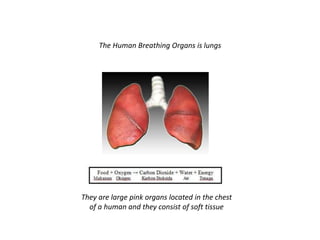
The Human Breathing Organs is lungs
They are large pink organs located in the chest
of a human and they consist of soft tissue
‘Breathing process also known as respiration.
All living things breathe all the time to stay
alive.
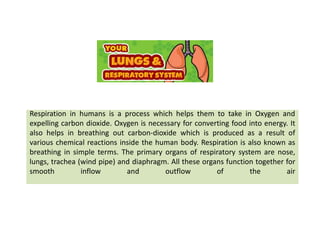
Respiration in humans is a process which helps them to take in Oxygen and
expelling carbon dioxide. Oxygen is necessary for converting food into energy. It
also helps in breathing out carbon-dioxide which is produced as a result of
various chemical reactions inside the human body. Respiration is also known as
breathing in simple terms. The primary organs of respiratory system are nose,
lungs, trachea (wind pipe) and diaphragm. All these organs function together for
smooth inflow and outflow of the air
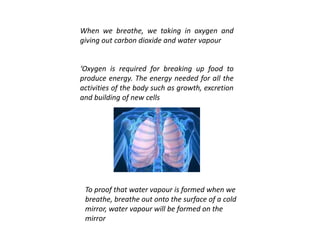
When we breathe, we taking in oxygen and
giving out carbon dioxide and water vapour
‘Oxygen is required for breaking up food to
produce energy. The energy needed for all the
activities of the body such as growth, excretion
and building of new cells
To proof that water vapour is formed when we
breathe, breathe out onto the surface of a cold
mirror, water vapour will be formed on the
mirror
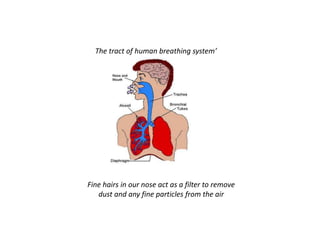
The tract of human breathing system’
Fine hairs in our nose act as a filter to remove
dust and any fine particles from the air
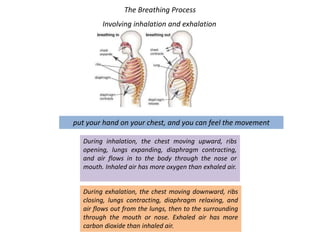
The Breathing Process
Involving inhalation and exhalation
put your hand on your chest, and you can feel the movement
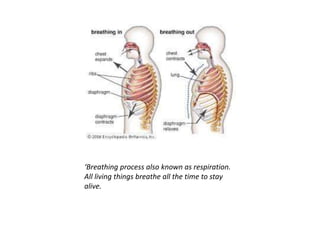
During inhalation, the chest moving upward, ribs
opening, lungs expanding, diaphragm contracting,
and air flows in to the body through the nose or
mouth. Inhaled air has more oxygen than exhaled air.
During exhalation, the chest moving downward, ribs
closing, lungs contracting, diaphragm relaxing, and
air flows out from the lungs, then to the surrounding
through the mouth or nose. Exhaled air has more
carbon dioxide than inhaled air.
The rate of breathing is the number of chest
movements in a period of time.
Different people have different rates of
breathing. This depends on their gender or
energy requirement such as a person needs
more energy if the body is active, so that their
rates of breathing increasing.
Rate of Breathing

Breathing process

  • 2.
    The Human BreathingOrgans is lungs They are large pink organs located in the chest of a human and they consist of soft tissue
  • 3.
    ‘Breathing process alsoknown as respiration. All living things breathe all the time to stay alive.
  • 4.
    Respiration in humansis a process which helps them to take in Oxygen and expelling carbon dioxide. Oxygen is necessary for converting food into energy. It also helps in breathing out carbon-dioxide which is produced as a result of various chemical reactions inside the human body. Respiration is also known as breathing in simple terms. The primary organs of respiratory system are nose, lungs, trachea (wind pipe) and diaphragm. All these organs function together for smooth inflow and outflow of the air
  • 5.
    When we breathe,we taking in oxygen and giving out carbon dioxide and water vapour ‘Oxygen is required for breaking up food to produce energy. The energy needed for all the activities of the body such as growth, excretion and building of new cells To proof that water vapour is formed when we breathe, breathe out onto the surface of a cold mirror, water vapour will be formed on the mirror
  • 6.
    The tract ofhuman breathing system’ Fine hairs in our nose act as a filter to remove dust and any fine particles from the air
  • 7.
    The Breathing Process Involvinginhalation and exhalation put your hand on your chest, and you can feel the movement During inhalation, the chest moving upward, ribs opening, lungs expanding, diaphragm contracting, and air flows in to the body through the nose or mouth. Inhaled air has more oxygen than exhaled air. During exhalation, the chest moving downward, ribs closing, lungs contracting, diaphragm relaxing, and air flows out from the lungs, then to the surrounding through the mouth or nose. Exhaled air has more carbon dioxide than inhaled air.
  • 8.
    The rate ofbreathing is the number of chest movements in a period of time. Different people have different rates of breathing. This depends on their gender or energy requirement such as a person needs more energy if the body is active, so that their rates of breathing increasing. Rate of Breathing