St Cloud Mining Company
January 2013
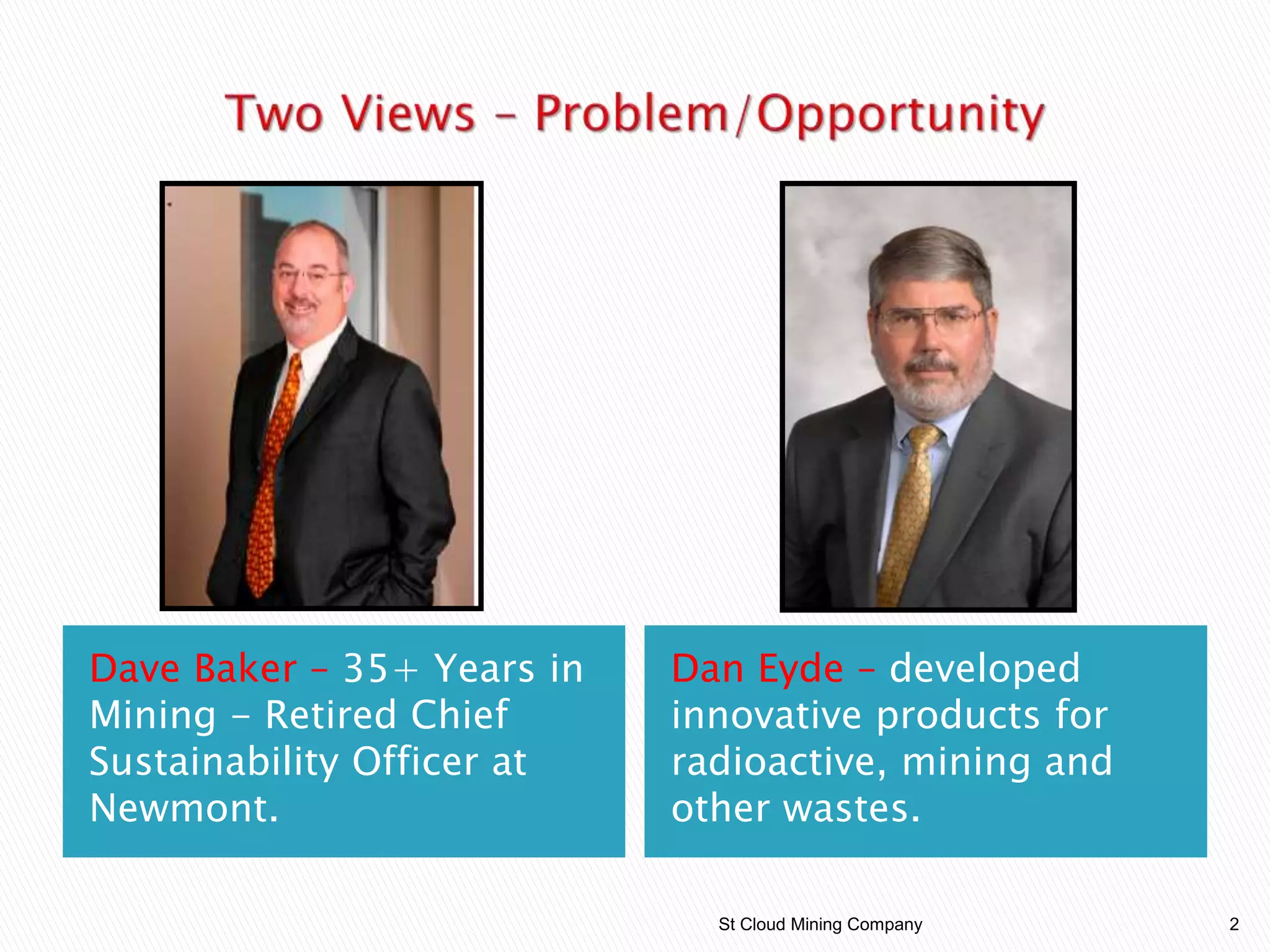
Dave Baker – 35+ Years in
Mining - Retired Chief
Sustainability Officer at
Newmont.
Dan Eyde – developed
innovative products for
radioactive, mining and
other wastes.
St Cloud Mining Company 2
St Cloud Mining Company 3
• Evaluating the potential financial threats to mining
companies who do not adequately account for
post-closure site water management
• Assessing the significant impact of poorly managed
legacy mine sites on local environments, water
tables and communities
• Tackling the actual source controls to minimize
contamination and reduce the amount of water left
to actually treat
St Cloud Mining Company 4
Closure Good Practice
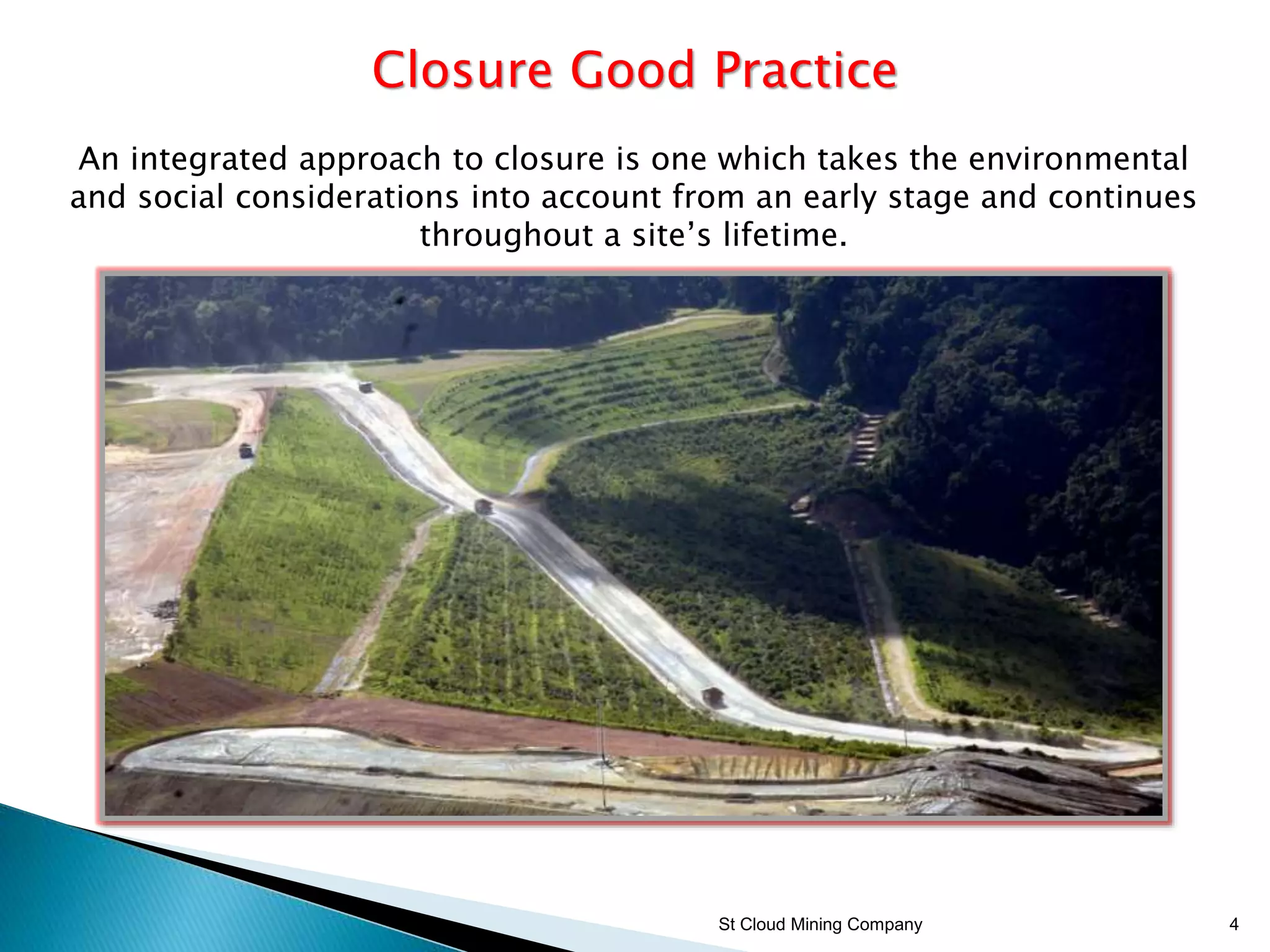
An integrated approach to closure is one which takes the environmental
and social considerations into account from an early stage and continues
throughout a site’s lifetime.
St Cloud Mining Company 5
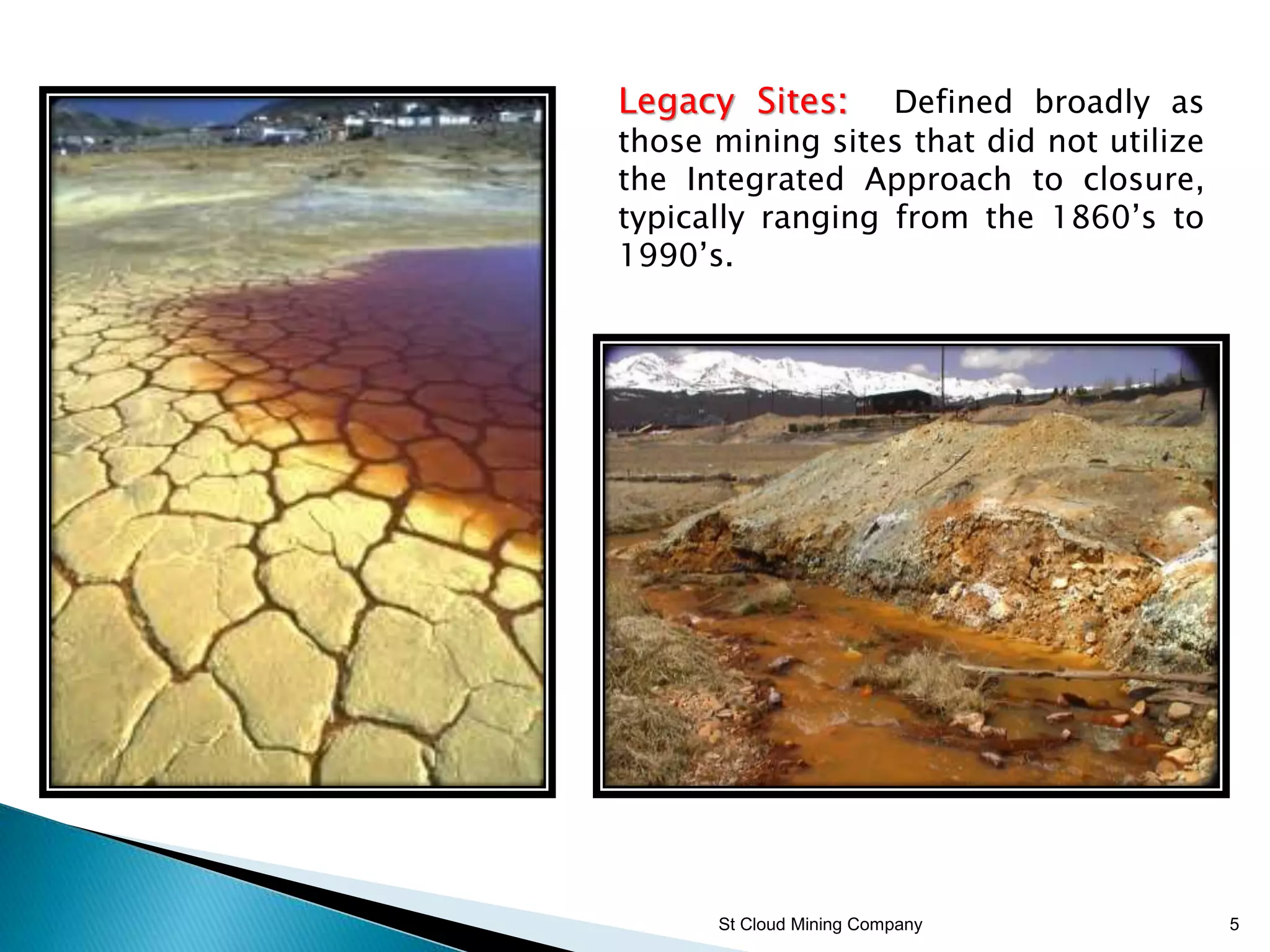
Legacy Sites: Defined broadly as
those mining sites that did not utilize
the Integrated Approach to closure,
typically ranging from the 1860’s to
1990’s.
St Cloud Mining Company 6
Mining Legacy Sites Present a Complicated
Calculus
The Variables:
 Technical Challenges
 Liability
 Litigation
 Community Perspective(s)
 Political Perspective(s)
 Reputation
 Water Management
 Limited or Difficult Technical Solutions and Options
 Timeframe
 Cost
St Cloud Mining Company 7
The Financial Threat to a Company
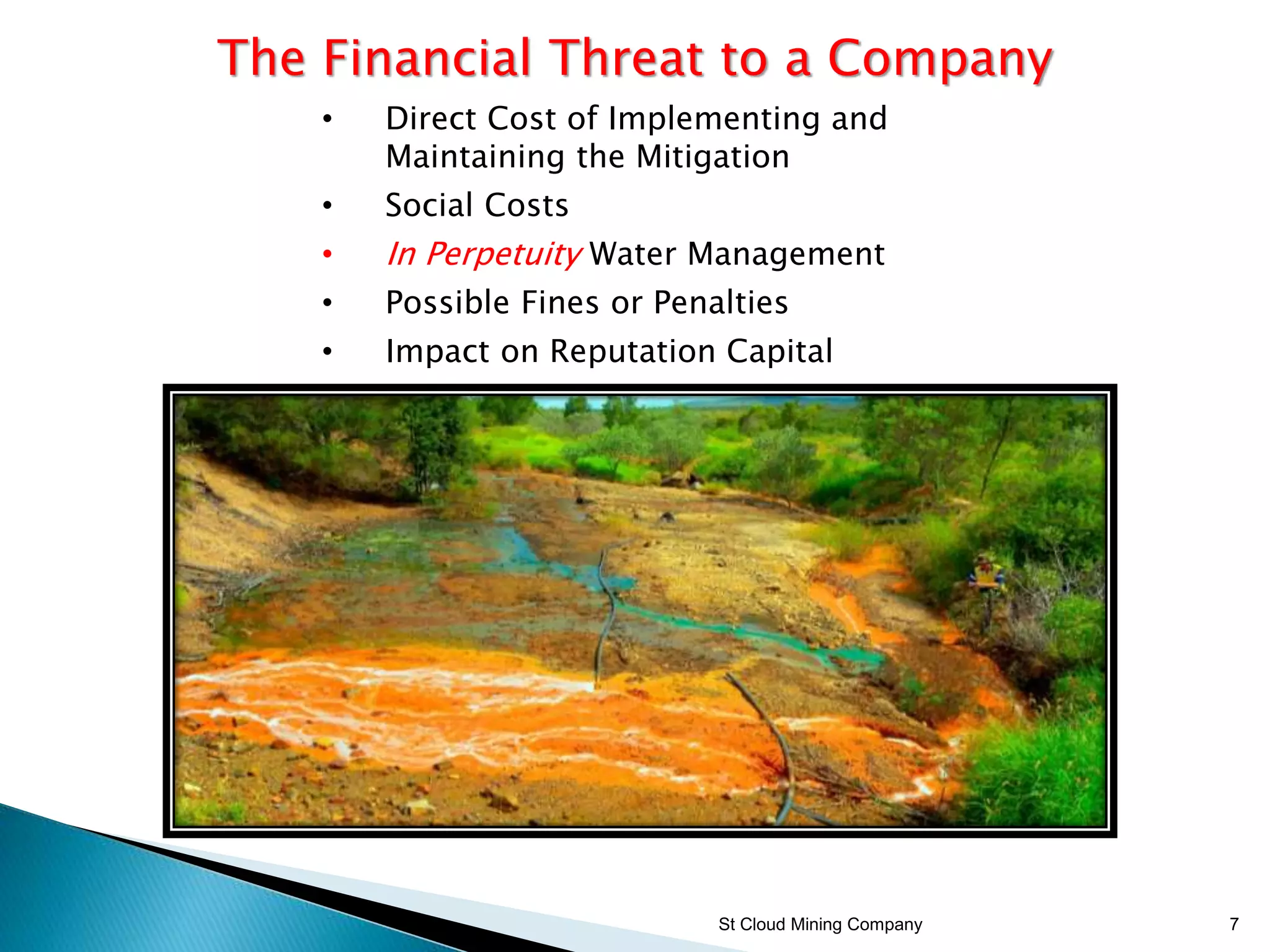
• Direct Cost of Implementing and
Maintaining the Mitigation
• Social Costs
• In Perpetuity Water Management
• Possible Fines or Penalties
• Impact on Reputation Capital
St Cloud Mining Company 8
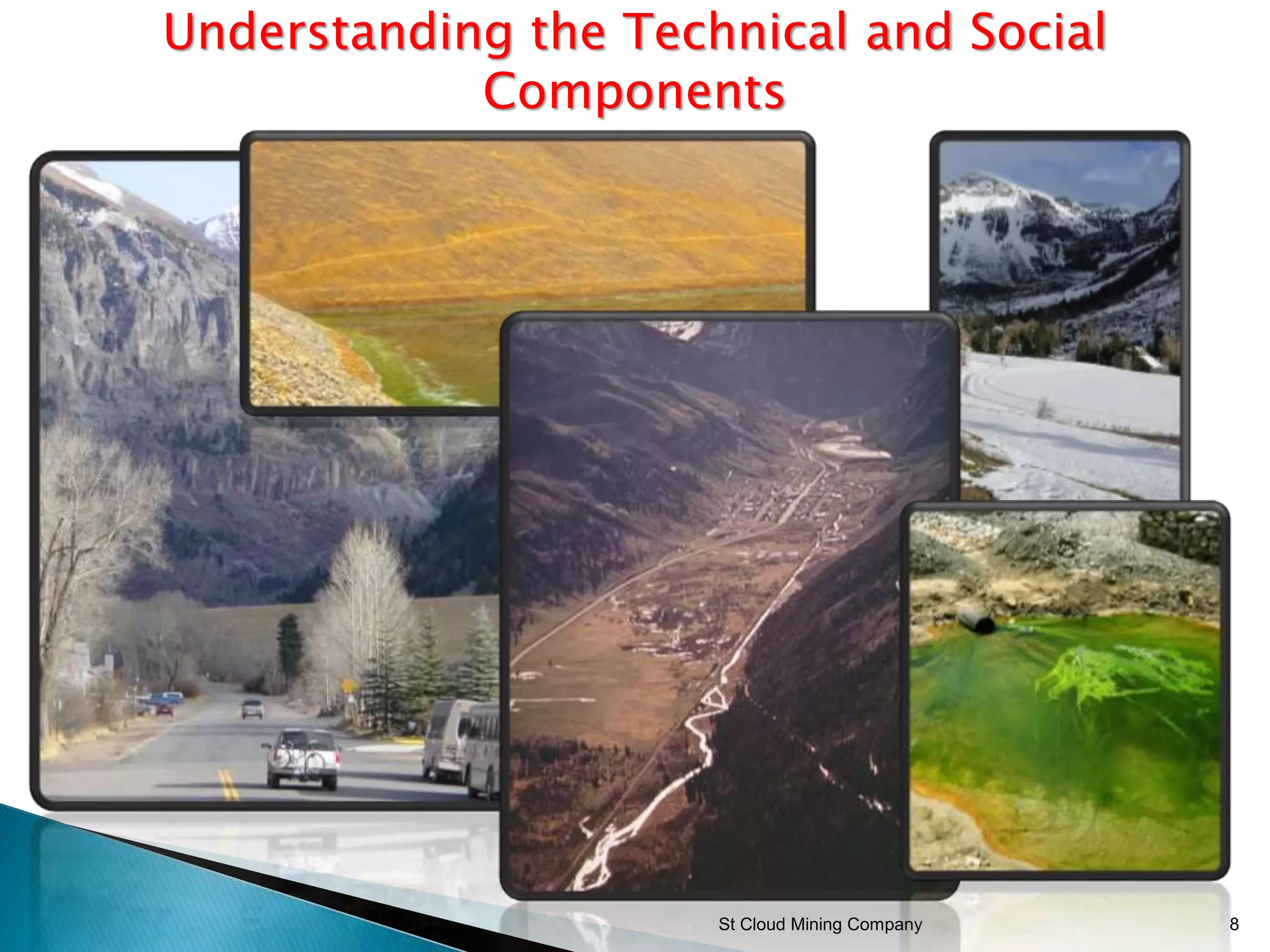
Understanding the Technical and Social
Components
St Cloud Mining Company 9
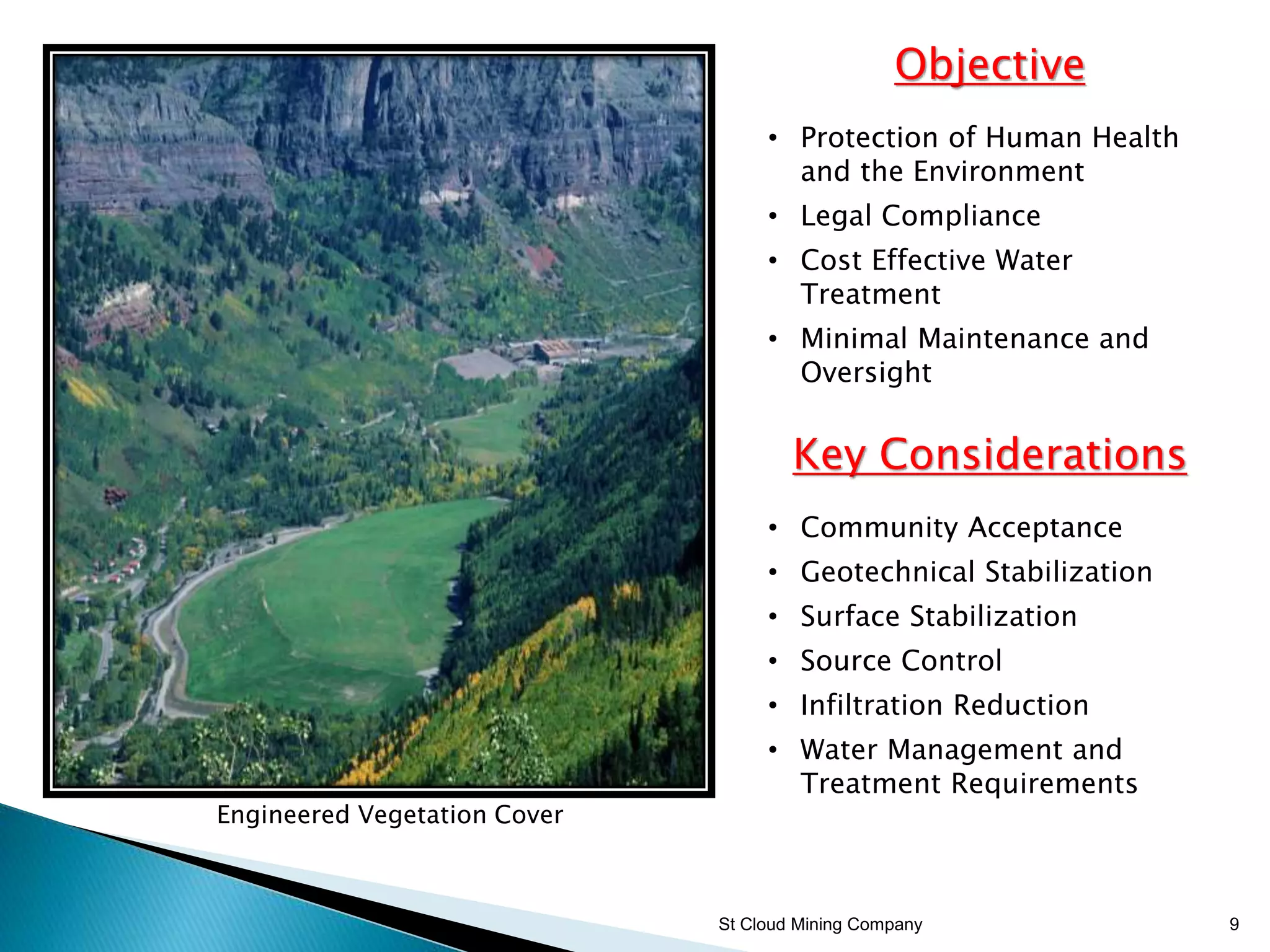
Objective
• Protection of Human Health
and the Environment
• Legal Compliance
• Cost Effective Water
Treatment
• Minimal Maintenance and
Oversight
Key Considerations
• Community Acceptance
• Geotechnical Stabilization
• Surface Stabilization
• Source Control
• Infiltration Reduction
• Water Management and
Treatment Requirements
Engineered Vegetation Cover
St Cloud Mining Company 10
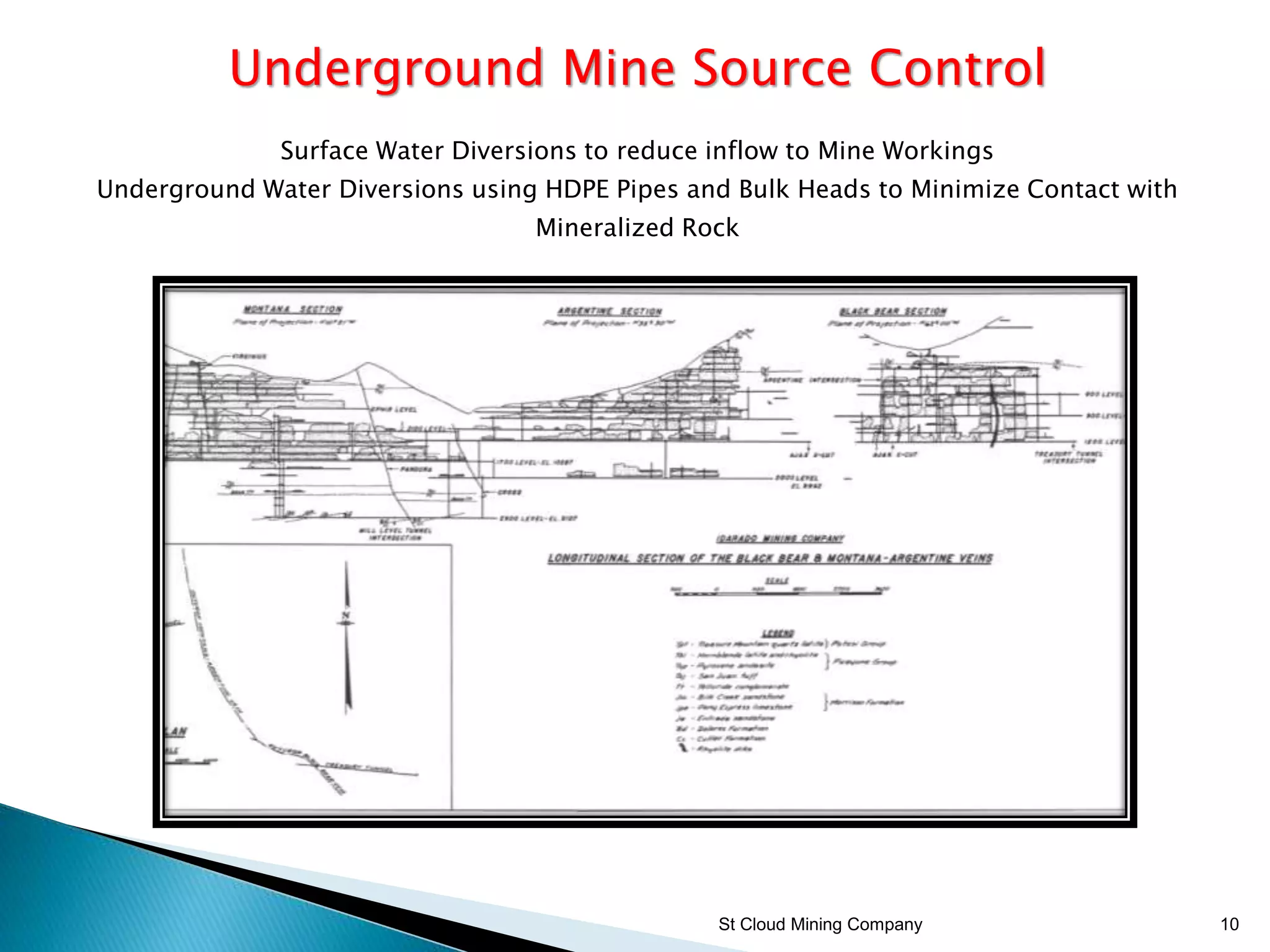
Underground Mine Source Control
Surface Water Diversions to reduce inflow to Mine Workings
Underground Water Diversions using HDPE Pipes and Bulk Heads to Minimize Contact with
Mineralized Rock
St Cloud Mining Company 11
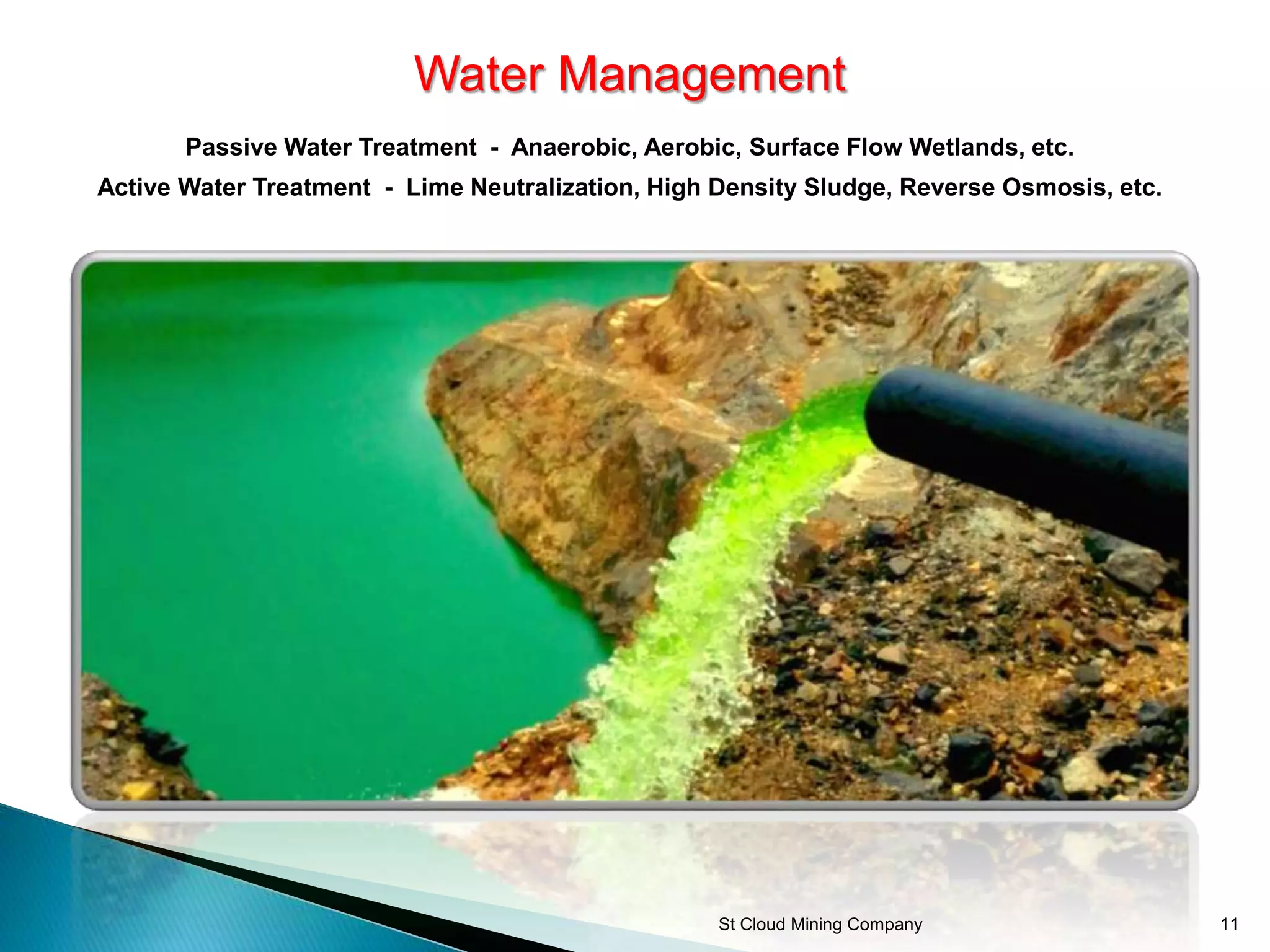
Water Management
Passive Water Treatment - Anaerobic, Aerobic, Surface Flow Wetlands, etc.
Active Water Treatment - Lime Neutralization, High Density Sludge, Reverse Osmosis, etc.
• Investigation of the range of treatments for legacy
mines including active mechanical treatments
• Appraising the use of passive and semi-passive
water treatments against standard lime treatment
plans – i.e. sulphate reducing bio reactors and in
situ treatment using bio agents – what are the
latest results showing?
St Cloud Mining Company 12
St Cloud Mining Company 13
 NPDES Program requirements now include specific contaminant
limits based on the receiving water in-stream water quality criteria.
◦ Recent initiatives are directed toward ensuring pollution
discharge levels are met on a watershed basis.
 This means that Federal, State and Tribal derived limits for some
constituents can be, and many times are, specified lower than
typical drinking water standards.
◦ Extreme examples are trace level requirements for arsenic,
radium and selenium below the allowable drinking water
concentrations for these metals.
St Cloud Mining Company 14
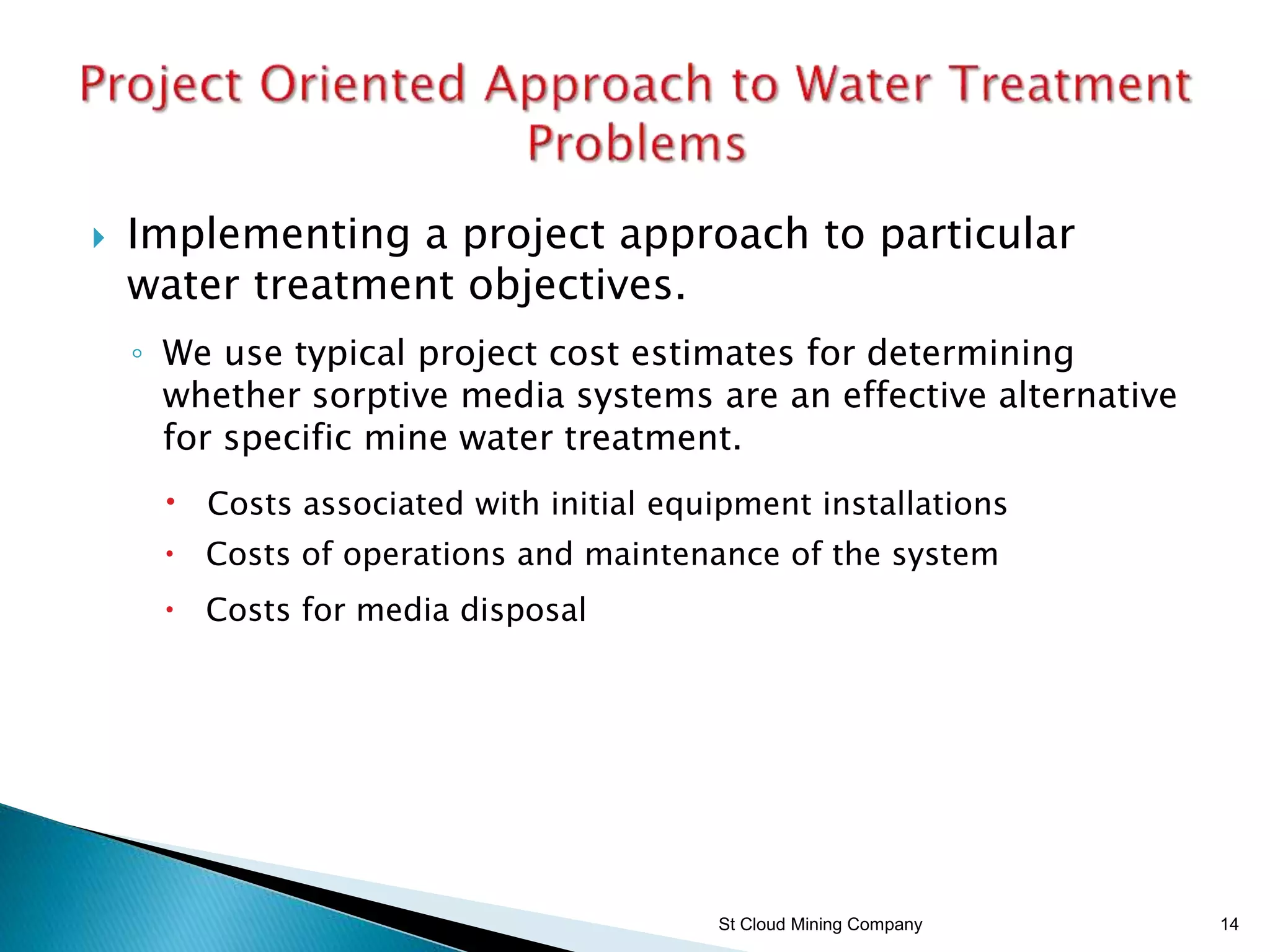
 Implementing a project approach to particular
water treatment objectives.
◦ We use typical project cost estimates for determining
whether sorptive media systems are an effective alternative
for specific mine water treatment.
 Costs associated with initial equipment installations
 Costs of operations and maintenance of the system
 Costs for media disposal
St Cloud Mining Company 15
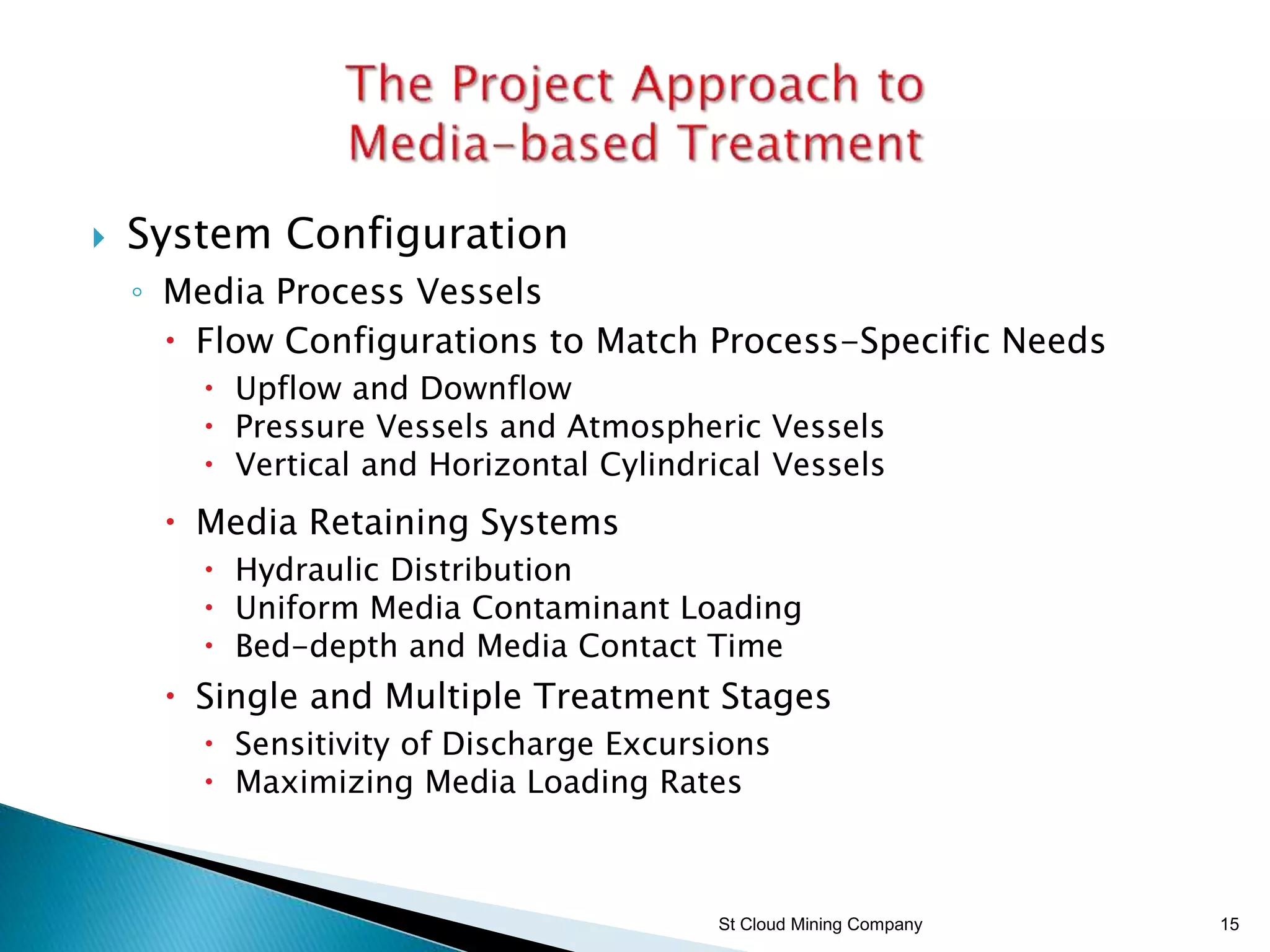
 System Configuration
◦ Media Process Vessels
 Flow Configurations to Match Process-Specific Needs
 Upflow and Downflow
 Pressure Vessels and Atmospheric Vessels
 Vertical and Horizontal Cylindrical Vessels
 Media Retaining Systems
 Hydraulic Distribution
 Uniform Media Contaminant Loading
 Bed-depth and Media Contact Time
 Single and Multiple Treatment Stages
 Sensitivity of Discharge Excursions
 Maximizing Media Loading Rates
St Cloud Mining Company 16
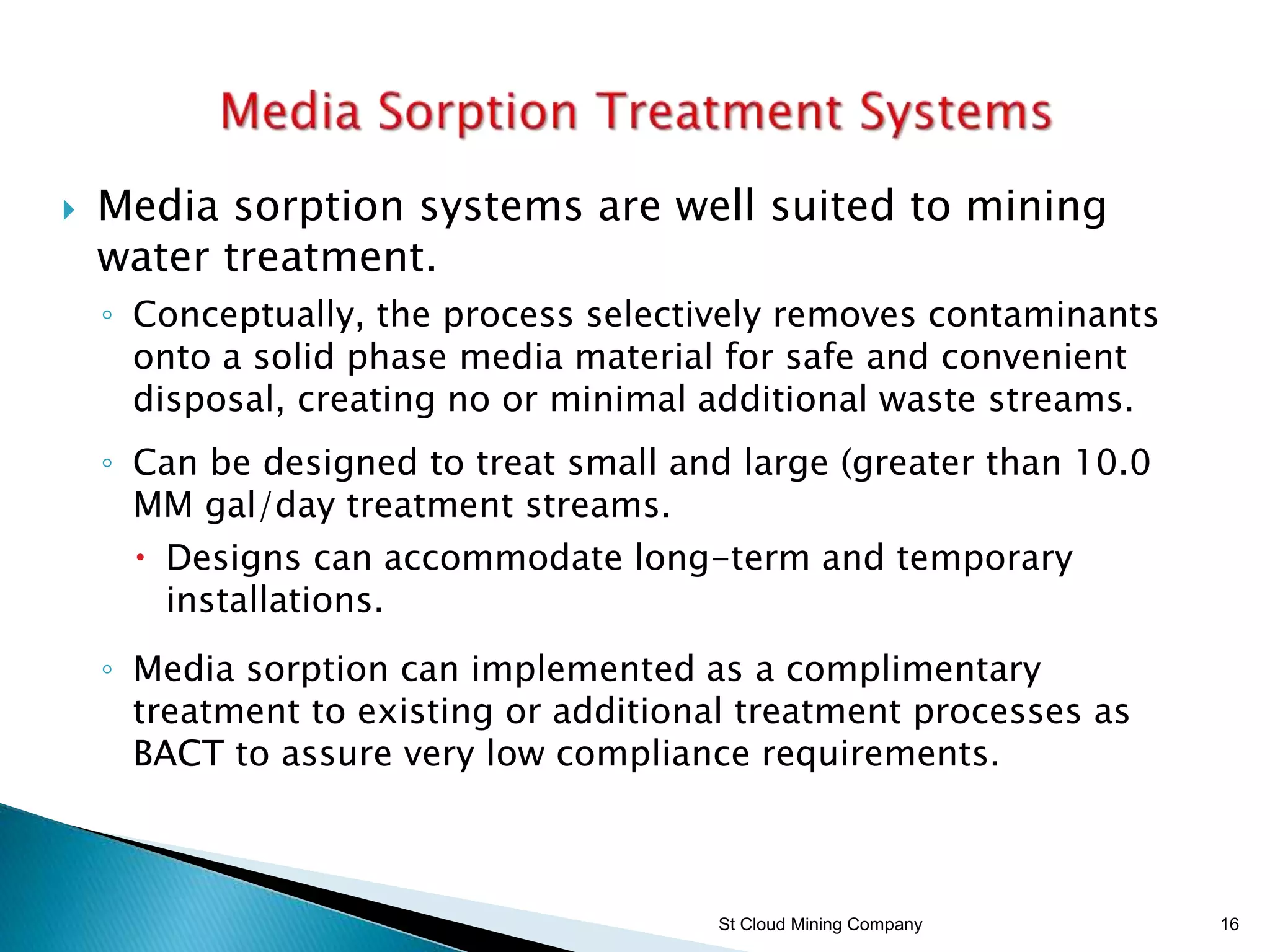
 Media sorption systems are well suited to mining
water treatment.
◦ Conceptually, the process selectively removes contaminants
onto a solid phase media material for safe and convenient
disposal, creating no or minimal additional waste streams.
◦ Can be designed to treat small and large (greater than 10.0
MM gal/day treatment streams.
 Designs can accommodate long-term and temporary
installations.
◦ Media sorption can implemented as a complimentary
treatment to existing or additional treatment processes as
BACT to assure very low compliance requirements.
St Cloud Mining Company 17
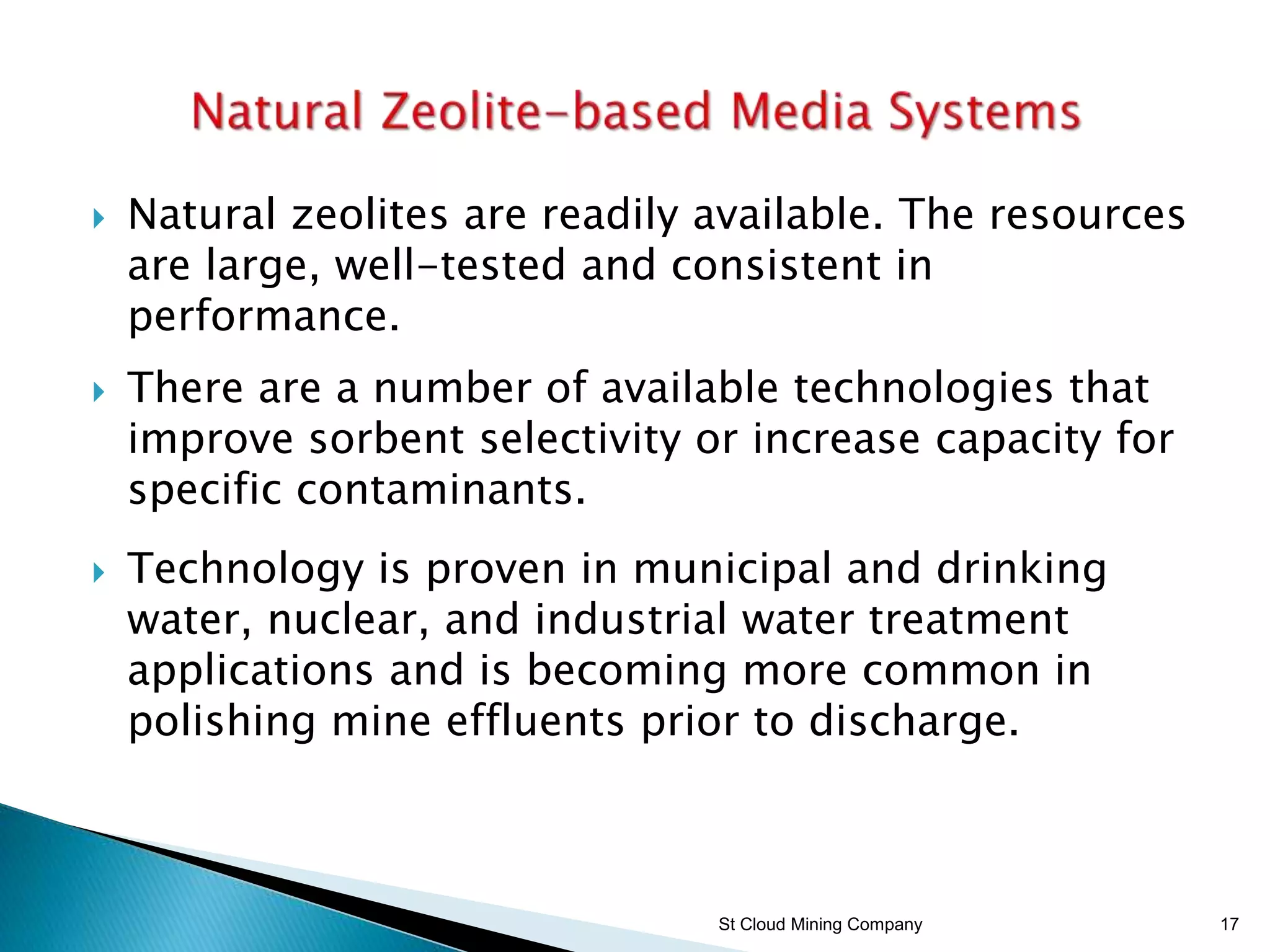
 Natural zeolites are readily available. The resources
are large, well-tested and consistent in
performance.
 There are a number of available technologies that
improve sorbent selectivity or increase capacity for
specific contaminants.
 Technology is proven in municipal and drinking
water, nuclear, and industrial water treatment
applications and is becoming more common in
polishing mine effluents prior to discharge.
St Cloud Mining Company 18
 Natural zeolite ion exchange properties are well
documented and studied.
◦ Cation exchange directly allows removal of lead, zinc,
cadmium and copper.
◦ Raw natural zeolites for once-through processing of waste
water is very cost effective compared to synthetic ion
exchange materials or other adsorbants where removal
performance is similar.
◦ Surface modified zeolites have shown effective removal of
oxy-anion metal complexes of selenium, manganese,
arsenic and chrome from waste streams.
◦ Natural zeolites are easily processed to facilitate their use
in water treatment systems.
St Cloud Mining Company 19
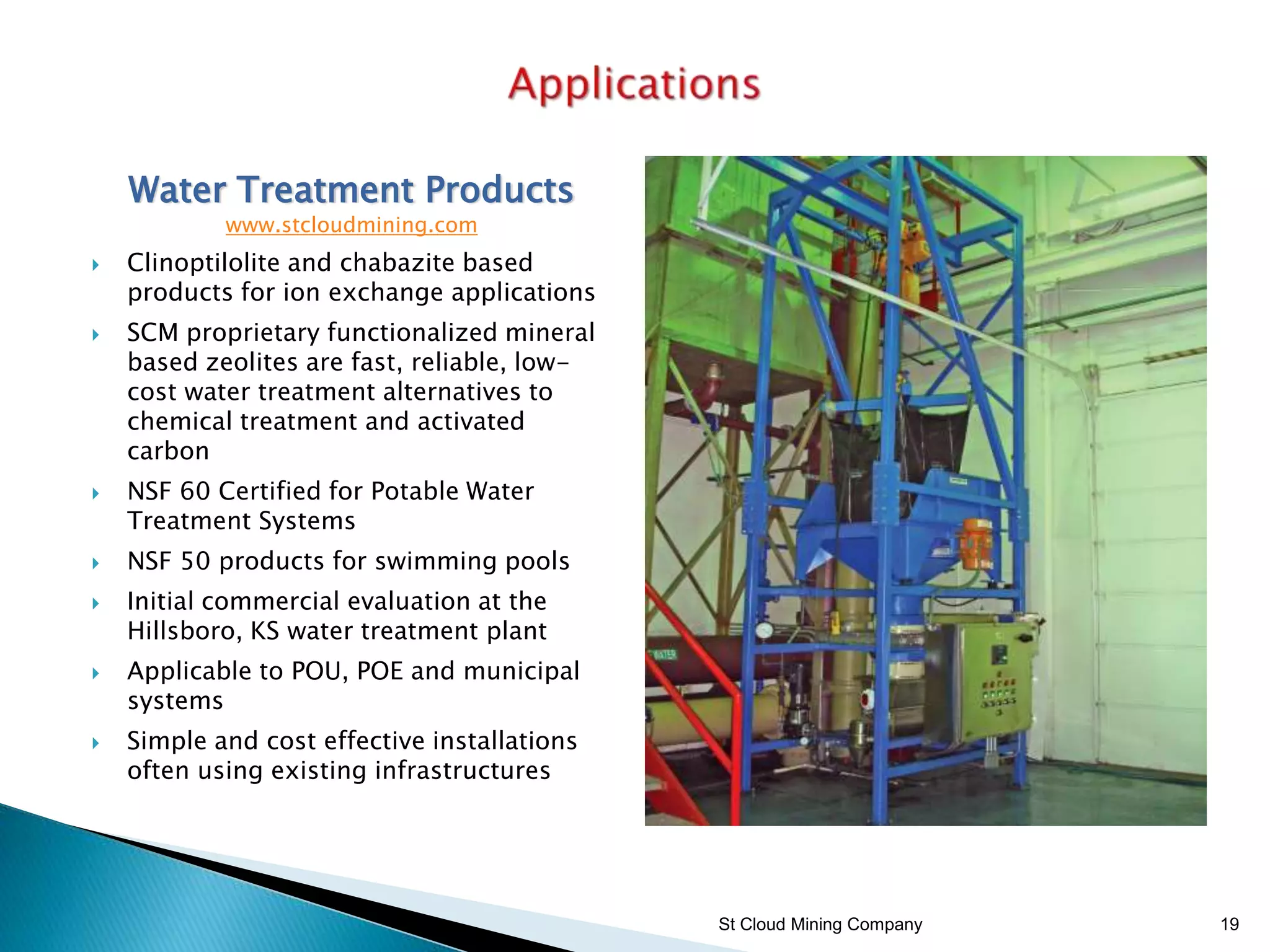
Water Treatment Products
www.stcloudmining.com
 Clinoptilolite and chabazite based
products for ion exchange applications
 SCM proprietary functionalized mineral
based zeolites are fast, reliable, low-
cost water treatment alternatives to
chemical treatment and activated
carbon
 NSF 60 Certified for Potable Water
Treatment Systems
 NSF 50 products for swimming pools
 Initial commercial evaluation at the
Hillsboro, KS water treatment plant
 Applicable to POU, POE and municipal
systems
 Simple and cost effective installations
often using existing infrastructures
St Cloud Mining Company 20
 Primary Targeted Contaminants Suitable for Media Sorption
◦ Metals: Arsenic, Molybdenum, Lead, Mercury, Selenium,
Copper, Chromium, Cadmium, Thallium
◦ Radionuclides: Uranium, Radium, Gross Alpha-emitters
 Why
◦ Concentrations of these constituents in most waste waters
are low enough to provide reasonable service volumes
between media exchanges.
◦ Media sorption provides the best opportunity to reduce
effluent concentrations to extremely low trace levels. The
technologies were developed in the treatment of radioactive
wastes. The largest most recent application was the
Fukushima disaster in Japan.
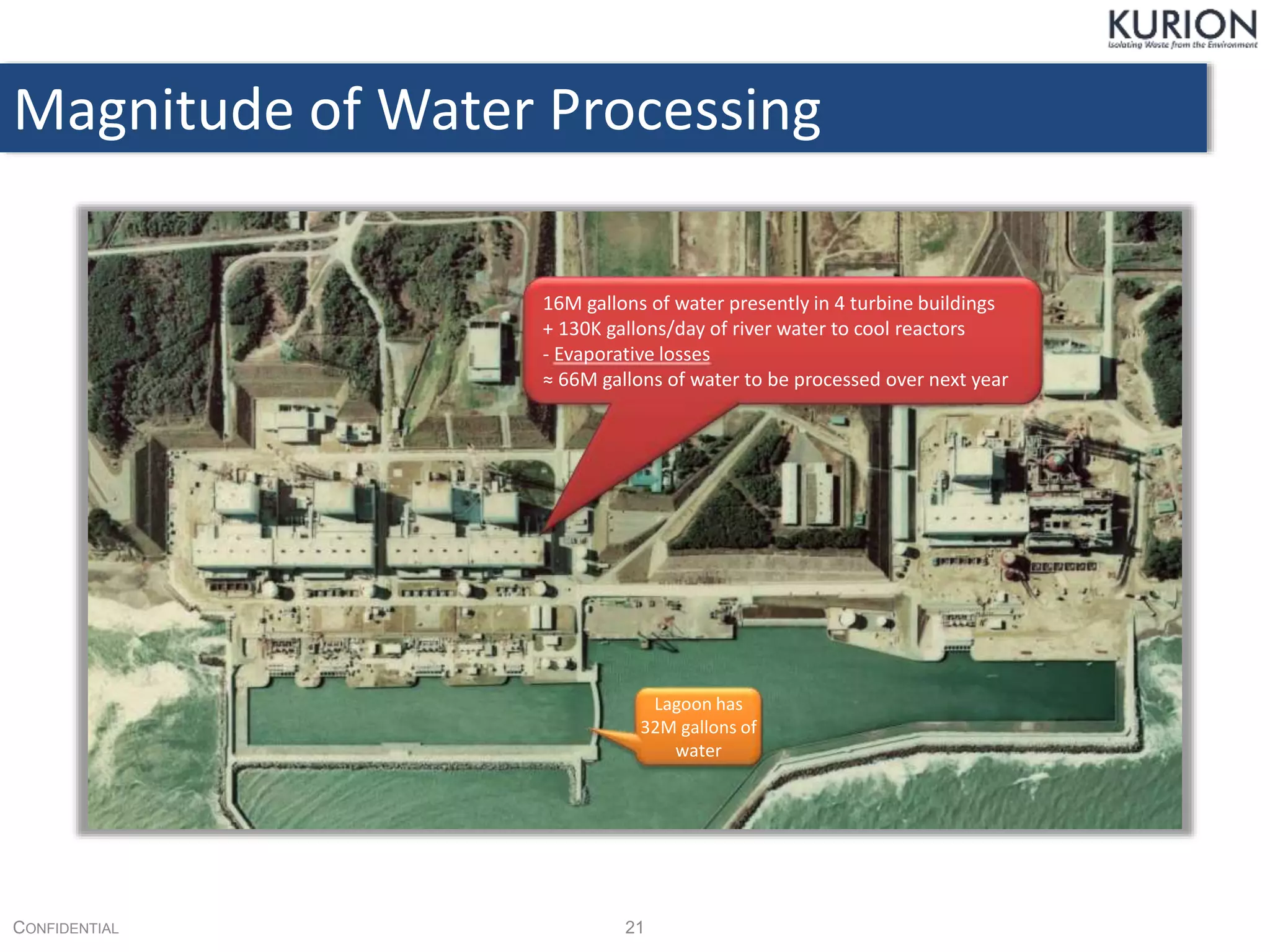
Magnitude of Water Processing
CONFIDENTIAL 21
Lagoon has
32M gallons of
water
16M gallons of water presently in 4 turbine buildings
+ 130K gallons/day of river water to cool reactors
- Evaporative losses
≈ 66M gallons of water to be processed over next year
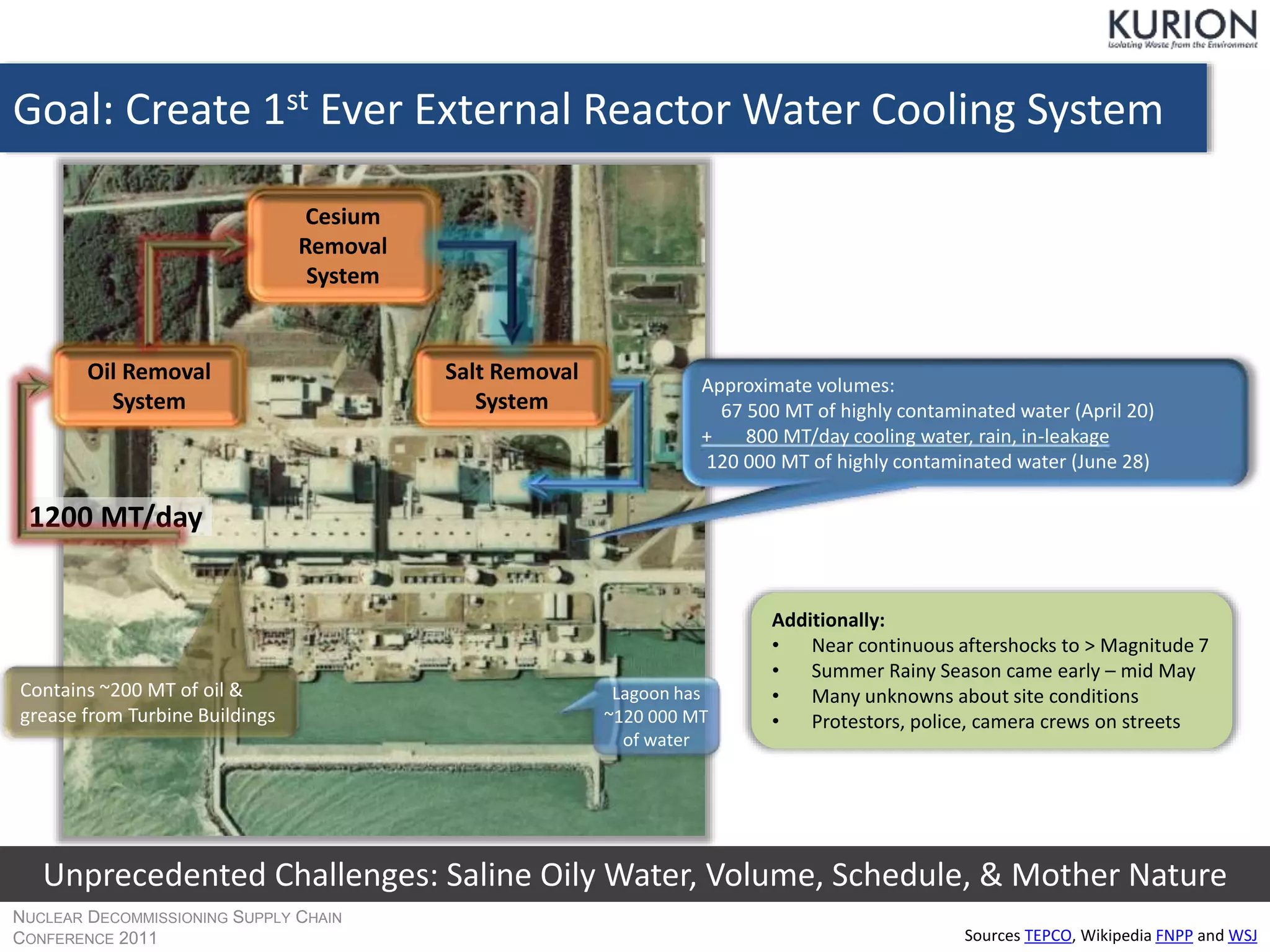
Goal: Create 1st Ever External Reactor Water Cooling System
NUCLEAR DECOMMISSIONING SUPPLY CHAIN
CONFERENCE 2011
Unprecedented Challenges: Saline Oily Water, Volume, Schedule, & Mother Nature
Approximate volumes:
67 500 MT of highly contaminated water (April 20)
+ 800 MT/day cooling water, rain, in-leakage
120 000 MT of highly contaminated water (June 28)
Additionally:
• Near continuous aftershocks to > Magnitude 7
• Summer Rainy Season came early – mid May
• Many unknowns about site conditions
• Protestors, police, camera crews on streets
Sources TEPCO, Wikipedia FNPP and WSJ
1200 MT/day
Cesium
Removal
System
Oil Removal
System
Salt Removal
System
Lagoon has
~120 000 MT
of water
Contains ~200 MT of oil &
grease from Turbine Buildings
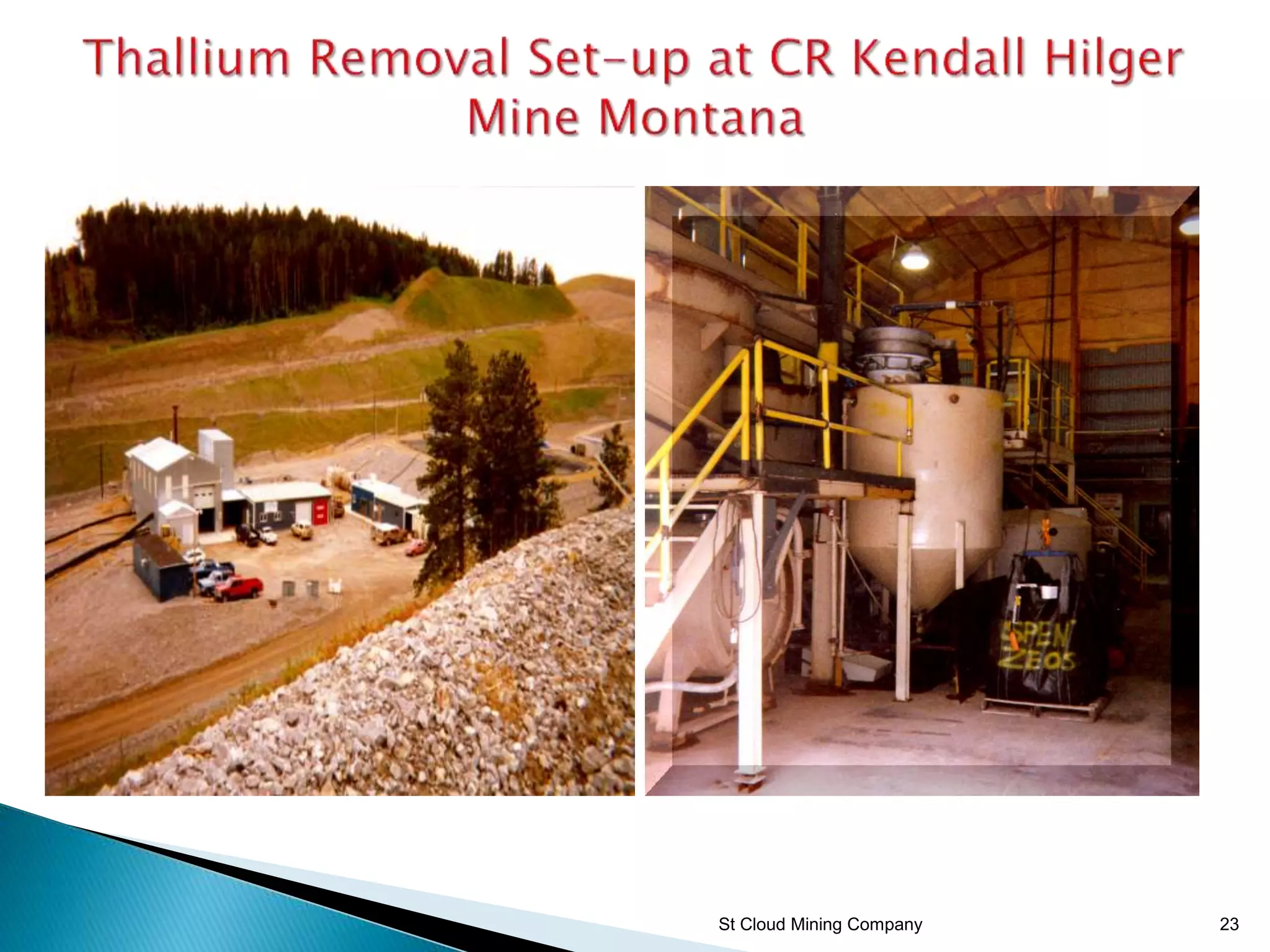
St Cloud Mining Company 23
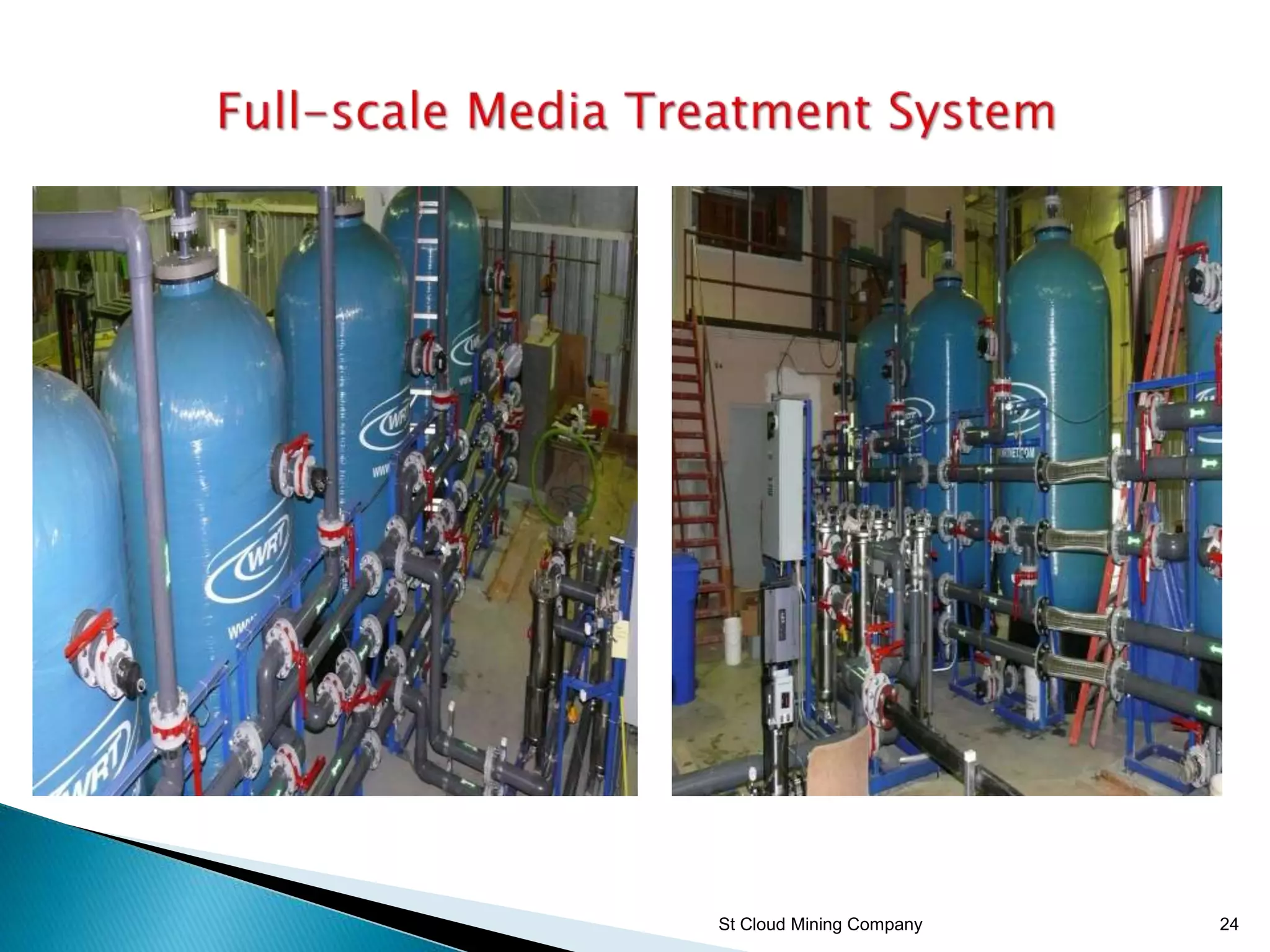
St Cloud Mining Company 24
Advantages
 Lower Cost
 Lower Maintenance
 Higher Volumes
 Generally fewer moving parts and well suited for
remote sites
Disadvantages
 Less Flexible
 Can have a larger footprint
St Cloud Mining Company 25
St Cloud Mining Company 26
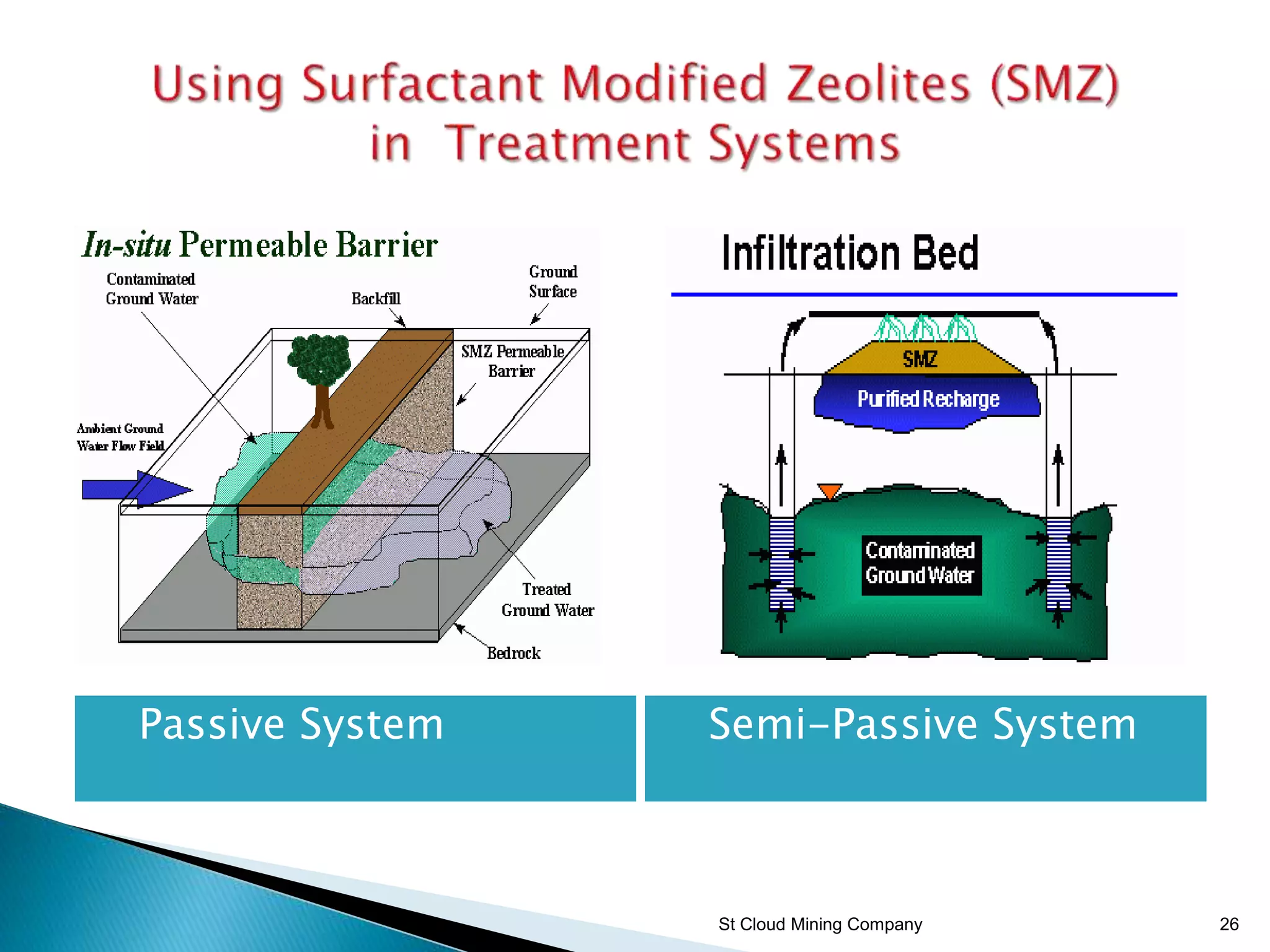
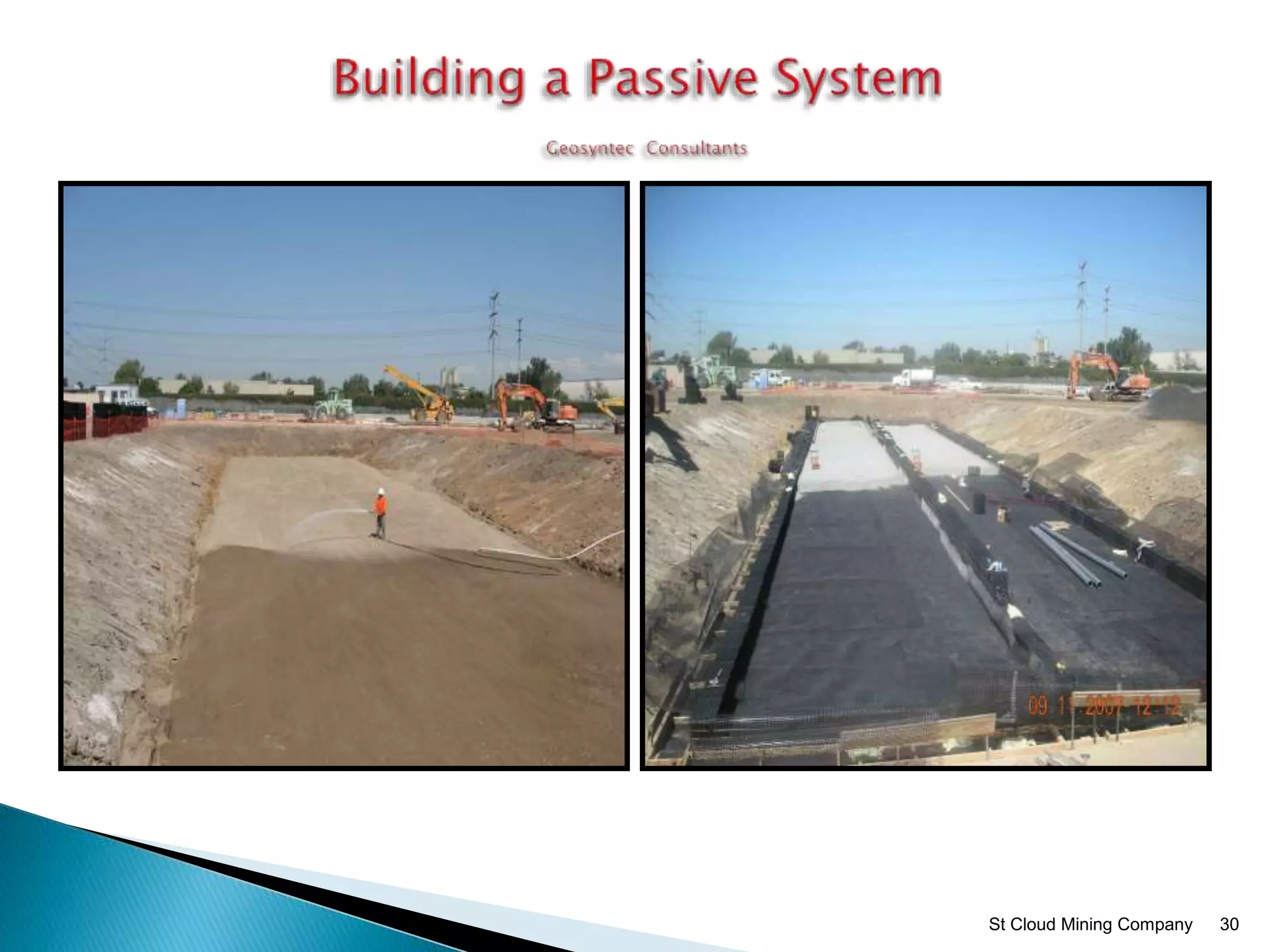
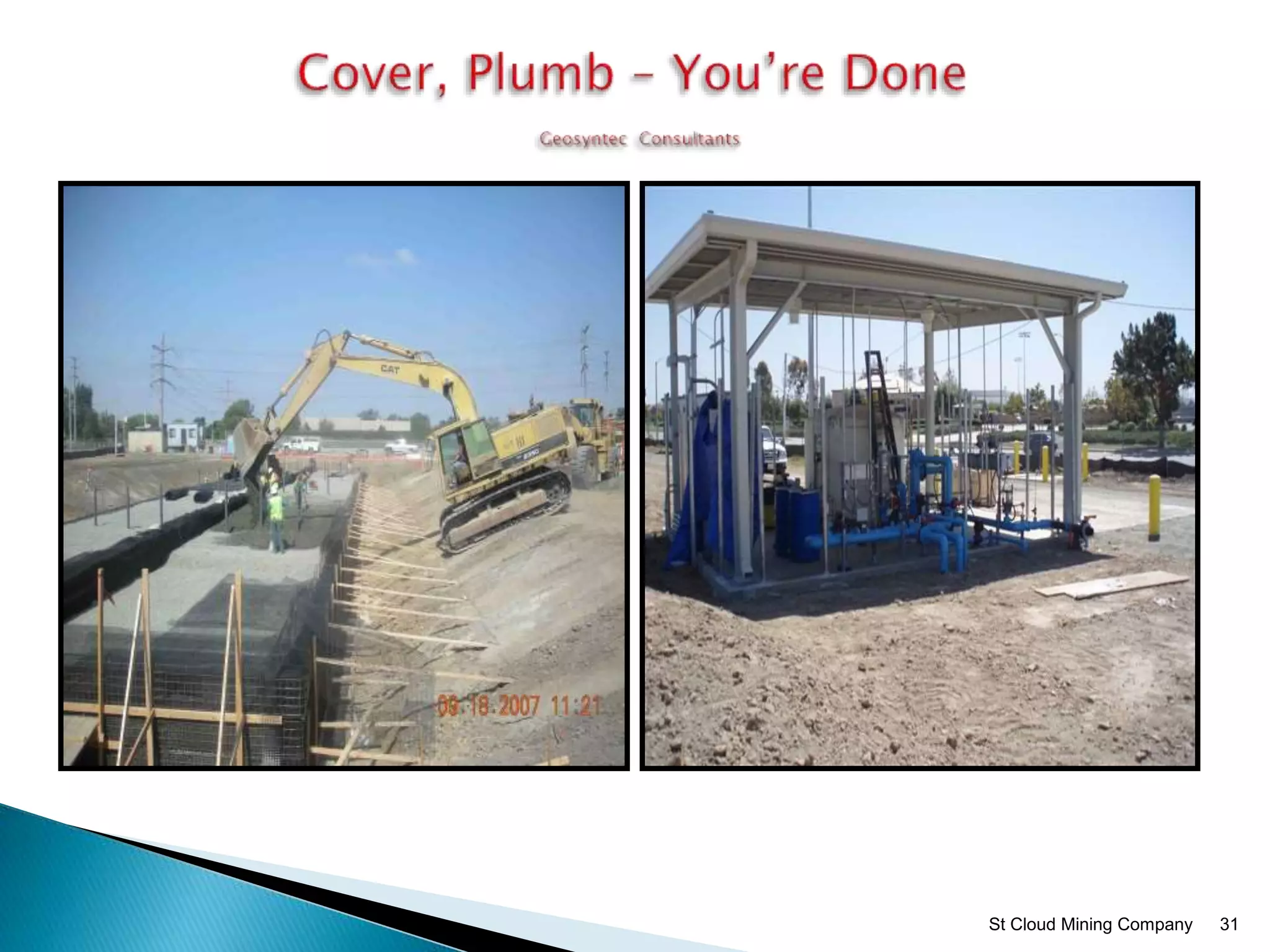
 Passive System  Semi-Passive System
St Cloud Mining Company 27
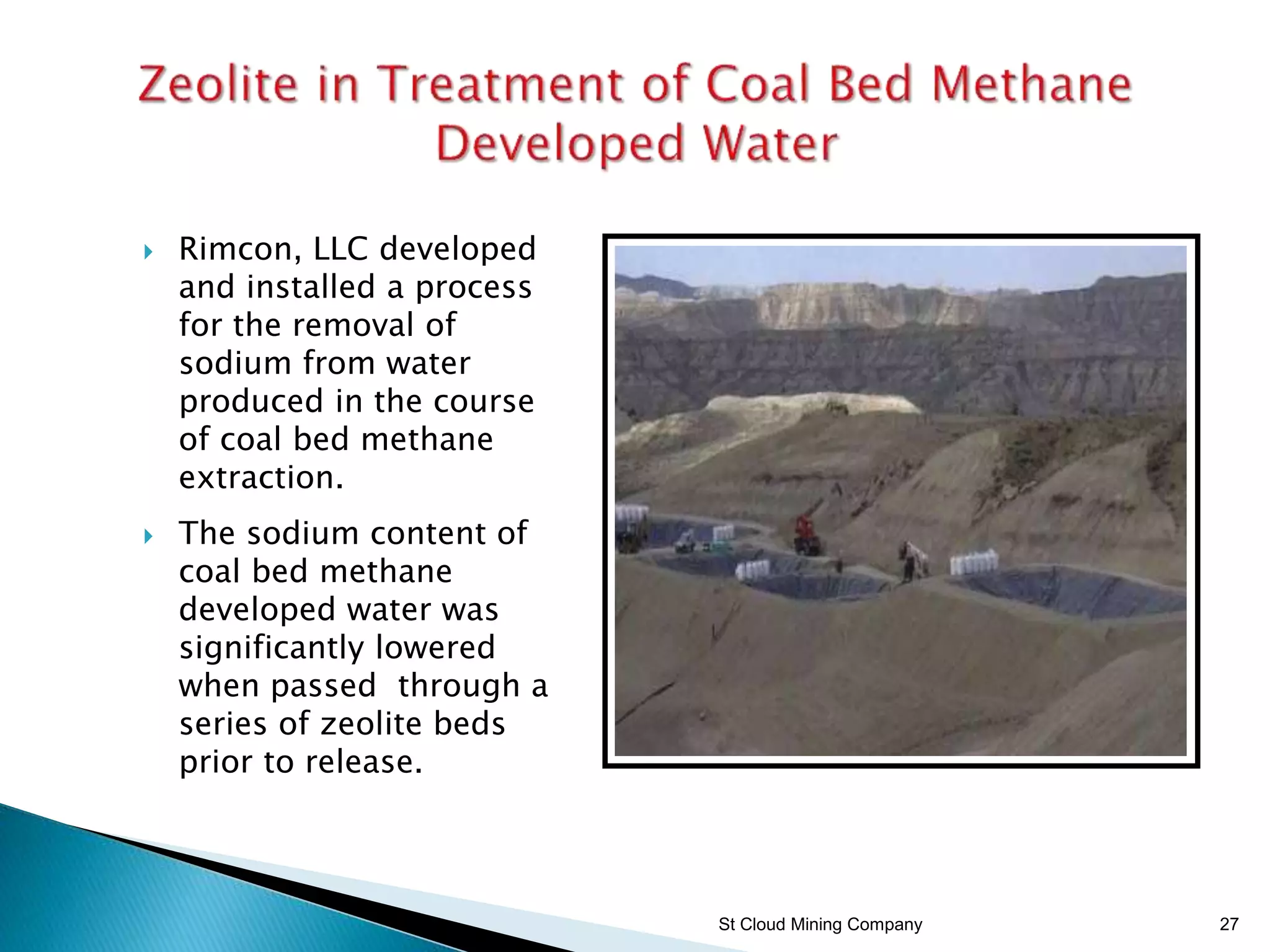
 Rimcon, LLC developed
and installed a process
for the removal of
sodium from water
produced in the course
of coal bed methane
extraction.
 The sodium content of
coal bed methane
developed water was
significantly lowered
when passed through a
series of zeolite beds
prior to release.
St Cloud Mining Company 28
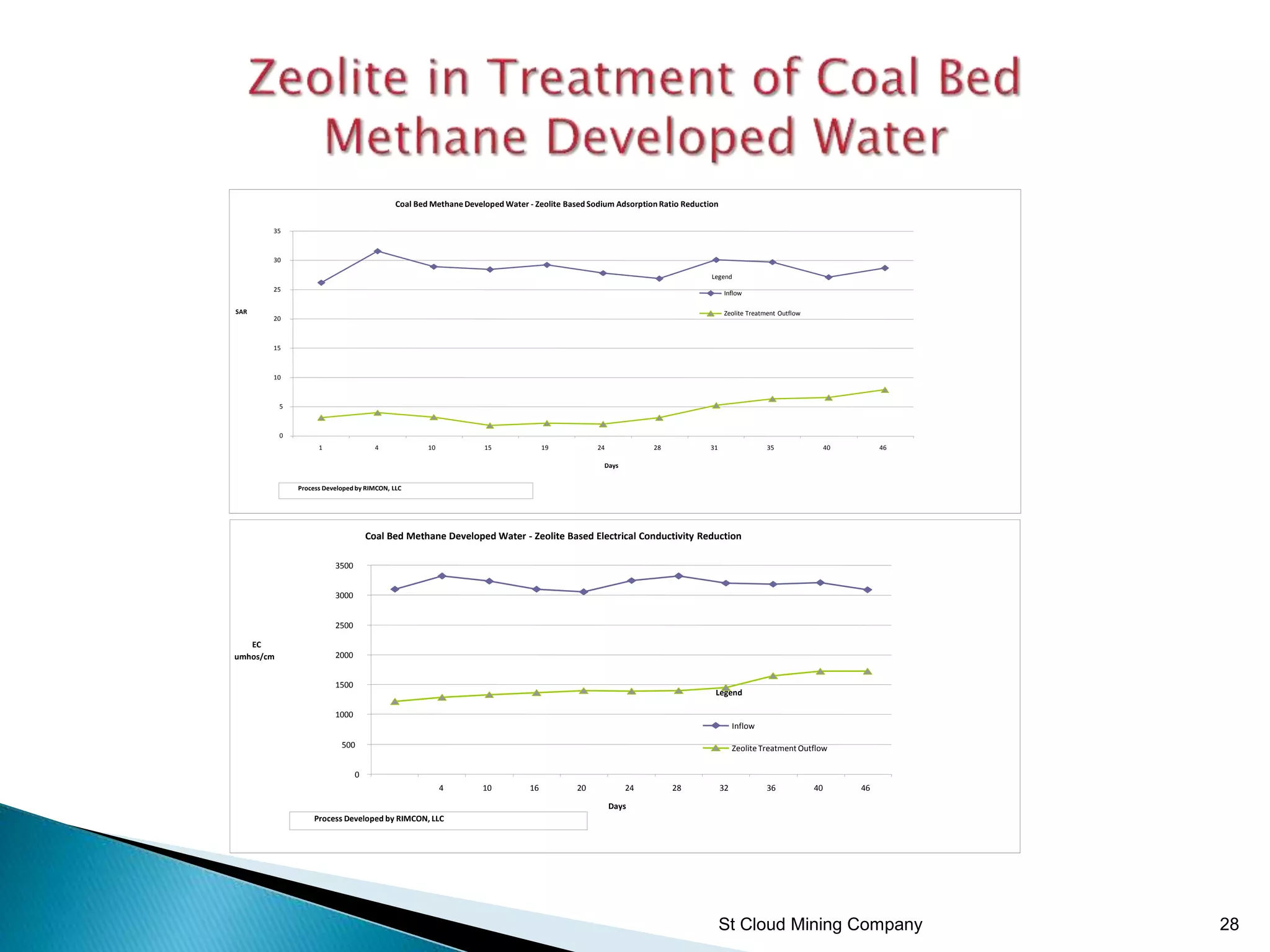
Coal Bed MethaneDeveloped Water - Zeolite Based Sodium Adsorption Ratio Reduction
0
5
10
15
20
25
30
35
1 4 10 15 19 24 28 31 35 40 46
Inflow
Zeolite Treatment Outflow
Legend
Days
SAR
Process Developed by RIMCON, LLC
Coal Bed Methane Developed Water - Zeolite Based Electrical Conductivity Reduction
0
500
1000
1500
2000
2500
3000
3500
4 10 16 20 24 28 32 36 40 46
Inflow
Zeolite TreatmentOutflow
Legend
Days
EC
umhos/cm
Process Developed by RIMCON, LLC
St Cloud Mining Company 29
30St Cloud Mining Company
31St Cloud Mining Company
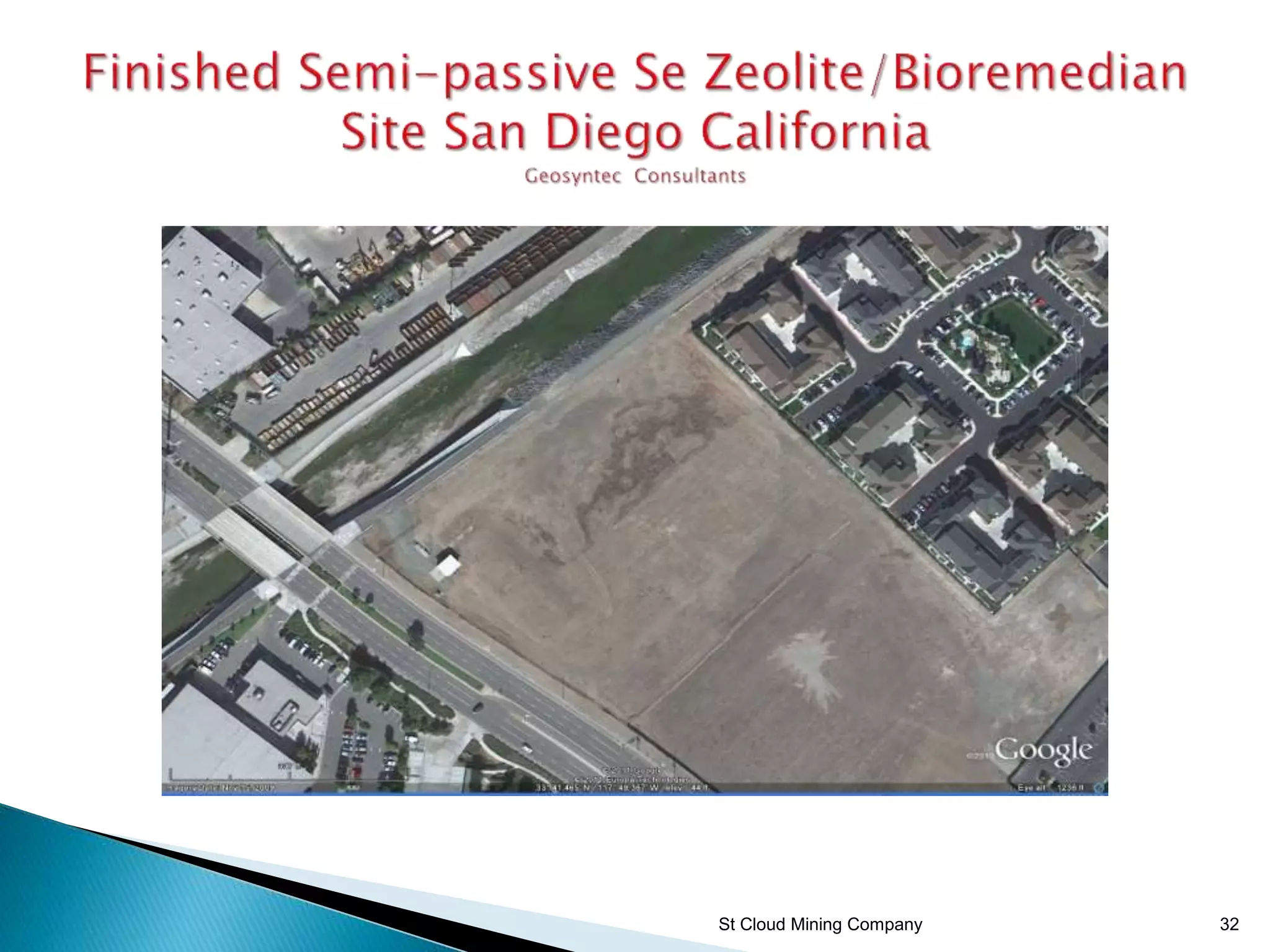
St Cloud Mining Company 32
Contact Information:
Dan Eyde St Cloud Mining Company
1401 W Glenn
Tucson, AZ 85705
Office: 520.744.6667
deyde@stcloudmining.com
Dave Baker PO Box 103040
Denver, CO
St Cloud Mining Company 33

Breaking down the best practices for the planning and operation of legacy sites v12 chg11

  • 1.
    St Cloud MiningCompany January 2013
  • 2.
    Dave Baker –35+ Years in Mining - Retired Chief Sustainability Officer at Newmont. Dan Eyde – developed innovative products for radioactive, mining and other wastes. St Cloud Mining Company 2
  • 3.
    St Cloud MiningCompany 3 • Evaluating the potential financial threats to mining companies who do not adequately account for post-closure site water management • Assessing the significant impact of poorly managed legacy mine sites on local environments, water tables and communities • Tackling the actual source controls to minimize contamination and reduce the amount of water left to actually treat
  • 4.
    St Cloud MiningCompany 4 Closure Good Practice An integrated approach to closure is one which takes the environmental and social considerations into account from an early stage and continues throughout a site’s lifetime.
  • 5.
    St Cloud MiningCompany 5 Legacy Sites: Defined broadly as those mining sites that did not utilize the Integrated Approach to closure, typically ranging from the 1860’s to 1990’s.
  • 6.
    St Cloud MiningCompany 6 Mining Legacy Sites Present a Complicated Calculus The Variables:  Technical Challenges  Liability  Litigation  Community Perspective(s)  Political Perspective(s)  Reputation  Water Management  Limited or Difficult Technical Solutions and Options  Timeframe  Cost
  • 7.
    St Cloud MiningCompany 7 The Financial Threat to a Company • Direct Cost of Implementing and Maintaining the Mitigation • Social Costs • In Perpetuity Water Management • Possible Fines or Penalties • Impact on Reputation Capital
  • 8.
    St Cloud MiningCompany 8 Understanding the Technical and Social Components
  • 9.
    St Cloud MiningCompany 9 Objective • Protection of Human Health and the Environment • Legal Compliance • Cost Effective Water Treatment • Minimal Maintenance and Oversight Key Considerations • Community Acceptance • Geotechnical Stabilization • Surface Stabilization • Source Control • Infiltration Reduction • Water Management and Treatment Requirements Engineered Vegetation Cover
  • 10.
    St Cloud MiningCompany 10 Underground Mine Source Control Surface Water Diversions to reduce inflow to Mine Workings Underground Water Diversions using HDPE Pipes and Bulk Heads to Minimize Contact with Mineralized Rock
  • 11.
    St Cloud MiningCompany 11 Water Management Passive Water Treatment - Anaerobic, Aerobic, Surface Flow Wetlands, etc. Active Water Treatment - Lime Neutralization, High Density Sludge, Reverse Osmosis, etc.
  • 12.
    • Investigation ofthe range of treatments for legacy mines including active mechanical treatments • Appraising the use of passive and semi-passive water treatments against standard lime treatment plans – i.e. sulphate reducing bio reactors and in situ treatment using bio agents – what are the latest results showing? St Cloud Mining Company 12
  • 13.
    St Cloud MiningCompany 13  NPDES Program requirements now include specific contaminant limits based on the receiving water in-stream water quality criteria. ◦ Recent initiatives are directed toward ensuring pollution discharge levels are met on a watershed basis.  This means that Federal, State and Tribal derived limits for some constituents can be, and many times are, specified lower than typical drinking water standards. ◦ Extreme examples are trace level requirements for arsenic, radium and selenium below the allowable drinking water concentrations for these metals.
  • 14.
    St Cloud MiningCompany 14  Implementing a project approach to particular water treatment objectives. ◦ We use typical project cost estimates for determining whether sorptive media systems are an effective alternative for specific mine water treatment.  Costs associated with initial equipment installations  Costs of operations and maintenance of the system  Costs for media disposal
  • 15.
    St Cloud MiningCompany 15  System Configuration ◦ Media Process Vessels  Flow Configurations to Match Process-Specific Needs  Upflow and Downflow  Pressure Vessels and Atmospheric Vessels  Vertical and Horizontal Cylindrical Vessels  Media Retaining Systems  Hydraulic Distribution  Uniform Media Contaminant Loading  Bed-depth and Media Contact Time  Single and Multiple Treatment Stages  Sensitivity of Discharge Excursions  Maximizing Media Loading Rates
  • 16.
    St Cloud MiningCompany 16  Media sorption systems are well suited to mining water treatment. ◦ Conceptually, the process selectively removes contaminants onto a solid phase media material for safe and convenient disposal, creating no or minimal additional waste streams. ◦ Can be designed to treat small and large (greater than 10.0 MM gal/day treatment streams.  Designs can accommodate long-term and temporary installations. ◦ Media sorption can implemented as a complimentary treatment to existing or additional treatment processes as BACT to assure very low compliance requirements.
  • 17.
    St Cloud MiningCompany 17  Natural zeolites are readily available. The resources are large, well-tested and consistent in performance.  There are a number of available technologies that improve sorbent selectivity or increase capacity for specific contaminants.  Technology is proven in municipal and drinking water, nuclear, and industrial water treatment applications and is becoming more common in polishing mine effluents prior to discharge.
  • 18.
    St Cloud MiningCompany 18  Natural zeolite ion exchange properties are well documented and studied. ◦ Cation exchange directly allows removal of lead, zinc, cadmium and copper. ◦ Raw natural zeolites for once-through processing of waste water is very cost effective compared to synthetic ion exchange materials or other adsorbants where removal performance is similar. ◦ Surface modified zeolites have shown effective removal of oxy-anion metal complexes of selenium, manganese, arsenic and chrome from waste streams. ◦ Natural zeolites are easily processed to facilitate their use in water treatment systems.
  • 19.
    St Cloud MiningCompany 19 Water Treatment Products www.stcloudmining.com  Clinoptilolite and chabazite based products for ion exchange applications  SCM proprietary functionalized mineral based zeolites are fast, reliable, low- cost water treatment alternatives to chemical treatment and activated carbon  NSF 60 Certified for Potable Water Treatment Systems  NSF 50 products for swimming pools  Initial commercial evaluation at the Hillsboro, KS water treatment plant  Applicable to POU, POE and municipal systems  Simple and cost effective installations often using existing infrastructures
  • 20.
    St Cloud MiningCompany 20  Primary Targeted Contaminants Suitable for Media Sorption ◦ Metals: Arsenic, Molybdenum, Lead, Mercury, Selenium, Copper, Chromium, Cadmium, Thallium ◦ Radionuclides: Uranium, Radium, Gross Alpha-emitters  Why ◦ Concentrations of these constituents in most waste waters are low enough to provide reasonable service volumes between media exchanges. ◦ Media sorption provides the best opportunity to reduce effluent concentrations to extremely low trace levels. The technologies were developed in the treatment of radioactive wastes. The largest most recent application was the Fukushima disaster in Japan.
  • 21.
    Magnitude of WaterProcessing CONFIDENTIAL 21 Lagoon has 32M gallons of water 16M gallons of water presently in 4 turbine buildings + 130K gallons/day of river water to cool reactors - Evaporative losses ≈ 66M gallons of water to be processed over next year
  • 22.
    Goal: Create 1stEver External Reactor Water Cooling System NUCLEAR DECOMMISSIONING SUPPLY CHAIN CONFERENCE 2011 Unprecedented Challenges: Saline Oily Water, Volume, Schedule, & Mother Nature Approximate volumes: 67 500 MT of highly contaminated water (April 20) + 800 MT/day cooling water, rain, in-leakage 120 000 MT of highly contaminated water (June 28) Additionally: • Near continuous aftershocks to > Magnitude 7 • Summer Rainy Season came early – mid May • Many unknowns about site conditions • Protestors, police, camera crews on streets Sources TEPCO, Wikipedia FNPP and WSJ 1200 MT/day Cesium Removal System Oil Removal System Salt Removal System Lagoon has ~120 000 MT of water Contains ~200 MT of oil & grease from Turbine Buildings
  • 23.
    St Cloud MiningCompany 23
  • 24.
    St Cloud MiningCompany 24
  • 25.
    Advantages  Lower Cost Lower Maintenance  Higher Volumes  Generally fewer moving parts and well suited for remote sites Disadvantages  Less Flexible  Can have a larger footprint St Cloud Mining Company 25
  • 26.
    St Cloud MiningCompany 26  Passive System  Semi-Passive System
  • 27.
    St Cloud MiningCompany 27  Rimcon, LLC developed and installed a process for the removal of sodium from water produced in the course of coal bed methane extraction.  The sodium content of coal bed methane developed water was significantly lowered when passed through a series of zeolite beds prior to release.
  • 28.
    St Cloud MiningCompany 28 Coal Bed MethaneDeveloped Water - Zeolite Based Sodium Adsorption Ratio Reduction 0 5 10 15 20 25 30 35 1 4 10 15 19 24 28 31 35 40 46 Inflow Zeolite Treatment Outflow Legend Days SAR Process Developed by RIMCON, LLC Coal Bed Methane Developed Water - Zeolite Based Electrical Conductivity Reduction 0 500 1000 1500 2000 2500 3000 3500 4 10 16 20 24 28 32 36 40 46 Inflow Zeolite TreatmentOutflow Legend Days EC umhos/cm Process Developed by RIMCON, LLC
  • 29.
    St Cloud MiningCompany 29
  • 30.
  • 31.
  • 32.
    St Cloud MiningCompany 32
  • 33.
    Contact Information: Dan EydeSt Cloud Mining Company 1401 W Glenn Tucson, AZ 85705 Office: 520.744.6667 deyde@stcloudmining.com Dave Baker PO Box 103040 Denver, CO St Cloud Mining Company 33