The 70 minute manager


        Elisabeth Leonard, MSLS, MBA
             Market Research Analyst
               SAGE Publications, Inc.

   http://www.slideshare.net/eleonard
Twitter: ElisabethAnn | Slideshare:
  www.slideshare.net/eleonard
formally

Management     is “the art
 of getting things done
 through people”
 Mary Parker Foskett 1941.
 Dynamic Administration. London:
 Pittman

           Twitter: ElisabethAnn | Slideshare:
             www.slideshare.net/eleonard
Breaking it down by function
 Planning
 Organizing

 Staffing

 Directing

 Controlling (Evaluating)

 Reporting

 Budgeting

Based on Henri Fayol ~1872
Gulick, Luther and Urwick, Lyndall (1937) Papers on the Science of
                      Twitter: ElisabethAnn | Slideshare:
   Administration, Institute of Public Administration, New York
                         www.slideshare.net/eleonard
Who writes about it?
   Popular literature abounds! Anyone
    can be a manager or write a book
    about it.
   Studied by faculty in business,
    psychology, sociology,
    communications, and any discipline
    that includes practitioners


           Twitter: ElisabethAnn | Slideshare:
             www.slideshare.net/eleonard
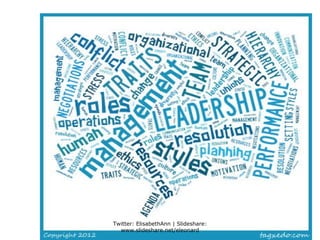
Topics include:
   Management and leadership roles,
    styles and traits, team performance,
    conflict resolution, motivation,
    human resources, strategic
    planning, operations, organizational
    culture and hierarchy, negotiations,
    ethics, diversity, change
    management, innovation, stress,
    unions, communication, agenda
    setting, and much more
           Twitter: ElisabethAnn | Slideshare:
             www.slideshare.net/eleonard
Top management journals
   MIS Quarterly, Academy of Management Journal,
    Organizational Science, Administrative Science
    Quarterly, Strategic Management Journal,
    Organizational Research Methods, Leadership
    Quarterly, MIT Sloane Management Review, Harvard
    Business Review, Journal of Economics and
    Management Strategy, International Small Business
    Journal, IEEE Transactions of Engineering
    Management, Industrial and Corporate Change,
    British Journal of Management, California
    Management Review, European Journal of Work and
    Organizational Psychology, Canadian Journal of
    Administrative Sciences

              Twitter: ElisabethAnn | Slideshare:
                www.slideshare.net/eleonard
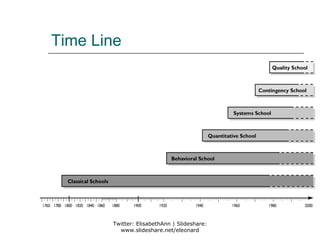
Schools of thought


PAST AS PROLOGUE

                     Twitter: ElisabethAnn | Slideshare:
                       www.slideshare.net/eleonard
Time Line


       Twitter: ElisabethAnn | Slideshare:
         www.slideshare.net/eleonard
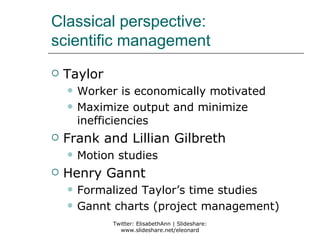
Classical perspective:
scientific management
   Taylor
       Worker is economically motivated
       Maximize output and minimize
        inefficiencies
   Frank and Lillian Gilbreth
       Motion studies
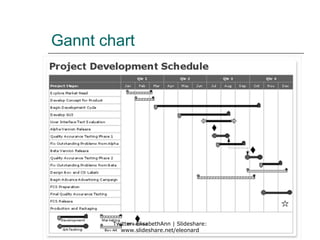
   Henry Gannt
       Formalized Taylor’s time studies
       Gannt charts (project management)
              Twitter: ElisabethAnn | Slideshare:
                www.slideshare.net/eleonard
Gannt chart


        Twitter: ElisabethAnn | Slideshare:
          www.slideshare.net/eleonard
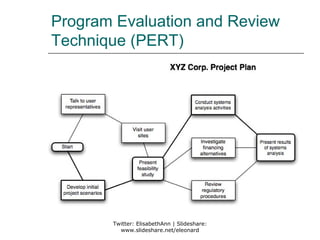
Program Evaluation and Review
Technique (PERT)


       Twitter: ElisabethAnn | Slideshare:
         www.slideshare.net/eleonard
Behavioral school of thought
   Human relations movement
       Focus on the individual: if I can make
        you happy, you will be a more
        productive employee
       Best known: Chester Barnard (social
        responsibility, fair wages), Mary Parker
        Follett (shared goals, worker
        participation), Elton Mayo (Hawthorne
        studies)
   Self-actualizing
              Twitter: ElisabethAnn | Slideshare:
                www.slideshare.net/eleonard
Self-actualizing:
Theory X and Theory Y
   Douglas McGregor (1960)
    There are 2 styles, X and Y, that
    establish managers’ expectations
       Theory X (authoritarian management)
          Average person:
              Inherently dislikes work
            Must be coerced, controlled, directed,
             threatened with punishment
            Aren’t able to solve work problems
            Prefers to be directed and wishes to
             avoid responsibility

                Twitter: ElisabethAnn | Slideshare:
                  www.slideshare.net/eleonard
Theory X and Theory Y
   Theory Y (participative management)
       The average person
            Physical and mental effort is as natural as play or
             rest
            Doesn’t dislike work
            Work can be satisfying & will be done voluntarily
            Accepts and seeks responsibility
            Imagination and creativity is widely distributed in
             an organization
            Intellectual potentials are only partially utilised
       Belief in Theory Y leads to decentralization,
        delegation, empowerment


                  Twitter: ElisabethAnn | Slideshare:
                    www.slideshare.net/eleonard
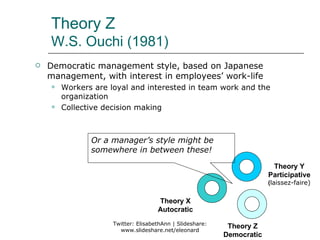
Theory Z
    W.S. Ouchi (1981)
   Democratic management style, based on Japanese
    management, with interest in employees’ work-life
       Workers are loyal and interested in team work and the
        organization
       Collective decision making


               Or a manager’s style might be
               somewhere in between these!

                                                                         Theory Y
                                                                        Participative
                                                                        (laissez-faire)

                                     Theory X
                                     Autocratic
                     Twitter: ElisabethAnn | Slideshare:
                                                            Theory Z
                       www.slideshare.net/eleonard
                                                           Democratic
Management science school
   Also called quantitative school
   Harkens back to scientific management
   World War II
   Applies mathematical and statistical
    thinking
   Production becomes Operations
    Management
       Inventory control theory, goal programming,
        queuing models, and simulation
   Birth of MIS

               Twitter: ElisabethAnn | Slideshare:
                 www.slideshare.net/eleonard
Modern management:
Systems theory
   Focus on organization as a whole and
    as an ecosystem
   Each unit affects every other unit
   Decisions are made after considering
    impact on others (including partners)
   Stakeholders, not just shareholders


           Twitter: ElisabethAnn | Slideshare:
             www.slideshare.net/eleonard
Modern management:
Total Quality Management (TQM)
 Big in the 80’s and into the 90’s
 Total: Quality involves everyone and all
  activities in the company.
 Quality: Conformance to requirements

 Management: typically top down

 TQM: continuous improvement; permeates
  everything the company and each
  employee does
*Training and professional development
  stressed
          Twitter: ElisabethAnn | Slideshare:
            www.slideshare.net/eleonard
What TQM is used for
   Improve customer service
   Increase productivity
   Decrease need to rework/scrap
   Improve product reliability
   Decrease time-to-market cycles
   Increase competitive advantage?
   Now is “Quality Management”

           Twitter: ElisabethAnn | Slideshare:
             www.slideshare.net/eleonard
Modern management:
learning organization
   Peter Senge
   Focus on problem solving, not
    efficiency
   Continuous change
   Every employee has a role
   Team learning
   Shared vision
   Shift from command-control to
    informationElisabethAnn | Slideshare:
             Twitter:
                      based organization
    (Drucker)  www.slideshare.net/eleonard
Leadership and management
Remember this?
 Planning
 Organizing

 Staffing

 Directing (Leading)

 Controlling (Evaluating)

 Reporting

 Budgeting

Based on Henri Fayol ~1872
Gulick, Luther and Urwick, Lyndall (1937) Papers on the Science of
                 Twitter: ElisabethAnn | Slideshare:
   Administration, Institute of Public Administration, New York
                   www.slideshare.net/eleonard
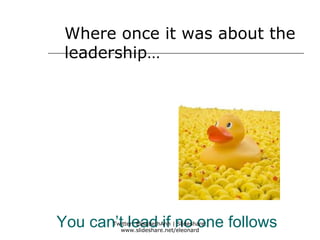
Where once it was about the
 leadership…


You can’t lead if no one follows
        Twitter: ElisabethAnn | Slideshare:
          www.slideshare.net/eleonard
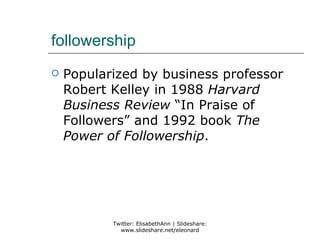
followership
   Popularized by business professor
    Robert Kelley in 1988 Harvard
    Business Review “In Praise of
    Followers” and 1992 book The
    Power of Followership.


           Twitter: ElisabethAnn | Slideshare:
             www.slideshare.net/eleonard
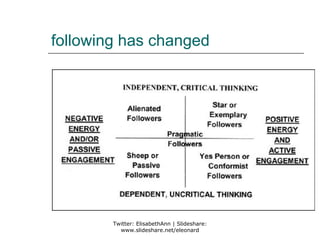
following has changed


        Twitter: ElisabethAnn | Slideshare:
          www.slideshare.net/eleonard
Basics of change and
innovation


What a manager should know
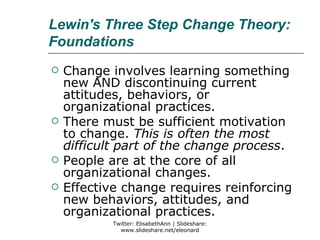
Lewin's Three Step Change Theory:
Foundations
   Change involves learning something
    new AND discontinuing current
    attitudes, behaviors, or
    organizational practices.
   There must be sufficient motivation
    to change. This is often the most
    difficult part of the change process.
   People are at the core of all
    organizational changes.
   Effective change requires reinforcing
    new behaviors, attitudes, and
    organizational practices.
            Twitter: ElisabethAnn | Slideshare:
              www.slideshare.net/eleonard
Three steps for change
   unfreezing
   changing

   refreezing


         Twitter: ElisabethAnn | Slideshare:
           www.slideshare.net/eleonard
Step one: Unfreezing
   Goal: release the status quo!
   The focus is to motivate individuals to
    change.
   Encourage old behaviors and attitudes to
    be replaced with desired behaviors and
    attitudes
   Recognize all issues openly
   Brainstorm as a group
   Trust is essential


            Twitter: ElisabethAnn | Slideshare:
              www.slideshare.net/eleonard
Step two: Change
   Goal: arrive at a new understanding

   Employees learn new information,
    behavioral models and view points.
   Useful at this stage are role models,
    mentors, experts, benchmarking,
    and training.


           Twitter: ElisabethAnn | Slideshare:
             www.slideshare.net/eleonard
Step three: Refreeze
   Change is stabilized.
   Employees integrate what they learned in
    stage 2 into their routine
   Use positive reinforcement, coaching,
    modeling


            Twitter: ElisabethAnn | Slideshare:
              www.slideshare.net/eleonard
There’s more to it
   Model is linear; change isn’t
   "Understand and honor the DNA of the
    organization. The system will reject you
    otherwise."[1]
   Many factors motivate people for or
    against change
   Resistance to change occurs even when
    the goals are desired by everyone.
   [1] Berfield, S. (2007, February 12). The Right Way To Shake Up a Company. Business Week.


                         Twitter: ElisabethAnn | Slideshare:
                           www.slideshare.net/eleonard
Change agents
   The change agent is someone “who translates the
    strategic change vision of leaders into pragmatic
    change behaviour. They will be the early adopters
    — through structured learning programmes and
    other stimuli — of the new values, actions and
    skills required by the company. Through this
    knowledge, they will act as a catalyst for the
    introduction of new ways of doing things across
    the four corners of the corporation. Their goal will
    be to act as a positive virus infecting their host
    company.”[1]
[1] Dover, P. (2003, February). Change agents at work: Lessons from
    Siemens Nixdorf. Journal of Change Management, 3(3), 243.


                 Twitter: ElisabethAnn | Slideshare:
                   www.slideshare.net/eleonard
Which leads to innovation
   Not all change is innovation
   Something new to an organization
    that adds value
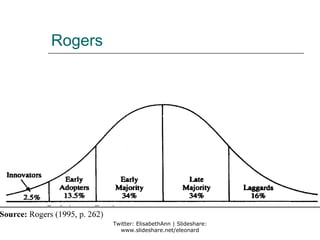
   Biggest name: Rogers


           Twitter: ElisabethAnn | Slideshare:
             www.slideshare.net/eleonard
Rogers


         Twitter: ElisabethAnn | Slideshare:
           www.slideshare.net/eleonard
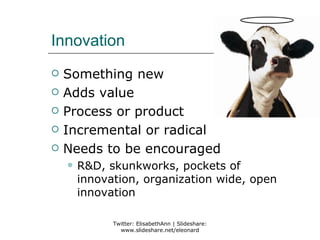
Innovation
   Something new
   Adds value
   Process or product
   Incremental or radical
   Needs to be encouraged
       R&D, skunkworks, pockets of
        innovation, organization wide, open
        innovation

              Twitter: ElisabethAnn | Slideshare:
                www.slideshare.net/eleonard
What’s the point of it all?
Managers are taught:
 Know who you are, who your
  employees are, and who you serve
 Know what the situation is
       Culture, stakeholders, strategic direction,
        short term and long term goals
   Decide how best to meet the
    challenges of the situation (follows the
    contingency school of thought!)
   Evaluate the results
            Twitter: ElisabethAnn | Slideshare:
   Adjust and Repeat.
              www.slideshare.net/eleonard
Resources to help you
   TOC alerts
   strategy+business
   Knowledge@Wharton
   YouTube!
   Textbooks
   Business Week and NYT bestsellers


           Twitter: ElisabethAnn | Slideshare:
             www.slideshare.net/eleonard
YOUR TURN!

       Twitter: ElisabethAnn | Slideshare:
         www.slideshare.net/eleonard
STRATEGY

       Twitter: ElisabethAnn | Slideshare:
         www.slideshare.net/eleonard
Strategic planning vs. operations
   Operations is day to day
   Strategic plan is long term
       SWOT (1960’s)
       Look at how to achieve vision and or
        competitive advantage


              Twitter: ElisabethAnn | Slideshare:
                www.slideshare.net/eleonard
Competitive advantage
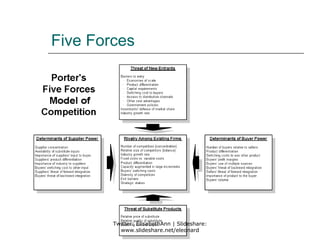
   Michael Porter
   Compete on cost, differentiation, focus
   Five forces
       Bargaining power of customers
       Bargaining power of suppliers
       Threat of new entrants
       Threat of substitute products
       Rivalry within industry

             Twitter: ElisabethAnn | Slideshare:
               www.slideshare.net/eleonard
Five Forces


        Twitter: ElisabethAnn | Slideshare:
          www.slideshare.net/eleonard
Patrons and their questions
   Don’t be surprised by…
       A VERY specific question for a very
        broad assignment (team work in
        action)
       The patron doesn’t come alone
        (team work in action)
       The patron (including the student) is
        working under a tight deadline
       The patron has a question and isn’t
        sharing enough info
        (often Twitter: ElisabethAnn | Slideshare: or a concern
               a personnel issue
        about competitive intelligence)
                 www.slideshare.net/eleonard
Resource based view (RBV)
   From Penrose
   Popularized by Prahalad and Hamel
   Adds firms resources to the SW
   Ideally makes it harder for other
    firms to catch up
The core competencies of the organization.
  Harvard Business Review. May/June 1990,
  p. 79-91.
Penrose, E. (1959). The theory and growth
  of the firm. New York: Wiley.
           Twitter: ElisabethAnn | Slideshare:
             www.slideshare.net/eleonard
Knowledge based view
   Based on Penrose
   Leverage knowledge for creating
    current goods/services to other
    areas (core competencies)


           Twitter: ElisabethAnn | Slideshare:
             www.slideshare.net/eleonard

BRASS MBA in a Day

  • 1.
    The 70 minutemanager Elisabeth Leonard, MSLS, MBA Market Research Analyst SAGE Publications, Inc. http://www.slideshare.net/eleonard
  • 2.
    Twitter: ElisabethAnn |Slideshare: www.slideshare.net/eleonard
  • 3.
    formally Management is “the art of getting things done through people” Mary Parker Foskett 1941. Dynamic Administration. London: Pittman Twitter: ElisabethAnn | Slideshare: www.slideshare.net/eleonard
  • 4.
    Breaking it downby function  Planning  Organizing  Staffing  Directing  Controlling (Evaluating)  Reporting  Budgeting Based on Henri Fayol ~1872 Gulick, Luther and Urwick, Lyndall (1937) Papers on the Science of Twitter: ElisabethAnn | Slideshare: Administration, Institute of Public Administration, New York www.slideshare.net/eleonard
  • 5.
    Who writes aboutit?  Popular literature abounds! Anyone can be a manager or write a book about it.  Studied by faculty in business, psychology, sociology, communications, and any discipline that includes practitioners Twitter: ElisabethAnn | Slideshare: www.slideshare.net/eleonard
  • 6.
    Topics include:  Management and leadership roles, styles and traits, team performance, conflict resolution, motivation, human resources, strategic planning, operations, organizational culture and hierarchy, negotiations, ethics, diversity, change management, innovation, stress, unions, communication, agenda setting, and much more Twitter: ElisabethAnn | Slideshare: www.slideshare.net/eleonard
  • 7.
    Top management journals  MIS Quarterly, Academy of Management Journal, Organizational Science, Administrative Science Quarterly, Strategic Management Journal, Organizational Research Methods, Leadership Quarterly, MIT Sloane Management Review, Harvard Business Review, Journal of Economics and Management Strategy, International Small Business Journal, IEEE Transactions of Engineering Management, Industrial and Corporate Change, British Journal of Management, California Management Review, European Journal of Work and Organizational Psychology, Canadian Journal of Administrative Sciences Twitter: ElisabethAnn | Slideshare: www.slideshare.net/eleonard
  • 8.
    Schools of thought PASTAS PROLOGUE Twitter: ElisabethAnn | Slideshare: www.slideshare.net/eleonard
  • 9.
    Time Line Twitter: ElisabethAnn | Slideshare: www.slideshare.net/eleonard
  • 10.
    Classical perspective: scientific management  Taylor  Worker is economically motivated  Maximize output and minimize inefficiencies  Frank and Lillian Gilbreth  Motion studies  Henry Gannt  Formalized Taylor’s time studies  Gannt charts (project management) Twitter: ElisabethAnn | Slideshare: www.slideshare.net/eleonard
  • 11.
    Gannt chart Twitter: ElisabethAnn | Slideshare: www.slideshare.net/eleonard
  • 12.
    Program Evaluation andReview Technique (PERT) Twitter: ElisabethAnn | Slideshare: www.slideshare.net/eleonard
  • 13.
    Behavioral school ofthought  Human relations movement  Focus on the individual: if I can make you happy, you will be a more productive employee  Best known: Chester Barnard (social responsibility, fair wages), Mary Parker Follett (shared goals, worker participation), Elton Mayo (Hawthorne studies)  Self-actualizing Twitter: ElisabethAnn | Slideshare: www.slideshare.net/eleonard
  • 14.
    Self-actualizing: Theory X andTheory Y  Douglas McGregor (1960) There are 2 styles, X and Y, that establish managers’ expectations  Theory X (authoritarian management)  Average person:  Inherently dislikes work  Must be coerced, controlled, directed, threatened with punishment  Aren’t able to solve work problems  Prefers to be directed and wishes to avoid responsibility Twitter: ElisabethAnn | Slideshare: www.slideshare.net/eleonard
  • 15.
    Theory X andTheory Y  Theory Y (participative management)  The average person  Physical and mental effort is as natural as play or rest  Doesn’t dislike work  Work can be satisfying & will be done voluntarily  Accepts and seeks responsibility  Imagination and creativity is widely distributed in an organization  Intellectual potentials are only partially utilised  Belief in Theory Y leads to decentralization, delegation, empowerment Twitter: ElisabethAnn | Slideshare: www.slideshare.net/eleonard
  • 16.
    Theory Z W.S. Ouchi (1981)  Democratic management style, based on Japanese management, with interest in employees’ work-life  Workers are loyal and interested in team work and the organization  Collective decision making Or a manager’s style might be somewhere in between these! Theory Y Participative (laissez-faire) Theory X Autocratic Twitter: ElisabethAnn | Slideshare: Theory Z www.slideshare.net/eleonard Democratic
  • 17.
    Management science school  Also called quantitative school  Harkens back to scientific management  World War II  Applies mathematical and statistical thinking  Production becomes Operations Management  Inventory control theory, goal programming, queuing models, and simulation  Birth of MIS Twitter: ElisabethAnn | Slideshare: www.slideshare.net/eleonard
  • 18.
    Modern management: Systems theory  Focus on organization as a whole and as an ecosystem  Each unit affects every other unit  Decisions are made after considering impact on others (including partners)  Stakeholders, not just shareholders Twitter: ElisabethAnn | Slideshare: www.slideshare.net/eleonard
  • 19.
    Modern management: Total QualityManagement (TQM)  Big in the 80’s and into the 90’s  Total: Quality involves everyone and all activities in the company.  Quality: Conformance to requirements  Management: typically top down  TQM: continuous improvement; permeates everything the company and each employee does *Training and professional development stressed Twitter: ElisabethAnn | Slideshare: www.slideshare.net/eleonard
  • 20.
    What TQM isused for  Improve customer service  Increase productivity  Decrease need to rework/scrap  Improve product reliability  Decrease time-to-market cycles  Increase competitive advantage?  Now is “Quality Management” Twitter: ElisabethAnn | Slideshare: www.slideshare.net/eleonard
  • 21.
    Modern management: learning organization  Peter Senge  Focus on problem solving, not efficiency  Continuous change  Every employee has a role  Team learning  Shared vision  Shift from command-control to informationElisabethAnn | Slideshare: Twitter: based organization (Drucker) www.slideshare.net/eleonard
  • 22.
  • 23.
    Remember this?  Planning Organizing  Staffing  Directing (Leading)  Controlling (Evaluating)  Reporting  Budgeting Based on Henri Fayol ~1872 Gulick, Luther and Urwick, Lyndall (1937) Papers on the Science of Twitter: ElisabethAnn | Slideshare: Administration, Institute of Public Administration, New York www.slideshare.net/eleonard
  • 24.
    Where once itwas about the leadership… You can’t lead if no one follows Twitter: ElisabethAnn | Slideshare: www.slideshare.net/eleonard
  • 25.
    followership  Popularized by business professor Robert Kelley in 1988 Harvard Business Review “In Praise of Followers” and 1992 book The Power of Followership. Twitter: ElisabethAnn | Slideshare: www.slideshare.net/eleonard
  • 26.
    following has changed Twitter: ElisabethAnn | Slideshare: www.slideshare.net/eleonard
  • 27.
    Basics of changeand innovation What a manager should know
  • 28.
    Lewin's Three StepChange Theory: Foundations  Change involves learning something new AND discontinuing current attitudes, behaviors, or organizational practices.  There must be sufficient motivation to change. This is often the most difficult part of the change process.  People are at the core of all organizational changes.  Effective change requires reinforcing new behaviors, attitudes, and organizational practices. Twitter: ElisabethAnn | Slideshare: www.slideshare.net/eleonard
  • 29.
    Three steps forchange  unfreezing  changing  refreezing Twitter: ElisabethAnn | Slideshare: www.slideshare.net/eleonard
  • 30.
    Step one: Unfreezing  Goal: release the status quo!  The focus is to motivate individuals to change.  Encourage old behaviors and attitudes to be replaced with desired behaviors and attitudes  Recognize all issues openly  Brainstorm as a group  Trust is essential Twitter: ElisabethAnn | Slideshare: www.slideshare.net/eleonard
  • 31.
    Step two: Change  Goal: arrive at a new understanding  Employees learn new information, behavioral models and view points.  Useful at this stage are role models, mentors, experts, benchmarking, and training. Twitter: ElisabethAnn | Slideshare: www.slideshare.net/eleonard
  • 32.
    Step three: Refreeze  Change is stabilized.  Employees integrate what they learned in stage 2 into their routine  Use positive reinforcement, coaching, modeling Twitter: ElisabethAnn | Slideshare: www.slideshare.net/eleonard
  • 33.
    There’s more toit  Model is linear; change isn’t  "Understand and honor the DNA of the organization. The system will reject you otherwise."[1]  Many factors motivate people for or against change  Resistance to change occurs even when the goals are desired by everyone.  [1] Berfield, S. (2007, February 12). The Right Way To Shake Up a Company. Business Week. Twitter: ElisabethAnn | Slideshare: www.slideshare.net/eleonard
  • 34.
    Change agents  The change agent is someone “who translates the strategic change vision of leaders into pragmatic change behaviour. They will be the early adopters — through structured learning programmes and other stimuli — of the new values, actions and skills required by the company. Through this knowledge, they will act as a catalyst for the introduction of new ways of doing things across the four corners of the corporation. Their goal will be to act as a positive virus infecting their host company.”[1] [1] Dover, P. (2003, February). Change agents at work: Lessons from Siemens Nixdorf. Journal of Change Management, 3(3), 243. Twitter: ElisabethAnn | Slideshare: www.slideshare.net/eleonard
  • 35.
    Which leads toinnovation  Not all change is innovation  Something new to an organization that adds value  Biggest name: Rogers Twitter: ElisabethAnn | Slideshare: www.slideshare.net/eleonard
  • 36.
    Rogers Twitter: ElisabethAnn | Slideshare: www.slideshare.net/eleonard
  • 37.
    Innovation  Something new  Adds value  Process or product  Incremental or radical  Needs to be encouraged  R&D, skunkworks, pockets of innovation, organization wide, open innovation Twitter: ElisabethAnn | Slideshare: www.slideshare.net/eleonard
  • 38.
    What’s the pointof it all? Managers are taught:  Know who you are, who your employees are, and who you serve  Know what the situation is  Culture, stakeholders, strategic direction, short term and long term goals  Decide how best to meet the challenges of the situation (follows the contingency school of thought!)  Evaluate the results Twitter: ElisabethAnn | Slideshare:  Adjust and Repeat. www.slideshare.net/eleonard
  • 39.
    Resources to helpyou  TOC alerts  strategy+business  Knowledge@Wharton  YouTube!  Textbooks  Business Week and NYT bestsellers Twitter: ElisabethAnn | Slideshare: www.slideshare.net/eleonard
  • 40.
    YOUR TURN! Twitter: ElisabethAnn | Slideshare: www.slideshare.net/eleonard
  • 41.
    STRATEGY Twitter: ElisabethAnn | Slideshare: www.slideshare.net/eleonard
  • 42.
    Strategic planning vs.operations  Operations is day to day  Strategic plan is long term  SWOT (1960’s)  Look at how to achieve vision and or competitive advantage Twitter: ElisabethAnn | Slideshare: www.slideshare.net/eleonard
  • 43.
    Competitive advantage  Michael Porter  Compete on cost, differentiation, focus  Five forces  Bargaining power of customers  Bargaining power of suppliers  Threat of new entrants  Threat of substitute products  Rivalry within industry Twitter: ElisabethAnn | Slideshare: www.slideshare.net/eleonard
  • 44.
    Five Forces Twitter: ElisabethAnn | Slideshare: www.slideshare.net/eleonard
  • 45.
    Patrons and theirquestions  Don’t be surprised by…  A VERY specific question for a very broad assignment (team work in action)  The patron doesn’t come alone (team work in action)  The patron (including the student) is working under a tight deadline  The patron has a question and isn’t sharing enough info (often Twitter: ElisabethAnn | Slideshare: or a concern a personnel issue about competitive intelligence) www.slideshare.net/eleonard
  • 46.
    Resource based view(RBV)  From Penrose  Popularized by Prahalad and Hamel  Adds firms resources to the SW  Ideally makes it harder for other firms to catch up The core competencies of the organization. Harvard Business Review. May/June 1990, p. 79-91. Penrose, E. (1959). The theory and growth of the firm. New York: Wiley. Twitter: ElisabethAnn | Slideshare: www.slideshare.net/eleonard
  • 47.
    Knowledge based view  Based on Penrose  Leverage knowledge for creating current goods/services to other areas (core competencies) Twitter: ElisabethAnn | Slideshare: www.slideshare.net/eleonard

Editor's Notes

  • #7 Management and leadership roles, styles and traits, team performance, conflict resolution, motivation, human resources, strategic planning, operations, organizational culture and hierarchy, negotiations, ethics, diversity, change management, innovation, stress, unions, communication, agenda setting,
  • #11 Time study (Taylor) Motion study
  • #14 1930’s Hawthorne: workers motivated by social rewards/sanctions more than $$ Actions influenced by group
  • #24 Good management leads to improved levels of employee engagement, enhances people's working lives and adds to the bottom line; boosting productivity, retention rates and customer loyalty. Good leadership moves the entire organization along strategically, showing the organization where it needs to change, providing future direction