Branding Strategy for Business
            By Vibrant Internet Marketing
                    June 5, 2012

  All rights reserved. No portion of this presentation
 may be duplicated without permission of the author.
   Vibrant Internet Marketing is available to provide
    customized presentations to your organization.
 Contact us at vibrantinternetmarketing@comcast.net.
Branding Strategy for Business
• Brand strategy is how, what, when and to whom
  you will be communicating your services.
• Having a clear and concise brand strategy leads to
  stronger overall brand equity
• How people feel about or perceive your product
  will dictate how much they are willing to pay for
  it.
• Even though it seems intangible, it’s that “hard-
  to-pin-down” feeling that separates powerhouse
  and mediocre brands from one another.
Branding Strategy for Business
1. Your brand’s strategy should be based on your
   company’s goals.
2. Your brand is not the services you offer, your
   logo, your website, your name or your tagline.
Your brand is:
• What your customers perceive about you.
• How you make them feel.
• Describing what your business does best beyond
   what you sell.
Branding Strategy for Business
3. Solve specific problems.
What problem(s) does your business solve for
  your customers?
4. Play the word game.
• Volvo = safe
• Coke = refreshing
• Disney = entertainment
• Your Company = ?
Branding Strategy for Business
5. Decide which aspect is the most important
  about your service and make it a part of every
  aspect of your brand communication.
What is the most important aspect of Your
  Company?
6. It is best to have one, clear “benefit” that you
  are promoting to avoid confusion and
  frustration on the part of the customer.
Branding Strategy for Business
7. Be consistent. Make sure the attributes of
  your brand are clear and understood
  throughout all of your communications.
8. Talk about things that relate to your brand.
For example, if you add a new photo to
  Facebook, explain what it means to your
  company.
Branding Strategy for Business
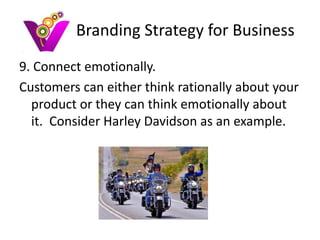
9. Connect emotionally.
Customers can either think rationally about your
  product or they can think emotionally about
  it. Consider Harley Davidson as an example.
Branding Strategy for Business
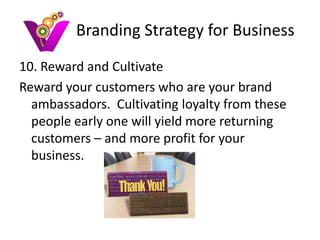
10. Reward and Cultivate
Reward your customers who are your brand
  ambassadors. Cultivating loyalty from these
  people early on will yield more returning
  customers – and more profit for your
  business.
Branding Strategy for Business
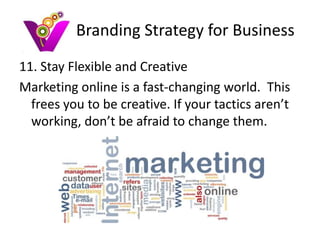
11. Stay Flexible and Creative
Marketing online is a fast-changing world. This
  frees you to be creative. If your tactics aren’t
  working, don’t be afraid to change them.
Branding Strategy for Business
11. Watch Out for Competitors
Pay attention to what is
  happening online. You never
  know who else your customers
  are listening to. Your
  competitors are a challenge to
  improve your own strategy
  and create greater value in
  your overall brand.
Build Your Buyer Persona
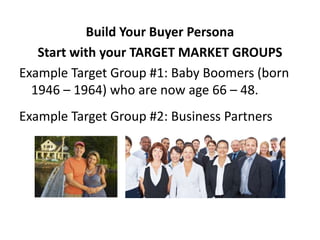
   Start with your TARGET MARKET GROUPS
Example Target Group #1: Baby Boomers (born
  1946 – 1964) who are now age 66 – 48.
Example Target Group #2: Business Partners
What are their biggest concerns?
Example: What are Baby Boomers biggest concerns?
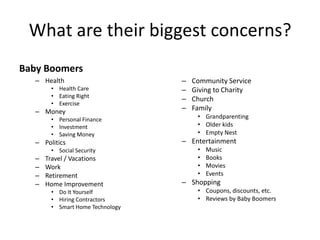
   – Health                       –   Community Service
        • Health Care             –   Giving to Charity
        • Eating Right
                                  –   Church
        • Exercise
   – Money                        –   Family
        • Personal Finance             • Grandparenting
        • Investment                   • Older kids
        • Saving Money                 • Empty Nest
   – Politics                     – Entertainment
        • Social Security              •   Music
   –   Travel / Vacations              •   Books
   –   Work                            •   Movies
   –   Retirement                      •   Events
   –   Home Improvement           – Shopping
        • Do It Yourself               • Coupons, discounts, etc.
        • Hiring Contractors           • Reviews by Baby Boomers
        • Smart Home Technology
What are their biggest concerns?
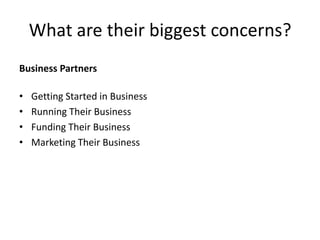
Example, what are Business Partners biggest concerns?

•   Getting Started in Business
•   Running Their Business
•   Funding Their Business
•   Marketing Their Business
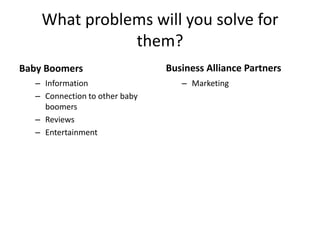
What problems will you solve for
               them?
Baby Boomers                    Business Partners
   – Information                   – Marketing
   – Connection to other baby
     boomers
   – Reviews
   – Entertainment
What do they need the most?
Baby Boomers      Business Partners
What information are they typically
            searching for?
Baby Boomers        Business Partners
What trends are influencing their
    personal or business success?
Baby Boomers        Business Partners
What kinds of content do they prefer?

Baby Boomers       Business Partners
What do they do online?
Baby Boomers        Business Partners
What service do they spend the most
            time reading?
Baby Boomers       Business Partners
Where are they most likely to be when
they become aware of Your Company?
Baby Boomers       Business Partners
Where are they most likely to be when they
  research / educate themselves about BBG?

Baby Boomers           Business Alliance Partners
Where are they most likely to be when they
  compare your services with other services?

Baby Boomers           Business Partners
Where are they most likely to be when they
     decide to purchase your services?

Baby Boomers           Business Partners
   – Website              – Website
Branding Strategy for Business
Food for Thought:
How will your measure the effectiveness of
  your brand strategy?

We will discuss this in our next presentation,
 “How to Measure Online Return on
 Investment (ROI)”

Branding strategy for business

  • 1.
    Branding Strategy forBusiness By Vibrant Internet Marketing June 5, 2012 All rights reserved. No portion of this presentation may be duplicated without permission of the author. Vibrant Internet Marketing is available to provide customized presentations to your organization. Contact us at vibrantinternetmarketing@comcast.net.
  • 2.
    Branding Strategy forBusiness • Brand strategy is how, what, when and to whom you will be communicating your services. • Having a clear and concise brand strategy leads to stronger overall brand equity • How people feel about or perceive your product will dictate how much they are willing to pay for it. • Even though it seems intangible, it’s that “hard- to-pin-down” feeling that separates powerhouse and mediocre brands from one another.
  • 3.
    Branding Strategy forBusiness 1. Your brand’s strategy should be based on your company’s goals. 2. Your brand is not the services you offer, your logo, your website, your name or your tagline. Your brand is: • What your customers perceive about you. • How you make them feel. • Describing what your business does best beyond what you sell.
  • 4.
    Branding Strategy forBusiness 3. Solve specific problems. What problem(s) does your business solve for your customers? 4. Play the word game. • Volvo = safe • Coke = refreshing • Disney = entertainment • Your Company = ?
  • 5.
    Branding Strategy forBusiness 5. Decide which aspect is the most important about your service and make it a part of every aspect of your brand communication. What is the most important aspect of Your Company? 6. It is best to have one, clear “benefit” that you are promoting to avoid confusion and frustration on the part of the customer.
  • 6.
    Branding Strategy forBusiness 7. Be consistent. Make sure the attributes of your brand are clear and understood throughout all of your communications. 8. Talk about things that relate to your brand. For example, if you add a new photo to Facebook, explain what it means to your company.
  • 7.
    Branding Strategy forBusiness 9. Connect emotionally. Customers can either think rationally about your product or they can think emotionally about it. Consider Harley Davidson as an example.
  • 8.
    Branding Strategy forBusiness 10. Reward and Cultivate Reward your customers who are your brand ambassadors. Cultivating loyalty from these people early on will yield more returning customers – and more profit for your business.
  • 9.
    Branding Strategy forBusiness 11. Stay Flexible and Creative Marketing online is a fast-changing world. This frees you to be creative. If your tactics aren’t working, don’t be afraid to change them.
  • 10.
    Branding Strategy forBusiness 11. Watch Out for Competitors Pay attention to what is happening online. You never know who else your customers are listening to. Your competitors are a challenge to improve your own strategy and create greater value in your overall brand.
  • 11.
    Build Your BuyerPersona Start with your TARGET MARKET GROUPS Example Target Group #1: Baby Boomers (born 1946 – 1964) who are now age 66 – 48. Example Target Group #2: Business Partners
  • 12.
    What are theirbiggest concerns? Example: What are Baby Boomers biggest concerns? – Health – Community Service • Health Care – Giving to Charity • Eating Right – Church • Exercise – Money – Family • Personal Finance • Grandparenting • Investment • Older kids • Saving Money • Empty Nest – Politics – Entertainment • Social Security • Music – Travel / Vacations • Books – Work • Movies – Retirement • Events – Home Improvement – Shopping • Do It Yourself • Coupons, discounts, etc. • Hiring Contractors • Reviews by Baby Boomers • Smart Home Technology
  • 13.
    What are theirbiggest concerns? Example, what are Business Partners biggest concerns? • Getting Started in Business • Running Their Business • Funding Their Business • Marketing Their Business
  • 14.
    What problems willyou solve for them? Baby Boomers Business Partners – Information – Marketing – Connection to other baby boomers – Reviews – Entertainment
  • 15.
    What do theyneed the most? Baby Boomers Business Partners
  • 16.
    What information arethey typically searching for? Baby Boomers Business Partners
  • 17.
    What trends areinfluencing their personal or business success? Baby Boomers Business Partners
  • 18.
    What kinds ofcontent do they prefer? Baby Boomers Business Partners
  • 19.
    What do theydo online? Baby Boomers Business Partners
  • 20.
    What service dothey spend the most time reading? Baby Boomers Business Partners
  • 21.
    Where are theymost likely to be when they become aware of Your Company? Baby Boomers Business Partners
  • 22.
    Where are theymost likely to be when they research / educate themselves about BBG? Baby Boomers Business Alliance Partners
  • 23.
    Where are theymost likely to be when they compare your services with other services? Baby Boomers Business Partners
  • 24.
    Where are theymost likely to be when they decide to purchase your services? Baby Boomers Business Partners – Website – Website
  • 25.
    Branding Strategy forBusiness Food for Thought: How will your measure the effectiveness of your brand strategy? We will discuss this in our next presentation, “How to Measure Online Return on Investment (ROI)”

Editor's Notes

  • #3 Brand strategy is the how, what, when, and to whom you plan on communicating your product or service. Having a clear and concise brand strategy leads to stronger overall brand equity -- how people feel about or perceive your product, and how much they are willing to pay for it.It's the stuff that feels intangible, but it's that hard-to-pin-down feeling that separates powerhouse and mediocre brands from one another. So to help you rein in what many marketers consider more of an art and less of a science, we've broken down seven components of a comprehensive brand strategy that will help keep your company around for ages. So is your company's brand strategy smooth like Bond? Or will it leave your company shaken harder than Bond's martini?
  • #4 Your brand’s strategy should be based on company goals. And just like James Bond wouldn't have gotten too far without a plan, your business will eventually hit a wall without a cohesive brand strategy. Sure, maybe you can finagle a big sale or trick a Russian spy or two, but one day you'll wake up and have no idea how your company got from A-to-Q -- it’s supposed to go from A-to-B, remember? And skipping steps is not how a great company that stands the test of time is built.
  • #7 6. Be consistent. Make sure the attributes of your brand are clear and understood throughout all of your communications.7. Talk about things that relate to your brand.For example, if you add a new photo to Facebook, explain what it means to your company.
  • #8 Customers can either think rationally about your product or they can think emotionally about it. Consider Harley Davidson as an example. Customers pay thousands of dollars more for a Harley than they would for another, equally well-made bike. Why? The emotional connection to being a Harley-owner. Harley owners feel they belong to a larger, tight-knit group. (HOG = Harley Owner’s Group)
  • #9 Reward and Cultivate.Sometimes, just a thank you is all that's needed, but great brands also tend to give more than that. Write them a personalized letter. Do you have some extra special swag? Sent it to them. Ask them to write a review, and feature them prominently on your website. For example, Porsche reached 1 million Facebook fans quicker than any other automotive brand, so to thank its fans, Porsche made a wraparound for its GT3 Hybrid that included all 1 million names. No doubt the car company also received an extra bit of buzz for it. And showing how happy your current customers are with your product certainly helps your sales organization, too, because it shows the positive end result of becoming a customer.
  • #10 So if your old tactics aren’t working anymore, don’t be afraid to change them just because it worked in the past. Take the opportunity to engage your followers in fresh, new ways. Are there some out-of-the-box partnerships your brand can make? Are there attributes about your product you never highlighted? Use those to connect with new customers and remind your old ones why they love you.
  • #11 Take the competition as a challenge to improve your own strategy and create greater value in your overall brand. You are in the same business and going after the same customers, right? So watch what they do. Do some of their tactics succeed? Do some fail? Tailor your tactics based on their experience to better your brand and company. For too many years, American car companies ignored their foreign competitors. But they finally realized they needed to change their model for the changing times and tout a more fuel-efficient agenda to keep pace with foreign competitors.