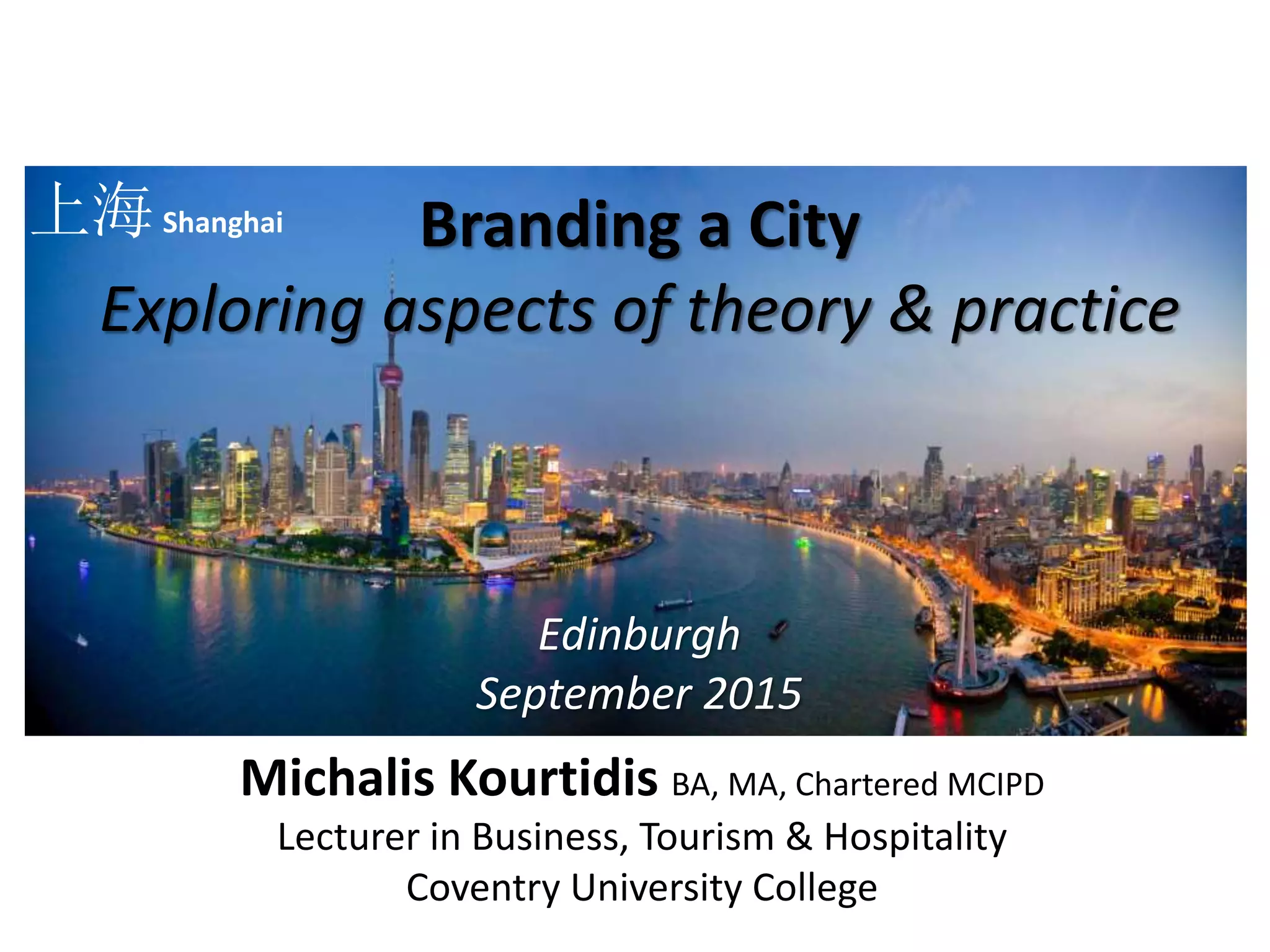
Branding a City
Exploring aspects of theory & practice
Edinburgh
September 2015
Michalis Kourtidis BA, MA, Chartered MCIPD
Lecturer in Business, Tourism & Hospitality
Coventry University College
上海Shanghai
Outline
• Concept, origin and development of City
branding in Scotland or U.K.;
• Various factors needing to be considered
when branding a city;
• Different perspectives or method in terms of
city branding;
• Any problems or thinking during the process
of branding the city
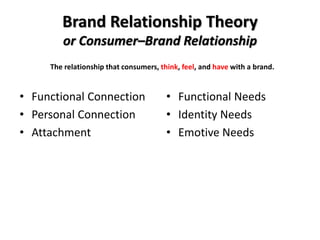
Brand Relationship Theory
or Consumer–Brand Relationship
• Functional Connection
• Personal Connection
• Attachment
• Functional Needs
• Identity Needs
• Emotive Needs
The relationship that consumers, think, feel, and have with a brand.
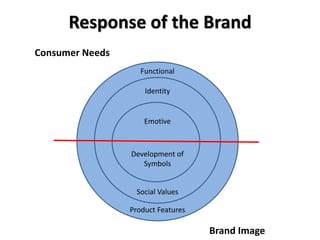
Response of the Brand
Consumer Needs
Brand Image
Functional
Identity
Emotive
Development of
Symbols
Social Values
Product Features
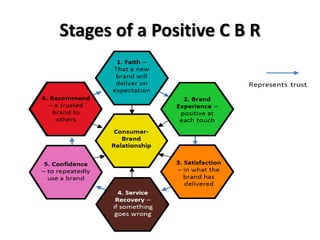
Stages of a Positive C B R
EDINBURGH
The case of
Nicknames of the city
• Auld Reekie
• The Athens of the North
• The World’s Festival City
What is there to offer?
1. Scotland’s capital city, home of the Scottish Parliament
2. A global festival city
3. UNESCO World Heritage Site – Old & New Towns
4. The first UNESCO City of Literature – from Sir Walter
Scott to JK Rowling
5. National Galleries & Museums
6. Reputation of innovations – from the telephone to
Dolly the Sheep
7. City centre surrounded by mountains
8. Royal palace & a castle at the heart of the city
2007
Collective Marketing Brand
1st joint marketing campaign by
• New Festivals Edinburgh Organisation
• Scottish Government
• City of Edinburgh Council
• VisitScotland
• EventScotland
• Scottish Enterprise
Scottish Government
The interest of the stakeholders:
• Conscious that a strong reputational capital
brand is essential for an increasingly outward
looking Scotland seeking to assert itself in the
global stage.
• Edinburgh to become for cultural diplomacy
what Davos is for economics (Edinburgh
International Culture Summit 2012 – back in
2014).
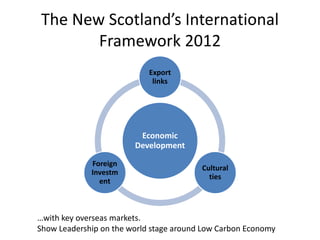
The New Scotland’s International
Framework 2012
Economic
Development
Export
links
Cultural
ties
Foreign
Investm
ent
…with key overseas markets.
Show Leadership on the world stage around Low Carbon Economy
Is it all great?
• Newspapers play the role of getting the pulse of the
locals
• Locals do not buy in the marketing campaign
• Big parts of the population have lost confidence in
the government
• The image of Edinburgh is perceived to be only for
the outsiders
• Luck of inspiration from a leading politician with the
task to promote well-being of locals: an elected
Mayor (not only for the City, but the City Region)
Why do you need that?
• Closer to the pubic, deals with everyday life
and confronts negative PR on a daily basis; can
inspire locals (see New York, London, etc.)
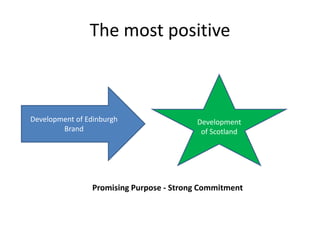
The most positive
Development of Edinburgh
Brand
Development
of Scotland
Promising Purpose - Strong Commitment
SHANGHAI
Building our case
Confusion
Ad campaigns
Branding
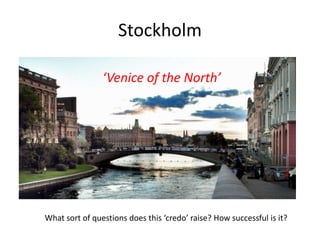
Stockholm
‘Venice of the North’
What sort of questions does this ‘credo’ raise? How successful is it?
Confusion
• Big cities have multiple identities
– Architecture?
– History?
– Eco?
– ICT?
– Shopping?
– …
• They have to decide which one prevails or
• find something which ties them all up together
What are the identities of Shanghai?
Go to:
http://padlet.com/mkourtidis/Shanghai
Ultimate purpose of Urban branding
1. For the city to become better understood in
various facets
2. and more attractive to or appreciated or
trusted by
3. more people
Morgan, N., Pritchard, A. and Pride, R. (2011). Destination Brands:
Managing Place Reputation (3rd Ed). Oxford: Elsevier
1. Understand why you are re-branding your city.
2. Conduct thorough research.
3. Start to craft your city's brand message.
4. Educate inside and out.
Understand why you are
re-branding your city
Identity/ -ies
Back to the exercise
Conduct thorough research.
• Perception of the city already exists among
inhabitants
Strategy of Creating Identity
Impose creativity, consistency, truthfulness, effectiveness
onto:
• Development & promotion of National & Regional
Tourism, Inward Investment, Recruitment & Trade
• Branding of exports
• International relations & foreign policy
• Social & cultural policy
• Urban & environmental planning
• Membership of supranational bodies
• Diasporas
• Sport
• Media management
• More of a topical significance
Start to craft your city's brand message
• Invest in Reality, not Image. Regenerate,
invest, transform first. Only when change is
visible should you start to "brand" it
• Look at the key assets. Make something
tangible about the city & make people
connect with that
• The role of the media: Photos, videos, movies
need to capture the spirit of the city
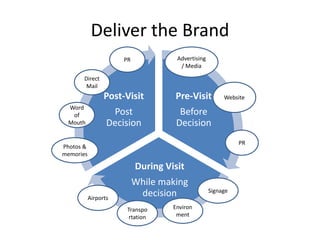
Deliver the Brand
Pre-Visit
Before
Decision
During Visit
While making
decision
Post-Visit
Post
Decision
Advertising
/ Media
Website
PR
PR
Signage
Environ
ment
Transpo
rtation
Airports
Direct
Mail
Word
of
Mouth
Photos &
memories
Educate inside and out
• Clean streets
• Effective & efficient transportation
• Residents feel proud to be brand ambassadors
– When citizens are proud, visitors are encouraged
to find out why they are proud and then tell the
world.
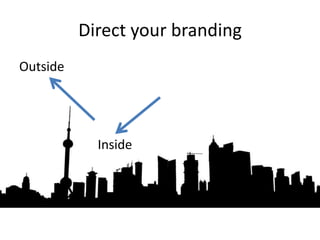
Direct your branding
Outside
Inside
People are Culture
Most successfully branded cities
• Paris
• Hong-Kong
• New York
• Liverpool
• Edinburgh
• Sydney
• Glasgow
The Guardian
Least successfully branded cities
• Belfast
• London
• Jerusalem
• Birmingham
• Bristol
• Toronto
The Guardian
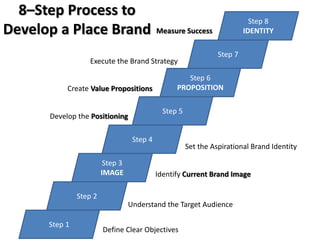
8–Step Process to
Develop a Place Brand
Step 1
Step 2
Step 3
IMAGE
Step 4
Step 5
Step 6
PROPOSITION
Step 7
Step 8
IDENTITY
Define Clear Objectives
Understand the Target Audience
Identify Current Brand Image
Set the Aspirational Brand Identity
Develop the Positioning
Create Value Propositions
Execute the Brand Strategy
Measure Success
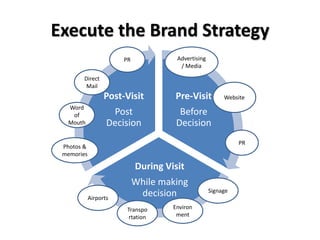
Execute the Brand Strategy
Pre-Visit
Before
Decision
During Visit
While making
decision
Post-Visit
Post
Decision
Advertising
/ Media
Website
PR
PR
Signage
Environ
ment
Transpo
rtation
Airports
Direct
Mail
Word
of
Mouth
Photos &
memories
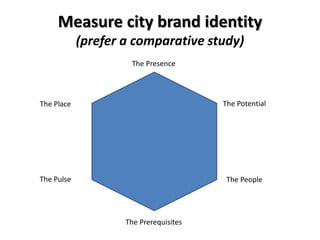
Measure city brand identity
(prefer a comparative study)
The Presence
The Potential
The People
The Prerequisites
The Pulse
The Place
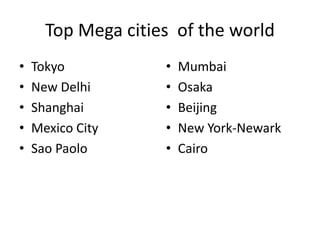
Top Mega cities of the world
• Tokyo
• New Delhi
• Shanghai
• Mexico City
• Sao Paolo
• Mumbai
• Osaka
• Beijing
• New York-Newark
• Cairo
Megacities will become even bigger
• Well-being at the centre of inhabitants
• Where will they live? Think creative…
– http://video.cnbc.com/gallery/?video=3000235756
Who owns the destination?
• Not a matter of a closed group of people
• The importance of stakeholders
– The example of Vancouver:
https://vimeo.com/66920801
• Partnership, shared vision, involvement of
stakeholders is key
What’s included in place branding?
• Hardware of a city: geography, environment,
industries developed because of the physical
offerings
• Software of a city: experiences, culture,
people, unique characteristics
What’s culture in city brand identity?
• Not for sale - A promotional gift
• “Culture is the rich harmonic accompaniment to
the simple, accessible, easily memorable melody
of the commercial competitive advantage. You
can whistle a [city’s] commercial brand, and not
it’s cultural counterpoint; but the former is
worth very much less without the latter.”
– Anholt, S
文化
Culture is next-door to tourism
• Makes a complete place, rather than a tourist
destination, a place worth visiting at different
times of the year (broad social appeal, usually
well behaved visitors)
• Attractions are the commercial dress of
culture and should be aligned with it.
Steps towards branding
• Audit of current brand perceptions and
communication: messages sent out by
– Government
– Industry
– Guest experience – tourist’s perceptions
• Alignment
Steps towards branding
• Engage stakeholders*
– Business players
– Governmental & civic level
– Community level
– Tourism destination market level
– People
* Vancouver spoke to more than 130 stakeholders to finalise their proposition
https://vimeo.com/68405297
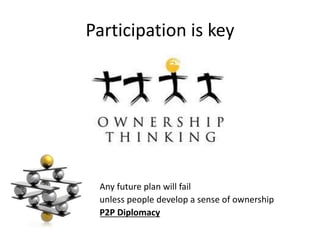
Participation is key
• Any future plan will fail
• unless people develop a sense of ownership
• P2P Diplomacy
Alignment of the interests
attracts investment
Ultimate aim:
develop Residence
Set your targets
Measure your expectations
• Set small victories and celebrate them
• What if the usual visitor extends their visit and
stays to Shanghai from 72 hours to 96 hours?
• How would they spend their extra day?
• Would they be interested in that?
• What would that mean for Shanghai?
Visualise
Not only
who you are
but
what you want to become
To sum up
• Brand has to respond to Consumer’s needs
• Edinburgh: a successful international example of city branding
• A national perspective: involvement of the government,
industry, people
• Identify and make stakeholders buy into the idea; let them
participate
• Identity has to be real – discover it
• 8 Steps to follow
• Measure branding
• Value and use Culture to support commercial aspect of city
• A long journey
Future is Created Now
Reference list
• Anholt, S. (2006). Competitive Identity. Palgrave Macmillan.
• Chen, X. (2009). Shanghai Rising : State Power and Local
Transformations in a Global Megacity, ed. Minneapolis, MN, USA:
University of Minnesota Press
• Musterd, S. and Kovacs, Z. (2013) Place-making and Policies for
Competitive Cities, Chinchester, John Wiley & Sons
• Prophet Consultancy (2006). Branding Your City. CEOs for Cities.
March
• Todd, L.A. (2015) Developing brand relationship theory for
festivals: a study of the Edinburgh Festival Fringe. In: The Future
of Events and Festivals. Routledge Advances in Event Research
Series . Routledge, Abingdon Oxon, pp. 157-176.

Branding a city

  • 1.
    Branding a City Exploringaspects of theory & practice Edinburgh September 2015 Michalis Kourtidis BA, MA, Chartered MCIPD Lecturer in Business, Tourism & Hospitality Coventry University College 上海Shanghai
  • 2.
    Outline • Concept, originand development of City branding in Scotland or U.K.; • Various factors needing to be considered when branding a city; • Different perspectives or method in terms of city branding; • Any problems or thinking during the process of branding the city
  • 3.
    Brand Relationship Theory orConsumer–Brand Relationship • Functional Connection • Personal Connection • Attachment • Functional Needs • Identity Needs • Emotive Needs The relationship that consumers, think, feel, and have with a brand.
  • 4.
    Response of theBrand Consumer Needs Brand Image Functional Identity Emotive Development of Symbols Social Values Product Features
  • 5.
    Stages of aPositive C B R
  • 6.
  • 7.
    Nicknames of thecity • Auld Reekie • The Athens of the North • The World’s Festival City
  • 8.
    What is thereto offer? 1. Scotland’s capital city, home of the Scottish Parliament 2. A global festival city 3. UNESCO World Heritage Site – Old & New Towns 4. The first UNESCO City of Literature – from Sir Walter Scott to JK Rowling 5. National Galleries & Museums 6. Reputation of innovations – from the telephone to Dolly the Sheep 7. City centre surrounded by mountains 8. Royal palace & a castle at the heart of the city
  • 9.
    2007 Collective Marketing Brand 1stjoint marketing campaign by • New Festivals Edinburgh Organisation • Scottish Government • City of Edinburgh Council • VisitScotland • EventScotland • Scottish Enterprise
  • 10.
    Scottish Government The interestof the stakeholders: • Conscious that a strong reputational capital brand is essential for an increasingly outward looking Scotland seeking to assert itself in the global stage. • Edinburgh to become for cultural diplomacy what Davos is for economics (Edinburgh International Culture Summit 2012 – back in 2014).
  • 11.
    The New Scotland’sInternational Framework 2012 Economic Development Export links Cultural ties Foreign Investm ent …with key overseas markets. Show Leadership on the world stage around Low Carbon Economy
  • 12.
    Is it allgreat? • Newspapers play the role of getting the pulse of the locals • Locals do not buy in the marketing campaign • Big parts of the population have lost confidence in the government • The image of Edinburgh is perceived to be only for the outsiders • Luck of inspiration from a leading politician with the task to promote well-being of locals: an elected Mayor (not only for the City, but the City Region)
  • 13.
    Why do youneed that? • Closer to the pubic, deals with everyday life and confronts negative PR on a daily basis; can inspire locals (see New York, London, etc.)
  • 14.
    The most positive Developmentof Edinburgh Brand Development of Scotland Promising Purpose - Strong Commitment
  • 15.
  • 16.
  • 17.
    Stockholm ‘Venice of theNorth’ What sort of questions does this ‘credo’ raise? How successful is it?
  • 18.
    Confusion • Big citieshave multiple identities – Architecture? – History? – Eco? – ICT? – Shopping? – … • They have to decide which one prevails or • find something which ties them all up together What are the identities of Shanghai? Go to: http://padlet.com/mkourtidis/Shanghai
  • 19.
    Ultimate purpose ofUrban branding 1. For the city to become better understood in various facets 2. and more attractive to or appreciated or trusted by 3. more people Morgan, N., Pritchard, A. and Pride, R. (2011). Destination Brands: Managing Place Reputation (3rd Ed). Oxford: Elsevier
  • 20.
    1. Understand whyyou are re-branding your city. 2. Conduct thorough research. 3. Start to craft your city's brand message. 4. Educate inside and out.
  • 21.
    Understand why youare re-branding your city Identity/ -ies Back to the exercise
  • 22.
    Conduct thorough research. •Perception of the city already exists among inhabitants
  • 23.
    Strategy of CreatingIdentity Impose creativity, consistency, truthfulness, effectiveness onto: • Development & promotion of National & Regional Tourism, Inward Investment, Recruitment & Trade • Branding of exports • International relations & foreign policy • Social & cultural policy • Urban & environmental planning • Membership of supranational bodies • Diasporas • Sport • Media management • More of a topical significance
  • 24.
    Start to craftyour city's brand message • Invest in Reality, not Image. Regenerate, invest, transform first. Only when change is visible should you start to "brand" it • Look at the key assets. Make something tangible about the city & make people connect with that • The role of the media: Photos, videos, movies need to capture the spirit of the city
  • 25.
    Deliver the Brand Pre-Visit Before Decision DuringVisit While making decision Post-Visit Post Decision Advertising / Media Website PR PR Signage Environ ment Transpo rtation Airports Direct Mail Word of Mouth Photos & memories
  • 26.
    Educate inside andout • Clean streets • Effective & efficient transportation • Residents feel proud to be brand ambassadors – When citizens are proud, visitors are encouraged to find out why they are proud and then tell the world.
  • 27.
  • 28.
  • 29.
    Most successfully brandedcities • Paris • Hong-Kong • New York • Liverpool • Edinburgh • Sydney • Glasgow The Guardian
  • 30.
    Least successfully brandedcities • Belfast • London • Jerusalem • Birmingham • Bristol • Toronto The Guardian
  • 31.
    8–Step Process to Developa Place Brand Step 1 Step 2 Step 3 IMAGE Step 4 Step 5 Step 6 PROPOSITION Step 7 Step 8 IDENTITY Define Clear Objectives Understand the Target Audience Identify Current Brand Image Set the Aspirational Brand Identity Develop the Positioning Create Value Propositions Execute the Brand Strategy Measure Success
  • 32.
    Execute the BrandStrategy Pre-Visit Before Decision During Visit While making decision Post-Visit Post Decision Advertising / Media Website PR PR Signage Environ ment Transpo rtation Airports Direct Mail Word of Mouth Photos & memories
  • 33.
    Measure city brandidentity (prefer a comparative study) The Presence The Potential The People The Prerequisites The Pulse The Place
  • 34.
    Top Mega citiesof the world • Tokyo • New Delhi • Shanghai • Mexico City • Sao Paolo • Mumbai • Osaka • Beijing • New York-Newark • Cairo
  • 35.
    Megacities will becomeeven bigger • Well-being at the centre of inhabitants • Where will they live? Think creative… – http://video.cnbc.com/gallery/?video=3000235756
  • 36.
    Who owns thedestination? • Not a matter of a closed group of people • The importance of stakeholders – The example of Vancouver: https://vimeo.com/66920801 • Partnership, shared vision, involvement of stakeholders is key
  • 37.
    What’s included inplace branding? • Hardware of a city: geography, environment, industries developed because of the physical offerings • Software of a city: experiences, culture, people, unique characteristics
  • 38.
    What’s culture incity brand identity? • Not for sale - A promotional gift • “Culture is the rich harmonic accompaniment to the simple, accessible, easily memorable melody of the commercial competitive advantage. You can whistle a [city’s] commercial brand, and not it’s cultural counterpoint; but the former is worth very much less without the latter.” – Anholt, S 文化
  • 39.
    Culture is next-doorto tourism • Makes a complete place, rather than a tourist destination, a place worth visiting at different times of the year (broad social appeal, usually well behaved visitors) • Attractions are the commercial dress of culture and should be aligned with it.
  • 40.
    Steps towards branding •Audit of current brand perceptions and communication: messages sent out by – Government – Industry – Guest experience – tourist’s perceptions • Alignment
  • 41.
    Steps towards branding •Engage stakeholders* – Business players – Governmental & civic level – Community level – Tourism destination market level – People * Vancouver spoke to more than 130 stakeholders to finalise their proposition https://vimeo.com/68405297
  • 42.
    Participation is key •Any future plan will fail • unless people develop a sense of ownership • P2P Diplomacy
  • 43.
    Alignment of theinterests attracts investment Ultimate aim: develop Residence
  • 44.
    Set your targets Measureyour expectations • Set small victories and celebrate them • What if the usual visitor extends their visit and stays to Shanghai from 72 hours to 96 hours? • How would they spend their extra day? • Would they be interested in that? • What would that mean for Shanghai?
  • 45.
    Visualise Not only who youare but what you want to become
  • 46.
    To sum up •Brand has to respond to Consumer’s needs • Edinburgh: a successful international example of city branding • A national perspective: involvement of the government, industry, people • Identify and make stakeholders buy into the idea; let them participate • Identity has to be real – discover it • 8 Steps to follow • Measure branding • Value and use Culture to support commercial aspect of city • A long journey
  • 47.
  • 48.
    Reference list • Anholt,S. (2006). Competitive Identity. Palgrave Macmillan. • Chen, X. (2009). Shanghai Rising : State Power and Local Transformations in a Global Megacity, ed. Minneapolis, MN, USA: University of Minnesota Press • Musterd, S. and Kovacs, Z. (2013) Place-making and Policies for Competitive Cities, Chinchester, John Wiley & Sons • Prophet Consultancy (2006). Branding Your City. CEOs for Cities. March • Todd, L.A. (2015) Developing brand relationship theory for festivals: a study of the Edinburgh Festival Fringe. In: The Future of Events and Festivals. Routledge Advances in Event Research Series . Routledge, Abingdon Oxon, pp. 157-176.

Editor's Notes

  • #13 http://www.creativebrief.com/blog/2012/11/20/city-brand-leaders-%E2%80%93-edinburgh-2/
  • #17 Ad campaigns may give a city a nice haircut but this doesn’t change its personality. It will soon loose its form Marketing & advertising only reflects what’s real. If it’s not real it’ll fade out soon.
  • #21 Although it can be a long and tedious journey, the effort falls into four basic phases. 1.) First, understand why you are re-branding your city.  Usually the answer is economic growth, but how?  Do you want companies to move to your city? Or are you trying to draw more visitors? Getting consensus on this issue will direct all of the future re-branding activities. 2.) Conduct thorough research. Understand how your city is viewed by residents and your target audience. What is your city's reputation? What are the strengths, assets and even problem areas in the community? Is the city negatively perceived by those on the outside? Getting an accurate and honest assessment of the situation is a key success factor. 3.) Once you have collected research, you can start to craft your city's brand message. It should be short, but meaningful. It will paint a mental picture when combined with your new logo and represent your city's assets. For example, Jacksonville's brand now stimulates the images of Florida vacationing in an often overlooked city.  4.) Educate inside and out. Report back to residents surveyed during the research phase. Their buy-in will help successfully launch the new brand. You can also host special events and press conferences. Determine who on the outside needs to be educated about your new brand. Target regions where your city was misunderstood. Strategic ad placement will realign those perceptions.  Source: http://www.polarismr.com/POV/bid/86884/Brand-Research-How-Cities-Brand-Themselves
  • #30 http://www.theguardian.com/society/2008/oct/01/city.urban.branding
  • #31 http://www.theguardian.com/society/2008/oct/01/city.urban.branding
  • #32 http://miplace.org/sites/default/files/CEOsforCities_BrandingYourCity.pdf
  • #34 Presence: international status and standing Place: physical awareness, pleasant or unpleasant image Potential: economic & educational opportunities Pulse: vibrant urban lifestyle, interesting things to do (short-term visitor and long-term resident) People: warm & friendly or cold & prejudiced against outsiders. How safe they visitors feel Prerequisites: perception of the basic qualities of the city: what they think life would be here, how easy they think is to find satisfactory accommodation, what public amenities look like (school, hospitals, transport, sports facilities, exercising religious beliefs, etc.)