Copyright © 2013 Pearson Education, Inc. Publishing as Prentice Hall.
CHAPTER:13
MANAGING BRANDS
OVER TIME
Copyright © 2013 Pearson Education, Inc. Publishing as Prentice Hall.
Learning Objectives
 Understand the important considerations in
brand reinforcement
 Describe the range of brand revitalization
options to a company
 Outline the various strategies to improve brand
awareness and brand image
 Define the key steps in managing a brand
crisis
Copyright © 2013 Pearson Education, Inc. Publishing as Prentice Hall.
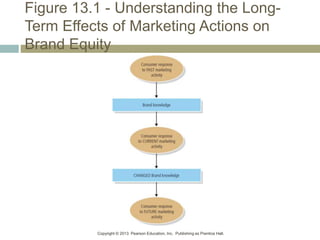
Figure 13.1 - Understanding the Long-
Term Effects of Marketing Actions on
Brand Equity
Copyright © 2013 Pearson Education, Inc. Publishing as Prentice Hall.
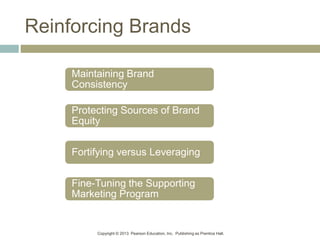
Reinforcing Brands
Maintaining Brand
Consistency
Protecting Sources of Brand
Equity
Fortifying versus Leveraging
Fine-Tuning the Supporting
Marketing Program
Copyright © 2013 Pearson Education, Inc. Publishing as Prentice Hall.
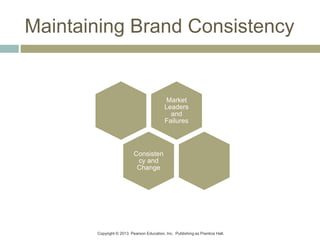
Maintaining Brand Consistency
Market
Leaders
and
Failures
Consisten
cy and
Change
Copyright © 2013 Pearson Education, Inc. Publishing as Prentice Hall.
 Maintaining brand consistency
• Brands with shrinking research and
development and marketing communication
budgets run the risk of becoming
technologically disadvantaged.
Market leaders and failures
• Inadequate marketing support is an especially
dangerous strategy when combined with price
increases.
• An example of failure to adequately support a
brand occurred in the kitchen and bath fixtures
Copyright © 2013 Pearson Education, Inc. Publishing as Prentice Hall.
Consistency and change
• Managing brand equity with consistency requires
making numerous tactical shifts and changes in
order to maintain the strategic thrust and direction
of the brand.
• The most effective tactics for a particular brand at
any one time varies.
• The strategic positioning of many leading brands
has been kept uniform over time by the retention of
key elements of the marketing program and the
preservation of the brand meaning
Copyright © 2013 Pearson Education, Inc. Publishing as Prentice Hall.
Protecting Sources of Brand
Equity
 Unless some the company makes the strategic
positioning of the brand less powerful, there is:
 Little need to deviate from a successful
positioning
 Brands should always look for potentially
powerful new sources of brand equity
 Top priority is to preserve and defend those that
already exist
 Key sources of brand equity are of enduring
value
Copyright © 2013 Pearson Education, Inc. Publishing as Prentice Hall.
Fortifying versus Leveraging
 Marketers can design marketing programs that
mainly try to capitalize on or maximize brand
awareness and image
 Without its sources of brand equity, the brand
itself may not continue to yield valuable
benefits
Copyright © 2013 Pearson Education, Inc. Publishing as Prentice Hall.
Fine-Tuning the Supporting Marketing
Program
.
 Marketers should make changes only when
it’s clear the marketing program and tactics
are no longer making the desired contributions
to maintaining or strengthening brand equity
1 Product-related performance associations
2 Non-product-related imagery associations
Copyright © 2013 Pearson Education, Inc. Publishing as Prentice Hall.
1 Product-related performance associations
For brands whose core associations are primarily product-
related performance attributes or benefits, innovation in
product design, manufacturing, and merchandising is
especially critical to maintaining or enhancing brand equity.
• For companies in diverse categories innovation is critical to
success.
• Product innovations are critical for performance-based brands
whose sources of equity reside primarily in product-related
associations.
• It is important not to change products too much, especially
if the brand meaning for consumers is wrapped up in the
product design or makeup.
Copyright © 2013 Pearson Education, Inc. Publishing as Prentice Hall.
2 Non-product-related imagery
associations
• For brands whose core associations are
primarily non-product-related attributes and
symbolic or experiential benefits, relevance in
user and usage imagery is especially critical.
• Ill-conceived or too-frequent repositionings can
blur the image of a brand and confuse or even
alienate consumers.
• Brand images can be extremely sticky, and once
strong associations have formed, they may be
difficult to change.
Copyright © 2013 Pearson Education, Inc. Publishing as Prentice Hall.
To Sum Up…
 Reinforcing brand equity requires consistency
in the amount and nature of the supporting
marketing program for the brand
 Product innovation and relevance are
paramount in maintaining continuity and
expanding the meaning of the brand
Copyright © 2013 Pearson Education, Inc. Publishing as Prentice Hall.
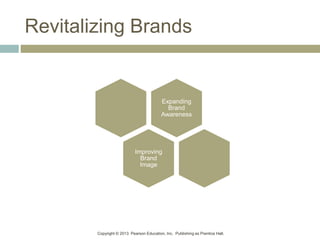
Revitalizing Brands
Expanding
Brand
Awareness
Improving
Brand
Image
Copyright © 2013 Pearson Education, Inc. Publishing as Prentice Hall.
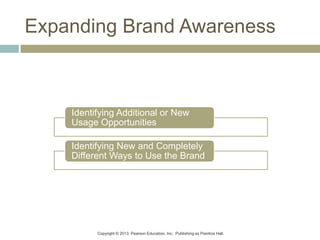
Expanding Brand Awareness
Identifying Additional or New
Usage Opportunities
Identifying New and Completely
Different Ways to Use the Brand
Copyright © 2013 Pearson Education, Inc. Publishing as Prentice Hall.
Identifying additional or new usage
opportunities
• To identify additional or new opportunities for
consumers, the marketing program should
include:
• Communications about the appropriateness and
advantages of using the brand more frequently in
existing situations or in new situations.
• Reminders to consumers to actually use the
brand as close as possible in time to those
situations for which it could be used.
Copyright © 2013 Pearson Education, Inc. Publishing as Prentice Hall.
• To increase frequency of usage for products of short
life spans:
• Tie the act of replacing the product to a certain holiday,
event, or time of year.
• Oral-B toothbrushes
• Provide consumers with better information about:
• When they first used the product or need to replace it.
• The current level of product performance.
• Consumers can be convinced of the merits of more
regular usage and overcome any potential hurdles to
increased usage, such as by making product designs
Copyright © 2013 Pearson Education, Inc. Publishing as Prentice Hall.
Identifying new and completely different
ways to use the brand
• New usage applications may require more than
just new ad campaigns or merchandising
approaches.
Copyright © 2013 Pearson Education, Inc. Publishing as Prentice Hall.
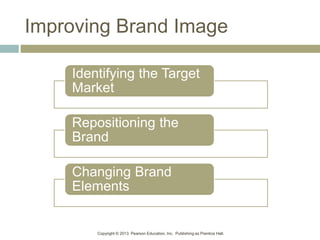
Improving Brand Image
Identifying the Target
Market
Repositioning the
Brand
Changing Brand
Elements
Copyright © 2013 Pearson Education, Inc. Publishing as Prentice Hall.
Identifying the target market
• Key target market segments:
• Retaining vulnerable customers.
• Recapturing lost customers.
• Identifying neglected segments.
• Attracting new customers.
• During a decline in sales, it is best to ensure that no more customers are
lost in the short run before targeting new ones.
• Segmenting on the basis of demographic variables or other means and
identifying neglected segments.
• Abandon the consumer group that supported it in the past to target a
completely new market segment.
• Marketers also introduce programs targeted to different racial and ethnic
groups, age groups, and income groups.
Copyright © 2013 Pearson Education, Inc. Publishing as Prentice Hall.
Repositioning the brand
• A common problem for marketers of
established, mature brands is to make them
more contemporary by creating relevant usage
situations, a more contemporary user profile, or
a more modern brand personality.
• Updating a brand may require some
combination of new products, new advertising,
new promotions, and new packaging.
Copyright © 2013 Pearson Education, Inc. Publishing as Prentice Hall.
Changing brand elements
• One or more brand elements are changed
either to convey new information or to signal
that the brand has taken on new meaning
because the product or some other aspect of
the marketing program has changed.
• Brand name is typically the most important brand
element.
• It is easier to change other brand elements
especially if they play an important awareness
or image function.
Copyright © 2013 Pearson Education, Inc. Publishing as Prentice Hall.
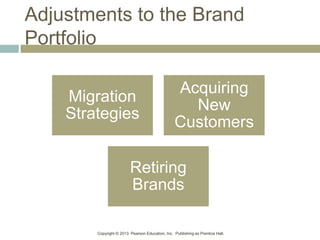
Adjustments to the Brand
Portfolio
Migration
Strategies
Acquiring
New
Customers
Retiring
Brands
Copyright © 2013 Pearson Education, Inc. Publishing as Prentice Hall.
Migration strategies
• Brand migration strategy: Helps consumers
understand how various brands in the portfolio
can satisfy their needs as they change over
time, or as the products and brands themselves
change over time.
• Brands that are ordered in a logical manner
provide the hierarchical structure in consumers’
minds to facilitate brand migration.
Copyright © 2013 Pearson Education, Inc. Publishing as Prentice Hall.
Acquiring new customers
• Firms must proactively develop strategies to attract new customers,
especially younger ones.
• The marketing challenge lies in making a brand seem relevant to vastly
different generations and cohort groups or lifestyles.
• Challenge is greater when the brand has a strong personality.
• Some marketers have attempted to cut loose from the past to deal with
marketing across generations.
• Other brands have attempted to develop more inclusive marketing strategies
to encompass both new and old customers.
• Brooks Brothers
Retiring brands
• First step in retrenching a fading brand is to reduce the number of its product
types.
• This reduces the cost of supporting the brand and allows it to
concentrate on its strength so it can more easily hit profit targets.
Copyright © 2013 Pearson Education, Inc. Publishing as Prentice Hall.
Orphan brand
• Once-popular brand with diminished equity that a
parent company allows to decline by withdrawing
marketing support.
• When the brand is beyond repair, marketers have to
take more drastic measures, such as consolidating it
into a stronger brand.
• A permanent solution is to discontinue the product
altogether.
• Obsoleting existing products:
• Abandon dying brands.
• Decision to retire a brand depends on a number of
factors.
Copyright © 2013 Pearson Education, Inc. Publishing as Prentice Hall.
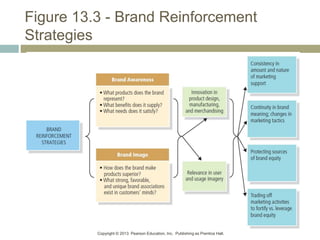
Figure 13.3 - Brand Reinforcement
Strategies
Copyright © 2013 Pearson Education, Inc. Publishing as Prentice Hall.
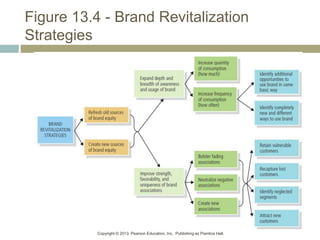
Figure 13.4 - Brand Revitalization
Strategies
Copyright © 2013 Pearson Education, Inc. Publishing as Prentice Hall.
To Sum Up…
 Effective brand management requires taking a
long-term view
 Dictates proactive strategies designed to maintain
and enhance customer-based brand equity over
time
 Marketers reinforce brand equity by actions
that consistently convey the meaning of the
brand
 Most important consideration in reinforcing
brands is consistency in the nature and
amount of marketing support
Copyright © 2013 Pearson Education, Inc. Publishing as Prentice Hall.
To Sum Up..
 The strategy for reinforcing brand meaning
depends on the nature of the brand
association
 In managing brand equity, managers have to
make trade-offs between those marketing
activities that:
 Fortify the brand and reinforce its meaning,
 Attempt to leverage or borrow from its existing
brand equity to reap some financial benefit
 Revitalizing a brand requires marketers to
either recapture lost sources of brand equity or

brand reinforcing and revitalizing.ppt

  • 1.
    Copyright © 2013Pearson Education, Inc. Publishing as Prentice Hall. CHAPTER:13 MANAGING BRANDS OVER TIME
  • 2.
    Copyright © 2013Pearson Education, Inc. Publishing as Prentice Hall. Learning Objectives  Understand the important considerations in brand reinforcement  Describe the range of brand revitalization options to a company  Outline the various strategies to improve brand awareness and brand image  Define the key steps in managing a brand crisis
  • 3.
    Copyright © 2013Pearson Education, Inc. Publishing as Prentice Hall. Figure 13.1 - Understanding the Long- Term Effects of Marketing Actions on Brand Equity
  • 4.
    Copyright © 2013Pearson Education, Inc. Publishing as Prentice Hall. Reinforcing Brands Maintaining Brand Consistency Protecting Sources of Brand Equity Fortifying versus Leveraging Fine-Tuning the Supporting Marketing Program
  • 5.
    Copyright © 2013Pearson Education, Inc. Publishing as Prentice Hall. Maintaining Brand Consistency Market Leaders and Failures Consisten cy and Change
  • 6.
    Copyright © 2013Pearson Education, Inc. Publishing as Prentice Hall.  Maintaining brand consistency • Brands with shrinking research and development and marketing communication budgets run the risk of becoming technologically disadvantaged. Market leaders and failures • Inadequate marketing support is an especially dangerous strategy when combined with price increases. • An example of failure to adequately support a brand occurred in the kitchen and bath fixtures
  • 7.
    Copyright © 2013Pearson Education, Inc. Publishing as Prentice Hall. Consistency and change • Managing brand equity with consistency requires making numerous tactical shifts and changes in order to maintain the strategic thrust and direction of the brand. • The most effective tactics for a particular brand at any one time varies. • The strategic positioning of many leading brands has been kept uniform over time by the retention of key elements of the marketing program and the preservation of the brand meaning
  • 8.
    Copyright © 2013Pearson Education, Inc. Publishing as Prentice Hall. Protecting Sources of Brand Equity  Unless some the company makes the strategic positioning of the brand less powerful, there is:  Little need to deviate from a successful positioning  Brands should always look for potentially powerful new sources of brand equity  Top priority is to preserve and defend those that already exist  Key sources of brand equity are of enduring value
  • 9.
    Copyright © 2013Pearson Education, Inc. Publishing as Prentice Hall. Fortifying versus Leveraging  Marketers can design marketing programs that mainly try to capitalize on or maximize brand awareness and image  Without its sources of brand equity, the brand itself may not continue to yield valuable benefits
  • 10.
    Copyright © 2013Pearson Education, Inc. Publishing as Prentice Hall. Fine-Tuning the Supporting Marketing Program .  Marketers should make changes only when it’s clear the marketing program and tactics are no longer making the desired contributions to maintaining or strengthening brand equity 1 Product-related performance associations 2 Non-product-related imagery associations
  • 11.
    Copyright © 2013Pearson Education, Inc. Publishing as Prentice Hall. 1 Product-related performance associations For brands whose core associations are primarily product- related performance attributes or benefits, innovation in product design, manufacturing, and merchandising is especially critical to maintaining or enhancing brand equity. • For companies in diverse categories innovation is critical to success. • Product innovations are critical for performance-based brands whose sources of equity reside primarily in product-related associations. • It is important not to change products too much, especially if the brand meaning for consumers is wrapped up in the product design or makeup.
  • 12.
    Copyright © 2013Pearson Education, Inc. Publishing as Prentice Hall. 2 Non-product-related imagery associations • For brands whose core associations are primarily non-product-related attributes and symbolic or experiential benefits, relevance in user and usage imagery is especially critical. • Ill-conceived or too-frequent repositionings can blur the image of a brand and confuse or even alienate consumers. • Brand images can be extremely sticky, and once strong associations have formed, they may be difficult to change.
  • 13.
    Copyright © 2013Pearson Education, Inc. Publishing as Prentice Hall. To Sum Up…  Reinforcing brand equity requires consistency in the amount and nature of the supporting marketing program for the brand  Product innovation and relevance are paramount in maintaining continuity and expanding the meaning of the brand
  • 14.
    Copyright © 2013Pearson Education, Inc. Publishing as Prentice Hall. Revitalizing Brands Expanding Brand Awareness Improving Brand Image
  • 15.
    Copyright © 2013Pearson Education, Inc. Publishing as Prentice Hall. Expanding Brand Awareness Identifying Additional or New Usage Opportunities Identifying New and Completely Different Ways to Use the Brand
  • 16.
    Copyright © 2013Pearson Education, Inc. Publishing as Prentice Hall. Identifying additional or new usage opportunities • To identify additional or new opportunities for consumers, the marketing program should include: • Communications about the appropriateness and advantages of using the brand more frequently in existing situations or in new situations. • Reminders to consumers to actually use the brand as close as possible in time to those situations for which it could be used.
  • 17.
    Copyright © 2013Pearson Education, Inc. Publishing as Prentice Hall. • To increase frequency of usage for products of short life spans: • Tie the act of replacing the product to a certain holiday, event, or time of year. • Oral-B toothbrushes • Provide consumers with better information about: • When they first used the product or need to replace it. • The current level of product performance. • Consumers can be convinced of the merits of more regular usage and overcome any potential hurdles to increased usage, such as by making product designs
  • 18.
    Copyright © 2013Pearson Education, Inc. Publishing as Prentice Hall. Identifying new and completely different ways to use the brand • New usage applications may require more than just new ad campaigns or merchandising approaches.
  • 19.
    Copyright © 2013Pearson Education, Inc. Publishing as Prentice Hall. Improving Brand Image Identifying the Target Market Repositioning the Brand Changing Brand Elements
  • 20.
    Copyright © 2013Pearson Education, Inc. Publishing as Prentice Hall. Identifying the target market • Key target market segments: • Retaining vulnerable customers. • Recapturing lost customers. • Identifying neglected segments. • Attracting new customers. • During a decline in sales, it is best to ensure that no more customers are lost in the short run before targeting new ones. • Segmenting on the basis of demographic variables or other means and identifying neglected segments. • Abandon the consumer group that supported it in the past to target a completely new market segment. • Marketers also introduce programs targeted to different racial and ethnic groups, age groups, and income groups.
  • 21.
    Copyright © 2013Pearson Education, Inc. Publishing as Prentice Hall. Repositioning the brand • A common problem for marketers of established, mature brands is to make them more contemporary by creating relevant usage situations, a more contemporary user profile, or a more modern brand personality. • Updating a brand may require some combination of new products, new advertising, new promotions, and new packaging.
  • 22.
    Copyright © 2013Pearson Education, Inc. Publishing as Prentice Hall. Changing brand elements • One or more brand elements are changed either to convey new information or to signal that the brand has taken on new meaning because the product or some other aspect of the marketing program has changed. • Brand name is typically the most important brand element. • It is easier to change other brand elements especially if they play an important awareness or image function.
  • 23.
    Copyright © 2013Pearson Education, Inc. Publishing as Prentice Hall. Adjustments to the Brand Portfolio Migration Strategies Acquiring New Customers Retiring Brands
  • 24.
    Copyright © 2013Pearson Education, Inc. Publishing as Prentice Hall. Migration strategies • Brand migration strategy: Helps consumers understand how various brands in the portfolio can satisfy their needs as they change over time, or as the products and brands themselves change over time. • Brands that are ordered in a logical manner provide the hierarchical structure in consumers’ minds to facilitate brand migration.
  • 25.
    Copyright © 2013Pearson Education, Inc. Publishing as Prentice Hall. Acquiring new customers • Firms must proactively develop strategies to attract new customers, especially younger ones. • The marketing challenge lies in making a brand seem relevant to vastly different generations and cohort groups or lifestyles. • Challenge is greater when the brand has a strong personality. • Some marketers have attempted to cut loose from the past to deal with marketing across generations. • Other brands have attempted to develop more inclusive marketing strategies to encompass both new and old customers. • Brooks Brothers Retiring brands • First step in retrenching a fading brand is to reduce the number of its product types. • This reduces the cost of supporting the brand and allows it to concentrate on its strength so it can more easily hit profit targets.
  • 26.
    Copyright © 2013Pearson Education, Inc. Publishing as Prentice Hall. Orphan brand • Once-popular brand with diminished equity that a parent company allows to decline by withdrawing marketing support. • When the brand is beyond repair, marketers have to take more drastic measures, such as consolidating it into a stronger brand. • A permanent solution is to discontinue the product altogether. • Obsoleting existing products: • Abandon dying brands. • Decision to retire a brand depends on a number of factors.
  • 27.
    Copyright © 2013Pearson Education, Inc. Publishing as Prentice Hall. Figure 13.3 - Brand Reinforcement Strategies
  • 28.
    Copyright © 2013Pearson Education, Inc. Publishing as Prentice Hall. Figure 13.4 - Brand Revitalization Strategies
  • 29.
    Copyright © 2013Pearson Education, Inc. Publishing as Prentice Hall. To Sum Up…  Effective brand management requires taking a long-term view  Dictates proactive strategies designed to maintain and enhance customer-based brand equity over time  Marketers reinforce brand equity by actions that consistently convey the meaning of the brand  Most important consideration in reinforcing brands is consistency in the nature and amount of marketing support
  • 30.
    Copyright © 2013Pearson Education, Inc. Publishing as Prentice Hall. To Sum Up..  The strategy for reinforcing brand meaning depends on the nature of the brand association  In managing brand equity, managers have to make trade-offs between those marketing activities that:  Fortify the brand and reinforce its meaning,  Attempt to leverage or borrow from its existing brand equity to reap some financial benefit  Revitalizing a brand requires marketers to either recapture lost sources of brand equity or

Editor's Notes

  • #6 Maintaining brand consistency Brands with shrinking research and development and marketing communication budgets run the risk of becoming technologically disadvantaged. Market leaders and failures Inadequate marketing support is an especially dangerous strategy when combined with price increases. An example of failure to adequately support a brand occurred in the kitchen and bath fixtures market. Consistency and change Managing brand equity with consistency requires making numerous tactical shifts and changes in order to maintain the strategic thrust and direction of the brand. The most effective tactics for a particular brand at any one time varies. The strategic positioning of many leading brands has been kept uniform over time by the retention of key elements of the marketing program and the preservation of the brand meaning.
  • #11 Fine-tuning the supporting marketing program Marketers should make changes only when it’s clear the marketing program and tactics are no longer making the desired contributions to maintaining or strengthening brand equity. Product-related performance associations For brands whose core associations are primarily product-related performance attributes or benefits, innovation in product design, manufacturing, and merchandising is especially critical to maintaining or enhancing brand equity. For companies in diverse categories innovation is critical to success. Product innovations are critical for performance-based brands whose sources of equity reside primarily in product-related associations. It is important not to change products too much, especially if the brand meaning for consumers is wrapped up in the product design or makeup. Non-product-related imagery associations For brands whose core associations are primarily non-product-related attributes and symbolic or experiential benefits, relevance in user and usage imagery is especially critical. Ill-conceived or too-frequent repositionings can blur the image of a brand and confuse or even alienate consumers. Brand images can be extremely sticky, and once strong associations have formed, they may be difficult to change.
  • #15 Revitalizing brands Brands sometimes have to return to their roots to recapture lost sources of equity. In profiling brand knowledge structures to guide repositioning, marketers need to accurately and completely characterize the breadth and depth of brand awareness. Revitalization strategies run along a continuum, with pure back-to-basics at one end and pure reinvention at the other. Market failures, in which insufficient consumers are attracted to a brand, are typically much less damaging than product failures, in which the brand fundamentally fails to live up to its consumer promise. In market failure a relaunch can sometimes prove successful. In product failure, the brand fundamentally fails to live up to its consumer promise. Strategic options on how best to refresh old sources of brand equity or create new ones to achieve the intended positioning: Expand the depth or breadth of brand awareness, or both, by improving consumer recall. Improve the strength, favorability, and uniqueness of the brand associations making up the brand image.
  • #16 Identifying additional or new usage opportunities To identify additional or new opportunities for consumers, the marketing program should include: Communications about the appropriateness and advantages of using the brand more frequently in existing situations or in new situations. Reminders to consumers to actually use the brand as close as possible in time to those situations for which it could be used. To increase frequency of usage for products of short life spans: Tie the act of replacing the product to a certain holiday, event, or time of year. Oral-B toothbrushes Provide consumers with better information about: When they first used the product or need to replace it. The current level of product performance. Consumers can be convinced of the merits of more regular usage and overcome any potential hurdles to increased usage, such as by making product designs and packaging more convenient and easier to use. Identifying new and completely different ways to use the brand New usage applications may require more than just new ad campaigns or merchandising approaches.
  • #20 Identifying the target market Key target market segments: Retaining vulnerable customers. Recapturing lost customers. Identifying neglected segments. Attracting new customers. During a decline in sales, it is best to ensure that no more customers are lost in the short run before targeting new ones. Segmenting on the basis of demographic variables or other means and identifying neglected segments. Abandon the consumer group that supported it in the past to target a completely new market segment. Marketers also introduce programs targeted to different racial and ethnic groups, age groups, and income groups. Repositioning the brand A common problem for marketers of established, mature brands is to make them more contemporary by creating relevant usage situations, a more contemporary user profile, or a more modern brand personality. Updating a brand may require some combination of new products, new advertising, new promotions, and new packaging. Changing brand elements One or more brand elements are changed either to convey new information or to signal that the brand has taken on new meaning because the product or some other aspect of the marketing program has changed. Brand name is typically the most important brand element. It is easier to change other brand elements especially if they play an important awareness or image function.
  • #24 Migration strategies Brand migration strategy: Helps consumers understand how various brands in the portfolio can satisfy their needs as they change over time, or as the products and brands themselves change over time. Brands that are ordered in a logical manner provide the hierarchical structure in consumers’ minds to facilitate brand migration. Acquiring new customers Firms must proactively develop strategies to attract new customers, especially younger ones. The marketing challenge lies in making a brand seem relevant to vastly different generations and cohort groups or lifestyles. Challenge is greater when the brand has a strong personality. Some marketers have attempted to cut loose from the past to deal with marketing across generations. Tommy Hilfiger Other brands have attempted to develop more inclusive marketing strategies to encompass both new and old customers. Brooks Brothers Retiring brands First step in retrenching a fading brand is to reduce the number of its product types. This reduces the cost of supporting the brand and allows it to concentrate on its strength so it can more easily hit profit targets. Orphan brand: Once-popular brand with diminished equity that a parent company allows to decline by withdrawing marketing support. When the brand is beyond repair, marketers have to take more drastic measures, such as consolidating it into a stronger brand. A permanent solution is to discontinue the product altogether. Obsoleting existing products: Abandon dying brands. Decision to retire a brand depends on a number of factors. The issue is the existing and latent equity of the brand.