WHAT  IS  A  BRAND? It is combination of features (what the product is), customer benefits (what needs & wants the product meets), & values ( what the customer associates with the product.) A brand is created when marketing adds values to a product in the process differentiates it from other products with similar features & benefits. BRAND
BRAND VALUES INSTRUMENTAL VALUES - WHAT DOES THE BRAND DO ?   (ex) Cleans teeth better, or lasts longer   - More functional Benefit . DIRECT EXPRESSIVE VALUES - HOW DOES THE BRAND DO ?   They reflect the character of the Brand    frequently the user.   (ex) Modern/ Traditional/ Feminine
C) CENTRAL VALUES   - WHAT ELSE DOES IT DO ?   They relate to the aspiration   (Personal Drives)   (ex) Confidence/ Security/ Freedom CORE VALUES
BUT, WHAT IS A GENUINE BRAND? “  The internalized sum of all impressions received by customers and consumers resulting in a distinctive position in their ‘ Mind’s Eye’ based on perceived emotional and functional benefits”. Relative Brand Distinction Commodities  -----------  No diff. except price.   Brand  name  -----------  Well known but similar.   Brand  -----------  Distinctive.   Genuine  brand  ----------  Perceived by the consumer as unique.
A)  Yesterday way to build a  Brand F.R.E.D. Model Familiarity Relevance Esteem Differentiation
TODAY’S WAY TO BUILD A BRAND D.R.E.A.M  Model Differentiation. Relevance. Esteem. Awareness. Mind’s eye. What is the distinctive benefit to be communicated to the Tgt audience? What are the best ways to build a specific brand’s image? How is the Mktg. Budget directed to optimize Brand Equity?
WHAT  IS  BRANDING? It is a creation & infusion of Brand elements that serve to identify & differentiate a product from others. So, the task of Branding is to define what the brand infuses into the the product/ service & how the brand transforms it.  BRAND ELEMENT It is a visual or verbal information that serves to identify & differentiate a product. What are they? Brand name Logo Symbols Characters Packages Slogans
Criteria for choosing Brand Elements Memorability. Meaningfulness. Transferability. Adaptability. Protect ability.
THE LOGIC OF BRANDING A Brand aims to segment the market Brands are built up by Persistent Difference over the long run. A brand is a living memory A brand gives products their meaning direction A brand is a Genetic program A brand is a contract It Simplifies customer decision making.
BRAND MANAGEMENT PROCESS Mkt. Analysis Brand Situation Analysis Tgtg. Future Positions Testing New Offers Planning & Evaluating Performance
BRAND NAME THE BRAND NAME IS The basic core indicator of the brand The basis for awareness The basis for communication effects The basis for Sales measurement More permanent then anything else
WHAT THE BRAND NAME CAN DO? It helps create association in the mind that act as Descriptor – what it is? And What it does? (ex) – Xerox It provides entry barrier in its category once it gets established.   (ex) Burnal/ Surf/ Dettol Through time & use, it becomes a viable asset. (ex) Tata/ Godrej
TYPES OF NAMES DESCRIPTIVE BRNAD NAME SUGGESTIVE FREE STANDING
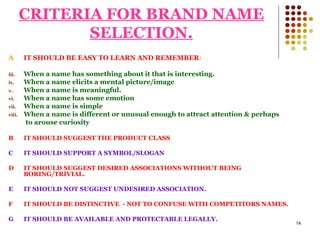
CRITERIA FOR BRAND NAME SELECTION. A IT SHOULD BE EASY TO LEARN AND REMEMBER : When a name has something about it that is interesting. When a name elicits a mental picture/image When a name is meaningful. When a name has some emotion When a name is simple When a name is different or unusual enough to attract attention & perhaps to arouse curiosity B IT SHOULD SUGGEST THE PRODUCT CLASS C IT SHOULD SUPPORT A SYMBOL/SLOGAN D IT SHOULD SUGGEST DESIRED ASSOCIATIONS WITHOUT BEING BORING/TRIVIAL. E IT SHOULD NOT SUGGEST UNDESIRED ASSOCIATION. F IT SHOULD BE DISTINCTIVE  - NOT TO CONFUSE WITH COMPETITORS NAMES. G IT SHOULD BE AVAILABLE AND PROTECTABLE LEGALLY.
SIMPLE QUANTITVE RESEAECH FOR BRAND NAME What Thoughts come to your mind on hearing this name? What does the name mean to you? How would you Pronounce this name? What do you Particularly like about the name? What do you particularly dislike about the name? Which products would the name suit? Which products would the name not suit? Which name do you like the most & Why? Which name do you dislike the most & Why?
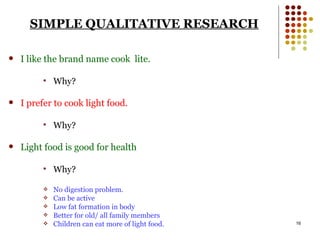
SIMPLE QUALITATIVE RESEARCH I like the brand name cook  lite. Why? I prefer to cook light food. Why? Light food is good for health Why? No digestion problem. Can be active Low fat formation in body Better for old/ all family members Children can eat more of light food.
BRAND REASONS Why should a consumer buy the Brand? What can be the rational reasons? What can be the emotional resons?
RATIONAL  REASONS a)  Feature Based : Technology . Design. Ingredients. b)  Attribute Based : Colour. Shape. Look. Size
C)  Benefit based : Price. Product delivery. Service. Packaging. Maintenance.
EMOTIONAL REASONS What are the emotional reasons for buying the Brand? There are nine universal emotions namely Happiness, anger, disgust, fear, sorrow, courage, compassion, wonder and serenity. (Ex) Pride/Self worth/Confidence/Image projection/ Achievement/ Envy.
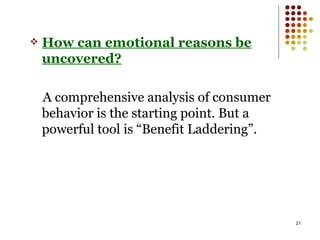
How can emotional reasons be uncovered? A comprehensive analysis of consumer behavior is the starting point. But a powerful tool is “Benefit Laddering”.
BENEFIT LADDERING The set of “Why” questions could lead us in to many different directions. Child can Grow All Ingredients Child needs Health Beverage with 23 vital Ingredients.  Famous Mother Cricket Captain Strong Kid Success in Sports Physical Growth of kids Proud Mother IAS/ IIT/ Doctor Success in exams Mental growth of kids
Brand Strategies New Brands Multi brands Brand Extension Brand Expansion New Existing Product Category New Existing Brand Name Brand Name

Brand Management

  • 1.
    WHAT IS A BRAND? It is combination of features (what the product is), customer benefits (what needs & wants the product meets), & values ( what the customer associates with the product.) A brand is created when marketing adds values to a product in the process differentiates it from other products with similar features & benefits. BRAND
  • 2.
    BRAND VALUES INSTRUMENTALVALUES - WHAT DOES THE BRAND DO ? (ex) Cleans teeth better, or lasts longer - More functional Benefit . DIRECT EXPRESSIVE VALUES - HOW DOES THE BRAND DO ? They reflect the character of the Brand frequently the user. (ex) Modern/ Traditional/ Feminine
  • 3.
    C) CENTRAL VALUES - WHAT ELSE DOES IT DO ? They relate to the aspiration (Personal Drives) (ex) Confidence/ Security/ Freedom CORE VALUES
  • 4.
    BUT, WHAT ISA GENUINE BRAND? “ The internalized sum of all impressions received by customers and consumers resulting in a distinctive position in their ‘ Mind’s Eye’ based on perceived emotional and functional benefits”. Relative Brand Distinction Commodities ----------- No diff. except price. Brand name ----------- Well known but similar. Brand ----------- Distinctive. Genuine brand ---------- Perceived by the consumer as unique.
  • 5.
    A) Yesterdayway to build a Brand F.R.E.D. Model Familiarity Relevance Esteem Differentiation
  • 6.
    TODAY’S WAY TOBUILD A BRAND D.R.E.A.M Model Differentiation. Relevance. Esteem. Awareness. Mind’s eye. What is the distinctive benefit to be communicated to the Tgt audience? What are the best ways to build a specific brand’s image? How is the Mktg. Budget directed to optimize Brand Equity?
  • 7.
    WHAT IS BRANDING? It is a creation & infusion of Brand elements that serve to identify & differentiate a product from others. So, the task of Branding is to define what the brand infuses into the the product/ service & how the brand transforms it. BRAND ELEMENT It is a visual or verbal information that serves to identify & differentiate a product. What are they? Brand name Logo Symbols Characters Packages Slogans
  • 8.
    Criteria for choosingBrand Elements Memorability. Meaningfulness. Transferability. Adaptability. Protect ability.
  • 9.
    THE LOGIC OFBRANDING A Brand aims to segment the market Brands are built up by Persistent Difference over the long run. A brand is a living memory A brand gives products their meaning direction A brand is a Genetic program A brand is a contract It Simplifies customer decision making.
  • 10.
    BRAND MANAGEMENT PROCESSMkt. Analysis Brand Situation Analysis Tgtg. Future Positions Testing New Offers Planning & Evaluating Performance
  • 11.
    BRAND NAME THEBRAND NAME IS The basic core indicator of the brand The basis for awareness The basis for communication effects The basis for Sales measurement More permanent then anything else
  • 12.
    WHAT THE BRANDNAME CAN DO? It helps create association in the mind that act as Descriptor – what it is? And What it does? (ex) – Xerox It provides entry barrier in its category once it gets established. (ex) Burnal/ Surf/ Dettol Through time & use, it becomes a viable asset. (ex) Tata/ Godrej
  • 13.
    TYPES OF NAMESDESCRIPTIVE BRNAD NAME SUGGESTIVE FREE STANDING
  • 14.
    CRITERIA FOR BRANDNAME SELECTION. A IT SHOULD BE EASY TO LEARN AND REMEMBER : When a name has something about it that is interesting. When a name elicits a mental picture/image When a name is meaningful. When a name has some emotion When a name is simple When a name is different or unusual enough to attract attention & perhaps to arouse curiosity B IT SHOULD SUGGEST THE PRODUCT CLASS C IT SHOULD SUPPORT A SYMBOL/SLOGAN D IT SHOULD SUGGEST DESIRED ASSOCIATIONS WITHOUT BEING BORING/TRIVIAL. E IT SHOULD NOT SUGGEST UNDESIRED ASSOCIATION. F IT SHOULD BE DISTINCTIVE - NOT TO CONFUSE WITH COMPETITORS NAMES. G IT SHOULD BE AVAILABLE AND PROTECTABLE LEGALLY.
  • 15.
    SIMPLE QUANTITVE RESEAECHFOR BRAND NAME What Thoughts come to your mind on hearing this name? What does the name mean to you? How would you Pronounce this name? What do you Particularly like about the name? What do you particularly dislike about the name? Which products would the name suit? Which products would the name not suit? Which name do you like the most & Why? Which name do you dislike the most & Why?
  • 16.
    SIMPLE QUALITATIVE RESEARCHI like the brand name cook lite. Why? I prefer to cook light food. Why? Light food is good for health Why? No digestion problem. Can be active Low fat formation in body Better for old/ all family members Children can eat more of light food.
  • 17.
    BRAND REASONS Whyshould a consumer buy the Brand? What can be the rational reasons? What can be the emotional resons?
  • 18.
    RATIONAL REASONSa) Feature Based : Technology . Design. Ingredients. b) Attribute Based : Colour. Shape. Look. Size
  • 19.
    C) Benefitbased : Price. Product delivery. Service. Packaging. Maintenance.
  • 20.
    EMOTIONAL REASONS Whatare the emotional reasons for buying the Brand? There are nine universal emotions namely Happiness, anger, disgust, fear, sorrow, courage, compassion, wonder and serenity. (Ex) Pride/Self worth/Confidence/Image projection/ Achievement/ Envy.
  • 21.
    How can emotionalreasons be uncovered? A comprehensive analysis of consumer behavior is the starting point. But a powerful tool is “Benefit Laddering”.
  • 22.
    BENEFIT LADDERING Theset of “Why” questions could lead us in to many different directions. Child can Grow All Ingredients Child needs Health Beverage with 23 vital Ingredients. Famous Mother Cricket Captain Strong Kid Success in Sports Physical Growth of kids Proud Mother IAS/ IIT/ Doctor Success in exams Mental growth of kids
  • 23.
    Brand Strategies NewBrands Multi brands Brand Extension Brand Expansion New Existing Product Category New Existing Brand Name Brand Name