Prevention
(continued)
let’s talk about
Stroke, TIA and
Warning Signs
What is a TIA?
TIA, or transient ischemic attack, is a “minor stroke”
that occurs when a blood clot blocks an artery for a short
time. The symptoms of a TIA are the same as those of a
stroke, but they usually last only a few minutes.About 15
percent of major strokes are preceded by TIAs, so don’t
ignore a TIA. Call 9-1-1 or seek emergency medical
attention immediately!
Isn’t stroke hopeless?
No. Stroke is largely preventable.You can reduce your
stroke risk by living a healthy lifestyle — controlling
high blood pressure; not smoking; eating a low-fat, low-
cholesterol diet; being physically active; maintaining
a healthy body weight; managing diabetes; drinking
moderately or not at all.
Also, much is being done to fight the effects of stroke.
For example, the FDA approved use of the clot-
dissolving drug tissue plasminogen activator (tPA) to
treat stroke. This is an advance because tPA can stop a
stroke in progress and reduce disability. But to be eligible
for tPA, you must seek emergency treatment right
away, because it must be given within 4.5 hours after
symptoms start, and have a clot-caused stroke.
What are warning signs of stroke?
You and your family should recognize the warning
signs of stroke.You may have some or all of these signs.
Note the time when symptoms start and call 9-1-1 or
the emergency medical number in your area. Stroke is a
medical emergency!
Don’t ignore these warning signs, even if they go away.
Timing is important. There are treatments that can be
considered within 4 1/2 hours of the onset of symptoms.
Stroke Warning Signs:
• Sudden numbness or weakness of the face, arm or leg,
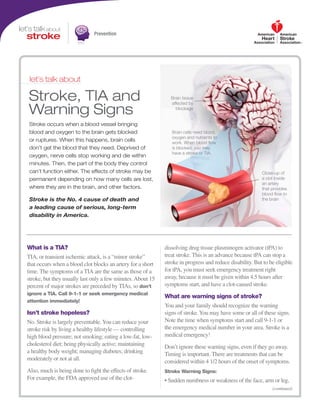
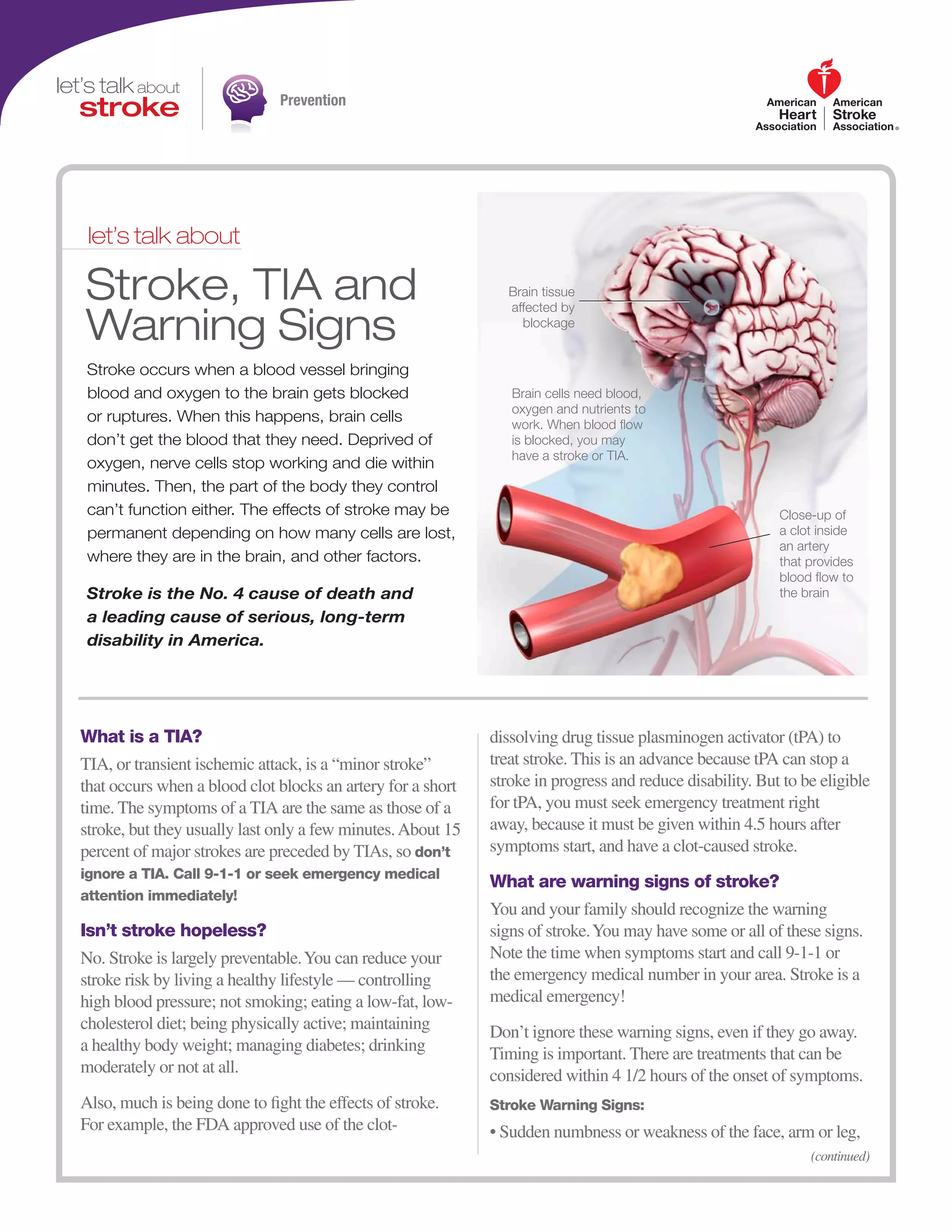
Stroke occurs when a blood vessel bringing
blood and oxygen to the brain gets blocked
or ruptures. When this happens, brain cells
don’t get the blood that they need. Deprived of
oxygen, nerve cells stop working and die within
minutes. Then, the part of the body they control
can’t function either. The effects of stroke may be
permanent depending on how many cells are lost,
where they are in the brain, and other factors.
Stroke is the No. 4 cause of death and
a leading cause of serious, long-term
disability in America.
Brain cells need blood,
oxygen and nutrients to
work. When blood flow
is blocked, you may
have a stroke or TIA.
Close-up of
a clot inside
an artery
that provides
blood flow to
the brain
Brain tissue
affected by
blockage
Prevention
We have many other fact sheets to help you make healthier choices to reduce your risk, manage
disease or care for a loved one. Visit strokeassociation.org/letstalkaboutstroke to learn more.
Knowledge is power, so Learn and Live!
Take a few minutes to
write your questions for
the next time you see
your healthcare provider.
For example:
Talk to your doctor, nurse or other
healthcare professionals. Ask about
other stroke topics.
Call 1-888-4-STROKE (1-888-478-7653)
or visit us at StrokeAssociation.org to
learn more about stroke.
Call the American Stroke Association’s
“Warmline” at 1-888-4-STROKE
(1-888-478-7653), and:
• Sign up for Stroke Connection, a free
magazine for stroke survivors and
caregivers.
• Talk to other stroke survivors and
caregivers and find local support groups.
HOW CAN I LEARN MORE? Do you have
questions for the
doctor or nurse?
©2012, American Heart Association
Which facility
close to me is best
equipped to treat me
if I am having stroke
symptoms?
How can I reduce my
risk for stroke?
My Questions:
Stroke, TIA and Warning Signs
especially on one side of the body
• Sudden confusion, trouble speaking or understanding
• Sudden trouble seeing in one or both eyes
• Sudden trouble walking, dizziness, loss of balance or
coordination
• Sudden severe headache with no known cause
Before you need to take emergency action, find out
where the emergency entrance is to your nearest hospital.
Also, keep a list of emergency phone numbers next to
your phone and with you at all times, just in case. Take
these steps NOW!
If you think you may be having a stroke, don’t hesitate... immediately
call 9-1-1 or your emergency response number.

Stroke

  • 1.
    Prevention (continued) let’s talk about Stroke,TIA and Warning Signs What is a TIA? TIA, or transient ischemic attack, is a “minor stroke” that occurs when a blood clot blocks an artery for a short time. The symptoms of a TIA are the same as those of a stroke, but they usually last only a few minutes.About 15 percent of major strokes are preceded by TIAs, so don’t ignore a TIA. Call 9-1-1 or seek emergency medical attention immediately! Isn’t stroke hopeless? No. Stroke is largely preventable.You can reduce your stroke risk by living a healthy lifestyle — controlling high blood pressure; not smoking; eating a low-fat, low- cholesterol diet; being physically active; maintaining a healthy body weight; managing diabetes; drinking moderately or not at all. Also, much is being done to fight the effects of stroke. For example, the FDA approved use of the clot- dissolving drug tissue plasminogen activator (tPA) to treat stroke. This is an advance because tPA can stop a stroke in progress and reduce disability. But to be eligible for tPA, you must seek emergency treatment right away, because it must be given within 4.5 hours after symptoms start, and have a clot-caused stroke. What are warning signs of stroke? You and your family should recognize the warning signs of stroke.You may have some or all of these signs. Note the time when symptoms start and call 9-1-1 or the emergency medical number in your area. Stroke is a medical emergency! Don’t ignore these warning signs, even if they go away. Timing is important. There are treatments that can be considered within 4 1/2 hours of the onset of symptoms. Stroke Warning Signs: • Sudden numbness or weakness of the face, arm or leg, Stroke occurs when a blood vessel bringing blood and oxygen to the brain gets blocked or ruptures. When this happens, brain cells don’t get the blood that they need. Deprived of oxygen, nerve cells stop working and die within minutes. Then, the part of the body they control can’t function either. The effects of stroke may be permanent depending on how many cells are lost, where they are in the brain, and other factors. Stroke is the No. 4 cause of death and a leading cause of serious, long-term disability in America. Brain cells need blood, oxygen and nutrients to work. When blood flow is blocked, you may have a stroke or TIA. Close-up of a clot inside an artery that provides blood flow to the brain Brain tissue affected by blockage
  • 2.
    Prevention We have manyother fact sheets to help you make healthier choices to reduce your risk, manage disease or care for a loved one. Visit strokeassociation.org/letstalkaboutstroke to learn more. Knowledge is power, so Learn and Live! Take a few minutes to write your questions for the next time you see your healthcare provider. For example: Talk to your doctor, nurse or other healthcare professionals. Ask about other stroke topics. Call 1-888-4-STROKE (1-888-478-7653) or visit us at StrokeAssociation.org to learn more about stroke. Call the American Stroke Association’s “Warmline” at 1-888-4-STROKE (1-888-478-7653), and: • Sign up for Stroke Connection, a free magazine for stroke survivors and caregivers. • Talk to other stroke survivors and caregivers and find local support groups. HOW CAN I LEARN MORE? Do you have questions for the doctor or nurse? ©2012, American Heart Association Which facility close to me is best equipped to treat me if I am having stroke symptoms? How can I reduce my risk for stroke? My Questions: Stroke, TIA and Warning Signs especially on one side of the body • Sudden confusion, trouble speaking or understanding • Sudden trouble seeing in one or both eyes • Sudden trouble walking, dizziness, loss of balance or coordination • Sudden severe headache with no known cause Before you need to take emergency action, find out where the emergency entrance is to your nearest hospital. Also, keep a list of emergency phone numbers next to your phone and with you at all times, just in case. Take these steps NOW! If you think you may be having a stroke, don’t hesitate... immediately call 9-1-1 or your emergency response number.