EMOTIONAL LANGUAGE
PRODUCTION:
Time course, behavioral and
electrophysiological correlates
NAFIZ ISHTIAQUE AHMED
LITERATURE REVIEW
UOU – UNIVERSITY OF ULSAN
Agenda
● Language production
● Speech planningContext
● Early posterior negativity
● Self monitoring
● Residue interaction decomposition
Approach
● RAID Experiment no 1 (+ , - , N )
● RAID Experiment no 2 (- & N)Finding
● Discussion
Overview
Language production
Mental lexicon stores generalize concept of
semantic meaning.
Activation of respected lexical entries.
In addition with categorical link, the mental
lexicon is also sensitive to emotional content.
Speech planning
Well investigated semantic message
generation.
Is there any relation between emotional
language production at speech planning?
Approach
The research will bridge the gap using event-
related potential (ERP) on EEG while overt
speaking in two steps.
REF:: https://multimodalmetaphor.com/2016/11/15/%E4%BD%A0%E5%A5%BD-emma-hi-everyone-from-the-psycholinguistics-lab-at-
university-of-nottingham-ningbo-in-china/
(i) EPN (early posterior negativity)
Motivated attention & enhanced sensory
perception affect the pre-word processing.
They assume the basic conceptual and lexical
process should be affected because of the
combination of semantic meaning and
emotional meaning.
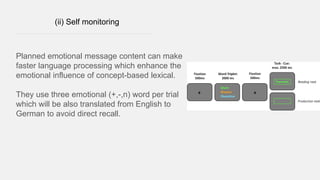
(ii) Self monitoring
Planned emotional message content can make
faster language processing which enhance the
emotional influence of concept-based lexical.
They use three emotional (+,-,n) word per trial
which will be also translated from English to
German to avoid direct recall.
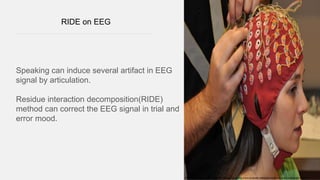
RIDE on EEG
Speaking can induce several artifact in EEG
signal by articulation.
Residue interaction decomposition(RIDE)
method can correct the EEG signal in trial and
error mood.
REF::https://www.evolving-science.com/bioengineering-brain-computer-interfaces/monitoring-brain-outside-lab-00129
Finding
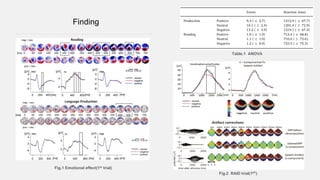
Table.1 ANOVA
Fig.2 RAID trial(1ST)
Fig.1 Emotional effect(1st trial)
Finding
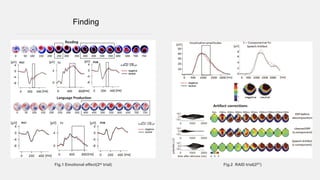
Fig.1 Emotional effect(2st trial) Fig.2 RAID trial(2ST)
Discussion
Emotion effect were found for negative
content only.
Whereas, no reliable effects of emotion on
semantic and lexical stage on language
production were found.
Contact Nafiz Ishtiaque Ahmed
cse.ishtiaque@gmail.com
@Nafiz_Ishtiaque

Brain signal seminar

  • 1.
    EMOTIONAL LANGUAGE PRODUCTION: Time course,behavioral and electrophysiological correlates NAFIZ ISHTIAQUE AHMED LITERATURE REVIEW UOU – UNIVERSITY OF ULSAN
  • 2.
    Agenda ● Language production ●Speech planningContext ● Early posterior negativity ● Self monitoring ● Residue interaction decomposition Approach ● RAID Experiment no 1 (+ , - , N ) ● RAID Experiment no 2 (- & N)Finding ● Discussion Overview
  • 3.
    Language production Mental lexiconstores generalize concept of semantic meaning. Activation of respected lexical entries. In addition with categorical link, the mental lexicon is also sensitive to emotional content.
  • 4.
    Speech planning Well investigatedsemantic message generation. Is there any relation between emotional language production at speech planning?
  • 5.
    Approach The research willbridge the gap using event- related potential (ERP) on EEG while overt speaking in two steps. REF:: https://multimodalmetaphor.com/2016/11/15/%E4%BD%A0%E5%A5%BD-emma-hi-everyone-from-the-psycholinguistics-lab-at- university-of-nottingham-ningbo-in-china/
  • 6.
    (i) EPN (earlyposterior negativity) Motivated attention & enhanced sensory perception affect the pre-word processing. They assume the basic conceptual and lexical process should be affected because of the combination of semantic meaning and emotional meaning.
  • 7.
    (ii) Self monitoring Plannedemotional message content can make faster language processing which enhance the emotional influence of concept-based lexical. They use three emotional (+,-,n) word per trial which will be also translated from English to German to avoid direct recall.
  • 8.
    RIDE on EEG Speakingcan induce several artifact in EEG signal by articulation. Residue interaction decomposition(RIDE) method can correct the EEG signal in trial and error mood. REF::https://www.evolving-science.com/bioengineering-brain-computer-interfaces/monitoring-brain-outside-lab-00129
  • 9.
    Finding Table.1 ANOVA Fig.2 RAIDtrial(1ST) Fig.1 Emotional effect(1st trial)
  • 10.
    Finding Fig.1 Emotional effect(2sttrial) Fig.2 RAID trial(2ST)
  • 11.
    Discussion Emotion effect werefound for negative content only. Whereas, no reliable effects of emotion on semantic and lexical stage on language production were found.
  • 12.
    Contact Nafiz IshtiaqueAhmed cse.ishtiaque@gmail.com @Nafiz_Ishtiaque