GECCO - 2018
Genetic Programming for Tuberculosis
Screening from Raw X-ray Images
-
Armand R. Burks, William F. Punch
NAFIZ ISHTIAQUE AHMED
20185748
DEPARTMENT of BIOMEDICAL ENGINEERING
UOU – UNIVERSITY OF ULSAN
Agenda
● Background
● IntroductionIntroduction
● Method
● ExperimentApproach
● Finding
● DiscussionOverview
Introduction
Genetic programming for detecting active tuberculosis
in raw X-ray images.
A classifiers that do not require pre-processing,
segmentation, or feature extraction.
A classifiers faster than the reported times form
traditional techniques.
Genetic Programming for Image Classification
The traditional approach to image classification
involves first performing segmentation and feature
extraction and then classifying the image using the
extracted features.
This can be time-consuming since the images must
be preprocessed.
A three-tiered GP approach (3TGP) was developed as
a means of evolving programs that are capable of
performing all the steps.
3TGP Architecture
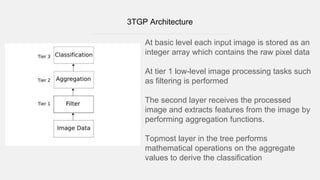
At basic level each input image is stored as an
integer array which contains the raw pixel data
At tier 1 low-level image processing tasks such
as filtering is performed
The second layer receives the processed
image and extracts features from the image by
performing aggregation functions.
Topmost layer in the tree performs
mathematical operations on the aggregate
values to derive the classification
Method
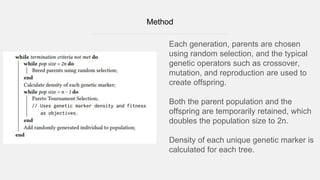
Each generation, parents are chosen
using random selection, and the typical
genetic operators such as crossover,
mutation, and reproduction are used to
create offspring.
Both the parent population and the
offspring are temporarily retained, which
doubles the population size to 2n.
Density of each unique genetic marker is
calculated for each tree.
Method
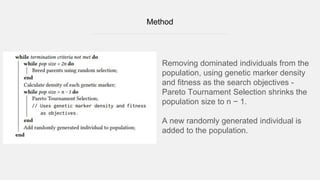
Removing dominated individuals from the
population, using genetic marker density
and fitness as the search objectives -
Pareto Tournament Selection shrinks the
population size to n − 1.
A new randomly generated individual is
added to the population.
TB Experiment
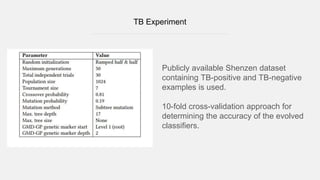
Publicly available Shenzen dataset
containing TB-positive and TB-negative
examples is used.
10-fold cross-validation approach for
determining the accuracy of the evolved
classifiers.
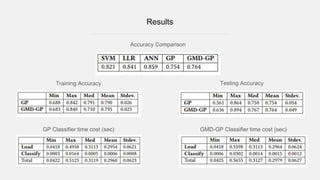
Results
Testing AccuracyTraining Accuracy
Accuracy Comparison
GP Classifier time cost (sec) GMD-GP Classifier time cost (sec)
Results
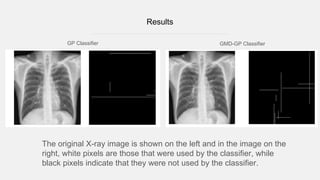
The original X-ray image is shown on the left and in the image on the
right, white pixels are those that were used by the classifier, while
black pixels indicate that they were not used by the classifier.
GP Classifier GMD-GP Classifier
Discussion
The 2TGP framework classifiers perform all of the classification
steps in a single program, providing a classification for an X-ray
in only a fraction of a second, which is significantly faster than
the reported times of the other techniques.
Faster classification speed hence required large memory.
However, the actual classifiers only operate on a single image
at any given time and can be executed on inexpensive
hardware such as a personal computer.
Thank You
Nafiz Ishtiaque Ahmed
cse.ishtiaque@gmail.com
@Nafiz_Ishtiaque

Brain signal seminar

  • 1.
    GECCO - 2018 GeneticProgramming for Tuberculosis Screening from Raw X-ray Images - Armand R. Burks, William F. Punch NAFIZ ISHTIAQUE AHMED 20185748 DEPARTMENT of BIOMEDICAL ENGINEERING UOU – UNIVERSITY OF ULSAN
  • 2.
    Agenda ● Background ● IntroductionIntroduction ●Method ● ExperimentApproach ● Finding ● DiscussionOverview
  • 3.
    Introduction Genetic programming fordetecting active tuberculosis in raw X-ray images. A classifiers that do not require pre-processing, segmentation, or feature extraction. A classifiers faster than the reported times form traditional techniques.
  • 4.
    Genetic Programming forImage Classification The traditional approach to image classification involves first performing segmentation and feature extraction and then classifying the image using the extracted features. This can be time-consuming since the images must be preprocessed. A three-tiered GP approach (3TGP) was developed as a means of evolving programs that are capable of performing all the steps.
  • 5.
    3TGP Architecture At basiclevel each input image is stored as an integer array which contains the raw pixel data At tier 1 low-level image processing tasks such as filtering is performed The second layer receives the processed image and extracts features from the image by performing aggregation functions. Topmost layer in the tree performs mathematical operations on the aggregate values to derive the classification
  • 6.
    Method Each generation, parentsare chosen using random selection, and the typical genetic operators such as crossover, mutation, and reproduction are used to create offspring. Both the parent population and the offspring are temporarily retained, which doubles the population size to 2n. Density of each unique genetic marker is calculated for each tree.
  • 7.
    Method Removing dominated individualsfrom the population, using genetic marker density and fitness as the search objectives - Pareto Tournament Selection shrinks the population size to n − 1. A new randomly generated individual is added to the population.
  • 8.
    TB Experiment Publicly availableShenzen dataset containing TB-positive and TB-negative examples is used. 10-fold cross-validation approach for determining the accuracy of the evolved classifiers.
  • 9.
    Results Testing AccuracyTraining Accuracy AccuracyComparison GP Classifier time cost (sec) GMD-GP Classifier time cost (sec)
  • 10.
    Results The original X-rayimage is shown on the left and in the image on the right, white pixels are those that were used by the classifier, while black pixels indicate that they were not used by the classifier. GP Classifier GMD-GP Classifier
  • 11.
    Discussion The 2TGP frameworkclassifiers perform all of the classification steps in a single program, providing a classification for an X-ray in only a fraction of a second, which is significantly faster than the reported times of the other techniques. Faster classification speed hence required large memory. However, the actual classifiers only operate on a single image at any given time and can be executed on inexpensive hardware such as a personal computer.
  • 12.
    Thank You Nafiz IshtiaqueAhmed cse.ishtiaque@gmail.com @Nafiz_Ishtiaque