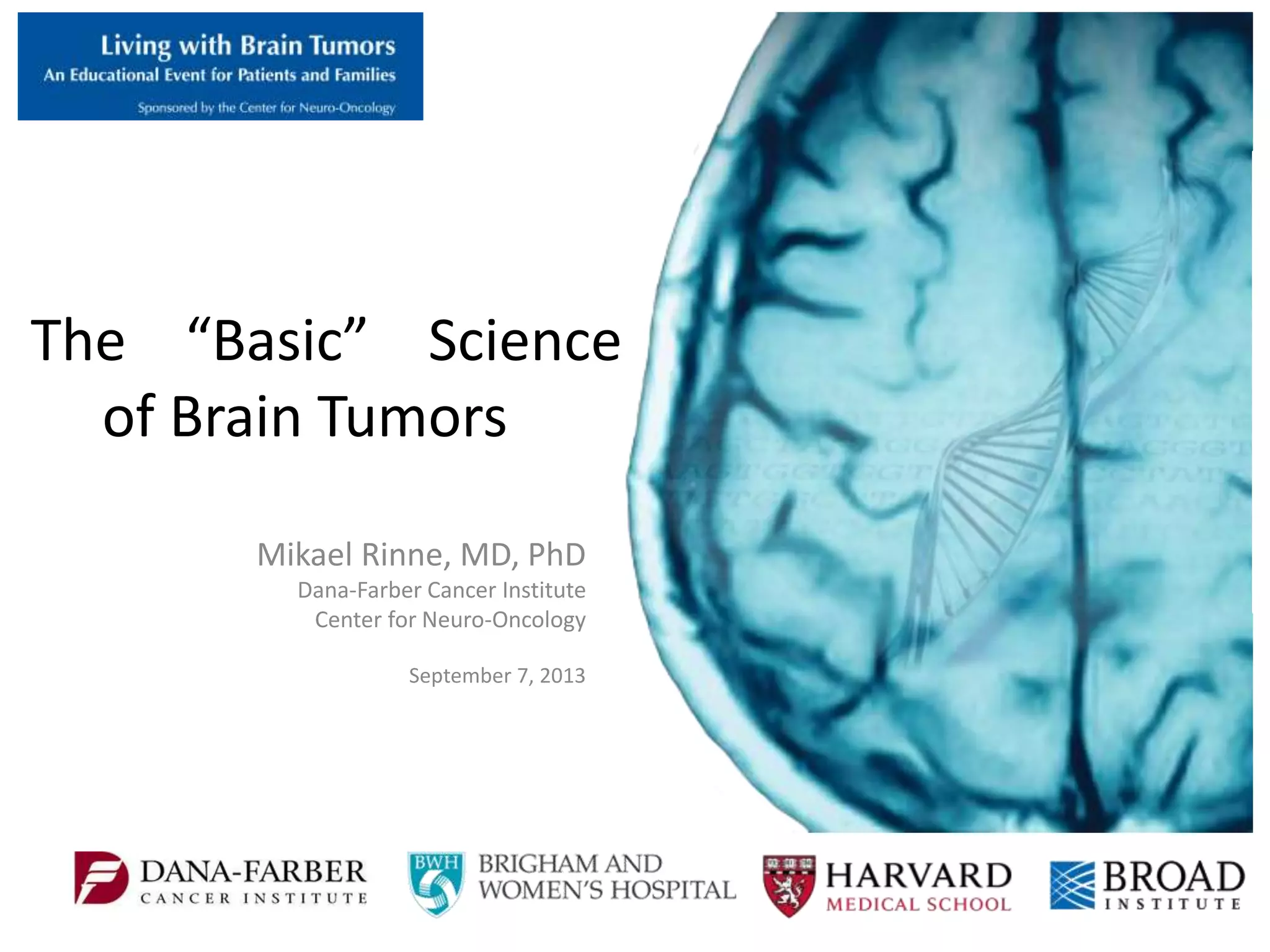
The “Basic” Science
Mikael Rinne, M.D., Ph.D.
Dana-Farber Cancer Institute
Center for Neuro-Oncology
September 7, 2013
of Brain Tumors
What is Cancer?
DNA directs the functions of cells
Adaptedfromwww.scienceprogress.org
Alterations in the DNA can disrupt cellular function
(mutation, amplification, deletion)
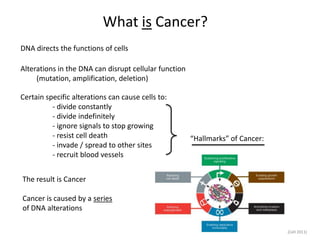
Certain specific alterations can cause cells to:
- divide constantly
- divide indefinitely
- ignore signals to stop growing
- resist cell death
- invade / spread to other sites
- recruit blood vessels
What is Cancer?
DNA directs the functions of cells
“Hallmarks” of Cancer:
(Cell 2011)
Adaptedfromwww.scienceprogress.org
Alterations in the DNA can disrupt cellular function
(mutation, amplification, deletion)
Certain specific alterations can cause cells to:
- divide constantly
- divide indefinitely
- ignore signals to stop growing
- resist cell death
- invade / spread to other sites
- recruit blood vessels
What is Cancer?
DNA directs the functions of cells
“Hallmarks” of Cancer:
(Cell 2011)
Adaptedfromwww.scienceprogress.org
Alterations in the DNA can disrupt cellular function
(mutation, amplification, deletion)
Certain specific alterations can cause cells to:
- divide constantly
- divide indefinitely
- ignore signals to stop growing
- resist cell death
- invade / spread to other sites
- recruit blood vessels
The result is Cancer
Cancer is caused by a series
of DNA alterations
What causes these changes in DNA?
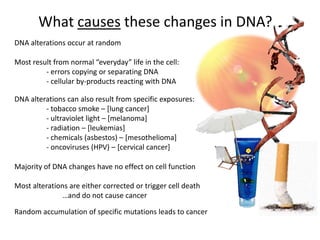
DNA alterations occur at random
Most result from normal “everyday” life in the cell:
- errors copying or separating DNA
- cellular by-products reacting with DNA
What causes these changes in DNA?
DNA alterations occur at random
Most result from normal “everyday” life in the cell:
- errors copying or separating DNA
- cellular by-products reacting with DNA
DNA alterations can also result from specific exposures:
- tobacco smoke – [lung cancer]
- ultraviolet light – [melanoma]
- radiation – [leukemias]
- chemicals (asbestos) – [mesothelioma]
- oncoviruses (HPV) – [cervical cancer]
What causes these changes in DNA?
DNA alterations occur at random
Random accumulation of specific mutations leads to cancer
Most result from normal “everyday” life in the cell:
- errors copying or separating DNA
- cellular by-products reacting with DNA
DNA alterations can also result from specific exposures:
- tobacco smoke – [lung cancer]
- ultraviolet light – [melanoma]
- radiation – [leukemias]
- chemicals (asbestos) – [mesothelioma]
- oncoviruses (HPV) – [cervical cancer]
Majority of DNA changes have no effect on cell function
Most alterations are either corrected or trigger cell death
…and do not cause cancer
How can cancer cell growth be stopped?
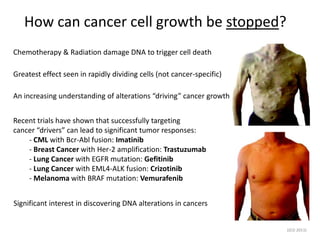
Chemotherapy & Radiation damage DNA to trigger cell death
Greatest effect seen in rapidly dividing cells (not cancer-specific)
An increasing understanding of alterations “driving” cancer growth
How can cancer cell growth be stopped?
(NEJM 2004)
(NEJM 2010)
(NEJM 2010)
Chemotherapy & Radiation damage DNA to trigger cell death
Greatest effect seen in rapidly dividing cells (not cancer-specific)
An increasing understanding of alterations “driving” cancer growth
Recent trials have shown that successfully targeting
cancer “drivers” can lead to significant tumor responses:
- CML with Bcr-Abl fusion: Imatinib
- Breast Cancer with Her-2 amplification: Trastuzumab
- Lung Cancer with EGFR mutation: Gefitinib
- Lung Cancer with EML4-ALK fusion: Crizotinib
- Melanoma with BRAF mutation: Vemurafenib
How can cancer cell growth be stopped?
(NEJM 2004)
(NEJM 2010)
(NEJM 2010)
Chemotherapy & Radiation damage DNA to trigger cell death
Greatest effect seen in rapidly dividing cells (not cancer-specific)
An increasing understanding of alterations “driving” cancer growth
Recent trials have shown that successfully targeting
cancer “drivers” can lead to significant tumor responses:
- CML with Bcr-Abl fusion: Imatinib
- Breast Cancer with Her-2 amplification: Trastuzumab
- Lung Cancer with EGFR mutation: Gefitinib
- Lung Cancer with EML4-ALK fusion: Crizotinib
- Melanoma with BRAF mutation: Vemurafenib
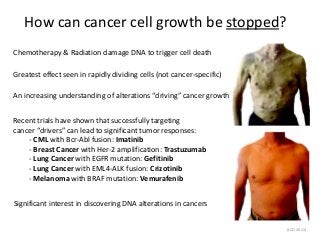
How can cancer cell growth be stopped?
(NEJM 2004)
(NEJM 2010)
(NEJM 2010)
(JCO 2011)
Significant interest in discovering DNA alterations in cancers
Chemotherapy & Radiation damage DNA to trigger cell death
Greatest effect seen in rapidly dividing cells (not cancer-specific)
An increasing understanding of alterations “driving” cancer growth
Recent trials have shown that successfully targeting
cancer “drivers” can lead to significant tumor responses:
- CML with Bcr-Abl fusion: Imatinib
- Breast Cancer with Her-2 amplification: Trastuzumab
- Lung Cancer with EGFR mutation: Gefitinib
- Lung Cancer with EML4-ALK fusion: Crizotinib
- Melanoma with BRAF mutation: Vemurafenib
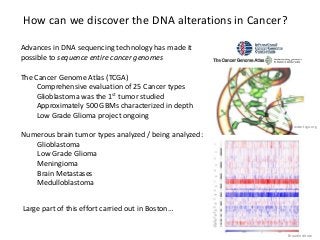
How can we discover the DNA alterations in Cancer?
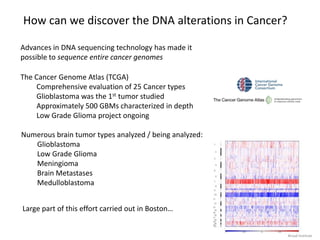
Advances in DNA sequencing technology has made it
possible to sequence entire cancer genomes
www.tcga.org
Broad Institute
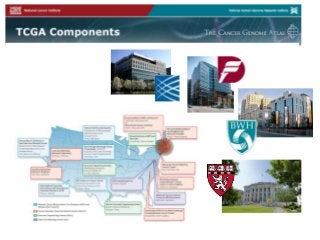
Large part of this effort carried out in Boston…
The Cancer Genome Atlas (TCGA)
Comprehensive evaluation of 25 Cancer types
Glioblastoma was the 1st tumor studied
Approximately 500 GBMs characterized in depth
Low Grade Glioma project ongoing
Numerous brain tumor types analyzed / being analyzed:
Glioblastoma
Low Grade Glioma
Meningioma
Brain Metastases
Medulloblastoma
What about DNA alterations in Individual Tumors?
Every tumor can have different alterations
Potential for different “drivers” of tumor growth
Certain alterations are more common
Revealed by studying many tumors
To translate these findings to individual patients,
we need to know which alterations are present
in an individual patient’s tumor
What about DNA alterations in Individual Tumors?
Every tumor can have different alterations
Potential for different “drivers” of tumor growth
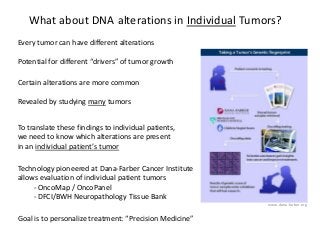
www.dana-farber.org
Goal is to personalize treatment: “Precision Medicine”
Certain alterations are more common
Revealed by studying many tumors
To translate these findings to individual patients,
we need to know which alterations are present
in an individual patient’s tumor
Technology pioneered at Dana-Farber Cancer Institute
allows evaluation of individual patient tumors
- OncoMap / OncoPanel
- DFCI/BWH Neuropathology Tissue Bank
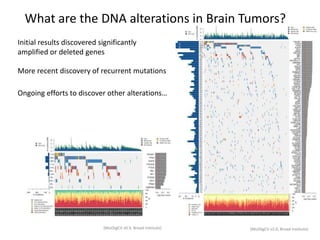
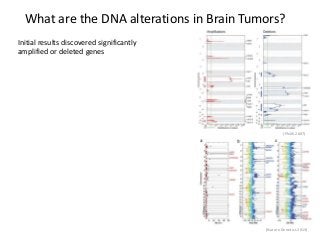
What are the DNA alterations in Brain Tumors?
Initial results discovered significantly
amplified or deleted genes
(Nature Genetics 2013)
(PNAS 2007)
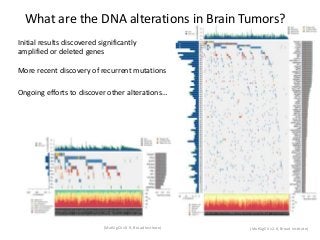
What are the DNA alterations in Brain Tumors?
(MutSigCV v0.9, Broad Institute)
Initial results discovered significantly
amplified or deleted genes
(Nature Genetics 2013)
(PNAS 2007)
(MutSigCV v2.0, Broad Institute)
Ongoing efforts to discover other alterations…
More recent discovery of recurrent mutations
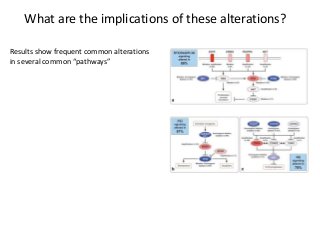
What are the implications of these alterations?
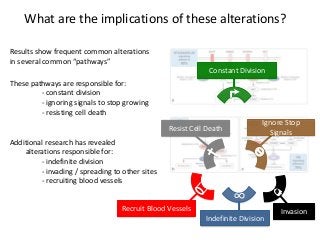
Results show frequent common alterations
in several common “pathways”
What are the implications of these alterations?
Results show frequent common alterations
in several common “pathways”
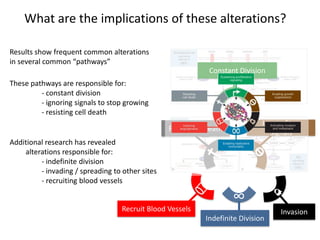
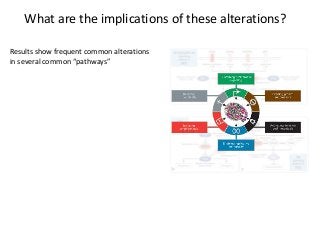
What are the implications of these alterations?
Results show frequent common alterations
in several common “pathways”
Constant Division
Ignore Stop
Signals
Resist Cell Death
Indefinite Division
∞
Recruit Blood Vessels Invasion
Additional research has revealed
alterations responsible for:
- indefinite division
- invading / spreading to other sites
- recruiting blood vessels
These pathways are responsible for:
- constant division
- ignoring signals to stop growing
- resisting cell death
Indefinite Division
∞
Recruit Blood Vessels Invasion
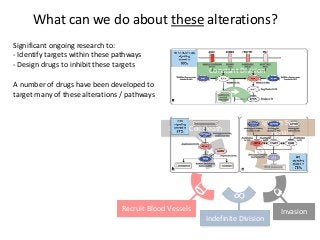
What can we do about these alterations?
Constant Division
Ignore Stop
Signals
Resist Cell Death
A number of drugs have been developed to
target many of these alterations / pathways
Significant ongoing research to:
- Identify targets within these pathways
- Design drugs to inhibit these targets
Indefinite Division
∞
Recruit Blood Vessels Invasion
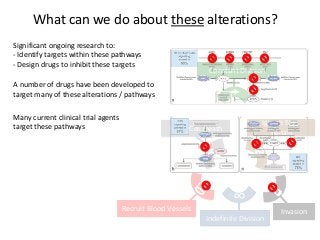
What can we do about these alterations?
Constant Division
Ignore Stop
Signals
Resist Cell Death
A number of drugs have been developed to
target many of these alterations / pathways
Many current clinical trial agents
target these pathways
Significant ongoing research to:
- Identify targets within these pathways
- Design drugs to inhibit these targets
Indefinite Division
∞
Recruit Blood Vessels Invasion
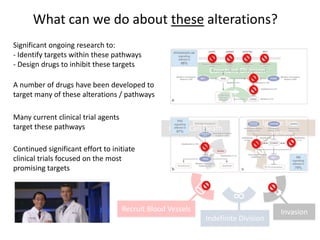
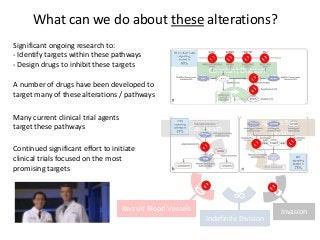
What can we do about these alterations?
Constant Division
Ignore Stop
Signals
Resist Cell Death
A number of drugs have been developed to
target many of these alterations / pathways
Continued significant effort to initiate
clinical trials focused on the most
promising targets
Many current clinical trial agents
target these pathways
Significant ongoing research to:
- Identify targets within these pathways
- Design drugs to inhibit these targets

The Basic Science of Brain Tumors

  • 1.
    The “Basic” Science MikaelRinne, M.D., Ph.D. Dana-Farber Cancer Institute Center for Neuro-Oncology September 7, 2013 of Brain Tumors
  • 2.
    What is Cancer? DNAdirects the functions of cells Adaptedfromwww.scienceprogress.org Alterations in the DNA can disrupt cellular function (mutation, amplification, deletion) Certain specific alterations can cause cells to: - divide constantly - divide indefinitely - ignore signals to stop growing - resist cell death - invade / spread to other sites - recruit blood vessels
  • 3.
    What is Cancer? DNAdirects the functions of cells “Hallmarks” of Cancer: (Cell 2011) Adaptedfromwww.scienceprogress.org Alterations in the DNA can disrupt cellular function (mutation, amplification, deletion) Certain specific alterations can cause cells to: - divide constantly - divide indefinitely - ignore signals to stop growing - resist cell death - invade / spread to other sites - recruit blood vessels
  • 4.
    What is Cancer? DNAdirects the functions of cells “Hallmarks” of Cancer: (Cell 2011) Adaptedfromwww.scienceprogress.org Alterations in the DNA can disrupt cellular function (mutation, amplification, deletion) Certain specific alterations can cause cells to: - divide constantly - divide indefinitely - ignore signals to stop growing - resist cell death - invade / spread to other sites - recruit blood vessels The result is Cancer Cancer is caused by a series of DNA alterations
  • 5.
    What causes thesechanges in DNA? DNA alterations occur at random Most result from normal “everyday” life in the cell: - errors copying or separating DNA - cellular by-products reacting with DNA
  • 6.
    What causes thesechanges in DNA? DNA alterations occur at random Most result from normal “everyday” life in the cell: - errors copying or separating DNA - cellular by-products reacting with DNA DNA alterations can also result from specific exposures: - tobacco smoke – [lung cancer] - ultraviolet light – [melanoma] - radiation – [leukemias] - chemicals (asbestos) – [mesothelioma] - oncoviruses (HPV) – [cervical cancer]
  • 7.
    What causes thesechanges in DNA? DNA alterations occur at random Random accumulation of specific mutations leads to cancer Most result from normal “everyday” life in the cell: - errors copying or separating DNA - cellular by-products reacting with DNA DNA alterations can also result from specific exposures: - tobacco smoke – [lung cancer] - ultraviolet light – [melanoma] - radiation – [leukemias] - chemicals (asbestos) – [mesothelioma] - oncoviruses (HPV) – [cervical cancer] Majority of DNA changes have no effect on cell function Most alterations are either corrected or trigger cell death …and do not cause cancer
  • 8.
    How can cancercell growth be stopped? Chemotherapy & Radiation damage DNA to trigger cell death Greatest effect seen in rapidly dividing cells (not cancer-specific) An increasing understanding of alterations “driving” cancer growth
  • 9.
    How can cancercell growth be stopped? (NEJM 2004) (NEJM 2010) (NEJM 2010) Chemotherapy & Radiation damage DNA to trigger cell death Greatest effect seen in rapidly dividing cells (not cancer-specific) An increasing understanding of alterations “driving” cancer growth Recent trials have shown that successfully targeting cancer “drivers” can lead to significant tumor responses: - CML with Bcr-Abl fusion: Imatinib - Breast Cancer with Her-2 amplification: Trastuzumab - Lung Cancer with EGFR mutation: Gefitinib - Lung Cancer with EML4-ALK fusion: Crizotinib - Melanoma with BRAF mutation: Vemurafenib
  • 10.
    How can cancercell growth be stopped? (NEJM 2004) (NEJM 2010) (NEJM 2010) Chemotherapy & Radiation damage DNA to trigger cell death Greatest effect seen in rapidly dividing cells (not cancer-specific) An increasing understanding of alterations “driving” cancer growth Recent trials have shown that successfully targeting cancer “drivers” can lead to significant tumor responses: - CML with Bcr-Abl fusion: Imatinib - Breast Cancer with Her-2 amplification: Trastuzumab - Lung Cancer with EGFR mutation: Gefitinib - Lung Cancer with EML4-ALK fusion: Crizotinib - Melanoma with BRAF mutation: Vemurafenib
  • 11.
    How can cancercell growth be stopped? (NEJM 2004) (NEJM 2010) (NEJM 2010) (JCO 2011) Significant interest in discovering DNA alterations in cancers Chemotherapy & Radiation damage DNA to trigger cell death Greatest effect seen in rapidly dividing cells (not cancer-specific) An increasing understanding of alterations “driving” cancer growth Recent trials have shown that successfully targeting cancer “drivers” can lead to significant tumor responses: - CML with Bcr-Abl fusion: Imatinib - Breast Cancer with Her-2 amplification: Trastuzumab - Lung Cancer with EGFR mutation: Gefitinib - Lung Cancer with EML4-ALK fusion: Crizotinib - Melanoma with BRAF mutation: Vemurafenib
  • 12.
    How can wediscover the DNA alterations in Cancer? Advances in DNA sequencing technology has made it possible to sequence entire cancer genomes www.tcga.org Broad Institute Large part of this effort carried out in Boston… The Cancer Genome Atlas (TCGA) Comprehensive evaluation of 25 Cancer types Glioblastoma was the 1st tumor studied Approximately 500 GBMs characterized in depth Low Grade Glioma project ongoing Numerous brain tumor types analyzed / being analyzed: Glioblastoma Low Grade Glioma Meningioma Brain Metastases Medulloblastoma
  • 14.
    What about DNAalterations in Individual Tumors? Every tumor can have different alterations Potential for different “drivers” of tumor growth Certain alterations are more common Revealed by studying many tumors To translate these findings to individual patients, we need to know which alterations are present in an individual patient’s tumor
  • 15.
    What about DNAalterations in Individual Tumors? Every tumor can have different alterations Potential for different “drivers” of tumor growth www.dana-farber.org Goal is to personalize treatment: “Precision Medicine” Certain alterations are more common Revealed by studying many tumors To translate these findings to individual patients, we need to know which alterations are present in an individual patient’s tumor Technology pioneered at Dana-Farber Cancer Institute allows evaluation of individual patient tumors - OncoMap / OncoPanel - DFCI/BWH Neuropathology Tissue Bank
  • 16.
    What are theDNA alterations in Brain Tumors? Initial results discovered significantly amplified or deleted genes (Nature Genetics 2013) (PNAS 2007)
  • 17.
    What are theDNA alterations in Brain Tumors? (MutSigCV v0.9, Broad Institute) Initial results discovered significantly amplified or deleted genes (Nature Genetics 2013) (PNAS 2007) (MutSigCV v2.0, Broad Institute) Ongoing efforts to discover other alterations… More recent discovery of recurrent mutations
  • 18.
    What are theimplications of these alterations? Results show frequent common alterations in several common “pathways”
  • 19.
    What are theimplications of these alterations? Results show frequent common alterations in several common “pathways”
  • 20.
    What are theimplications of these alterations? Results show frequent common alterations in several common “pathways” Constant Division Ignore Stop Signals Resist Cell Death Indefinite Division ∞ Recruit Blood Vessels Invasion Additional research has revealed alterations responsible for: - indefinite division - invading / spreading to other sites - recruiting blood vessels These pathways are responsible for: - constant division - ignoring signals to stop growing - resisting cell death
  • 21.
    Indefinite Division ∞ Recruit BloodVessels Invasion What can we do about these alterations? Constant Division Ignore Stop Signals Resist Cell Death A number of drugs have been developed to target many of these alterations / pathways Significant ongoing research to: - Identify targets within these pathways - Design drugs to inhibit these targets
  • 22.
    Indefinite Division ∞ Recruit BloodVessels Invasion What can we do about these alterations? Constant Division Ignore Stop Signals Resist Cell Death A number of drugs have been developed to target many of these alterations / pathways Many current clinical trial agents target these pathways Significant ongoing research to: - Identify targets within these pathways - Design drugs to inhibit these targets
  • 23.
    Indefinite Division ∞ Recruit BloodVessels Invasion What can we do about these alterations? Constant Division Ignore Stop Signals Resist Cell Death A number of drugs have been developed to target many of these alterations / pathways Continued significant effort to initiate clinical trials focused on the most promising targets Many current clinical trial agents target these pathways Significant ongoing research to: - Identify targets within these pathways - Design drugs to inhibit these targets