Energy Policy
Introduction
 By 2020, clean energy will be one of the world’s biggest industries,
totaling as much as $2.3 trillion.
 Other countries made huge investments to seize the economic
opportunity provided by the evolving transition from fossil-based
energy to renewable, low-waste electricity and fuel.
 These investments were a result of intentional public policies, which in
turn provided a strong stimulus for new public and private investment
in new clean-energy markets, infrastructure, and human resources.
 Potential still exists, for bipartisan cooperation between
President Obama and the new Congress on reducing oil use, investing
in clean energy technologies and jobs, and preventing future oil
disaster.
Energy Policy
Topics
 Potential Bipartisan National Energy Policy
 North Carolina Energy Policy - NC’s Reps (Session
Law 2007-397)
 North Carolina Sustainable Energy Association
(NCSEA), 2010 Renewable Energy & Energy
Efficiency Industry Census
Energy Policy
Objectives
 Summarize the key issues in the Bipartisan National Energy Policy, NC’s
REPS (Session Law 2007-397) and NCSEA 2010 Renewable Energy &
Efficiency Census
 Analyze the above policies’ and the census findings for their implications
for and potential impact on renewable energy investments, technologies,
and jobs in North Carolina.
 Identify gaps, disconnects, connections, synergies in the policies and
research presented
 Generate your own policy and business solutions and ideas
 Generate additional topics for review and discussion.
Energy Policy
House and Senate Bills - Pending
U.S. House of Representatives -
ACES
U.S. Senate - ACELA Senators John Kerry and Joe
Lieberman - APA
The American Clean Energy and
Security Act of 2009 (H.R. 2454 or
ACES) passed the House on June 26,
2009 by a vote of 219 to 212. ACES
combines standards and incentives to
promote clean energy and energy
efficiency technologies with a firm
cap on greenhouse gas emissions.
The American Council for an Energy
Efficient Economy (ACEEE) estimates
that, in 2030 alone, the energy
efficiency provisions in ACES could
reduce energy consumption by about
8.8 quadrillion BTU, avoid about 539
million metric tons (MMT) of carbon
emissions, and save about $62 billion
in net consumer savings, or $486 per
household.
The American Clean Energy
Leadership Act (S.1462 or ACELA)
passed the Senate Energy and
Natural Resources Committee on
June 17, 2009. ACELA is an energy
bill that contains many energy
policies similar to ACES, but does
not include a greenhouse gas
pollution reduction program.
ACEEE estimates that, in 2030, the
energy efficiency provisions in
ACELA could reduce energy
consumption by about 4.3 quads,
avoid about 65 MMT of carbon
emissions, and save about $36
billion in net consumer savings, or
about $240 per household.
The American Power Act
(APA) was introduced by
Senators John Kerry (D-Mass.)
and Joe Lieberman (I-Conn.) to
the Senate on May 12, 2010.
The long-awaited climate bill
would establish a greenhouse
gas pollution reduction program
and encourage development
of nuclear power, offshore oil
and gas drilling, coal, clean
transportation, and, to a lesser
extent, energy efficiency and
renewable energy.
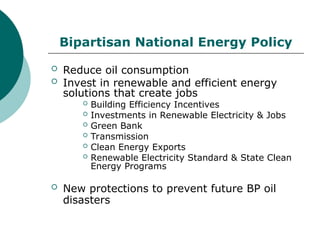
Bipartisan National Energy Policy
 Reduce oil consumption
 Invest in renewable and efficient energy
solutions that create jobs
 Building Efficiency Incentives
 Investments in Renewable Electricity & Jobs
 Green Bank
 Transmission
 Clean Energy Exports
 Renewable Electricity Standard & State Clean
Energy Programs
 New protections to prevent future BP oil
disasters
Bipartisan National Energy Policy
REDUCE OIL CONSUMPTION & IMPROVE
ENERGY SECURITY
 Natural gas trucks: create more than 100,000
direct manufacturing and labor jobs & more than
450,000 indirect jobs…National Gas Industry
estimate.
 Electric cars: speed the transition to electric
vehicles by creating a $400 million pilot program to
create electric car recharging infrastructure for plug-
in hybrid and all electric vehicles, such as the
Chevrolet Volt and Nissan Leaf
Bipartisan National Energy Policy
Building Efficiency Incentives & Jobs
Incentives for homeowners and building owners to invest in
energy savings measures to lower electricity bills & create jobs in
energy efficiency technology, sales, and installation. Two proposed
programs include:
 HOME STAR (Cash for Caulkers): 168,000 jobs over two years
primarily in construction and manufacturing. The program
would help 3 million families save $9 billion on their electricity
bills over a decade, and it would reduce global warming pollution
equivalent to taking 615,000 cars off the road
 BUILDING STAR: cover 30 percent of the cost of installing energy
efficiency technologies in commercial and apartment
buildings, Reduce energy bills by over $3 billion annually. Create
150,000 to 200,000 jobs over the next two years
Bipartisan National Energy Policy
INVESTMENTS IN RENEWABLE ELECTRICITY & JOBS
 Spain and Germany & China, have invested significant resources
and adopted policies that would boost their domestic clean energy
industries.
 Markets: Expanding markets and driving demand for new
clean and efficient energy products and services
 Financing: Investing across the full value chain of
clean-energy solutions: research, development,
commercialization, production, and deployment—needed to
meet demand
 Infrastructure: Revitalizing and reinvesting in the physical
and human capital infrastructure upon which the clean-energy
transformation— like all major industrial transformations in
the past—will ultimately be built
 New policies to continue to grow the clean energy sector are
needed as The American Recovery and Reinvestment Act
renewable energy programs funds are spent.
Bipartisan National Energy Policy
GREEN BANK
 An independent Clean Energy Deployment Administration
(CEDA) or “green bank” would provide loans, guarantees,
and credit enhancements to help companies successfully
traverse the so-called “valley of death” to take new
technologies from successful R&D to deployment.
 CEDA has bipartisan support in the House and Senate. It
was included in ACES and ACELA in slightly different forms
 CEDA funds would provide this capital and leverage $10 in
private capital for every $1 of public investment.
Bipartisan National Energy Policy
TRANSMISSION
 Electricity
congestion currently costs the eastern United States $1
6.5 billion each year
.
 Transmission lines must be enhanced and expanded to
transfer clean electricity from wind turbines in North
Dakota to factories in Illinois.
 Building transmission lines can also create thousands of
jobs. Example - building the 20,000 miles of new
transmission we need could create 280,000 new jobs.
Bipartisan National Energy Policy
CLEAN ENERGY EXPORTS
 America’s global competitiveness will partly depend
on development and deployment of renewable and
efficient energy technologies that we can export to
other countries.
 Clean Energy Exports would provide $85.6 billion
over five years for research, development, and
deployment of new technologies across a range of
industries, including clean energy.
Bipartisan National Energy Policy
RENEWABLE ELECTRICITY STANDARD & STATE
CLEAN ENERGY PROGRAMS
 RES - Renewable electricity or portfolio standard. RES requires
electric utilities to generate a specific amount of power from renewable
sources such as wind, solar, geothermal, biomass and other emerging
Technologies.
 A national RES would increase demand for these clean electricity sources
and help speed their commercialization at scale
 Feed-in-Tariffs - Congress should allow states to set long-term rates at
which renewable electricity generators can sell their power to utilities.
Creates the transparency, longevity, and certainty in policy that makes
financing renewable energy possible.
North Carolina Energy Policy
NC’s REPS (Session Law 2007-397)
North Carolina became the 25th state in the nation – and the first in
the Southeast – to enact a mandatory renewable energy and energy
efficiency portfolio standard or REPS.
 The REPS requires North Carolina’s three investor-owned utilities – Duke
Energy Carolinas, Progress Energy Carolinas and Dominion North Carolina
Power – to generate at least 12.5% of their electricity from renewable energy
and energy saved through efficiency by 2021. Rural electric cooperatives and
municipal electric suppliers are subject to a 10% REPS requirement.
 A utility may meet the REPS requirements by generating its own renewable
energy, by purchasing electric power from another renewable energy facility, or
by purchasing renewable energy certificates (RECs) generated from renewable
energy resources
 An investor-owned utility may also meet the REPS requirement by reducing
energy consumption through energy efficiency measures. In the early years of
the standard – years 2012 through 2018 – electric utilities have the option to
meet up to 25% percent of the REPS requirement through measurable energy
efficiency programs
.
North Carolina Energy Policy
NC’s REPS (Session Law 2007-397)
Renewable Energy
 Solar electric (known as “photovoltaic” or “PV”). Solar thermal hot
water,Wind, Geothermal, Tidal energy and biomass resources
 NC has a technical potential for 13,000 megawatts (MW) of new
renewable energy generation with a practical potential of at least
3,400 MW (this number does not include solar power, which
would more than double this amount).
Energy Efficiency
 Insulation, sealing leaks, High R value Building Envelope, Energy
Efficient Appliances, Programmable Thermostats, siting, shading
 NC’s electricity needs could be reduced by 14% by 2017 using
energy efficiency measures.
North Carolina Energy Policy
NC’s REPS (Session Law 2007-397)
Connecting to the Electricity Grid
The REPS law required the North Carolina Utilities Commission
(NCUC) to establish an interconnection standard for renewable
Energy facilities up to 10 MW in size.
Interconnection standards and net metering are important to the
Development of renewable energy resources.
 An interconnection standard is the technical rules for customers to
connect their renewable energy system to the electric grid.
 Net metering is a billing arrangement that allows the owner of a
renewable energy system to offset their electricity consumption and
sell or contribute the excess electricity to the electric grid for the
utility to sell to other customers.
North Carolina Energy Policy
NC’s REPS (Session Law 2007-397)
NC GreenPower vs. NC’s REPS
 NC GreenPower is a non-profit organization that
accepts voluntary contributions through utility bills to
develop renewable energy resources in the state.
 Carolina’s REPS is a mandatory requirement and NC
GreenPower is a voluntary program.
 Citizens interested in supporting renewable energy
above and beyond the REPS law can contribute to the
voluntary NC GreenPower program or directly
purchase RECs when they become available.
North Carolina Energy Policy
NC’s REPS (Session Law 2007-397)
NC’s REPS: Renewable Energy Resources, Investments & Jobs
The retention and creation of thousands of green jobs across North
Carolina is one of the largest benefits of the REPS. As a result, North
Carolina:
 Is a leader in solar energy and currently ranks 7th among US states in the
amount of required solar energy generation
 Will have roughly 300 megawatts of new solar power installations by 2018
 Will realize more than $2.5 billion in new renewable energy investments by
2018 and $350 million in energy efficiency investments by 2021
 Employ more than 4,000 North Carolinians at good wages due to sufficient in-
state renewable resources and unutilized energy efficiency potential
North Carolina Energy Policy
NC’s REPS (Session Law 2007-397)
NC’s Future Energy Needs: Costs & Policy
Policymakers must go beyond Session Law 2007- 397 to evaluate NC’s future
Energy portfolio and set policy that will result in the lowest cost and reliable
mix of energy resources for North Carolina and that also deliver the greatest
job creation investment, economic development and environmental benefits
possible.
What you Can do
The public can participate in the rulemaking process by writing letters to the
NC Utilities Commission at 4325 Mail Service Center, Raleigh, NC 27699-4325.
The three most important issues to stress in personal correspondence to the
NCUC are:
 Transparency
 Energy Efficiency
 Ensuring Compliance
North Carolina Sustainable Energy Association (NCSEA)
2010 Renewable Energy & Energy Efficiency Industry
Census
The North Carolina Sustainable Energy
Association’s (NCSEA) 2010
Renewable Energy & Energy Efficiency
Industry Census surveyed firms
operating in the first two categories –
renewable energy and energy efficiency
industries.
The purpose of the census is to
document ongoing Employment trends
and industry dynamics within these
markets.
What is a Green Business,
Green Job?
Energy from renewable sources
Energy efficiency
Pollution reduction and removal
Greenhouse gas reduction
Recycling and reuse
Natural resource conservation and
environmental compliance
Education and training, and public
awareness
North Carolina Sustainable Energy Association (NCSEA)
2010 Renewable Energy & Energy Efficiency Industry
Census
According to the 2010 Renewable Energy & Energy Efficiency
Industry Census, released by NCSEA:
 The renewable energy and energy efficiency industries in
North Carolina consist of over 1,100 firms
 Renewable energy and energy efficiency firms
conservatively generate more than $3.5 billion in annual
revenue from North Carolina business activities
 The majority of firms and employment occur at firms
focused on energy efficiency and building sciences.
 Renewable energy and energy efficiency firms maintain a
presence in all 100 NC counties
North Carolina Sustainable Energy Association (NCSEA)
2010 Renewable Energy & Energy Efficiency Industry Census
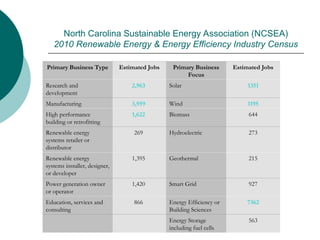
Employment
Primary Business Type Estimated Jobs Primary Business
Focus
Estimated Jobs
Research and
development
2,963 Solar 1351
Manufacturing 3,959 Wind 1195
High performance
building or retrofitting
1,622 Biomass 644
Renewable energy
systems retailer or
distributor
269 Hydroelectric 273
Renewable energy
systems installer, de­
signer,
or developer
1,395 Geothermal 215
Power generation owner
or operator
1,420 Smart Grid 927
Education, services and
consulting
866 Energy Efficiency or
Building Sciences
7362
Energy Storage
including fuel cells
563
North Carolina Sustainable Energy Association (NCSEA)
2010 Renewable Energy & Energy Efficiency Industry
Census
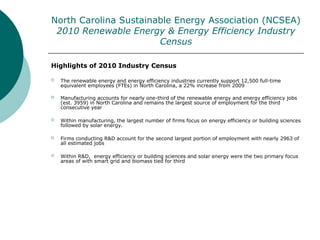
Highlights of 2010 Industry Census
 The renewable energy and energy efficiency industries currently support 12,500 full-time
equivalent employees (FTEs) in North Carolina, a 22% increase from 2009
 Manufacturing accounts for nearly one-third of the renewable energy and energy efficiency jobs
(est. 3959) in North Carolina and remains the largest source of employment for the third
consecutive year
 Within manufacturing, the largest number of firms focus on energy efficiency or building sciences
followed by solar energy.
 Firms conducting R&D account for the second largest portion of employment with nearly 2963 of
all estimated jobs
 Within R&D, energy efficiency or building sciences and solar energy were the two primary focus
areas of with smart grid and biomass tied for third
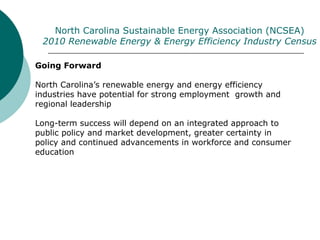
Going Forward
North Carolina’s renewable energy and energy efficiency
industries have potential for strong employment growth and
regional leadership
Long-term success will depend on an integrated approach to
public policy and market development, greater certainty in
policy and continued advancements in workforce and consumer
education
North Carolina Sustainable Energy Association (NCSEA)
2010 Renewable Energy & Energy Efficiency Industry Census
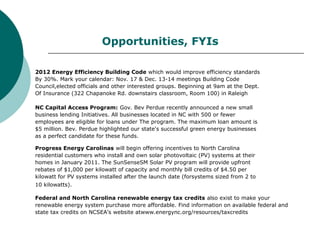
2012 Energy Efficiency Building Code which would improve efficiency standards
By 30%. Mark your calendar: Nov. 17 & Dec. 13-14 meetings Building Code
Council,elected officials and other interested groups. Beginning at 9am at the Dept.
Of Insurance (322 Chapanoke Rd. downstairs classroom, Room 100) in Raleigh
NC Capital Access Program: Gov. Bev Perdue recently announced a new small
business lending Initiatives. All businesses located in NC with 500 or fewer
employees are eligible for loans under The program. The maximum loan amount is
$5 million. Bev. Perdue highlighted our state's successful green energy businesses
as a perfect candidate for these funds.
Progress Energy Carolinas will begin offering incentives to North Carolina
residential customers who install and own solar photovoltaic (PV) systems at their
homes in January 2011. The SunSenseSM Solar PV program will provide upfront
rebates of $1,000 per kilowatt of capacity and monthly bill credits of $4.50 per
kilowatt for PV systems installed after the launch date (forsystems sized from 2 to
10 kilowatts).
Federal and North Carolina renewable energy tax credits also exist to make your
renewable energy system purchase more affordable. Find information on available federal and
state tax credits on NCSEA’s website atwww.energync.org/resources/taxcredits
Opportunities, FYIs
Links and Resources
North Carolina
North Carolina Sustainable Energy Association (NCSEA) www.ncsea.org
2010 Renewable Energy & Energy Efficiency Industry Census
http://energync.org/assets/files/2010%20Industry%20Census.pdf
Citizens Guide to the NC REPS http://energync.org/resources/publications/ncsea-publications/
North Carolina Utilities Commission: www.ncuc.net REPS Rulemaking: Docket No. E-100, Sub
113Interconnection Standards: Docket No. E-100, Sub 101Net Metering: Docket No. E-100, Sub
83RECs Tracking System: Docket No. E-100, Sub 121
NC State Solar Center, Database of State Incentives for Renewable and Efficiency
(DSIRE):www.dsireusa.org
NC State Solar Center, DSIRE Solar http://www.dsireusa.org/solar/index.cfm?ee=1&RE=1&spf=1&st=1
NC Green Power: www.ncgreenpower.org
Duke Energy Interconnection Process, Checklist and Forms:http://www.duke-energy.com/customer
Owned generation/nc-interconnection-information.asp
Progress Energy Interconnection Process and Forms:
http://www.progress-energy.com/environment/ras/interconnectionprocedures.asp
Links and Resources
National
Center for American Progress http://www.americanprogress.org/
l
Cooperation or Confrontation
http://www.americanprogress.org/issues/2010/11/cooperation_or_confrontation.html
Out of the Running
http://www.americanprogress.org/issues/2010/03/out_of_running.html
Investing in Clean Energy
http://www.americanprogress.org/issues/2010/11/investing_clean_energy.html
Alliance to Save Energy, http://ase.org/resources/comparison-aces-acela-and-apa
California’s Global Warming Law AB 32 http://gov.ca.gov/index.php?/fact-sheet/4445/
http://www.ucsusa.org/assets/documents/global_warming/economic-impacts-of-ab-32.pdf
The American Council for an Energy Efficiency Economy - The American Power Act and
Enhanced Energy Efficiency Provisions: Impacts on the U.S. Economy
http://www.aceee.org/research-report/e103
The Skeptical environmentalist http and Cool it - http://www.amazon.com/Bjørn
Lomborg/e/B001H6WWF2/ref=ntt_athr_dp_pel_1

energypolicy-doc-130423151402-phpapp01.ppt

  • 1.
    Energy Policy Introduction  By2020, clean energy will be one of the world’s biggest industries, totaling as much as $2.3 trillion.  Other countries made huge investments to seize the economic opportunity provided by the evolving transition from fossil-based energy to renewable, low-waste electricity and fuel.  These investments were a result of intentional public policies, which in turn provided a strong stimulus for new public and private investment in new clean-energy markets, infrastructure, and human resources.  Potential still exists, for bipartisan cooperation between President Obama and the new Congress on reducing oil use, investing in clean energy technologies and jobs, and preventing future oil disaster.
  • 2.
    Energy Policy Topics  PotentialBipartisan National Energy Policy  North Carolina Energy Policy - NC’s Reps (Session Law 2007-397)  North Carolina Sustainable Energy Association (NCSEA), 2010 Renewable Energy & Energy Efficiency Industry Census
  • 3.
    Energy Policy Objectives  Summarizethe key issues in the Bipartisan National Energy Policy, NC’s REPS (Session Law 2007-397) and NCSEA 2010 Renewable Energy & Efficiency Census  Analyze the above policies’ and the census findings for their implications for and potential impact on renewable energy investments, technologies, and jobs in North Carolina.  Identify gaps, disconnects, connections, synergies in the policies and research presented  Generate your own policy and business solutions and ideas  Generate additional topics for review and discussion.
  • 4.
    Energy Policy House andSenate Bills - Pending U.S. House of Representatives - ACES U.S. Senate - ACELA Senators John Kerry and Joe Lieberman - APA The American Clean Energy and Security Act of 2009 (H.R. 2454 or ACES) passed the House on June 26, 2009 by a vote of 219 to 212. ACES combines standards and incentives to promote clean energy and energy efficiency technologies with a firm cap on greenhouse gas emissions. The American Council for an Energy Efficient Economy (ACEEE) estimates that, in 2030 alone, the energy efficiency provisions in ACES could reduce energy consumption by about 8.8 quadrillion BTU, avoid about 539 million metric tons (MMT) of carbon emissions, and save about $62 billion in net consumer savings, or $486 per household. The American Clean Energy Leadership Act (S.1462 or ACELA) passed the Senate Energy and Natural Resources Committee on June 17, 2009. ACELA is an energy bill that contains many energy policies similar to ACES, but does not include a greenhouse gas pollution reduction program. ACEEE estimates that, in 2030, the energy efficiency provisions in ACELA could reduce energy consumption by about 4.3 quads, avoid about 65 MMT of carbon emissions, and save about $36 billion in net consumer savings, or about $240 per household. The American Power Act (APA) was introduced by Senators John Kerry (D-Mass.) and Joe Lieberman (I-Conn.) to the Senate on May 12, 2010. The long-awaited climate bill would establish a greenhouse gas pollution reduction program and encourage development of nuclear power, offshore oil and gas drilling, coal, clean transportation, and, to a lesser extent, energy efficiency and renewable energy.
  • 5.
    Bipartisan National EnergyPolicy  Reduce oil consumption  Invest in renewable and efficient energy solutions that create jobs  Building Efficiency Incentives  Investments in Renewable Electricity & Jobs  Green Bank  Transmission  Clean Energy Exports  Renewable Electricity Standard & State Clean Energy Programs  New protections to prevent future BP oil disasters
  • 6.
    Bipartisan National EnergyPolicy REDUCE OIL CONSUMPTION & IMPROVE ENERGY SECURITY  Natural gas trucks: create more than 100,000 direct manufacturing and labor jobs & more than 450,000 indirect jobs…National Gas Industry estimate.  Electric cars: speed the transition to electric vehicles by creating a $400 million pilot program to create electric car recharging infrastructure for plug- in hybrid and all electric vehicles, such as the Chevrolet Volt and Nissan Leaf
  • 7.
    Bipartisan National EnergyPolicy Building Efficiency Incentives & Jobs Incentives for homeowners and building owners to invest in energy savings measures to lower electricity bills & create jobs in energy efficiency technology, sales, and installation. Two proposed programs include:  HOME STAR (Cash for Caulkers): 168,000 jobs over two years primarily in construction and manufacturing. The program would help 3 million families save $9 billion on their electricity bills over a decade, and it would reduce global warming pollution equivalent to taking 615,000 cars off the road  BUILDING STAR: cover 30 percent of the cost of installing energy efficiency technologies in commercial and apartment buildings, Reduce energy bills by over $3 billion annually. Create 150,000 to 200,000 jobs over the next two years
  • 8.
    Bipartisan National EnergyPolicy INVESTMENTS IN RENEWABLE ELECTRICITY & JOBS  Spain and Germany & China, have invested significant resources and adopted policies that would boost their domestic clean energy industries.  Markets: Expanding markets and driving demand for new clean and efficient energy products and services  Financing: Investing across the full value chain of clean-energy solutions: research, development, commercialization, production, and deployment—needed to meet demand  Infrastructure: Revitalizing and reinvesting in the physical and human capital infrastructure upon which the clean-energy transformation— like all major industrial transformations in the past—will ultimately be built  New policies to continue to grow the clean energy sector are needed as The American Recovery and Reinvestment Act renewable energy programs funds are spent.
  • 9.
    Bipartisan National EnergyPolicy GREEN BANK  An independent Clean Energy Deployment Administration (CEDA) or “green bank” would provide loans, guarantees, and credit enhancements to help companies successfully traverse the so-called “valley of death” to take new technologies from successful R&D to deployment.  CEDA has bipartisan support in the House and Senate. It was included in ACES and ACELA in slightly different forms  CEDA funds would provide this capital and leverage $10 in private capital for every $1 of public investment.
  • 10.
    Bipartisan National EnergyPolicy TRANSMISSION  Electricity congestion currently costs the eastern United States $1 6.5 billion each year .  Transmission lines must be enhanced and expanded to transfer clean electricity from wind turbines in North Dakota to factories in Illinois.  Building transmission lines can also create thousands of jobs. Example - building the 20,000 miles of new transmission we need could create 280,000 new jobs.
  • 11.
    Bipartisan National EnergyPolicy CLEAN ENERGY EXPORTS  America’s global competitiveness will partly depend on development and deployment of renewable and efficient energy technologies that we can export to other countries.  Clean Energy Exports would provide $85.6 billion over five years for research, development, and deployment of new technologies across a range of industries, including clean energy.
  • 12.
    Bipartisan National EnergyPolicy RENEWABLE ELECTRICITY STANDARD & STATE CLEAN ENERGY PROGRAMS  RES - Renewable electricity or portfolio standard. RES requires electric utilities to generate a specific amount of power from renewable sources such as wind, solar, geothermal, biomass and other emerging Technologies.  A national RES would increase demand for these clean electricity sources and help speed their commercialization at scale  Feed-in-Tariffs - Congress should allow states to set long-term rates at which renewable electricity generators can sell their power to utilities. Creates the transparency, longevity, and certainty in policy that makes financing renewable energy possible.
  • 13.
    North Carolina EnergyPolicy NC’s REPS (Session Law 2007-397) North Carolina became the 25th state in the nation – and the first in the Southeast – to enact a mandatory renewable energy and energy efficiency portfolio standard or REPS.  The REPS requires North Carolina’s three investor-owned utilities – Duke Energy Carolinas, Progress Energy Carolinas and Dominion North Carolina Power – to generate at least 12.5% of their electricity from renewable energy and energy saved through efficiency by 2021. Rural electric cooperatives and municipal electric suppliers are subject to a 10% REPS requirement.  A utility may meet the REPS requirements by generating its own renewable energy, by purchasing electric power from another renewable energy facility, or by purchasing renewable energy certificates (RECs) generated from renewable energy resources  An investor-owned utility may also meet the REPS requirement by reducing energy consumption through energy efficiency measures. In the early years of the standard – years 2012 through 2018 – electric utilities have the option to meet up to 25% percent of the REPS requirement through measurable energy efficiency programs .
  • 14.
    North Carolina EnergyPolicy NC’s REPS (Session Law 2007-397) Renewable Energy  Solar electric (known as “photovoltaic” or “PV”). Solar thermal hot water,Wind, Geothermal, Tidal energy and biomass resources  NC has a technical potential for 13,000 megawatts (MW) of new renewable energy generation with a practical potential of at least 3,400 MW (this number does not include solar power, which would more than double this amount). Energy Efficiency  Insulation, sealing leaks, High R value Building Envelope, Energy Efficient Appliances, Programmable Thermostats, siting, shading  NC’s electricity needs could be reduced by 14% by 2017 using energy efficiency measures.
  • 15.
    North Carolina EnergyPolicy NC’s REPS (Session Law 2007-397) Connecting to the Electricity Grid The REPS law required the North Carolina Utilities Commission (NCUC) to establish an interconnection standard for renewable Energy facilities up to 10 MW in size. Interconnection standards and net metering are important to the Development of renewable energy resources.  An interconnection standard is the technical rules for customers to connect their renewable energy system to the electric grid.  Net metering is a billing arrangement that allows the owner of a renewable energy system to offset their electricity consumption and sell or contribute the excess electricity to the electric grid for the utility to sell to other customers.
  • 16.
    North Carolina EnergyPolicy NC’s REPS (Session Law 2007-397) NC GreenPower vs. NC’s REPS  NC GreenPower is a non-profit organization that accepts voluntary contributions through utility bills to develop renewable energy resources in the state.  Carolina’s REPS is a mandatory requirement and NC GreenPower is a voluntary program.  Citizens interested in supporting renewable energy above and beyond the REPS law can contribute to the voluntary NC GreenPower program or directly purchase RECs when they become available.
  • 17.
    North Carolina EnergyPolicy NC’s REPS (Session Law 2007-397) NC’s REPS: Renewable Energy Resources, Investments & Jobs The retention and creation of thousands of green jobs across North Carolina is one of the largest benefits of the REPS. As a result, North Carolina:  Is a leader in solar energy and currently ranks 7th among US states in the amount of required solar energy generation  Will have roughly 300 megawatts of new solar power installations by 2018  Will realize more than $2.5 billion in new renewable energy investments by 2018 and $350 million in energy efficiency investments by 2021  Employ more than 4,000 North Carolinians at good wages due to sufficient in- state renewable resources and unutilized energy efficiency potential
  • 18.
    North Carolina EnergyPolicy NC’s REPS (Session Law 2007-397) NC’s Future Energy Needs: Costs & Policy Policymakers must go beyond Session Law 2007- 397 to evaluate NC’s future Energy portfolio and set policy that will result in the lowest cost and reliable mix of energy resources for North Carolina and that also deliver the greatest job creation investment, economic development and environmental benefits possible. What you Can do The public can participate in the rulemaking process by writing letters to the NC Utilities Commission at 4325 Mail Service Center, Raleigh, NC 27699-4325. The three most important issues to stress in personal correspondence to the NCUC are:  Transparency  Energy Efficiency  Ensuring Compliance
  • 19.
    North Carolina SustainableEnergy Association (NCSEA) 2010 Renewable Energy & Energy Efficiency Industry Census The North Carolina Sustainable Energy Association’s (NCSEA) 2010 Renewable Energy & Energy Efficiency Industry Census surveyed firms operating in the first two categories – renewable energy and energy efficiency industries. The purpose of the census is to document ongoing Employment trends and industry dynamics within these markets. What is a Green Business, Green Job? Energy from renewable sources Energy efficiency Pollution reduction and removal Greenhouse gas reduction Recycling and reuse Natural resource conservation and environmental compliance Education and training, and public awareness
  • 20.
    North Carolina SustainableEnergy Association (NCSEA) 2010 Renewable Energy & Energy Efficiency Industry Census According to the 2010 Renewable Energy & Energy Efficiency Industry Census, released by NCSEA:  The renewable energy and energy efficiency industries in North Carolina consist of over 1,100 firms  Renewable energy and energy efficiency firms conservatively generate more than $3.5 billion in annual revenue from North Carolina business activities  The majority of firms and employment occur at firms focused on energy efficiency and building sciences.  Renewable energy and energy efficiency firms maintain a presence in all 100 NC counties
  • 21.
    North Carolina SustainableEnergy Association (NCSEA) 2010 Renewable Energy & Energy Efficiency Industry Census Employment Primary Business Type Estimated Jobs Primary Business Focus Estimated Jobs Research and development 2,963 Solar 1351 Manufacturing 3,959 Wind 1195 High performance building or retrofitting 1,622 Biomass 644 Renewable energy systems retailer or distributor 269 Hydroelectric 273 Renewable energy systems installer, de­ signer, or developer 1,395 Geothermal 215 Power generation owner or operator 1,420 Smart Grid 927 Education, services and consulting 866 Energy Efficiency or Building Sciences 7362 Energy Storage including fuel cells 563
  • 22.
    North Carolina SustainableEnergy Association (NCSEA) 2010 Renewable Energy & Energy Efficiency Industry Census Highlights of 2010 Industry Census  The renewable energy and energy efficiency industries currently support 12,500 full-time equivalent employees (FTEs) in North Carolina, a 22% increase from 2009  Manufacturing accounts for nearly one-third of the renewable energy and energy efficiency jobs (est. 3959) in North Carolina and remains the largest source of employment for the third consecutive year  Within manufacturing, the largest number of firms focus on energy efficiency or building sciences followed by solar energy.  Firms conducting R&D account for the second largest portion of employment with nearly 2963 of all estimated jobs  Within R&D, energy efficiency or building sciences and solar energy were the two primary focus areas of with smart grid and biomass tied for third
  • 23.
    Going Forward North Carolina’srenewable energy and energy efficiency industries have potential for strong employment growth and regional leadership Long-term success will depend on an integrated approach to public policy and market development, greater certainty in policy and continued advancements in workforce and consumer education North Carolina Sustainable Energy Association (NCSEA) 2010 Renewable Energy & Energy Efficiency Industry Census
  • 24.
    2012 Energy EfficiencyBuilding Code which would improve efficiency standards By 30%. Mark your calendar: Nov. 17 & Dec. 13-14 meetings Building Code Council,elected officials and other interested groups. Beginning at 9am at the Dept. Of Insurance (322 Chapanoke Rd. downstairs classroom, Room 100) in Raleigh NC Capital Access Program: Gov. Bev Perdue recently announced a new small business lending Initiatives. All businesses located in NC with 500 or fewer employees are eligible for loans under The program. The maximum loan amount is $5 million. Bev. Perdue highlighted our state's successful green energy businesses as a perfect candidate for these funds. Progress Energy Carolinas will begin offering incentives to North Carolina residential customers who install and own solar photovoltaic (PV) systems at their homes in January 2011. The SunSenseSM Solar PV program will provide upfront rebates of $1,000 per kilowatt of capacity and monthly bill credits of $4.50 per kilowatt for PV systems installed after the launch date (forsystems sized from 2 to 10 kilowatts). Federal and North Carolina renewable energy tax credits also exist to make your renewable energy system purchase more affordable. Find information on available federal and state tax credits on NCSEA’s website atwww.energync.org/resources/taxcredits Opportunities, FYIs
  • 25.
    Links and Resources NorthCarolina North Carolina Sustainable Energy Association (NCSEA) www.ncsea.org 2010 Renewable Energy & Energy Efficiency Industry Census http://energync.org/assets/files/2010%20Industry%20Census.pdf Citizens Guide to the NC REPS http://energync.org/resources/publications/ncsea-publications/ North Carolina Utilities Commission: www.ncuc.net REPS Rulemaking: Docket No. E-100, Sub 113Interconnection Standards: Docket No. E-100, Sub 101Net Metering: Docket No. E-100, Sub 83RECs Tracking System: Docket No. E-100, Sub 121 NC State Solar Center, Database of State Incentives for Renewable and Efficiency (DSIRE):www.dsireusa.org NC State Solar Center, DSIRE Solar http://www.dsireusa.org/solar/index.cfm?ee=1&RE=1&spf=1&st=1 NC Green Power: www.ncgreenpower.org Duke Energy Interconnection Process, Checklist and Forms:http://www.duke-energy.com/customer Owned generation/nc-interconnection-information.asp Progress Energy Interconnection Process and Forms: http://www.progress-energy.com/environment/ras/interconnectionprocedures.asp
  • 26.
    Links and Resources National Centerfor American Progress http://www.americanprogress.org/ l Cooperation or Confrontation http://www.americanprogress.org/issues/2010/11/cooperation_or_confrontation.html Out of the Running http://www.americanprogress.org/issues/2010/03/out_of_running.html Investing in Clean Energy http://www.americanprogress.org/issues/2010/11/investing_clean_energy.html Alliance to Save Energy, http://ase.org/resources/comparison-aces-acela-and-apa California’s Global Warming Law AB 32 http://gov.ca.gov/index.php?/fact-sheet/4445/ http://www.ucsusa.org/assets/documents/global_warming/economic-impacts-of-ab-32.pdf The American Council for an Energy Efficiency Economy - The American Power Act and Enhanced Energy Efficiency Provisions: Impacts on the U.S. Economy http://www.aceee.org/research-report/e103 The Skeptical environmentalist http and Cool it - http://www.amazon.com/Bjørn Lomborg/e/B001H6WWF2/ref=ntt_athr_dp_pel_1

Editor's Notes

  • #1 Introduction The race toward a clean-energy future is underway, and those nations that lead will reap enormous economic benefits. With the right investments and smart policies, the United States can be among them, a top player in the emerging global low-carbon economy. The just-elected 112th Congress will be quite different—and much more conservative—than the 111th Congress that enacted major health care and financial reforms but failed on clean energy legislation. As we can see, there were a number of bipartisan proposals to address these challenges over the past two years.
  • #2 .
  • #4 ACES, ACELA, APA Bills After the election day hurricane that replaced moderate legislators with conservatives it's clear that global warming solutions will need to meet certain criteria - -similar ideas that previously had significant bipartisan support, significant support from business, and little impact on the federal deficit
  • #5 Three sets of clean energy objectives, abstracted from the house and senate bills have fairly broad bipartisan support: reducing oil consumption, investing in renewable and efficient energy solutions that create jobs; and new protections to prevent future BP oil disasters
  • #6 The BP oil disaster and rising oil prices are reminders that the United States must dramatically reduce its oil use to enhance energy security and economic prosperity. Americans currently spend $1 billion per day on oil imports, and one out of every five barrels of oil consumed in the United States comes from countries the State Department classifies as “dangerous or unstable.” Natural gas trucks CAP estimates that converting a significant portion of medium and heavy trucks and buses to natural gas could save 1.2 million barrels of oil per day by 2035. Electric cars The Electric Vehicle Deployment Act, S. 3442 and H.R. 5442, would speed the transition to electric vehicles by creating a $400 million pilot program to help up to 15 communities create electric vehicle recharging infrastructure for plug-in hybrid and all electric vehicles, such as the Chevrolet Volt and Nissan Leaf.
  • #7 One of the easiest and most cost-effective ways to reduce pollution and save money is to simply use less energy in our homes and businesses. Homestar and Building Star would provide incentives for homeowners and building owners to invest in simple and effective energy savings measures that will lower electricity bills and return these savings to families’ or businesses pockets. These incentives will also create thousands of jobs in energy efficiency technology sales and installation. Federal and State & Local Incentives for tax paying home and building owners include: Federal and NC Tax Credit for cost of panels and installation You must have the tax liability but the credit can be carried over. Maximum Federal: $10,500 Maximum State: $ 9,000 Chatham County Rebate Program
  • #8 Other nations, particularly Spain, Germany and China have invested significant resources and adopted policies that would boost their domestic clean energy industries. This has also helped them create an export market for these new technologies. The key to successfully restoring markets is to send clear policy signals that create investment certainty. A commitment to reducing carbon emissions is the first and best signal that a country is serious about moving toward low-carbon electricity and fuel solutions. The United States risks falling out of the running to lead this 21st century industry if we do not invest more in this field.
  • #9 GREEN BANK An independent Clean Energy Deployment Administration or “green bank” would provide capital - loans, guarantees, and credit enhancements - to help companies successfully traverse the so-called “valley of death” to take new technologies from successful R&D to deployment. CEDA funds would provide this capital and leverage $10 in private capital for every $1 of public investment. CEDA has bipartisan support in the House and Senate. It was included in ACES and ACELA in slightly different forms
  • #10 TRANSMISSION A missing ingredient in U.S. efforts to generate more renewable electricity and manufacture more clean energy technology is our aging system of transmission lines. Electricity congestion currently costs the eastern United States $16.5 billion each year. Additionally, transmission lines must be enhanced and expanded to transfer clean electricity from wind turbines in North Dakota to factories in Illinois. Studies of three comparable large-scale projects show that on average new transmission lines create about 14 jobs per mile of transmission…
  • #11 . … as well as funding for education in science, technology, and math that will help prepare students to become leaders in the low-carbon economy.
  • #12 RENEWABLE ELECTRICITY STANDARD Thirty states have a renewable electricity or portfolio standard, or RES, including North Carolina. STATE CLEAN ENERGY PROGRAMS Congress should allow states to set long-term, pre-determined, cost-based rates at which renewable electricity generators can sell their power to utilities. These renewable energy payments—sometimes called “feed-in tariffs”—create the transparency, longevity, and certainty in policy that makes financing renewable energy possible. ACES includes a provision (Section 102) to clarify that states have this right. The Let the States Innovate on Sustainable Energy Act, S. 3923, has similar language
  • #13 North Carolina’s leaders adopted the REPS law because they learned that using renewable energy resources inside North Carolina and finding more ways to save energy would cost our citizens less than simply building more coal, nuclear and natural gas power plants to meet our growing electricity needs The REPS will achieve these goals by promoting energy efficiency measures while incorporating renewable energy resources into the fuel mix used for generating the electricity we use. Should the US Congress enact a federal renewable energy standard (ES), Session Law 2007- 397 says our leaders must implement whichever law is stronger – either the state law or a new federal law.
  • #14 By combining energy efficiency and renewable energy, NC would experience a maximum potential electricity rate increase of less than 1%. Energy efficiency has been proven to be a low-cost, method for reliably reducing electricity demand. Many energy efficiency measures, if implemented by businesses independent of regulated utilities, can be cheaper than current retail electricity rates.
  • #15  North Carolina’s market for renewable energy cannot thrive without a functional and usable interconnection standard and netmetering. Net metering …in essence, allows the owner’s electric meter to roll backwards. The billing arrangement lets your excess electricity roll over for one year
  • #16 Also, the REPS law declares a REC generated from a renewable resource cannot be counted by both programs – it may be applied to either the REPS or to NC GreenPower, but not to both
  • #17 REPS will produce unprecedented economic benefits to North Carolina, enabling the state to: Avoid nearly $500 million in costs for new coal, natural gas and nuclear power by investing in North Carolina renewable sources and efficiency Eliminate the need for at least 1,800 megawatts of coal and nuclear power plants Make it more transparent to connect a renewable energy system to the electricity grid Reduce cumulative greenhouse gas emissions by approximately 125 million metric tons between 2007 and 2020
  • #18 By satisfying the REPS and passage of additional sustainable energy policies, North Carolina is likely to become the Southeast economic leader in the green energy economy and maintain a high quality of life for North Carolina citizens for generations to come. The public can participate in the rulemaking process by writing letters to the NC Utilities Commission at 4325 Mail Service Center, Raleigh, NC 27699-4325. The three most important issues to stress in personal correspondence to the NCUC: Transparency • To develop sufficient renewable energy to satisfy the REPS requirements as cheaply as possible, competition needs to exist. This competition will only happen with transparency in renewable energy markets and limits on how much renewable energy is owned and operated by regulated utilities. Energy Efficiency • in the adopted rules, only the utilities can produce energy efficiency RECs. There is no competition allowed among North Carolina’s hundreds of energy efficiency companies to meet the REPS requirement through energy efficiency programs Ensuring Compliance The passage of the REPs in 2007, RE & EE Requirement are now the law in North Carolina
  • #19 According to the U.S. Bureau of Labor Statistics Green jobs are defined as:: Jobs in businesses that produce goods or provide services that benefit the environment or conserve natural resources. Jobs in which workers’ duties involve making their establishment’s production processes more enviromentally friendly or use fewer natural resources. . Which breaks down to six areas:
  • #20 Green Energy Jobs & Business Opportunities Continue to provide diverse employment for people of all skill levels and educational backgrounds in every region of our state. The emerging renewable energy and energy efficiency industries have expanded rapidly in recent years and further expansion is expected in 2011…. ….which will be driven by increasing consumer demand, the on-going implementation of North Carolina’s energy policies, and additional venture capital infusions
  • #21 Manufacturing accounts for nearly one-third of the renewable energy and energy efficiency jobs (est. 3959) in North Carolina and remains the largest source of employment for the third consecutive year. Firms conducting R&D account for the second largest portion of employment with nearly 2963 of all estimated jobs
  • #22  Given the recently-passed renewable energy manufacturing tax credit, current manufacturing facilities can re-tool, transition, and grow into the sustainable energy industries. This retooling could create even more green jobs, but more importantly, on-going manufacturing layoffs could be prevented in the future.” The overlapping focus areas between manufacturing and research and development indicate North Carolina is strongly positioned to develop and scale-up emergent technologies The state’s comparative advantage is further enhanced by the presence of a skilled workforce, prominent research and educational institutions, a robust transportation infrastructure, a high quality of life, and well regarded business climate.