Federal Energy  Efficiency Policy  Prospects ACEEE Ally Webinar Steven Nadel May 5, 2010
Possible Bills for 2010 Jobs bills (e.g. Home Star) Energy-only bills (e.g. ACELA, Lugar) Energy and climate bills (e.g. KGL) Climate only (e.g. Cantwell-Collins) Tax incentives (extenders and new)
Jobs Bill Proposed new legislation to address high unemployment Initial bill enacted (e.g. unemployment insurance) Second bill mostly tax based, passed Senate Third bill may include several efficiency provisions Key question is how to pay for it (ARRA, TARP, deficit??)
Potential Efficiency Provisions  in a Jobs Bill Home Star / “Cash for Caulkers” Additional funds for oversubscribed ARRA programs: Advanced Energy Investment Credits for manufacturers (mostly renewable energy) Industrial grants and Manufacturing Extension Partnership Other new ideas “ Building Star” program – prescriptive rebates Replacement of old manufactured homes (Tester) Rural loans through electric co-ops (Third Way)
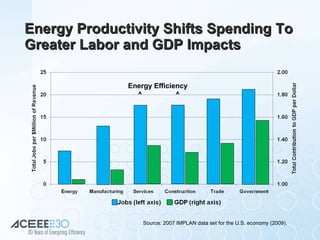
Energy Productivity Shifts Spending To Greater Labor and GDP Impacts Source: 2007 IMPLAN data set for the U.S. economy (2009). Energy Efficiency ^  ^
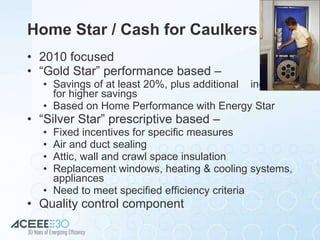
Home Star / Cash for Caulkers 2010 focused “ Gold Star” performance based – Savings of at least 20%, plus additional  incentives for higher savings Based on Home Performance with Energy Star “ Silver Star” prescriptive based –  Fixed incentives for specific measures Air and duct sealing Attic, wall and crawl space insulation Replacement windows, heating & cooling systems, appliances Need to meet specified efficiency criteria Quality control component
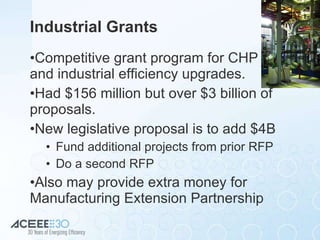
Industrial Grants Competitive grant program for CHP  and industrial efficiency upgrades. Had $156 million but over $3 billion of proposals. New legislative proposal is to add $4B Fund additional projects from prior RFP Do a second RFP Also may provide extra money for Manufacturing Extension Partnership
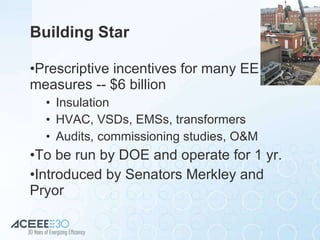
Building Star Prescriptive incentives for many EE  measures -- $6 billion Insulation HVAC, VSDs, EMSs, transformers Audits, commissioning studies, O&M To be run by DOE and operate for 1 yr. Introduced by Senators Merkley and Pryor
Current Status of Jobs Bills House scheduled to vote on Home Star on Thurs. 5/6/10.  Will be an authorization. Senate Energy Committee has had a hearing, but needs to reintroduce before scheduling a vote. The key outstanding issue is how to pay for these and other jobs bill  components.
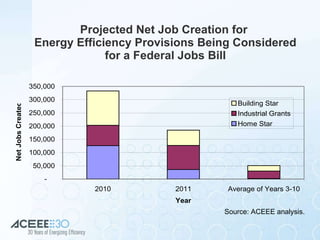
Projected Net Job Creation for  Energy Efficiency Provisions Being Considered for a Federal Jobs Bill Source: ACEEE analysis.
Federal Energy and Climate  Legislation Status House passed combined energy & climate change bill (ACES) Senate Energy reported out energy-only bill (ACELA) Senate EPW reported out a cap and trade bill Plan was to combine these, along with other provisions, into a more comprehensive bill But there are not 60 votes for this.
Kerry, Graham and Lieberman Trying for compromise bill to get 60 votes Appears to include: Cap and trade for utilities Carbon fee on transportation fuels Regulations on large industrial, ~2016 Significant sections on nuclear, clean coal,  oil and gas [but latter likely to change] Very little for efficiency: ACELA included by reference Utilities permitted (but not required) to spend funds for consumers on EE.
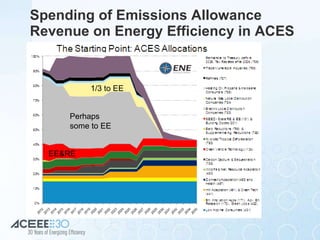
Spending of Emissions Allowance Revenue on Energy Efficiency in ACES 1/3 to EE Perhaps some to EE EE&RE
CLEAR Act ( Carbon Limits & Energy for America’s Renewal) Targets set and ramp down ¼%/year Emissions allowances auctioned off to fossil fuel producers and importers No third parties (e.g. traders, speculators) Price collar 75% of auction revenue to consumers, per capita 25% for Clean Energy Reinvestment Trust fund Appropriated annually by Congress
Lugar “Practical Energy and Climate Plan” Reduce oil imports Revise CAFÉ thru 2030, “feebates” Energy efficiency Building codes, federal buildings, national retrofit program (loans & subsidies), industrial efficiency, appliances and equipment Diverse domestic power Clean energy standard thru 2050, authorizes incentives to retire old coal plants Measurement & review of climate programs
Efficiency Elements in House and Senate Energy Bills Energy efficiency resource standards Appliance and equipment standards Improved building codes Residential and commercial retrofits Building labeling Appliance incentives (House only so far) Industrial & building job training & TA – IAC, BTAC Programs for industry (Senate only so far) Demand response (House only so far) Energy Star (Senate only so far)
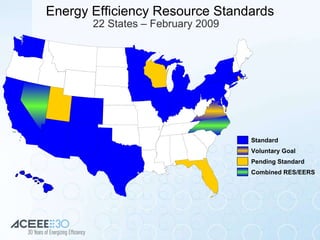
Energy Efficiency Resource Standards  Analogous to a Renewable Portfolio Standard Electric and/or gas savings targets for utilities Includes end-use efficiency and sometimes combined heat & power (CHP) and codes/standards Targets generally start low and increase over time Savings must be documented in accordance with evaluation rules established by regulators
22 States – February 2009 Energy Efficiency Resource Standards Standard Voluntary Goal Pending Standard Combined RES/EERS
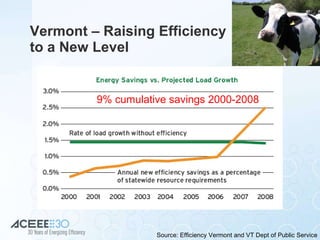
Vermont – Raising Efficiency to a New Level Source: Efficiency Vermont and VT Dept of Public Service 9% cumulative savings 2000-2008
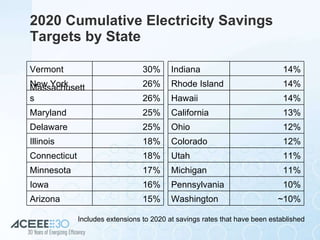
2020 Cumulative Electricity Savings Targets by State Includes extensions to 2020 at savings rates that have been established Vermont 30% New York 26% Massachusetts 26% Maryland 25% Delaware 25% Illinois 18% Connecticut 18% Minnesota 17% Iowa 16% Arizona 15% Indiana 14% Rhode Island 14% Hawaii 14% California 13% Ohio 12% Colorado 12% Utah 11% Michigan 11% Pennsylvania 10% Washington ~10%
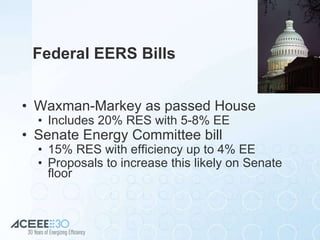
Federal EERS Bills Waxman-Markey as passed House Includes 20% RES with 5-8% EE Senate Energy Committee bill 15% RES with efficiency up to 4% EE Proposals to increase this likely on Senate floor
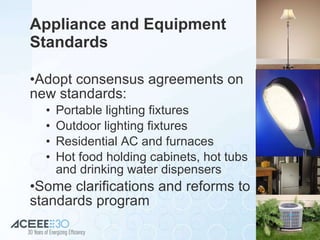
Appliance and Equipment  Standards Adopt consensus agreements on new standards: Portable lighting fixtures Outdoor lighting fixtures Residential AC and furnaces Hot food holding cabinets, hot tubs and drinking water dispensers Some clarifications and reforms to standards program
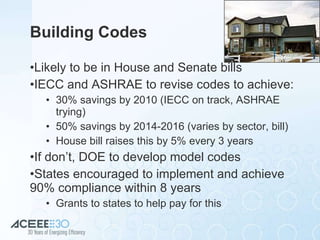
Building Codes Likely to be in House and Senate bills IECC and ASHRAE to revise codes to achieve: 30% savings by 2010 (IECC on track, ASHRAE trying) 50% savings by 2014-2016 (varies by sector, bill) House bill raises this by 5% every 3 years If don’t, DOE to develop model codes States encouraged to implement and achieve 90% compliance within 8 years Grants to states to help pay for this
Incentives for Building Retrofits Performance-based incentives for comprehensive retrofits – in both House  and Senate bills Both residential (like Home Star Gold) and commercial Targeting savings of 20% or more EPA/DOE provide technical program guidance DOE provides funds to states to run programs Funding to come from emissions allowances
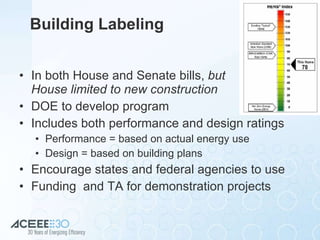
Building Labeling In both House and Senate bills,  but  House limited to new construction DOE to develop program Includes both performance and design ratings Performance = based on actual energy use Design = based on building plans Encourage states and federal agencies to use Funding  and TA for demonstration projects
Will ACELA Programs be Funded? Many of the programs require funding Without funding, savings much lower Includes: Building retrofits Code implementation Labeling
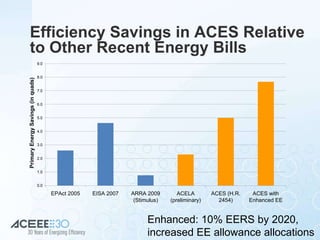
Efficiency Savings in ACES Relative to Other Recent Energy Bills Enhanced: 10% EERS by 2020,  increased EE allowance allocations
Tax Incentives Very unclear what will move forward New home and heavy-duty vehicle incentives need renewal; in 2 nd  jobs bill Some refinements to new home and commercial building incentives proposed by Senators Bingaman, Snowe & Feinstein These 3 Senators also proposed new incentives for industrial motors, replacing old CFC chillers, and upgrading water pumping systems. These last two are most likely to be included in an energy bill… if there is one
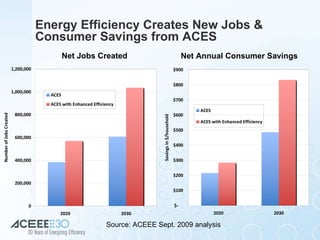
Energy Efficiency Creates New Jobs & Consumer Savings from ACES Net Annual Consumer Savings Net Jobs Created Source: ACEEE Sept. 2009 analysis
Prognosis Need bipartisan approach. Members reluctant to make difficult votes (election year; on top of health care). Some jobs bill likely; probably include Home Star and Advanced Energy Investment Credits; maybe rural co-op bill; other provisions longer shots. CC legislation unlikely unless Graham & Reid settle their tiff soon. Energy-only a possibility, targeting clean energy, with less offshore oil than ACELA.
Contact Info Steven Nadel [email_address] 202-507-4000 www.aceee.org

Nep ally webinar 5 5-10

  • 1.
    Federal Energy Efficiency Policy Prospects ACEEE Ally Webinar Steven Nadel May 5, 2010
  • 2.
    Possible Bills for2010 Jobs bills (e.g. Home Star) Energy-only bills (e.g. ACELA, Lugar) Energy and climate bills (e.g. KGL) Climate only (e.g. Cantwell-Collins) Tax incentives (extenders and new)
  • 3.
    Jobs Bill Proposednew legislation to address high unemployment Initial bill enacted (e.g. unemployment insurance) Second bill mostly tax based, passed Senate Third bill may include several efficiency provisions Key question is how to pay for it (ARRA, TARP, deficit??)
  • 4.
    Potential Efficiency Provisions in a Jobs Bill Home Star / “Cash for Caulkers” Additional funds for oversubscribed ARRA programs: Advanced Energy Investment Credits for manufacturers (mostly renewable energy) Industrial grants and Manufacturing Extension Partnership Other new ideas “ Building Star” program – prescriptive rebates Replacement of old manufactured homes (Tester) Rural loans through electric co-ops (Third Way)
  • 5.
    Energy Productivity ShiftsSpending To Greater Labor and GDP Impacts Source: 2007 IMPLAN data set for the U.S. economy (2009). Energy Efficiency ^ ^
  • 6.
    Home Star /Cash for Caulkers 2010 focused “ Gold Star” performance based – Savings of at least 20%, plus additional incentives for higher savings Based on Home Performance with Energy Star “ Silver Star” prescriptive based – Fixed incentives for specific measures Air and duct sealing Attic, wall and crawl space insulation Replacement windows, heating & cooling systems, appliances Need to meet specified efficiency criteria Quality control component
  • 7.
    Industrial Grants Competitivegrant program for CHP and industrial efficiency upgrades. Had $156 million but over $3 billion of proposals. New legislative proposal is to add $4B Fund additional projects from prior RFP Do a second RFP Also may provide extra money for Manufacturing Extension Partnership
  • 8.
    Building Star Prescriptiveincentives for many EE measures -- $6 billion Insulation HVAC, VSDs, EMSs, transformers Audits, commissioning studies, O&M To be run by DOE and operate for 1 yr. Introduced by Senators Merkley and Pryor
  • 9.
    Current Status ofJobs Bills House scheduled to vote on Home Star on Thurs. 5/6/10. Will be an authorization. Senate Energy Committee has had a hearing, but needs to reintroduce before scheduling a vote. The key outstanding issue is how to pay for these and other jobs bill components.
  • 10.
    Projected Net JobCreation for Energy Efficiency Provisions Being Considered for a Federal Jobs Bill Source: ACEEE analysis.
  • 11.
    Federal Energy andClimate Legislation Status House passed combined energy & climate change bill (ACES) Senate Energy reported out energy-only bill (ACELA) Senate EPW reported out a cap and trade bill Plan was to combine these, along with other provisions, into a more comprehensive bill But there are not 60 votes for this.
  • 12.
    Kerry, Graham andLieberman Trying for compromise bill to get 60 votes Appears to include: Cap and trade for utilities Carbon fee on transportation fuels Regulations on large industrial, ~2016 Significant sections on nuclear, clean coal, oil and gas [but latter likely to change] Very little for efficiency: ACELA included by reference Utilities permitted (but not required) to spend funds for consumers on EE.
  • 13.
    Spending of EmissionsAllowance Revenue on Energy Efficiency in ACES 1/3 to EE Perhaps some to EE EE&RE
  • 14.
    CLEAR Act (Carbon Limits & Energy for America’s Renewal) Targets set and ramp down ¼%/year Emissions allowances auctioned off to fossil fuel producers and importers No third parties (e.g. traders, speculators) Price collar 75% of auction revenue to consumers, per capita 25% for Clean Energy Reinvestment Trust fund Appropriated annually by Congress
  • 15.
    Lugar “Practical Energyand Climate Plan” Reduce oil imports Revise CAFÉ thru 2030, “feebates” Energy efficiency Building codes, federal buildings, national retrofit program (loans & subsidies), industrial efficiency, appliances and equipment Diverse domestic power Clean energy standard thru 2050, authorizes incentives to retire old coal plants Measurement & review of climate programs
  • 16.
    Efficiency Elements inHouse and Senate Energy Bills Energy efficiency resource standards Appliance and equipment standards Improved building codes Residential and commercial retrofits Building labeling Appliance incentives (House only so far) Industrial & building job training & TA – IAC, BTAC Programs for industry (Senate only so far) Demand response (House only so far) Energy Star (Senate only so far)
  • 17.
    Energy Efficiency ResourceStandards Analogous to a Renewable Portfolio Standard Electric and/or gas savings targets for utilities Includes end-use efficiency and sometimes combined heat & power (CHP) and codes/standards Targets generally start low and increase over time Savings must be documented in accordance with evaluation rules established by regulators
  • 18.
    22 States –February 2009 Energy Efficiency Resource Standards Standard Voluntary Goal Pending Standard Combined RES/EERS
  • 19.
    Vermont – RaisingEfficiency to a New Level Source: Efficiency Vermont and VT Dept of Public Service 9% cumulative savings 2000-2008
  • 20.
    2020 Cumulative ElectricitySavings Targets by State Includes extensions to 2020 at savings rates that have been established Vermont 30% New York 26% Massachusetts 26% Maryland 25% Delaware 25% Illinois 18% Connecticut 18% Minnesota 17% Iowa 16% Arizona 15% Indiana 14% Rhode Island 14% Hawaii 14% California 13% Ohio 12% Colorado 12% Utah 11% Michigan 11% Pennsylvania 10% Washington ~10%
  • 21.
    Federal EERS BillsWaxman-Markey as passed House Includes 20% RES with 5-8% EE Senate Energy Committee bill 15% RES with efficiency up to 4% EE Proposals to increase this likely on Senate floor
  • 22.
    Appliance and Equipment Standards Adopt consensus agreements on new standards: Portable lighting fixtures Outdoor lighting fixtures Residential AC and furnaces Hot food holding cabinets, hot tubs and drinking water dispensers Some clarifications and reforms to standards program
  • 23.
    Building Codes Likelyto be in House and Senate bills IECC and ASHRAE to revise codes to achieve: 30% savings by 2010 (IECC on track, ASHRAE trying) 50% savings by 2014-2016 (varies by sector, bill) House bill raises this by 5% every 3 years If don’t, DOE to develop model codes States encouraged to implement and achieve 90% compliance within 8 years Grants to states to help pay for this
  • 24.
    Incentives for BuildingRetrofits Performance-based incentives for comprehensive retrofits – in both House and Senate bills Both residential (like Home Star Gold) and commercial Targeting savings of 20% or more EPA/DOE provide technical program guidance DOE provides funds to states to run programs Funding to come from emissions allowances
  • 25.
    Building Labeling Inboth House and Senate bills, but House limited to new construction DOE to develop program Includes both performance and design ratings Performance = based on actual energy use Design = based on building plans Encourage states and federal agencies to use Funding and TA for demonstration projects
  • 26.
    Will ACELA Programsbe Funded? Many of the programs require funding Without funding, savings much lower Includes: Building retrofits Code implementation Labeling
  • 27.
    Efficiency Savings inACES Relative to Other Recent Energy Bills Enhanced: 10% EERS by 2020, increased EE allowance allocations
  • 28.
    Tax Incentives Veryunclear what will move forward New home and heavy-duty vehicle incentives need renewal; in 2 nd jobs bill Some refinements to new home and commercial building incentives proposed by Senators Bingaman, Snowe & Feinstein These 3 Senators also proposed new incentives for industrial motors, replacing old CFC chillers, and upgrading water pumping systems. These last two are most likely to be included in an energy bill… if there is one
  • 29.
    Energy Efficiency CreatesNew Jobs & Consumer Savings from ACES Net Annual Consumer Savings Net Jobs Created Source: ACEEE Sept. 2009 analysis
  • 30.
    Prognosis Need bipartisanapproach. Members reluctant to make difficult votes (election year; on top of health care). Some jobs bill likely; probably include Home Star and Advanced Energy Investment Credits; maybe rural co-op bill; other provisions longer shots. CC legislation unlikely unless Graham & Reid settle their tiff soon. Energy-only a possibility, targeting clean energy, with less offshore oil than ACELA.
  • 31.
    Contact Info StevenNadel [email_address] 202-507-4000 www.aceee.org