Workshop
Introduction to Structural Equation Modeling with
SmartPLS2.0
PhD Student Hugo Watanuki
Research and Innovation Office (RIO)
Napier University, UK
17th May 2018
1
Agenda
▪ Morning schedule
▪ 09:30 to 11:00
✓ Welcome
✓ Basic concepts and application
▪ 11:00 to 11:15
✓ Coffee-break
▪ 11:15 to 13:00
✓ Main components: structural and measurement models
✓ The PLS algorithm
▪ 13:00 to 13:30
✓ Lunch
▪ Afternoon schedule
▪ 13:30 to 15:00
✓ The analysis method: reflective model
▪ 15:00 to 15:15
✓ Tea
▪ 15:15 to 16:30
✓ The analysis method: formative model
✓ Adjourn
S
m
a
r
t
P
L
S
2
.
0
2
About me
• PhD student @University of São Paulo, Brazil
• Research interest: team collaboration in virtual workplaces
• Teaching associate @Fundação Vanzolini, Brazil
• Research methods for MBA students
• Background: Mechanical (BSc) / Production Engr. (MSc)
• ~13 years as IT professional
Now, it’s your turn …
3
Basic concepts and
application
4
Contextualization
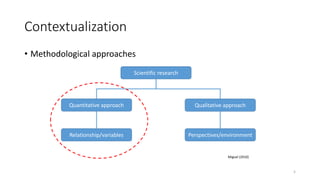
Scientific research
Quantitative approach Qualitative approach
Perspectives/environmentRelationship/variables
Miguel (2010)
5
• Methodological approaches
Contextualization
• Quantitative methods
• Simulation
• Experiment/Quasi-experiment
• Survey
Miguel (2010)
6
Contextualization
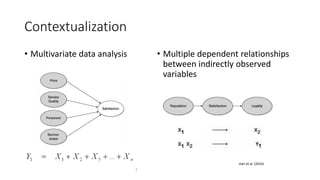
• Multivariate data analysis
7
• Multiple dependent relationships
between indirectly observed
variables
Hair et al. (2014)
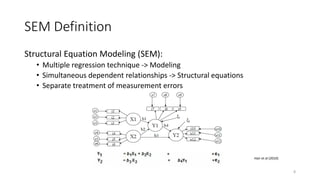
SEM Definition
Structural Equation Modeling (SEM):
• Multiple regression technique -> Modeling
• Simultaneous dependent relationships -> Structural equations
• Separate treatment of measurement errors
Hair et al (2010)
8
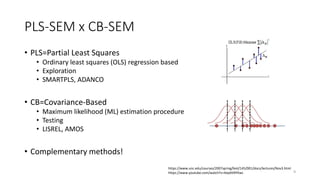
PLS-SEM x CB-SEM
• PLS=Partial Least Squares
• Ordinary least squares (OLS) regression based
• Exploration
• SMARTPLS, ADANCO
• CB=Covariance-Based
• Maximum likelihood (ML) estimation procedure
• Testing
• LISREL, AMOS
• Complementary methods!
9
https://www.unc.edu/courses/2007spring/biol/145/001/docs/lectures/Nov3.html
https://www.youtube.com/watch?v=XepXtl9YKwc
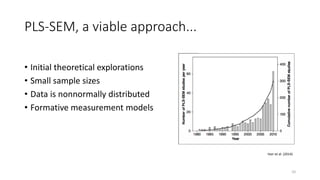
PLS-SEM, a viable approach...
• Initial theoretical explorations
• Small sample sizes
• Data is nonnormally distributed
• Formative measurement models
10
Hair et al. (2014)
More details ...
• HAIR, J. F., HULT, G. T. M., RINGLE, C. M., & SARSTEDT, M. (2014). A
primer on partial least squares structural equation modeling (PLS-SEM).
Thousand Oaks: Sage.
• HENSELER, J., RINGLE, C. M., & SINKOVICS, R. R. (2009). The use of
partial least squares path modeling in international marketing. Advances
in International Marketing, 20, 277-319.
• TENENHAUS, M., VINZI, V. E., CHATELIN, Y., & LAURO, C. (2005). PLS path
modeling. Computational Statistics & Data Analysis, 48(1), 159-205.
• VINZI, V. E., CHIN, W. W., HENSELER, J., & WANG, H. (2010). Handbook of
partial least squares: Concepts, methods and applications. Berlin:
Springer.
11
SmartPLS2.0
download and installation
12
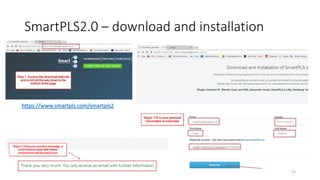
SmartPLS2.0 – download and installation
13
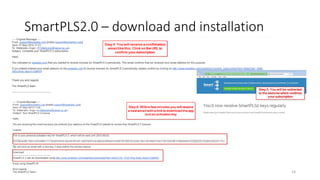
SmartPLS2.0 – download and installation
14
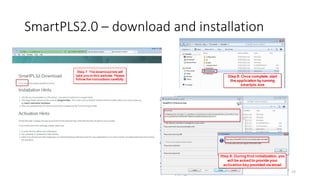
SmartPLS2.0 – download and installation
15
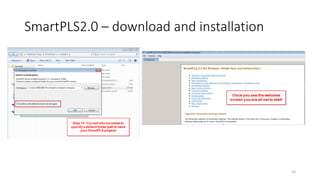
SmartPLS2.0 – download and installation
16
Main components
17
Structural and measurement models
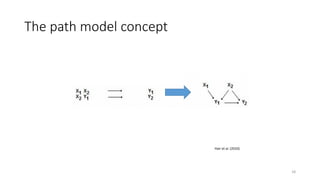
The path model concept
Hair et al. (2010)
18
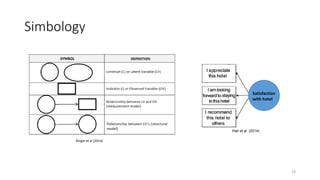
Simbology
Ringle et al (2014)
Hair et al. (2014)
Satisfaction
with hotel
19
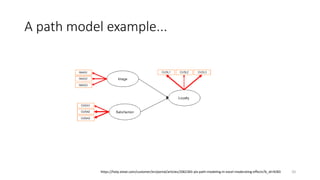
A path model example...
20https://help.xlstat.com/customer/en/portal/articles/2062365-pls-path-modeling-in-excel-moderating-effects?b_id=9283
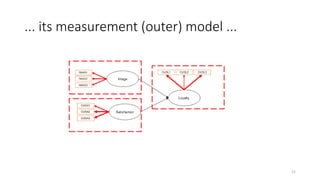
... its measurement (outer) model ...
21
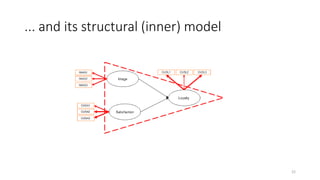
... and its structural (inner) model
22
Types of variables
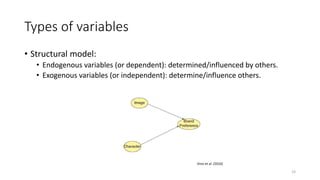
• Structural model:
• Endogenous variables (or dependent): determined/influenced by others.
• Exogenous variables (or independent): determine/influence others.
Vinzi et al. (2010)
23
Types of variables
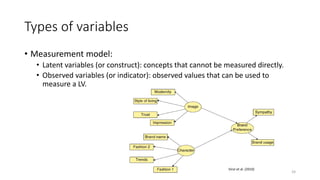
• Measurement model:
• Latent variables (or construct): concepts that cannot be measured directly.
• Observed variables (or indicator): observed values that can be used to
measure a LV.
Vinzi et al. (2010)
24
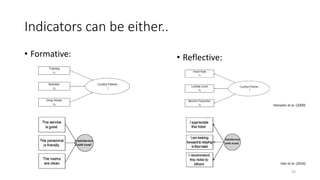
Indicators can be either..
• Formative:
25
Hair et al. (2014)
• Reflective:
Henseler et al. (2009)
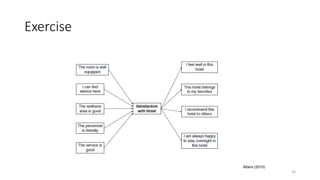
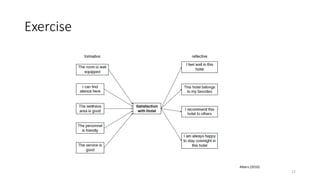
Exercise
Albers (2010)
26
Exercise
Albers (2010)
27
SmartPLS2.0
Creating a new project/model
28
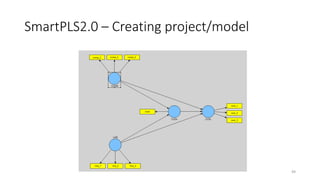
SmartPLS2.0 – Creating project/model
Hair et al. (2014)
29
Research question: “What determines
Customer Loyalty (CUSL)?” Competence (COMP)
comp_l [The company] is a top competitor in its market.
comp_2 As far as I know, [the company] is recognized worldwide.
comp_3 I believe that [the company] performs at a premium level.
Likeability (LIKE)
like_l [The company] is a company that I can better identify with than other companies.
like_2
[The company] is a company that I would regret more not having if it no longer existed
than I would other companies.
like_3 I regard [the company] as a likeable company.
Customer Satisfaction (CUSA)
cusa If you consider your experiences with [company], how satisfied are you with [company]?
Customer Loyalty (CUSL)
cusl_l I would recommend [company] to friends and relatives.
cusl_2 If I had to choose again, I would choose [company] as my mobile phone services provider.
cusl_3 I will remain a customer of [company] in the future.
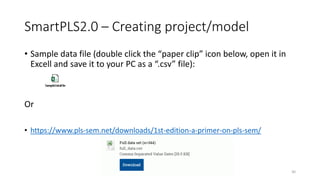
SmartPLS2.0 – Creating project/model
• Sample data file (double click the “paper clip” icon below, open it in
Excell and save it to your PC as a “.csv” file):
Or
• https://www.pls-sem.net/downloads/1st-edition-a-primer-on-pls-sem/
30
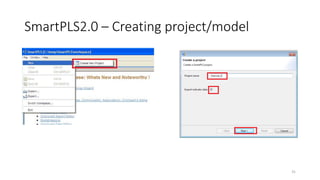
SmartPLS2.0 – Creating project/model
31
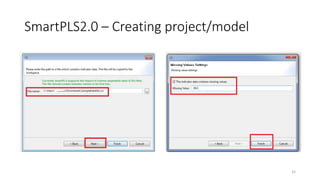
SmartPLS2.0 – Creating project/model
32
SmartPLS2.0 – Creating project/model
33
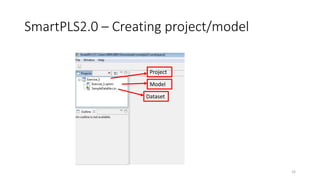
Project
Model
Dataset
SmartPLS2.0 – Creating project/model
34
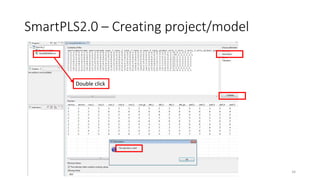
Double click
SmartPLS2.0 – Creating project/model
35
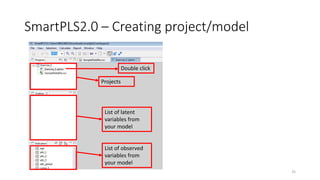
Projects
List of latent
variables from
your model
List of observed
variables from
your model
Double click
SmartPLS2.0 – Creating project/model
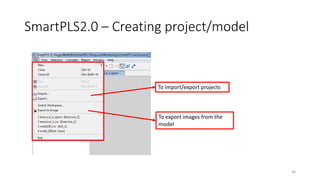
To import/export projects
To export images from the
model
36
SmartPLS2.0 – Creating project/model
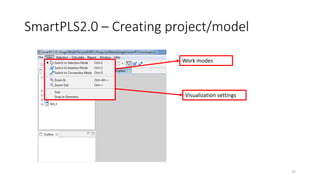
Work modes
Visualization settings
37
SmartPLS2.0 – Creating project/model
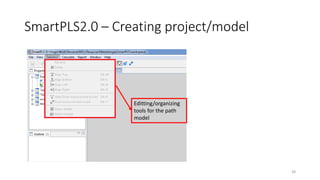
Editting/organizing
tools for the path
model
38
SmartPLS2.0 – Creating project/model
39
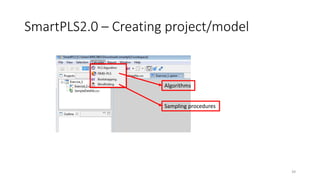
Algorithms
Sampling procedures
SmartPLS2.0 – Creating project/model
40
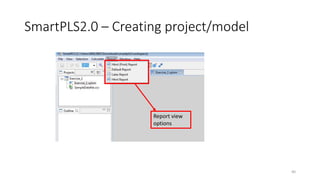
Report view
options
SmartPLS2.0 – Creating project/model
41
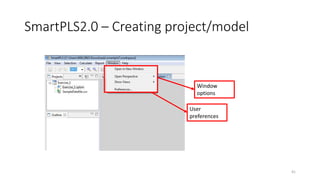
Window
options
User
preferences
SmartPLS2.0 – Creating project/model
42
SmartPLS2.0 – Creating project/model
43
SmartPLS2.0 – Creating project/model
44
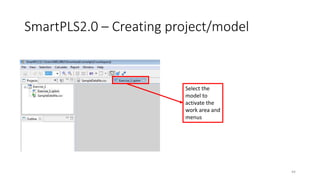
Select the
model to
activate the
work area and
menus
SmartPLS2.0 – Creating project/model
45
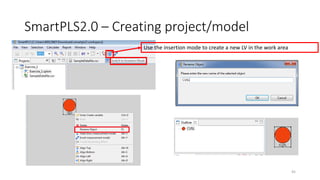
Use the insertion mode to create a new LV in the work area
SmartPLS2.0 – Creating project/model
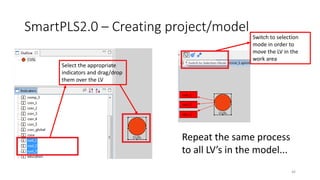
Repeat the same process
to all LV’s in the model...
Select the appropriate
indicators and drag/drop
them over the LV
Switch to selection
mode in order to
move the LV in the
work area
46
SmartPLS2.0 – Creating project/model
47
SmartPLS2.0 – Creating project/model
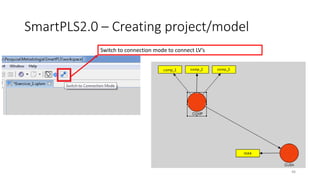
Switch to connection mode to connect LV’s
48
SmartPLS2.0 – Creating project/model
49
SmartPLS2.0 – Creating project/model
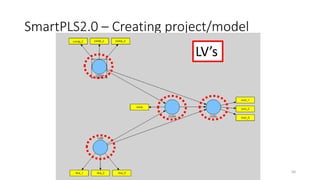
LV’s
50
SmartPLS2.0 – Creating project/model
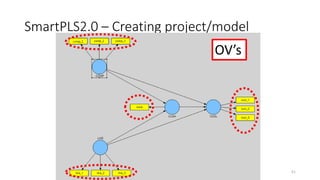
OV’s
51
SmartPLS2.0 – Creating project/model
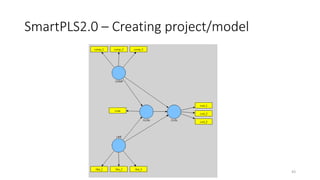
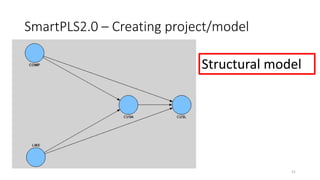
Structural model
52
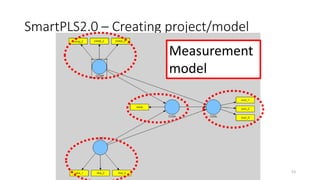
SmartPLS2.0 – Creating project/model
Measurement
model
53
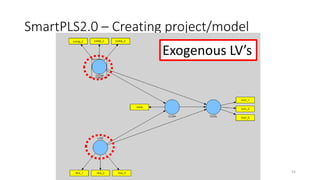
SmartPLS2.0 – Creating project/model
Exogenous LV’s
54
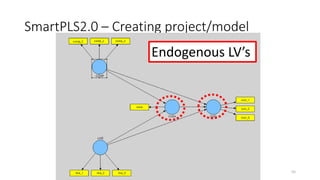
SmartPLS2.0 – Creating project/model
Endogenous LV’s
55
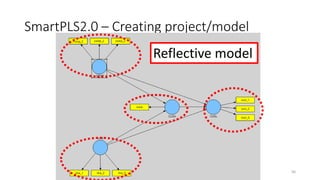
SmartPLS2.0 – Creating project/model
Reflective model
56
The PLS algorithm
57
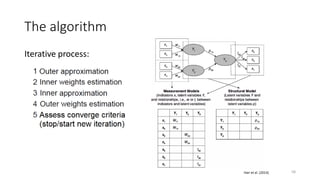
The algorithm
Hair et al. (2014) 58
Iterative process:
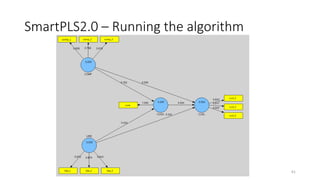
SmartPLS2.0
Running the algorithm
59
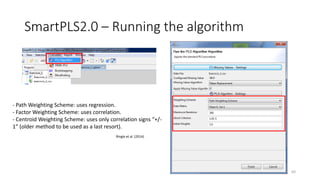
SmartPLS2.0 – Running the algorithm
60
- Path Weighting Scheme: uses regression.
- Factor Weighting Scheme: uses correlation.
- Centroid Weighting Scheme: uses only correlation signs “+/-
1” (older method to be used as a last resort).
Ringle et al. (2014)
SmartPLS2.0 – Running the algorithm
61
The analysis method
Reflective model
62
Two stage process
1. Assessment of the measurement model
• Are the measurement errors under control?
• Every measure is subject to errors (specially when measuring feelings, emotions,
competences, etc).
• Quality of measures affects quality of research.
2. Assessment of the structural model
• How well does the model explain the behavior of the target variable?
• How generalizable is the model?
63
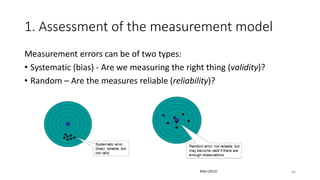
1. Assessment of the measurement model
Measurement errors can be of two types:
• Systematic (bias) - Are we measuring the right thing (validity)?
• Random – Are the measures reliable (reliability)?
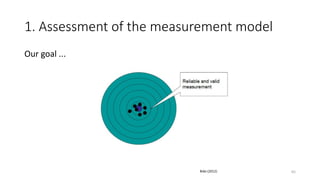
Bido (2012) 64
1. Assessment of the measurement model
Our goal ...
65Bido (2012)
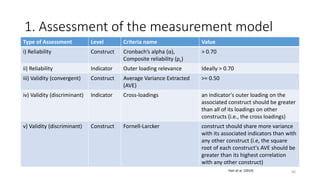
1. Assessment of the measurement model
Type of Assessment Level Criteria name Value
i) Reliability Construct Cronbach’s alpha (α),
Composite reliability (ρc)
> 0.70
ii) Reliability Indicator Outer loading relevance Ideally > 0.70
iii) Validity (convergent) Construct Average Variance Extracted
(AVE)
>= 0.50
iv) Validity (discriminant) Indicator Cross-loadings an indicator's outer loading on the
associated construct should be greater
than all of its loadings on other
constructs (i.e., the cross loadings)
v) Validity (discriminant) Construct Fornell-Larcker construct should share more variance
with its associated indicators than with
any other construct (i.e, the square
root of each construct's AVE should be
greater than its highest correlation
with any other construct)
66Hair et al. (2014)
1. Assessment of the measurement model
67
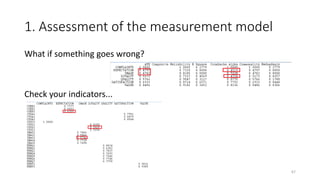
What if something goes wrong?
Check your indicators...
1. Assessment of the measurement model
68
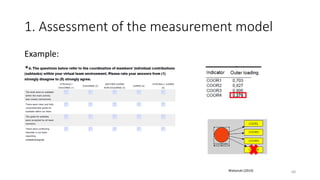
Example:
Watanuki (2014)
SmartPLS2.0
Assessing the measurement model
69
SmartPLS2.0 – Assessing the measurement...
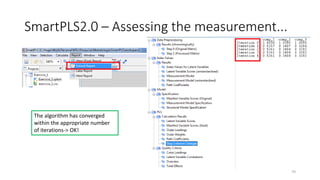
The algorithm has converged
within the appropriate number
of iterations-> OK!
70
SmartPLS2.0 – Assessing the measurement...
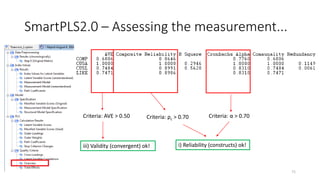
Criteria: AVE > 0.50 Criteria: ρc > 0.70 Criteria: α > 0.70
i) Reliability (constructs) ok!iii) Validity (convergent) ok!
71
SmartPLS2.0 – Assessing the measurement...
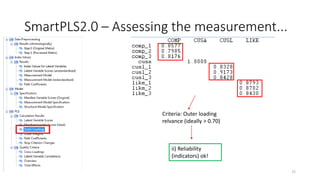
ii) Reliability
(indicators) ok!
Criteria: Outer loading
relvance (ideally > 0.70)
72
SmartPLS2.0 – Assessing the measurement...
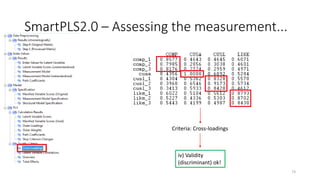
iv) Validity
(discriminant) ok!
73
Criteria: Cross-loadings
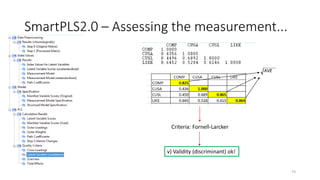
SmartPLS2.0 – Assessing the measurement...
v) Validity (discriminant) ok!
74
Criteria: Fornell-Larcker
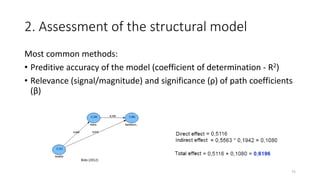
2. Assessment of the structural model
Most common methods:
• Preditive accuracy of the model (coefficient of determination - R2)
• Relevance (signal/magnitude) and significance (ρ) of path coefficients
(β)
75
Bido (2012)
2. Assessment of the structural model
Hair et al. (2014)
76
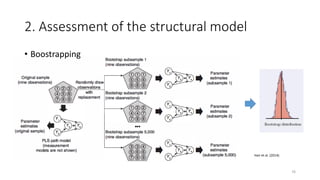
• Boostrapping
2. Assessment of the structural model
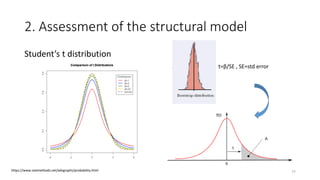
Student’s t distribution
77https://www.statmethods.net/advgraphs/probability.html
t=β/SE , SE=std error
2. Assessment of the structural model
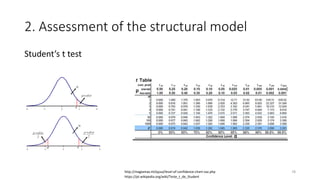
Student’s t test
78http://magiamax.ml/qysul/level-of-confidence-chart-vaz.php
https://pt.wikipedia.org/wiki/Teste_t_de_Student
SmartPLS2.0
Assessing the structural model
79
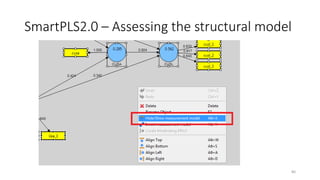
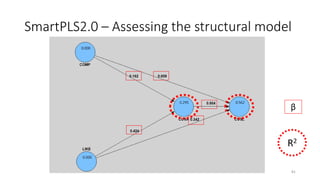
SmartPLS2.0 – Assessing the structural model
80
SmartPLS2.0 – Assessing the structural model
81
R2
β
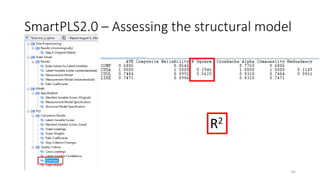
SmartPLS2.0 – Assessing the structural model
R2
82
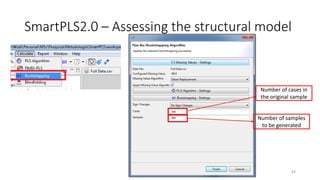
SmartPLS2.0 – Assessing the structural model
Number of cases in
the original sample
Number of samples
to be generated
83
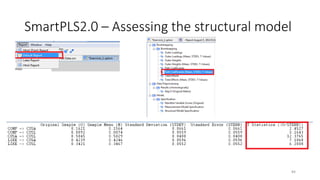
SmartPLS2.0 – Assessing the structural model
84
SmartPLS2.0 – Assessing the structural model
85
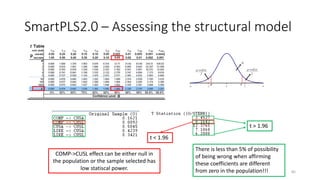
t > 1.96
There is less than 5% of possibility
of being wrong when affirming
these coefficients are different
from zero in the population!!!
COMP->CUSL effect can be either null in
the population or the sample selected has
low statiscal power.
t < 1.96
SmartPLS2.0 – Assessing the structural model
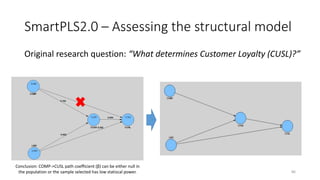
Original research question: “What determines Customer Loyalty (CUSL)?”
86
Conclusion: COMP->CUSL path coefficient (β) can be either null in
the population or the sample selected has low statiscal power.
The analysis method
Formative model
87
Two stage process
1. Assessment of the measurement model
• Are the measurement errors under control?
• Every measure is subject to errors (specially when measuring feelings, emotions,
competences, etc).
• Quality of measures affects quality of research.
2. Assessment of the structural model
• How well does the model explain the behavior of the target variable?
• How generalizable is the model?
88
1. Assessment of the measurement model
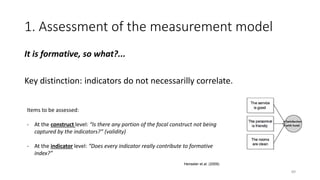
It is formative, so what?...
Key distinction: indicators do not necessarilly correlate.
89
Items to be assessed:
- At the construct level: “Is there any portion of the focal construct not being
captured by the indicators?” (validity)
- At the indicator level: “Does every indicator really contribute to formative
index?”
Henseler et al. (2009)
1. Assessment of the measurement model
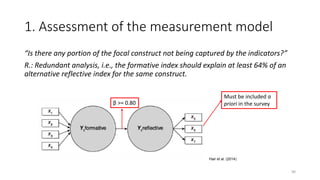
“Is there any portion of the focal construct not being captured by the indicators?”
R.: Redundant analysis, i.e., the formative index should explain at least 64% of an
alternative reflective index for the same construct.
90
Hair et al. (2014)
Must be included a
priori in the surveyβ >= 0.80
1. Assessment of the measurement model
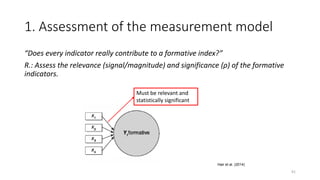
“Does every indicator really contribute to a formative index?”
R.: Assess the relevance (signal/magnitude) and significance (ρ) of the formative
indicators.
91
Hair et al. (2014)
Must be relevant and
statistically significant
1. Assessment of the measurement model
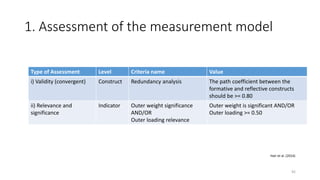
Type of Assessment Level Criteria name Value
i) Validity (convergent) Construct Redundancy analysis The path coefficient between the
formative and reflective constructs
should be >= 0.80
ii) Relevance and
significance
Indicator Outer weight significance
AND/OR
Outer loading relevance
Outer weight is significant AND/OR
Outer loading >= 0.50
92
Hair et al. (2014)
SmartPLS2.0
A mixed model example
93
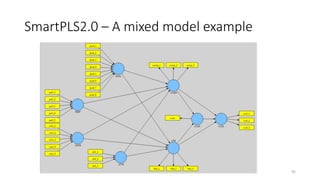
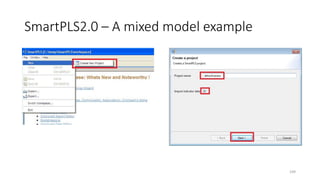
SmartPLS2.0 – A mixed model example
Hair et al. (2014)
94
Research question: “Which marketing
strategy should be prioritized for a larger
increase in Customer Loyalty (CUSL)?”
Quality (QUAL)
qual_1 The products/services offered by [the company] are of high quality.
qual_2 In my opinion [the company] tends to be an innovator, rather than an imitator with respect to [industry].
qual_3 I think that [the company]'s products/services offer good value for money.
qual_4 The services [the company] offers are good.
qual_5 Customer concerns are held in high regard at [the company].
qual_6 [The company] seems to be a reliable partner for customers.
qual_7 I regard [the company] as a trustworthy company.
qual_8 I have a lot of respect for [the company].
Performance (PERF)
perf_1 [The company] is a very well-managed company.
perf_2 [The company] is an economically stable company.
perf_3 I assess the business risk for [the company] as modest compared to its competitors.
perf_4 I think that [the company] has growth potential.
perf_5 [The company] has a clear vision about the future of the company.
Corporate Social Responsibility (CSOR)
csor_1 [The company] behaves in a socially conscious way.
csor_2 I have the impression that [the company] is forthright in giving information to the public.
csor_3 I have the impression that [the company] has a fair attitude toward competitors.
csor_4 [The company] is concerned about the preservation of the environment.
csor_5 I have the feeling that [the company] is not only concerned about profits.
Attractiveness (ATTR)
attr_1 In my opinion [the company] is successful in attracting high-quality employees.
attr_2 I could see myself working at [the company].
attr_3 I like the physical appearance of [the company] (company, buildings, shops, etc.).
SmartPLS2.0 – A mixed model example
95
SmartPLS2.0 – A mixed model example
96
SmartPLS2.0 – A mixed model example
97
SmartPLS2.0 – A mixed model example
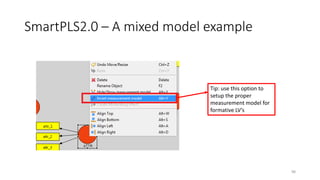
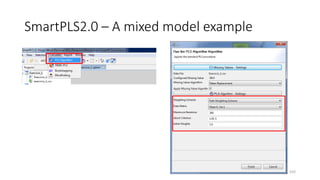
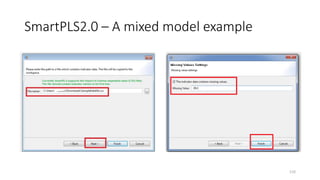
Tip: use this option to
setup the proper
measurement model for
formative LV’s
98
SmartPLS2.0 – A mixed model example
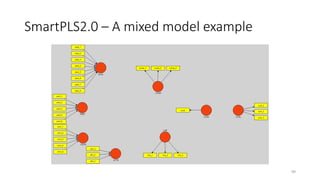
99
SmartPLS2.0 – A mixed model example
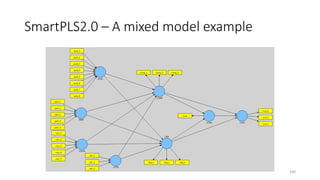
100
SmartPLS2.0 – A mixed model example
101
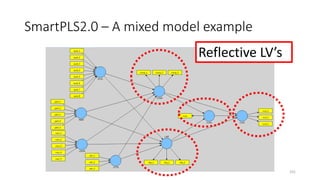
Reflective LV’s
SmartPLS2.0 – A mixed model example
102
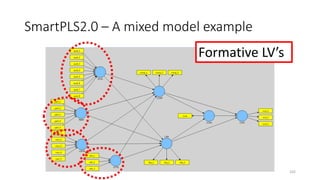
Formative LV’s
SmartPLS2.0 – A mixed model example
103
SmartPLS2.0 – A mixed model example
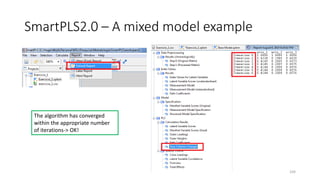
The algorithm has converged
within the appropriate number
of iterations-> OK!
104
SmartPLS2.0 – A mixed model example
105
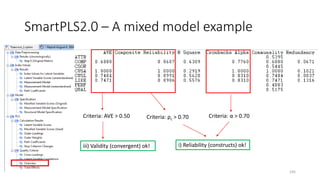
Criteria: AVE > 0.50 Criteria: ρc > 0.70 Criteria: α > 0.70
i) Reliability (constructs) ok!iii) Validity (convergent) ok!
SmartPLS2.0 – A mixed model example
106
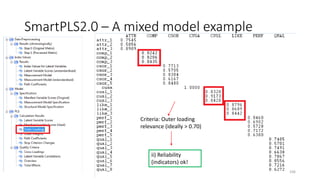
ii) Reliability
(indicators) ok!
Criteria: Outer loading
relevance (ideally > 0.70)
SmartPLS2.0 – A mixed model example
107
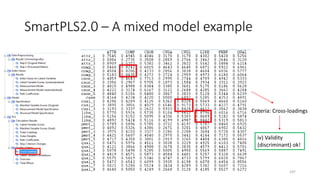
iv) Validity
(discriminant) ok!
Criteria: Cross-loadings
SmartPLS2.0 – A mixed model example
108
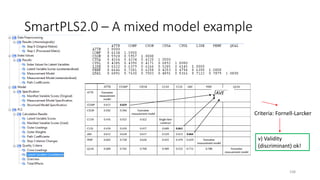
v) Validity
(discriminant) ok!
Criteria: Fornell-Larcker
SmartPLS2.0 – A mixed model example
109
SmartPLS2.0 – A mixed model example
110
SmartPLS2.0 – A mixed model example
111
SmartPLS2.0 – A mixed model example
112
SmartPLS2.0 – A mixed model example
113
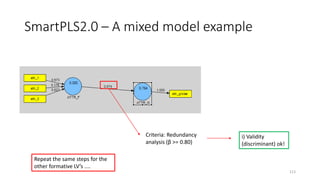
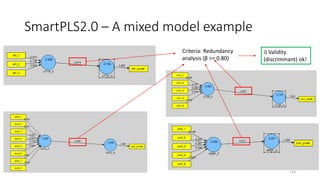
i) Validity
(discriminant) ok!
Criteria: Redundancy
analysis (β >= 0.80)
Repeat the same steps for the
other formative LV’s ....
SmartPLS2.0 – A mixed model example
114
i) Validity
(discriminant) ok!
Criteria: Redundancy
analysis (β >= 0.80)
SmartPLS2.0 – A mixed model example
115
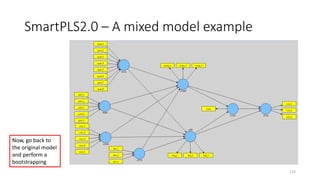
Now, go back to
the original model
and perform a
bootstrapping
SmartPLS2.0 – A mixed model example
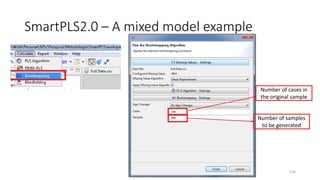
Number of cases in
the original sample
Number of samples
to be generated
116
SmartPLS2.0 – A mixed model example
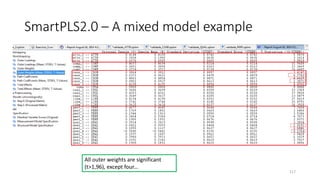
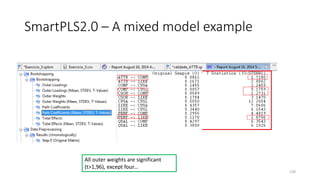
All outer weights are significant
(t>1,96), except four...
117
SmartPLS2.0 – A mixed model example
118
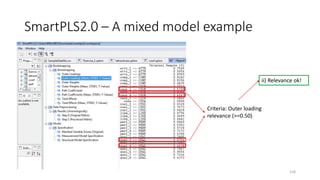
ii) Relevance ok!
Criteria: Outer loading
relevance (>=0.50)
SmartPLS2.0 – A mixed model example
119
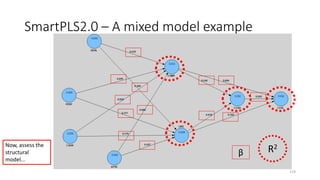
Now, assess the
structural
model...
R2
β
SmartPLS2.0 – A mixed model example
120
All outer weights are significant
(t>1,96), except four...
SmartPLS2.0 – A mixed model example
121
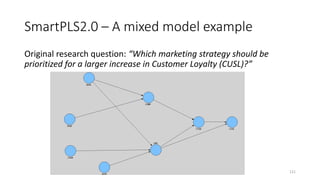
Original research question: “Which marketing strategy should be
prioritized for a larger increase in Customer Loyalty (CUSL)?”
SmartPLS2.0 – A mixed model example
122
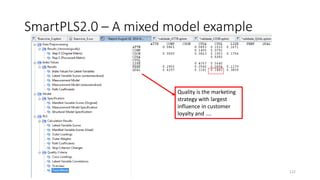
Quality is the marketing
strategy with largest
influence in customer
loyalty and ....
SmartPLS2.0 – A mixed model example
123
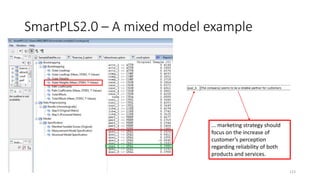
... marketing strategy should
focus on the increase of
customer’s perception
regarding reliability of both
products and services.
Main limitations
Structural Equation Modeling with SmartPLS2.0
124
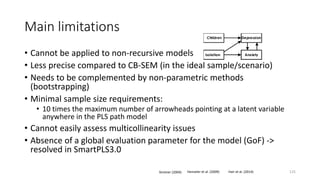
Main limitations
• Cannot be applied to non-recursive models
• Less precise compared to CB-SEM (in the ideal sample/scenario)
• Needs to be complemented by non-parametric methods
(bootstrapping)
• Minimal sample size requirements:
• 10 times the maximum number of arrowheads pointing at a latent variable
anywhere in the PLS path model
• Cannot easily assess multicollinearity issues
• Absence of a global evaluation parameter for the model (GoF) ->
resolved in SmartPLS3.0
125Henseler et al. (2009) Hair et al. (2014)Streiner (2004)
Practical aspects
126
Practical aspects
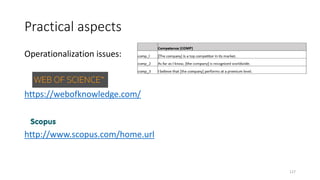
Operationalization issues:
https://webofknowledge.com/
http://www.scopus.com/home.url
127
Practical aspects
128
Electronic questionnaires:
https://www.surveymonkey.com/
https://surveys.google.com/
Practical aspects
Advertising the survey:
• Email, social media, class organizations,
etc
• Direct mail/advertising companies
129https://thenextweb.com/contributors/2017/08/21/blockchain-can-make-social-networks-private-profitable/
Practical aspects
130
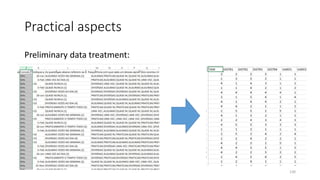
Preliminary data treatment:
Workshop
Introduction to Structural Equation Modeling with
SmartPLS2.0
PhD Student Hugo Watanuki
Research and Innovation Office (RIO)
Napier University, UK
17th May 2018
131
Let’s stay in touch...
• http://lattes.cnpq.br/8871662215636083
• https://www.researchgate.net/profile/Hugo_Watanuki
• https://www.linkedin.com/in/hugo-watanuki-82ba53a/
• https://www.slideshare.net/HugoWatanuki
• hwatanuki@usp.br
• @hugowtnk
• +44 (0) 794 419 1980
• +55 (11) 94142 0218
132
References
• ALBERS, S. (2010). PLS and Success Factor Studies in Marketing. In: VINZI, V. E., CHIN, W. W., HENSELER, J., & WANG, H. (Org.), Handbook of partial
least squares: Concepts, methods and applications (pp. 409-425). Berlin: Springer.
• BIDO, D. S. (2012). Modelagem em equações estruturais com estimação PLS (partial least squares-path modeling). Workshop presented at Encontro
Nacional da ANPAD. Available at: http://www.anpad.org.br/diversos/enanpad2012/
• HAIR JR., J. F., BLACK, W. C., BABIN, B. J., & ANDERSON, R. E. (2014). Multivariate Data Analysis. New Jersey: Prentice Hall.
• HAIR, J. F., HULT, G. T. M., RINGLE, C. M., & SARSTEDT, M. (2014). A primer on partial least squares structural equation modeling (PLS-SEM). Thousand
Oaks: Sage.
• HENSELER, J., RINGLE, C. M., & SINKOVICS, R. R. (2009). The use of partial least squares path modeling in international marketing. Advances in
International Marketing, 20, 277-319.
• MIGUEL, P. A. C. (2010). Metodologia de Pesquisa em Engenharia de Produção e Gestão de Operações. Rio de Janeiro: Editora Campus.
• RINGLE, C. M., SILVA, D., & BIDO, D. (2014). Modelagem de equações estruturais com utilização do SmartPLS. Revista Brasileira de Marketing, 13, 54-
71.
• RINGLE, C. M., WENDE, S., & WILL, A. (2005). Smart PLS 2.0 M3. Hamburg University. Available at: http://www.smartpls.de
• STREINER, D. L. (2005). Finding Our Way: An Introduction to Path Analysis. The Canadian Journal of Psychiatry, 50 (2), 115-122.
• TENENHAUS, M., VINZI, V. E., CHATELIN, Y., & LAURO, C. (2005). PLS path modeling. Computational Statistics & Data Analysis, 48(1), 159-205.
• VINZI, V. E., TRINCHERA, L., & AMATO, S. (2010). PLS Path Modeling: From Foundations to Recent Development and Open Issues for Model
Assessment and Improvement. In: VINZI, V. E., CHIN, W. W., HENSELER, J., & WANG, H. (Org.), Handbook of partial least squares: Concepts, methods
and applications (pp. 47-82). Berlin: Springer.
• WATANUKI, H.M. (2014). Desempenho de equipes virtuais no multisourcing de serviços de tecnologia da informação (Dissertation, Polytechnic School,
University of São Paulo. Available at: http://www.teses.usp.br
133
Backup slide
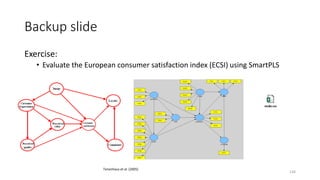
Exercise:
• Evaluate the European consumer satisfaction index (ECSI) using SmartPLS
134
Tenenhaus et al. (2005)

Slides pls workshop_uk-napier_v1

  • 1.
    Workshop Introduction to StructuralEquation Modeling with SmartPLS2.0 PhD Student Hugo Watanuki Research and Innovation Office (RIO) Napier University, UK 17th May 2018 1
  • 2.
    Agenda ▪ Morning schedule ▪09:30 to 11:00 ✓ Welcome ✓ Basic concepts and application ▪ 11:00 to 11:15 ✓ Coffee-break ▪ 11:15 to 13:00 ✓ Main components: structural and measurement models ✓ The PLS algorithm ▪ 13:00 to 13:30 ✓ Lunch ▪ Afternoon schedule ▪ 13:30 to 15:00 ✓ The analysis method: reflective model ▪ 15:00 to 15:15 ✓ Tea ▪ 15:15 to 16:30 ✓ The analysis method: formative model ✓ Adjourn S m a r t P L S 2 . 0 2
  • 3.
    About me • PhDstudent @University of São Paulo, Brazil • Research interest: team collaboration in virtual workplaces • Teaching associate @Fundação Vanzolini, Brazil • Research methods for MBA students • Background: Mechanical (BSc) / Production Engr. (MSc) • ~13 years as IT professional Now, it’s your turn … 3
  • 4.
  • 5.
    Contextualization Scientific research Quantitative approachQualitative approach Perspectives/environmentRelationship/variables Miguel (2010) 5 • Methodological approaches
  • 6.
    Contextualization • Quantitative methods •Simulation • Experiment/Quasi-experiment • Survey Miguel (2010) 6
  • 7.
    Contextualization • Multivariate dataanalysis 7 • Multiple dependent relationships between indirectly observed variables Hair et al. (2014)
  • 8.
    SEM Definition Structural EquationModeling (SEM): • Multiple regression technique -> Modeling • Simultaneous dependent relationships -> Structural equations • Separate treatment of measurement errors Hair et al (2010) 8
  • 9.
    PLS-SEM x CB-SEM •PLS=Partial Least Squares • Ordinary least squares (OLS) regression based • Exploration • SMARTPLS, ADANCO • CB=Covariance-Based • Maximum likelihood (ML) estimation procedure • Testing • LISREL, AMOS • Complementary methods! 9 https://www.unc.edu/courses/2007spring/biol/145/001/docs/lectures/Nov3.html https://www.youtube.com/watch?v=XepXtl9YKwc
  • 10.
    PLS-SEM, a viableapproach... • Initial theoretical explorations • Small sample sizes • Data is nonnormally distributed • Formative measurement models 10 Hair et al. (2014)
  • 11.
    More details ... •HAIR, J. F., HULT, G. T. M., RINGLE, C. M., & SARSTEDT, M. (2014). A primer on partial least squares structural equation modeling (PLS-SEM). Thousand Oaks: Sage. • HENSELER, J., RINGLE, C. M., & SINKOVICS, R. R. (2009). The use of partial least squares path modeling in international marketing. Advances in International Marketing, 20, 277-319. • TENENHAUS, M., VINZI, V. E., CHATELIN, Y., & LAURO, C. (2005). PLS path modeling. Computational Statistics & Data Analysis, 48(1), 159-205. • VINZI, V. E., CHIN, W. W., HENSELER, J., & WANG, H. (2010). Handbook of partial least squares: Concepts, methods and applications. Berlin: Springer. 11
  • 12.
  • 13.
    SmartPLS2.0 – downloadand installation 13
  • 14.
    SmartPLS2.0 – downloadand installation 14
  • 15.
    SmartPLS2.0 – downloadand installation 15
  • 16.
    SmartPLS2.0 – downloadand installation 16
  • 17.
  • 18.
    The path modelconcept Hair et al. (2010) 18
  • 19.
    Simbology Ringle et al(2014) Hair et al. (2014) Satisfaction with hotel 19
  • 20.
    A path modelexample... 20https://help.xlstat.com/customer/en/portal/articles/2062365-pls-path-modeling-in-excel-moderating-effects?b_id=9283
  • 21.
    ... its measurement(outer) model ... 21
  • 22.
    ... and itsstructural (inner) model 22
  • 23.
    Types of variables •Structural model: • Endogenous variables (or dependent): determined/influenced by others. • Exogenous variables (or independent): determine/influence others. Vinzi et al. (2010) 23
  • 24.
    Types of variables •Measurement model: • Latent variables (or construct): concepts that cannot be measured directly. • Observed variables (or indicator): observed values that can be used to measure a LV. Vinzi et al. (2010) 24
  • 25.
    Indicators can beeither.. • Formative: 25 Hair et al. (2014) • Reflective: Henseler et al. (2009)
  • 26.
  • 27.
  • 28.
  • 29.
    SmartPLS2.0 – Creatingproject/model Hair et al. (2014) 29 Research question: “What determines Customer Loyalty (CUSL)?” Competence (COMP) comp_l [The company] is a top competitor in its market. comp_2 As far as I know, [the company] is recognized worldwide. comp_3 I believe that [the company] performs at a premium level. Likeability (LIKE) like_l [The company] is a company that I can better identify with than other companies. like_2 [The company] is a company that I would regret more not having if it no longer existed than I would other companies. like_3 I regard [the company] as a likeable company. Customer Satisfaction (CUSA) cusa If you consider your experiences with [company], how satisfied are you with [company]? Customer Loyalty (CUSL) cusl_l I would recommend [company] to friends and relatives. cusl_2 If I had to choose again, I would choose [company] as my mobile phone services provider. cusl_3 I will remain a customer of [company] in the future.
  • 30.
    SmartPLS2.0 – Creatingproject/model • Sample data file (double click the “paper clip” icon below, open it in Excell and save it to your PC as a “.csv” file): Or • https://www.pls-sem.net/downloads/1st-edition-a-primer-on-pls-sem/ 30
  • 31.
    SmartPLS2.0 – Creatingproject/model 31
  • 32.
    SmartPLS2.0 – Creatingproject/model 32
  • 33.
    SmartPLS2.0 – Creatingproject/model 33 Project Model Dataset
  • 34.
    SmartPLS2.0 – Creatingproject/model 34 Double click
  • 35.
    SmartPLS2.0 – Creatingproject/model 35 Projects List of latent variables from your model List of observed variables from your model Double click
  • 36.
    SmartPLS2.0 – Creatingproject/model To import/export projects To export images from the model 36
  • 37.
    SmartPLS2.0 – Creatingproject/model Work modes Visualization settings 37
  • 38.
    SmartPLS2.0 – Creatingproject/model Editting/organizing tools for the path model 38
  • 39.
    SmartPLS2.0 – Creatingproject/model 39 Algorithms Sampling procedures
  • 40.
    SmartPLS2.0 – Creatingproject/model 40 Report view options
  • 41.
    SmartPLS2.0 – Creatingproject/model 41 Window options User preferences
  • 42.
    SmartPLS2.0 – Creatingproject/model 42
  • 43.
    SmartPLS2.0 – Creatingproject/model 43
  • 44.
    SmartPLS2.0 – Creatingproject/model 44 Select the model to activate the work area and menus
  • 45.
    SmartPLS2.0 – Creatingproject/model 45 Use the insertion mode to create a new LV in the work area
  • 46.
    SmartPLS2.0 – Creatingproject/model Repeat the same process to all LV’s in the model... Select the appropriate indicators and drag/drop them over the LV Switch to selection mode in order to move the LV in the work area 46
  • 47.
    SmartPLS2.0 – Creatingproject/model 47
  • 48.
    SmartPLS2.0 – Creatingproject/model Switch to connection mode to connect LV’s 48
  • 49.
    SmartPLS2.0 – Creatingproject/model 49
  • 50.
    SmartPLS2.0 – Creatingproject/model LV’s 50
  • 51.
    SmartPLS2.0 – Creatingproject/model OV’s 51
  • 52.
    SmartPLS2.0 – Creatingproject/model Structural model 52
  • 53.
    SmartPLS2.0 – Creatingproject/model Measurement model 53
  • 54.
    SmartPLS2.0 – Creatingproject/model Exogenous LV’s 54
  • 55.
    SmartPLS2.0 – Creatingproject/model Endogenous LV’s 55
  • 56.
    SmartPLS2.0 – Creatingproject/model Reflective model 56
  • 57.
  • 58.
    The algorithm Hair etal. (2014) 58 Iterative process:
  • 59.
  • 60.
    SmartPLS2.0 – Runningthe algorithm 60 - Path Weighting Scheme: uses regression. - Factor Weighting Scheme: uses correlation. - Centroid Weighting Scheme: uses only correlation signs “+/- 1” (older method to be used as a last resort). Ringle et al. (2014)
  • 61.
    SmartPLS2.0 – Runningthe algorithm 61
  • 62.
  • 63.
    Two stage process 1.Assessment of the measurement model • Are the measurement errors under control? • Every measure is subject to errors (specially when measuring feelings, emotions, competences, etc). • Quality of measures affects quality of research. 2. Assessment of the structural model • How well does the model explain the behavior of the target variable? • How generalizable is the model? 63
  • 64.
    1. Assessment ofthe measurement model Measurement errors can be of two types: • Systematic (bias) - Are we measuring the right thing (validity)? • Random – Are the measures reliable (reliability)? Bido (2012) 64
  • 65.
    1. Assessment ofthe measurement model Our goal ... 65Bido (2012)
  • 66.
    1. Assessment ofthe measurement model Type of Assessment Level Criteria name Value i) Reliability Construct Cronbach’s alpha (α), Composite reliability (ρc) > 0.70 ii) Reliability Indicator Outer loading relevance Ideally > 0.70 iii) Validity (convergent) Construct Average Variance Extracted (AVE) >= 0.50 iv) Validity (discriminant) Indicator Cross-loadings an indicator's outer loading on the associated construct should be greater than all of its loadings on other constructs (i.e., the cross loadings) v) Validity (discriminant) Construct Fornell-Larcker construct should share more variance with its associated indicators than with any other construct (i.e, the square root of each construct's AVE should be greater than its highest correlation with any other construct) 66Hair et al. (2014)
  • 67.
    1. Assessment ofthe measurement model 67 What if something goes wrong? Check your indicators...
  • 68.
    1. Assessment ofthe measurement model 68 Example: Watanuki (2014)
  • 69.
  • 70.
    SmartPLS2.0 – Assessingthe measurement... The algorithm has converged within the appropriate number of iterations-> OK! 70
  • 71.
    SmartPLS2.0 – Assessingthe measurement... Criteria: AVE > 0.50 Criteria: ρc > 0.70 Criteria: α > 0.70 i) Reliability (constructs) ok!iii) Validity (convergent) ok! 71
  • 72.
    SmartPLS2.0 – Assessingthe measurement... ii) Reliability (indicators) ok! Criteria: Outer loading relvance (ideally > 0.70) 72
  • 73.
    SmartPLS2.0 – Assessingthe measurement... iv) Validity (discriminant) ok! 73 Criteria: Cross-loadings
  • 74.
    SmartPLS2.0 – Assessingthe measurement... v) Validity (discriminant) ok! 74 Criteria: Fornell-Larcker
  • 75.
    2. Assessment ofthe structural model Most common methods: • Preditive accuracy of the model (coefficient of determination - R2) • Relevance (signal/magnitude) and significance (ρ) of path coefficients (β) 75 Bido (2012)
  • 76.
    2. Assessment ofthe structural model Hair et al. (2014) 76 • Boostrapping
  • 77.
    2. Assessment ofthe structural model Student’s t distribution 77https://www.statmethods.net/advgraphs/probability.html t=β/SE , SE=std error
  • 78.
    2. Assessment ofthe structural model Student’s t test 78http://magiamax.ml/qysul/level-of-confidence-chart-vaz.php https://pt.wikipedia.org/wiki/Teste_t_de_Student
  • 79.
  • 80.
    SmartPLS2.0 – Assessingthe structural model 80
  • 81.
    SmartPLS2.0 – Assessingthe structural model 81 R2 β
  • 82.
    SmartPLS2.0 – Assessingthe structural model R2 82
  • 83.
    SmartPLS2.0 – Assessingthe structural model Number of cases in the original sample Number of samples to be generated 83
  • 84.
    SmartPLS2.0 – Assessingthe structural model 84
  • 85.
    SmartPLS2.0 – Assessingthe structural model 85 t > 1.96 There is less than 5% of possibility of being wrong when affirming these coefficients are different from zero in the population!!! COMP->CUSL effect can be either null in the population or the sample selected has low statiscal power. t < 1.96
  • 86.
    SmartPLS2.0 – Assessingthe structural model Original research question: “What determines Customer Loyalty (CUSL)?” 86 Conclusion: COMP->CUSL path coefficient (β) can be either null in the population or the sample selected has low statiscal power.
  • 87.
  • 88.
    Two stage process 1.Assessment of the measurement model • Are the measurement errors under control? • Every measure is subject to errors (specially when measuring feelings, emotions, competences, etc). • Quality of measures affects quality of research. 2. Assessment of the structural model • How well does the model explain the behavior of the target variable? • How generalizable is the model? 88
  • 89.
    1. Assessment ofthe measurement model It is formative, so what?... Key distinction: indicators do not necessarilly correlate. 89 Items to be assessed: - At the construct level: “Is there any portion of the focal construct not being captured by the indicators?” (validity) - At the indicator level: “Does every indicator really contribute to formative index?” Henseler et al. (2009)
  • 90.
    1. Assessment ofthe measurement model “Is there any portion of the focal construct not being captured by the indicators?” R.: Redundant analysis, i.e., the formative index should explain at least 64% of an alternative reflective index for the same construct. 90 Hair et al. (2014) Must be included a priori in the surveyβ >= 0.80
  • 91.
    1. Assessment ofthe measurement model “Does every indicator really contribute to a formative index?” R.: Assess the relevance (signal/magnitude) and significance (ρ) of the formative indicators. 91 Hair et al. (2014) Must be relevant and statistically significant
  • 92.
    1. Assessment ofthe measurement model Type of Assessment Level Criteria name Value i) Validity (convergent) Construct Redundancy analysis The path coefficient between the formative and reflective constructs should be >= 0.80 ii) Relevance and significance Indicator Outer weight significance AND/OR Outer loading relevance Outer weight is significant AND/OR Outer loading >= 0.50 92 Hair et al. (2014)
  • 93.
  • 94.
    SmartPLS2.0 – Amixed model example Hair et al. (2014) 94 Research question: “Which marketing strategy should be prioritized for a larger increase in Customer Loyalty (CUSL)?” Quality (QUAL) qual_1 The products/services offered by [the company] are of high quality. qual_2 In my opinion [the company] tends to be an innovator, rather than an imitator with respect to [industry]. qual_3 I think that [the company]'s products/services offer good value for money. qual_4 The services [the company] offers are good. qual_5 Customer concerns are held in high regard at [the company]. qual_6 [The company] seems to be a reliable partner for customers. qual_7 I regard [the company] as a trustworthy company. qual_8 I have a lot of respect for [the company]. Performance (PERF) perf_1 [The company] is a very well-managed company. perf_2 [The company] is an economically stable company. perf_3 I assess the business risk for [the company] as modest compared to its competitors. perf_4 I think that [the company] has growth potential. perf_5 [The company] has a clear vision about the future of the company. Corporate Social Responsibility (CSOR) csor_1 [The company] behaves in a socially conscious way. csor_2 I have the impression that [the company] is forthright in giving information to the public. csor_3 I have the impression that [the company] has a fair attitude toward competitors. csor_4 [The company] is concerned about the preservation of the environment. csor_5 I have the feeling that [the company] is not only concerned about profits. Attractiveness (ATTR) attr_1 In my opinion [the company] is successful in attracting high-quality employees. attr_2 I could see myself working at [the company]. attr_3 I like the physical appearance of [the company] (company, buildings, shops, etc.).
  • 95.
    SmartPLS2.0 – Amixed model example 95
  • 96.
    SmartPLS2.0 – Amixed model example 96
  • 97.
    SmartPLS2.0 – Amixed model example 97
  • 98.
    SmartPLS2.0 – Amixed model example Tip: use this option to setup the proper measurement model for formative LV’s 98
  • 99.
    SmartPLS2.0 – Amixed model example 99
  • 100.
    SmartPLS2.0 – Amixed model example 100
  • 101.
    SmartPLS2.0 – Amixed model example 101 Reflective LV’s
  • 102.
    SmartPLS2.0 – Amixed model example 102 Formative LV’s
  • 103.
    SmartPLS2.0 – Amixed model example 103
  • 104.
    SmartPLS2.0 – Amixed model example The algorithm has converged within the appropriate number of iterations-> OK! 104
  • 105.
    SmartPLS2.0 – Amixed model example 105 Criteria: AVE > 0.50 Criteria: ρc > 0.70 Criteria: α > 0.70 i) Reliability (constructs) ok!iii) Validity (convergent) ok!
  • 106.
    SmartPLS2.0 – Amixed model example 106 ii) Reliability (indicators) ok! Criteria: Outer loading relevance (ideally > 0.70)
  • 107.
    SmartPLS2.0 – Amixed model example 107 iv) Validity (discriminant) ok! Criteria: Cross-loadings
  • 108.
    SmartPLS2.0 – Amixed model example 108 v) Validity (discriminant) ok! Criteria: Fornell-Larcker
  • 109.
    SmartPLS2.0 – Amixed model example 109
  • 110.
    SmartPLS2.0 – Amixed model example 110
  • 111.
    SmartPLS2.0 – Amixed model example 111
  • 112.
    SmartPLS2.0 – Amixed model example 112
  • 113.
    SmartPLS2.0 – Amixed model example 113 i) Validity (discriminant) ok! Criteria: Redundancy analysis (β >= 0.80) Repeat the same steps for the other formative LV’s ....
  • 114.
    SmartPLS2.0 – Amixed model example 114 i) Validity (discriminant) ok! Criteria: Redundancy analysis (β >= 0.80)
  • 115.
    SmartPLS2.0 – Amixed model example 115 Now, go back to the original model and perform a bootstrapping
  • 116.
    SmartPLS2.0 – Amixed model example Number of cases in the original sample Number of samples to be generated 116
  • 117.
    SmartPLS2.0 – Amixed model example All outer weights are significant (t>1,96), except four... 117
  • 118.
    SmartPLS2.0 – Amixed model example 118 ii) Relevance ok! Criteria: Outer loading relevance (>=0.50)
  • 119.
    SmartPLS2.0 – Amixed model example 119 Now, assess the structural model... R2 β
  • 120.
    SmartPLS2.0 – Amixed model example 120 All outer weights are significant (t>1,96), except four...
  • 121.
    SmartPLS2.0 – Amixed model example 121 Original research question: “Which marketing strategy should be prioritized for a larger increase in Customer Loyalty (CUSL)?”
  • 122.
    SmartPLS2.0 – Amixed model example 122 Quality is the marketing strategy with largest influence in customer loyalty and ....
  • 123.
    SmartPLS2.0 – Amixed model example 123 ... marketing strategy should focus on the increase of customer’s perception regarding reliability of both products and services.
  • 124.
    Main limitations Structural EquationModeling with SmartPLS2.0 124
  • 125.
    Main limitations • Cannotbe applied to non-recursive models • Less precise compared to CB-SEM (in the ideal sample/scenario) • Needs to be complemented by non-parametric methods (bootstrapping) • Minimal sample size requirements: • 10 times the maximum number of arrowheads pointing at a latent variable anywhere in the PLS path model • Cannot easily assess multicollinearity issues • Absence of a global evaluation parameter for the model (GoF) -> resolved in SmartPLS3.0 125Henseler et al. (2009) Hair et al. (2014)Streiner (2004)
  • 126.
  • 127.
  • 128.
  • 129.
    Practical aspects Advertising thesurvey: • Email, social media, class organizations, etc • Direct mail/advertising companies 129https://thenextweb.com/contributors/2017/08/21/blockchain-can-make-social-networks-private-profitable/
  • 130.
  • 131.
    Workshop Introduction to StructuralEquation Modeling with SmartPLS2.0 PhD Student Hugo Watanuki Research and Innovation Office (RIO) Napier University, UK 17th May 2018 131
  • 132.
    Let’s stay intouch... • http://lattes.cnpq.br/8871662215636083 • https://www.researchgate.net/profile/Hugo_Watanuki • https://www.linkedin.com/in/hugo-watanuki-82ba53a/ • https://www.slideshare.net/HugoWatanuki • hwatanuki@usp.br • @hugowtnk • +44 (0) 794 419 1980 • +55 (11) 94142 0218 132
  • 133.
    References • ALBERS, S.(2010). PLS and Success Factor Studies in Marketing. In: VINZI, V. E., CHIN, W. W., HENSELER, J., & WANG, H. (Org.), Handbook of partial least squares: Concepts, methods and applications (pp. 409-425). Berlin: Springer. • BIDO, D. S. (2012). Modelagem em equações estruturais com estimação PLS (partial least squares-path modeling). Workshop presented at Encontro Nacional da ANPAD. Available at: http://www.anpad.org.br/diversos/enanpad2012/ • HAIR JR., J. F., BLACK, W. C., BABIN, B. J., & ANDERSON, R. E. (2014). Multivariate Data Analysis. New Jersey: Prentice Hall. • HAIR, J. F., HULT, G. T. M., RINGLE, C. M., & SARSTEDT, M. (2014). A primer on partial least squares structural equation modeling (PLS-SEM). Thousand Oaks: Sage. • HENSELER, J., RINGLE, C. M., & SINKOVICS, R. R. (2009). The use of partial least squares path modeling in international marketing. Advances in International Marketing, 20, 277-319. • MIGUEL, P. A. C. (2010). Metodologia de Pesquisa em Engenharia de Produção e Gestão de Operações. Rio de Janeiro: Editora Campus. • RINGLE, C. M., SILVA, D., & BIDO, D. (2014). Modelagem de equações estruturais com utilização do SmartPLS. Revista Brasileira de Marketing, 13, 54- 71. • RINGLE, C. M., WENDE, S., & WILL, A. (2005). Smart PLS 2.0 M3. Hamburg University. Available at: http://www.smartpls.de • STREINER, D. L. (2005). Finding Our Way: An Introduction to Path Analysis. The Canadian Journal of Psychiatry, 50 (2), 115-122. • TENENHAUS, M., VINZI, V. E., CHATELIN, Y., & LAURO, C. (2005). PLS path modeling. Computational Statistics & Data Analysis, 48(1), 159-205. • VINZI, V. E., TRINCHERA, L., & AMATO, S. (2010). PLS Path Modeling: From Foundations to Recent Development and Open Issues for Model Assessment and Improvement. In: VINZI, V. E., CHIN, W. W., HENSELER, J., & WANG, H. (Org.), Handbook of partial least squares: Concepts, methods and applications (pp. 47-82). Berlin: Springer. • WATANUKI, H.M. (2014). Desempenho de equipes virtuais no multisourcing de serviços de tecnologia da informação (Dissertation, Polytechnic School, University of São Paulo. Available at: http://www.teses.usp.br 133
  • 134.
    Backup slide Exercise: • Evaluatethe European consumer satisfaction index (ECSI) using SmartPLS 134 Tenenhaus et al. (2005)