Launch Strategy
for the Philips
Health Platform
Group 15
Frans Dijckmeester
Joris van Doorninck	
Max Barnsteiner
Paola Montserrat
2
Table of
contents.
Introduction
Debrief
Analysis
Healthcare Consumers
Competition
Company analysis
Brand strategy
Brand DNA
Brand rationale
Message
Concept
Visual brand appearance
Manifestation
Launch strategy
Overall launch plan
Starting off with maternity
Maternity marketing material
Detailed launch plan
Conclusion
3
4
6-7
8-9
10
12-13
14-15
16
17
18-19
20-21
24-25
26-27
28-29
30
31
3
Creating a launch strategy for Philips
The new venture of Philips, is the ultimate Personal
Healthcare Record (PHR). An online platform that
connects the patients’ personal data with doctors
expertise. The aim of this project is to create a
desirable, feasible and viable launch strategy for
this platform, starting from the summer of 2018, in
The Netherlands.
This report covers a new brand, a launch strategy
and execution plan for this venture to make a
successful entrance to the Dutch market.
First Page
Introduction
4
Debrief
The specifications
Goal: It is to become the preferred Personal Health Record for Dutch
citizens and to reach highest adoption rates when launched.
Scope: This project is aimed at the Netherlands, going from one
hospital department to another.
General Requirements:
· Budget: 		 5.000-10.000 euros per hospital department
· Final deliverables: 	 report & video
· Timeframe: 		 delivery before the 6th of July 2018
· Roll-out of product & launch strategy: directly after the final delivery
5
Analysis
Coming up with an excellent brand and launch
strategy out of the blue is hard. To be sure
the strategies we come up fit with the current
healthcare market and company, a few analyses
are conducted.
In the healthcare market analysis, the research
combined broader market developments and the
competitive field with specific customer needs.
For the company, we dived into what Philips’
current brand image is and what could be used
and what should be changed for the new Philips
Health Platform.
This all was of great relevance for the evaluation
of the context and for crafting a realistic strategy.
6
Healthcare
consumers
Consumer unreliable nature of medical information on the
internet. Both among professionals as well as the
healthcare consumer itself. [3]
The Dutch healthcare system is one of the best,
worldwide [4]. A lot of medical technology
patents are coming from the Netherlands [5],
new technologies are implemented every year
and medical practitioners pass a qualitative high
education.
However, the pressure to maximize efficiency has
made the system rather impersonal. Less and
less personal contact between practitioner and
patient, is reducing the patients trust in diagnoses
and treatments and increases the error rate of
practitioners. The choice of a treatment is made on
a general basis and not focused on the individual
patient needs [6].
Another trend in the healthcare sector is preventive
care. Of course it is the better choice to avoid
diseases, instead of treating them - people live a
healthier life and the government can save costs
in the healthcare [7].Patients and practitioners
Consumers are in our case medical patients in the
Netherlands. They are aware of the largest trend
in healthcare, which is to make the system more
efficient and profit focused.[1] They experience
it, through reduced appointment times and
shorter treatments. Serious diagnoses are made
and communicated within few minutes. The
personal connection between patient and medical
practitioner is diminishing. This development makes
patients doubt and worry. Is the diagnosis and
treatment the best one for my health, or is it the
one that improves the hospitals profit? As a result,
trust has been described as the scarcest of medical
commodities [2].
In addition it is hard to access all the professional
expertise on your health in the moment it is needed.
Also, in a digital world consumers are used to
finding the, personalised, information they need
immediately or even before they thought about it.
This is not yet the case in healthcare. Healthcare on
demand is not yet realised. As consequence, patients
have a higher desire for knowledge. The required
information is mostly found on the internet. However,
there is a large concern regarding the variable and
Context
7
are aware of the advantages of preventive care, but
it is difficult to completely change a system that has
always been focused on curing. This is why there is
a large potential to support this movement towards
preventive care.
We already have a good healthcare system.
However, out of the analysis, four elements to
improve were found (as shown on the right).
These are exactly the elements that the Philips
Health Platform can add and these elements should
be incorporated in the brand.
[1] Zorguitgaven stijgen in 2017 met 2,1 procent. (2018, 29 mei).
Geraadpleegd op 5 juli 2018, van https://www.cbs.nl/nl-nl/
nieuws/2018/22/zorguitgaven-stijgen-in-2017-met-2-1-procent
[2] Illingworth, P., „Trust: The Scarcest of Medical Resources“, J. Med
Philos 2002;27: 31-46.
[3] Scullard P et al. Googling children‘s health: Reliability of medical
advice on the internet. Arch Dis Child 2010 Apr 6. (http://dx.doi.
org/10.1136/adc.2009.168856)
[4] Legatum Institute Foundation. (2017). The Legatum Prosperity Index
2017. London: Legatum Institute.
[5] World Intellectual Property Organization. (2017). World Intellectual
Property Indicators 2017 Patent. Geneva: WIPO .
[6] Björnberg, A. (2018). Euro Health Consumer Index 2017 Report.
Marseillan: Health Consumer Powerhouse Ltd.
[7] World Economic Forum, McKinsey & Company. (2013). Healthcare
Industry 2013: Sustainable Health Systems Visions, Strategies, Critical
Uncertainties and Scenarios. /Geneva: World Economic Forum.
Opportunities
in healthcare
8
Competition
Competition
This finding reveals the opportunity to position
the system as the only solution that links high-
end consumer focus with professional healthcare
providers - being personal & professional at the
same time. Realising this challenging combination
would result in a strong position over the
competition.
The main competition is the status-quo, which is the
non-use of a digital health platform. Most patients
do not know that there are such systems existing and
why it is solving their needs. That is why mainly should
be focused on the added values in comparison to the
current healthcare system or how a PHR can add to
the current healthcare system.
Furthermore, there are already health platforms in
use. These can be divided in two categories:
The first category are platforms that are focused on
healthcare providers, “patient ehealth systems”. These
platforms are designed for professional use and often
are often very technical, impersonal and therefore
unattractive for patients.
Secondly, there is a more consumer oriented category,
the “citizen ehealth systems”. These systems come in
form of browser portals or smartphone applications.
These services are attractive for consumers, but the
downside of these systems is the missing connection
with healthcare providers, as the product does not
provide communication with experts or professional
advice.
9
Area of
opportunity
Focused on personal use
Focusedonprofessionaluse
10
Company
analysis.
Philips brand However, to be successful in the healthcare
market, we need to shift the perception of our
sub-brand, towards a more medical focus. This
makes it necessary to convince consumers by
additional values, like caring and personal. The
goal of our brand should therefore be focused on
conveying these values.
Subsequently, the Philips brand itself could
benefit from the brand image, created through
the sub-brand. As the Philips Health Platform will
be a service which is used daily by (healthcare)
consumers, it can help Philips to be considered
more as a healthcare company.
The Philips brand is currently in the process of a
large redefinition. The company has changed its
strategy and focuses now mainly on the health
department by improving people’s health and
enabling better outcomes across the health
continuum. Almost all other departments got
sold off. However, despite Philips’ brand
efforts, the Dutch community still perceives
the brand mainly as trustable, and reliable
producer of consumer electronics and domestic
appliances.
The Philips Health Platform is an online platform
developed by a venture through the incubator
program Philips HealthWorks. The company is all
about this one product, so for now the brand of the
product and the venture can be seen as one.
The advantage of having Philips as parent brand
is that values which are currently associated with
Philips, like reliability and trustworthiness can be
transferred to the new sub-brand.
Philips Health Platform
11
Brand strategy
In the next phase, a Brand DNA was created,
based on the findings from the previous
analysis. Brand purpose, positioning and
personality were defined.
The brand DNA was then translated into a key
message and a general branding concept, which
is the base of the launch strategy.
12
Brand
DNA Positioning
personal: caring, forward looking
professional: reliable, trustworthy
Personality
caregiver
mother
Purpose
True care can only be achieved by combining highly
personal treatment and advice with the expertise of
professional practicioners.
13
Brand purpose, positioning and personality
The Philips Health Platform is a complex
technological solution, which is why it is crucial to
simplify and make meaningful connections between
the service and the customer. The brand should
deliver a return on emotion directly connected to
consumer needs.
That is what Sana does. Sana stands for the best form
of healthcare, true care. A form of healthcare that did
not exist before because of technological limitations.
The core believe is that true care can only be
achieved by combining highly personal treatment
and advice with the expertise of professional
practitioners, while making this care accessible on
demand.
Sana is using values like reliable, trustworthy and
forward looking which are already associated with
Philips, but especially positions itself as a personal
and caring brand.
This is why the brand should communicate a
personality that is caregiver, or more specific, a
mother.
Brand name
The focus of the brand should be on the personal
aspect in the first place.
This is why a first name has been chosen. It
represents the personal connection that the health
platforms provides, just like a family member or
very good friend. It is a name, people can easily
relate to and that makes the complex digital system
approachable . It sounds like a common first name,
but actually means “health” or “healing” in Latin.
This comes from the ultimate goal to establish the
platform as synonym for health.
14
Brand
rationale
Fit with Philips
Philips is currently perceived as a reliable and
trustworthy electronics brand. As said, the new
brand for the platform can and should make use of
the trustworthiness and reliability people associate
with Philips, but without mentioning Philips too
much - since that will weaken the personal and
caring positioning of the new Brand DNA.
Another advantage is that Sana can help Philips
help change their image and strengthen that
Philips provides innovative healthcare solutions,
instead of electronics, for everyone.
Through
SANA:
personal, caring
Current
PHILIPS
image:
reliable, trustworthy
Desired
PHILIPS
identity:
reliable, caring
personal,
caringg
trustworthy,
reliableg
15
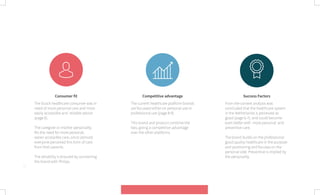
Consumer fit
The Dutch healthcare consumer was in
need of more personal care and more
easily accessible and reliable advice
(page 6).
The caregiver or mother personality
fits the need for more personal,
easier accessible care, since (almost)
everyone perceived this form of care
from their parents.
The reliability is ensured by connecting
the brand with Philips.
Competitive advantage
The current healthcare platform brands
are focussed either on personal use or
professional use (page 8-9)
This brand and product combine the
two, giving a competitive advantage
over the other platforms.
Success Factors
From the context analysis was
concluded that the healthcare system
in the Netherlands is perceived as
good (page 6-7), and could become
even better with more personal and
preventive care.
The brand builds on the professional
good quality healthcare in the purpose
and positioning and focuses on the
personal side. Preventive is implied by
the personality.
16
Message
The Philips Health Platform is
all care should be about.
It brings back the safe feeling of the personal treatment
and advice that you received as a child, by knowing your
individual needs and by always being there for you. It
combines this personal element, with the expertise of
health practitioners, to ensure that you get professional
information at the right time.
17
True care...
...is knowing what you need
…and what you don’t need
...informs …and explains
True Care
...is helping you take care of
yourself and is always there
for you...
True care
...is finally enabled, by Sana.
Concept
Creating brand resonance
Branding is about planting the purpose,
personality and positioning of our brand identity
into the mind of customers.
With this concept we want to make Sana the
synonym of true care, by showing they are exactly
about the same thing: delivering the best personal
and professional care.
18
Visual
brand
appearance.
Logo, colours & name
The brand is combining personal with professional
care. As described in the brand DNA, the focus of
the brand should be on the personal aspect in the
first place.
The logo continues with the concept and
combines the professional health side in form of a
cross, with the personal care, in form of a heart.
The color palette, which is used for all brand
manifestations, underlines the personal aspect of
care and combines a soft red, with a warm blue, as
blue is known as the color of healthcare.
The soft and warm aspect of personal care is
also translated into the reduced saturation of the
pictures used.
19
20
Manifestation
True Care
is always
there for
you.
True Care
informs and
explains
21
True Care
is helping
you to take
care of
yourself.
True Care
is finally
enabled.
True Care
knows
you.
22
Manifestation
video
23
Launch Strategy
At this point, we defined the right brand strategy
for the platform, built upon an analysis. Next
step is to explain what the best way is to use the
brand. In the debrief it is described to go from
department to department, so that the message
can be adopted to the specific patient needs.
So, first is described what department should
be started with and in what order should be
succeeded. Next we will dive into each step.
Per step the conformed key messages are
explained and translated into concept.
24
Overall
launch
plan.
The most strategic choice to start the launch of the
platform with the prior described brand, is, in our
opinion, the maternity department. This is because of
two reasons.
1. The platform will get a kickstart. The love from
a parent for its child is used as a metaphor for the
true care the platform delivers. Almost everyone can
remember this feeling, but this message is especially
effective for pregnant women (and their spouse).
Also, the consumers at the pregnancy department are
younger and therefore probably more willing to try a
digital platform. These reasons will help to increase
adoption rates quickly.
2. It will make the brand stronger. If people hear
from the platform for the first time in the context
of pregnancy, the platform will be perceived as
something positive, instead of curing sick people.
This will create and amplify our brand image Also the
metaphor of true care will come across better, since
the love of a mother to her child is something almost
everyone can relate to. This branding will happen
in mouth-to-mouth chatter (for instance a pregnant
woman talking to their mother) and we will also use
this in advertisement material to convince everyone.
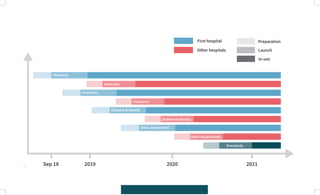
Then the other departments will follow, from
young to old. So next pediatrics, then diabetes
& obesity and so on. This order is suggested,
because of the same reasons as for maternity, the
positive branding and the easier digital adaptation
are higher for these departments.
For all departments applies that first the platform
will be adapted to the specific patient needs in
co-creation with healthcare professionals. This,
and the creation of content, will be done in the
pre-launch. Then is started with the pilot hospital
where the platform is actively launched for four
months. Different ideas can be tested and lessons
learned will be used for the same department at
other hospitals.
In the end the goal is to become the most used
personal health platform in the Netherlands. We
suggest to launch the platform for everyone in the
end of 2020.
25
Maternity
Sep 18 2019 2020 2021
Maternity
Pediatrics
Pediatrics
Diabetes & obesity
Diabetes & obesity
Other department
Other departments
Everybody
First hospital
Other hospitals
Preparation
Launch
In-use
26
Starting
off with
maternity.
Targeting pregnant women
The previous plan is comprehensive, but generic.
Since we suggest to start with pregnancy and to
show more in-depth how the launch will go at one
department, we worked out a more detailed plan for
the maternity department.
The concept needs to be adjusted to the specific
needs of pregnant women and new parents. The two
most important insights are that pregnant women:
Feel uncertain about personal conditions [1]
Use a lot of unverified information [2]
Translated into the specific concept:
True care… knows you and your baby, since every
pregnancy is different
True care… informs and explains, since internet
doesn’t know best
True care… is helping you take care of yourself
True care… is always there for you
[1] Podvornik, N., & Velikonja, V. (2015). Depression and Anxiety in Women
During Pregnancy in Slovenia. Slovenian journal of Public Health, 54(1),
45-50.
[2] Aaronson, L. S., Mural, C. M., & Pfoutz, S. K. (1988). Seeking information:
where do pregnant women go? Health Education, 15(3), 335-345.
27
The customer will
arrive at the
hospital to the
gynecological
In the waiting room, there will
be a screen projecting the
promotional video of Sana. At
the same time, there will be
tablets where the customers
can try a demo and sign-up to
Sana.
Subsequently, during the
appointment, the doctor will
congratulate the new parents, next,
he/she will explain the system Sana
and their benefits. The doctor will
highly recommend the use of it. The
doctor will deliver marketing material
that will be an information card and a
measurement tape to measure the
tummy during the following months.
The doctor will also explain, if the couple use
Sana during their pregnancy, they can get a
photo-diary called “Baby first book.” This
photo-diary will contain relevant and
sentimental information of the pregnancy,
and space to start to document all important
memories of their baby conjointly with the
system Sana. The process is then repeated for
the next department, pediatrics. Integrating a
new member to the Sana family
Screen
Video
Waiting Room
Demo
Sign up
Tablets
Enter to appointment
Doctor
Using Sana during Pregnancy
Marketing
Baby’s born
Photo-diary
Poster
28
Maternity
marketing
material
Information card
When the doctor recommends the platform and
congratulates the new mother during the intake
appointment in the hospital a custom Sana
measuring band is handed to the parents. This can be
used to measure the baby’s progress and strengthen
the Sana brand.
It also serves as a reminder to use and update the
platform during the pregnancy. When entering the
belly circumference other data about the baby is likely
to be added. This data is then coupled with the user’s
data to inform about the progress and health status of
the baby.
Measuring tape
A flyer gets lost in a crowded waiting room.
Therefore to grab the attention of the hospital
visitor a Photo flyer with a personal feeling is used
to grab the attention and stand out of the more
generic advertising.
The card can also be stored in your wallet, like
done with people‘s’ own photos.
29
Photo diary
A recommendation would be, to implement the
functionality in the Sana platform, to create a
photo diary. This diary will be a combination of
the mother’s stories and experiences during the
pregnancy, the relevant and special healthcare
data of the baby, pictures of the pregnancy and
pictures/stories of the first few months after the
pregnancy.
We all know a photobook is shown to family
and friends, because it is so personal. Especially
a ‘baby’ photobook. This is possibly one of the
best marketing to create brand awareness for a
‘personal & professional’ healthcare platform! Also
this way the name is spread beyond pregnancy to
all ages.
Month 1st 2nd
Pre-launch
3rd 4th
Launch
5th Forward
Post- launch
Physical
Marketing
(Hospital)
Online
Marketing
Video
Platform demo
Doctors
recommendation
Marketing
material
Hospital website
Philips’ channel
Create a promotional video.
Distribute hospital dept.
Create demo for Sana and
set-up tables with stand.
Familiarize doctors with Sana and
set-up with their account.
Design and distribute
material to the hospital
Create advertisement
Announce Sana system
advertisement for brand awareness
Show promo-video in the waiting
rooms of departments.
Allow people to demo and
sign-up while waiting.
Doctors recommend the
use of the system
Use material in waiting room
and let doctor hand it out
Launch advertisement
Advertise for brand awareness
Post advertisement articles
Detailed launch
plan for departments
31
True Care
is always
there for
you.
Conclusion
Brand DNA Brand concept
True care is...
Manifestation Launch plan
Purpose
True care can only be achieved by combining highly
personal treatment and advice with the expertise of
professional practicioners.
True Care
is finally
enabled. Maternity
Other departments
Everyone

BPC final report

  • 1.
    Launch Strategy for thePhilips Health Platform Group 15 Frans Dijckmeester Joris van Doorninck Max Barnsteiner Paola Montserrat
  • 2.
    2 Table of contents. Introduction Debrief Analysis Healthcare Consumers Competition Companyanalysis Brand strategy Brand DNA Brand rationale Message Concept Visual brand appearance Manifestation Launch strategy Overall launch plan Starting off with maternity Maternity marketing material Detailed launch plan Conclusion 3 4 6-7 8-9 10 12-13 14-15 16 17 18-19 20-21 24-25 26-27 28-29 30 31
  • 3.
    3 Creating a launchstrategy for Philips The new venture of Philips, is the ultimate Personal Healthcare Record (PHR). An online platform that connects the patients’ personal data with doctors expertise. The aim of this project is to create a desirable, feasible and viable launch strategy for this platform, starting from the summer of 2018, in The Netherlands. This report covers a new brand, a launch strategy and execution plan for this venture to make a successful entrance to the Dutch market. First Page Introduction
  • 4.
    4 Debrief The specifications Goal: Itis to become the preferred Personal Health Record for Dutch citizens and to reach highest adoption rates when launched. Scope: This project is aimed at the Netherlands, going from one hospital department to another. General Requirements: · Budget: 5.000-10.000 euros per hospital department · Final deliverables: report & video · Timeframe: delivery before the 6th of July 2018 · Roll-out of product & launch strategy: directly after the final delivery
  • 5.
    5 Analysis Coming up withan excellent brand and launch strategy out of the blue is hard. To be sure the strategies we come up fit with the current healthcare market and company, a few analyses are conducted. In the healthcare market analysis, the research combined broader market developments and the competitive field with specific customer needs. For the company, we dived into what Philips’ current brand image is and what could be used and what should be changed for the new Philips Health Platform. This all was of great relevance for the evaluation of the context and for crafting a realistic strategy.
  • 6.
    6 Healthcare consumers Consumer unreliable natureof medical information on the internet. Both among professionals as well as the healthcare consumer itself. [3] The Dutch healthcare system is one of the best, worldwide [4]. A lot of medical technology patents are coming from the Netherlands [5], new technologies are implemented every year and medical practitioners pass a qualitative high education. However, the pressure to maximize efficiency has made the system rather impersonal. Less and less personal contact between practitioner and patient, is reducing the patients trust in diagnoses and treatments and increases the error rate of practitioners. The choice of a treatment is made on a general basis and not focused on the individual patient needs [6]. Another trend in the healthcare sector is preventive care. Of course it is the better choice to avoid diseases, instead of treating them - people live a healthier life and the government can save costs in the healthcare [7].Patients and practitioners Consumers are in our case medical patients in the Netherlands. They are aware of the largest trend in healthcare, which is to make the system more efficient and profit focused.[1] They experience it, through reduced appointment times and shorter treatments. Serious diagnoses are made and communicated within few minutes. The personal connection between patient and medical practitioner is diminishing. This development makes patients doubt and worry. Is the diagnosis and treatment the best one for my health, or is it the one that improves the hospitals profit? As a result, trust has been described as the scarcest of medical commodities [2]. In addition it is hard to access all the professional expertise on your health in the moment it is needed. Also, in a digital world consumers are used to finding the, personalised, information they need immediately or even before they thought about it. This is not yet the case in healthcare. Healthcare on demand is not yet realised. As consequence, patients have a higher desire for knowledge. The required information is mostly found on the internet. However, there is a large concern regarding the variable and Context
  • 7.
    7 are aware ofthe advantages of preventive care, but it is difficult to completely change a system that has always been focused on curing. This is why there is a large potential to support this movement towards preventive care. We already have a good healthcare system. However, out of the analysis, four elements to improve were found (as shown on the right). These are exactly the elements that the Philips Health Platform can add and these elements should be incorporated in the brand. [1] Zorguitgaven stijgen in 2017 met 2,1 procent. (2018, 29 mei). Geraadpleegd op 5 juli 2018, van https://www.cbs.nl/nl-nl/ nieuws/2018/22/zorguitgaven-stijgen-in-2017-met-2-1-procent [2] Illingworth, P., „Trust: The Scarcest of Medical Resources“, J. Med Philos 2002;27: 31-46. [3] Scullard P et al. Googling children‘s health: Reliability of medical advice on the internet. Arch Dis Child 2010 Apr 6. (http://dx.doi. org/10.1136/adc.2009.168856) [4] Legatum Institute Foundation. (2017). The Legatum Prosperity Index 2017. London: Legatum Institute. [5] World Intellectual Property Organization. (2017). World Intellectual Property Indicators 2017 Patent. Geneva: WIPO . [6] Björnberg, A. (2018). Euro Health Consumer Index 2017 Report. Marseillan: Health Consumer Powerhouse Ltd. [7] World Economic Forum, McKinsey & Company. (2013). Healthcare Industry 2013: Sustainable Health Systems Visions, Strategies, Critical Uncertainties and Scenarios. /Geneva: World Economic Forum. Opportunities in healthcare
  • 8.
    8 Competition Competition This finding revealsthe opportunity to position the system as the only solution that links high- end consumer focus with professional healthcare providers - being personal & professional at the same time. Realising this challenging combination would result in a strong position over the competition. The main competition is the status-quo, which is the non-use of a digital health platform. Most patients do not know that there are such systems existing and why it is solving their needs. That is why mainly should be focused on the added values in comparison to the current healthcare system or how a PHR can add to the current healthcare system. Furthermore, there are already health platforms in use. These can be divided in two categories: The first category are platforms that are focused on healthcare providers, “patient ehealth systems”. These platforms are designed for professional use and often are often very technical, impersonal and therefore unattractive for patients. Secondly, there is a more consumer oriented category, the “citizen ehealth systems”. These systems come in form of browser portals or smartphone applications. These services are attractive for consumers, but the downside of these systems is the missing connection with healthcare providers, as the product does not provide communication with experts or professional advice.
  • 9.
    9 Area of opportunity Focused onpersonal use Focusedonprofessionaluse
  • 10.
    10 Company analysis. Philips brand However,to be successful in the healthcare market, we need to shift the perception of our sub-brand, towards a more medical focus. This makes it necessary to convince consumers by additional values, like caring and personal. The goal of our brand should therefore be focused on conveying these values. Subsequently, the Philips brand itself could benefit from the brand image, created through the sub-brand. As the Philips Health Platform will be a service which is used daily by (healthcare) consumers, it can help Philips to be considered more as a healthcare company. The Philips brand is currently in the process of a large redefinition. The company has changed its strategy and focuses now mainly on the health department by improving people’s health and enabling better outcomes across the health continuum. Almost all other departments got sold off. However, despite Philips’ brand efforts, the Dutch community still perceives the brand mainly as trustable, and reliable producer of consumer electronics and domestic appliances. The Philips Health Platform is an online platform developed by a venture through the incubator program Philips HealthWorks. The company is all about this one product, so for now the brand of the product and the venture can be seen as one. The advantage of having Philips as parent brand is that values which are currently associated with Philips, like reliability and trustworthiness can be transferred to the new sub-brand. Philips Health Platform
  • 11.
    11 Brand strategy In thenext phase, a Brand DNA was created, based on the findings from the previous analysis. Brand purpose, positioning and personality were defined. The brand DNA was then translated into a key message and a general branding concept, which is the base of the launch strategy.
  • 12.
    12 Brand DNA Positioning personal: caring,forward looking professional: reliable, trustworthy Personality caregiver mother Purpose True care can only be achieved by combining highly personal treatment and advice with the expertise of professional practicioners.
  • 13.
    13 Brand purpose, positioningand personality The Philips Health Platform is a complex technological solution, which is why it is crucial to simplify and make meaningful connections between the service and the customer. The brand should deliver a return on emotion directly connected to consumer needs. That is what Sana does. Sana stands for the best form of healthcare, true care. A form of healthcare that did not exist before because of technological limitations. The core believe is that true care can only be achieved by combining highly personal treatment and advice with the expertise of professional practitioners, while making this care accessible on demand. Sana is using values like reliable, trustworthy and forward looking which are already associated with Philips, but especially positions itself as a personal and caring brand. This is why the brand should communicate a personality that is caregiver, or more specific, a mother. Brand name The focus of the brand should be on the personal aspect in the first place. This is why a first name has been chosen. It represents the personal connection that the health platforms provides, just like a family member or very good friend. It is a name, people can easily relate to and that makes the complex digital system approachable . It sounds like a common first name, but actually means “health” or “healing” in Latin. This comes from the ultimate goal to establish the platform as synonym for health.
  • 14.
    14 Brand rationale Fit with Philips Philipsis currently perceived as a reliable and trustworthy electronics brand. As said, the new brand for the platform can and should make use of the trustworthiness and reliability people associate with Philips, but without mentioning Philips too much - since that will weaken the personal and caring positioning of the new Brand DNA. Another advantage is that Sana can help Philips help change their image and strengthen that Philips provides innovative healthcare solutions, instead of electronics, for everyone. Through SANA: personal, caring Current PHILIPS image: reliable, trustworthy Desired PHILIPS identity: reliable, caring personal, caringg trustworthy, reliableg
  • 15.
    15 Consumer fit The Dutchhealthcare consumer was in need of more personal care and more easily accessible and reliable advice (page 6). The caregiver or mother personality fits the need for more personal, easier accessible care, since (almost) everyone perceived this form of care from their parents. The reliability is ensured by connecting the brand with Philips. Competitive advantage The current healthcare platform brands are focussed either on personal use or professional use (page 8-9) This brand and product combine the two, giving a competitive advantage over the other platforms. Success Factors From the context analysis was concluded that the healthcare system in the Netherlands is perceived as good (page 6-7), and could become even better with more personal and preventive care. The brand builds on the professional good quality healthcare in the purpose and positioning and focuses on the personal side. Preventive is implied by the personality.
  • 16.
    16 Message The Philips HealthPlatform is all care should be about. It brings back the safe feeling of the personal treatment and advice that you received as a child, by knowing your individual needs and by always being there for you. It combines this personal element, with the expertise of health practitioners, to ensure that you get professional information at the right time.
  • 17.
    17 True care... ...is knowingwhat you need …and what you don’t need ...informs …and explains True Care ...is helping you take care of yourself and is always there for you... True care ...is finally enabled, by Sana. Concept Creating brand resonance Branding is about planting the purpose, personality and positioning of our brand identity into the mind of customers. With this concept we want to make Sana the synonym of true care, by showing they are exactly about the same thing: delivering the best personal and professional care.
  • 18.
    18 Visual brand appearance. Logo, colours &name The brand is combining personal with professional care. As described in the brand DNA, the focus of the brand should be on the personal aspect in the first place. The logo continues with the concept and combines the professional health side in form of a cross, with the personal care, in form of a heart. The color palette, which is used for all brand manifestations, underlines the personal aspect of care and combines a soft red, with a warm blue, as blue is known as the color of healthcare. The soft and warm aspect of personal care is also translated into the reduced saturation of the pictures used.
  • 19.
  • 20.
    20 Manifestation True Care is always therefor you. True Care informs and explains
  • 21.
    21 True Care is helping youto take care of yourself. True Care is finally enabled. True Care knows you.
  • 22.
  • 23.
    23 Launch Strategy At thispoint, we defined the right brand strategy for the platform, built upon an analysis. Next step is to explain what the best way is to use the brand. In the debrief it is described to go from department to department, so that the message can be adopted to the specific patient needs. So, first is described what department should be started with and in what order should be succeeded. Next we will dive into each step. Per step the conformed key messages are explained and translated into concept.
  • 24.
    24 Overall launch plan. The most strategicchoice to start the launch of the platform with the prior described brand, is, in our opinion, the maternity department. This is because of two reasons. 1. The platform will get a kickstart. The love from a parent for its child is used as a metaphor for the true care the platform delivers. Almost everyone can remember this feeling, but this message is especially effective for pregnant women (and their spouse). Also, the consumers at the pregnancy department are younger and therefore probably more willing to try a digital platform. These reasons will help to increase adoption rates quickly. 2. It will make the brand stronger. If people hear from the platform for the first time in the context of pregnancy, the platform will be perceived as something positive, instead of curing sick people. This will create and amplify our brand image Also the metaphor of true care will come across better, since the love of a mother to her child is something almost everyone can relate to. This branding will happen in mouth-to-mouth chatter (for instance a pregnant woman talking to their mother) and we will also use this in advertisement material to convince everyone. Then the other departments will follow, from young to old. So next pediatrics, then diabetes & obesity and so on. This order is suggested, because of the same reasons as for maternity, the positive branding and the easier digital adaptation are higher for these departments. For all departments applies that first the platform will be adapted to the specific patient needs in co-creation with healthcare professionals. This, and the creation of content, will be done in the pre-launch. Then is started with the pilot hospital where the platform is actively launched for four months. Different ideas can be tested and lessons learned will be used for the same department at other hospitals. In the end the goal is to become the most used personal health platform in the Netherlands. We suggest to launch the platform for everyone in the end of 2020.
  • 25.
    25 Maternity Sep 18 20192020 2021 Maternity Pediatrics Pediatrics Diabetes & obesity Diabetes & obesity Other department Other departments Everybody First hospital Other hospitals Preparation Launch In-use
  • 26.
    26 Starting off with maternity. Targeting pregnantwomen The previous plan is comprehensive, but generic. Since we suggest to start with pregnancy and to show more in-depth how the launch will go at one department, we worked out a more detailed plan for the maternity department. The concept needs to be adjusted to the specific needs of pregnant women and new parents. The two most important insights are that pregnant women: Feel uncertain about personal conditions [1] Use a lot of unverified information [2] Translated into the specific concept: True care… knows you and your baby, since every pregnancy is different True care… informs and explains, since internet doesn’t know best True care… is helping you take care of yourself True care… is always there for you [1] Podvornik, N., & Velikonja, V. (2015). Depression and Anxiety in Women During Pregnancy in Slovenia. Slovenian journal of Public Health, 54(1), 45-50. [2] Aaronson, L. S., Mural, C. M., & Pfoutz, S. K. (1988). Seeking information: where do pregnant women go? Health Education, 15(3), 335-345.
  • 27.
    27 The customer will arriveat the hospital to the gynecological In the waiting room, there will be a screen projecting the promotional video of Sana. At the same time, there will be tablets where the customers can try a demo and sign-up to Sana. Subsequently, during the appointment, the doctor will congratulate the new parents, next, he/she will explain the system Sana and their benefits. The doctor will highly recommend the use of it. The doctor will deliver marketing material that will be an information card and a measurement tape to measure the tummy during the following months. The doctor will also explain, if the couple use Sana during their pregnancy, they can get a photo-diary called “Baby first book.” This photo-diary will contain relevant and sentimental information of the pregnancy, and space to start to document all important memories of their baby conjointly with the system Sana. The process is then repeated for the next department, pediatrics. Integrating a new member to the Sana family Screen Video Waiting Room Demo Sign up Tablets Enter to appointment Doctor Using Sana during Pregnancy Marketing Baby’s born Photo-diary Poster
  • 28.
    28 Maternity marketing material Information card When thedoctor recommends the platform and congratulates the new mother during the intake appointment in the hospital a custom Sana measuring band is handed to the parents. This can be used to measure the baby’s progress and strengthen the Sana brand. It also serves as a reminder to use and update the platform during the pregnancy. When entering the belly circumference other data about the baby is likely to be added. This data is then coupled with the user’s data to inform about the progress and health status of the baby. Measuring tape A flyer gets lost in a crowded waiting room. Therefore to grab the attention of the hospital visitor a Photo flyer with a personal feeling is used to grab the attention and stand out of the more generic advertising. The card can also be stored in your wallet, like done with people‘s’ own photos.
  • 29.
    29 Photo diary A recommendationwould be, to implement the functionality in the Sana platform, to create a photo diary. This diary will be a combination of the mother’s stories and experiences during the pregnancy, the relevant and special healthcare data of the baby, pictures of the pregnancy and pictures/stories of the first few months after the pregnancy. We all know a photobook is shown to family and friends, because it is so personal. Especially a ‘baby’ photobook. This is possibly one of the best marketing to create brand awareness for a ‘personal & professional’ healthcare platform! Also this way the name is spread beyond pregnancy to all ages.
  • 30.
    Month 1st 2nd Pre-launch 3rd4th Launch 5th Forward Post- launch Physical Marketing (Hospital) Online Marketing Video Platform demo Doctors recommendation Marketing material Hospital website Philips’ channel Create a promotional video. Distribute hospital dept. Create demo for Sana and set-up tables with stand. Familiarize doctors with Sana and set-up with their account. Design and distribute material to the hospital Create advertisement Announce Sana system advertisement for brand awareness Show promo-video in the waiting rooms of departments. Allow people to demo and sign-up while waiting. Doctors recommend the use of the system Use material in waiting room and let doctor hand it out Launch advertisement Advertise for brand awareness Post advertisement articles Post advertisement articles Detailed launch plan for departments
  • 31.
    31 True Care is always therefor you. Conclusion Brand DNA Brand concept True care is... Manifestation Launch plan Purpose True care can only be achieved by combining highly personal treatment and advice with the expertise of professional practicioners. True Care is finally enabled. Maternity Other departments Everyone