Bonner Start-Up Check-List Review
Access to
Education,
Opportunity to
Serve
Agenda
Agenda
• Staffing and Location
• Securing Work-Study Stipends
• Recruiting Your First Class of Bonners
• Setting Training and Enrichment Calendar
• Developing
Staffing and Location
• Decide where would the program be housed.
• Decide who will coordinate the Bonner
Leader Program in the first year and other
individuals who can provide support for the
program.
• Recruit 2-3 sophomore or juniors to assist
you with the start-up steps outlined below
(and then be available to serve as Bonner
Senior Interns in the start-up year).
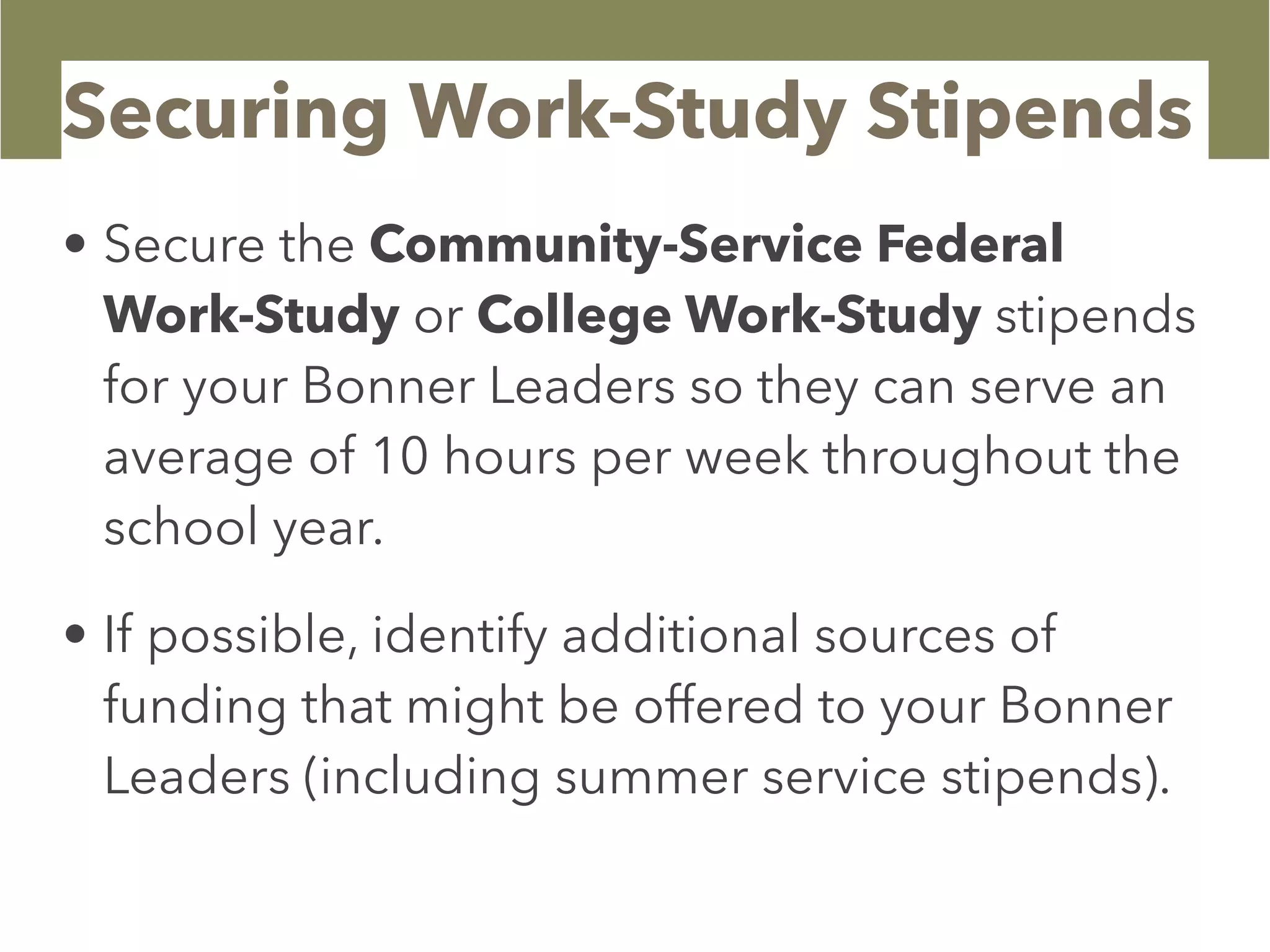
Securing Work-Study Stipends
• Secure the Community-Service Federal
Work-Study or College Work-Study stipends
for your Bonner Leaders so they can serve an
average of 10 hours per week throughout the
school year.
• If possible, identify additional sources of
funding that might be offered to your Bonner
Leaders (including summer service stipends).
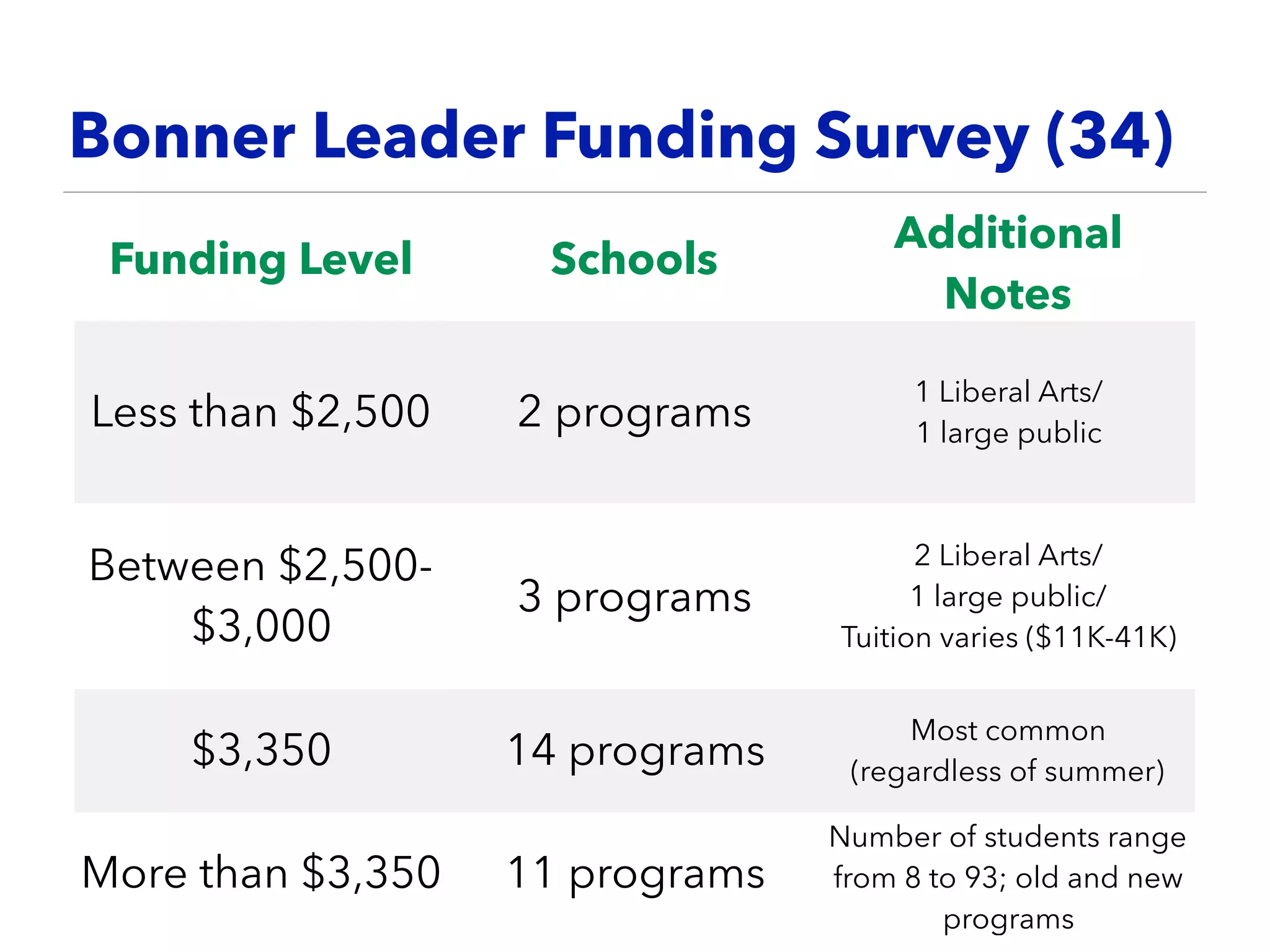
Bonner Leader Funding Survey (34)
Funding Level Schools
Additional
Notes
Less than $2,500 2 programs
1 Liberal Arts/

1 large public
Between $2,500-
$3,000
3 programs
2 Liberal Arts/

1 large public/ 

Tuition varies ($11K-41K)
$3,350 14 programs
Most common 

(regardless of summer)
More than $3,350 11 programs
Number of students range
from 8 to 93; old and new
programs
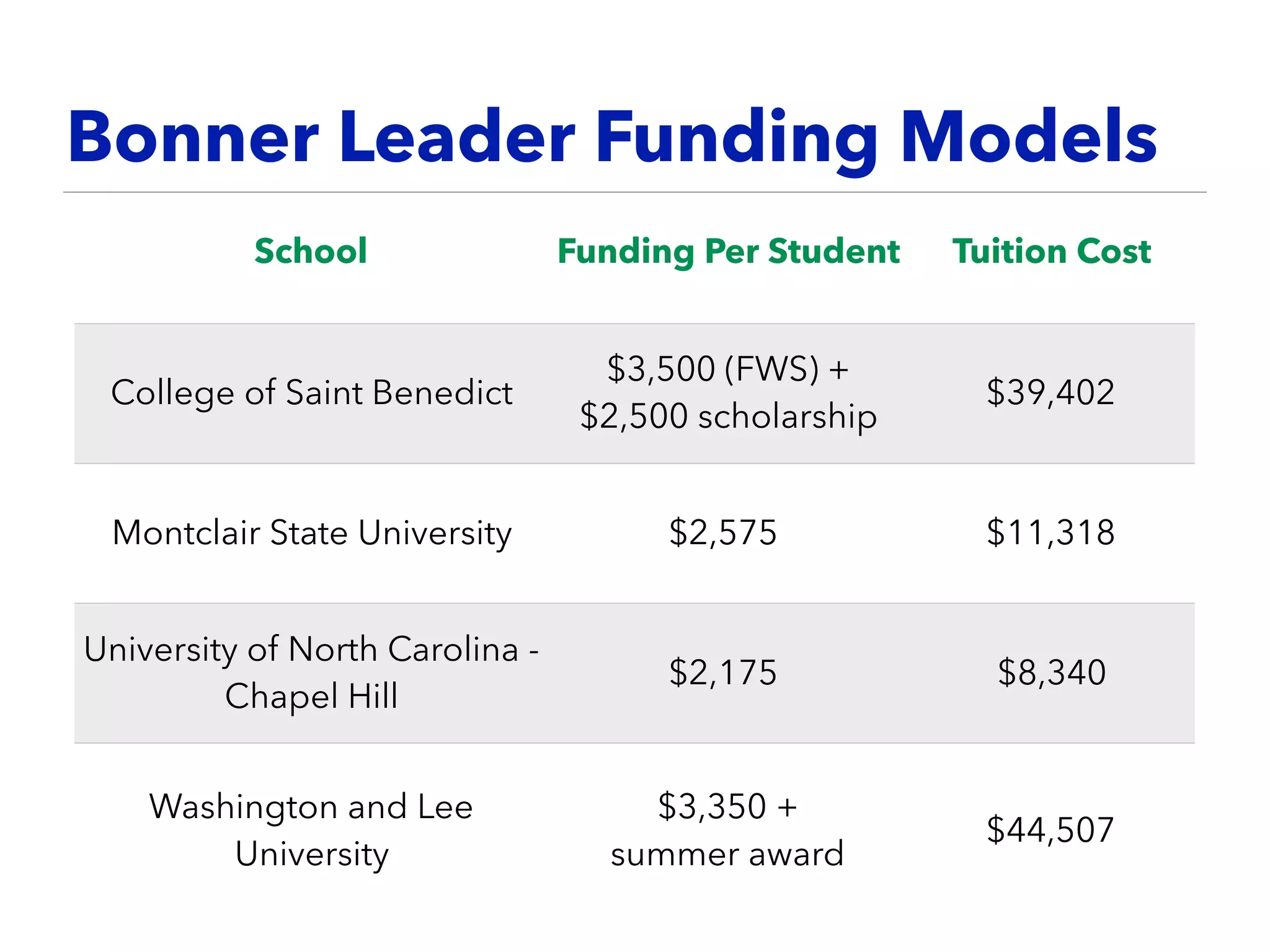
Bonner Leader Funding Models
School Funding Per Student Tuition Cost
College of Saint Benedict
$3,500 (FWS) +
$2,500 scholarship
$39,402
Montclair State University $2,575 $11,318
University of North Carolina -
Chapel Hill
$2,175 $8,340
Washington and Lee
University
$3,350 +
summer award
$44,507
Profile: Who to Recruit
Ethic of service and 4-year commitment
Min 5 per class with minimum of 20 total
> 75% Federal Work Study eligible
> 60/40 gender balance
> diversity of school
Recruiting Your First Class
• Decide how many Bonner Leaders you want
to recruit for the first year.
• Develop marketing material (e.g., website,
brochure)
• Develop application material and process
• Recruit selection committee and process
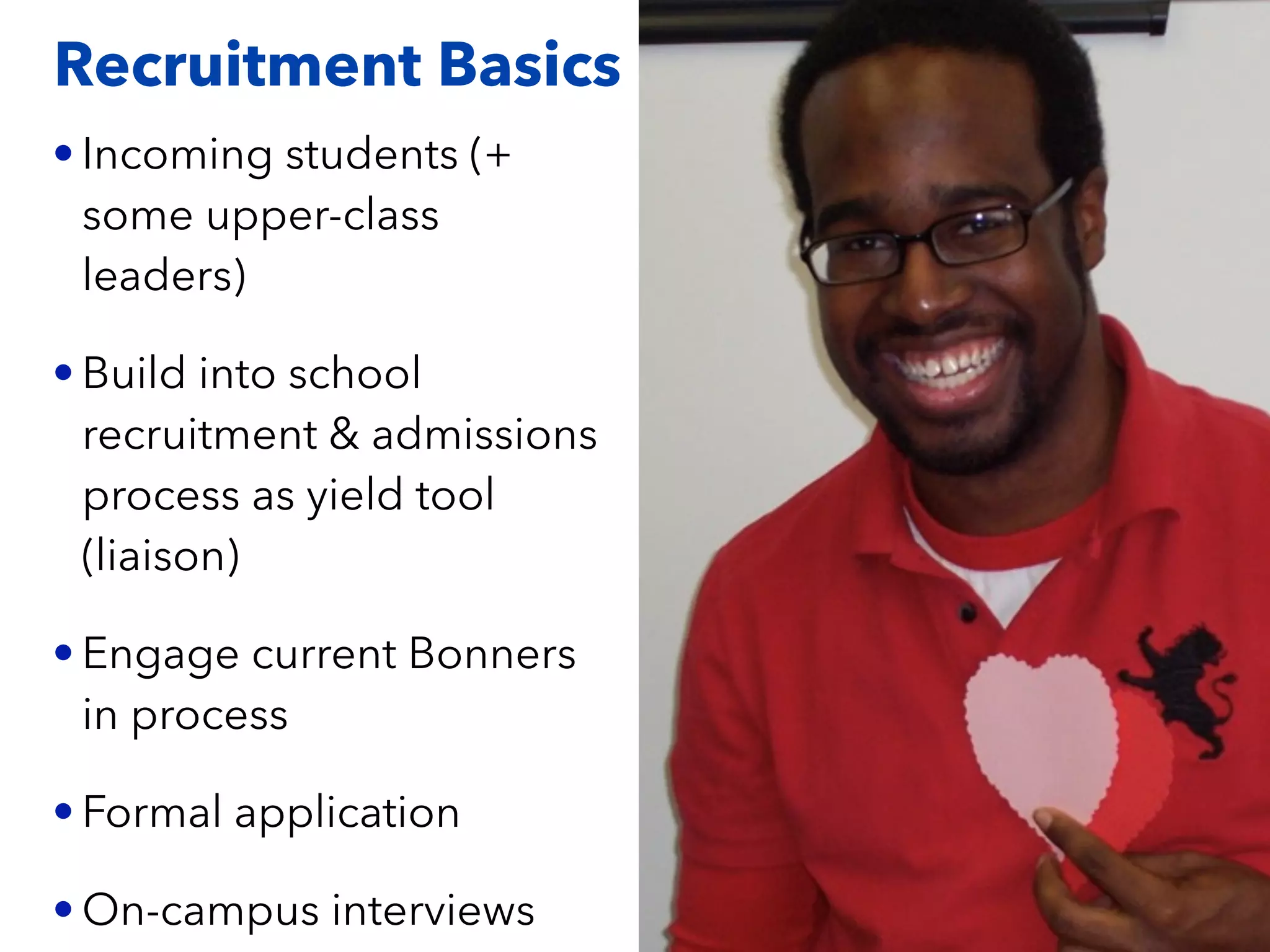
Recruitment Basics
• Incoming students (+
some upper-class
leaders)
• Build into school
recruitment & admissions
process as yield tool
(liaison)
• Engage current Bonners
in process
• Formal application
• On-campus interviews
Admissions Collaboration
•Designate 1-2 admissions
counselors as liaisons
•Annual presentation to all
Admissions staff
•Identify eligible Students
•Align application process
•Intentional outreach
•Recruitment events/calls
•Synchronize timelines
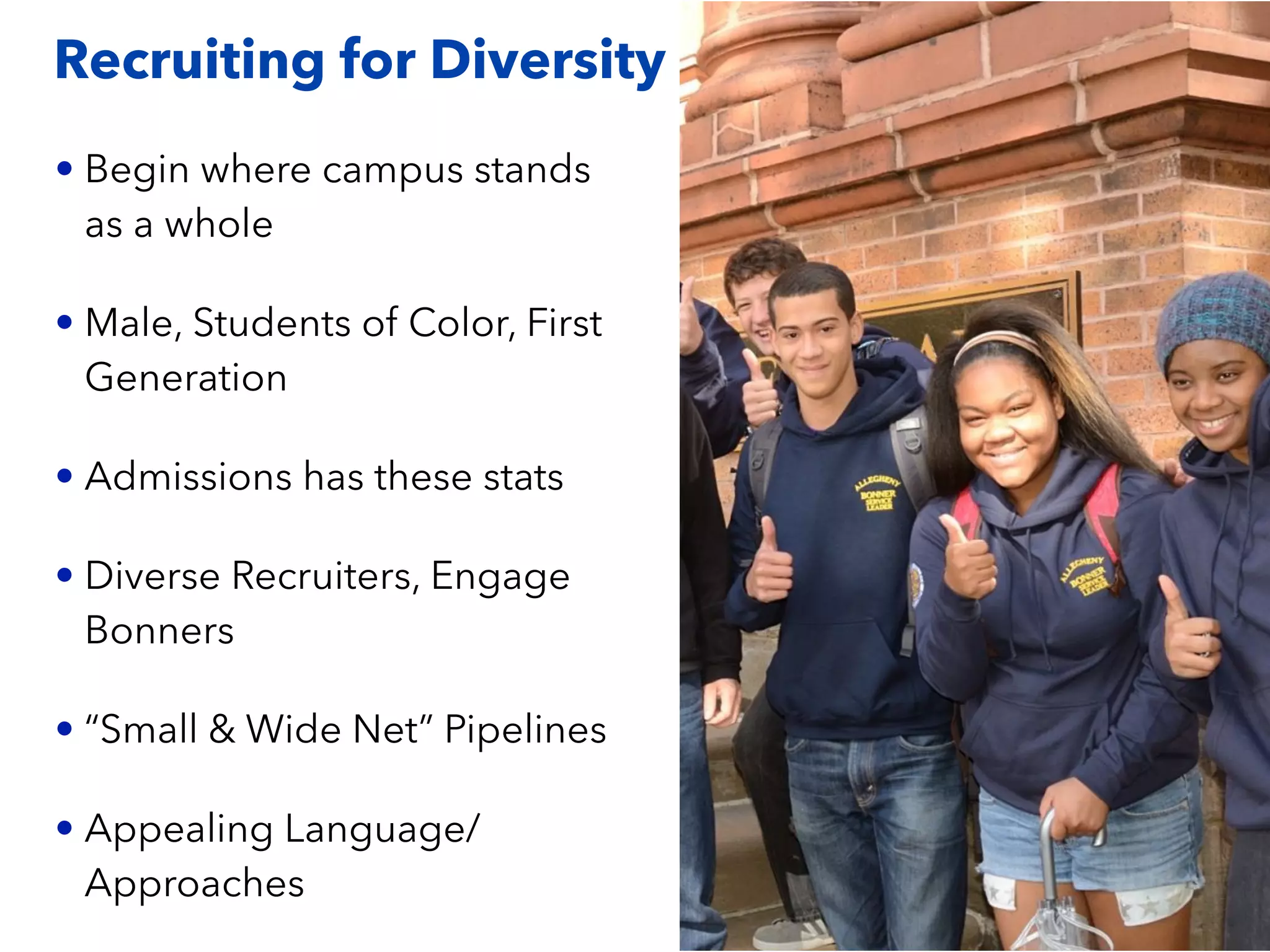
Recruiting for Diversity
• Begin where campus stands
as a whole
• Male, Students of Color, First
Generation
• Admissions has these stats
• Diverse Recruiters, Engage
Bonners
• “Small & Wide Net” Pipelines
• Appealing Language/
Approaches
Interview Day
•Opportunity for face-to-
face
•Engage Bonners and
key campus contacts
•Go over Program
Requirements
•Service partners and
placements
•Parent/family sessions
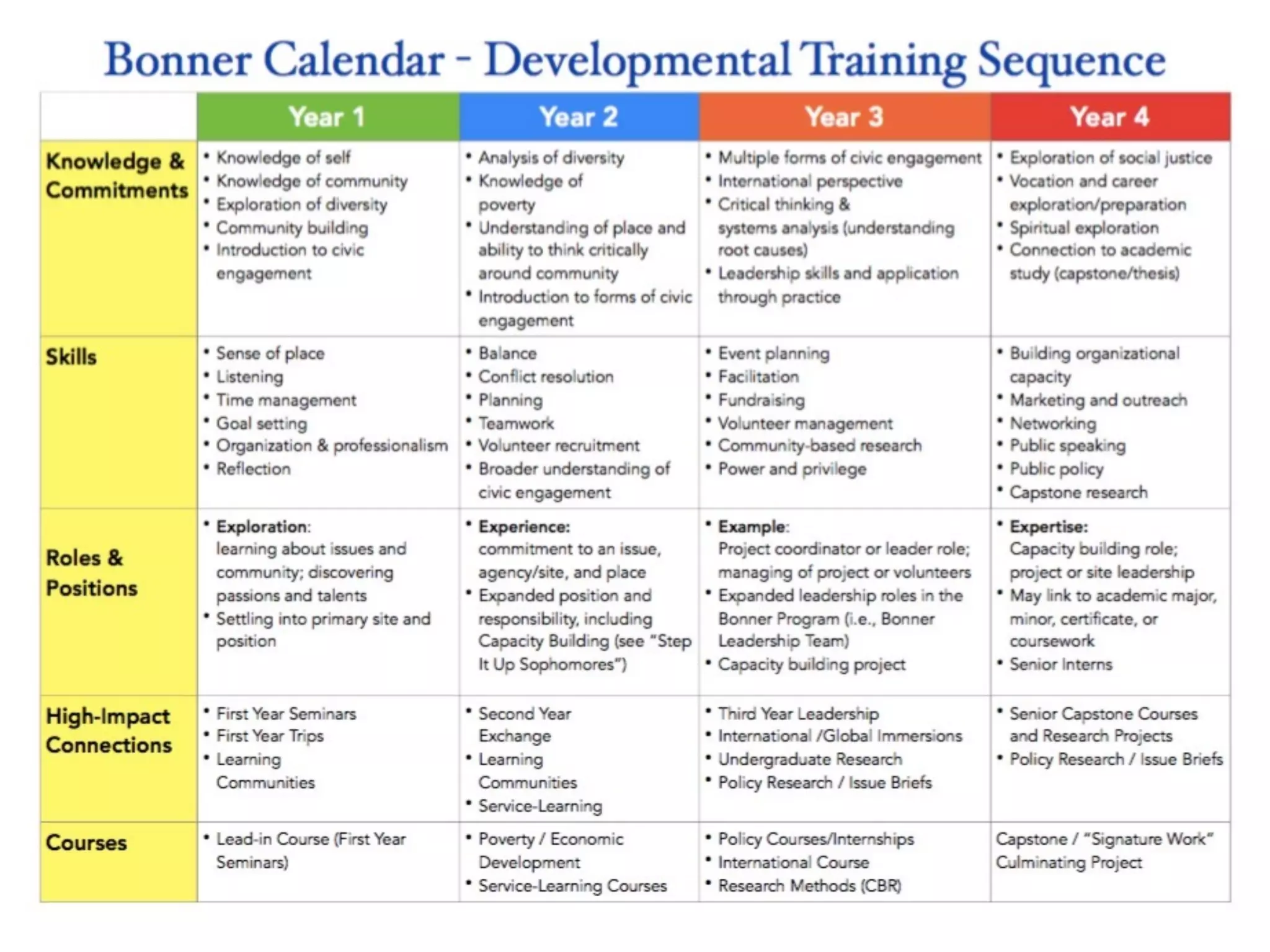
Setting Training Calendar
• Plan your Bonner Orientation, ideally for one
or two days before the regular first year
orientation.
• Decide when during each week can you
schedule a regular Bonner training and
reflection meetings.
• Plan the topics for the first year of weekly
Bonner meetings.
Community Partnerships:
Service Road with Rising Expectations
Exploration - intentional placements that provide
exposure and result in additional commitment
Experience - solid programmatic role
(Program Assistant or specific title)
Example - Site or Project Leader
Expertise - Specialist
Finding Service Placements
• Decide which community partners would be
good placements for the first year Bonners.
• Meet with community partners to explain
Bonner Program model and begin planning
service placements.
• Hold an orientation for Bonner community
partners.
Site-
Based
Team
Site-
Based
Team
Site-
Based
Team
Site-
Based
Team
Regular Volunteer
Intentional Short-Term Placement
Program
Coordinator
Community Partnerships:
Organizing Structure
Community Engagement Models
Partners Service Provider Collaborative Campaign
Roles
Client
Service
Program
Coordinator
Organization Capacity Building Advocacy
Tasks
e.g., tutoring,
serving soup,
etc.
Recruiting,
training, and
supervising
volunteers
1) Volunteer Management
2) Program Development
3) Fundraising
4) Communication
5) Research: CBR & PolicyOptions
e.g., letter
writing,
community
organizing, etc.
Program
Structures
Clearinghouse/Directory Listing of Opportunities (online database)
Site/Issue-Based Teams (coalition of student-led service projects)
Bonner Program (four year training & increased roles culminating in capstone project)
Academic
Structures
Service-Learning & Community-Based Research Courses
Problem / Issue-Based Concentrations

(courses, service roles, CBR, and capstone project)
Skill-based Certificate / Fellowships

(courses, client-defined capacity-building projects)
Bonner Engagement Model
Connecting to Bonner Network
• Ask the Bonner Foundation staff to recommend
2-3 current Bonner directors/ coordinators as
mentors during your start-up phase.
• Invite Bonner Foundation staff member to visit
campus during planning year and/ or your
start-up semester.
National Bonner Meetings
• Consider sending the Bonner coordinator/director and the
student interns (Bonner Senior Interns) to the Bonner Summer
Leadership Institute (May 23-26) (~$200-225 room & board
fee).
• Decide who will attend the New Bonner Director and
Coordinator Orientation held in Princeton, New Jersey (July
30 - August 2) (~$375-400 room & board fee).
• Begin thinking about who will attend the Fall Bonner Student
Congress (mid to late October)(~$75-100 room & board fee).
• Begin thinking about who will attend the Fall Bonner
Directors and Coordinators Meeting (early November)
(~$375-400 room & board fee).
Bonner Wiki Resources

Bonner Leader Program: Start-Up Check List

  • 1.
  • 2.
  • 3.
  • 4.
    Agenda • Staffing andLocation • Securing Work-Study Stipends • Recruiting Your First Class of Bonners • Setting Training and Enrichment Calendar • Developing
  • 5.
    Staffing and Location •Decide where would the program be housed. • Decide who will coordinate the Bonner Leader Program in the first year and other individuals who can provide support for the program. • Recruit 2-3 sophomore or juniors to assist you with the start-up steps outlined below (and then be available to serve as Bonner Senior Interns in the start-up year).
  • 6.
    Securing Work-Study Stipends •Secure the Community-Service Federal Work-Study or College Work-Study stipends for your Bonner Leaders so they can serve an average of 10 hours per week throughout the school year. • If possible, identify additional sources of funding that might be offered to your Bonner Leaders (including summer service stipends).
  • 7.
    Bonner Leader FundingSurvey (34) Funding Level Schools Additional Notes Less than $2,500 2 programs 1 Liberal Arts/
 1 large public Between $2,500- $3,000 3 programs 2 Liberal Arts/
 1 large public/ 
 Tuition varies ($11K-41K) $3,350 14 programs Most common 
 (regardless of summer) More than $3,350 11 programs Number of students range from 8 to 93; old and new programs
  • 8.
    Bonner Leader FundingModels School Funding Per Student Tuition Cost College of Saint Benedict $3,500 (FWS) + $2,500 scholarship $39,402 Montclair State University $2,575 $11,318 University of North Carolina - Chapel Hill $2,175 $8,340 Washington and Lee University $3,350 + summer award $44,507
  • 9.
    Profile: Who toRecruit Ethic of service and 4-year commitment Min 5 per class with minimum of 20 total > 75% Federal Work Study eligible > 60/40 gender balance > diversity of school
  • 10.
    Recruiting Your FirstClass • Decide how many Bonner Leaders you want to recruit for the first year. • Develop marketing material (e.g., website, brochure) • Develop application material and process • Recruit selection committee and process
  • 11.
    Recruitment Basics • Incomingstudents (+ some upper-class leaders) • Build into school recruitment & admissions process as yield tool (liaison) • Engage current Bonners in process • Formal application • On-campus interviews
  • 12.
    Admissions Collaboration •Designate 1-2admissions counselors as liaisons •Annual presentation to all Admissions staff •Identify eligible Students •Align application process •Intentional outreach •Recruitment events/calls •Synchronize timelines
  • 13.
    Recruiting for Diversity •Begin where campus stands as a whole • Male, Students of Color, First Generation • Admissions has these stats • Diverse Recruiters, Engage Bonners • “Small & Wide Net” Pipelines • Appealing Language/ Approaches
  • 14.
    Interview Day •Opportunity forface-to- face •Engage Bonners and key campus contacts •Go over Program Requirements •Service partners and placements •Parent/family sessions
  • 15.
    Setting Training Calendar •Plan your Bonner Orientation, ideally for one or two days before the regular first year orientation. • Decide when during each week can you schedule a regular Bonner training and reflection meetings. • Plan the topics for the first year of weekly Bonner meetings.
  • 16.
    Community Partnerships: Service Roadwith Rising Expectations Exploration - intentional placements that provide exposure and result in additional commitment Experience - solid programmatic role (Program Assistant or specific title) Example - Site or Project Leader Expertise - Specialist
  • 18.
    Finding Service Placements •Decide which community partners would be good placements for the first year Bonners. • Meet with community partners to explain Bonner Program model and begin planning service placements. • Hold an orientation for Bonner community partners.
  • 19.
    Site- Based Team Site- Based Team Site- Based Team Site- Based Team Regular Volunteer Intentional Short-TermPlacement Program Coordinator Community Partnerships: Organizing Structure
  • 20.
    Community Engagement Models PartnersService Provider Collaborative Campaign Roles Client Service Program Coordinator Organization Capacity Building Advocacy Tasks e.g., tutoring, serving soup, etc. Recruiting, training, and supervising volunteers 1) Volunteer Management 2) Program Development 3) Fundraising 4) Communication 5) Research: CBR & PolicyOptions e.g., letter writing, community organizing, etc. Program Structures Clearinghouse/Directory Listing of Opportunities (online database) Site/Issue-Based Teams (coalition of student-led service projects) Bonner Program (four year training & increased roles culminating in capstone project) Academic Structures Service-Learning & Community-Based Research Courses Problem / Issue-Based Concentrations
 (courses, service roles, CBR, and capstone project) Skill-based Certificate / Fellowships
 (courses, client-defined capacity-building projects) Bonner Engagement Model
  • 21.
    Connecting to BonnerNetwork • Ask the Bonner Foundation staff to recommend 2-3 current Bonner directors/ coordinators as mentors during your start-up phase. • Invite Bonner Foundation staff member to visit campus during planning year and/ or your start-up semester.
  • 22.
    National Bonner Meetings •Consider sending the Bonner coordinator/director and the student interns (Bonner Senior Interns) to the Bonner Summer Leadership Institute (May 23-26) (~$200-225 room & board fee). • Decide who will attend the New Bonner Director and Coordinator Orientation held in Princeton, New Jersey (July 30 - August 2) (~$375-400 room & board fee). • Begin thinking about who will attend the Fall Bonner Student Congress (mid to late October)(~$75-100 room & board fee). • Begin thinking about who will attend the Fall Bonner Directors and Coordinators Meeting (early November) (~$375-400 room & board fee).
  • 23.
  • 24.
  • 25.