Body Fluid Compartments
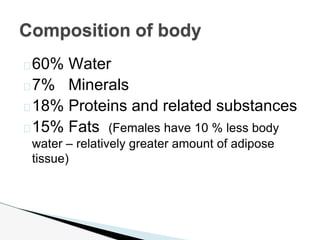
�60% Water
�7% Minerals
�18% Proteins and related substances
�15% Fats (Females have 10 % less body
water – relatively greater amount of adipose
tissue)
Composition of body
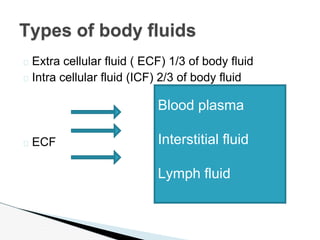
� Extra cellular fluid ( ECF) 1/3 of body fluid
� Intra cellular fluid (ICF) 2/3 of body fluid
� ECF
Types of body fluids
Blood plasma
Interstitial fluid
Lymph fluid
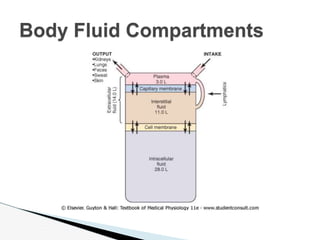
Body Fluid Compartments
� Body fluid compartments have different
sizes and volumes, and different
compositions.
� If you manipulate one body fluid compartment, it
has an effect on another compartment.
� in all the compartments you should get the
same number of particles: 300 million
particles per liter,
Can you manipulate the fluid?
6
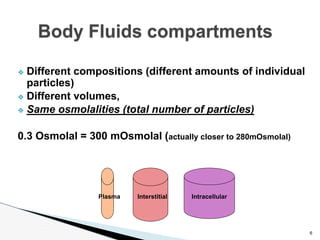
Body Fluids compartments
❖ Different compositions (different amounts of individual
particles)
❖ Different volumes,
❖ Same osmolalities (total number of particles)
0.3 Osmolal = 300 mOsmolal (actually closer to 280mOsmolal)
Intracellular
Interstitial
Plasma
7
Different compositions across the
membrane:
How this difference is
maintained
� If the numbers of particles are always the same,
how can we have higher numbers of potassium
ions inside of the cell compared to the outside of
the cell?
� Won’t the potassium ions want to move down
their concentration gradient towards equilibrium?
Yes, they will want to, but the cell membranes are
semi-permeable and will prevent the potassium
(and other particles) from crossing.
8
� If you have a cell containing 300 mOsm of
potassium (K+) immersed in pure water,
will it shrink or burst? The potassium
cannot flow out of the cell to equalize its
numbers inside and outside of the cell
because it is blocked in by the cell
membrane. The particles in the cell will
suck water into the cell until the cell
bursts.
potassium (K+)
� What particles can cross the cell membrane?
� Gases (O2, CO2)
� Lipids and lipid-loving (hydrophobic or
lipophylic) substances, such as alcohol
11
Functions of Membrane- Selective
Permeability and Transport
� Selectively
permeable- allows
some substances
to pass
� Only small
uncharged
molecules or fat
soluble molecules
can pass through
membrane without
http://www.northland.cc.mn.us/biology/BIOLOGY1111/animations/active1.swf
How does water move?
� Two ways:
� Osmosis
� Hydrostatic pressure
12
� Osmosis
◦ a chemical potential energy difference
dependent on the water concentration on
two sides of the membrane
◦ Driving force for water movement across cell
membranes
� Hydrostatic pressure
◦ The pressure of the fluid exerted on the
vessels, or container (change in
energy/mole)
◦ Animal cell membranes are “flexible” so it
is not a driving force across cell
membranes
◦ IT IS a driving force for moving plasma water
across walls of capillaries
How does water move?
Osmotic pressure
� Osmotic pressure is the amount of
hydrostatic pressure required to stop
osmosis from moving water from low to high
concentration across a cell membrane.
Osmotic pressure is attributed to the osmolarity
of a solution. The solution with the highest
number of particles will have the highest
hydrostatic pressure.
14
15
Osmotic Pressure:
the amount of hydrostatic pressure (force of fluid exerted on
the vessel wall) required to counter osmosis
Osmotic pressure is
attributed to the
osmolarity
of a solution
Figure 4-10;
Guyton & Hall
Isosmotic - has same
osmolarity as body fluids
Hyperosmotic - higher
osmolarity than body fluids
Hyposmotic- lower
osmolarity than body fluids
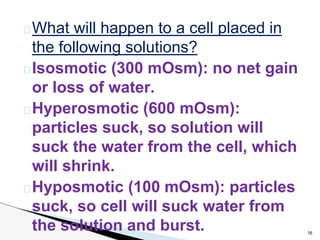
�What will happen to a cell placed in
the following solutions?
�Isosmotic (300 mOsm): no net gain
or loss of water.
�Hyperosmotic (600 mOsm):
particles suck, so solution will
suck the water from the cell, which
will shrink.
�Hyposmotic (100 mOsm): particles
suck, so cell will suck water from
the solution and burst. 16
� Membrane Potential
� Active Electrical Properties of the Neuron
Synaptic Transmission
Neuron as the functional units of nervous
system
Structure of a neuron
1x Neuron: carrying signals
50x Supporting cells: protect, insulate, reinforce, assist
neurons
Multiple sclerosis (MS): immune system-myelin
sheath
loss of signal conduction, muscle control, brain
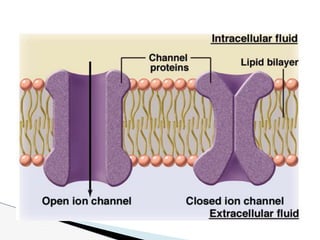
Ion Channels Are Important for Signaling in
the Nervous System
� Ion channels have three important properties
1. They conduct ions
2. They recognize and select specific ions
3. They open and close in response to specific
electrical, mechanical, or chemical signals.
� Gates: voltage-gated channels, ligand-gated
channels, mechanically gated channels, non-
gated channels
Several types of stimuli control the opening
and closing of ion channels
[Ca++]i⇑
Voltage-gated channel
Only a very thin shell of charge difference
is needed to establish a membrane
potential.
Resting potential: the voltage across the plasma membrane of a resting
neuron
A nerve signal originates as a change in the resting potential: The action
potential
Vg Na+ channel
open
Vg K+ channel open
Any + ion
Thank You
By aaryan
Mbbs-2022

bodyfluid.pptx

  • 1.
  • 2.
    �60% Water �7% Minerals �18%Proteins and related substances �15% Fats (Females have 10 % less body water – relatively greater amount of adipose tissue) Composition of body
  • 3.
    � Extra cellularfluid ( ECF) 1/3 of body fluid � Intra cellular fluid (ICF) 2/3 of body fluid � ECF Types of body fluids Blood plasma Interstitial fluid Lymph fluid
  • 4.
  • 5.
    � Body fluidcompartments have different sizes and volumes, and different compositions. � If you manipulate one body fluid compartment, it has an effect on another compartment. � in all the compartments you should get the same number of particles: 300 million particles per liter, Can you manipulate the fluid?
  • 6.
    6 Body Fluids compartments ❖Different compositions (different amounts of individual particles) ❖ Different volumes, ❖ Same osmolalities (total number of particles) 0.3 Osmolal = 300 mOsmolal (actually closer to 280mOsmolal) Intracellular Interstitial Plasma
  • 7.
  • 8.
    How this differenceis maintained � If the numbers of particles are always the same, how can we have higher numbers of potassium ions inside of the cell compared to the outside of the cell? � Won’t the potassium ions want to move down their concentration gradient towards equilibrium? Yes, they will want to, but the cell membranes are semi-permeable and will prevent the potassium (and other particles) from crossing. 8
  • 9.
    � If youhave a cell containing 300 mOsm of potassium (K+) immersed in pure water, will it shrink or burst? The potassium cannot flow out of the cell to equalize its numbers inside and outside of the cell because it is blocked in by the cell membrane. The particles in the cell will suck water into the cell until the cell bursts. potassium (K+)
  • 10.
    � What particlescan cross the cell membrane? � Gases (O2, CO2) � Lipids and lipid-loving (hydrophobic or lipophylic) substances, such as alcohol
  • 11.
    11 Functions of Membrane-Selective Permeability and Transport � Selectively permeable- allows some substances to pass � Only small uncharged molecules or fat soluble molecules can pass through membrane without http://www.northland.cc.mn.us/biology/BIOLOGY1111/animations/active1.swf
  • 12.
    How does watermove? � Two ways: � Osmosis � Hydrostatic pressure 12
  • 13.
    � Osmosis ◦ achemical potential energy difference dependent on the water concentration on two sides of the membrane ◦ Driving force for water movement across cell membranes � Hydrostatic pressure ◦ The pressure of the fluid exerted on the vessels, or container (change in energy/mole) ◦ Animal cell membranes are “flexible” so it is not a driving force across cell membranes ◦ IT IS a driving force for moving plasma water across walls of capillaries How does water move?
  • 14.
    Osmotic pressure � Osmoticpressure is the amount of hydrostatic pressure required to stop osmosis from moving water from low to high concentration across a cell membrane. Osmotic pressure is attributed to the osmolarity of a solution. The solution with the highest number of particles will have the highest hydrostatic pressure. 14
  • 15.
    15 Osmotic Pressure: the amountof hydrostatic pressure (force of fluid exerted on the vessel wall) required to counter osmosis Osmotic pressure is attributed to the osmolarity of a solution Figure 4-10; Guyton & Hall Isosmotic - has same osmolarity as body fluids Hyperosmotic - higher osmolarity than body fluids Hyposmotic- lower osmolarity than body fluids
  • 16.
    �What will happento a cell placed in the following solutions? �Isosmotic (300 mOsm): no net gain or loss of water. �Hyperosmotic (600 mOsm): particles suck, so solution will suck the water from the cell, which will shrink. �Hyposmotic (100 mOsm): particles suck, so cell will suck water from the solution and burst. 16
  • 17.
    � Membrane Potential �Active Electrical Properties of the Neuron Synaptic Transmission
  • 18.
    Neuron as thefunctional units of nervous system Structure of a neuron 1x Neuron: carrying signals 50x Supporting cells: protect, insulate, reinforce, assist neurons Multiple sclerosis (MS): immune system-myelin sheath loss of signal conduction, muscle control, brain
  • 20.
    Ion Channels AreImportant for Signaling in the Nervous System � Ion channels have three important properties 1. They conduct ions 2. They recognize and select specific ions 3. They open and close in response to specific electrical, mechanical, or chemical signals. � Gates: voltage-gated channels, ligand-gated channels, mechanically gated channels, non- gated channels
  • 21.
    Several types ofstimuli control the opening and closing of ion channels
  • 22.
  • 23.
    Only a verythin shell of charge difference is needed to establish a membrane potential.
  • 24.
    Resting potential: thevoltage across the plasma membrane of a resting neuron
  • 25.
    A nerve signaloriginates as a change in the resting potential: The action potential Vg Na+ channel open Vg K+ channel open Any + ion
  • 26.