Session 7
Session 7
Unit 307: Provide body electrotherapy treatments
Session 7
Body types
What is a body type?
• Body types can indicate various characteristics:
– type of diet required
– lifestyle
– health
• There are seven body types which are often referred to as somatypes.
(Handout 10)
Session 7
Somatypes
• Balanced
• Ectomorph
• Endomorph
• Mesomorph
• Endo-Ectomorph
• Ecto-Mesomorph
• Meso-Endomorph
Session 7
Endomorph characteristics
• 80% fat
• 10% muscle
• 10% lineality
• Large round head
• Small facial features
• Short neck
• Round, plump in the extreme, as near spherical as possible
• Average to short stature/height
• Large fat abdominal area
• % of fat well developed areas of residual fat, deposited on hips,
abdomen, neck, upper arms and shoulders
• Spine flat with reduced curves
• Tendency to be sluggish
• Very sociable usually
Session 7
Endomorph
Session 7
Mesomorph characteristics
• 80% muscle
• 10% fat
• 10% lineality
• Lifestyle athletic; very active
• Powerful and agile
• The body type has a low percentage of fat, minimal areas of adipose tissue
• Classically athletic
• Well developed and toned muscles
• Well defined bone structure
• Cubical head
• Broad shoulders, deep chest
• Well marked curves of the spine
• Tendency to be overweight in later life
• Skin tans easily
• Needs first class protein
• Manic depressive tendency
Session 7
Mesomorph
Session 7
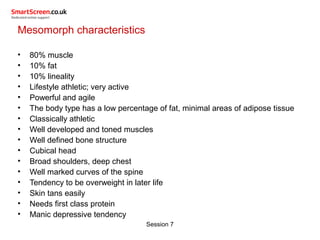
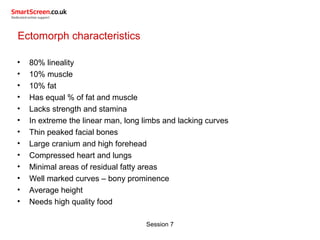
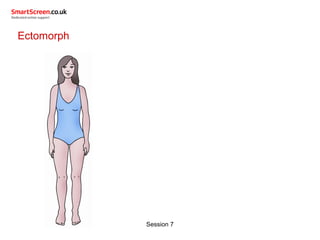
Ectomorph characteristics
• 80% lineality
• 10% muscle
• 10% fat
• Has equal % of fat and muscle
• Lacks strength and stamina
• In extreme the linear man, long limbs and lacking curves
• Thin peaked facial bones
• Large cranium and high forehead
• Compressed heart and lungs
• Minimal areas of residual fatty areas
• Well marked curves – bony prominence
• Average height
• Needs high quality food
Session 7
Ectomorph
Session 7
Postural assessment
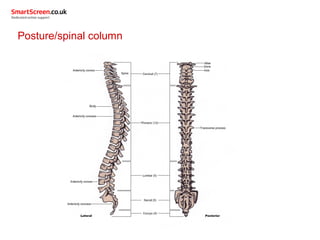
• The therapist will need to have a basic understanding of the structure of the
spine and how to identify postural and figure faults, body type, muscle tone,
fat type and skin conditions
• This will allow the therapist to select the most appropriate electrical and
mechanical treatments and products for the conditions present
Session 7
Posture/spinal column
Session 7
Postural faults
There are 3 main postural faults to be considered:
1. kyphosis
2. lordosis
3. scoliosis
Session 7
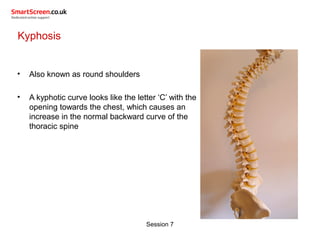
Kyphosis
• Also known as round shoulders
• A kyphotic curve looks like the letter ‘C’ with the
opening towards the chest, which causes an
increase in the normal backward curve of the
thoracic spine
Session 7
Symptoms of kyphosis
• Round shoulders
• Tight and shortened pectoral muscles, neck flexors, hamstrings and gluteals
• Poking out nose and chin
• Extensors of upper neck and back are lengthened/stretched and therefore
weakened, (extensor splinius, sacrospinalis, errector spinae, trapezius,
rhomboids, the hip flexors and quadriceps, rota cuff muscles)
• In kyphosis the ileum of the pelvis is tilted backward at a 45-degree angle
and the pubis bone is tilted forward which affects the hip flexors and hip
extensors
Session 7
Causes of kyphosis
• Kyphosis tends to start between the age of 10 and 20 years and its most
common cause is habitual bad posture ie, faulty sitting position
• However other causes include:
– congenital spinal problem, Cerebral Palsy
– over-rapid growth rate in childhood
– lack of proper exercise
– trauma to the spine
Session 7
Normal spine
Session 7
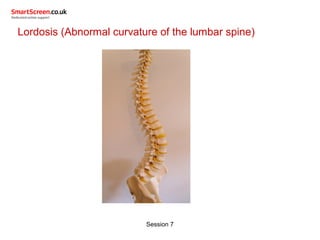
Lordosis (Abnormal curvature of the lumbar spine)
Session 7
Lordosis
• Commonly referred to as hollow back or sway back
• With this condition there is an abnormal and excessive inward curvature of
the lumbar vertebrae
• The angle of pelvic tilt is increased forward to 75% and the chest is elevated
with the shoulders pulled back
Session 7
Symptoms of lordosis
• Lower back pain
• Buttocks/gluteals appear prominent due to excessive arching/curving of the
lumbar spine
• There is tightness of the hip flexors and hamstrings
• Weakness in the abdominal and gluteal muscle groups
Session 7
Main causes of lordosis
• Congenital
• Pregnancy; pelvic tilt alters
• Poor postural habits especially with people whose occupation requires long
periods of standing, shop assistants etc
• Overweight clients, due to the angle of the pelvic tilt altering
• Gymnasts, due to the posture
• May occur in childhood
Session 7
Scoliosis
Signs of scoliosis:
• uneven shoulders
• curve in spine
• uneven hips.
Session 7
Two types: ‘C’ or ‘S’ curve
• There may be one large ’C’ shaped curve extending the whole length of spine
or two smaller curves
• One primary ‘C’ which occurs near the top of the spine whilst the other
compensatory curve occurs near the base of the spine in the opposite
direction to counter balance the body weight
• Most ‘C’ curves are to the left due to the majority of people being right
handed
• Scoliosis ‘S’ curve (S for scoliosis and sideways)
• Usually one lumber and one thoracic curve, pelvis tilted down on side of
convexity in lumbar area. Scapular level at thoracic area
• 80% of ‘S’ scoliosis is due to poor posture
Session 7
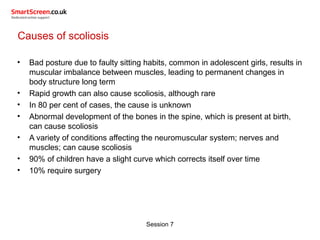
Causes of scoliosis
• Bad posture due to faulty sitting habits, common in adolescent girls, results in
muscular imbalance between muscles, leading to permanent changes in
body structure long term
• Rapid growth can also cause scoliosis, although rare
• In 80 per cent of cases, the cause is unknown
• Abnormal development of the bones in the spine, which is present at birth,
can cause scoliosis
• A variety of conditions affecting the neuromuscular system; nerves and
muscles; can cause scoliosis
• 90% of children have a slight curve which corrects itself over time
• 10% require surgery
Session 7
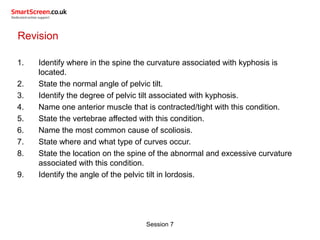
Revision
1. Identify where in the spine the curvature associated with kyphosis is
located.
2. State the normal angle of pelvic tilt.
3. Identify the degree of pelvic tilt associated with kyphosis.
4. Name one anterior muscle that is contracted/tight with this condition.
5. State the vertebrae affected with this condition.
6. Name the most common cause of scoliosis.
7. State where and what type of curves occur.
8. State the location on the spine of the abnormal and excessive curvature
associated with this condition.
9. Identify the angle of the pelvic tilt in lordosis.
Session 7
Answers
1. The curvature associated with kyphosis is in the thoracic spine.
2. The normal angle of the pelvic tilt is 55 to 65 degrees.
3. The degree of pelvic tilt in kyphosis is 45 degrees.
4. Tight and shortened pectoral muscles and neck flexors.
5. Cervical 6th and 7th vertebrae affected with fibrous and fatty tissue
building up.
6. Abnormal development of the bones in the spine, which is present at birth,
poor posture, rapid growth pre-puberty.
7. There are two types of scoliosis, ‘C’ curve or ‘S’ curve.
8. There is an abnormal and excessive inward curvature of the lumbar
vertebrae.
9. The angle of pelvic tilt is 75 degrees.
Session 7
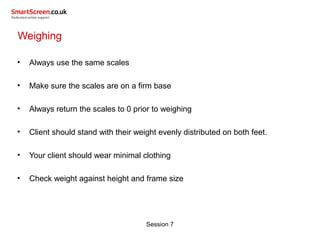
Weighing
• Always use the same scales
• Make sure the scales are on a firm base
• Always return the scales to 0 prior to weighing
• Client should stand with their weight evenly distributed on both feet.
• Your client should wear minimal clothing
• Check weight against height and frame size
Session 7
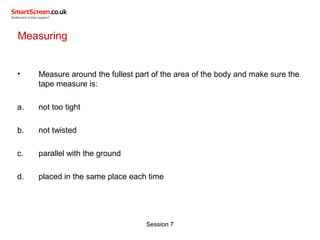
Measuring
• Measure around the fullest part of the area of the body and make sure the
tape measure is:
a. not too tight
b. not twisted
c. parallel with the ground
d. placed in the same place each time
Session 7
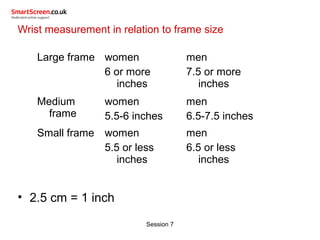
Wrist measurement in relation to frame size
• 2.5 cm = 1 inch
Large frame women
6 or more
inches
men
7.5 or more
inches
Medium
frame
women
5.5-6 inches
men
6.5-7.5 inches
Small frame women
5.5 or less
inches
men
6.5 or less
inches
Session 7
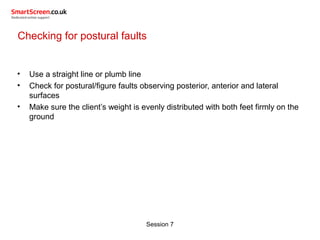
Checking for postural faults
• Use a straight line or plumb line
• Check for postural/figure faults observing posterior, anterior and lateral
surfaces
• Make sure the client’s weight is evenly distributed with both feet firmly on the
ground
Session 7
Points to consider for manual assessment review
• Postural assessment
• Somatype
• Mobility/flexibility
• Fat distribution/BMI
• Muscle tone
• Areas of tension
• Local contra-indications
• Skin condition/any areas of imperfections
Session 7
Any questions?

Body types and postural faults

  • 1.
    Session 7 Session 7 Unit307: Provide body electrotherapy treatments
  • 2.
    Session 7 Body types Whatis a body type? • Body types can indicate various characteristics: – type of diet required – lifestyle – health • There are seven body types which are often referred to as somatypes. (Handout 10)
  • 3.
    Session 7 Somatypes • Balanced •Ectomorph • Endomorph • Mesomorph • Endo-Ectomorph • Ecto-Mesomorph • Meso-Endomorph
  • 4.
    Session 7 Endomorph characteristics •80% fat • 10% muscle • 10% lineality • Large round head • Small facial features • Short neck • Round, plump in the extreme, as near spherical as possible • Average to short stature/height • Large fat abdominal area • % of fat well developed areas of residual fat, deposited on hips, abdomen, neck, upper arms and shoulders • Spine flat with reduced curves • Tendency to be sluggish • Very sociable usually
  • 5.
  • 6.
    Session 7 Mesomorph characteristics •80% muscle • 10% fat • 10% lineality • Lifestyle athletic; very active • Powerful and agile • The body type has a low percentage of fat, minimal areas of adipose tissue • Classically athletic • Well developed and toned muscles • Well defined bone structure • Cubical head • Broad shoulders, deep chest • Well marked curves of the spine • Tendency to be overweight in later life • Skin tans easily • Needs first class protein • Manic depressive tendency
  • 7.
  • 8.
    Session 7 Ectomorph characteristics •80% lineality • 10% muscle • 10% fat • Has equal % of fat and muscle • Lacks strength and stamina • In extreme the linear man, long limbs and lacking curves • Thin peaked facial bones • Large cranium and high forehead • Compressed heart and lungs • Minimal areas of residual fatty areas • Well marked curves – bony prominence • Average height • Needs high quality food
  • 9.
  • 10.
    Session 7 Postural assessment •The therapist will need to have a basic understanding of the structure of the spine and how to identify postural and figure faults, body type, muscle tone, fat type and skin conditions • This will allow the therapist to select the most appropriate electrical and mechanical treatments and products for the conditions present
  • 11.
  • 12.
    Session 7 Postural faults Thereare 3 main postural faults to be considered: 1. kyphosis 2. lordosis 3. scoliosis
  • 13.
    Session 7 Kyphosis • Alsoknown as round shoulders • A kyphotic curve looks like the letter ‘C’ with the opening towards the chest, which causes an increase in the normal backward curve of the thoracic spine
  • 14.
    Session 7 Symptoms ofkyphosis • Round shoulders • Tight and shortened pectoral muscles, neck flexors, hamstrings and gluteals • Poking out nose and chin • Extensors of upper neck and back are lengthened/stretched and therefore weakened, (extensor splinius, sacrospinalis, errector spinae, trapezius, rhomboids, the hip flexors and quadriceps, rota cuff muscles) • In kyphosis the ileum of the pelvis is tilted backward at a 45-degree angle and the pubis bone is tilted forward which affects the hip flexors and hip extensors
  • 15.
    Session 7 Causes ofkyphosis • Kyphosis tends to start between the age of 10 and 20 years and its most common cause is habitual bad posture ie, faulty sitting position • However other causes include: – congenital spinal problem, Cerebral Palsy – over-rapid growth rate in childhood – lack of proper exercise – trauma to the spine
  • 16.
  • 17.
    Session 7 Lordosis (Abnormalcurvature of the lumbar spine)
  • 18.
    Session 7 Lordosis • Commonlyreferred to as hollow back or sway back • With this condition there is an abnormal and excessive inward curvature of the lumbar vertebrae • The angle of pelvic tilt is increased forward to 75% and the chest is elevated with the shoulders pulled back
  • 19.
    Session 7 Symptoms oflordosis • Lower back pain • Buttocks/gluteals appear prominent due to excessive arching/curving of the lumbar spine • There is tightness of the hip flexors and hamstrings • Weakness in the abdominal and gluteal muscle groups
  • 20.
    Session 7 Main causesof lordosis • Congenital • Pregnancy; pelvic tilt alters • Poor postural habits especially with people whose occupation requires long periods of standing, shop assistants etc • Overweight clients, due to the angle of the pelvic tilt altering • Gymnasts, due to the posture • May occur in childhood
  • 21.
    Session 7 Scoliosis Signs ofscoliosis: • uneven shoulders • curve in spine • uneven hips.
  • 22.
    Session 7 Two types:‘C’ or ‘S’ curve • There may be one large ’C’ shaped curve extending the whole length of spine or two smaller curves • One primary ‘C’ which occurs near the top of the spine whilst the other compensatory curve occurs near the base of the spine in the opposite direction to counter balance the body weight • Most ‘C’ curves are to the left due to the majority of people being right handed • Scoliosis ‘S’ curve (S for scoliosis and sideways) • Usually one lumber and one thoracic curve, pelvis tilted down on side of convexity in lumbar area. Scapular level at thoracic area • 80% of ‘S’ scoliosis is due to poor posture
  • 23.
    Session 7 Causes ofscoliosis • Bad posture due to faulty sitting habits, common in adolescent girls, results in muscular imbalance between muscles, leading to permanent changes in body structure long term • Rapid growth can also cause scoliosis, although rare • In 80 per cent of cases, the cause is unknown • Abnormal development of the bones in the spine, which is present at birth, can cause scoliosis • A variety of conditions affecting the neuromuscular system; nerves and muscles; can cause scoliosis • 90% of children have a slight curve which corrects itself over time • 10% require surgery
  • 24.
    Session 7 Revision 1. Identifywhere in the spine the curvature associated with kyphosis is located. 2. State the normal angle of pelvic tilt. 3. Identify the degree of pelvic tilt associated with kyphosis. 4. Name one anterior muscle that is contracted/tight with this condition. 5. State the vertebrae affected with this condition. 6. Name the most common cause of scoliosis. 7. State where and what type of curves occur. 8. State the location on the spine of the abnormal and excessive curvature associated with this condition. 9. Identify the angle of the pelvic tilt in lordosis.
  • 25.
    Session 7 Answers 1. Thecurvature associated with kyphosis is in the thoracic spine. 2. The normal angle of the pelvic tilt is 55 to 65 degrees. 3. The degree of pelvic tilt in kyphosis is 45 degrees. 4. Tight and shortened pectoral muscles and neck flexors. 5. Cervical 6th and 7th vertebrae affected with fibrous and fatty tissue building up. 6. Abnormal development of the bones in the spine, which is present at birth, poor posture, rapid growth pre-puberty. 7. There are two types of scoliosis, ‘C’ curve or ‘S’ curve. 8. There is an abnormal and excessive inward curvature of the lumbar vertebrae. 9. The angle of pelvic tilt is 75 degrees.
  • 26.
    Session 7 Weighing • Alwaysuse the same scales • Make sure the scales are on a firm base • Always return the scales to 0 prior to weighing • Client should stand with their weight evenly distributed on both feet. • Your client should wear minimal clothing • Check weight against height and frame size
  • 27.
    Session 7 Measuring • Measurearound the fullest part of the area of the body and make sure the tape measure is: a. not too tight b. not twisted c. parallel with the ground d. placed in the same place each time
  • 28.
    Session 7 Wrist measurementin relation to frame size • 2.5 cm = 1 inch Large frame women 6 or more inches men 7.5 or more inches Medium frame women 5.5-6 inches men 6.5-7.5 inches Small frame women 5.5 or less inches men 6.5 or less inches
  • 29.
    Session 7 Checking forpostural faults • Use a straight line or plumb line • Check for postural/figure faults observing posterior, anterior and lateral surfaces • Make sure the client’s weight is evenly distributed with both feet firmly on the ground
  • 30.
    Session 7 Points toconsider for manual assessment review • Postural assessment • Somatype • Mobility/flexibility • Fat distribution/BMI • Muscle tone • Areas of tension • Local contra-indications • Skin condition/any areas of imperfections
  • 31.