Body Mechanics and
Ergonomics
Objectives
By the end of the session students will be able to demonstrate
and apply knowledge and skills of good body mechanics and
ergonomics in nursing patients.
Introduction
•Body mechanics involves the coordinated effort of muscles,
bones, and the nervous system to maintain balance, posture,
and alignment during moving, transferring, and positioning
patients.
•Proper body mechanics allows individuals to carry out activities
without excessive use of energy, and helps prevent injuries for
patients and health care providers (Perry, Potter, & Ostendorf,
2014).
Importance of Body Mechanics
Proper body mechanics prevents the following:
•Musculoskeletal strain
•Injuries to members of the staff
•Injury to the client
•Fatigue
Elements of Body Mechanics
•Body movement requires coordinated muscle activity and
neurological integration.
•It involves the basic elements of body alignment (posture),
balance, and coordinated movement.
Elements of Body Mechanics
•Body alignment and posture bring body parts into position to
promote optimal balance and body function.
•When the body is well aligned, whether standing, sitting, or
lying, the strain on the joints, muscles, tendons, and ligaments
is minimized.
Elements of Body Mechanics
•Body alignment is achieved by placing one body part in line
with another body part in a vertical or horizontal line.
•Correct alignment contributes to body balance and decreases
strain on muscle-skeletal structures.
• Without this balance, the risk of falls and injuries increase. In
body mechanics, the centre of gravity is the centre of the
weight of an object or person.
Elements of Body Mechanics
•A lower centre of gravity increases stability. This can be achieved by
bending the knees and bringing the centre of gravity closer to the
base of support, keeping the back straight.
• A wide base of support is the foundation for stability. A wide base of
support is achieved by placing feet comfortable, shoulder width
distance apart. When a vertical line falls from the centre of gravity
through the wide base of support, body balance is achieved.
•If the vertical line moves outside the base of support, the body will
lose balance.
Action Principle of body mechanics
Assess the environment. Assess the weight of the load before
lifting and determine if assistance is
required.
Plan the move. Plan the move; gather all supplies and
clear the area of obstacles.
Avoid stretching and twisting. Avoid stretching, reaching, and twisting,
which may place the line of gravity
outside the base of support.
Ensure proper body stance. Keep stance (feet) shoulder-width apart.
Tighten abdominal, gluteal, and leg
muscles in anticipation of the move.
Stand up straight to protect the back
and provide balance.
Action Principles of body mechanics
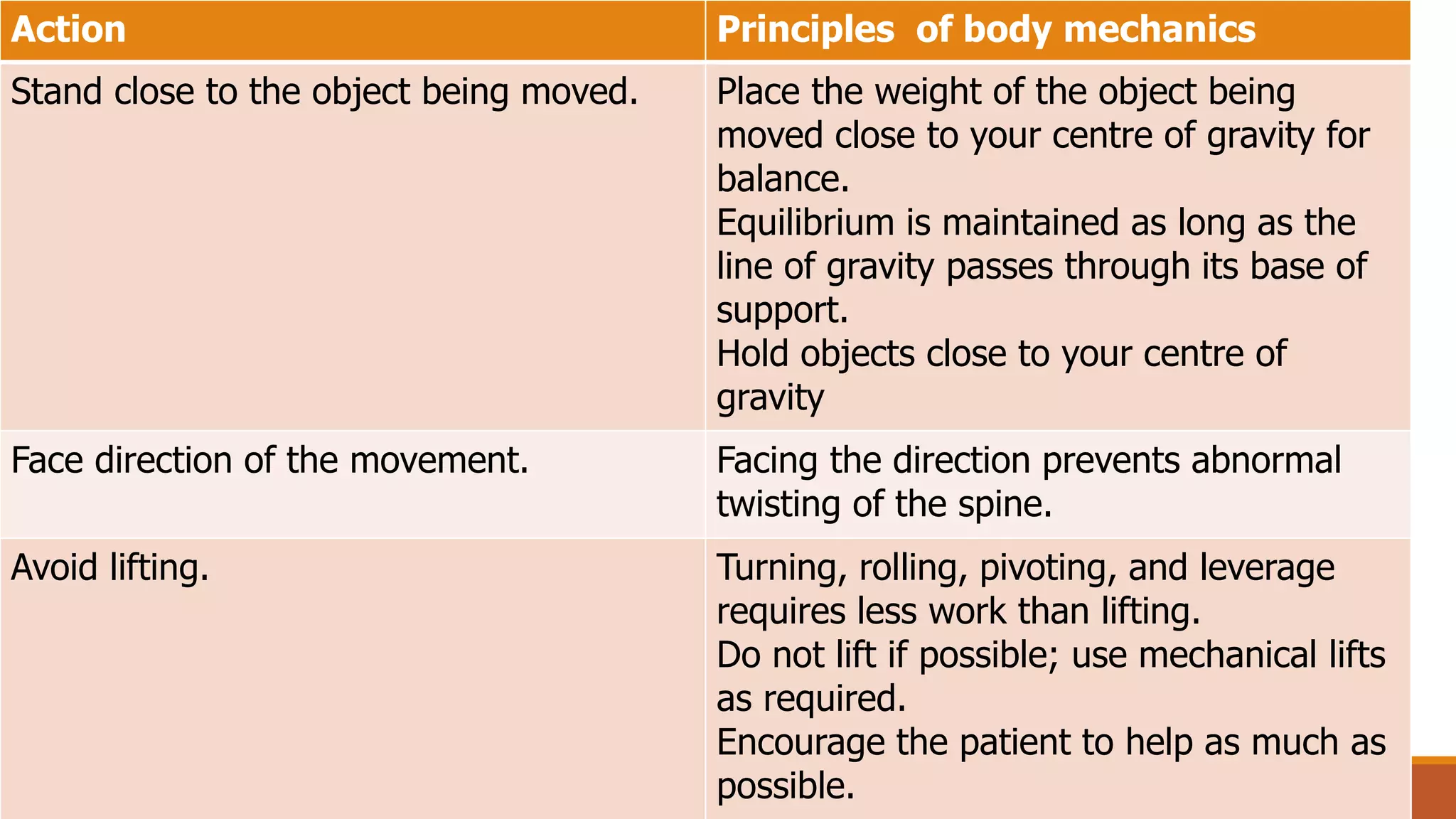
Stand close to the object being moved. Place the weight of the object being
moved close to your centre of gravity for
balance.
Equilibrium is maintained as long as the
line of gravity passes through its base of
support.
Hold objects close to your centre of
gravity
Face direction of the movement. Facing the direction prevents abnormal
twisting of the spine.
Avoid lifting. Turning, rolling, pivoting, and leverage
requires less work than lifting.
Do not lift if possible; use mechanical lifts
as required.
Encourage the patient to help as much as
possible.
Action Principles of body mechanics
Work at waist level. Keep all work at waist level to avoid
stooping.
Raise the height of the bed or object if
possible.
Do not bend at the waist.
Reduce friction between surfaces. Reduce friction between surfaces so that
less force is required to move the patient.
Bend the knees. Bending the knees maintains your centre
of gravity and lets the strong muscles of
your legs do the lifting.
Push the object rather than pull it, and
maintain continuous movement.
It is easier to push an object than to pull
it.
Less energy is required to keep an object
moving than it is to stop and start it.
Action Principles of body mechanics
Use assistive devices. Use assistive devices (gait belt, slider
boards, mechanical lifts) as required to
position patients and transfer them
from one surface to another.
Work with others. The person with the heaviest load
should coordinate all the effort of the
others involved in the handling
technique.
Assistive Devices
An assistive device is an object or piece of equipment
designed to help a patient with activities of daily living, such as
a walker, cane, gait belt, or mechanical lift
Discussion
What are some of the assistive devices in the hospital
Assistive Devices
Gait belt or transfer belt
•Used to ensure a good grip on unstable
patients.
•The device provides more stability
when transferring patients.
•It is a 2-inch-wide (5 mm) belt, with or
without handles, that is placed around
a patient’s waist and fastened.
Assistive Devices
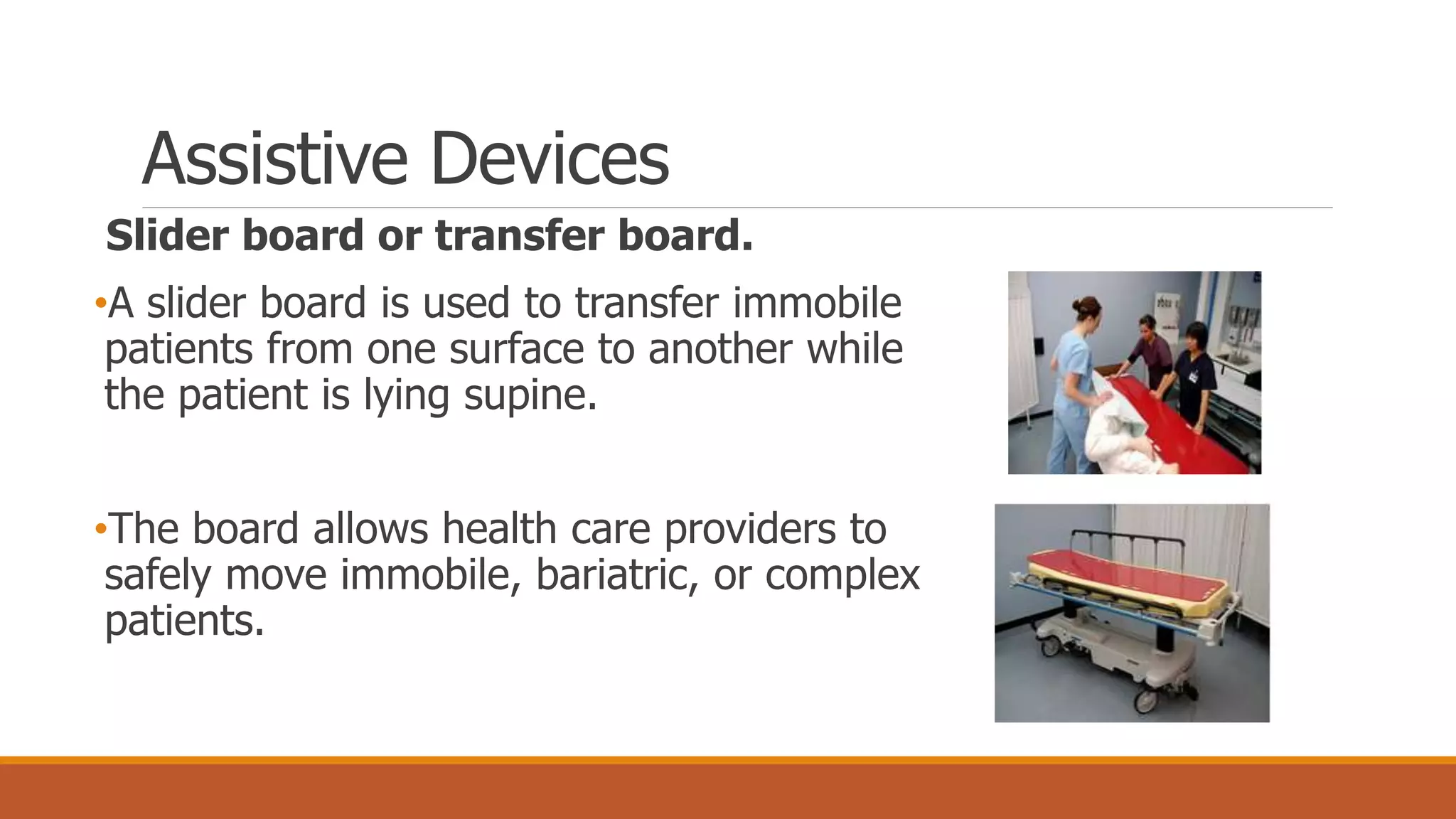
Slider board or transfer board.
•A slider board is used to transfer immobile
patients from one surface to another while
the patient is lying supine.
•The board allows health care providers to
safely move immobile, bariatric, or complex
patients.
Assistive Devices
Mechanical lift
A mechanical lift is a hydraulic lift, usually
attached to a ceiling, used to move
patients who cannot bear weight, who are
unpredictable or unreliable, or who have a
medical condition that does not allow them
to stand or assist with moving.
Assistive Devices
Consideration for assistive devices
•Use assistive devices only if properly trained in their safe use.
•Always tell patients what you are about to do and how they should
assist you in the procedure.
•Always perform a patient risk assessment or mobility assessment
prior to using any assistive devices.
•Use proper body mechanics when using assistive devices.
Assignments
How do body alignment and body balance contribute to proper
body mechanics?
John is asked to lift a heavy box from a table onto a trolley.
Name five principles of body mechanics John can implement to
prevent an musculoskeletal injury .
Ergonomics
•Ergonomics is the science of fitting workplace conditions and
job demands to the capabilities of the working population.
•To reduce injuries, caregiving institutions provide special
equipment to assist employees with patient care. While these
tools help, employees ultimately create a safe work
environment.
Ergonomics
•Ergonomics helps reduce workplace injuries due to physical
activity.
•When an employee’s workload is too demanding, this risk
increases.
• The practice of ergonomics in nursing, as in other careers,
decreases the impact work has on the body, preventing injuries
before they occur.
Ergonomic equipment
•Sliding boards
•Lateral transfer aids
•Transfer chairs
•Gait belts
•Full body lifts
•Standing and repositioning lifts
•Bedding modifications
•Geriatric chairs

Body Mechanics and Ergonomics.pptx

  • 1.
  • 2.
    Objectives By the endof the session students will be able to demonstrate and apply knowledge and skills of good body mechanics and ergonomics in nursing patients.
  • 3.
    Introduction •Body mechanics involvesthe coordinated effort of muscles, bones, and the nervous system to maintain balance, posture, and alignment during moving, transferring, and positioning patients. •Proper body mechanics allows individuals to carry out activities without excessive use of energy, and helps prevent injuries for patients and health care providers (Perry, Potter, & Ostendorf, 2014).
  • 4.
    Importance of BodyMechanics Proper body mechanics prevents the following: •Musculoskeletal strain •Injuries to members of the staff •Injury to the client •Fatigue
  • 5.
    Elements of BodyMechanics •Body movement requires coordinated muscle activity and neurological integration. •It involves the basic elements of body alignment (posture), balance, and coordinated movement.
  • 6.
    Elements of BodyMechanics •Body alignment and posture bring body parts into position to promote optimal balance and body function. •When the body is well aligned, whether standing, sitting, or lying, the strain on the joints, muscles, tendons, and ligaments is minimized.
  • 7.
    Elements of BodyMechanics •Body alignment is achieved by placing one body part in line with another body part in a vertical or horizontal line. •Correct alignment contributes to body balance and decreases strain on muscle-skeletal structures. • Without this balance, the risk of falls and injuries increase. In body mechanics, the centre of gravity is the centre of the weight of an object or person.
  • 9.
    Elements of BodyMechanics •A lower centre of gravity increases stability. This can be achieved by bending the knees and bringing the centre of gravity closer to the base of support, keeping the back straight. • A wide base of support is the foundation for stability. A wide base of support is achieved by placing feet comfortable, shoulder width distance apart. When a vertical line falls from the centre of gravity through the wide base of support, body balance is achieved. •If the vertical line moves outside the base of support, the body will lose balance.
  • 10.
    Action Principle ofbody mechanics Assess the environment. Assess the weight of the load before lifting and determine if assistance is required. Plan the move. Plan the move; gather all supplies and clear the area of obstacles. Avoid stretching and twisting. Avoid stretching, reaching, and twisting, which may place the line of gravity outside the base of support. Ensure proper body stance. Keep stance (feet) shoulder-width apart. Tighten abdominal, gluteal, and leg muscles in anticipation of the move. Stand up straight to protect the back and provide balance.
  • 11.
    Action Principles ofbody mechanics Stand close to the object being moved. Place the weight of the object being moved close to your centre of gravity for balance. Equilibrium is maintained as long as the line of gravity passes through its base of support. Hold objects close to your centre of gravity Face direction of the movement. Facing the direction prevents abnormal twisting of the spine. Avoid lifting. Turning, rolling, pivoting, and leverage requires less work than lifting. Do not lift if possible; use mechanical lifts as required. Encourage the patient to help as much as possible.
  • 12.
    Action Principles ofbody mechanics Work at waist level. Keep all work at waist level to avoid stooping. Raise the height of the bed or object if possible. Do not bend at the waist. Reduce friction between surfaces. Reduce friction between surfaces so that less force is required to move the patient. Bend the knees. Bending the knees maintains your centre of gravity and lets the strong muscles of your legs do the lifting. Push the object rather than pull it, and maintain continuous movement. It is easier to push an object than to pull it. Less energy is required to keep an object moving than it is to stop and start it.
  • 13.
    Action Principles ofbody mechanics Use assistive devices. Use assistive devices (gait belt, slider boards, mechanical lifts) as required to position patients and transfer them from one surface to another. Work with others. The person with the heaviest load should coordinate all the effort of the others involved in the handling technique.
  • 14.
    Assistive Devices An assistivedevice is an object or piece of equipment designed to help a patient with activities of daily living, such as a walker, cane, gait belt, or mechanical lift
  • 15.
    Discussion What are someof the assistive devices in the hospital
  • 16.
    Assistive Devices Gait beltor transfer belt •Used to ensure a good grip on unstable patients. •The device provides more stability when transferring patients. •It is a 2-inch-wide (5 mm) belt, with or without handles, that is placed around a patient’s waist and fastened.
  • 17.
    Assistive Devices Slider boardor transfer board. •A slider board is used to transfer immobile patients from one surface to another while the patient is lying supine. •The board allows health care providers to safely move immobile, bariatric, or complex patients.
  • 18.
    Assistive Devices Mechanical lift Amechanical lift is a hydraulic lift, usually attached to a ceiling, used to move patients who cannot bear weight, who are unpredictable or unreliable, or who have a medical condition that does not allow them to stand or assist with moving.
  • 19.
    Assistive Devices Consideration forassistive devices •Use assistive devices only if properly trained in their safe use. •Always tell patients what you are about to do and how they should assist you in the procedure. •Always perform a patient risk assessment or mobility assessment prior to using any assistive devices. •Use proper body mechanics when using assistive devices.
  • 20.
    Assignments How do bodyalignment and body balance contribute to proper body mechanics? John is asked to lift a heavy box from a table onto a trolley. Name five principles of body mechanics John can implement to prevent an musculoskeletal injury .
  • 21.
    Ergonomics •Ergonomics is thescience of fitting workplace conditions and job demands to the capabilities of the working population. •To reduce injuries, caregiving institutions provide special equipment to assist employees with patient care. While these tools help, employees ultimately create a safe work environment.
  • 22.
    Ergonomics •Ergonomics helps reduceworkplace injuries due to physical activity. •When an employee’s workload is too demanding, this risk increases. • The practice of ergonomics in nursing, as in other careers, decreases the impact work has on the body, preventing injuries before they occur.
  • 23.
    Ergonomic equipment •Sliding boards •Lateraltransfer aids •Transfer chairs •Gait belts •Full body lifts •Standing and repositioning lifts •Bedding modifications •Geriatric chairs