Board

Reporting Framework
Research

(Source: IIRB: Towards Integrated Reporting – Communicating Value in the 21st Century)

(Source: David Parmenter – Limit the time spent on Board Reporting)

(Source: IIRB: Towards
Integrated Reporting – Communicating Value in the 21st Century)

(Source: Damon Kitney – Directors need to set agenda)
Basics
1. What information do we need to fulfil our role?
2. What is the information telling us?
3. What do we need to do about it?
4. How will this be done?

5. How will we know when we it has been done?
Typical Requirements
Objective
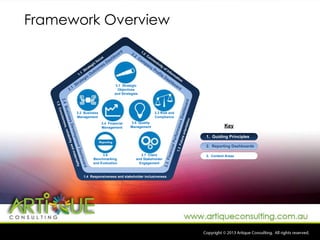
Framework Overview

1.1

2.1

ra
St

r
St

te

s
cu
fo
Da
ic
es
eg
at
m

c
ut
cO
gi

o

r
oa
hb
s

d

1 .2

2 .2

Co
nn
Co
ec
m
tiv
pa
ity
ny
of
Pr
In
of
fo
ile
rm
at
Da
io
n
sh
bo
ar
3.1 Strategic
d
Objectives

3.6
Benchmarking
and Evaluation

3.7 Client
and Stakeholder
Engagement

ial P
e r fo
rma

3.5 Quality
Management

1.4 Responsiveness and stakeholder inclusiveness

1.3

ard
hbo
Das
y
ent
ialit
opm
ater

m
el
and
lity
iabi
, rel

Dev

s
nes

s
ines

3.4 Financial
Management

Fina
nc

Bus

cise
Con

3.3 Risk and
Compliance

2.3

1.5

2.4
3.2 Business
Management

nce
Futu
Das
re o
hbo
rien
ard
tatio
n

and Strategies

Key
1. Guiding Principles
2. Reporting Dashboards
3. Content Areas
Framework Principles

Bus
2.4

cise
Con
1.5

o

Da

3.1 Strategic
Objectives and
Strategies

3.2 Business
Management

m

at
sh
io
n
bo
ar
d

3.3 Risk and
Compliance
3.4 Financial
Management

3.5 Quality
Management

n

oard
shb
y
t Da
ialit
men
a te r
elop
dm

a
lity
iabi
, rel

Dev

s
nes

s
ines

1.5 Conciseness, reliability and
materiality - provides concise, reliable
information that is material to assessing
the companies ability to create and
sustain value in the short, medium and
long term.

te

c
ut
cO
gi

1.2 Connectivity of information - shows the
connections between the different components
of A companies business model, external
factors and the various resources and
pa
ity
ny
of
relationships on which The company and its
Pr
In
of
fo
performance depend.
ile
r

Co
nn
Co
ec
tiv
m

ial P
erf

2 .1

ra
St

r
St

1.2
2 .2

orm
1.3
anc
e Da
Futu
shb
re o
oard
rien
tatio
n

1.1

s
cu
fo
Da
ic
eg
es
at
m

d
ar
bo
sh

3.6
Benchmarking
and Evaluation

3.7 Client
and Stakeholder
Engagement

2.3
Fina
nc

1.1 Strategic focus - provides insight into a
companies strategic objectives, and how
those objectives relate to its ability to create
and sustain value over time.

1.3 Future orientation - includes The
companies expectations about the future,
as well as other information to assess
future prospects or uncertainties it faces.

Key
1. Guiding Principles

1.4 Responsiveness and stakeholder inclusiveness

2. Reporting Dashboards

1.4 Responsiveness and stakeholder
inclusiveness - provides insight into the companies
relationships with its key stakeholders and how and to
what extent the company understands, takes into
account and responds to their needs.

3. Content Areas
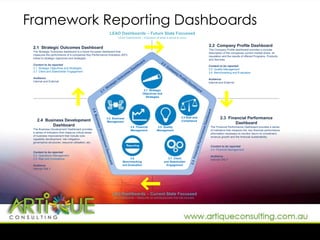
Framework Reporting Dashboards
LEAD Dashboards – Future State Focussed
LEAD Dashboards – Indicators of what is about to occur

2.2 Company Profile Dashboard

2.1 Strategic Outcomes Dashboard

The Company Profile dashboard provides a concise
description of the companies current market share, its
reputation and the results of offered Programs, Products
and Services.

The Strategic Outcomes dashboard is a future focussed dashboard that
measures the performance of a companies Key Performance Indicators (KPI)
linked to strategic objectives and strategies.
Content to be reported
3.1 Strategic Objectives and Strategies
3.7 Client and Stakeholder Engagement
Audience
Internal and External

2 .1

t
ra
St

tc
Ou
ic
eg

om

D
es

a

ar
bo
sh

d

2.2

Co
m

pa
ny
Pr
of
ile
D

3.1 Strategic
Objectives and
Strategies

Content to be reported
3.5 Quality Management
3.6 Benchmarking and Evaluation

as

hb
oa
r

Audience
Internal and External

d

t Da
men
elop
oard
shb

3.6
Benchmarking
and Evaluation

3.7 Client
and Stakeholder
Engagement

ial P
e r fo
rma

3.5 Quality
Management

2.3
Fina
nc

3.4 Financial
Management

nce
D

3.3 Risk and
Compliance

3.2 Business
Management

Dev

Audience
Internal ONLY

s
ines

Content to be reported
3.2 Operations Management
3.3 Risk and Compliance

Bus

The Business Development Dashboard provides
a series of indicators that measure critical areas
of business improvement that include core
capability development, risk mitigation,
governance structures, resource utilisation, etc.

ash
boa
rd

2.4

2.4 Business Development
Dashboard

LAG Dashboards – Current State Focussed
LAG Dashboards – Measures on activity/process that has occured

2.3 Financial Performance
Dashboard

The Financial Performance Dashboard provides a series
of indicators that measure the key financial performance
information necessary to monitor return on investment,
revenue growth and the financial sustainability.

Content to be reported
3.4 Financial Management
Audience
Internal ONLY
Framework Content Areas
3.1. Strategic Objectives and Strategies – These dashboards and supporting
reports must provide essential context by identifying:
Vision, principal activities, market share, products and services.
Business model, value drivers and critical stakeholder dependencies;
What makes the company unique and able to realise value in the future
The commercial, social and environmental context within which the business operates.

3.2. Business Management - These dashboards and supporting reports must
provide essential context by identifying:
Resources and relationships that are key to the companies success.
KPI’s (Key Performance Indicators) and KRA’s (Key Result Areas) regarding strategic
objectives and related strategies – including how the business fared against its targets.
Critical governance structures and decision making processes.
3.1 Strategic
Objectives and
Strategies

3.3. Risk and Compliance – These dashboards and supporting reports must
provide essential context by identifying:
Key risks and opportunities – including processes to determine and manage/ mitigate
risks and opportunities.
Significant laws and regulations that affect the companies ability to create and sustain
value in the short, medium and long term

3.2 Business
Management

3.3 Risk and
Compliance
3.4 Financial
Management

3.5 Quality
Management

3.4. Financial Management – These dashboards and supporting reports must
provide essential context by identifying:
The financial viability of the business in the short, medium and long term.
The profitability and financial performance of Programs, Products and Services

3.5. Quality Management – These dashboards and supporting reports must provide
3.6
Benchmarking
and Evaluation

3.7 Client
and Stakeholder
Engagement

essential context by identifying:
The extent to which quality standards, criteria, guidelines and frameworks have been
met (including the outcomes achieved) during the lifecycle of a Program, Product or
Service.

3.6. Benchmarking and Evaluation –These dashboards and supporting reports
must provide essential context by identifying:
The impact and the continued availability, quality and affordability of Programs,
Products and Services (including the impact (both positive and negative) on the
resources and relationships on which it depends.
Customer, Market and Industry benchmarks of performance comparable to
competitors.

3.7. Client and Stakeholder Engagement – These dashboards and supporting
reports must provide essential context by identifying:
Key stakeholders, their legitimate needs, interests and expectations.
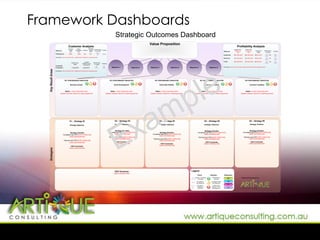
Framework Dashboards
Strategic Outcomes Dashboard
Value Proposition

Customer Analysis
Demand
Target
YTD

Measure
Participants

XXX

Profitability Analysis

Demand
Actual
Performance Trending
Participants Variance Target to
to Forecast
EOFY
YTD

XXX

XX

Measure

Performance
Target

Key Result Areas

Customer
Evaluation

X out of 5

Average
feedback score
for the QTR

Performance
to Target

X out of 5

$X,XXX,XXX

$XXX,XXX

X%

$X,XXX,XXX

$X,XXX,XXX

$XXX,XXX

X%

Profit

$X,XXX,XXX

$X,XXX,XXX

$XXX,XXX

X%

Performance
to Target

Trending

Objective 1

Objective 3

Objective 2

Objective 4

Objective 5

Objective 6

Comments: Insert comments here. Update trend indicators for reporting period

Comments: Insert comments here. Update trend indicators for reporting period

KEY PERFORMANCE INDICATOR

KEY PERFORMANCE INDICATOR

KEY PERFORMANCE INDICATOR

Business Growth

Brand Development

Financially Viability

Status – Insert comments here
Update indicator above for reporting period

Status - Insert comments here
Update indicator above for reporting period

Status – Insert comments here
Update indicator above for reporting period

S2 – Strategy #2

Strategy Objective:

Strategic Objective:

Strategy Activities
Completed last QTR (QTR X 20XX-XX):
Insert comments here
Planned next QTR (QTR X 20XX-XX)
Insert comments here
CEO Comments:
Insert comments here

Strategy Activities:
Completed last QTR (QTR X 20XX-XX):
Insert comments here
Planned next QTR (QTR X 20XX-XX)
Insert comments here
CEO Comments:
Insert comments here

CEO Summary:

le
p

KEY PERFORMANCE INDICATOR

KEY PERFORMANCE INDICATOR

Sector Participation

Customer Feedback

Status - Insert comments here
Update indicator above for reporting period

Status – Insert comments here
Update indicator above for reporting period

S3 – Strategy #3

S4 – Strategy #4

S5 – Strategy #5

Strategic Objective:

Strategic Objective:

Strategic Position:

Strategy Activities:
Completed last QTR (QTR X 20XX-XX):
Insert comments here

Strategy Activities:
Completed last QTR (QTR X 20XX-XX)
Insert comments here

Planned next QTR (QTR X 20XX-XX)
Insert comments here

Planned next QTR QTR X 20XX-XX)
Insert comments here

CEO Comments:
Insert comments here

CEO Comments:
Insert comments here

m
a

x
E

S1 – Strategy #1

Strategies

Variance to
target

$X,XXX,XXX

Revenue

Comments: Insert comments here. Update trend indicators for reporting period

Actual YTDDay/Month/
Year

Expenses

XX

Budget YTD Day/Month/
Year

Strategy Activities:
Completed last QTR (QTR X 20XX-XX):
Insert comments here
Planned next QTR (QTR X 20XX-XX)
Insert comments here
CEO Comments:
Insert comments here

Legend

Insert comments here
Trend

Indicator

Increase / Exceeding
Forecasts

KPI/Objectives
Achieved

No Change /
Not Measured

On Target to Meet
KPI/Objectives

Relevance
DET
Cath
ISQ

Decrease /
Forecasts not
achieved

Further Work
required to meet
KPI/Objectives

ALL

Dashboard developed by:

Trending
Contact Us

Board Reporting Framework - Engage your board members and keep them strategic!

  • 1.
  • 2.
    Research (Source: IIRB: TowardsIntegrated Reporting – Communicating Value in the 21st Century) (Source: David Parmenter – Limit the time spent on Board Reporting) (Source: IIRB: Towards Integrated Reporting – Communicating Value in the 21st Century) (Source: Damon Kitney – Directors need to set agenda)
  • 3.
    Basics 1. What informationdo we need to fulfil our role? 2. What is the information telling us? 3. What do we need to do about it? 4. How will this be done? 5. How will we know when we it has been done?
  • 4.
  • 5.
  • 6.
    Framework Overview 1.1 2.1 ra St r St te s cu fo Da ic es eg at m c ut cO gi o r oa hb s d 1 .2 2.2 Co nn Co ec m tiv pa ity ny of Pr In of fo ile rm at Da io n sh bo ar 3.1 Strategic d Objectives 3.6 Benchmarking and Evaluation 3.7 Client and Stakeholder Engagement ial P e r fo rma 3.5 Quality Management 1.4 Responsiveness and stakeholder inclusiveness 1.3 ard hbo Das y ent ialit opm ater m el and lity iabi , rel Dev s nes s ines 3.4 Financial Management Fina nc Bus cise Con 3.3 Risk and Compliance 2.3 1.5 2.4 3.2 Business Management nce Futu Das re o hbo rien ard tatio n and Strategies Key 1. Guiding Principles 2. Reporting Dashboards 3. Content Areas
  • 7.
    Framework Principles Bus 2.4 cise Con 1.5 o Da 3.1 Strategic Objectivesand Strategies 3.2 Business Management m at sh io n bo ar d 3.3 Risk and Compliance 3.4 Financial Management 3.5 Quality Management n oard shb y t Da ialit men a te r elop dm a lity iabi , rel Dev s nes s ines 1.5 Conciseness, reliability and materiality - provides concise, reliable information that is material to assessing the companies ability to create and sustain value in the short, medium and long term. te c ut cO gi 1.2 Connectivity of information - shows the connections between the different components of A companies business model, external factors and the various resources and pa ity ny of relationships on which The company and its Pr In of fo performance depend. ile r Co nn Co ec tiv m ial P erf 2 .1 ra St r St 1.2 2 .2 orm 1.3 anc e Da Futu shb re o oard rien tatio n 1.1 s cu fo Da ic eg es at m d ar bo sh 3.6 Benchmarking and Evaluation 3.7 Client and Stakeholder Engagement 2.3 Fina nc 1.1 Strategic focus - provides insight into a companies strategic objectives, and how those objectives relate to its ability to create and sustain value over time. 1.3 Future orientation - includes The companies expectations about the future, as well as other information to assess future prospects or uncertainties it faces. Key 1. Guiding Principles 1.4 Responsiveness and stakeholder inclusiveness 2. Reporting Dashboards 1.4 Responsiveness and stakeholder inclusiveness - provides insight into the companies relationships with its key stakeholders and how and to what extent the company understands, takes into account and responds to their needs. 3. Content Areas
  • 8.
    Framework Reporting Dashboards LEADDashboards – Future State Focussed LEAD Dashboards – Indicators of what is about to occur 2.2 Company Profile Dashboard 2.1 Strategic Outcomes Dashboard The Company Profile dashboard provides a concise description of the companies current market share, its reputation and the results of offered Programs, Products and Services. The Strategic Outcomes dashboard is a future focussed dashboard that measures the performance of a companies Key Performance Indicators (KPI) linked to strategic objectives and strategies. Content to be reported 3.1 Strategic Objectives and Strategies 3.7 Client and Stakeholder Engagement Audience Internal and External 2 .1 t ra St tc Ou ic eg om D es a ar bo sh d 2.2 Co m pa ny Pr of ile D 3.1 Strategic Objectives and Strategies Content to be reported 3.5 Quality Management 3.6 Benchmarking and Evaluation as hb oa r Audience Internal and External d t Da men elop oard shb 3.6 Benchmarking and Evaluation 3.7 Client and Stakeholder Engagement ial P e r fo rma 3.5 Quality Management 2.3 Fina nc 3.4 Financial Management nce D 3.3 Risk and Compliance 3.2 Business Management Dev Audience Internal ONLY s ines Content to be reported 3.2 Operations Management 3.3 Risk and Compliance Bus The Business Development Dashboard provides a series of indicators that measure critical areas of business improvement that include core capability development, risk mitigation, governance structures, resource utilisation, etc. ash boa rd 2.4 2.4 Business Development Dashboard LAG Dashboards – Current State Focussed LAG Dashboards – Measures on activity/process that has occured 2.3 Financial Performance Dashboard The Financial Performance Dashboard provides a series of indicators that measure the key financial performance information necessary to monitor return on investment, revenue growth and the financial sustainability. Content to be reported 3.4 Financial Management Audience Internal ONLY
  • 9.
    Framework Content Areas 3.1.Strategic Objectives and Strategies – These dashboards and supporting reports must provide essential context by identifying: Vision, principal activities, market share, products and services. Business model, value drivers and critical stakeholder dependencies; What makes the company unique and able to realise value in the future The commercial, social and environmental context within which the business operates. 3.2. Business Management - These dashboards and supporting reports must provide essential context by identifying: Resources and relationships that are key to the companies success. KPI’s (Key Performance Indicators) and KRA’s (Key Result Areas) regarding strategic objectives and related strategies – including how the business fared against its targets. Critical governance structures and decision making processes. 3.1 Strategic Objectives and Strategies 3.3. Risk and Compliance – These dashboards and supporting reports must provide essential context by identifying: Key risks and opportunities – including processes to determine and manage/ mitigate risks and opportunities. Significant laws and regulations that affect the companies ability to create and sustain value in the short, medium and long term 3.2 Business Management 3.3 Risk and Compliance 3.4 Financial Management 3.5 Quality Management 3.4. Financial Management – These dashboards and supporting reports must provide essential context by identifying: The financial viability of the business in the short, medium and long term. The profitability and financial performance of Programs, Products and Services 3.5. Quality Management – These dashboards and supporting reports must provide 3.6 Benchmarking and Evaluation 3.7 Client and Stakeholder Engagement essential context by identifying: The extent to which quality standards, criteria, guidelines and frameworks have been met (including the outcomes achieved) during the lifecycle of a Program, Product or Service. 3.6. Benchmarking and Evaluation –These dashboards and supporting reports must provide essential context by identifying: The impact and the continued availability, quality and affordability of Programs, Products and Services (including the impact (both positive and negative) on the resources and relationships on which it depends. Customer, Market and Industry benchmarks of performance comparable to competitors. 3.7. Client and Stakeholder Engagement – These dashboards and supporting reports must provide essential context by identifying: Key stakeholders, their legitimate needs, interests and expectations.
  • 10.
    Framework Dashboards Strategic OutcomesDashboard Value Proposition Customer Analysis Demand Target YTD Measure Participants XXX Profitability Analysis Demand Actual Performance Trending Participants Variance Target to to Forecast EOFY YTD XXX XX Measure Performance Target Key Result Areas Customer Evaluation X out of 5 Average feedback score for the QTR Performance to Target X out of 5 $X,XXX,XXX $XXX,XXX X% $X,XXX,XXX $X,XXX,XXX $XXX,XXX X% Profit $X,XXX,XXX $X,XXX,XXX $XXX,XXX X% Performance to Target Trending Objective 1 Objective 3 Objective 2 Objective 4 Objective 5 Objective 6 Comments: Insert comments here. Update trend indicators for reporting period Comments: Insert comments here. Update trend indicators for reporting period KEY PERFORMANCE INDICATOR KEY PERFORMANCE INDICATOR KEY PERFORMANCE INDICATOR Business Growth Brand Development Financially Viability Status – Insert comments here Update indicator above for reporting period Status - Insert comments here Update indicator above for reporting period Status – Insert comments here Update indicator above for reporting period S2 – Strategy #2 Strategy Objective: Strategic Objective: Strategy Activities Completed last QTR (QTR X 20XX-XX): Insert comments here Planned next QTR (QTR X 20XX-XX) Insert comments here CEO Comments: Insert comments here Strategy Activities: Completed last QTR (QTR X 20XX-XX): Insert comments here Planned next QTR (QTR X 20XX-XX) Insert comments here CEO Comments: Insert comments here CEO Summary: le p KEY PERFORMANCE INDICATOR KEY PERFORMANCE INDICATOR Sector Participation Customer Feedback Status - Insert comments here Update indicator above for reporting period Status – Insert comments here Update indicator above for reporting period S3 – Strategy #3 S4 – Strategy #4 S5 – Strategy #5 Strategic Objective: Strategic Objective: Strategic Position: Strategy Activities: Completed last QTR (QTR X 20XX-XX): Insert comments here Strategy Activities: Completed last QTR (QTR X 20XX-XX) Insert comments here Planned next QTR (QTR X 20XX-XX) Insert comments here Planned next QTR QTR X 20XX-XX) Insert comments here CEO Comments: Insert comments here CEO Comments: Insert comments here m a x E S1 – Strategy #1 Strategies Variance to target $X,XXX,XXX Revenue Comments: Insert comments here. Update trend indicators for reporting period Actual YTDDay/Month/ Year Expenses XX Budget YTD Day/Month/ Year Strategy Activities: Completed last QTR (QTR X 20XX-XX): Insert comments here Planned next QTR (QTR X 20XX-XX) Insert comments here CEO Comments: Insert comments here Legend Insert comments here Trend Indicator Increase / Exceeding Forecasts KPI/Objectives Achieved No Change / Not Measured On Target to Meet KPI/Objectives Relevance DET Cath ISQ Decrease / Forecasts not achieved Further Work required to meet KPI/Objectives ALL Dashboard developed by: Trending
  • 11.