BMW – A CASE STUDY
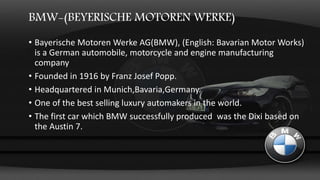
• Bayerische Motoren Werke AG(BMW), (English: Bavarian Motor Works)
is a German automobile, motorcycle and engine manufacturing
company
• Founded in 1916 by Franz Josef Popp.
• Headquartered in Munich,Bavaria,Germany.
• One of the best selling luxury automakers in the world.
• The first car which BMW successfully produced was the Dixi based on
the Austin 7.
BMW-(BEYERISCHE MOTOREN WERKE)
CONTD..
• Current Tagline has changed from “The Ultimate Driving Machine” to
“Sheer Driving Pleasure” & “BMW-The Joy of Driving”.
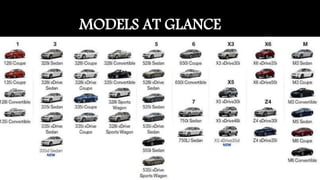
MODELS AT GLANCE
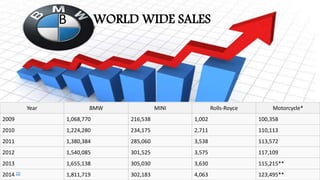
B WORLD WIDE SALES
Year BMW MINI Rolls-Royce Motorcycle
2009 1,068,770 216,538 1,002 100,358
2010 1,224,280 234,175 2,711 110,113
2011 1,380,384 285,060 3,538 113,572
2012 1,540,085 301,525 3,575 117,109
2013 1,655,138 305,030 3,630 115,215
2014 1,811,719 302,183 4,063 123,495
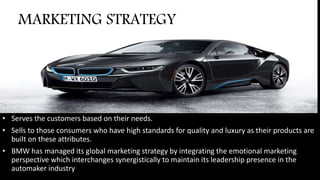
• Serves the customers based on their needs.
• Sells to those consumers who have high standards for quality and luxury as their products are
built on these attributes.
• BMW has managed its global marketing strategy by integrating the emotional marketing
perspective which interchanges synergistically to maintain its leadership presence in the
automaker industry
MARKETING STRATEGY
CONTD..
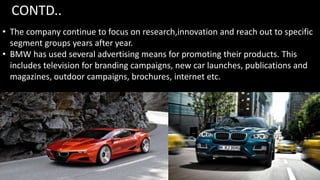
• The company continue to focus on research,innovation and reach out to specific
segment groups years after year.
• BMW has used several advertising means for promoting their products. This
includes television for branding campaigns, new car launches, publications and
magazines, outdoor campaigns, brochures, internet etc.
• BMW has categorized its market segment in 3 series that is comprised of three different
engine sections; this helps people to differentiate as each engine has a different price.
• The company has used Demographic market segmentation where they allow the customers to
make a purchase decision based on their demands.
• BMW is mostly favored by men of age over 35 whose income level is usually more than
$75.000.
• The company’s retail stores are mostly located in areas where the majority of the consumers
live in the upper class region. This is how BMW execute its geographic segmentation
MARKET SEGMENTATION
BMW TARGETING
• BMW use a differentiated strategy, this means that they target specific automobile markets. These markets suit different
people within the segmentation stratosphere.
• BMW Group uses mono-segment type of positioning and accordingly, the company makes an appeal to a single customer
segment.
• The market positioning is always meant for the upper affluent class. For instance, the Mercedes Benz SL Class Roadster. SL is
positioned as a sports car icon which originated since 6o years. Another model of Mercedes Benz, Smart For Two Coup is
focused on the lifestyle and environment.
CONTD..
• BMW’S Most luxurious car ,targeted a group called “upper
conservatives” adding comfort and luxury to these cars to attract the
customers.
• BMW launched the X5 by targeting “upper liberals” who demanded
bigger cars for their active lifestyles and growing families, Thus BMW
created a high performance luxury SUV.
• BMW Created the lower priced 1 series and X3 SUV to target the
“modern mainstream” who had earlier avoided BMWs because of their
premium cost.
• It then launched the convertibles and roadsters to target “post-
moderns” a high-income group that continues to attract attention with
more flamboyant cars.
• BMW continues to reach out other segment groups years after year
BMW SEGMENTATION,TARGETING AND
POSITIONING FOR DIFFERENT GROUPS
Type of
segmentation
Segmentation criteria BMW Group target segment
BMW MINI Rolls-Royce
Geog-raphic
Region Domestic/international Domestic/international Domestic/international
Density Urban/rural Urban Urban
Demog-raphic
Age 20-65 25-45 40+
Gender Males & Females Males & Females Males & Females
Life-cycle stage
Bachelor Stage/Newly Married
Couples
Full Nest I
Full Nest II
Full Nest III
Empty Nest I
Empty Nest II
Solitary Survivor I
Solitary Survivor II
Bachelor StageNewly Married
Couples
Full Nest I
Full Nest IIFull Nest III
Empty Nest I
Empty Nest II
Solitary Survivor I
Solitary Survivor II
Income High High High
Occupa-tion Professionals & executives Professionals & executives Professionals & executives
Behavi-oral
Degree of loyalty
‘Hard core loyals”Soft core loyals’
‘Switchers’
‘Soft core loyals”Switchers’ ‘Hard core loyals’
Benefits sought
Reliability Sense of achievement
Speed
ReliabilitySense of achievement
Speed
ReliabilitySense of achievement
Expression of high status
Persona-lity Determined and ambitious Easygoing Determined and ambitious
User status
non-usersregular users,
ex-users
potential users, first-time users first-time users regular users
Psychographic
Social class Middle classUpper class Middle class Upper class
Lifestyle[1] AspirerSucceeder ExplorerReformer Resigned
What are the pros and cons to BMWs
Selective target marketing?
PROS:
• Better focus on
customer needs and
develop customized
products.
• Heavy engineering and
robust models.
• Extremely responsive
service support.
• Better relationship with
customers.
CONS:
• Lots of research and
efforts lead to pulling up
the prices.
• Sales dipped during
recession.
• Cars only for the ones who
could afford, ignored the
low income groups of the
society.
• Limited profit options.
• High risk of failure of a
model.
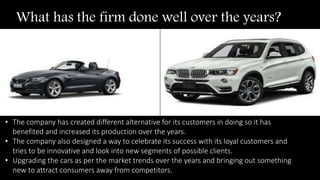
What has the firm done well over the years?
• The company has created different alternative for its customers in doing so it has
benefited and increased its production over the years.
• The company also designed a way to celebrate its success with its loyal customers and
tries to be innovative and look into new segments of possible clients.
• Upgrading the cars as per the market trends over the years and bringing out something
new to attract consumers away from competitors.
Where could it improve?
• In order to make
improvement, the company
should widen its target group
where market is bigger with
more opportunities like
developing countries.
• They should also focus on
other sections of the society
as well who can’t afford such
high priced cars.
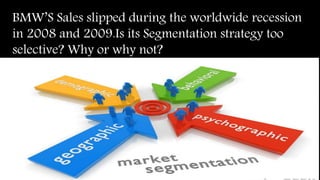
BMW’S Sales slipped during the worldwide recession
in 2008 and 2009.Is its Segmentation strategy too
selective? Why or why not?
• BMW’S selective strategy for segmentation was the reason for slip in sales
during the world wide recession.
• BMW targeted mainly the growing market of baby boomers and
professional yuppies, with recession their incomes dropped, so is BMW’s
sales.
• The earning to saving of this segment depended on the volatility of the
market. So does their spending on capacity on the luxury brands.
• Although, During the recession, everybody struggled. So to blame BMW
for their strategy that had made them so successful in the first place
would not be fair
CONCLUSION
• In June 2012, BMW was listed as
the #1 most reputable company in
the world by Forbes.com.
• Its selective marketing strategy
and continuous research and
innovation has contributed towards
its growth.
• In future it should focus more on
their sales in developing countries
and using artificial intelligence and
intuitive technology as a part of
their innovation and development
to outstand all its competitors.
CHANGES ARE AFOOT AT BMW
DISCLAIMER
Created by Trijya Saini, College of Technology, Pantnagar
during a marketing internship by
Prof. Sameer Mathur,IIM Lucknow

BMW - A case study

  • 1.
    BMW – ACASE STUDY
  • 2.
    • Bayerische MotorenWerke AG(BMW), (English: Bavarian Motor Works) is a German automobile, motorcycle and engine manufacturing company • Founded in 1916 by Franz Josef Popp. • Headquartered in Munich,Bavaria,Germany. • One of the best selling luxury automakers in the world. • The first car which BMW successfully produced was the Dixi based on the Austin 7. BMW-(BEYERISCHE MOTOREN WERKE)
  • 3.
    CONTD.. • Current Taglinehas changed from “The Ultimate Driving Machine” to “Sheer Driving Pleasure” & “BMW-The Joy of Driving”.
  • 4.
  • 5.
    B WORLD WIDESALES Year BMW MINI Rolls-Royce Motorcycle 2009 1,068,770 216,538 1,002 100,358 2010 1,224,280 234,175 2,711 110,113 2011 1,380,384 285,060 3,538 113,572 2012 1,540,085 301,525 3,575 117,109 2013 1,655,138 305,030 3,630 115,215 2014 1,811,719 302,183 4,063 123,495
  • 6.
    • Serves thecustomers based on their needs. • Sells to those consumers who have high standards for quality and luxury as their products are built on these attributes. • BMW has managed its global marketing strategy by integrating the emotional marketing perspective which interchanges synergistically to maintain its leadership presence in the automaker industry MARKETING STRATEGY
  • 7.
    CONTD.. • The companycontinue to focus on research,innovation and reach out to specific segment groups years after year. • BMW has used several advertising means for promoting their products. This includes television for branding campaigns, new car launches, publications and magazines, outdoor campaigns, brochures, internet etc.
  • 8.
    • BMW hascategorized its market segment in 3 series that is comprised of three different engine sections; this helps people to differentiate as each engine has a different price. • The company has used Demographic market segmentation where they allow the customers to make a purchase decision based on their demands. • BMW is mostly favored by men of age over 35 whose income level is usually more than $75.000. • The company’s retail stores are mostly located in areas where the majority of the consumers live in the upper class region. This is how BMW execute its geographic segmentation MARKET SEGMENTATION
  • 9.
    BMW TARGETING • BMWuse a differentiated strategy, this means that they target specific automobile markets. These markets suit different people within the segmentation stratosphere. • BMW Group uses mono-segment type of positioning and accordingly, the company makes an appeal to a single customer segment. • The market positioning is always meant for the upper affluent class. For instance, the Mercedes Benz SL Class Roadster. SL is positioned as a sports car icon which originated since 6o years. Another model of Mercedes Benz, Smart For Two Coup is focused on the lifestyle and environment.
  • 10.
    CONTD.. • BMW’S Mostluxurious car ,targeted a group called “upper conservatives” adding comfort and luxury to these cars to attract the customers. • BMW launched the X5 by targeting “upper liberals” who demanded bigger cars for their active lifestyles and growing families, Thus BMW created a high performance luxury SUV. • BMW Created the lower priced 1 series and X3 SUV to target the “modern mainstream” who had earlier avoided BMWs because of their premium cost. • It then launched the convertibles and roadsters to target “post- moderns” a high-income group that continues to attract attention with more flamboyant cars. • BMW continues to reach out other segment groups years after year
  • 11.
  • 12.
    Type of segmentation Segmentation criteriaBMW Group target segment BMW MINI Rolls-Royce Geog-raphic Region Domestic/international Domestic/international Domestic/international Density Urban/rural Urban Urban Demog-raphic Age 20-65 25-45 40+ Gender Males & Females Males & Females Males & Females Life-cycle stage Bachelor Stage/Newly Married Couples Full Nest I Full Nest II Full Nest III Empty Nest I Empty Nest II Solitary Survivor I Solitary Survivor II Bachelor StageNewly Married Couples Full Nest I Full Nest IIFull Nest III Empty Nest I Empty Nest II Solitary Survivor I Solitary Survivor II Income High High High Occupa-tion Professionals & executives Professionals & executives Professionals & executives Behavi-oral Degree of loyalty ‘Hard core loyals”Soft core loyals’ ‘Switchers’ ‘Soft core loyals”Switchers’ ‘Hard core loyals’ Benefits sought Reliability Sense of achievement Speed ReliabilitySense of achievement Speed ReliabilitySense of achievement Expression of high status Persona-lity Determined and ambitious Easygoing Determined and ambitious User status non-usersregular users, ex-users potential users, first-time users first-time users regular users Psychographic Social class Middle classUpper class Middle class Upper class Lifestyle[1] AspirerSucceeder ExplorerReformer Resigned
  • 13.
    What are thepros and cons to BMWs Selective target marketing?
  • 14.
    PROS: • Better focuson customer needs and develop customized products. • Heavy engineering and robust models. • Extremely responsive service support. • Better relationship with customers.
  • 15.
    CONS: • Lots ofresearch and efforts lead to pulling up the prices. • Sales dipped during recession. • Cars only for the ones who could afford, ignored the low income groups of the society. • Limited profit options. • High risk of failure of a model.
  • 16.
    What has thefirm done well over the years? • The company has created different alternative for its customers in doing so it has benefited and increased its production over the years. • The company also designed a way to celebrate its success with its loyal customers and tries to be innovative and look into new segments of possible clients. • Upgrading the cars as per the market trends over the years and bringing out something new to attract consumers away from competitors.
  • 17.
    Where could itimprove? • In order to make improvement, the company should widen its target group where market is bigger with more opportunities like developing countries. • They should also focus on other sections of the society as well who can’t afford such high priced cars.
  • 18.
    BMW’S Sales slippedduring the worldwide recession in 2008 and 2009.Is its Segmentation strategy too selective? Why or why not?
  • 19.
    • BMW’S selectivestrategy for segmentation was the reason for slip in sales during the world wide recession. • BMW targeted mainly the growing market of baby boomers and professional yuppies, with recession their incomes dropped, so is BMW’s sales. • The earning to saving of this segment depended on the volatility of the market. So does their spending on capacity on the luxury brands. • Although, During the recession, everybody struggled. So to blame BMW for their strategy that had made them so successful in the first place would not be fair
  • 20.
    CONCLUSION • In June2012, BMW was listed as the #1 most reputable company in the world by Forbes.com. • Its selective marketing strategy and continuous research and innovation has contributed towards its growth. • In future it should focus more on their sales in developing countries and using artificial intelligence and intuitive technology as a part of their innovation and development to outstand all its competitors. CHANGES ARE AFOOT AT BMW
  • 21.
    DISCLAIMER Created by TrijyaSaini, College of Technology, Pantnagar during a marketing internship by Prof. Sameer Mathur,IIM Lucknow