URBAN STRATEGIES
        COUNCIL

       African American Male
            Achievement
                   &
       Boys and Men of Color
              Initiatives
               Prepared by:
              Junious Williams
              Rebecca Brown
               Alicia Olivarez
               Sarah Marxer
1          www.urbanstrategies.org
Urban Strategies Council Mission

Work with partners to eliminate
 persistent poverty by building
 vibrant, healthy communities.


2
Urban Strategies Council…

is a social impact organization using
  tools of research, policy,
  collaboration, innovation and
  advocacy to achieve equity and
  social justice.


3
Why Focus on African
         American Male
    Achievement & Boys and
         Men of Color?


4
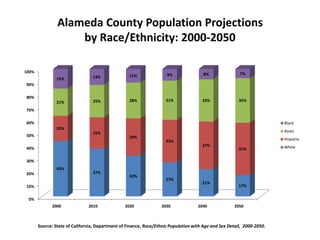
Alameda County Population Projections
                    by Race/Ethnicity: 2000-2050

100%                                                                                                    7%
                                                   11%               9%                8%
                15%              13%
90%

80%
                21%              25%               28%              31%               33%               35%

70%

60%                                                                                                                     Black
                20%
                                 25%                                                                                    Asian
50%                                                29%
                                                                    33%                                                 Hispanic
                                                                                      37%                               White
40%                                                                                                     41%

30%
                43%
20%                              37%
                                                   32%
                                                                    27%
                                                                                      21%
10%                                                                                                     17%


 0%
             2000              2010              2020             2030              2040              2050


       Source: State of California, Department of Finance, Race/Ethnic Population with Age and Sex Detail, 2000-2050.
All Californians…
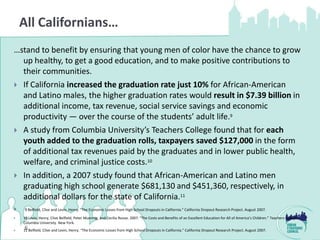
…stand to benefit by ensuring that young men of color have the chance to grow
  up healthy, to get a good education, and to make positive contributions to
  their communities.
 If California increased the graduation rate just 10% for African-American
  and Latino males, the higher graduation rates would result in $7.39 billion in
  additional income, tax revenue, social service savings and economic
  productivity — over the course of the students’ adult life.9
 A study from Columbia University’s Teachers College found that for each
  youth added to the graduation rolls, taxpayers saved $127,000 in the form
  of additional tax revenues paid by the graduates and in lower public health,
  welfare, and criminal justice costs.10
 In addition, a 2007 study found that African-American and Latino men
  graduating high school generate $681,130 and $451,360, respectively, in
  additional dollars for the state of California.11
   9 Belfield, Clive and Levin, Henry. “The Economic Losses from High School Dropouts in California.” California Dropout Research Project. August 2007.

   10 Levin, Henry, Clive Belfield, Peter Muennig, and Cecilia Rouse. 2007. “The Costs and Benefits of an Excellent Education for All of America’s Children.” Teachers College,
    Columbia University. New York.

     6
    11 Belfield, Clive and Levin, Henry. “The Economic Losses from High School Dropouts in California.” California Dropout Research Project. August 2007.
Oakland stands to benefit, too…
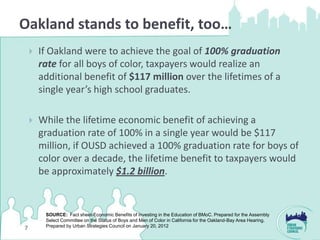
       If Oakland were to achieve the goal of 100% graduation
        rate for all boys of color, taxpayers would realize an
        additional benefit of $117 million over the lifetimes of a
        single year’s high school graduates.

       While the lifetime economic benefit of achieving a
        graduation rate of 100% in a single year would be $117
        million, if OUSD achieved a 100% graduation rate for boys of
        color over a decade, the lifetime benefit to taxpayers would
        be approximately $1.2 billion.


         SOURCE: Fact sheet-Economic Benefits of Investing in the Education of BMoC. Prepared for the Assembly
         Select Committee on the Status of Boys and Men of Color in California for the Oakland-Bay Area Hearing.
         Prepared by Urban Strategies Council on January 20, 2012
7
National Efforts for Boys and Men of Color

  Black Male Achievement Leadership & Sustainability Institute
   (LSI)- Open Society Foundation, PolicyLink & Root Cause
 http://leadershipandsustainabilityinstitute.com/
  Campaign for Black Male Achievement- Open Society
   Institute
 http://www.opensocietyfoundations.org/topics/black-male-
   achievement
  2025 Campaign for Black Men and Boys- The Ford
   Foundation, The Twenty First Century Foundation, the
   National Urban League & others
 http://www.2025bmb.org/


     8
National Efforts for Boys and Men of Color
  City Leadership to Promote Black Male Achievement-
   National League of Cities http://www.nlc.org/find-city-
   solutions/institute-for-youth-education-and-families/at-risk-
   youth/city-leadership-to-promote-black-male-achievement
  Schott Foundation Black Male Initiative- The Schott
   Foundation for Public Education
   http://www.schottfoundation.org/funds/black-male-initiative
  White House Initiative on Educational Excellence for African
   Americans- Executive Order from President Obama
 http://www.whitehouse.gov/the-press-
   office/2012/07/26/executive-order-white-house-initiative-
   educational-excellence-african-am


     9
Alliance for Boys and Men of Color


10
includes change agents from across the state of California who are
committed to improving the life chances of California’s boys and
young men of color. http://www.allianceforbmoc.org/


  Statewide Partners


 Regional Conveners


                            Oakland    Fresno      LA
 11
Assembly Select Committee on the Status
of Boys and Men of Color


     Alliance members partnered with the Committee to
      organize hearings in Sacramento, Oakland, Fresno,
      Los Angeles, and Coachella Valley and to solicit
      recommendations from a diverse cross section of
      stakeholders.

     The Committee's draft action plan, which includes 65
      practical and scalable recommendations can be found
      here: http://www.allianceforbmoc.org/

     12
Oakland-Alameda County
Alliance for Boys and Men of
            Color


13
Oakland-Alameda County Boys and Men of Color
Goals: Increase…
     educational outcomes including academic
      performance, graduation and readiness for
      careers and/or post-secondary education;

       participation in the labor force in “high
        quality” jobs and careers; and

       utilization of a fully-integrated “health
        home” that improves health outcomes.

   14
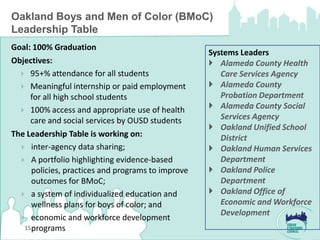
Oakland Boys and Men of Color (BMoC)
Leadership Table
Goal: 100% Graduation
                                                   Systems Leaders
Objectives:                                         Alameda County Health
   95+% attendance for all students                  Care Services Agency
   Meaningful internship or paid employment        Alameda County
     for all high school students                     Probation Department
   100% access and appropriate use of health
                                                    Alameda County Social
     care and social services by OUSD students        Services Agency
                                                    Oakland Unified School
The Leadership Table is working on:                   District
   inter-agency data sharing;                      Oakland Human Services
   A portfolio highlighting evidence-based           Department
     policies, practices and programs to improve    Oakland Police
     outcomes for BMoC;                               Department
   a system of individualized education and        Oakland Office of
     wellness plans for boys of color; and            Economic and Workforce
                                                      Development
   economic and workforce development
   15programs
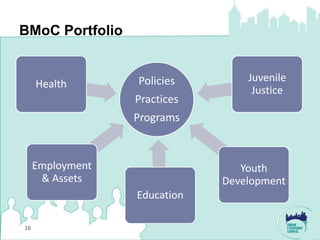
BMoC Portfolio


                  Policies        Juvenile
     Health
                                   Justice
                  Practices
                  Programs


     Employment                  Youth
      & Assets                Development
                  Education

16
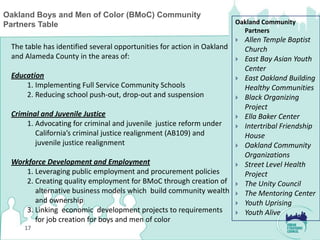
Oakland Boys and Men of Color (BMoC) Community
Partners Table                                                          Oakland Community
                                                                          Partners
                                                                           Allen Temple Baptist
 The table has identified several opportunities for action in Oakland       Church
 and Alameda County in the areas of:                                       East Bay Asian Youth
                                                                            Center
 Education                                                                 East Oakland Building
     1. Implementing Full Service Community Schools                         Healthy Communities
     2. Reducing school push-out, drop-out and suspension                  Black Organizing
                                                                            Project
 Criminal and Juvenile Justice                                             Ella Baker Center
     1. Advocating for criminal and juvenile justice reform under          Intertribal Friendship
        California’s criminal justice realignment (AB109) and               House
        juvenile justice realignment                                       Oakland Community
                                                                            Organizations
 Workforce Development and Employment                                      Street Level Health
     1. Leveraging public employment and procurement policies               Project
     2. Creating quality employment for BMoC through creation of           The Unity Council
        alternative business models which build community wealth           The Mentoring Center
        and ownership                                                      Youth Uprising
     3. Linking economic development projects to requirements              Youth Alive
        for job creation for boys and men of color
     17
Examples of Public Systems and Community Partner Work

  The   Unity Council Latino Men and Boys Program

  EBAYC Boys and Men of Color Mentoring Project

  The Oakland Unified School District Manhood
 Development and AAMA

  Alameda County Health Care Services Agency has
 implemented an Emergency Medical Technician
 Program

 Social Services Fatherhood Initiative
   18
Joint Systems Leader and Community Partner
Work
Community Communication Plan
the Initiative looks forward to its first joint project:

• to effectively communicate within public systems
and organizations, across communities of color, and
to the public and policy makers the importance of
improving the outcomes for BMoC; and

•to actively contribute to changing the narrative
around BMoC to an asset frame including stories
about their many successes and contributions to
family, community and society.
  19
Oakland Unified School
 District African American Male
     Achievement Initiative


20
African American Male Achievement
Initiative

 Began in fall 2010
 Partnership:
       Oakland Unified School District
       East Bay Community Foundation
       Urban Strategies Council
       Partners in School Innovation
Focus: Eliminating disparities and
 improving educational and social
 outcomes for African American male
 students in OUSD
21
Urban Strategies Council’s Role
1.    Develop indicators, measures and targets for
      goal areas and conduct analyses to determine
      status of African American males in these areas

2.    Literature reviews to better understand causes
      of disparities and strategies for addressing
      them

3.    Special studies on key issues for African
      American male students (three reports)

 22
4.    Policy analysis to inform interventions
Reports
 Goal Areas, Indicators and Targets
    Developed indicators and targets
    Conducted longitudinal analysis
    Compared across school levels
    Compared across ethnic groups

 Graduation Likelihood
 Attendance
 Suspensions


23
Goal Areas, Indicators and Targets

http://www.urbanstrategies.org/programs/schools/docs/A
AMAI%20Goal%20Data%20Packet%2004-04-11.pdf
Initiative Goal Areas
     1.   Achievement Gap (English
          Language Arts and Math)

     2.   High School Graduation

     3.   Literacy (4th Grade)

     4.   Suspension

     5.   Attendance

     6.   Middle School Holding Power

     7.   Juvenile Detention (Incarceration)
25
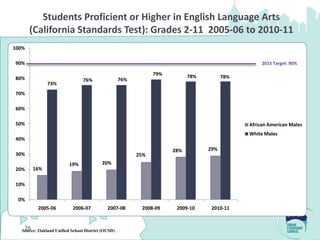
Students Proficient or Higher in English Language Arts
       (California Standards Test): Grades 2-11 2005-06 to 2010-11
100%

90%                                                                                               2015 Target: 90%

                                                               79%         78%
80%                                                                                    78%
                                76%                76%
              73%
70%

60%

50%                                                                                          African American Males
                                                                                             White Males
40%

                                                                     28%         29%
30%                                                      25%
                         19%             20%
20%    16%

10%

 0%
          2005-06          2006-07          2007-08       2008-09     2009-10     2010-11


   26
  Source: Oakland Unified School District (OUSD)
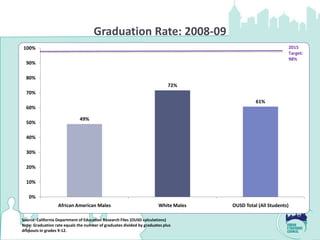
Graduation Rate: 2008-09
100%                                                                                                             2015
                                                                                                                 Target:
                                                                                                                 98%
  90%

  80%
                                                                            72%
  70%
                                                                                               61%
  60%

                              49%
  50%

  40%

  30%

  20%

  10%

   0%
                   African American Males                              White Males   OUSD Total (All Students)

Source: California Department of Education Research Files (OUSD calculations)
Note: Graduation rate equals the number of graduates divided by graduates plus
 27
dropouts in grades 9-12.
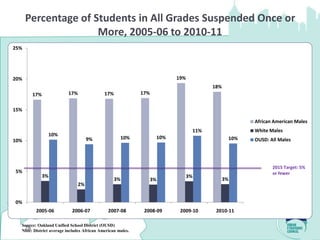
Percentage of Students in All Grades Suspended Once or
                     More, 2005-06 to 2010-11
25%


20%                                                                           19%
                                                                                               18%
       17%               17%                17%              17%


15%

                                                                                                                African American Males
                                                                                         11%                    White Males
                  10%
                                    9%                 10%              10%                               10%   OUSD: All Males
10%


                                                                                                                       2015 Target: 5%
5%                                                                                                                     or fewer
             3%                                                                     3%
                                                  3%               3%                                3%
                               2%


0%
         2005-06           2006-07            2007-08         2008-09          2009-10          2010-11

  Source: Oakland Unified School District (OUSD)
   28
  Note: District average includes African American males.
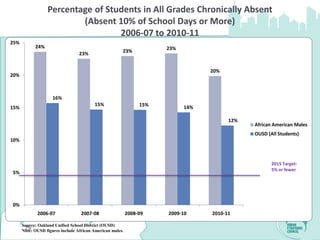
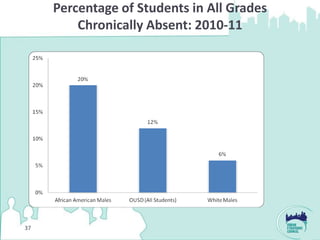
Percentage of Students in All Grades Chronically Absent
                          (Absent 10% of School Days or More)
                                   2006-07 to 2010-11
25%
            24%                                                       23%
                                                       23%
                                  23%


                                                                                  20%
20%


                     16%
                                         15%                    15%
15%                                                                         14%

                                                                                        12%
                                                                                              African American Males
                                                                                              OUSD (All Students)
10%


                                                                                                     2015 Target:
                                                                                                     5% or fewer
5%


0%
             2006-07               2007-08                 2008-09    2009-10     2010-11

      Source: Oakland Unified School District (OUSD)
       29
      Note: OUSD figures include African American males.
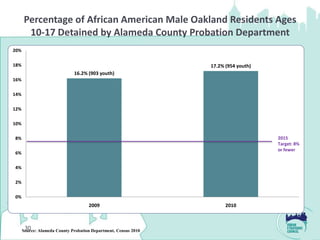
Percentage of African American Male Oakland Residents Ages
       10-17 Detained by Alameda County Probation Department
20%

18%                                                              17.2% (954 youth)
                              16.2% (903 youth)
16%

14%

12%

10%

8%                                                                                   2015
                                                                                     Target: 8%
                                                                                     or fewer
6%

4%

2%

0%
                                     2009                              2010


       30
      Source: Alameda County Probation Department, Census 2010
Examining Graduation Likelihood

http://urbanstrategies.org/aamai/images/docs/AAMAI_
OnCourseToGraduate.pdf


 z:EducationExcellenceEquity FrameworkData DisaggregationData disaggregation ppt
 4.17.12 rb
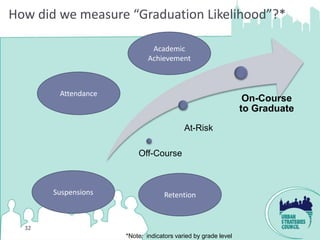
How did we measure “Graduation Likelihood”?*

                              Academic
                             Achievement


        Attendance
                                                                On-Course
                                                               to Graduate
                                          At-Risk

                         Off-Course


       Suspensions                 Retention


  32
                     *Note: indicators varied by grade level
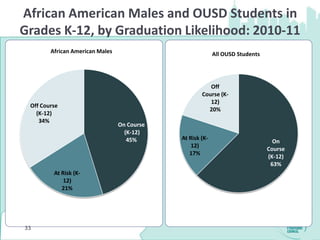
African American Males and OUSD Students in
Grades K-12, by Graduation Likelihood: 2010-11
        African American Males                             All OUSD Students


                                                        Off
                                                     Course (K-
                                                        12)
 Off Course
                                                       20%
   (K-12)
    34%
                                 On Course
                                   (K-12)
                                    45%      At Risk (K-
                                                                                 On
                                                 12)
                                                                               Course
                                                17%
                                                                               (K-12)
                                                                                63%
         At Risk (K-
             12)
            21%


33
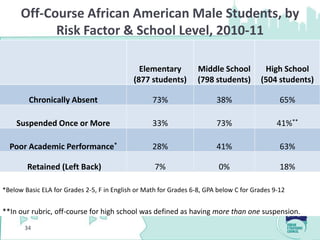
Off-Course African American Male Students, by
            Risk Factor & School Level, 2010-11

                                               Elementary          Middle School         High School
                                             (877 students)        (798 students)       (504 students)

         Chronically Absent                        73%                   38%                   65%

    Suspended Once or More                         33%                   73%                  41%**

  Poor Academic Performance*                       28%                   41%                   63%

        Retained (Left Back)                        7%                    0%                   18%

*Below Basic ELA for Grades 2-5, F in English or Math for Grades 6-8, GPA below C for Grades 9-12


**In our rubric, off-course for high school was defined as having more than one suspension.
       34
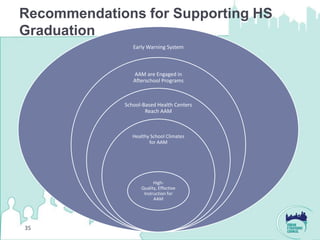
Recommendations for Supporting HS
Graduation
                Early Warning System


                AAM are Engaged in
                Afterschool Programs


             School-Based Health Centers
                     Reach AAM


                Healthy School Climates
                       for AAM


                         High-
                   Quality, Effective
                    Instruction for
                         AAM


35
Examining Chronic Absence

http://www.urbanstrategies.org/aamai/images/docs/AAMAI
_AttendanceReport.pdf


z:EducationExcellenceEquity FrameworkData DisaggregationData disaggregation ppt
4.17.12 rb
Percentage of Students in All Grades
         Chronically Absent: 2010-11


37
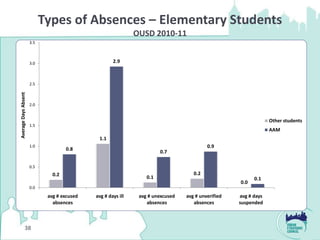
Types of Absences – Elementary Students
                                                              OUSD 2010-11
                      3.5


                      3.0                            2.9


                      2.5
Average Days Absent


                      2.0


                                                                                                                 Other students
                      1.5
                                                                                                                 AAM
                                              1.1
                      1.0                                                                 0.9
                                     0.8
                                                                        0.7

                      0.5
                               0.2                                                  0.2
                                                                  0.1                                     0.1
                                                                                                    0.0
                      0.0
                             avg # excused   avg # days ill    avg # unexcused   avg # unverified   avg # days
                               absences                           absences          absences        suspended


              38
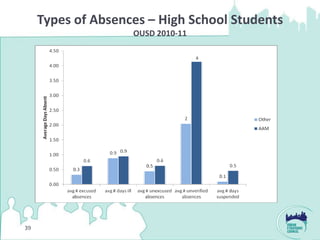
Types of Absences – High School Students
                    OUSD 2010-11


39
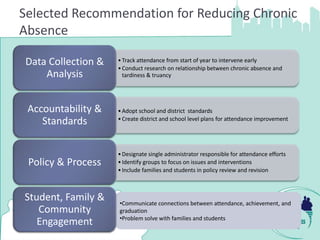
Selected Recommendation for Reducing Chronic
Absence

Data Collection &   • Track attendance from start of year to intervene early
                    • Conduct research on relationship between chronic absence and
    Analysis          tardiness & truancy


 Accountability &   • Adopt school and district standards
    Standards       • Create district and school level plans for attendance improvement


                    • Designate single administrator responsible for attendance efforts
 Policy & Process   • Identify groups to focus on issues and interventions
                    • Include families and students in policy review and revision


Student, Family &   •Communicate connections between attendance, achievement, and
   Community        graduation
                    •Problem solve with families and students
40
   Engagement
Examining Suspensions

http://www.urbanstrategies.org/aamai/images/docs/AAMA_OUSD_
SuspensionAnalysis.pdf


 z:EducationExcellenceEquity FrameworkData DisaggregationData disaggregation ppt
 4.17.12 rb
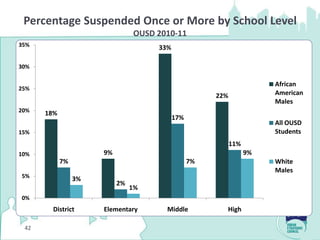
Percentage Suspended Once or More by School Level
                                OUSD 2010-11
35%                                  33%

30%

                                                                       African
25%
                                                      22%              American
                                                                       Males
20%   18%
                                           17%
                                                                       All OUSD
15%                                                                    Students
                                                            11%
10%                   9%                                          9%
            7%                                   7%                    White
                                                                       Males
5%               3%
                           2%
                                1%
0%
        District      Elementary       Middle           High

 42
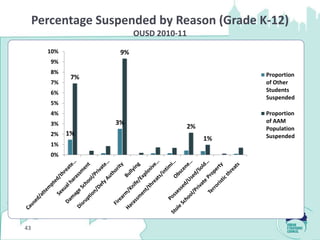
Percentage Suspended by Reason (Grade K-12)
                         OUSD 2010-11
       10%          9%
        9%
        8%                                    Proportion
              7%
        7%                                    of Other
        6%                                    Students
                                              Suspended
        5%
        4%                                    Proportion
        3%         3%                         of AAM
                                    2%        Population
        2%   1%                               Suspended
                                         1%
        1%
        0%


43
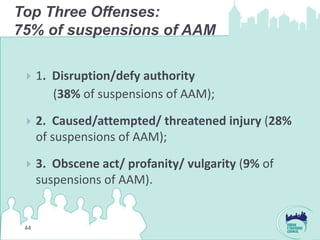
Top Three Offenses:
75% of suspensions of AAM

     1. Disruption/defy authority
         (38% of suspensions of AAM);

     2. Caused/attempted/ threatened injury (28%
      of suspensions of AAM);

     3. Obscene act/ profanity/ vulgarity (9% of
      suspensions of AAM).


 44
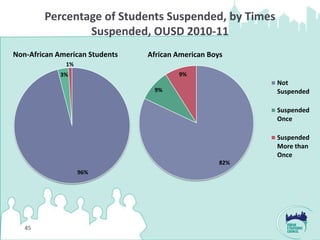
Percentage of Students Suspended, by Times
                Suspended, OUSD 2010-11
Non-African American Students   African American Boys
              1%
             3%                         9%
                                                          Not
                                 9%                       Suspended

                                                          Suspended
                                                          Once

                                                          Suspended
                                                          More than
                                                          Once
                                                    82%
                   96%


   45
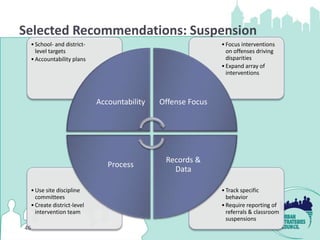
Selected Recommendations: Suspension
 • School- and district-                                    • Focus interventions
   level targets                                              on offenses driving
 • Accountability plans                                       disparities
                                                            • Expand array of
                                                              interventions


                           Accountability   Offense Focus


                                             Records &
                              Process
                                               Data

 • Use site discipline                                      • Track specific
   committees                                                 behavior
 • Create district-level                                    • Require reporting of
   intervention team                                          referrals & classroom
                                                              suspensions
46
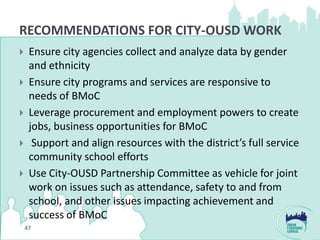
RECOMMENDATIONS FOR CITY-OUSD WORK
    Ensure city agencies collect and analyze data by gender
     and ethnicity
    Ensure city programs and services are responsive to
     needs of BMoC
    Leverage procurement and employment powers to create
     jobs, business opportunities for BMoC
     Support and align resources with the district’s full service
     community school efforts
    Use City-OUSD Partnership Committee as vehicle for joint
     work on issues such as attendance, safety to and from
     school, and other issues impacting achievement and
     success of BMoC
    47
FOR MORE INFORMATION
    Oakland-Alameda County Boys and Men of Color
     http://www.urbanstrategies.org/bmoc/
    African American Male Achievement Initiative
     http://www.urbanstrategies.org/programs/schools/AAM
     AI.php; http://thrivingstudents.org/33
    Building an Educational Equity Framework
     http://www.urbanstrategies.org/programs/schools/docs/
     Equity%20Framework%20Concept%20Paper_5.9.12final.
     pdf


    48

BMOC Presentation by Junious Williams

  • 1.
    URBAN STRATEGIES COUNCIL African American Male Achievement & Boys and Men of Color Initiatives Prepared by: Junious Williams Rebecca Brown Alicia Olivarez Sarah Marxer 1 www.urbanstrategies.org
  • 2.
    Urban Strategies CouncilMission Work with partners to eliminate persistent poverty by building vibrant, healthy communities. 2
  • 3.
    Urban Strategies Council… isa social impact organization using tools of research, policy, collaboration, innovation and advocacy to achieve equity and social justice. 3
  • 4.
    Why Focus onAfrican American Male Achievement & Boys and Men of Color? 4
  • 5.
    Alameda County PopulationProjections by Race/Ethnicity: 2000-2050 100% 7% 11% 9% 8% 15% 13% 90% 80% 21% 25% 28% 31% 33% 35% 70% 60% Black 20% 25% Asian 50% 29% 33% Hispanic 37% White 40% 41% 30% 43% 20% 37% 32% 27% 21% 10% 17% 0% 2000 2010 2020 2030 2040 2050 Source: State of California, Department of Finance, Race/Ethnic Population with Age and Sex Detail, 2000-2050.
  • 6.
    All Californians… …stand tobenefit by ensuring that young men of color have the chance to grow up healthy, to get a good education, and to make positive contributions to their communities.  If California increased the graduation rate just 10% for African-American and Latino males, the higher graduation rates would result in $7.39 billion in additional income, tax revenue, social service savings and economic productivity — over the course of the students’ adult life.9  A study from Columbia University’s Teachers College found that for each youth added to the graduation rolls, taxpayers saved $127,000 in the form of additional tax revenues paid by the graduates and in lower public health, welfare, and criminal justice costs.10  In addition, a 2007 study found that African-American and Latino men graduating high school generate $681,130 and $451,360, respectively, in additional dollars for the state of California.11  9 Belfield, Clive and Levin, Henry. “The Economic Losses from High School Dropouts in California.” California Dropout Research Project. August 2007.  10 Levin, Henry, Clive Belfield, Peter Muennig, and Cecilia Rouse. 2007. “The Costs and Benefits of an Excellent Education for All of America’s Children.” Teachers College, Columbia University. New York.  6 11 Belfield, Clive and Levin, Henry. “The Economic Losses from High School Dropouts in California.” California Dropout Research Project. August 2007.
  • 7.
    Oakland stands tobenefit, too…  If Oakland were to achieve the goal of 100% graduation rate for all boys of color, taxpayers would realize an additional benefit of $117 million over the lifetimes of a single year’s high school graduates.  While the lifetime economic benefit of achieving a graduation rate of 100% in a single year would be $117 million, if OUSD achieved a 100% graduation rate for boys of color over a decade, the lifetime benefit to taxpayers would be approximately $1.2 billion. SOURCE: Fact sheet-Economic Benefits of Investing in the Education of BMoC. Prepared for the Assembly Select Committee on the Status of Boys and Men of Color in California for the Oakland-Bay Area Hearing. Prepared by Urban Strategies Council on January 20, 2012 7
  • 8.
    National Efforts forBoys and Men of Color  Black Male Achievement Leadership & Sustainability Institute (LSI)- Open Society Foundation, PolicyLink & Root Cause http://leadershipandsustainabilityinstitute.com/  Campaign for Black Male Achievement- Open Society Institute http://www.opensocietyfoundations.org/topics/black-male- achievement  2025 Campaign for Black Men and Boys- The Ford Foundation, The Twenty First Century Foundation, the National Urban League & others http://www.2025bmb.org/ 8
  • 9.
    National Efforts forBoys and Men of Color  City Leadership to Promote Black Male Achievement- National League of Cities http://www.nlc.org/find-city- solutions/institute-for-youth-education-and-families/at-risk- youth/city-leadership-to-promote-black-male-achievement  Schott Foundation Black Male Initiative- The Schott Foundation for Public Education http://www.schottfoundation.org/funds/black-male-initiative  White House Initiative on Educational Excellence for African Americans- Executive Order from President Obama http://www.whitehouse.gov/the-press- office/2012/07/26/executive-order-white-house-initiative- educational-excellence-african-am 9
  • 10.
    Alliance for Boysand Men of Color 10
  • 11.
    includes change agentsfrom across the state of California who are committed to improving the life chances of California’s boys and young men of color. http://www.allianceforbmoc.org/ Statewide Partners Regional Conveners Oakland Fresno LA 11
  • 12.
    Assembly Select Committeeon the Status of Boys and Men of Color  Alliance members partnered with the Committee to organize hearings in Sacramento, Oakland, Fresno, Los Angeles, and Coachella Valley and to solicit recommendations from a diverse cross section of stakeholders.  The Committee's draft action plan, which includes 65 practical and scalable recommendations can be found here: http://www.allianceforbmoc.org/ 12
  • 13.
    Oakland-Alameda County Alliance forBoys and Men of Color 13
  • 14.
    Oakland-Alameda County Boysand Men of Color Goals: Increase…  educational outcomes including academic performance, graduation and readiness for careers and/or post-secondary education;  participation in the labor force in “high quality” jobs and careers; and  utilization of a fully-integrated “health home” that improves health outcomes. 14
  • 15.
    Oakland Boys andMen of Color (BMoC) Leadership Table Goal: 100% Graduation Systems Leaders Objectives:  Alameda County Health  95+% attendance for all students Care Services Agency  Meaningful internship or paid employment  Alameda County for all high school students Probation Department  100% access and appropriate use of health  Alameda County Social care and social services by OUSD students Services Agency  Oakland Unified School The Leadership Table is working on: District  inter-agency data sharing;  Oakland Human Services  A portfolio highlighting evidence-based Department policies, practices and programs to improve  Oakland Police outcomes for BMoC; Department  a system of individualized education and  Oakland Office of wellness plans for boys of color; and Economic and Workforce Development  economic and workforce development 15programs
  • 16.
    BMoC Portfolio Policies Juvenile Health Justice Practices Programs Employment Youth & Assets Development Education 16
  • 17.
    Oakland Boys andMen of Color (BMoC) Community Partners Table Oakland Community Partners  Allen Temple Baptist The table has identified several opportunities for action in Oakland Church and Alameda County in the areas of:  East Bay Asian Youth Center Education  East Oakland Building 1. Implementing Full Service Community Schools Healthy Communities 2. Reducing school push-out, drop-out and suspension  Black Organizing Project Criminal and Juvenile Justice  Ella Baker Center 1. Advocating for criminal and juvenile justice reform under  Intertribal Friendship California’s criminal justice realignment (AB109) and House juvenile justice realignment  Oakland Community Organizations Workforce Development and Employment  Street Level Health 1. Leveraging public employment and procurement policies Project 2. Creating quality employment for BMoC through creation of  The Unity Council alternative business models which build community wealth  The Mentoring Center and ownership  Youth Uprising 3. Linking economic development projects to requirements  Youth Alive for job creation for boys and men of color 17
  • 18.
    Examples of PublicSystems and Community Partner Work  The Unity Council Latino Men and Boys Program  EBAYC Boys and Men of Color Mentoring Project  The Oakland Unified School District Manhood Development and AAMA  Alameda County Health Care Services Agency has implemented an Emergency Medical Technician Program Social Services Fatherhood Initiative 18
  • 19.
    Joint Systems Leaderand Community Partner Work Community Communication Plan the Initiative looks forward to its first joint project: • to effectively communicate within public systems and organizations, across communities of color, and to the public and policy makers the importance of improving the outcomes for BMoC; and •to actively contribute to changing the narrative around BMoC to an asset frame including stories about their many successes and contributions to family, community and society. 19
  • 20.
    Oakland Unified School District African American Male Achievement Initiative 20
  • 21.
    African American MaleAchievement Initiative  Began in fall 2010  Partnership:  Oakland Unified School District  East Bay Community Foundation  Urban Strategies Council  Partners in School Innovation Focus: Eliminating disparities and improving educational and social outcomes for African American male students in OUSD 21
  • 22.
    Urban Strategies Council’sRole 1. Develop indicators, measures and targets for goal areas and conduct analyses to determine status of African American males in these areas 2. Literature reviews to better understand causes of disparities and strategies for addressing them 3. Special studies on key issues for African American male students (three reports) 22 4. Policy analysis to inform interventions
  • 23.
    Reports  Goal Areas,Indicators and Targets  Developed indicators and targets  Conducted longitudinal analysis  Compared across school levels  Compared across ethnic groups  Graduation Likelihood  Attendance  Suspensions 23
  • 24.
    Goal Areas, Indicatorsand Targets http://www.urbanstrategies.org/programs/schools/docs/A AMAI%20Goal%20Data%20Packet%2004-04-11.pdf
  • 25.
    Initiative Goal Areas 1. Achievement Gap (English Language Arts and Math) 2. High School Graduation 3. Literacy (4th Grade) 4. Suspension 5. Attendance 6. Middle School Holding Power 7. Juvenile Detention (Incarceration) 25
  • 26.
    Students Proficient orHigher in English Language Arts (California Standards Test): Grades 2-11 2005-06 to 2010-11 100% 90% 2015 Target: 90% 79% 78% 80% 78% 76% 76% 73% 70% 60% 50% African American Males White Males 40% 28% 29% 30% 25% 19% 20% 20% 16% 10% 0% 2005-06 2006-07 2007-08 2008-09 2009-10 2010-11 26 Source: Oakland Unified School District (OUSD)
  • 27.
    Graduation Rate: 2008-09 100% 2015 Target: 98% 90% 80% 72% 70% 61% 60% 49% 50% 40% 30% 20% 10% 0% African American Males White Males OUSD Total (All Students) Source: California Department of Education Research Files (OUSD calculations) Note: Graduation rate equals the number of graduates divided by graduates plus 27 dropouts in grades 9-12.
  • 28.
    Percentage of Studentsin All Grades Suspended Once or More, 2005-06 to 2010-11 25% 20% 19% 18% 17% 17% 17% 17% 15% African American Males 11% White Males 10% 9% 10% 10% 10% OUSD: All Males 10% 2015 Target: 5% 5% or fewer 3% 3% 3% 3% 3% 2% 0% 2005-06 2006-07 2007-08 2008-09 2009-10 2010-11 Source: Oakland Unified School District (OUSD) 28 Note: District average includes African American males.
  • 29.
    Percentage of Studentsin All Grades Chronically Absent (Absent 10% of School Days or More) 2006-07 to 2010-11 25% 24% 23% 23% 23% 20% 20% 16% 15% 15% 15% 14% 12% African American Males OUSD (All Students) 10% 2015 Target: 5% or fewer 5% 0% 2006-07 2007-08 2008-09 2009-10 2010-11 Source: Oakland Unified School District (OUSD) 29 Note: OUSD figures include African American males.
  • 30.
    Percentage of AfricanAmerican Male Oakland Residents Ages 10-17 Detained by Alameda County Probation Department 20% 18% 17.2% (954 youth) 16.2% (903 youth) 16% 14% 12% 10% 8% 2015 Target: 8% or fewer 6% 4% 2% 0% 2009 2010 30 Source: Alameda County Probation Department, Census 2010
  • 31.
    Examining Graduation Likelihood http://urbanstrategies.org/aamai/images/docs/AAMAI_ OnCourseToGraduate.pdf z:EducationExcellenceEquity FrameworkData DisaggregationData disaggregation ppt 4.17.12 rb
  • 32.
    How did wemeasure “Graduation Likelihood”?* Academic Achievement Attendance On-Course to Graduate At-Risk Off-Course Suspensions Retention 32 *Note: indicators varied by grade level
  • 33.
    African American Malesand OUSD Students in Grades K-12, by Graduation Likelihood: 2010-11 African American Males All OUSD Students Off Course (K- 12) Off Course 20% (K-12) 34% On Course (K-12) 45% At Risk (K- On 12) Course 17% (K-12) 63% At Risk (K- 12) 21% 33
  • 34.
    Off-Course African AmericanMale Students, by Risk Factor & School Level, 2010-11 Elementary Middle School High School (877 students) (798 students) (504 students) Chronically Absent 73% 38% 65% Suspended Once or More 33% 73% 41%** Poor Academic Performance* 28% 41% 63% Retained (Left Back) 7% 0% 18% *Below Basic ELA for Grades 2-5, F in English or Math for Grades 6-8, GPA below C for Grades 9-12 **In our rubric, off-course for high school was defined as having more than one suspension. 34
  • 35.
    Recommendations for SupportingHS Graduation Early Warning System AAM are Engaged in Afterschool Programs School-Based Health Centers Reach AAM Healthy School Climates for AAM High- Quality, Effective Instruction for AAM 35
  • 36.
  • 37.
    Percentage of Studentsin All Grades Chronically Absent: 2010-11 37
  • 38.
    Types of Absences– Elementary Students OUSD 2010-11 3.5 3.0 2.9 2.5 Average Days Absent 2.0 Other students 1.5 AAM 1.1 1.0 0.9 0.8 0.7 0.5 0.2 0.2 0.1 0.1 0.0 0.0 avg # excused avg # days ill avg # unexcused avg # unverified avg # days absences absences absences suspended 38
  • 39.
    Types of Absences– High School Students OUSD 2010-11 39
  • 40.
    Selected Recommendation forReducing Chronic Absence Data Collection & • Track attendance from start of year to intervene early • Conduct research on relationship between chronic absence and Analysis tardiness & truancy Accountability & • Adopt school and district standards Standards • Create district and school level plans for attendance improvement • Designate single administrator responsible for attendance efforts Policy & Process • Identify groups to focus on issues and interventions • Include families and students in policy review and revision Student, Family & •Communicate connections between attendance, achievement, and Community graduation •Problem solve with families and students 40 Engagement
  • 41.
  • 42.
    Percentage Suspended Onceor More by School Level OUSD 2010-11 35% 33% 30% African 25% 22% American Males 20% 18% 17% All OUSD 15% Students 11% 10% 9% 9% 7% 7% White Males 5% 3% 2% 1% 0% District Elementary Middle High 42
  • 43.
    Percentage Suspended byReason (Grade K-12) OUSD 2010-11 10% 9% 9% 8% Proportion 7% 7% of Other 6% Students Suspended 5% 4% Proportion 3% 3% of AAM 2% Population 2% 1% Suspended 1% 1% 0% 43
  • 44.
    Top Three Offenses: 75%of suspensions of AAM  1. Disruption/defy authority (38% of suspensions of AAM);  2. Caused/attempted/ threatened injury (28% of suspensions of AAM);  3. Obscene act/ profanity/ vulgarity (9% of suspensions of AAM). 44
  • 45.
    Percentage of StudentsSuspended, by Times Suspended, OUSD 2010-11 Non-African American Students African American Boys 1% 3% 9% Not 9% Suspended Suspended Once Suspended More than Once 82% 96% 45
  • 46.
    Selected Recommendations: Suspension • School- and district- • Focus interventions level targets on offenses driving • Accountability plans disparities • Expand array of interventions Accountability Offense Focus Records & Process Data • Use site discipline • Track specific committees behavior • Create district-level • Require reporting of intervention team referrals & classroom suspensions 46
  • 47.
    RECOMMENDATIONS FOR CITY-OUSDWORK  Ensure city agencies collect and analyze data by gender and ethnicity  Ensure city programs and services are responsive to needs of BMoC  Leverage procurement and employment powers to create jobs, business opportunities for BMoC  Support and align resources with the district’s full service community school efforts  Use City-OUSD Partnership Committee as vehicle for joint work on issues such as attendance, safety to and from school, and other issues impacting achievement and success of BMoC 47
  • 48.
    FOR MORE INFORMATION  Oakland-Alameda County Boys and Men of Color http://www.urbanstrategies.org/bmoc/  African American Male Achievement Initiative http://www.urbanstrategies.org/programs/schools/AAM AI.php; http://thrivingstudents.org/33  Building an Educational Equity Framework http://www.urbanstrategies.org/programs/schools/docs/ Equity%20Framework%20Concept%20Paper_5.9.12final. pdf 48

Editor's Notes

  • #3 Who we are:a social impact organization using the tools of research, policy, collaboration, innovation, and advocacy to achieve equity and social justice.Our mission: to eliminate persistent poverty by working with partners to transform low-income neighborhoods into vibrant, healthy communities.
  • #4 Who we are:a social impact organization using the tools of research, policy, collaboration, innovation, and advocacy to achieve equity and social justice.Our mission: to eliminate persistent poverty by working with partners to transform low-income neighborhoods into vibrant, healthy communities.
  • #14 Our overall goal is to improve the health, wellness and life outcomes for BMoC throughout their life course.Our specific goals for Oakland Boys and Men of Color include significantly improving their:Educational outcomes including academic performance, graduation and readiness for careers and/or post-secondary education; Utilization of a fully-integrated “health home” that improves health outcomes. Participation in the labor force in “high quality” jobs and careers;
  • #15 Our overall goal is to improve the health, wellness and life outcomes for BMoC throughout their life course.Our specific goals for Oakland Boys and Men of Color include significantly improving their:Educational outcomes including academic performance, graduation and readiness for careers and/or post-secondary education; Utilization of a fully-integrated “health home” that improves health outcomes. Participation in the labor force in “high quality” jobs and careers;
  • #17 Explain validated, promising and innovative categories.The Leadership Table will use the portfolio to guide partner agencies and the public by promoting existing validated, promising and innovative polices, practices, and programs. Agencies have a pool of validated, promising and innovative strategies for boys and men of color to employ within their agencies, give preference to in contracting, provide funding to, or build other relationships with. The portfolio will build the capacity of local organizations to promote and secure more funding for effective strategies by creating a mechanism for evaluating new or growing policies, practices, and programs.  In a time of economic crisis, austere policies, and budget cuts, the portfolio also offers public systems and community partners an opportunity to better leverage social, political, and creative capital towards strategies that most effectively address life outcomes for boys and men of color. In addition to supporting what works, the portfolio fosters innovation by creating pathways for promising practices to become validated. Taken together, the programs, policies, and practices in the BMoC Portfolio will: Address issues for boys and men of color across the life spanInclude a comprehensive array of interventions at the levels of policy, program, and practiceCatalyze transformation at the societal, institutional, neighborhood, and personal levelsInclude policies, programs, and practices in each of the priority issue areas: health, education, employment, safety and juvenile justice, and youth development Support specific ethnic and geographic communities of Oakland and Alameda County boys and men of color in culturally relevant ways Foster well being among sexual minority (GBTQQ), undocumented, foster care, disabled, and other vulnerable populations of boys and men of color 
  • #18 Our objectives for achieving these overall and specific goals include:Reducing involvement in the criminal justice system and exposure to violence;Reducing involvement in the foster care system when possible and increasing the effectiveness of services and transitioning for those young people who are best served by participation in the foster care system; Increasing quality effective services that address the effects of trauma/chronic adversity with an anchored focus on healing;Building the capacities of families, especially fathers, to support the positive development and success of BMoC;Improving the quality of built environments serving BMoC, especially schools;Increasing the availability of and participation in engagement activities that promote positive leadership development and cultural competency; Promoting and supporting youth advocacy and organizing;Increasing community control through civic engagement and leadership development for BMoC; Developing a positive sense of manhood among BMoC, which includes positively redefining masculinity and promoting respect for gay, bisexual and transgender BMoC; andDeveloping inter-ethnic understanding, cross-cultural competency and unity as a foundation for establishing a common agenda that advances improved outcomes for all BMoC.
  • #19 Our METHODS for accomplishing our goals and objectives include:Advancing a policy and advocacy agenda that moves systems toward working together, encourages comprehensive and integrated approaches across systems, addresses system inequities and holds systems accountable for investment of public resources and improved outcomes (e.g., Interagency Children’s Policy Council, Youth Ventures Joint Powers Authority); Developing and supporting community development policies and practices which transform neighborhoods and create business, job and career opportunities for BMoC; Directly investing in young people as agents of change by hiring young people for the services they can provide in improving conditions and outcomes in their communities such as peer counseling and cascading mentorship with older youth mentoring younger youth;Recognizing the importance of engaging fathers, especially young fathers, and families in the positive development of boys of color and building their capacities to support their children;
  • #20 Building the capacities of programs, organizations, and agencies most intimately involved with impacting the health and well-being of BMoC to serve them effectively, in a culturally and linguistically competent manner, and holding them accountable for doing so; Supporting youth, family and community organizing so that they become effective advocates for themselves and their communities, broaden their civic engagement and build power to participate with public systems in decision making about their lives and communities; Creating a locally- and regionally-based network of systems leaders, community-based organizations, faith and business leaders, and other stakeholders that will champion the issues of BMoC and move a change agenda; andWorking with law enforcement and corrections to develop policies and practices that decrease crime and violence, and improve their relationships with and their responsiveness to BMoC.
  • #26 The thorniest indicators to develop were middle school holding power (because of the need to clarify the term) and incarceration/detention (because of the need to forge a new data-sharing agreement with the Alameda County Probation Department.For context: From 6th through 12th grades, nearly one in five OUSD students was an African American Male in 2010-11. Number of AAM in K-12: 6,415
  • #27 ACHIEVEMENT GAP (ENGLISH LANGUAGE ARTS) A large gap exists between the percentage of AAM and White male students in OUSD scoring proficient oradvanced in English Language Arts on the California Standards Test. From 2005-06 through 2010-11, the percentage of AAM proficient or advanced in English Language Arts increased from 16% to 29%. The percentage of White males proficient or higher increased less dramatically over that time, so the gap between AAM and their White male peers decreased – from 57 percentage points in 05-06 to 49 percentage points in 2010-11. Exercise caution in interpreting these results, as White male enrollment is concentrated in the elementary grades, when students in all groups tend to be more likely to score proficient or advanced on the CST.2010-11 Enrollment in Grades 2-11African American Males: 4,097White Males: 1,293
  • #28 GRADUATION The AAM graduation rate indicates that fewer than half of 9th graders are graduating from high school four years later. The AAM graduation rate is lower than the district-wide graduation rate and the rate for White males. Note: The graduation rate equals the number of graduates divided by graduates plus dropouts in grades 9-12. (National Center for Education Statistics formula)Number of Graduates: 2008-09African American Males: 280White Males: 48OUSD Total: 1,671
  • #29 SUSPENSION The percentage of AAM students suspended once or more hovered around 17-19% from 2005-06 to 2010-11. The gap between the suspension rate for AAM and White males is very large.Enrollment in Grades K-12: 2010-11African American Males: 6,415White Males: 2,145
  • #30 ATTENDANCE AAM students are more likely to be chronically absent than OUSD students as a whole. In 2010-11, the proportion of students who were chronically absent declined, both among AAM and for OUSD overall. Still, in 2010-11, one in five AAM students missed 10% of school days or more. In 2010-11, 1,267 AAM students in grades K-12 were chronically absent.
  • #31 JUVENILE DETENTION (INCARCERATION) In 2009, 16.2% of African American male Oakland residents, ages 10-17, (903 youth) were detained by the Alameda County Probation Department. This includes pre- and post-adjudication detainment. In 2010, that percentage rose to 17.2% (954 youth).
  • #34 African American males are more likely to be off course and less likely to be on course than students in the district as a whole (this would be more pronounced if we removed AAM from the comparison group).
  • #35 In which areas are off-course African American boys struggling the most (i.e. are more of them off-course because of academic, attendance, or behavior problems)?Chronic absence is a key issue for AAM in elementary school and high school , with 73% of off-course AAM in elementary and 65% in high school displaying this risk factor. Suspension is a key issue for AAM in middle school, with 73% of off-course AAM displaying this risk factor. Poor academic performance affects nearly half of off-track AAM middle school students, and 63% of off-track high school students. More than one in six (18%) off-course AAM in high school were left back at the end of the 2010-11 school year.
  • #38 Chronic absence means missing 10% or more of school days.
  • #39 AAM missed more than twice as many days due to illness, on average, as other students, though illness was the leading cause of days missed for both AAM and non-African American elementary school students. For every absence reason, AAM missed more days than did other students.
  • #40 At the high school level, unverified absences accounted for more days missed than any other type of absence, both for AAM and other students. AAM missed twice as many days due to unverified absences as did their peers.
  • #44 Note that this is the percentage of all students suspended for each offense (e.g. 9% of African American boys in OUSD were suspended for disruption/defiance in 2010-11, while 3% of other students were suspended for that offense).
  • #46 AAM were more likely to be suspended multiple times than non-AA students were to be suspended once.
  • #47 Recommendations emerging from the report include:Accountability and Standards:Adopting school level and district-wide goals for suspension rates and for racial disparities.Holding school sites that exceed those standards accountable for developing annual targets and plans for reaching those standards.Offense FocusTarget the offenses that contribute most to the disparate suspension rate for AAM: defiance/disruption and cause/attempt/threaten injuryTo ensure clear behavioral standards and to evaluate which interventions and alternatives to suspension are most effective.Record Keeping and Data AnalysisAdapt the district record keeping and reporting system to record the specific conduct leading to suspensions for the three offenses contributing most to the suspension disparities for AAM.Require data collection on referrals for the target offenses, including what corrective actions and alternatives to suspension were used.Require reporting of Classroom Suspensions.ProcessUse site discipline committees as a vehicle for addressing disparities in suspensions at the school site level.Create an intervention team to assist schools in identifying and implementing prevention and corrective actions for the focus offenses.More detailed recommendations are available in the suspension report.With that, I’ll turn it over to Jean Wing from the Research, Assessment and Data department at OUSD who will begin to share some of the promising initiatives underway to address these issues.