ASSIGNMENT
DRIVE SPRING DRIVE 2015
PROGRAM BACHELOR OF BUSINESSADMINISTRATION (BBA)
SEMESTER I
SUBJECT CODE & NAME BBA103-Business Environment
BK ID B1499
CREDIT 4
MARKS 60
1. External analysis of environment:
External analysis means analysis of "Political, Economic, Social, and
Technological, Environmental and Legal analysis". It is a part of the external analysis
when conducting a strategic analysis or doing market research and gives a certain
overview of the different macro environmental factors that the company has to take into
consideration.
Political factors:
How and to what degree a government intervenes in the economy. Specifically,
political factors include areas such as tax policy, labor law, environmental law, trade
restrictions, tariffs, and political stability. Political factors may also include goods and
services which the government wants to provide or be provided (merit goods) and those
that the government does not want to be provided (demerit goods). Furthermore,
governments have great influence on the health, education, and infrastructure of a nation.
Economic factors:
It includes economic growth, interest rates, exchange rates and the inflation rate.
These factors have major impacts on how businesses operate and make decisions. For
example, interest rates affect a firm's cost of capital and therefore to what extent a
business grows and expands. Exchange rates affect the costs of exporting goods and the
supply and price of imported goods in an economy.
Social factors:
It includes the cultural aspects and include health consciousness, population
growth rate, age distribution, career attitudes and emphasis on safety. Trends in social
factors affect the demand for a company's products and how that company operates. For
example, an ageing population may imply a smaller and less-willing workforce (thus
increasing the cost of labor). Furthermore, companies may change various management
strategies to adapt to these social trends (such as recruiting older workers).
Technological factors:
It includes ecological and environmental aspects, such as R&D activity,
automation, technology incentives and the rate of technological change. They can
determine barriers to entry, minimum efficient production level and influence
outsourcing decisions. Furthermore, technological shifts can affect costs, quality, and
lead to innovation.
Environmental factors:
It includes weather, climate, and climate change, which may especially affect
industries such as tourism, farming, and insurance. Furthermore, growing awareness to
climate change is affecting how companies operate and the products they offer--it is both
creating new markets and diminishing or destroying existing ones.
Legal factors:
It includes discrimination law, consumer law, antitrust law, employment law, and
health and safety law. These factors can affect how a company operates, its costs, and the
demand for its products.
The business environment and the forces that push against it are something every
manager must deal with and learn to work with. In this lesson, we will detail the four key
functions of management and review how different forces present in the business
environment impact these four key functions
Managers have to deal with multiple different forces that pull and push their
businesses and companies in any number of directions. In many ways, it's like working in
an obstacle course. There are obstacles you have to deal with, new things that you might
not have ever seen before and challenges that will come up that will test your abilities.
Managers as a whole focus on four key functions:
 Plan: Have a specific outline of the steps they will take to be successful or have
their department of company be successful.
 Control: Be able to keep all the pieces and parts of the plan moving together.
 Organize: Get all the people and equipment together to support the plan.
 Lead: Show vision and enthusiasm to reach the goal of the plan.
They have obstacles, if you will, that arise while they are focusing on these areas.
Technology
Technology is the application of scientific knowledge for practical purposes, and it
represents potentially the fastest-moving force on the four functions of management - and
it encompasses all forms of technology (communication, manufacturing, marketing, etc.).
Technology is moving at an incredibly fast pace, and that forces managers to adjust how
they plan, organize, lead and control. Primarily, technology allows a manager to have
access to more data and to communicate that data faster and to more people. Thus, they
have to be able to work with technology, understand how to use it as a manager
and disseminate that information to their employees.
Innovation
For any manager to be able to truly utilize the four main functions, they have to be
able to accept innovation and indeed be innovative themselves. Innovation, which is the
introduction of new ideas, impacts managers constantly. Just think of the huge changes
the Internet posed to managers. Simple things, such as email or text messaging, changed
how they managed their employees and communicated with them.
Simple innovations such as these changed the landscape they worked in, and they had to
be able to integrate this innovation into their management functions.
Globalization and Diversity
The world, in a word, is shrinking. Influences of different cultures are being felt in
all countries via globalization. Globalization is the integration of cultures throughout the
world and can be as simple as McDonalds opening a store in Saudi Arabia (bringing the
taste of the U.S. to the Middle East, if you will) or as complicated as a mosque opening in
a small suburban town. These examples bring a different culture to the location and thus a
different perspective on the world. So, as a manager works through the basic functions of
management, they have to understand that culturally the world around them is changing,
and they need to embrace this diversity.
When cultures mix we are experiencing diversity, or an environment made up of many
different cultures and viewpoints. Now, a manager could be managing people from India,
Mexico and Germany all in the same office. Thus, planning their work, organizing it,
leading it and controlling it will make the manager change his or her approach. They
cannot, for example, lead a person from Mexico the same way they would someone from
India. These cultures have different ways of working, and a manager must adjust his or
her methods to manage those diverse cultures.
=====================================================================================
2. The fiscal policy is concerned with the raising of government revenue and incurring of
government expenditure. To generate revenue and to incur expenditure, the
government frames a policy called budgetary policy or fiscal policy. So, the fiscal policy is
concerned with government expenditure and government revenue.
Fiscal policy has to decide on the size and pattern of flow of expenditure from the
government to the economy and from the economy back to the government. So, in
broad term fiscal policy refers to "that segment of national economic policy which is
primarily concerned with the receipts and expenditure of central government." In other
words, fiscal policy refers to the policy of the government with regard to taxation, public
expenditure and public borrowings.
The role of fiscal policy is to provide growth and stability to the economy of a
nation or region of the world through government intervention in taxation and the
adjustment of government expenditure. Fiscal policy has often taken a central role in
the economy of a country when an economic downturn occurs and the government
feels that stabilization is required. Long-term fiscal policy aims include the reduction of
poverty for a nation's citizens and the sustainable growth of an economy.
Government intervention in an economy can take two forms — fiscal policy or
monetary policy. Fiscal policy is controlled by government agencies and departments,
while monetary policy is controlled by banks changing interest rates and selling
government securities. The role of fiscal policy is to increase or decrease taxation
and government spending depending on the needs of the economy. When an economy
slows, a government can attempt to stimulate it through increased expenditure and
lowered taxes, providing citizens with an increased amount of money to spend.
Increased spending from more disposable income is returned to the government in
taxes collected from sales at both local and national levels.
In the short term, the role of fiscal policy is to stabilize a struggling economy by
increasing the spending and making temporary tax cuts. Short-term tax cuts often have
a minimal impact on an economy because the people given the tax cut often save the
increased amount of money. The money saved is used for a perceived return to
economic difficulties when the taxation changes return to previous levels. Economic
growth is the long-term aim of fiscal policies introduced by a government at sustainable
levels that do not allow an economy to grow at uncontrollably fast or slow levels.
Government fiscal policies often include stabilizers that automatically kick into
action when the economy grows or reduces at alarming levels. An economic downturn
sees more government expenditure on unemployment benefits and healthcare, with
government spending adjusted at small levels without legislative interference. A slowing
economy is often stimulated at small levels by reductions in taxation to promote
spending.
Throughout history, the role of fiscal policy has changed due to the needs of a
country at a specific moment. Prior to the Great Depression of the 1930s, most
governments did not interfere with the running of their economy in a significant way,
but allowed market forces to govern the growth of the economy. The worldwide
economic crash of the 1930s prompted governments to intervene and establish fiscal
policies to provide stabilization. By the end of the 20th
century, government policies in
most nations had returned fiscal control to the stock market and investment markets,
followed by the economic downturn of the first decade of the 21st
century prompting
more government involvement in fiscal policy.
The objectives of fiscal policy are as under:
1. Development by effective Mobilization of Resources:
The principal objective of fiscal policy is to ensure rapid economic growth and
development. This objective of economic growth and development can be achieved by
Mobilization of Financial Resources. The central and the state governments in India have
used fiscal policy to mobilize resources. The financial resources can be mobilized by:-
Taxation: Through effective fiscal policies, the government aims to mobilize resources
by way of direct taxes as well as indirect taxes because most important source of
resource mobilization in India is taxation.
Public Savings: The resources can be mobilized through public savings by reducing
government expenditure and increasing surpluses of public sector enterprises.
Private Savings: Through effective fiscal measures such as tax benefits, the government
can raise resources from private sector and households. Resources can be mobilized
through government borrowings by ways of treasury bills, issue of government bonds,
etc., loans from domestic and foreign parties and by deficit financing.
2. Efficient allocation of Financial Resources:
The central and state governments have tried to make efficient allocation of
financial resources. These resources are allocated for Development Activities which
includes expenditure on railways, infrastructure, etc. While Non-development Activities
includes expenditure on defense, interest payments, subsidies, etc.
But generally the fiscal policy should ensure that the resources are allocated for
generation of goods and services which are socially desirable. Therefore, India's fiscal
policy is designed in such a manner so as to encourage production of desirable goods
and discourage those goods which are socially undesirable.
3. Reduction in inequalities of Income and Wealth:
Fiscal policy aims at achieving equity or social justice by reducing income
inequalities among different sections of the society. The direct taxes such as income tax
are charged more on the rich people as compared to lower income groups. Indirect
taxes are also more in the case of semi-luxury and luxury items, which are mostly
consumed by the upper middle class and the upper class. The government invests a
significant proportion of its tax revenue in the implementation of Poverty Alleviation
Programs to improve the conditions of poor people in society.
4. Price Stability and Control of Inflation:
One of the main objectives of fiscal policy is to control inflation and stabilize
price. Therefore, the government always aims to control the inflation by reducing fiscal
deficits, introducing tax savings schemes, Productive use of financial resources, etc.
5. Employment Generation:
The government is making every possible effort to increase employment in the
country through effective fiscal measure. Investment in infrastructure has resulted in
direct and indirect employment. Lower taxes and duties on small-scale industrial (SSI)
units encourage more investment and consequently generate more employment.
Various rural employment programs have been undertaken by the Government of India
to solve problems in rural areas. Similarly, self-employment scheme is taken to provide
employment to technically qualified persons in the urban areas.
6. Balanced Regional Development:
Another main objective of the fiscal policy is to bring about a balanced regional
development. There are various incentives from the government for setting up projects
in backward areas such as Cash subsidy, Concession in taxes and duties in the form of
tax holidays, Finance at concessional interest rates, etc.
7. Reducing the Deficit in the Balance of Payment:
Fiscal policy attempts to encourage more exports by way of fiscal measures like
Exemption of income tax on export earnings, Exemption of central excise duties and
customs, Exemption of sales tax, etc.
The foreign exchange is also conserved by providing fiscal benefits to import
substitute industries, imposing customs duties on imports, etc.
The foreign exchange earned by way of exports and saved by way of import
substitutes helps to solve balance of payments problem. In this way adverse balance of
payment can be corrected either by imposing duties on imports or by giving subsidies to
export.
8. Capital Formation:
The objective of fiscal policy in India is also to increase the rate of capital
formation so as to accelerate the rate of economic growth. An underdeveloped country
is trapped in vicious (danger) circle of poverty mainly on account of capital deficiency. In
order to increase the rate of capital formation, the fiscal policy must be efficiently
designed to encourage savings and discourage and reduce spending.
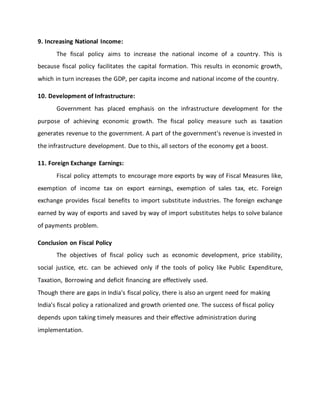
9. Increasing National Income:
The fiscal policy aims to increase the national income of a country. This is
because fiscal policy facilitates the capital formation. This results in economic growth,
which in turn increases the GDP, per capita income and national income of the country.
10. Development of Infrastructure:
Government has placed emphasis on the infrastructure development for the
purpose of achieving economic growth. The fiscal policy measure such as taxation
generates revenue to the government. A part of the government's revenue is invested in
the infrastructure development. Due to this, all sectors of the economy get a boost.
11. Foreign Exchange Earnings:
Fiscal policy attempts to encourage more exports by way of Fiscal Measures like,
exemption of income tax on export earnings, exemption of sales tax, etc. Foreign
exchange provides fiscal benefits to import substitute industries. The foreign exchange
earned by way of exports and saved by way of import substitutes helps to solve balance
of payments problem.
Conclusion on Fiscal Policy
The objectives of fiscal policy such as economic development, price stability,
social justice, etc. can be achieved only if the tools of policy like Public Expenditure,
Taxation, Borrowing and deficit financing are effectively used.
Though there are gaps in India's fiscal policy, there is also an urgent need for making
India's fiscal policy a rationalized and growth oriented one. The success of fiscal policy
depends upon taking timely measures and their effective administration during
implementation.
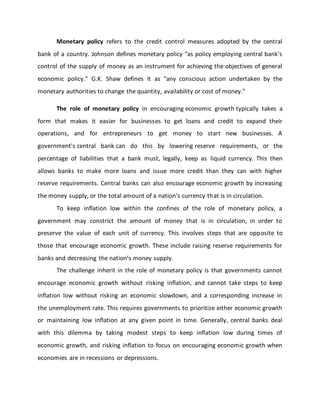
Monetary policy refers to the credit control measures adopted by the central
bank of a country. Johnson defines monetary policy “as policy employing central bank’s
control of the supply of money as an instrument for achieving the objectives of general
economic policy.” G.K. Shaw defines it as “any conscious action undertaken by the
monetary authorities to change the quantity, availability or cost of money.”
The role of monetary policy in encouraging economic growth typically takes a
form that makes it easier for businesses to get loans and credit to expand their
operations, and for entrepreneurs to get money to start new businesses. A
government's central bank can do this by lowering reserve requirements, or the
percentage of liabilities that a bank must, legally, keep as liquid currency. This then
allows banks to make more loans and issue more credit than they can with higher
reserve requirements. Central banks can also encourage economic growth by increasing
the money supply, or the total amount of a nation's currency that is in circulation.
To keep inflation low within the confines of the role of monetary policy, a
government may constrict the amount of money that is in circulation, in order to
preserve the value of each unit of currency. This involves steps that are opposite to
those that encourage economic growth. These include raising reserve requirements for
banks and decreasing the nation's money supply.
The challenge inherit in the role of monetary policy is that governments cannot
encourage economic growth without risking inflation, and cannot take steps to keep
inflation low without risking an economic slowdown, and a corresponding increase in
the unemployment rate. This requires governments to prioritize either economic growth
or maintaining low inflation at any given point in time. Generally, central banks deal
with this dilemma by taking modest steps to keep inflation low during times of
economic growth, and risking inflation to focus on encouraging economic growth when
economies are in recessions or depressions.
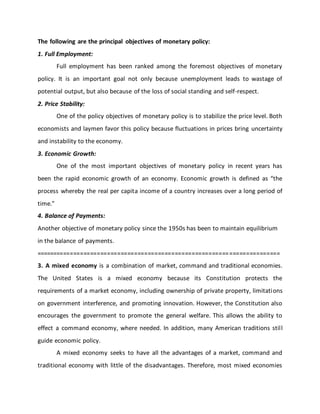
The following are the principal objectives of monetary policy:
1. Full Employment:
Full employment has been ranked among the foremost objectives of monetary
policy. It is an important goal not only because unemployment leads to wastage of
potential output, but also because of the loss of social standing and self-respect.
2. Price Stability:
One of the policy objectives of monetary policy is to stabilize the price level. Both
economists and laymen favor this policy because fluctuations in prices bring uncertainty
and instability to the economy.
3. Economic Growth:
One of the most important objectives of monetary policy in recent years has
been the rapid economic growth of an economy. Economic growth is defined as “the
process whereby the real per capita income of a country increases over a long period of
time.”
4. Balance of Payments:
Another objective of monetary policy since the 1950s has been to maintain equilibrium
in the balance of payments.
========================================================================
3. A mixed economy is a combination of market, command and traditional economies.
The United States is a mixed economy because its Constitution protects the
requirements of a market economy, including ownership of private property, limitations
on government interference, and promoting innovation. However, the Constitution also
encourages the government to promote the general welfare. This allows the ability to
effect a command economy, where needed. In addition, many American traditions still
guide economic policy.
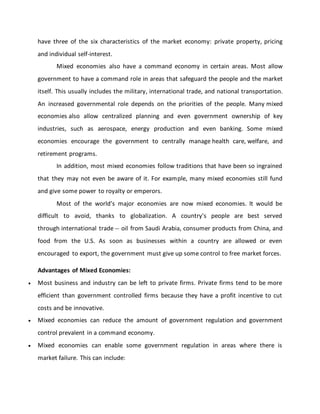
A mixed economy seeks to have all the advantages of a market, command and
traditional economy with little of the disadvantages. Therefore, most mixed economies
have three of the six characteristics of the market economy: private property, pricing
and individual self-interest.
Mixed economies also have a command economy in certain areas. Most allow
government to have a command role in areas that safeguard the people and the market
itself. This usually includes the military, international trade, and national transportation.
An increased governmental role depends on the priorities of the people. Many mixed
economies also allow centralized planning and even government ownership of key
industries, such as aerospace, energy production and even banking. Some mixed
economies encourage the government to centrally manage health care, welfare, and
retirement programs.
In addition, most mixed economies follow traditions that have been so ingrained
that they may not even be aware of it. For example, many mixed economies still fund
and give some power to royalty or emperors.
Most of the world's major economies are now mixed economies. It would be
difficult to avoid, thanks to globalization. A country's people are best served
through international trade -- oil from Saudi Arabia, consumer products from China, and
food from the U.S. As soon as businesses within a country are allowed or even
encouraged to export, the government must give up some control to free market forces.
Advantages of Mixed Economies:
 Most business and industry can be left to private firms. Private firms tend to be more
efficient than government controlled firms because they have a profit incentive to cut
costs and be innovative.
 Mixed economies can reduce the amount of government regulation and government
control prevalent in a command economy.
 Mixed economies can enable some government regulation in areas where there is
market failure. This can include:
 Regulation on the abuse of monopoly power, e.g. prevent mergers, prevent
excessively high prices.
 Taxation and regulation of goods with negative externalities, e.g. pollution,
 Subsidy or state support for goods and services which tend to be under consumed
in a free market. This can include public goods, like police and national defense, and
merit goods like education and health care.
 A mixed economy can create greater equality and provide a ‘safety net’ to prevent
people living in absolute poverty. At the same time, a mixed economy can enable
people to enjoy the financial rewards of hard work and entrepreneurship.
 Government can pursue policies to provide macro-economic stability, e.g. expansionary
fiscal policy in times of a recession.
Disadvantages Mixed Economies
 Can be difficult to know how much governments should intervene, e.g. discretionary
fiscal policy may create alternative problems such as government borrowing.
 Mixed economies are criticized by Socialists for allowing too much market forces,
leading to inequality and an inefficient allocation of resources.
 Mixed economies are criticized by free market economists for allowing too much
government intervention. Libertarians argue that governments make very poor
managers of the economy, invariably being influenced by political and short-term
factors.
Conclusion
In reality, it depends how a mixed economy is managed. Even the most ardent market
economists argue we need a degree of government intervention – if only to protect
private property. Adam Smith in Wealth of Nations argued governments needed to
prevent the exploitation of monopoly power.
4. Liberalization:
The rules and laws which were aimed at regulating the economic activities
became major hindrances in growth and development. Liberalization was introduced to
put an end to these restrictions and open up various sectors of the economy. Though a
few liberalization measures were introduced in 1980s in areas of industrial licensing,
export-import policy, technology up gradation, fiscal policy and foreign investment,
reform policies initiated in 1991 were more comprehensive. Let us study some
important areas such as the industrial sector, financial sector, tax reforms, foreign
exchange markets and trade and investment sectors which received greater attention in
and after 1991.
Privatization:
It implies shedding of the ownership or management of a government owned
enterprise. Government companies can be converted into private companies in two
ways (i) by withdrawal of the government from ownership and management of public
sector companies and or (ii) by outright sale of public sector companies. Privatization of
the public sector undertakings by selling off part of the equity of PSUs to the public is
known as disinvestment. The purpose of the sale, according to the government, was
mainly to improve financial discipline and facilitate modernization. It was also envisaged
that private capital and managerial capabilities could be effectively utilized to improve
the performance of the PSUs.
Globalization:
Globalization is the outcome of the policies of liberalization and privatization.
Although globalization is generally understood to mean integration of the economy of
the country with the world economy, it is a complex phenomenon. It is an outcome of
the set of various policies that are aimed at transforming the world towards greater
interdependence and integration. It involves creation of networks and activities
transcending economic, social and geographical boundaries. Globalization attempts to
establish links in such a way that the happenings in India can be influenced by events
happening miles away. It is turning the world into one whole or creating a borderless
world.
The effect on Indian economy:
Indian economy had experienced major policy changes in early 1990s.The
new economic reform, popularly known as, Liberalization, Privatization and
Globalization (LPG model) aimed at making the Indian economy as fastest growing
economy and globally competitive. The series of reforms undertaken with respect to
industrial sector, trade as well as financial sector aimed at making the economy more
efficient.
With the onset of reforms to liberalize the Indian economy in July of 1991, a new
chapter has dawned for India and her billion plus population. This period of economic
transition has had a tremendous impact on the overall economic development of almost
all major sectors of the economy, and its effects over the last decade can hardly be
overlooked. Besides, it also marks the advent of the real integration of the Indian
economy into the global economy.
This era of reforms has also ushered in a remarkable change in the Indian
mindset, as it deviates from the traditional values held since Independence in 1947,
such as self-reliance and socialistic policies of economic development, which mainly due
to the inward looking restrictive form of governance, resulted in the isolation, overall
backwardness and inefficiency of the economy, amongst a host of other problems. This,
despite the fact that India has always had the potential to be on the fast track to
prosperity.
Now that India is in the process of restructuring her economy, with aspirations of
elevating herself from her present desolate position in the world, the need to speed up
her economic development is even more imperative. And having witnessed the positive
role that Foreign Direct Investment (FDI) has played in the rapid economic growth of
most of the Southeast
Asian countries and most notably China, India has embarked on an ambitious plan to
emulate the successes of her neighbors to the east and is trying to sell herself as a safe
and profitable destination for FDI.
Effect of liberalization on Indian economy:
The low annual growth rate of the economy of India before 1980, which
stagnated around 3.5% from 1950s to 1980s, while per capital income averaged 1.3%.At
the same time, Pakistan grew by 5%, Indonesia by 9%, Thailand by 9%, South Korea by
10% and in Taiwan by 12%. Only four or five licenses would be given for steel, power
and communications. License owners built up huge powerful empires. A huge public
sector emerged. State-owned enterprises made large losses. Infrastructure investment
was poor because of the public sector monopoly. License Raj established the
"irresponsible, self-perpetuating bureaucracy that still exists throughout much of the
country" and corruption flourished under this system.
Effect of privatization on Indian economy:
It frees the resources for a more productive utilization. Private concerns tend to be
profit oriented and transparent in their functioning as private owners are always
oriented towards making profits and get rid of sacred cows and hitches in conventional
bureaucratic management. Since the system becomes more transparent, all underlying
corruptions are minimized and owners have a free reign and incentive for profit
maximization so they tend to get rid of all free loaders and vices that are inherent in
government functions. Gets rid of employment inconsistencies like free loaders, or over
employed departments reducing the strain on resources. Effectively minimizes
corruption and optimizes output and functions. Gets rid of employment inconsistencies
like free loaders, over employed departments and reducing the strain on resources.
Private firms are less tolerant towards capitulations and appendages in government
departments and hence tend to right size the human resource potential befitting the
organization's needs and may cause resistance and disgruntled employees who are
accustomed to the benefits as government functionaries. Permit the private sector to
contribute to economic development. Development of the general budget resources
and diversifying sources of income.
Effect of globalization on Indian economy:
It also heralded the integration of the Indian economy into the global economy.
The Indian economy was in major crisis in 1991 when foreign currency reserves went
down to $1 billion. Globalization had its impact on various sectors including Agricultural,
Industrial, Financial, Health sector and many others. It was only after the LPG policy i.e.
Liberalization, Privatization and Globalization launched by the then Finance Minister
Man Mohan Singh that India saw its development in various sectors.
Effect of Globalization on Agricultural Sector:
Agricultural Sector is the mainstay of the rural Indian economy around which
socio-economic privileges and deprivations revolve and any change in its structure is
likely to have a corresponding impact on the existing pattern of Social equity. The
liberalization of India’s economy was adopted by India in 1991. Facing a severe
economic crisis, India approached the IMF for a loan, and the IMF granted what is called
a ‘structural adjustment’ loan, which is a loan with certain conditions attached which
relate to a structural change in the economy. Essentially, the reforms sought to
gradually phase out government control of the market (liberalization), privatize public
sector organizations (privatization), and reduce export subsidies and import barriers to
enable free trade (globalization). Globalization has helped in:
• Raising living standards,
• Alleviating poverty,
• Assuring food security,
• Generating buoyant market for expansion of industry and services, and
• Making substantial contribution to the national economic growth.
Impact of Globalization on Industrial Sector:
Effects of Globalization on Indian Industry started when the government opened
the country's markets to foreign investments in the early 1990s. Globalization of the
Indian Industry took place in its various sectors such as steel, pharmaceutical,
petroleum, chemical, textile, cement, retail, and BPO.
Globalization means the dismantling of trade barriers between nations and the
integration of the nations’ economies through financial flow, trade in goods and
services, and corporate investments between nations. Globalization has increased
across the world in recent years due to the fast progress that has been made in the field
of technology especially in communications and transport. The government of India
made changes in its economic policy in 1991 by which it allowed direct foreign
investments in the country. The benefits of the effects of globalization in the Indian
Industry are that many foreign companies set up industries in India, especially in the
pharmaceutical, BPO, petroleum, manufacturing, and chemical sectors and this helped
to provide employment to many people in the country. This helped reduce the level of
unemployment and poverty in the country. Also the benefit of the Effects of
Globalization on Indian Industry are that the foreign companies brought in highly
advanced technology with them and this helped to make the Indian Industry more
technologically advanced.
The negative Effects of Globalization on Indian Industry are that with the coming
of technology the number of labor required decreased and this resulted in many people
being removed from their jobs. This happened mainly in the pharmaceutical, chemical,
manufacturing, and cement industries.
Impact on Financial Sector:
Reforms of the financial sector constitute the most important component of
India’s program towards economic liberalization. The recent economic liberalization
measures have opened the door to foreign competitors to enter into our domestic
market. Innovation has become a must for survival. Financial intermediaries have come
out of their traditional approach and they are ready to assume more credit risks. As a
consequence, many innovations have taken place in the global financial sectors which
have its own impact on the domestic sector also. The emergences of various financial
institutions and regulatory bodies have transformed the financial services sector from
being a conservative industry to a very dynamic one. In this process this sector is facing
a number of challenges. In this changed context, the financial services industry in India
has to play a very positive and dynamic role in the years to come by offering many
innovative products to suit the varied requirements of the millions of prospective
investors spread throughout the country. Reforms of the financial sector constitute the
most important component of India’s program towards economic liberalization.
Growth in financial services (comprising banking, insurance, real estate and
business services), after dipping to 5.6% in 2003-04 bounced back to 8.7% in 2004-05
and 10.9% in 2005-06. The momentum has been maintained with a growth of 11.1% in
2006-07. Because of Globalization, the financial services industry is in a period of
transition. Market shifts, competition, and technological developments are ushering in
unprecedented changes in the global financial services industry.
Impact on Export and Import:
India's Export and Import in the year 2001-02 was to the extent of 32,572 and
38,362 million respectively. Many Indian companies have started becoming respectable
players in the International scene. Agriculture exports account for about 13 to 18% of
total annual of annual export of the country. In 2000-01 Agricultural products valued at
more than US $ 6million were exported from the country 23% of which was contributed
by the marine products alone. Marine products in recent years have emerged as the
single largest contributor to the total agricultural export from the country accounting for
over one fifth of the total agricultural exports. Cereals (mostly basmati rice and non-
basmati rice), oil seeds, tea and coffee are the other prominent products each of which
accounts for nearly 5 to 10% of the country’s total agricultural exports.
========================================================================
5. Corporate Social Responsibility (CSR) is defined as the voluntary activities
undertaken by a company to operate in an economic, social and environmentally
sustainable manner.
The Government of Canada understands that responsible corporate behavior by
Canadian companies operating internationally not only enhances their chances for
business success but can also contribute to broad-based economic benefits for the
countries in which they are active and for Canada. Investing and operating responsibly
also plays an important role in promoting Canadian values internationally and
contributes to the sustainable development of communities. The Government of
Canada is therefore committed to promoting responsible business practices; and
expects and encourages Canadian companies working internationally to respect all
applicable laws and international standards, to operate transparently and in
consultation with host governments and local communities, and to conduct their
activities in a socially and environmentally responsible manner.
When companies operate in an economically, socially and environmentally
responsible manner, and they do so transparently, it helps them succeed, in particular
through encouraging shared value and social license. Management and mitigation of
social and environmental risk factors are increasingly important for business success
abroad, as the costs to companies of losing that social license, both in terms of share
price and the bottom line, may be significant. As Canadian firms take advantage of
global opportunities, there is an increasing understanding that incorporation of
responsible business practices into investments and operations abroad not only
benefits the local economies and communities, but makes good business sense.
As per the Companies Act, 2013, section 135, every company having a net
worth of rupees five hundred crore or more, or a turnover of rupees one thousand
crore or more or a net profit of rupees five crore or more, during any financial year,
shall ensure that the company spends, in every financial year, at least two per cent of
the average net profits of the company made during the three immediately preceding
financial years, in pursuance of its Corporate Social Responsibility policy. The
application is to every company, including its holding or subsidiary, and a foreign
company having its branch or project office in India. The Ministry of Corporate Affairs
(MCA) has vide its notification dated 27 February 2014, and in exercise of powers
conferred by section 1(3) of the Companies Act, 2013 (‘the Act’), notified 1 April 2014
as the date on which the provisions of section 135 and Schedule VII of the Act shall
come into force. The MCA has also notified the Companies (Corporate Social
Responsibility Policy) Rules, 2014 (‘the Rules’) to be effective from 1 April 2014.
KPMG in India has been doing significant amount of work in the CSR space,
helping clients articulate social investment philosophy/vision and effectively
translating that into a robust and sustainable CSR strategy and plan.
Notable CSR work by some companies in India
Ashok Leyland
Operates a fun bus in Chennai and New Delhi. This bus, equipped with a
hydraulic lift, takes differently abled children and those from orphanages and
corporation primary schools on a day’s picnic. The company also runs AIDS awareness
and prevention programs in its Hosur factories for about 3.5 lakh drivers.
Axis Bank
The Axis Bank Foundation runs Balwadis which are learning places for children
living in large urban slum clusters. It also conducts skill development programs
(PREMA and Yuva Parivartan) in motor driving, welding, mobile repairing, tailoring
etc. for the youth in backward districts.
Bharat Petroleum Corporation
Its rain water harvesting project Boond, in association with the Oil Industries
Development Board, selects draught-stricken villages to turn them from „water-
scarce to water-positive‟. Some of BPCL‟s other social programs include adoption of
villages, prevention and care for HIV/AIDS and rural health care.
Hindalco Industries
Its CSR activities are concentrated in 692 villages and 12 urban slums, where it
reaches out to about 26 lakh people. It has constructed check dams, ponds and bore
wells to provide safe drinking water. In education, it awards scholarships to students
from the rural schools it supports. Its other interests include women’s empowerment
and health care, in which it treats patients in hospitals, runs medical camps and
operates rural mobile medical van services.
Indian Oil Corporation
It runs the Indian Oil Foundation (IOF), a non-profit trust, which works for the
preservation and promotion of the country’s heritage. IOCL also offers 150 sports
scholarships every year to promising youngsters. Some of its other initiatives lie in the
domains of clean drinking water, education, hospitals and health care.
Infosys
Science Foundation, set up in 2009, gives away the annual Infosys Prize to honor
outstanding achievements in the fields of science and engineering. The company
supports causes in health care, culture and rural development. In an interesting
initiative undertaken by it, 100 school teachers in Karnataka, who were suffering
from arthritis, underwent free surgery as a part of a week-long program.
Mahindra & Mahindra
Nanhi Kali, a program runs by the KC Mahindra Education Trust, supports
education of over 75,000 underprivileged girls. The trust has awarded grants and
scholarships to 83,245 students so far. In vocational training, the Mahindra Pride
School provides livelihood training to youth from socially and economically
disadvantaged communities. M&M also works for causes related to environment,
health care, sports and culture.
Oil & Natural Gas Corporation
It offers community-based health care services in rural areas through 30 Mobile
Medicare Units (MMUs). The ONGC-Eastern Swamp Deer Conservation Project works
to protect the rare species of Easter Swamp Deer at the Kaziranga National Park in
Assam. ONGC also supports education and women empowerment.
Tata Consultancy Services
Its Computer Based Functional Literacy (CBFL) initiative for providing adult
literacy has already benefitted 1.2 lakh people. The program is available in nine
Indian languages. Besides adult education, TCS also works in the areas of skill
development, health care and agriculture.
Tata Steel
It comes out with the Human Development Index (HDI), a composite index of
health, education and income levels, to assess the impact of its work in rural areas.
Health care is one of its main concerns. The Tata Steel Rural Development Society
aims to improve agricultural productivity and raise farmers‟ standard of living.
=======================================================================
6. According to the U.S. Census Bureau, the service sector primarily consists of truck
transportation, messenger services and warehousing; information sector services;
securities, commodities and other financial investment services; rental and leasing
services; professional, scientific and technical services; administrative and support
services; waste management and remediation; health care and social assistance; and
arts, entertainment and recreation services.
Individuals employed in this sector produce services rather than products. Examples of
service sector jobs include housekeeping, psychotherapy, tax preparation, guided tours,
nursing and teaching. By contrast, individuals employed in the industrial/manufacturing
sector might produce goods such as cars, clothing and toys.
Health care in India:
India has traditionally been a rural, agrarian economy. Nearly three quarters of
the population, currently 1.2 billion, still live in rural areas. However, India’s thriving
economy is raising average income levels, driving rapid urbanization, creating an
expanding middle class and increasing awareness of health insurance. More women are
entering the workforce that further boosts the purchasing power of Indian households.
However, nearly 400 million people in India live on less than 1.25 USD (PPP) per day1 ,
and 44 per cent of all children are malnourished2 and the infant and women mortality
rates are still unacceptably high despite earnest efforts by the government. Healthcare
is one of India's largest service sectors. The Indian healthcare sector can be viewed as a
glass half empty or a glass half full. The challenges the sector faces are substantial, from
the need to reduce mortality rates, improve physical infrastructure, necessity to provide
health insurance, ensuring availability of trained medical personnel etc. There has been
a rise in both communicable/infectious diseases and non-communicable diseases,
including chronic diseases. While ailments such as poliomyelitis3 , leprosy, and neonatal
tetanus will soon be eliminated, some infectious diseases once thought to be under
control, for example dengue fever, viral hepatitis, tuberculosis, malaria, and pneumonia
have returned in force or have developed a stubborn resistance to drugs. As Indians live
more affluent lives and adopt unhealthy diets that are high in fat and sugar, the country
is experiencing a rapidly rising trend in non-communicable diseases / lifestyle diseases
such as hypertension, cancer, and diabetes that is expected to grow at a faster rate than
infectious diseases.4 In addition, the growing elderly population will place an enormous
burden on India’s healthcare systems and services. There are considerable shortages of
hospital beds and trained medical staff such as doctors and nurses, and as a result public
accessibility is reduced. There is also a considerable rural-urban imbalance in which
accessibility is significantly lower in rural compared to urban areas. 5 Women are under-
represented in the healthcare workforce.6 The health needs of the country are
enormous and the financial resources and managerial capacity available to meet them,
even on the most optimistic projections, fall somewhat short. India’s National Health
Policy, 20027 had to make hard choices between various priorities and operational
options. It does not claim to be a road-map for meeting all the health needs of the
populace of the country. Furthermore, it has to be recognized that such health needs
are also dynamic, as threats in the area of public health keep changing over time. The
policy, while being holistic, focuses on the need for enhanced funding and an
organizational restructuring in order to facilitate more equitable access to the health
facilities. Also, the policy is focused on those diseases which are principally contributing
to the disease burden. This is not to say that other items contributing to the disease
burden of the country will be ignored; but only that the resources, and also the principal
focus of the public health administration, will recognize certain relative priorities. The
policy aims to achieve an acceptable standard of good health among the general
population of the country and has set goals to be achieved by the year 2015. However,
from a global perspective India’s public spending on health is extremely low. In 2009 it
amounted to just 1.1 per cent of GDP.8 Further, public spending across states also
reveals wide variations.9 The total health expenditure (combining public funds, private
funds and external flows) during this period equaled 4.1 per cent of GDP.10 The 12th
five-year plan (2012–17) aims to increase the public health investment from 1.1 per cent
to 2–3 per cent of GDP.
Education in India:
In ancient times, India had the Gurukula system of education in which anyone
who wished to study went to a teacher's (Guru) house and requested to be taught. If
accepted as a student by the guru, he would then stay at the guru's place and help in all
activities at home. This not only created a strong tie between the teacher and the
student, but also taught the student everything about running a house. The guru taught
everything the child wanted to learn, from Sanskrit to the Holy Scriptures and from
Mathematics to Metaphysics. The student stayed as long as she wished or until the guru
felt that he had taught everything he could teach. All learning was closely linked to
nature and to life, and not confined to memorizing some information.
The modern school system was brought to India, including the English language,
originally by Lord Thomas Babington Macaulay in the 1830s. The curriculum was
confined to “modern” subjects such as science and mathematics, and subjects like
metaphysics and philosophy were considered unnecessary. Teaching was confined to
classrooms and the link with nature was broken, as also the close relationship between
the teacher and the student.
The Uttar Pradesh (a state in India) Board of High School and Intermediate
Education was the first Board set up in India in the year 1921 with jurisdiction over
Rajputana, Central India and Gwalior. In 1929, the Board of High School and
Intermediate Education, Rajputana, was established. Later, boards were established in
some of the states. But eventually in 1952 the constitution of the board was amended
and it was renamed Central Board of Secondary Education (CBSE). All schools in Delhi
and some other regions came under the Board. It was the function of the Board to
decide on things like curriculum, textbooks and examination system for all schools
affiliated to it. Today there are thousands of schools affiliated to the Board, both within
India and in many other countries from Afghanistan to Zimbabwe.
Universal and compulsory education for all children in the age group of 6-14 was
a cherished dream of the new government of the Republic of India. This is evident from
the fact that it is incorporated as a directive policy in article 45 of the constitution. But
this objective remains far away even more than half a century later. However, in the
recent past, the government appears to have taken a serious note of this lapse and has
made primary education a Fundamental Right of every Indian citizen. The pressures of
economic growth and the acute scarcity of skilled and trained manpower must certainly
have played a role to make the government take such a step. The expenditure by the
Government of India on school education in recent years comes to around 3% of the
GDP, which is recognized to be very low.
India is divided into 28 states and 7 so-called “Union Territories”. The states have
their own elected governments while the Union Territories are ruled directly by the
Government of India, with the President of India appointing an administrator for each
Union Territory. As per the constitution of India, school education was originally a state
subject —that is, the states had complete authority on deciding policies and
implementing them. The role of the Government of India (GoI) was limited to
coordination and deciding on the standards of higher education. This was changed with
a constitutional amendment in 1976 so that education now comes in the so-
called concurrent list. That is, school education policies and programs are suggested at
the national level by the GoI though the state governments have a lot of freedom in
implementing programs. Policies are announced at the national level periodically. The
Central Advisory Board of Education (CABE), set up in 1935, continues to play a lead role
in the evolution and monitoring of educational policies and programs.
There is a national organization that plays a key role in developing policies and
programs, called the National Council for Educational Research and Training (NCERT)
that prepares a National Curriculum Framework. Each state has its counterpart called
the State Council for Educational Research and Training (SCERT). These are the bodies
that essentially propose educational strategies, curricula, pedagogical schemes and
evaluation methodologies to the states' departments of education. The SCERTs
generally follow guidelines established by the NCERT. But the states have considerable
freedom in implementing the education system.
The National Policy on Education, 1986 and the Program of Action (POA) 1992
envisaged free and compulsory education of satisfactory quality for all children below
14 years before the 21st Century. The government committed to earmark 6% of the
Gross Domestic Product (GDP) for education, half of which would be spent on primary
education. The expenditure on Education as a percentage of GDP also rose from 0.7 per
cent in 1951-52 to about 3.6 per cent in 1997-98.
The school system in India has four levels: lower primary (age 6 to 10), upper
primary (11 and 12), high (13 to 15) and higher secondary (17 and 18). The lower
primary school is divided into five “standards”, upper primary school into two, high
school into three and higher secondary into two. Students have to learn a common
curriculum largely (except for regional changes in mother tongue) till the end of high
school. There is some amount of specialization possible at the higher secondary level.
Students throughout the country have to learn three languages (namely, English, Hindi
and their mother tongue) except in regions where Hindi is the mother tongue and in
some streams as discussed below.
There are mainly three streams in school education in India. Two of these are
coordinated at the national level, of which one is under the Central Board of Secondary
Education (CBSE) and was originally meant for children of central government
employees who are periodically transferred and may have to move to any place in the
country. A number of “central schools” (named Kendriya Vidyalayas) have been
established for the purpose in all main urban areas in the country, and they follow a
common schedule so that a student going from one school to another on a particular
day will hardly see any difference in what is being taught. One subject (Social Studies,
consisting of History, Geography and Civics) is always taught in Hindi, and other subjects
in English, in these schools. Kendriya Vidyalayas admit other children also if seats are
available. All of them follow textbooks written and published by the NCERT. In addition
to these government-run schools, a number of private schools in the country follow the
CBSE syllabus though they may use different text books and follow different teaching
schedules. They have a certain amount of freedom in what they teach in lower classes.
The CBSE also has 141 affiliated schools in 21 other countries mainly catering to the
needs of the Indian population there.
The second central scheme is the Indian Certificate of Secondary Education
(ICSE). It seems that this was started as a replacement for the Cambridge School
Certificate. The idea was mooted in a conference held in 1952 under the Chairmanship
of Maulana Abul Kalam Azad, the then Minister for Education. The main purpose of the
conference was to consider the replacement of the overseas Cambridge School
Certificate Examination by an All India Examination. In October 1956 at the meeting of
the Inter-State Board for Anglo-Indian Education, a proposal was adopted for the setting
up of an Indian Council to administer the University of Cambridge, Local Examinations
Syndicate's Examination in India and to advise the Syndicate on the best way to adapt its
examination to the needs of the country. The inaugural meeting of the Council was held
on 3rd November, 1958. In December 1967, the Council was registered as a Society
under the Societies Registration Act, 1860. The Council was listed in the Delhi School
Education Act 1973, as a body conducting public examinations. Now a large number of
schools across the country are affiliated to this Council. All these are private schools and
generally cater to children from wealthy families.
Both the CBSE and the ICSE council conduct their own examinations in schools
across the country that are affiliated to them at the end of 10 years of schooling (after
high school) and again at the end of 12 years (after higher secondary). Admission to the
11th class is normally based on the performance in this all-India examination. Since this
puts a lot of pressure on the child to perform well, there have been suggestions to
remove the examination at the end of 10 years.
In addition to the above, there are a relatively small number of schools that
follow foreign curricula such as the so-called Senior Cambridge, though this was largely
superseded by the ICSE stream elsewhere. Some of these schools also offer the students
the opportunity to sit for the ICSE examinations. These are usually very expensive
residential schools where some of the Indians working abroad send their children. They
normally have fabulous infrastructure, low student-teacher ratio and very few students.
Many of them have teachers from abroad. There are also other exclusive schools such
as the Doon School in Dehradun that take in a small number of students and charge
exorbitant fees.
Apart from all of these, there are a handful of schools around the country, such
as the Rishi Valley school in Andhra Pradesh, that try to break away from the normal
education system that promotes rote learning and implement innovative systems such
as the Montessori method. Most such schools are expensive, have high teacher-student
ratios and provide a learning environment in which each child can learn at his/her own
pace. It would be interesting and instructive to do a study on what impact the kind of
school has had on the life of their alumni.
Each state in the country has its own Department of Education that runs its own
school system with its own textbooks and evaluation system. As mentioned earlier, the
curriculum, pedagogy and evaluation method are largely decided by the SCERT in the
state, following the national guidelines prescribed by the NCERT.
Each state has three kinds of schools that follow the state curriculum. The government
runs its own schools in land and buildings owned by the government and paying the
staff from its own resources. These are generally known as government schools. The
fees are quite low in such schools. Then there are privately owned schools with their
own land and buildings. Here the fees are high and the teachers are paid by the
management. Such schools mostly cater to the urban middle class families. The third
kind consists of schools that are provided grant-in-aid by the government, though the
school was started by a private agency in their own land and buildings. The grant-in-aid
is meant to help reduce the fees and make it possible for poor families to send their
children. In some states like Kerala, these schools are very similar to government
schools since the teachers are paid by the government and the fees are the same as in
government schools.
The state of Kerala, a small state in the South Western coast of India, has been
different from the rest of the country in many ways for the last few decades. It has, for
instance, the highest literacy rate among all states, and was declared the first fully
literate state about a decade back. Life expectancy, both male and female, is very high,
close to that of the developed world. Other parameters such as fertility rate, infant and
child mortality are among the best in the country, if not the best. The total fertility rate
has been below the replacement rate of 2.1 for the last two decades. Probably as a side-
effect of economic and social development, suicide rates and alcoholism are also very
high. Government policies also have been very different from the rest of the country,
leading to the development model followed in Kerala, with high expenditure in
education and welfare, coming to be known as the “Kerala Model“ among economists.
Kerala has also always shown interest in trying out ways of improving its school
education system. Every time the NCERT came up with new ideas, it was Kerala that
tried it out first. The state experimented with the District Primary Education Program
(DPEP) with gusto, though there was opposition to it from various quarters, and even
took it beyond primary classes. The state was the first in the country to move from the
traditional behaviorist way of teaching to a social constructivist paradigm. It was
mentioned in the National Curriculum Framework of NCERT in the year 2000, and Kerala
started trying it out the next year. The transaction in the classroom and the evaluation
methodology were changed. Instead of direct questions that could be answered only
through memorizing the lessons, indirect questions and open ended questions were
included so that the student needed to think before answering, and the answers could
be subjective to some extent. This meant that the students had to digest what they
studied and had to be able to use their knowledge in a specific situation to answer the
questions. At the same time, the new method took away a lot of pressure and the
children began to find examinations interesting and enjoyable instead of being stressful.
A Comprehensive and Continuous Evaluation (CCE) system was introduced along with
this, which took into consideration the overall personality of the student and reduced
the dependence on a single final examination for deciding promotion to the next class.
At present, the CBSE also has implemented CCE, but in a more flexible manner.
Kerala was also the first state in the country to introduce Information Technology
as a subject of study at the High School level. It was started in class 8 with the textbook
introducing Microsoft Windows and Microsoft Office. But within one year the
government was forced to include Free Software also in the curriculum by protests from
Free Software enthusiasts and a favorable stance taken by a school teachers association
that had the majority of government teachers as its members. Eventually, from the year
2007, only GNU/Linux was taught in the schools, and all computers in schools had only
GNU/Linux installed. At that time, perhaps even today, this was the largest installation
of GNU/Linux in schools, and made headlines even in other countries. Every year, from
2007 onwards, about 500,000 children pass out of the schools learning the concepts
behind Free Software and the GNU/Linux operating system and applications. The state is
now moving towards IT Enabled Education. Eventually, IT will not be taught as a
separate subject. Instead, all subjects will be taught with the help of IT so that the
children will, on the one hand, learn IT skills and, on the other, make use of educational
applications (such as those mentioned below) and resources in the Internet (such as
textual material from sites like Wikipedia, images, animations and videos) to study their
subjects and to do exercises.
The initiative taken by Kerala is now influencing other states and even the
policies of the Government of India. States like Karnataka and Gujarat are now planning
to introduce Free Software in their schools, and some other states like Maharashtra are
examining the option. The new education policy of the Government of India speaks
about constructivism; IT enabled education, Free Software and sharing educational
resources. Once a few of the larger states successfully migrate to Free Software, it is
hoped that the entire country would follow suit in a relatively short time. When that
happens, India could have the largest user base of GNU/Linux and Free Software in
general.

Business environment

  • 1.
    ASSIGNMENT DRIVE SPRING DRIVE2015 PROGRAM BACHELOR OF BUSINESSADMINISTRATION (BBA) SEMESTER I SUBJECT CODE & NAME BBA103-Business Environment BK ID B1499 CREDIT 4 MARKS 60 1. External analysis of environment: External analysis means analysis of "Political, Economic, Social, and Technological, Environmental and Legal analysis". It is a part of the external analysis when conducting a strategic analysis or doing market research and gives a certain overview of the different macro environmental factors that the company has to take into consideration. Political factors: How and to what degree a government intervenes in the economy. Specifically, political factors include areas such as tax policy, labor law, environmental law, trade restrictions, tariffs, and political stability. Political factors may also include goods and services which the government wants to provide or be provided (merit goods) and those that the government does not want to be provided (demerit goods). Furthermore, governments have great influence on the health, education, and infrastructure of a nation. Economic factors: It includes economic growth, interest rates, exchange rates and the inflation rate. These factors have major impacts on how businesses operate and make decisions. For example, interest rates affect a firm's cost of capital and therefore to what extent a business grows and expands. Exchange rates affect the costs of exporting goods and the supply and price of imported goods in an economy.
  • 2.
    Social factors: It includesthe cultural aspects and include health consciousness, population growth rate, age distribution, career attitudes and emphasis on safety. Trends in social factors affect the demand for a company's products and how that company operates. For example, an ageing population may imply a smaller and less-willing workforce (thus increasing the cost of labor). Furthermore, companies may change various management strategies to adapt to these social trends (such as recruiting older workers). Technological factors: It includes ecological and environmental aspects, such as R&D activity, automation, technology incentives and the rate of technological change. They can determine barriers to entry, minimum efficient production level and influence outsourcing decisions. Furthermore, technological shifts can affect costs, quality, and lead to innovation. Environmental factors: It includes weather, climate, and climate change, which may especially affect industries such as tourism, farming, and insurance. Furthermore, growing awareness to climate change is affecting how companies operate and the products they offer--it is both creating new markets and diminishing or destroying existing ones. Legal factors: It includes discrimination law, consumer law, antitrust law, employment law, and health and safety law. These factors can affect how a company operates, its costs, and the demand for its products.
  • 3.
    The business environmentand the forces that push against it are something every manager must deal with and learn to work with. In this lesson, we will detail the four key functions of management and review how different forces present in the business environment impact these four key functions Managers have to deal with multiple different forces that pull and push their businesses and companies in any number of directions. In many ways, it's like working in an obstacle course. There are obstacles you have to deal with, new things that you might not have ever seen before and challenges that will come up that will test your abilities. Managers as a whole focus on four key functions:  Plan: Have a specific outline of the steps they will take to be successful or have their department of company be successful.  Control: Be able to keep all the pieces and parts of the plan moving together.  Organize: Get all the people and equipment together to support the plan.  Lead: Show vision and enthusiasm to reach the goal of the plan. They have obstacles, if you will, that arise while they are focusing on these areas. Technology Technology is the application of scientific knowledge for practical purposes, and it represents potentially the fastest-moving force on the four functions of management - and it encompasses all forms of technology (communication, manufacturing, marketing, etc.). Technology is moving at an incredibly fast pace, and that forces managers to adjust how they plan, organize, lead and control. Primarily, technology allows a manager to have access to more data and to communicate that data faster and to more people. Thus, they have to be able to work with technology, understand how to use it as a manager and disseminate that information to their employees. Innovation For any manager to be able to truly utilize the four main functions, they have to be able to accept innovation and indeed be innovative themselves. Innovation, which is the introduction of new ideas, impacts managers constantly. Just think of the huge changes
  • 4.
    the Internet posedto managers. Simple things, such as email or text messaging, changed how they managed their employees and communicated with them. Simple innovations such as these changed the landscape they worked in, and they had to be able to integrate this innovation into their management functions. Globalization and Diversity The world, in a word, is shrinking. Influences of different cultures are being felt in all countries via globalization. Globalization is the integration of cultures throughout the world and can be as simple as McDonalds opening a store in Saudi Arabia (bringing the taste of the U.S. to the Middle East, if you will) or as complicated as a mosque opening in a small suburban town. These examples bring a different culture to the location and thus a different perspective on the world. So, as a manager works through the basic functions of management, they have to understand that culturally the world around them is changing, and they need to embrace this diversity. When cultures mix we are experiencing diversity, or an environment made up of many different cultures and viewpoints. Now, a manager could be managing people from India, Mexico and Germany all in the same office. Thus, planning their work, organizing it, leading it and controlling it will make the manager change his or her approach. They cannot, for example, lead a person from Mexico the same way they would someone from India. These cultures have different ways of working, and a manager must adjust his or her methods to manage those diverse cultures. ===================================================================================== 2. The fiscal policy is concerned with the raising of government revenue and incurring of government expenditure. To generate revenue and to incur expenditure, the government frames a policy called budgetary policy or fiscal policy. So, the fiscal policy is concerned with government expenditure and government revenue. Fiscal policy has to decide on the size and pattern of flow of expenditure from the government to the economy and from the economy back to the government. So, in broad term fiscal policy refers to "that segment of national economic policy which is
  • 5.
    primarily concerned withthe receipts and expenditure of central government." In other words, fiscal policy refers to the policy of the government with regard to taxation, public expenditure and public borrowings. The role of fiscal policy is to provide growth and stability to the economy of a nation or region of the world through government intervention in taxation and the adjustment of government expenditure. Fiscal policy has often taken a central role in the economy of a country when an economic downturn occurs and the government feels that stabilization is required. Long-term fiscal policy aims include the reduction of poverty for a nation's citizens and the sustainable growth of an economy. Government intervention in an economy can take two forms — fiscal policy or monetary policy. Fiscal policy is controlled by government agencies and departments, while monetary policy is controlled by banks changing interest rates and selling government securities. The role of fiscal policy is to increase or decrease taxation and government spending depending on the needs of the economy. When an economy slows, a government can attempt to stimulate it through increased expenditure and lowered taxes, providing citizens with an increased amount of money to spend. Increased spending from more disposable income is returned to the government in taxes collected from sales at both local and national levels. In the short term, the role of fiscal policy is to stabilize a struggling economy by increasing the spending and making temporary tax cuts. Short-term tax cuts often have a minimal impact on an economy because the people given the tax cut often save the increased amount of money. The money saved is used for a perceived return to economic difficulties when the taxation changes return to previous levels. Economic growth is the long-term aim of fiscal policies introduced by a government at sustainable levels that do not allow an economy to grow at uncontrollably fast or slow levels. Government fiscal policies often include stabilizers that automatically kick into action when the economy grows or reduces at alarming levels. An economic downturn
  • 6.
    sees more governmentexpenditure on unemployment benefits and healthcare, with government spending adjusted at small levels without legislative interference. A slowing economy is often stimulated at small levels by reductions in taxation to promote spending. Throughout history, the role of fiscal policy has changed due to the needs of a country at a specific moment. Prior to the Great Depression of the 1930s, most governments did not interfere with the running of their economy in a significant way, but allowed market forces to govern the growth of the economy. The worldwide economic crash of the 1930s prompted governments to intervene and establish fiscal policies to provide stabilization. By the end of the 20th century, government policies in most nations had returned fiscal control to the stock market and investment markets, followed by the economic downturn of the first decade of the 21st century prompting more government involvement in fiscal policy. The objectives of fiscal policy are as under: 1. Development by effective Mobilization of Resources: The principal objective of fiscal policy is to ensure rapid economic growth and development. This objective of economic growth and development can be achieved by Mobilization of Financial Resources. The central and the state governments in India have used fiscal policy to mobilize resources. The financial resources can be mobilized by:- Taxation: Through effective fiscal policies, the government aims to mobilize resources by way of direct taxes as well as indirect taxes because most important source of resource mobilization in India is taxation. Public Savings: The resources can be mobilized through public savings by reducing government expenditure and increasing surpluses of public sector enterprises. Private Savings: Through effective fiscal measures such as tax benefits, the government can raise resources from private sector and households. Resources can be mobilized
  • 7.
    through government borrowingsby ways of treasury bills, issue of government bonds, etc., loans from domestic and foreign parties and by deficit financing. 2. Efficient allocation of Financial Resources: The central and state governments have tried to make efficient allocation of financial resources. These resources are allocated for Development Activities which includes expenditure on railways, infrastructure, etc. While Non-development Activities includes expenditure on defense, interest payments, subsidies, etc. But generally the fiscal policy should ensure that the resources are allocated for generation of goods and services which are socially desirable. Therefore, India's fiscal policy is designed in such a manner so as to encourage production of desirable goods and discourage those goods which are socially undesirable. 3. Reduction in inequalities of Income and Wealth: Fiscal policy aims at achieving equity or social justice by reducing income inequalities among different sections of the society. The direct taxes such as income tax are charged more on the rich people as compared to lower income groups. Indirect taxes are also more in the case of semi-luxury and luxury items, which are mostly consumed by the upper middle class and the upper class. The government invests a significant proportion of its tax revenue in the implementation of Poverty Alleviation Programs to improve the conditions of poor people in society. 4. Price Stability and Control of Inflation: One of the main objectives of fiscal policy is to control inflation and stabilize price. Therefore, the government always aims to control the inflation by reducing fiscal deficits, introducing tax savings schemes, Productive use of financial resources, etc. 5. Employment Generation: The government is making every possible effort to increase employment in the country through effective fiscal measure. Investment in infrastructure has resulted in
  • 8.
    direct and indirectemployment. Lower taxes and duties on small-scale industrial (SSI) units encourage more investment and consequently generate more employment. Various rural employment programs have been undertaken by the Government of India to solve problems in rural areas. Similarly, self-employment scheme is taken to provide employment to technically qualified persons in the urban areas. 6. Balanced Regional Development: Another main objective of the fiscal policy is to bring about a balanced regional development. There are various incentives from the government for setting up projects in backward areas such as Cash subsidy, Concession in taxes and duties in the form of tax holidays, Finance at concessional interest rates, etc. 7. Reducing the Deficit in the Balance of Payment: Fiscal policy attempts to encourage more exports by way of fiscal measures like Exemption of income tax on export earnings, Exemption of central excise duties and customs, Exemption of sales tax, etc. The foreign exchange is also conserved by providing fiscal benefits to import substitute industries, imposing customs duties on imports, etc. The foreign exchange earned by way of exports and saved by way of import substitutes helps to solve balance of payments problem. In this way adverse balance of payment can be corrected either by imposing duties on imports or by giving subsidies to export. 8. Capital Formation: The objective of fiscal policy in India is also to increase the rate of capital formation so as to accelerate the rate of economic growth. An underdeveloped country is trapped in vicious (danger) circle of poverty mainly on account of capital deficiency. In order to increase the rate of capital formation, the fiscal policy must be efficiently designed to encourage savings and discourage and reduce spending.
  • 9.
    9. Increasing NationalIncome: The fiscal policy aims to increase the national income of a country. This is because fiscal policy facilitates the capital formation. This results in economic growth, which in turn increases the GDP, per capita income and national income of the country. 10. Development of Infrastructure: Government has placed emphasis on the infrastructure development for the purpose of achieving economic growth. The fiscal policy measure such as taxation generates revenue to the government. A part of the government's revenue is invested in the infrastructure development. Due to this, all sectors of the economy get a boost. 11. Foreign Exchange Earnings: Fiscal policy attempts to encourage more exports by way of Fiscal Measures like, exemption of income tax on export earnings, exemption of sales tax, etc. Foreign exchange provides fiscal benefits to import substitute industries. The foreign exchange earned by way of exports and saved by way of import substitutes helps to solve balance of payments problem. Conclusion on Fiscal Policy The objectives of fiscal policy such as economic development, price stability, social justice, etc. can be achieved only if the tools of policy like Public Expenditure, Taxation, Borrowing and deficit financing are effectively used. Though there are gaps in India's fiscal policy, there is also an urgent need for making India's fiscal policy a rationalized and growth oriented one. The success of fiscal policy depends upon taking timely measures and their effective administration during implementation.
  • 10.
    Monetary policy refersto the credit control measures adopted by the central bank of a country. Johnson defines monetary policy “as policy employing central bank’s control of the supply of money as an instrument for achieving the objectives of general economic policy.” G.K. Shaw defines it as “any conscious action undertaken by the monetary authorities to change the quantity, availability or cost of money.” The role of monetary policy in encouraging economic growth typically takes a form that makes it easier for businesses to get loans and credit to expand their operations, and for entrepreneurs to get money to start new businesses. A government's central bank can do this by lowering reserve requirements, or the percentage of liabilities that a bank must, legally, keep as liquid currency. This then allows banks to make more loans and issue more credit than they can with higher reserve requirements. Central banks can also encourage economic growth by increasing the money supply, or the total amount of a nation's currency that is in circulation. To keep inflation low within the confines of the role of monetary policy, a government may constrict the amount of money that is in circulation, in order to preserve the value of each unit of currency. This involves steps that are opposite to those that encourage economic growth. These include raising reserve requirements for banks and decreasing the nation's money supply. The challenge inherit in the role of monetary policy is that governments cannot encourage economic growth without risking inflation, and cannot take steps to keep inflation low without risking an economic slowdown, and a corresponding increase in the unemployment rate. This requires governments to prioritize either economic growth or maintaining low inflation at any given point in time. Generally, central banks deal with this dilemma by taking modest steps to keep inflation low during times of economic growth, and risking inflation to focus on encouraging economic growth when economies are in recessions or depressions.
  • 11.
    The following arethe principal objectives of monetary policy: 1. Full Employment: Full employment has been ranked among the foremost objectives of monetary policy. It is an important goal not only because unemployment leads to wastage of potential output, but also because of the loss of social standing and self-respect. 2. Price Stability: One of the policy objectives of monetary policy is to stabilize the price level. Both economists and laymen favor this policy because fluctuations in prices bring uncertainty and instability to the economy. 3. Economic Growth: One of the most important objectives of monetary policy in recent years has been the rapid economic growth of an economy. Economic growth is defined as “the process whereby the real per capita income of a country increases over a long period of time.” 4. Balance of Payments: Another objective of monetary policy since the 1950s has been to maintain equilibrium in the balance of payments. ======================================================================== 3. A mixed economy is a combination of market, command and traditional economies. The United States is a mixed economy because its Constitution protects the requirements of a market economy, including ownership of private property, limitations on government interference, and promoting innovation. However, the Constitution also encourages the government to promote the general welfare. This allows the ability to effect a command economy, where needed. In addition, many American traditions still guide economic policy. A mixed economy seeks to have all the advantages of a market, command and traditional economy with little of the disadvantages. Therefore, most mixed economies
  • 12.
    have three ofthe six characteristics of the market economy: private property, pricing and individual self-interest. Mixed economies also have a command economy in certain areas. Most allow government to have a command role in areas that safeguard the people and the market itself. This usually includes the military, international trade, and national transportation. An increased governmental role depends on the priorities of the people. Many mixed economies also allow centralized planning and even government ownership of key industries, such as aerospace, energy production and even banking. Some mixed economies encourage the government to centrally manage health care, welfare, and retirement programs. In addition, most mixed economies follow traditions that have been so ingrained that they may not even be aware of it. For example, many mixed economies still fund and give some power to royalty or emperors. Most of the world's major economies are now mixed economies. It would be difficult to avoid, thanks to globalization. A country's people are best served through international trade -- oil from Saudi Arabia, consumer products from China, and food from the U.S. As soon as businesses within a country are allowed or even encouraged to export, the government must give up some control to free market forces. Advantages of Mixed Economies:  Most business and industry can be left to private firms. Private firms tend to be more efficient than government controlled firms because they have a profit incentive to cut costs and be innovative.  Mixed economies can reduce the amount of government regulation and government control prevalent in a command economy.  Mixed economies can enable some government regulation in areas where there is market failure. This can include:
  • 13.
     Regulation onthe abuse of monopoly power, e.g. prevent mergers, prevent excessively high prices.  Taxation and regulation of goods with negative externalities, e.g. pollution,  Subsidy or state support for goods and services which tend to be under consumed in a free market. This can include public goods, like police and national defense, and merit goods like education and health care.  A mixed economy can create greater equality and provide a ‘safety net’ to prevent people living in absolute poverty. At the same time, a mixed economy can enable people to enjoy the financial rewards of hard work and entrepreneurship.  Government can pursue policies to provide macro-economic stability, e.g. expansionary fiscal policy in times of a recession. Disadvantages Mixed Economies  Can be difficult to know how much governments should intervene, e.g. discretionary fiscal policy may create alternative problems such as government borrowing.  Mixed economies are criticized by Socialists for allowing too much market forces, leading to inequality and an inefficient allocation of resources.  Mixed economies are criticized by free market economists for allowing too much government intervention. Libertarians argue that governments make very poor managers of the economy, invariably being influenced by political and short-term factors. Conclusion In reality, it depends how a mixed economy is managed. Even the most ardent market economists argue we need a degree of government intervention – if only to protect private property. Adam Smith in Wealth of Nations argued governments needed to prevent the exploitation of monopoly power.
  • 14.
    4. Liberalization: The rulesand laws which were aimed at regulating the economic activities became major hindrances in growth and development. Liberalization was introduced to put an end to these restrictions and open up various sectors of the economy. Though a few liberalization measures were introduced in 1980s in areas of industrial licensing, export-import policy, technology up gradation, fiscal policy and foreign investment, reform policies initiated in 1991 were more comprehensive. Let us study some important areas such as the industrial sector, financial sector, tax reforms, foreign exchange markets and trade and investment sectors which received greater attention in and after 1991. Privatization: It implies shedding of the ownership or management of a government owned enterprise. Government companies can be converted into private companies in two ways (i) by withdrawal of the government from ownership and management of public sector companies and or (ii) by outright sale of public sector companies. Privatization of the public sector undertakings by selling off part of the equity of PSUs to the public is known as disinvestment. The purpose of the sale, according to the government, was mainly to improve financial discipline and facilitate modernization. It was also envisaged that private capital and managerial capabilities could be effectively utilized to improve the performance of the PSUs. Globalization: Globalization is the outcome of the policies of liberalization and privatization. Although globalization is generally understood to mean integration of the economy of the country with the world economy, it is a complex phenomenon. It is an outcome of the set of various policies that are aimed at transforming the world towards greater interdependence and integration. It involves creation of networks and activities transcending economic, social and geographical boundaries. Globalization attempts to
  • 15.
    establish links insuch a way that the happenings in India can be influenced by events happening miles away. It is turning the world into one whole or creating a borderless world. The effect on Indian economy: Indian economy had experienced major policy changes in early 1990s.The new economic reform, popularly known as, Liberalization, Privatization and Globalization (LPG model) aimed at making the Indian economy as fastest growing economy and globally competitive. The series of reforms undertaken with respect to industrial sector, trade as well as financial sector aimed at making the economy more efficient. With the onset of reforms to liberalize the Indian economy in July of 1991, a new chapter has dawned for India and her billion plus population. This period of economic transition has had a tremendous impact on the overall economic development of almost all major sectors of the economy, and its effects over the last decade can hardly be overlooked. Besides, it also marks the advent of the real integration of the Indian economy into the global economy. This era of reforms has also ushered in a remarkable change in the Indian mindset, as it deviates from the traditional values held since Independence in 1947, such as self-reliance and socialistic policies of economic development, which mainly due to the inward looking restrictive form of governance, resulted in the isolation, overall backwardness and inefficiency of the economy, amongst a host of other problems. This, despite the fact that India has always had the potential to be on the fast track to prosperity. Now that India is in the process of restructuring her economy, with aspirations of elevating herself from her present desolate position in the world, the need to speed up her economic development is even more imperative. And having witnessed the positive
  • 16.
    role that ForeignDirect Investment (FDI) has played in the rapid economic growth of most of the Southeast Asian countries and most notably China, India has embarked on an ambitious plan to emulate the successes of her neighbors to the east and is trying to sell herself as a safe and profitable destination for FDI. Effect of liberalization on Indian economy: The low annual growth rate of the economy of India before 1980, which stagnated around 3.5% from 1950s to 1980s, while per capital income averaged 1.3%.At the same time, Pakistan grew by 5%, Indonesia by 9%, Thailand by 9%, South Korea by 10% and in Taiwan by 12%. Only four or five licenses would be given for steel, power and communications. License owners built up huge powerful empires. A huge public sector emerged. State-owned enterprises made large losses. Infrastructure investment was poor because of the public sector monopoly. License Raj established the "irresponsible, self-perpetuating bureaucracy that still exists throughout much of the country" and corruption flourished under this system. Effect of privatization on Indian economy: It frees the resources for a more productive utilization. Private concerns tend to be profit oriented and transparent in their functioning as private owners are always oriented towards making profits and get rid of sacred cows and hitches in conventional bureaucratic management. Since the system becomes more transparent, all underlying corruptions are minimized and owners have a free reign and incentive for profit maximization so they tend to get rid of all free loaders and vices that are inherent in government functions. Gets rid of employment inconsistencies like free loaders, or over employed departments reducing the strain on resources. Effectively minimizes corruption and optimizes output and functions. Gets rid of employment inconsistencies like free loaders, over employed departments and reducing the strain on resources.
  • 17.
    Private firms areless tolerant towards capitulations and appendages in government departments and hence tend to right size the human resource potential befitting the organization's needs and may cause resistance and disgruntled employees who are accustomed to the benefits as government functionaries. Permit the private sector to contribute to economic development. Development of the general budget resources and diversifying sources of income. Effect of globalization on Indian economy: It also heralded the integration of the Indian economy into the global economy. The Indian economy was in major crisis in 1991 when foreign currency reserves went down to $1 billion. Globalization had its impact on various sectors including Agricultural, Industrial, Financial, Health sector and many others. It was only after the LPG policy i.e. Liberalization, Privatization and Globalization launched by the then Finance Minister Man Mohan Singh that India saw its development in various sectors. Effect of Globalization on Agricultural Sector: Agricultural Sector is the mainstay of the rural Indian economy around which socio-economic privileges and deprivations revolve and any change in its structure is likely to have a corresponding impact on the existing pattern of Social equity. The liberalization of India’s economy was adopted by India in 1991. Facing a severe economic crisis, India approached the IMF for a loan, and the IMF granted what is called a ‘structural adjustment’ loan, which is a loan with certain conditions attached which relate to a structural change in the economy. Essentially, the reforms sought to gradually phase out government control of the market (liberalization), privatize public sector organizations (privatization), and reduce export subsidies and import barriers to enable free trade (globalization). Globalization has helped in: • Raising living standards, • Alleviating poverty,
  • 18.
    • Assuring foodsecurity, • Generating buoyant market for expansion of industry and services, and • Making substantial contribution to the national economic growth. Impact of Globalization on Industrial Sector: Effects of Globalization on Indian Industry started when the government opened the country's markets to foreign investments in the early 1990s. Globalization of the Indian Industry took place in its various sectors such as steel, pharmaceutical, petroleum, chemical, textile, cement, retail, and BPO. Globalization means the dismantling of trade barriers between nations and the integration of the nations’ economies through financial flow, trade in goods and services, and corporate investments between nations. Globalization has increased across the world in recent years due to the fast progress that has been made in the field of technology especially in communications and transport. The government of India made changes in its economic policy in 1991 by which it allowed direct foreign investments in the country. The benefits of the effects of globalization in the Indian Industry are that many foreign companies set up industries in India, especially in the pharmaceutical, BPO, petroleum, manufacturing, and chemical sectors and this helped to provide employment to many people in the country. This helped reduce the level of unemployment and poverty in the country. Also the benefit of the Effects of Globalization on Indian Industry are that the foreign companies brought in highly advanced technology with them and this helped to make the Indian Industry more technologically advanced. The negative Effects of Globalization on Indian Industry are that with the coming of technology the number of labor required decreased and this resulted in many people being removed from their jobs. This happened mainly in the pharmaceutical, chemical, manufacturing, and cement industries.
  • 19.
    Impact on FinancialSector: Reforms of the financial sector constitute the most important component of India’s program towards economic liberalization. The recent economic liberalization measures have opened the door to foreign competitors to enter into our domestic market. Innovation has become a must for survival. Financial intermediaries have come out of their traditional approach and they are ready to assume more credit risks. As a consequence, many innovations have taken place in the global financial sectors which have its own impact on the domestic sector also. The emergences of various financial institutions and regulatory bodies have transformed the financial services sector from being a conservative industry to a very dynamic one. In this process this sector is facing a number of challenges. In this changed context, the financial services industry in India has to play a very positive and dynamic role in the years to come by offering many innovative products to suit the varied requirements of the millions of prospective investors spread throughout the country. Reforms of the financial sector constitute the most important component of India’s program towards economic liberalization. Growth in financial services (comprising banking, insurance, real estate and business services), after dipping to 5.6% in 2003-04 bounced back to 8.7% in 2004-05 and 10.9% in 2005-06. The momentum has been maintained with a growth of 11.1% in 2006-07. Because of Globalization, the financial services industry is in a period of transition. Market shifts, competition, and technological developments are ushering in unprecedented changes in the global financial services industry. Impact on Export and Import: India's Export and Import in the year 2001-02 was to the extent of 32,572 and 38,362 million respectively. Many Indian companies have started becoming respectable players in the International scene. Agriculture exports account for about 13 to 18% of total annual of annual export of the country. In 2000-01 Agricultural products valued at more than US $ 6million were exported from the country 23% of which was contributed
  • 20.
    by the marineproducts alone. Marine products in recent years have emerged as the single largest contributor to the total agricultural export from the country accounting for over one fifth of the total agricultural exports. Cereals (mostly basmati rice and non- basmati rice), oil seeds, tea and coffee are the other prominent products each of which accounts for nearly 5 to 10% of the country’s total agricultural exports. ======================================================================== 5. Corporate Social Responsibility (CSR) is defined as the voluntary activities undertaken by a company to operate in an economic, social and environmentally sustainable manner. The Government of Canada understands that responsible corporate behavior by Canadian companies operating internationally not only enhances their chances for business success but can also contribute to broad-based economic benefits for the countries in which they are active and for Canada. Investing and operating responsibly also plays an important role in promoting Canadian values internationally and contributes to the sustainable development of communities. The Government of Canada is therefore committed to promoting responsible business practices; and expects and encourages Canadian companies working internationally to respect all applicable laws and international standards, to operate transparently and in consultation with host governments and local communities, and to conduct their activities in a socially and environmentally responsible manner. When companies operate in an economically, socially and environmentally responsible manner, and they do so transparently, it helps them succeed, in particular through encouraging shared value and social license. Management and mitigation of social and environmental risk factors are increasingly important for business success abroad, as the costs to companies of losing that social license, both in terms of share price and the bottom line, may be significant. As Canadian firms take advantage of global opportunities, there is an increasing understanding that incorporation of
  • 21.
    responsible business practicesinto investments and operations abroad not only benefits the local economies and communities, but makes good business sense. As per the Companies Act, 2013, section 135, every company having a net worth of rupees five hundred crore or more, or a turnover of rupees one thousand crore or more or a net profit of rupees five crore or more, during any financial year, shall ensure that the company spends, in every financial year, at least two per cent of the average net profits of the company made during the three immediately preceding financial years, in pursuance of its Corporate Social Responsibility policy. The application is to every company, including its holding or subsidiary, and a foreign company having its branch or project office in India. The Ministry of Corporate Affairs (MCA) has vide its notification dated 27 February 2014, and in exercise of powers conferred by section 1(3) of the Companies Act, 2013 (‘the Act’), notified 1 April 2014 as the date on which the provisions of section 135 and Schedule VII of the Act shall come into force. The MCA has also notified the Companies (Corporate Social Responsibility Policy) Rules, 2014 (‘the Rules’) to be effective from 1 April 2014. KPMG in India has been doing significant amount of work in the CSR space, helping clients articulate social investment philosophy/vision and effectively translating that into a robust and sustainable CSR strategy and plan. Notable CSR work by some companies in India Ashok Leyland Operates a fun bus in Chennai and New Delhi. This bus, equipped with a hydraulic lift, takes differently abled children and those from orphanages and corporation primary schools on a day’s picnic. The company also runs AIDS awareness and prevention programs in its Hosur factories for about 3.5 lakh drivers. Axis Bank
  • 22.
    The Axis BankFoundation runs Balwadis which are learning places for children living in large urban slum clusters. It also conducts skill development programs (PREMA and Yuva Parivartan) in motor driving, welding, mobile repairing, tailoring etc. for the youth in backward districts. Bharat Petroleum Corporation Its rain water harvesting project Boond, in association with the Oil Industries Development Board, selects draught-stricken villages to turn them from „water- scarce to water-positive‟. Some of BPCL‟s other social programs include adoption of villages, prevention and care for HIV/AIDS and rural health care. Hindalco Industries Its CSR activities are concentrated in 692 villages and 12 urban slums, where it reaches out to about 26 lakh people. It has constructed check dams, ponds and bore wells to provide safe drinking water. In education, it awards scholarships to students from the rural schools it supports. Its other interests include women’s empowerment and health care, in which it treats patients in hospitals, runs medical camps and operates rural mobile medical van services. Indian Oil Corporation It runs the Indian Oil Foundation (IOF), a non-profit trust, which works for the preservation and promotion of the country’s heritage. IOCL also offers 150 sports scholarships every year to promising youngsters. Some of its other initiatives lie in the domains of clean drinking water, education, hospitals and health care. Infosys Science Foundation, set up in 2009, gives away the annual Infosys Prize to honor outstanding achievements in the fields of science and engineering. The company supports causes in health care, culture and rural development. In an interesting
  • 23.
    initiative undertaken byit, 100 school teachers in Karnataka, who were suffering from arthritis, underwent free surgery as a part of a week-long program. Mahindra & Mahindra Nanhi Kali, a program runs by the KC Mahindra Education Trust, supports education of over 75,000 underprivileged girls. The trust has awarded grants and scholarships to 83,245 students so far. In vocational training, the Mahindra Pride School provides livelihood training to youth from socially and economically disadvantaged communities. M&M also works for causes related to environment, health care, sports and culture. Oil & Natural Gas Corporation It offers community-based health care services in rural areas through 30 Mobile Medicare Units (MMUs). The ONGC-Eastern Swamp Deer Conservation Project works to protect the rare species of Easter Swamp Deer at the Kaziranga National Park in Assam. ONGC also supports education and women empowerment. Tata Consultancy Services Its Computer Based Functional Literacy (CBFL) initiative for providing adult literacy has already benefitted 1.2 lakh people. The program is available in nine Indian languages. Besides adult education, TCS also works in the areas of skill development, health care and agriculture. Tata Steel It comes out with the Human Development Index (HDI), a composite index of health, education and income levels, to assess the impact of its work in rural areas. Health care is one of its main concerns. The Tata Steel Rural Development Society aims to improve agricultural productivity and raise farmers‟ standard of living. =======================================================================
  • 24.
    6. According tothe U.S. Census Bureau, the service sector primarily consists of truck transportation, messenger services and warehousing; information sector services; securities, commodities and other financial investment services; rental and leasing services; professional, scientific and technical services; administrative and support services; waste management and remediation; health care and social assistance; and arts, entertainment and recreation services. Individuals employed in this sector produce services rather than products. Examples of service sector jobs include housekeeping, psychotherapy, tax preparation, guided tours, nursing and teaching. By contrast, individuals employed in the industrial/manufacturing sector might produce goods such as cars, clothing and toys. Health care in India: India has traditionally been a rural, agrarian economy. Nearly three quarters of the population, currently 1.2 billion, still live in rural areas. However, India’s thriving economy is raising average income levels, driving rapid urbanization, creating an expanding middle class and increasing awareness of health insurance. More women are entering the workforce that further boosts the purchasing power of Indian households. However, nearly 400 million people in India live on less than 1.25 USD (PPP) per day1 , and 44 per cent of all children are malnourished2 and the infant and women mortality rates are still unacceptably high despite earnest efforts by the government. Healthcare is one of India's largest service sectors. The Indian healthcare sector can be viewed as a glass half empty or a glass half full. The challenges the sector faces are substantial, from the need to reduce mortality rates, improve physical infrastructure, necessity to provide health insurance, ensuring availability of trained medical personnel etc. There has been a rise in both communicable/infectious diseases and non-communicable diseases, including chronic diseases. While ailments such as poliomyelitis3 , leprosy, and neonatal tetanus will soon be eliminated, some infectious diseases once thought to be under control, for example dengue fever, viral hepatitis, tuberculosis, malaria, and pneumonia
  • 25.
    have returned inforce or have developed a stubborn resistance to drugs. As Indians live more affluent lives and adopt unhealthy diets that are high in fat and sugar, the country is experiencing a rapidly rising trend in non-communicable diseases / lifestyle diseases such as hypertension, cancer, and diabetes that is expected to grow at a faster rate than infectious diseases.4 In addition, the growing elderly population will place an enormous burden on India’s healthcare systems and services. There are considerable shortages of hospital beds and trained medical staff such as doctors and nurses, and as a result public accessibility is reduced. There is also a considerable rural-urban imbalance in which accessibility is significantly lower in rural compared to urban areas. 5 Women are under- represented in the healthcare workforce.6 The health needs of the country are enormous and the financial resources and managerial capacity available to meet them, even on the most optimistic projections, fall somewhat short. India’s National Health Policy, 20027 had to make hard choices between various priorities and operational options. It does not claim to be a road-map for meeting all the health needs of the populace of the country. Furthermore, it has to be recognized that such health needs are also dynamic, as threats in the area of public health keep changing over time. The policy, while being holistic, focuses on the need for enhanced funding and an organizational restructuring in order to facilitate more equitable access to the health facilities. Also, the policy is focused on those diseases which are principally contributing to the disease burden. This is not to say that other items contributing to the disease burden of the country will be ignored; but only that the resources, and also the principal focus of the public health administration, will recognize certain relative priorities. The policy aims to achieve an acceptable standard of good health among the general population of the country and has set goals to be achieved by the year 2015. However, from a global perspective India’s public spending on health is extremely low. In 2009 it amounted to just 1.1 per cent of GDP.8 Further, public spending across states also reveals wide variations.9 The total health expenditure (combining public funds, private
  • 26.
    funds and externalflows) during this period equaled 4.1 per cent of GDP.10 The 12th five-year plan (2012–17) aims to increase the public health investment from 1.1 per cent to 2–3 per cent of GDP. Education in India: In ancient times, India had the Gurukula system of education in which anyone who wished to study went to a teacher's (Guru) house and requested to be taught. If accepted as a student by the guru, he would then stay at the guru's place and help in all activities at home. This not only created a strong tie between the teacher and the student, but also taught the student everything about running a house. The guru taught everything the child wanted to learn, from Sanskrit to the Holy Scriptures and from Mathematics to Metaphysics. The student stayed as long as she wished or until the guru felt that he had taught everything he could teach. All learning was closely linked to nature and to life, and not confined to memorizing some information. The modern school system was brought to India, including the English language, originally by Lord Thomas Babington Macaulay in the 1830s. The curriculum was confined to “modern” subjects such as science and mathematics, and subjects like metaphysics and philosophy were considered unnecessary. Teaching was confined to classrooms and the link with nature was broken, as also the close relationship between the teacher and the student. The Uttar Pradesh (a state in India) Board of High School and Intermediate Education was the first Board set up in India in the year 1921 with jurisdiction over Rajputana, Central India and Gwalior. In 1929, the Board of High School and Intermediate Education, Rajputana, was established. Later, boards were established in some of the states. But eventually in 1952 the constitution of the board was amended and it was renamed Central Board of Secondary Education (CBSE). All schools in Delhi and some other regions came under the Board. It was the function of the Board to decide on things like curriculum, textbooks and examination system for all schools
  • 27.
    affiliated to it.Today there are thousands of schools affiliated to the Board, both within India and in many other countries from Afghanistan to Zimbabwe. Universal and compulsory education for all children in the age group of 6-14 was a cherished dream of the new government of the Republic of India. This is evident from the fact that it is incorporated as a directive policy in article 45 of the constitution. But this objective remains far away even more than half a century later. However, in the recent past, the government appears to have taken a serious note of this lapse and has made primary education a Fundamental Right of every Indian citizen. The pressures of economic growth and the acute scarcity of skilled and trained manpower must certainly have played a role to make the government take such a step. The expenditure by the Government of India on school education in recent years comes to around 3% of the GDP, which is recognized to be very low. India is divided into 28 states and 7 so-called “Union Territories”. The states have their own elected governments while the Union Territories are ruled directly by the Government of India, with the President of India appointing an administrator for each Union Territory. As per the constitution of India, school education was originally a state subject —that is, the states had complete authority on deciding policies and implementing them. The role of the Government of India (GoI) was limited to coordination and deciding on the standards of higher education. This was changed with a constitutional amendment in 1976 so that education now comes in the so- called concurrent list. That is, school education policies and programs are suggested at the national level by the GoI though the state governments have a lot of freedom in implementing programs. Policies are announced at the national level periodically. The Central Advisory Board of Education (CABE), set up in 1935, continues to play a lead role in the evolution and monitoring of educational policies and programs. There is a national organization that plays a key role in developing policies and programs, called the National Council for Educational Research and Training (NCERT)
  • 28.
    that prepares aNational Curriculum Framework. Each state has its counterpart called the State Council for Educational Research and Training (SCERT). These are the bodies that essentially propose educational strategies, curricula, pedagogical schemes and evaluation methodologies to the states' departments of education. The SCERTs generally follow guidelines established by the NCERT. But the states have considerable freedom in implementing the education system. The National Policy on Education, 1986 and the Program of Action (POA) 1992 envisaged free and compulsory education of satisfactory quality for all children below 14 years before the 21st Century. The government committed to earmark 6% of the Gross Domestic Product (GDP) for education, half of which would be spent on primary education. The expenditure on Education as a percentage of GDP also rose from 0.7 per cent in 1951-52 to about 3.6 per cent in 1997-98. The school system in India has four levels: lower primary (age 6 to 10), upper primary (11 and 12), high (13 to 15) and higher secondary (17 and 18). The lower primary school is divided into five “standards”, upper primary school into two, high school into three and higher secondary into two. Students have to learn a common curriculum largely (except for regional changes in mother tongue) till the end of high school. There is some amount of specialization possible at the higher secondary level. Students throughout the country have to learn three languages (namely, English, Hindi and their mother tongue) except in regions where Hindi is the mother tongue and in some streams as discussed below. There are mainly three streams in school education in India. Two of these are coordinated at the national level, of which one is under the Central Board of Secondary Education (CBSE) and was originally meant for children of central government employees who are periodically transferred and may have to move to any place in the country. A number of “central schools” (named Kendriya Vidyalayas) have been established for the purpose in all main urban areas in the country, and they follow a
  • 29.
    common schedule sothat a student going from one school to another on a particular day will hardly see any difference in what is being taught. One subject (Social Studies, consisting of History, Geography and Civics) is always taught in Hindi, and other subjects in English, in these schools. Kendriya Vidyalayas admit other children also if seats are available. All of them follow textbooks written and published by the NCERT. In addition to these government-run schools, a number of private schools in the country follow the CBSE syllabus though they may use different text books and follow different teaching schedules. They have a certain amount of freedom in what they teach in lower classes. The CBSE also has 141 affiliated schools in 21 other countries mainly catering to the needs of the Indian population there. The second central scheme is the Indian Certificate of Secondary Education (ICSE). It seems that this was started as a replacement for the Cambridge School Certificate. The idea was mooted in a conference held in 1952 under the Chairmanship of Maulana Abul Kalam Azad, the then Minister for Education. The main purpose of the conference was to consider the replacement of the overseas Cambridge School Certificate Examination by an All India Examination. In October 1956 at the meeting of the Inter-State Board for Anglo-Indian Education, a proposal was adopted for the setting up of an Indian Council to administer the University of Cambridge, Local Examinations Syndicate's Examination in India and to advise the Syndicate on the best way to adapt its examination to the needs of the country. The inaugural meeting of the Council was held on 3rd November, 1958. In December 1967, the Council was registered as a Society under the Societies Registration Act, 1860. The Council was listed in the Delhi School Education Act 1973, as a body conducting public examinations. Now a large number of schools across the country are affiliated to this Council. All these are private schools and generally cater to children from wealthy families. Both the CBSE and the ICSE council conduct their own examinations in schools across the country that are affiliated to them at the end of 10 years of schooling (after
  • 30.
    high school) andagain at the end of 12 years (after higher secondary). Admission to the 11th class is normally based on the performance in this all-India examination. Since this puts a lot of pressure on the child to perform well, there have been suggestions to remove the examination at the end of 10 years. In addition to the above, there are a relatively small number of schools that follow foreign curricula such as the so-called Senior Cambridge, though this was largely superseded by the ICSE stream elsewhere. Some of these schools also offer the students the opportunity to sit for the ICSE examinations. These are usually very expensive residential schools where some of the Indians working abroad send their children. They normally have fabulous infrastructure, low student-teacher ratio and very few students. Many of them have teachers from abroad. There are also other exclusive schools such as the Doon School in Dehradun that take in a small number of students and charge exorbitant fees. Apart from all of these, there are a handful of schools around the country, such as the Rishi Valley school in Andhra Pradesh, that try to break away from the normal education system that promotes rote learning and implement innovative systems such as the Montessori method. Most such schools are expensive, have high teacher-student ratios and provide a learning environment in which each child can learn at his/her own pace. It would be interesting and instructive to do a study on what impact the kind of school has had on the life of their alumni. Each state in the country has its own Department of Education that runs its own school system with its own textbooks and evaluation system. As mentioned earlier, the curriculum, pedagogy and evaluation method are largely decided by the SCERT in the state, following the national guidelines prescribed by the NCERT. Each state has three kinds of schools that follow the state curriculum. The government runs its own schools in land and buildings owned by the government and paying the staff from its own resources. These are generally known as government schools. The
  • 31.
    fees are quitelow in such schools. Then there are privately owned schools with their own land and buildings. Here the fees are high and the teachers are paid by the management. Such schools mostly cater to the urban middle class families. The third kind consists of schools that are provided grant-in-aid by the government, though the school was started by a private agency in their own land and buildings. The grant-in-aid is meant to help reduce the fees and make it possible for poor families to send their children. In some states like Kerala, these schools are very similar to government schools since the teachers are paid by the government and the fees are the same as in government schools. The state of Kerala, a small state in the South Western coast of India, has been different from the rest of the country in many ways for the last few decades. It has, for instance, the highest literacy rate among all states, and was declared the first fully literate state about a decade back. Life expectancy, both male and female, is very high, close to that of the developed world. Other parameters such as fertility rate, infant and child mortality are among the best in the country, if not the best. The total fertility rate has been below the replacement rate of 2.1 for the last two decades. Probably as a side- effect of economic and social development, suicide rates and alcoholism are also very high. Government policies also have been very different from the rest of the country, leading to the development model followed in Kerala, with high expenditure in education and welfare, coming to be known as the “Kerala Model“ among economists. Kerala has also always shown interest in trying out ways of improving its school education system. Every time the NCERT came up with new ideas, it was Kerala that tried it out first. The state experimented with the District Primary Education Program (DPEP) with gusto, though there was opposition to it from various quarters, and even took it beyond primary classes. The state was the first in the country to move from the traditional behaviorist way of teaching to a social constructivist paradigm. It was mentioned in the National Curriculum Framework of NCERT in the year 2000, and Kerala
  • 32.
    started trying itout the next year. The transaction in the classroom and the evaluation methodology were changed. Instead of direct questions that could be answered only through memorizing the lessons, indirect questions and open ended questions were included so that the student needed to think before answering, and the answers could be subjective to some extent. This meant that the students had to digest what they studied and had to be able to use their knowledge in a specific situation to answer the questions. At the same time, the new method took away a lot of pressure and the children began to find examinations interesting and enjoyable instead of being stressful. A Comprehensive and Continuous Evaluation (CCE) system was introduced along with this, which took into consideration the overall personality of the student and reduced the dependence on a single final examination for deciding promotion to the next class. At present, the CBSE also has implemented CCE, but in a more flexible manner. Kerala was also the first state in the country to introduce Information Technology as a subject of study at the High School level. It was started in class 8 with the textbook introducing Microsoft Windows and Microsoft Office. But within one year the government was forced to include Free Software also in the curriculum by protests from Free Software enthusiasts and a favorable stance taken by a school teachers association that had the majority of government teachers as its members. Eventually, from the year 2007, only GNU/Linux was taught in the schools, and all computers in schools had only GNU/Linux installed. At that time, perhaps even today, this was the largest installation of GNU/Linux in schools, and made headlines even in other countries. Every year, from 2007 onwards, about 500,000 children pass out of the schools learning the concepts behind Free Software and the GNU/Linux operating system and applications. The state is now moving towards IT Enabled Education. Eventually, IT will not be taught as a separate subject. Instead, all subjects will be taught with the help of IT so that the children will, on the one hand, learn IT skills and, on the other, make use of educational applications (such as those mentioned below) and resources in the Internet (such as
  • 33.
    textual material fromsites like Wikipedia, images, animations and videos) to study their subjects and to do exercises. The initiative taken by Kerala is now influencing other states and even the policies of the Government of India. States like Karnataka and Gujarat are now planning to introduce Free Software in their schools, and some other states like Maharashtra are examining the option. The new education policy of the Government of India speaks about constructivism; IT enabled education, Free Software and sharing educational resources. Once a few of the larger states successfully migrate to Free Software, it is hoped that the entire country would follow suit in a relatively short time. When that happens, India could have the largest user base of GNU/Linux and Free Software in general.