Presented by: Samruddhi Jadhav
Under Guidance of: Prof. E A Rangari
1. Introduction
2. What is Bluetooth
3. Types of Bluetooth Device
4. Importance of Bluetooth
5. Advantages and Disadvantages
6. ApplicationsFuture of Bluetooth
7. Conclusions
8. References
 This technology provide short -range ,wireless
connectivity between device .
 It is intended to replace the cables connecting portable
and/or fixed electronic devices.
 Cables limit the mobility of the consumer and are easily
lost or broken.
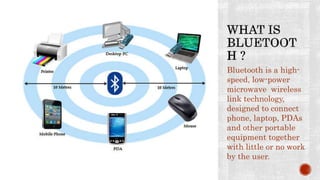
Bluetooth is a high-
speed, low-power
microwave wireless
link technology,
designed to connect
phone, laptop, PDAs
and other portable
equipment together
with little or no work
by the user.
It comprises of a base band processor, a radio and an
antenna. The based-band processor converts the data into
signal, the antenna of another Bluetooth device, within at
least 30 feet distance, receives a transmitted signal in the
air.
It uses a frequency hopping spread spectrum technique
(FHSS) - which is one of two basic modulation technique
used in spread spectrum signal transmission. Frequencies
are switched repeatedly during radio transmission to help
reduce unlawful access or other means of
telecommunications to cross paths and cause
interruption.
Headset
In-car Bluetooth System
Bluetooth Equipped Printer
Bluetooth Equipped Web Cam
Bluetooth GPS System
Bluetooth Keyboard
 These have replaced cables for transferring information
from one electronic devices to another one.
 These have decreased strain like carrying phones while
talking, making hands free to do another work.
 This is cheaply available.
 Its mobility is also very important as it doesn't need any
power outlet or internet connection or any other items.
Advantages
 Eliminates wires
 Facilitates data and voice
communication
 Offers formation of Ad hoc
networks
 Standardized protocol
 Free to charge
 Easy to use
Disadvantages
 Data sent between two
Bluetooth devices is very
slow compared with Wi-Fi
transfer rate.
 Range of a Bluetooth device
is15-30 feed depending upon
the device.
 Security is biggest
disadvantage as transfer
takes place through radio
waves and a hacker can
easily hack it.
 The internet bridge.
 An extension of this modal
could be mobile computer
that allows surfing the
internet irrespective of the
location of the user, and
regardless of whether the
user is cordlessly connected
through a cell phone
(cellular) or through a wire
line connection ( e.g.,
PSTN, ISDN, LAN, xDSL).
 Automatic check-in
 Hotels are testing or plan to
test , services that allow
guests to check in, unlock
room doors and even control
room temperature with
handheld devices equipped
with Bluetooth technology.
 Bluetooth has a good future ahead because it meets a basic need of
connectivity.
 Currently a protocol is being researched that would support large
ad hoc networks.
 Latest version of Bluetooth are improving both its security and
capabilities.
 Ultra wide band has been chosen by the bluetooth special interest
group as the future of bluetooth.
 New versions of Bluetooth technology will meet the high-speed and
large.
 Many companies are designing impressive
A new global standard for data and voice.
 Eliminates cables.
 Low power, low range, Low-cost network devices.
 Bluetooth seems to have a bright future after reviewing
its benefits and wide use.
 Further improvement are planned to be made in:-
• Data Rates
• Power Reduction
• Range.
 [1] Telephonic Interview with Mr. Kamran virk, Multimedia Broadcast
Technologies, at Kingston University London UK, Date May 3, 2009.
 [2] Interview (via phone) with Miss Asma. Four Telecom Pakistan, Date May 2,
2009.
 [3] Mobile Communications, (second edition) Addison Wesley Publications.
 [4] Bluetooth protocol architecture by Sailesh Rathi, Microware Architect.
Microware Systems Corporation. Article available from the internet:
http://www.dedicated-systems.com/Magazine/00q4/2000q4_p028.pdf [Cited
1 May 2009]
Bluetooth technology_new.pptx

Bluetooth technology_new.pptx

  • 1.
    Presented by: SamruddhiJadhav Under Guidance of: Prof. E A Rangari
  • 2.
    1. Introduction 2. Whatis Bluetooth 3. Types of Bluetooth Device 4. Importance of Bluetooth 5. Advantages and Disadvantages 6. ApplicationsFuture of Bluetooth 7. Conclusions 8. References
  • 3.
     This technologyprovide short -range ,wireless connectivity between device .  It is intended to replace the cables connecting portable and/or fixed electronic devices.  Cables limit the mobility of the consumer and are easily lost or broken.
  • 4.
    Bluetooth is ahigh- speed, low-power microwave wireless link technology, designed to connect phone, laptop, PDAs and other portable equipment together with little or no work by the user.
  • 5.
    It comprises ofa base band processor, a radio and an antenna. The based-band processor converts the data into signal, the antenna of another Bluetooth device, within at least 30 feet distance, receives a transmitted signal in the air. It uses a frequency hopping spread spectrum technique (FHSS) - which is one of two basic modulation technique used in spread spectrum signal transmission. Frequencies are switched repeatedly during radio transmission to help reduce unlawful access or other means of telecommunications to cross paths and cause interruption.
  • 6.
    Headset In-car Bluetooth System BluetoothEquipped Printer Bluetooth Equipped Web Cam Bluetooth GPS System Bluetooth Keyboard
  • 7.
     These havereplaced cables for transferring information from one electronic devices to another one.  These have decreased strain like carrying phones while talking, making hands free to do another work.  This is cheaply available.  Its mobility is also very important as it doesn't need any power outlet or internet connection or any other items.
  • 8.
    Advantages  Eliminates wires Facilitates data and voice communication  Offers formation of Ad hoc networks  Standardized protocol  Free to charge  Easy to use Disadvantages  Data sent between two Bluetooth devices is very slow compared with Wi-Fi transfer rate.  Range of a Bluetooth device is15-30 feed depending upon the device.  Security is biggest disadvantage as transfer takes place through radio waves and a hacker can easily hack it.
  • 9.
     The internetbridge.  An extension of this modal could be mobile computer that allows surfing the internet irrespective of the location of the user, and regardless of whether the user is cordlessly connected through a cell phone (cellular) or through a wire line connection ( e.g., PSTN, ISDN, LAN, xDSL).  Automatic check-in  Hotels are testing or plan to test , services that allow guests to check in, unlock room doors and even control room temperature with handheld devices equipped with Bluetooth technology.
  • 10.
     Bluetooth hasa good future ahead because it meets a basic need of connectivity.  Currently a protocol is being researched that would support large ad hoc networks.  Latest version of Bluetooth are improving both its security and capabilities.  Ultra wide band has been chosen by the bluetooth special interest group as the future of bluetooth.  New versions of Bluetooth technology will meet the high-speed and large.  Many companies are designing impressive
  • 11.
    A new globalstandard for data and voice.  Eliminates cables.  Low power, low range, Low-cost network devices.  Bluetooth seems to have a bright future after reviewing its benefits and wide use.  Further improvement are planned to be made in:- • Data Rates • Power Reduction • Range.
  • 12.
     [1] TelephonicInterview with Mr. Kamran virk, Multimedia Broadcast Technologies, at Kingston University London UK, Date May 3, 2009.  [2] Interview (via phone) with Miss Asma. Four Telecom Pakistan, Date May 2, 2009.  [3] Mobile Communications, (second edition) Addison Wesley Publications.  [4] Bluetooth protocol architecture by Sailesh Rathi, Microware Architect. Microware Systems Corporation. Article available from the internet: http://www.dedicated-systems.com/Magazine/00q4/2000q4_p028.pdf [Cited 1 May 2009]