An insight into… By Kenneth Ortega
contents Introduction Uses History Development The Future of Bluetooth
What is it?
What is it? Bluetooth is a form of wireless connection between various devices, ranging from anything such as mobile phones and computers to headphones/headsets and printers .  What Bluetooth is not.
What is it? It enables the user to create a wireless personal area network (PAN) using an unlicensed short range radio frequency. An example of the devices that can be connected wirelessly using Bluetooth
Uses
Uses Bluetooth technology has many different applications, the first common use being connecting mobile phones to hands free sets wirelessly.
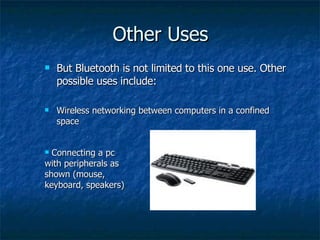
Other Uses But Bluetooth is not limited to this one use. Other possible uses include: Wireless networking between computers in a confined space Connecting a pc with peripherals as shown (mouse, keyboard, speakers)
Other Uses Transfer and synchronization of contacts and other lists between mobile devices Wirelessly connecting controllers to game consoles (Wii, PS3)
History of
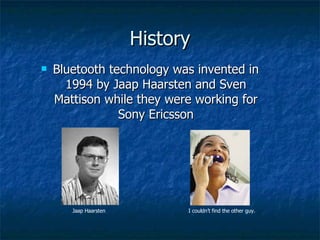
History Bluetooth technology was invented in 1994 by Jaap Haarsten and Sven Mattison while they were working for Sony Ericsson Jaap Haarsten I couldn’t find the other guy.
History It turned out big companies were interested in this new technology
History so in 1998, the Bluetooth Special Interest Group (SIG) was formed. This now includes over 7000 companies worldwide who have an interest and are in charge of developing Bluetooth for future products.
Development of
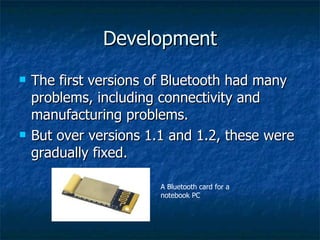
Development The first versions of Bluetooth had many problems, including connectivity and manufacturing problems.  But over versions 1.1 and 1.2, these were gradually fixed.  A Bluetooth card for a notebook PC
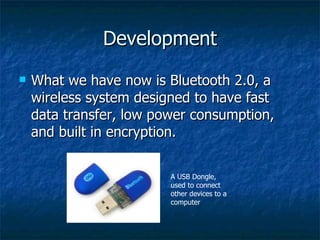
Development What we have now is Bluetooth 2.0, a wireless system designed to have fast data transfer, low power consumption, and built in encryption. A USB Dongle, used to connect other devices to a computer
The Future Of
Future Bluetooth is already a great invention, but it can still be improved further.  Just recently, Bluetooth 2.1 has been developed, which has been refined to give even better connectivity, and even faster data transfer.
Future But this is nowhere near the end of it’s life. Bluetooth 3.0 is already being worked on, which promises up to 160 times the speed of version 1.0 X 160 Faster
Future This vast speed capability would further increase the possible uses of Bluetooth, including:
Future mass Bluetooth networks linking every mobile phone on the planet privately or publicly streaming of high definition audio and video
Future less hassle synchronizing As well as a much longer range
Future Eventually, Bluetooth will replace other wireless transmissions because it will be fast, secure, will have low power consumption, and have a vast range. The possible future of Bluetooth
End

Kenneth Ortega US 5946

  • 1.
    An insight into…By Kenneth Ortega
  • 2.
    contents Introduction UsesHistory Development The Future of Bluetooth
  • 3.
  • 4.
    What is it?Bluetooth is a form of wireless connection between various devices, ranging from anything such as mobile phones and computers to headphones/headsets and printers . What Bluetooth is not.
  • 5.
    What is it?It enables the user to create a wireless personal area network (PAN) using an unlicensed short range radio frequency. An example of the devices that can be connected wirelessly using Bluetooth
  • 6.
  • 7.
    Uses Bluetooth technologyhas many different applications, the first common use being connecting mobile phones to hands free sets wirelessly.
  • 8.
    Other Uses ButBluetooth is not limited to this one use. Other possible uses include: Wireless networking between computers in a confined space Connecting a pc with peripherals as shown (mouse, keyboard, speakers)
  • 9.
    Other Uses Transferand synchronization of contacts and other lists between mobile devices Wirelessly connecting controllers to game consoles (Wii, PS3)
  • 10.
  • 11.
    History Bluetooth technologywas invented in 1994 by Jaap Haarsten and Sven Mattison while they were working for Sony Ericsson Jaap Haarsten I couldn’t find the other guy.
  • 12.
    History It turnedout big companies were interested in this new technology
  • 13.
    History so in1998, the Bluetooth Special Interest Group (SIG) was formed. This now includes over 7000 companies worldwide who have an interest and are in charge of developing Bluetooth for future products.
  • 14.
  • 15.
    Development The firstversions of Bluetooth had many problems, including connectivity and manufacturing problems. But over versions 1.1 and 1.2, these were gradually fixed. A Bluetooth card for a notebook PC
  • 16.
    Development What wehave now is Bluetooth 2.0, a wireless system designed to have fast data transfer, low power consumption, and built in encryption. A USB Dongle, used to connect other devices to a computer
  • 17.
  • 18.
    Future Bluetooth isalready a great invention, but it can still be improved further. Just recently, Bluetooth 2.1 has been developed, which has been refined to give even better connectivity, and even faster data transfer.
  • 19.
    Future But thisis nowhere near the end of it’s life. Bluetooth 3.0 is already being worked on, which promises up to 160 times the speed of version 1.0 X 160 Faster
  • 20.
    Future This vastspeed capability would further increase the possible uses of Bluetooth, including:
  • 21.
    Future mass Bluetoothnetworks linking every mobile phone on the planet privately or publicly streaming of high definition audio and video
  • 22.
    Future less hasslesynchronizing As well as a much longer range
  • 23.
    Future Eventually, Bluetoothwill replace other wireless transmissions because it will be fast, secure, will have low power consumption, and have a vast range. The possible future of Bluetooth
  • 24.