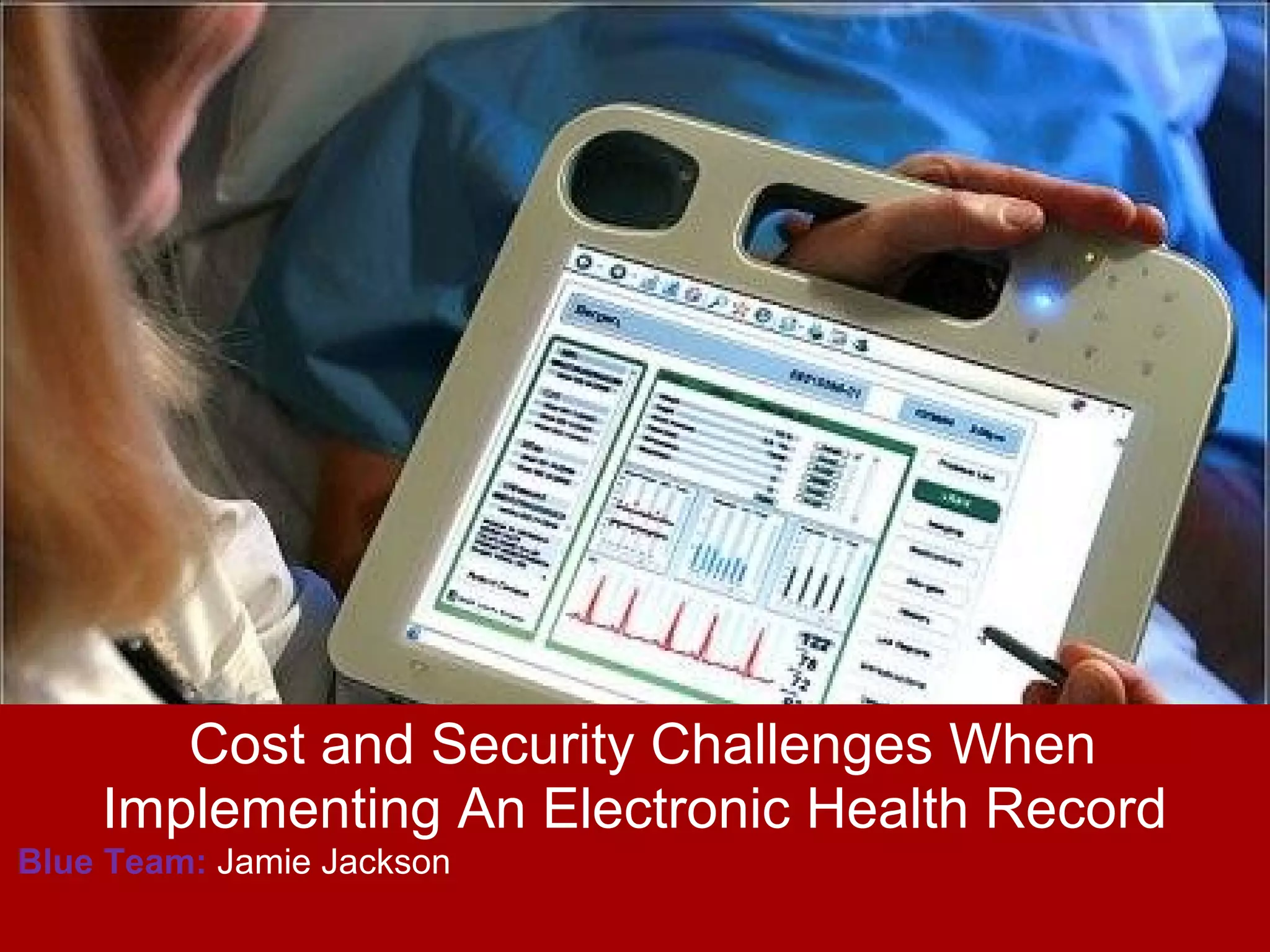
Cost and Security Challenges When
    Implementing An Electronic Health Record
Blue Team: Jamie Jackson
Purpose


 Purpose:
 • Discuss the challenges with cost and security of implementation of
   EHR

 • Discuss the causes and effects of these challenges

 • Discuss possible solutions
Problem Statement


 • With the unrelenting pressure and demand for implementing EHR,
   health care systems in the United States are facing many
   challenges with this process.
 • Two most critical factors underlying these challenges are cost of
   implementation and security during and once implemented
Methodology


   • Utilizing medical journals and other resources, as well as
     interviews with administrators and staff from leading hospitals
     and private practices, and health care organizations we were
     able to analyze the effects of these challenges as well as come
     up with possible solutions.
Healthcare
Organizations
Reviewed
 • Medical Center of Lewisville
    – 202 bed for profit community hospital
 • Children’s Medical Center
    – 559 bed not for profit pediatric hospital
 • Baylor Hospital of Plano
    – 112 bed not for profit county hospital
 • Dallas Associated Dermatologist
    – 50 year old dermatology facility
 • Health Information Management Systems Society
    – National Health Information Organization
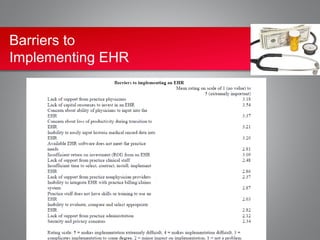
Barriers to
Implementing EHR
Cost Analysis


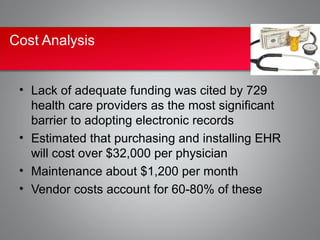
 • Lack of adequate funding was cited by 729
   health care providers as the most significant
   barrier to adopting electronic records
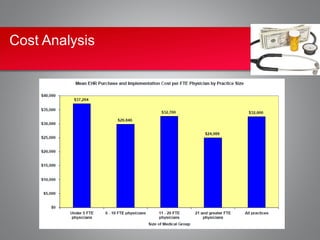
 • Estimated that purchasing and installing EHR
   will cost over $32,000 per physician
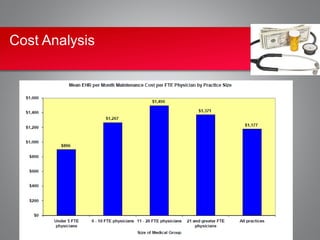
 • Maintenance about $1,200 per month
 • Vendor costs account for 60-80% of these
Cost Analysis


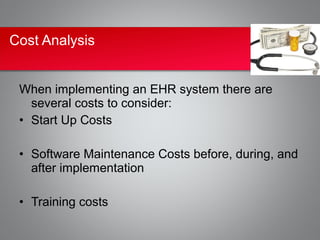
 When implementing an EHR system there are
   several costs to consider:
 • Start Up Costs

 • Software Maintenance Costs before, during, and
   after implementation

 • Training costs
Cost Analysis
Cost Analysis
Security Analysis


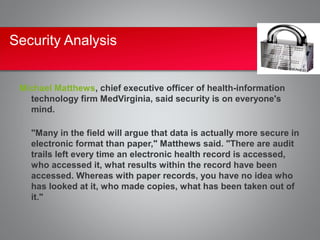
 Michael Matthews, chief executive officer of health-information
   technology firm MedVirginia, said security is on everyone's
   mind.

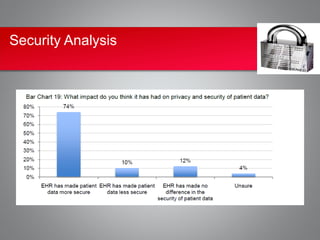
   "Many in the field will argue that data is actually more secure in
   electronic format than paper," Matthews said. "There are audit
   trails left every time an electronic health record is accessed,
   who accessed it, what results within the record have been
   accessed. Whereas with paper records, you have no idea who
   has looked at it, who made copies, what has been taken out of
   it."
Types of Breaches
U.S. Department of Health & Human Services


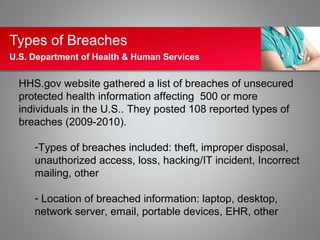
  HHS.gov website gathered a list of breaches of unsecured
  protected health information affecting 500 or more
  individuals in the U.S.. They posted 108 reported types of
  breaches (2009-2010).

     -Types of breaches included: theft, improper disposal,
     unauthorized access, loss, hacking/IT incident, Incorrect
     mailing, other

     - Location of breached information: laptop, desktop,
     network server, email, portable devices, EHR, other
Security Analysis
Security Analysis
Security Analysis
Conclusions


 • This project has provided an opportunity to
   understand the EHR technology system and the
   challenges during implementation as it relates to
   cost and security. Understanding the benefits of
   the technologies and the problems experienced
   by doctors who use the technologies can help
   others make a better decision for their practice.
Findings

 •   No true monetary savings due to the purchasing of new technology, software,
     hiring and ongoing training

 •   Trade off: increased efficiency, accuracy and safety

 •   If any savings it would be among larger institutions, which already draw in
     enough revenue for the funding of EHR systems

 •   Cost outweighed security as the largest concern to the implementation of EHR

 •   Vendors have taken advantage of the necessity of implementing EHR by
     padding their prices

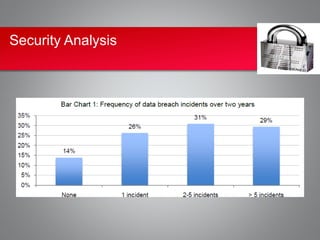
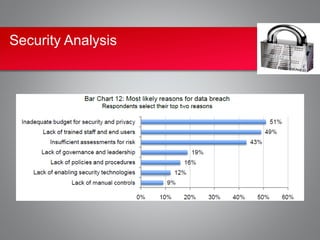
 •   Most security breaches are from carelessness among staff ,lack of training,
     inadequate funding for security
Recommendations


 • Quality leadership that embraces the goals of the organization
   regarding EHR
 • Training, training, training
 • Factor in additional equipment costs needed in addition to EHR
   product
 • Do not try to change the organization to meet the needs of the HER
 • Review and evaluate the organization as well as several different
   products
 • Make sure that EHR chosen is interoperable with technology
   already being used; i.e. billing systems, EMR
 • Look into discounts/perks offered by insurers for EHR use
References


 •   Breaches affecting 500 or more individuals. (2010). Retrieved from
      http://www.hhs.gov/ocr/privacy/hipaa/administrative/breachnotificationrule/postedbreaches.html

 •   Ponemon Institute LLC, Initials. (2010, November 9). Dgs health law blog [Web log message].
                Retrieved from http://www.dgshealthlaw.com/uploads/file/Ponemon_Benchma
          k_Study_on_Patient_Privacy_and_Data_Security%5B1%5D%281%29.pdf
Questions/Answers

Blue team pp_(final_4-12-11)[1]

  • 1.
    Cost and SecurityChallenges When Implementing An Electronic Health Record Blue Team: Jamie Jackson
  • 2.
    Purpose Purpose: •Discuss the challenges with cost and security of implementation of EHR • Discuss the causes and effects of these challenges • Discuss possible solutions
  • 3.
    Problem Statement •With the unrelenting pressure and demand for implementing EHR, health care systems in the United States are facing many challenges with this process. • Two most critical factors underlying these challenges are cost of implementation and security during and once implemented
  • 4.
    Methodology • Utilizing medical journals and other resources, as well as interviews with administrators and staff from leading hospitals and private practices, and health care organizations we were able to analyze the effects of these challenges as well as come up with possible solutions.
  • 5.
    Healthcare Organizations Reviewed • MedicalCenter of Lewisville – 202 bed for profit community hospital • Children’s Medical Center – 559 bed not for profit pediatric hospital • Baylor Hospital of Plano – 112 bed not for profit county hospital • Dallas Associated Dermatologist – 50 year old dermatology facility • Health Information Management Systems Society – National Health Information Organization
  • 6.
  • 7.
    Cost Analysis •Lack of adequate funding was cited by 729 health care providers as the most significant barrier to adopting electronic records • Estimated that purchasing and installing EHR will cost over $32,000 per physician • Maintenance about $1,200 per month • Vendor costs account for 60-80% of these
  • 8.
    Cost Analysis Whenimplementing an EHR system there are several costs to consider: • Start Up Costs • Software Maintenance Costs before, during, and after implementation • Training costs
  • 9.
  • 10.
  • 11.
    Security Analysis MichaelMatthews, chief executive officer of health-information technology firm MedVirginia, said security is on everyone's mind. "Many in the field will argue that data is actually more secure in electronic format than paper," Matthews said. "There are audit trails left every time an electronic health record is accessed, who accessed it, what results within the record have been accessed. Whereas with paper records, you have no idea who has looked at it, who made copies, what has been taken out of it."
  • 12.
    Types of Breaches U.S.Department of Health & Human Services HHS.gov website gathered a list of breaches of unsecured protected health information affecting 500 or more individuals in the U.S.. They posted 108 reported types of breaches (2009-2010). -Types of breaches included: theft, improper disposal, unauthorized access, loss, hacking/IT incident, Incorrect mailing, other - Location of breached information: laptop, desktop, network server, email, portable devices, EHR, other
  • 13.
  • 14.
  • 15.
  • 16.
    Conclusions • Thisproject has provided an opportunity to understand the EHR technology system and the challenges during implementation as it relates to cost and security. Understanding the benefits of the technologies and the problems experienced by doctors who use the technologies can help others make a better decision for their practice.
  • 17.
    Findings • No true monetary savings due to the purchasing of new technology, software, hiring and ongoing training • Trade off: increased efficiency, accuracy and safety • If any savings it would be among larger institutions, which already draw in enough revenue for the funding of EHR systems • Cost outweighed security as the largest concern to the implementation of EHR • Vendors have taken advantage of the necessity of implementing EHR by padding their prices • Most security breaches are from carelessness among staff ,lack of training, inadequate funding for security
  • 18.
    Recommendations • Qualityleadership that embraces the goals of the organization regarding EHR • Training, training, training • Factor in additional equipment costs needed in addition to EHR product • Do not try to change the organization to meet the needs of the HER • Review and evaluate the organization as well as several different products • Make sure that EHR chosen is interoperable with technology already being used; i.e. billing systems, EMR • Look into discounts/perks offered by insurers for EHR use
  • 19.
    References • Breaches affecting 500 or more individuals. (2010). Retrieved from http://www.hhs.gov/ocr/privacy/hipaa/administrative/breachnotificationrule/postedbreaches.html • Ponemon Institute LLC, Initials. (2010, November 9). Dgs health law blog [Web log message]. Retrieved from http://www.dgshealthlaw.com/uploads/file/Ponemon_Benchma k_Study_on_Patient_Privacy_and_Data_Security%5B1%5D%281%29.pdf
  • 20.

Editor's Notes

  • #3 Literature Review