Cybersecurity in Medical
Devices
Post Market Management
Safis Solutions
The Problem
• More and more Medical Devices are
being designed to be networked
with other patient care systems
Ø Networked devices include software that may
be vulnerable to cybersecurity threats
• Safety and Effectiveness Impact
• Risk to Public Health
Ø
The Impact
• Compromised Device Functionality
• Loss of Data Availability or Integrity
Ø Medical
Ø Personal
• Exposure of other connected devices
or networks to security threats
Ø All of the above may lead to potential patient
illness, injury, or death
Scope
• Software containing Medical Devices
• Software that is a Medical Device
Note: Guidance Not Applicable to Experimental or Investigational
Devices
The Solution - FDA’s
Expectation
• Holistic
Ø Includes the entire Product Lifecycle of the device
– from conception to obsolescence
• Not just a point-in-time intervention
Ø Continual monitoring, including post market
Ø E.g. Monitoring vulnerabilities inadvertently
introduced during patch releases
• Device Manufacturers responsible
Ø Proactive, not reactive, posture expected from
manufacturers
Ø Active, voluntary participation in an ISAO
ISAO: Information Sharing Analysis Organizations, per Executive
Order # 13691, released 13th Feb 2015
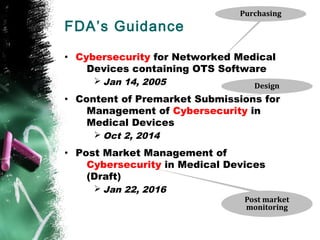
FDA’s Guidance
• Cybersecurity for Networked Medical
Devices containing OTS Software
Ø Jan 14, 2005
• Content of Premarket Submissions for
Management of Cybersecurity in
Medical Devices
Ø Oct 2, 2014
• Post Market Management of
Cybersecurity in Medical Devices
(Draft)
Ø Jan 22, 2016
Purchasing
Post market
monitoring
Design
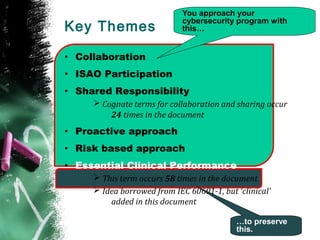
Key Themes
• Collaboration
• ISAO Participation
• Shared Responsibility
Ø Cognate terms for collaboration and sharing occur
24 times in the document
• Proactive approach
• Risk based approach
• Essential Clinical Performance
Ø This term occurs 58 times in the document
Ø Idea borrowed from IEC 60601-1, but ‘clinical’
added in this document
You approach your
cybersecurity program with
this…
…to preserve
this.
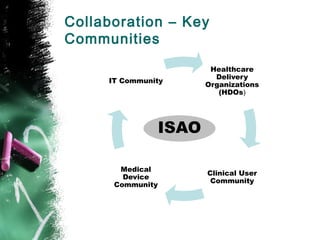
Collaboration – Key
Communities
Healthcare
Delivery
Organizations
(HDOs)
Clinical User
Community
Medical
Device
Community
IT Community
ISAO
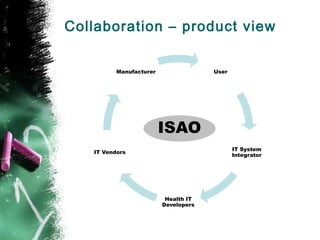
Collaboration – product view
User
IT System
Integrator
Health IT
Developers
IT Vendors
Manufacturer
ISAO
Collaboration
• Advantages
Ø Sharing of established resources
• Standards; Guidelines; Best practices;
Frameworks
Ø Consistent threat assessment & mitigation
• Outputs
Ø Develop a Cybersecurity Risk Management
Culture
Ø Establish a Common Understanding
• Goal
Ø Device safety is preserved
Ø Device effectiveness is not compromised
Comprehensive Cybersecurity
Program
• NIST Framework for improving critical
infrastructure cybersecurity
Ø Identify
Ø Protect
Ø Detect
Ø Respond
Ø Recover
•
http://
www.nist.gov/cyberframework/upload/cybersecurity-framework-021214.p
Identify
• Define Essential Clinical Performance
• Identify Cybersecurity Signals
•
Protect / Detect
• Assess and Characterize Vulnerability
• Analyze Risk (Threat Modeling)
• Analyze Threat Sources
• Incorporate Threat Detection
Capabilities
• ‘Impact Assess’ all Devices
•
Protect / Respond / Recover
• Assess Compensating Controls
Ø Detect / Respond
• Mitigate Risk of Essential Clinical
Performance
•
End Note
• The NIST Framework is mentioned here at
the very highest level
• The purpose of its mention is to simply
raise an awareness
• A separate slide deck is warranted to
delve deeper into what it is and how it
can be implemented
• Individuals are encouraged to ask
questions or provide comments on the
FDA guidance on post market
management of cybersecurity in medical
devices until April 21st of 2016

Cybersecurity in medical devices

  • 1.
    Cybersecurity in Medical Devices PostMarket Management Safis Solutions
  • 2.
    The Problem • Moreand more Medical Devices are being designed to be networked with other patient care systems Ø Networked devices include software that may be vulnerable to cybersecurity threats • Safety and Effectiveness Impact • Risk to Public Health Ø
  • 3.
    The Impact • CompromisedDevice Functionality • Loss of Data Availability or Integrity Ø Medical Ø Personal • Exposure of other connected devices or networks to security threats Ø All of the above may lead to potential patient illness, injury, or death
  • 4.
    Scope • Software containingMedical Devices • Software that is a Medical Device Note: Guidance Not Applicable to Experimental or Investigational Devices
  • 5.
    The Solution -FDA’s Expectation • Holistic Ø Includes the entire Product Lifecycle of the device – from conception to obsolescence • Not just a point-in-time intervention Ø Continual monitoring, including post market Ø E.g. Monitoring vulnerabilities inadvertently introduced during patch releases • Device Manufacturers responsible Ø Proactive, not reactive, posture expected from manufacturers Ø Active, voluntary participation in an ISAO ISAO: Information Sharing Analysis Organizations, per Executive Order # 13691, released 13th Feb 2015
  • 6.
    FDA’s Guidance • Cybersecurityfor Networked Medical Devices containing OTS Software Ø Jan 14, 2005 • Content of Premarket Submissions for Management of Cybersecurity in Medical Devices Ø Oct 2, 2014 • Post Market Management of Cybersecurity in Medical Devices (Draft) Ø Jan 22, 2016 Purchasing Post market monitoring Design
  • 7.
    Key Themes • Collaboration •ISAO Participation • Shared Responsibility Ø Cognate terms for collaboration and sharing occur 24 times in the document • Proactive approach • Risk based approach • Essential Clinical Performance Ø This term occurs 58 times in the document Ø Idea borrowed from IEC 60601-1, but ‘clinical’ added in this document You approach your cybersecurity program with this… …to preserve this.
  • 8.
    Collaboration – Key Communities Healthcare Delivery Organizations (HDOs) ClinicalUser Community Medical Device Community IT Community ISAO
  • 9.
    Collaboration – productview User IT System Integrator Health IT Developers IT Vendors Manufacturer ISAO
  • 10.
    Collaboration • Advantages Ø Sharingof established resources • Standards; Guidelines; Best practices; Frameworks Ø Consistent threat assessment & mitigation • Outputs Ø Develop a Cybersecurity Risk Management Culture Ø Establish a Common Understanding • Goal Ø Device safety is preserved Ø Device effectiveness is not compromised
  • 11.
    Comprehensive Cybersecurity Program • NISTFramework for improving critical infrastructure cybersecurity Ø Identify Ø Protect Ø Detect Ø Respond Ø Recover • http:// www.nist.gov/cyberframework/upload/cybersecurity-framework-021214.p
  • 12.
    Identify • Define EssentialClinical Performance • Identify Cybersecurity Signals •
  • 13.
    Protect / Detect •Assess and Characterize Vulnerability • Analyze Risk (Threat Modeling) • Analyze Threat Sources • Incorporate Threat Detection Capabilities • ‘Impact Assess’ all Devices •
  • 14.
    Protect / Respond/ Recover • Assess Compensating Controls Ø Detect / Respond • Mitigate Risk of Essential Clinical Performance •
  • 15.
    End Note • TheNIST Framework is mentioned here at the very highest level • The purpose of its mention is to simply raise an awareness • A separate slide deck is warranted to delve deeper into what it is and how it can be implemented • Individuals are encouraged to ask questions or provide comments on the FDA guidance on post market management of cybersecurity in medical devices until April 21st of 2016

Editor's Notes

  • #2 1
  • #3 2
  • #4 3
  • #5 4 Software includes firmware and/orprogrammable logic
  • #6 5
  • #7 6 Implications are:responsible purchasing, recognizing cybersecurity issues up front; Cybersecurity as a design consideration; and continual ongoing monitoring of patches post market
  • #8 7