W A L D E N U N I V E R S I T Y
H E A L T H C A R E I N F O R M A T I O N T E C H N O L O G Y
P R O F . P A O N E
P I E R R E J S A N O G U E T R I V E R A
Health Information Systems: Recommendation for
the Acquisition, Implementation, and Support of a
Health Information System
Problems and Opportunities
 Risk Management
 Privacy and security of PHI
 Patient’s medication information
 Organization and defragmentation of big data
 Compatibility with technological platforms and gadgets.
 Operational cost and time flexibility (aging population)
Problems and Opportunities
 Improving Opportunities
 Encrypted PHI.
 Privacy, security and HITECH compliance
 Operational cost reduction
 Organization and communication improvements
 Secure and faster sharing of information
 Compatibility with interfaces, applications, and other systems.
Legal and regulatory concerns
 Amount of data (Negligence)
 “Respondeat Superior”
 HIPAA violation concerns
 Documentation related issues (Copy-Paste)
 CDSS recommendations
 Clauses forbidding disclosure of EHR safety
problems
 HIE exchanges data privacy.
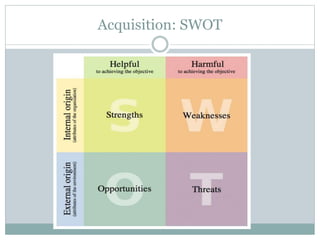
Acquisition: SWOT
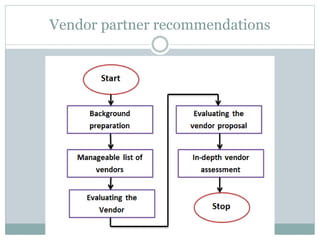
Vendor partner recommendations
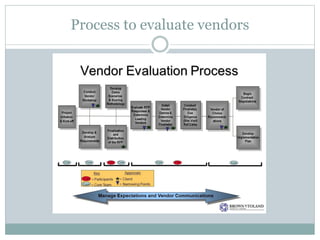
Process to evaluate vendors
Planning: Scope of the project
 Health Information Technology should be compliant
and supportive to:
 Organization’s vision and mission
 Expansion requirements
 Address privacy and security concerns
 Improve communication and prescription weak points
 Feasibility Assessment
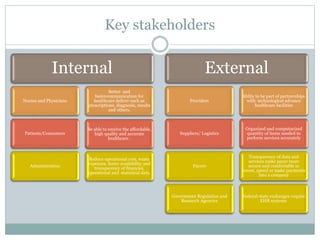
Key stakeholders
Internal
Nurses and Physicians
Patients/Consumers
Administration
Better and
fastercommunication for
healthcare deliver such as
prescriptions, diagnosis, results
and others.
Be able to receive the affordable,
high quality and accurate
healthcare .
Reduce operational cost, waste
expenses, faster availability and
transparency of financial,
operational and statistical data.
External
Providers
Suppliers/ Logistics
Payers
Government Regulation and
Research Agencies
Ablity to be part of partnerships
with technological advance
healthcare facilities
Organized and computarized
quantity of items needed to
perform services accurately
Transparency of data and
services make payer more
secure and comfortable to
invest, spend or make payments
into a company
Federal-state exchanges require
EHR systems.
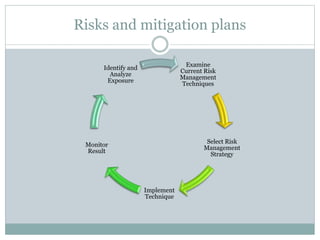
Risks and mitigation plans
Examine
Current Risk
Management
Techniques
Select Risk
Management
Strategy
Implement
Technique
Monitor
Result
Identify and
Analyze
Exposure
Financial justification
Acquiring and Implementing successfully a EHR
system will impact the organization finances.
 Operational Cost
 Reduce Errors
 HITECH
 HIE
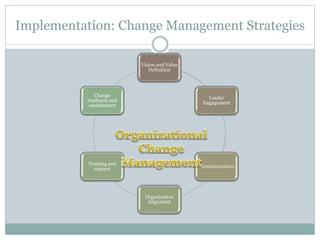
Implementation: Change Management Strategies
Vision and Value
Definition
Leader
Engagement
Communication
Organization
Alignment
Training and
support
Change
readiness and
sustainment
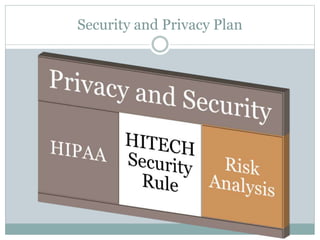
Security and Privacy Plan
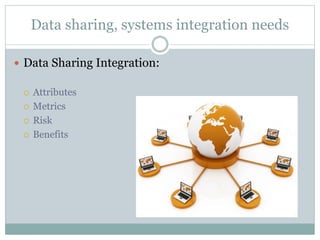
Data sharing, systems integration needs
 Data Sharing Integration:
 Attributes
 Metrics
 Risk
 Benefits
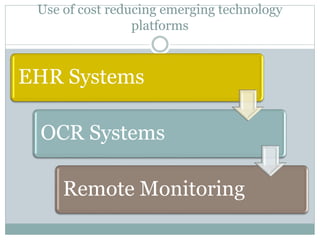
Use of cost reducing emerging technology
platforms
EHR Systems
OCR Systems
Remote Monitoring
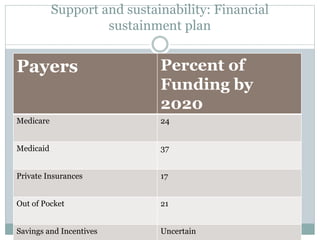
Support and sustainability: Financial
sustainment plan
Payers Percent of
Funding by
2020
Medicare 24
Medicaid 37
Private Insurances 17
Out of Pocket 21
Savings and Incentives Uncertain
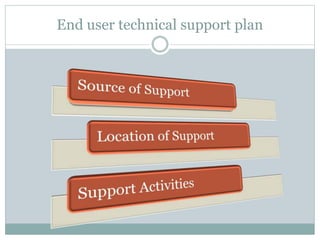
End user technical support plan
Potential fit with emerging industry technologies
 Intuitive Computer Interfaces
 Advance technology and Long Term Care
 Touchscreens interfaces
 Social connectedness
 Entertainment
 Brain fitness technology
References
Optical Character Recognition Technology in Health Care. (n.d.). Retrieved May 13, 2016, from
http://www.cvisiontech.com/library/ocr/file-ocr/the-use-of-optical-character-recognition-in-health-care.html
HealthIT.gov. (n.d.). Retrieved May 13, 2016, from https://www.healthit.gov/providers-professionals/faqs/how-do-i-select-vendor
HIT/EHR Vendor Contracting Checklist [Pdf]. (2011). Michigan State Medical Society.
McCall, N. (n.d.). Long Term Care: Definition, Demand,Cost,and Financing [Pdf].http://www.ache.org/pubs/1mccall.pdf
Data integration issues that a lean integration strategy can solve. (n.d.). Retrieved May 13, 2016, from
http://searchdatamanagement.techtarget.com/tutorial/Data-integration-issues-that-a-lean-integration-strategy-can-solve
Defining Change. (n.d.). Retrieved May 13, 2016, from http://www.parkeravery.co m/pov_Defining_Change_Manage ment.html
Understanding end-user support for health information technology: A theoretical framework | Shachak | Journal of Innovation in
Health Informatics. (n.d.). Retrieved May 13, 2016, from http://hijournal.bcs.org/index.p hp/jhi/article/view/810/822
Sittig, D. F., & Singh, H. (n.d.). Legal, Ethical, and Financial Dilemmas in Electronic Health Record Adoption and Use. Retrieved May
13, 2016, from http://www.ncbi.nlm.nih.gov/pmc/articles/PMC3065078/
 Noraziani, K. (2013). An Overview of Electronic Medical Record Implementation in
Healthcare System: Lesson to Learn [Pdf]. Department of Community Health, Universiti
Kebangsaan Malaysia Medical Centre, Malaysia 1 Center for Applied Management
Studies, 2 Faculty of Business Management, University Technology MARA, Malaysia.
 Wager, K. A., Lee, F. W., & Glaser, J. P. (2013). Health care information systems: A
practical approach for health care management (3rd ed.). San Francisco, CA: Jossey-
Bass.Chapter 11, “Security of Health Care Information Systems” (pp. 351-391)
 Improving Quality in Long-Term Care. (n.d.). Retrieved March 21, 2016, from
http://www.commonwealthfund.org/publications/literature-
abstracts/2010/aug/improving-quality-in-long-term-care
 New CMS rules may spur EHR uptake. (2015). Retrieved May 13, 2016, from
http://www.healthcareitnews.com/news/long-term-cares-digital-moment
 Sheehan, P. (n.d.). Technology takes off in long-term care. Retrieved May 13,
2016, from http://www.ltlmagazine.com/article/technology-takes-long-term-
care

WK11HIT

  • 1.
    W A LD E N U N I V E R S I T Y H E A L T H C A R E I N F O R M A T I O N T E C H N O L O G Y P R O F . P A O N E P I E R R E J S A N O G U E T R I V E R A Health Information Systems: Recommendation for the Acquisition, Implementation, and Support of a Health Information System
  • 2.
    Problems and Opportunities Risk Management  Privacy and security of PHI  Patient’s medication information  Organization and defragmentation of big data  Compatibility with technological platforms and gadgets.  Operational cost and time flexibility (aging population)
  • 3.
    Problems and Opportunities Improving Opportunities  Encrypted PHI.  Privacy, security and HITECH compliance  Operational cost reduction  Organization and communication improvements  Secure and faster sharing of information  Compatibility with interfaces, applications, and other systems.
  • 4.
    Legal and regulatoryconcerns  Amount of data (Negligence)  “Respondeat Superior”  HIPAA violation concerns  Documentation related issues (Copy-Paste)  CDSS recommendations  Clauses forbidding disclosure of EHR safety problems  HIE exchanges data privacy.
  • 5.
  • 6.
  • 7.
  • 8.
    Planning: Scope ofthe project  Health Information Technology should be compliant and supportive to:  Organization’s vision and mission  Expansion requirements  Address privacy and security concerns  Improve communication and prescription weak points  Feasibility Assessment
  • 9.
    Key stakeholders Internal Nurses andPhysicians Patients/Consumers Administration Better and fastercommunication for healthcare deliver such as prescriptions, diagnosis, results and others. Be able to receive the affordable, high quality and accurate healthcare . Reduce operational cost, waste expenses, faster availability and transparency of financial, operational and statistical data. External Providers Suppliers/ Logistics Payers Government Regulation and Research Agencies Ablity to be part of partnerships with technological advance healthcare facilities Organized and computarized quantity of items needed to perform services accurately Transparency of data and services make payer more secure and comfortable to invest, spend or make payments into a company Federal-state exchanges require EHR systems.
  • 10.
    Risks and mitigationplans Examine Current Risk Management Techniques Select Risk Management Strategy Implement Technique Monitor Result Identify and Analyze Exposure
  • 11.
    Financial justification Acquiring andImplementing successfully a EHR system will impact the organization finances.  Operational Cost  Reduce Errors  HITECH  HIE
  • 12.
    Implementation: Change ManagementStrategies Vision and Value Definition Leader Engagement Communication Organization Alignment Training and support Change readiness and sustainment
  • 13.
  • 14.
    Data sharing, systemsintegration needs  Data Sharing Integration:  Attributes  Metrics  Risk  Benefits
  • 15.
    Use of costreducing emerging technology platforms EHR Systems OCR Systems Remote Monitoring
  • 16.
    Support and sustainability:Financial sustainment plan Payers Percent of Funding by 2020 Medicare 24 Medicaid 37 Private Insurances 17 Out of Pocket 21 Savings and Incentives Uncertain
  • 17.
    End user technicalsupport plan
  • 18.
    Potential fit withemerging industry technologies  Intuitive Computer Interfaces  Advance technology and Long Term Care  Touchscreens interfaces  Social connectedness  Entertainment  Brain fitness technology
  • 19.
    References Optical Character RecognitionTechnology in Health Care. (n.d.). Retrieved May 13, 2016, from http://www.cvisiontech.com/library/ocr/file-ocr/the-use-of-optical-character-recognition-in-health-care.html HealthIT.gov. (n.d.). Retrieved May 13, 2016, from https://www.healthit.gov/providers-professionals/faqs/how-do-i-select-vendor HIT/EHR Vendor Contracting Checklist [Pdf]. (2011). Michigan State Medical Society. McCall, N. (n.d.). Long Term Care: Definition, Demand,Cost,and Financing [Pdf].http://www.ache.org/pubs/1mccall.pdf Data integration issues that a lean integration strategy can solve. (n.d.). Retrieved May 13, 2016, from http://searchdatamanagement.techtarget.com/tutorial/Data-integration-issues-that-a-lean-integration-strategy-can-solve Defining Change. (n.d.). Retrieved May 13, 2016, from http://www.parkeravery.co m/pov_Defining_Change_Manage ment.html Understanding end-user support for health information technology: A theoretical framework | Shachak | Journal of Innovation in Health Informatics. (n.d.). Retrieved May 13, 2016, from http://hijournal.bcs.org/index.p hp/jhi/article/view/810/822 Sittig, D. F., & Singh, H. (n.d.). Legal, Ethical, and Financial Dilemmas in Electronic Health Record Adoption and Use. Retrieved May 13, 2016, from http://www.ncbi.nlm.nih.gov/pmc/articles/PMC3065078/
  • 20.
     Noraziani, K.(2013). An Overview of Electronic Medical Record Implementation in Healthcare System: Lesson to Learn [Pdf]. Department of Community Health, Universiti Kebangsaan Malaysia Medical Centre, Malaysia 1 Center for Applied Management Studies, 2 Faculty of Business Management, University Technology MARA, Malaysia.  Wager, K. A., Lee, F. W., & Glaser, J. P. (2013). Health care information systems: A practical approach for health care management (3rd ed.). San Francisco, CA: Jossey- Bass.Chapter 11, “Security of Health Care Information Systems” (pp. 351-391)  Improving Quality in Long-Term Care. (n.d.). Retrieved March 21, 2016, from http://www.commonwealthfund.org/publications/literature- abstracts/2010/aug/improving-quality-in-long-term-care  New CMS rules may spur EHR uptake. (2015). Retrieved May 13, 2016, from http://www.healthcareitnews.com/news/long-term-cares-digital-moment  Sheehan, P. (n.d.). Technology takes off in long-term care. Retrieved May 13, 2016, from http://www.ltlmagazine.com/article/technology-takes-long-term- care

Editor's Notes

  • #3 Right now, Bethany’s Place is dealing with obsolete privacy and security techniques to protect PHI files. Patients’ medications and prescriptions could provide confidential information to unknown individuals of not contained in safe locations, Not being compliant with the HIPAA and HITECH standards broadens the chances of security failure and private information breaches, besides being fined a penalty for avoidance of the Meaningful Use clause in the HITECH law (Wager, K. A., Lee, F. W., & Glaser, J. P. (2013). Compatibility and communication with other systems and facilities could be crippled and if possible it is probably that communication has to be transmitted through poor security applications. Being able to communicate effectively through other systems and with different systems within the organization plays a key role to determine operational cost reduction rates as long term care demand is rising every year due to aging population. It is important to implement policies and procedures that provide time flexibility, communication efficiency and solid security techniques.
  • #4 HIT implementation could provide more reliable security techniques adoption like: Encrypted PHI Firewall Protection Proxy Servers Protection Access control techniques [(Wager, K. A., Lee, F. W., & Glaser, J. P. (2013). ] Privacy and PHI management measures are a concern when implementing EHR systems and other HIT systems. It is necessary to address and identify weaknesses in PHI management operations to focus attention to the areas that need higher priority. This includes patients’ medications and prescription security. There must be specific locations to hide or protect patient medications with personal information that could link a patients identity and a condition. The amount of data collected by HIT systems like EHR keeps piling up over the years, this could bring new safety concerns regarding possible negligence of nurses or physicians if its not kept updated and well organized (Wager, K. A., Lee, F. W., & Glaser, J. P. (2013). EHR systems implementations in Long Term facilities like Bethany’s Place are key to enhance the organization’s performance through new technological systems that could communicate with other systems through website networks, applications, software and servers. Through the meaningful use of technology operational cost could be decreased saving money for Bethany’s Place sustainment. Also, as communication and efficiency improves, the time invested in other issues that are going to be addressed by the adoption of HIT, is now more flexible to address other challenges of Bethany’s Place.
  • #5 Since the amount of data that comes from all EHR systems hardware in the facility is piling up day by day, this information becomes a large mountain of data that if not managed correctly could create negligence issues as nurses can unwillingly skip information on records and give a wrong treatment to a patient. Even further, if a case of negligence happens, the facility could be vulnerable to a lawsuit by the Respondeant Superior rule, which makes responsible an individual or a board responsible for not providing the correct tools or supervision (Sittig, D. F., & Singh, H.). HIPAA violation concerns among HER system are mainly because of: System failure Poor access control techniques Vulnerable location of hardware Network poor security standards. Another concern that could bring legal action against the facility could be documentation related issues meaning that, wrong information could be entered into the electronic record, copied into other sharing records and spread to other healthcare facilities who need related information of a specific patient’s record (Sittig, D. F., & Singh, H.). This could lead to negligence events since wrong information in a record could imply or restraint a patient from getting a wrong or right treatment. In order to improve EHR systems it is necessary to report EHR failures and safety hazards, however some vendors and companies forbids any disclosure of information about their product to federal sources.
  • #6 Strenghts: Safeguarding Information Confidentiality Reduces the possibility of lost health records Improve originality and quality of documentation Improve communication between providers Cost Saving Weakness High adoption cost Limitation on interoperability Lead to medical errors Require comprehensive staff Variation in software packages Vulnerable to threats Opportunities Reduce billing errors Improving report activities Support in decision making Improve practices for higher demand of services Threats Privacy issues System failure Users’ resistance to implementation Human- human interaction decreased.
  • #7 It is important to first, gather all possible information about market options, knowing what you need to address the challenges is imperative before starting to look for vendor options. If it is necessary to invest in HIT, then a list of the best qualified vendors must be done (www.healthit.gov/). An analysis of each vendor and its product is important to reveal the most accurate product you need according to the necessities of the organization, in this case an EHR system. A SWOT analysis is demonstrated to give a good picture of a vendor’s product quality, licenses and weaknesses to evaluate each vendor. Evaluating the vendor’s proposal focuses on imagining how the EHR system would effectively address the challenges Bethany’s Place need. This could include trying demos and other trial products to test the product’s performance (Michigan State Medical Society, 2011).
  • #9 A feasibility study is needed before investing in any kind of business or project, specially high cost initiatives. The feasibility study focuses on the cost required and the revenue to be attained, this could gives us an idea of what implementation strategies should be used and if its needed to think in other solutions.
  • #11 A risk analysis assessment is required by the HIPAA stated in the security rule (Wager, K. A., Lee, F. W., & Glaser, J. P. (2013). Risk analysis involves creating an assessment of potential risk and vulnerabilities of the integrity and privacy of PHI files. A risk analysis assessment makes possible to create and develop risk management programs or policies to address the weak spots found during the risk analysis. Boundary definition is a process of investigating and indentify all information inventories through the facility. Identification of possible threats as human, environmental or natural gives a heads up in order to define risk management policies. Examine current security controls adds valuable information to detect actual or potential vulnerabilities to determine priorities and rating levels of vulnerabilities(Wager, K. A., Lee, F. W., & Glaser, J. P. (2013). Once the vulnerabilities are rated they must be analyzed as how they would impact the organization if a breach was successful and categorize as high, medium or low according to the severity of the event. Once gathered all that information is possible to generate a risk management strategy to implement safeguard policies and procedures to avoid at all cost actions that could put at risk the security and privacy of PHI.
  • #12 Adoption and implementation of an EHR system is expected to lower operational cost. As paper is switched to electronic databases, less operation resources are needed such as administration paperwork, faxes and others. Though the use of coding is less common to produce billing errors and if there is one, it can be corrected relatively easily (www.ache.org/). By adopting an EHR system, Bethany’s Place will be in compliance with HITECH law and the Meaningful Use clause and participate in health information exchanges, this can avoid federal penalties and depending could make Bethany’s Place eligible for incentives or subsidies.
  • #13 Change management is planning and implementing tools, procedures and values for managing the people side of change necessary to reach the best outcomes of an initiative. In this process must participate targeted employees or departments, IT professionals and stakeholders. As Bethany’s Place is taking a big transformation from paper based to electronic data, organizational management strategies shall come handy in order to lead nurses, physicians and patients through this organizational change. There are many change management strategies like Kotter’s International Change Management Model, that address specific conditions of change management to specific industrial environments. Since Bethany’s Place is a long term care facility, its patients are senior citizens it is important to take change slow and firm without compromising the health or privacy of each one of the patients. Therefore, Kotter’s international Change Model makes a perfect fit in 8 steps to drive Bethany’s Place to reach the best outcomes for the EHR implementation initiative.
  • #14 Following guidelines of HIPAA, HITECH and Risk Analysis assessments should provide Bethany’s Place a solid privacy and security settings to implement and operate the HIT initiative successfully (Wager, K. A., Lee, F. W., & Glaser, J. P. (2013). Security and Privacy Plan consist of: Workforce Security: requires implementation of policies to ensure employees proper access to PHI according to their role. Information Access Management: implement policies for authorizing access to PHI. Security Awareness and Training: implementation of awareness and training programs for the workforce. Security Incident reports: implementation of policies regarding security breaches incidents. Contigency plan: Ellaborate procedures for recovery of information such as data backup, disaster recovery plan and emergency mode operation plan. Evaluation: requires periodically performing technical and non technical evaluations to identify changes that compromises security settings. Physical, Technical and Administrative safeguards: implement policies regarding location of information, management of information and security of information within software and hardware tools in order to ensure confidentiality and privacy. [(Wager, K. A., Lee, F. W., & Glaser, J. P. (2013). ]
  • #15 Metrics applies to managing tools capable of provide: Non duplicate data entry Number of interfaces between systems Relevance of core data Validation of non duplicate data Attributes: Data sharing Common database Fewer data redundancy Data Synchronization Data security Industry standards and applications working together Platform Compatibility User Friendly interface Real time data Risk Security and control of data access Single point failure impact Difficulty adapting software to business Misunderstanding of data by others Complexity of interdependencies Benefits Available, meaningful and accurate data Efficiency and productivity Improved customer service, reduced cost and less maintenance. Easier to learn and train Reduced paper, data transparency and assistance for legal issues Standarized procedures, competitive advantage, empower employees. In order for HIT to be integrated to Bethany’s Place visions and missions it needs all of the components from all the four basic elements of integration. Alignment of these elements into a targeted mission, ensure that sharing data through Bethany’s Place systems will be integrated and proffesional compliant with laws and regulations.
  • #16 EHR systems, optical character recognition systems and remote monitoring applications and devices are some of the technologies that are cost reducing services in the healthcare industry. EHR systems reduce operational cost by improving many elements of quality and efficiency within healthcare facilities by keeping electronic records of patients. OCR systems are more inclined to administrative or billing tools, these “scanners are capable of transferring information accurately from paper to other wireless systems or devices, making the information accessible faster and more accurate in other systems (www.cvisiontech.com). Remote monitoring consist in new HIT advancements that are still being studied, so far it has demonstrated cost reduction for hospitals with ICU facilities and readmission decrease. Remote monitoring could become very handy for Bethany’s Place as a future initiative, that could put Bethany’s Place above many other long term care settings and providing better outcomes.
  • #17 Long term care will face one of the biggest challenges of all time in the history of healthcare. Aging population is everyday more and more, it is estimated that more than 30 percent of the population by 2020 will be above 60 and 70 percent of those 30 percent will need in time long term care services. It is expected that private insurances for long term care will raise their prices and the private sector will play an active roll in long term care. By 2020 it is expected that Medicare and Medicaid will be responsible for more of the 50 percent of the revenues for long term care. However Medicare is expecting to cut their benefits and change their eligibility standards (www.commonwealthfund.org). Medicaid and private insurance will have a growth in long term spending. Revenues from savings and cost reduction can vary according to each facility and their implementation policies. However, adopting EHR does not make Bethany’s Place eligible to receive federal incentives for being in compliance with the HITECH law, nevertheless it is important that long term care facilities adopt EHR systems in order to communicate with other healthcare settings and share information to authorized stakeholders (www.healthcareitnews.com).
  • #18 The Source and Location of Support The source of support can come from another person or entity whose purpose is to assist users with technical difficulties. Support can come from a person but can also come from videos, audios or tutorials that explain in detail and are capable of answering users’ questions. Furthermore, the assistance can be performed physically or remotely. In other words, the source of assistance can be built in the facilities or can be installed outside of the main facilities. Remote support could be telephone services, internet videos or tutorials or software help programs (www.healthcareitnews.com). Support Activities Activities or actions that promote user friendly tools to find answers to their hardware or software insecurities or failures can be identified as support activities. Therefore, we can classify different activities into: Infrastructure support: relates to acquisition of hardware, websites, networks and periodically update them and keep running good. Software support: related to software updates, bug fixes and other programming developing issues. Functional support: relates to how to teach and learn to use full capacity of the technology provided. Data support: relates to data backup, data recovery and data input into IT receivers. Training and education support: extensive support feature that enable users to learn how to use software applications, counseling before and after implementation and integrate knowledge with all aspects of HIT and clinical data. [(www.healthcareitnews.com)].
  • #19 Technology and Long Term Care werent often words that linked one with each other, however LTC has advanced as much as other healthcare settings. Intuitive computer interfaces provide touchscreens interfaces to make it easier for seniors if they don’t feel comfortable using a mouse. This technology provide social inclusion feelings to patients who often feel abandoned or alone turning to depressive moods at some times. Internet entertainment could be used as a therapy tool to distract their thoughts and improve in their social and character moods. It is possible to take advantages over other healthcare settings by exercising brain fitness, memory puzzles and other activities to encourage critical thinking (http://www.ltlmagazine.com/).