Electronic Medical Records  & HITECH Lyon, Popanz     Forester May 13, 2009 An Introduction to:
Topics Origin and dollars Requirements Scope Status of implementation What’s different? Getting started
$19.2 billion for health information technology http://content.nejm.org/cgi/content/full/NEJMp0900665?query=TOC   Part of $787 billion economic stimulus   package American Recovery and Reinvestment Act of 2009 The Health Information Technology for Economic and Clinical Health Act or  HITECH The origin and the dollars
What does HITECH require? Provides incentives to hospitals and doctor's offices to move to electronic medical records There are incentives to and penalties for failure to  Use a “certified” EHR Demonstrate “meaningful use” of an EHR
Use a “certified” EHR The act does not specify what “certification” will mean or who will provide certification
Demonstrate “meaningful use” of EHR Health and Human Services (HHS) will define “meaningful use” which will include:  e-Prescribing over the Internet.  Electronically exchange clinical information with labs, hospitals, providers, and payers including Medicare and Medicaid  Submit clinical quality measures including payer-specific quality measures
We’ve been here before At this point there is only Vague direction A target date: 5 years Uncertainty Similar to HIPAA Y2K Mergers
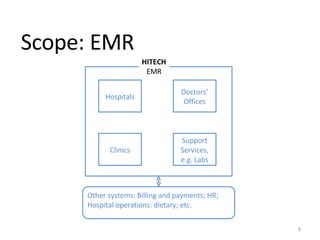
Scope: EMR Other systems: Billing and payments; HR; Hospital operations: dietary; etc. Hospitals Doctors’ Offices Clinics Support Services, e.g. Labs HITECH EMR
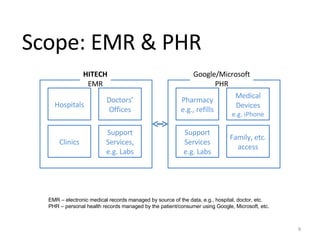
Scope: EMR & PHR EMR – electronic medical records managed by source of the data, e.g., hospital, doctor, etc. PHR – personal health records managed by the patient/consumer using Google, Microsoft, etc. HITECH EMR Hospitals Doctors’ Offices Clinics Support Services, e.g. Labs Google/Microsoft PHR Pharmacy e.g., refills Medical Devices  e.g. iPhone Support Services e.g. Labs Family, etc. access
Scope/Value/Quality A complete accurate record that is available  now  is far more valuable than one that is incomplete or has errors or is “off line” The value is in the network, the number of participants, and the quality of the data These are the basic lessons of the Internet
Status of Implementation The Wall Street Journal identified 10 types of EMR systems and assessed their implementation in hospitals: Highest: Laboratory Results 75% Lowest: Physician’s Notes & Clinical Guidelines:15% All others: 27% to 52% Full EMR: 1.5% of US hospitals * The survey did not address the question of whether or not these systems can be integrated into a common network without significant modification or replacement http://online.wsj.com/article_email/SB124104350516570503-lMyQjAxMDI5NDAxMTAwNDEzWj.html   April 30, 2009 *  There are about 5,000 hospitals of which about 3,000 have 100 beds or more
What’s different about EMR? Hospitals have had electronic records for years: payroll, HR, inventory …  What’s different? Part of the evolution toward system complexity that is happening in all industries, e.g., enterprise resource planning systems Increasing data exchange between systems within and outside the enterprise, e.g., payments processing systems Public access to real time data, e.g., home banking, iPhone apps
What’s different? Complexity More interfaces between systems inside and outside the enterprise Multiple use of some data elements The need for nationwide data and interface standardization Real time data acquisition and delivery Data integrity and error correction Security, security, …
How do you manage complexity? Manage at a very high level to assure common direction, visibility and coordination Manage at a very low levels to control the quality of systems, interfaces and data Communicate between the two with a maximum of value and minimum of overhead
What do you do at the top level? A “living strategy” to reflect the: Evolving nature of the uses of information Improvements in tools to deliver information Clarification of regulations as they are developed Growth and changes in the institution Changes in the  practice of medicine
What do you do at the application and infrastructure level? Projects and interfaces to define and manage the development and enhancement at the level of applications and infrastructure
How do you manage the levels? A project management office to coordinate the evolution of:  The living strategy and  The design and progress of projects A communication structure that provides the information that is needed when, where and to whom it is needed
Where should you start? Process Start with a process that will focus your efforts You don’t need to do everything at square one You can’t do everything at square one Designate a process manager who has started large, vague and time driven projects before, e.g.,  HIPAA ,  Y2K , mergers Build a small team
Where should you start? Team Create a team to focus and define: Scope and interfaces for ERM at your facility External status: regulatory, standards, vendor solutions, sources of support … Internal status: records processes, systems, infrastructure, plans … keep, modify, replace, add “ Success” for your organization High level strategy for organization , planning and budgeting
We have worked in the white space of  organizations … including HIPAA, Y2K, mergers and the implementation of evolving regulations The white spaces of organizations occur on  organization charts between internal  departments, in contractual ambiguity and regulatory complexity. They are places where functional  misunderstandings occur,  communication falters, roles change, priorities conflict, rewards are unclear,  risks are unknown, and managers  sometimes see threats to their careers  that outweigh the opportunities.  We work in those white spaces to  define problems so they can be solved,  design solutions so they can be implemented, and structure implementation so it can be managed. Hal Amens [email_address]

EMR Intro

  • 1.
    Electronic Medical Records & HITECH Lyon, Popanz  Forester May 13, 2009 An Introduction to:
  • 2.
    Topics Origin anddollars Requirements Scope Status of implementation What’s different? Getting started
  • 3.
    $19.2 billion forhealth information technology http://content.nejm.org/cgi/content/full/NEJMp0900665?query=TOC Part of $787 billion economic stimulus package American Recovery and Reinvestment Act of 2009 The Health Information Technology for Economic and Clinical Health Act or HITECH The origin and the dollars
  • 4.
    What does HITECHrequire? Provides incentives to hospitals and doctor's offices to move to electronic medical records There are incentives to and penalties for failure to  Use a “certified” EHR Demonstrate “meaningful use” of an EHR
  • 5.
    Use a “certified”EHR The act does not specify what “certification” will mean or who will provide certification
  • 6.
    Demonstrate “meaningful use”of EHR Health and Human Services (HHS) will define “meaningful use” which will include: e-Prescribing over the Internet. Electronically exchange clinical information with labs, hospitals, providers, and payers including Medicare and Medicaid Submit clinical quality measures including payer-specific quality measures
  • 7.
    We’ve been herebefore At this point there is only Vague direction A target date: 5 years Uncertainty Similar to HIPAA Y2K Mergers
  • 8.
    Scope: EMR Othersystems: Billing and payments; HR; Hospital operations: dietary; etc. Hospitals Doctors’ Offices Clinics Support Services, e.g. Labs HITECH EMR
  • 9.
    Scope: EMR &PHR EMR – electronic medical records managed by source of the data, e.g., hospital, doctor, etc. PHR – personal health records managed by the patient/consumer using Google, Microsoft, etc. HITECH EMR Hospitals Doctors’ Offices Clinics Support Services, e.g. Labs Google/Microsoft PHR Pharmacy e.g., refills Medical Devices e.g. iPhone Support Services e.g. Labs Family, etc. access
  • 10.
    Scope/Value/Quality A completeaccurate record that is available now is far more valuable than one that is incomplete or has errors or is “off line” The value is in the network, the number of participants, and the quality of the data These are the basic lessons of the Internet
  • 11.
    Status of ImplementationThe Wall Street Journal identified 10 types of EMR systems and assessed their implementation in hospitals: Highest: Laboratory Results 75% Lowest: Physician’s Notes & Clinical Guidelines:15% All others: 27% to 52% Full EMR: 1.5% of US hospitals * The survey did not address the question of whether or not these systems can be integrated into a common network without significant modification or replacement http://online.wsj.com/article_email/SB124104350516570503-lMyQjAxMDI5NDAxMTAwNDEzWj.html April 30, 2009 * There are about 5,000 hospitals of which about 3,000 have 100 beds or more
  • 12.
    What’s different aboutEMR? Hospitals have had electronic records for years: payroll, HR, inventory … What’s different? Part of the evolution toward system complexity that is happening in all industries, e.g., enterprise resource planning systems Increasing data exchange between systems within and outside the enterprise, e.g., payments processing systems Public access to real time data, e.g., home banking, iPhone apps
  • 13.
    What’s different? ComplexityMore interfaces between systems inside and outside the enterprise Multiple use of some data elements The need for nationwide data and interface standardization Real time data acquisition and delivery Data integrity and error correction Security, security, …
  • 14.
    How do youmanage complexity? Manage at a very high level to assure common direction, visibility and coordination Manage at a very low levels to control the quality of systems, interfaces and data Communicate between the two with a maximum of value and minimum of overhead
  • 15.
    What do youdo at the top level? A “living strategy” to reflect the: Evolving nature of the uses of information Improvements in tools to deliver information Clarification of regulations as they are developed Growth and changes in the institution Changes in the practice of medicine
  • 16.
    What do youdo at the application and infrastructure level? Projects and interfaces to define and manage the development and enhancement at the level of applications and infrastructure
  • 17.
    How do youmanage the levels? A project management office to coordinate the evolution of: The living strategy and The design and progress of projects A communication structure that provides the information that is needed when, where and to whom it is needed
  • 18.
    Where should youstart? Process Start with a process that will focus your efforts You don’t need to do everything at square one You can’t do everything at square one Designate a process manager who has started large, vague and time driven projects before, e.g., HIPAA , Y2K , mergers Build a small team
  • 19.
    Where should youstart? Team Create a team to focus and define: Scope and interfaces for ERM at your facility External status: regulatory, standards, vendor solutions, sources of support … Internal status: records processes, systems, infrastructure, plans … keep, modify, replace, add “ Success” for your organization High level strategy for organization , planning and budgeting
  • 20.
    We have workedin the white space of organizations … including HIPAA, Y2K, mergers and the implementation of evolving regulations The white spaces of organizations occur on organization charts between internal departments, in contractual ambiguity and regulatory complexity. They are places where functional misunderstandings occur, communication falters, roles change, priorities conflict, rewards are unclear, risks are unknown, and managers sometimes see threats to their careers that outweigh the opportunities. We work in those white spaces to define problems so they can be solved, design solutions so they can be implemented, and structure implementation so it can be managed. Hal Amens [email_address]