Facilitator: Gilbert Angeles By: W. Chan Kim & Renee Mauborgne 
BSU MBA
RReesseeaarrcchhiinngg tthhee hhiissttoorryy ooff bblluuee 
oocceeaann ccrreeaattiioonn 
••DDaattaa:: 115500 ssttrraatteeggiicc mmoovveess,, 
mmoorree tthhaann 3300 iinndduussttrriieess,, oovveerr 
110000 yyeeaarrss ((11880000‐‐22000000)) 
••VVaarriiaabblleess ccoonnssiiddeerreedd:: 
iinndduussttrriiaall,, oorrggaanniizzaattiioonnaall aanndd 
ssttrraatteeggiicc
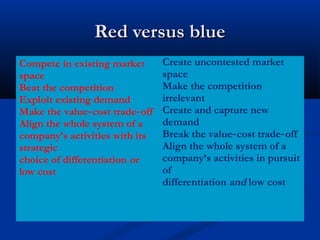
RReedd vveerrssuuss bblluuee 
Compete in existing market 
space 
Beat the competition 
Exploit existing demand 
Make the value‐cost trade‐off 
Align the whole system of a 
company’s activities with its 
strategic 
choice of differentiation or 
low cost 
Create uncontested market 
space 
Make the competition 
irrelevant 
Create and capture new 
demand 
Break the value‐cost trade‐off 
Align the whole system of a 
company’s activities in pursuit 
of 
differentiation and low cost
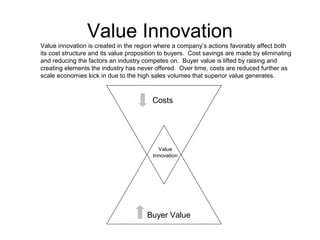
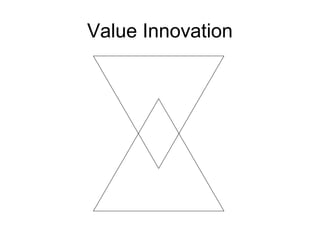
Value Innovation 
Value innovation is created in the region where a company’s actions favorably affect both 
its cost structure and its value proposition to buyers. Cost savings are made by eliminating 
and reducing the factors an industry competes on. Buyer value is lifted by raising and 
creating elements the industry has never offered. Over time, costs are reduced further as 
scale economies kick in due to the high sales volumes that superior value generates. 
Costs 
Value 
Innovation 
Buyer Value
Value Innovation
Red Ocean Versus Blue Ocean Startegy 
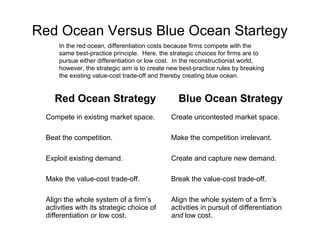
In the red ocean, differentiation costs because firms compete with the 
same best-practice principle. Here, the strategic choices for firms are to 
pursue either differentiation or low cost. In the reconstructionist world, 
however, the strategic aim is to create new best-practice rules by breaking 
the existing value-cost trade-off and thereby creating blue ocean. 
Red Ocean Strategy Blue Ocean Strategy 
Compete in existing market space. Create uncontested market space. 
Beat the competition. Make the competition irrelevant. 
Exploit existing demand. Create and capture new demand. 
Make the value-cost trade-off. Break the value-cost trade-off. 
Align the whole system of a firm’s 
activities with its strategic choice of 
differentiation or low cost. 
Align the whole system of a firm’s 
activities in pursuit of differentiation 
and low cost.
Red Ocean Versus Blue Ocean Strategy 
Red Ocean Strategy Blue Ocean Strategy
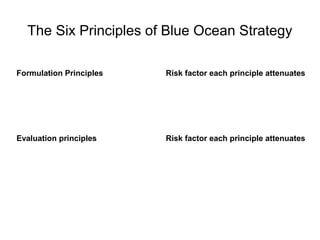
The Six Principles of Blue Ocean Strategy 
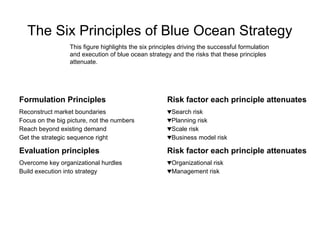
This figure highlights the six principles driving the successful formulation 
and execution of blue ocean strategy and the risks that these principles 
attenuate. 
Formulation Principles Risk factor each principle attenuates 
Reconstruct market boundaries 
Search risk 
Focus on the big picture, not the numbers 
Planning risk 
Reach beyond existing demand 
Scale risk 
Get the strategic sequence right 
Business model risk 
Evaluation principles Risk factor each principle attenuates 
Overcome key organizational hurdles 
Organizational risk 
Build execution into strategy 
Management risk
The Six Principles of Blue Ocean Strategy 
Formulation Principles Risk factor each principle attenuates 
Evaluation principles Risk factor each principle attenuates
Strategy Canvas 
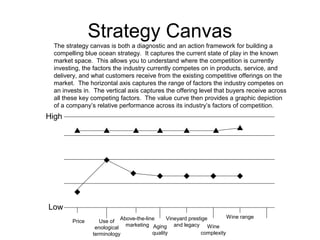
The strategy canvas is both a diagnostic and an action framework for building a 
compelling blue ocean strategy. It captures the current state of play in the known 
market space. This allows you to understand where the competition is currently 
investing, the factors the industry currently competes on in products, service, and 
delivery, and what customers receive from the existing competitive offerings on the 
market. The horizontal axis captures the range of factors the industry competes on 
an invests in. The vertical axis captures the offering level that buyers receive across 
all these key competing factors. The value curve then provides a graphic depiction 
of a company’s relative performance across its industry’s factors of competition. 
High 
Low 
Price Use of 
Above-the-line 
marketing Aging 
enological 
terminology 
Vineyard prestige 
quality 
and legacy Wine 
complexity 
Wine range
Strategy Canvas 
High 
Low
Four Actions Framework + 
Eliminate/Reduce/Raise/Create Grid 
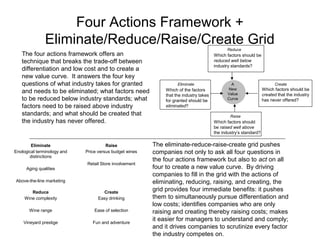
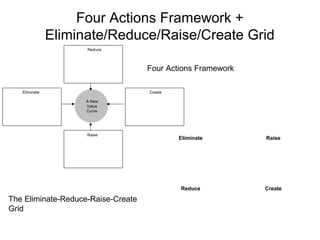
The four actions framework offers an 
technique that breaks the trade-off between 
differentiation and low cost and to create a 
new value curve. It answers the four key 
questions of what industry takes for granted 
and needs to be eliminated; what factors need 
to be reduced below industry standards; what 
factors need to be raised above industry 
standards; and what should be created that 
the industry has never offered. 
Reduce 
Which factors should be 
reduced well below 
industry standards? 
The eliminate-reduce-raise-create grid pushes 
companies not only to ask all four questions in 
the four actions framework but also to act on all 
four to create a new value curve. By driving 
companies to fill in the grid with the actions of 
eliminating, reducing, raising, and creating, the 
grid provides four immediate benefits: it pushes 
them to simultaneously pursue differentiation and 
low costs; identifies companies who are only 
raising and creating thereby raising costs; makes 
it easier for managers to understand and comply; 
and it drives companies to scrutinize every factor 
the industry competes on. 
Eliminate 
Enological terminology and 
distinctions 
Aging qualities 
Above-the-line marketing 
Raise 
Price versus budget wines 
Retail Store involvement 
Reduce 
Wine complexity 
Wine range 
Vineyard prestige 
Create 
Easy drinking 
Ease of selection 
Fun and adventure 
A 
New 
Value 
Curve 
Eliminate Create 
Raise 
Which factors should be 
created that the industry 
has never offered? 
Which factors should 
be raised well above 
the industry’s standard? 
Which of the factors 
that the industry takes 
for granted should be 
eliminated?
Four Actions Framework + 
Eliminate/Reduce/Raise/Create Grid 
Four Actions Framework 
Reduce 
Eliminate Create 
A New 
Value 
Curve 
Raise Eliminate Raise 
Reduce Create 
The Eliminate-Reduce-Raise-Create 
Grid
Four Steps of Visualizing Strategy 
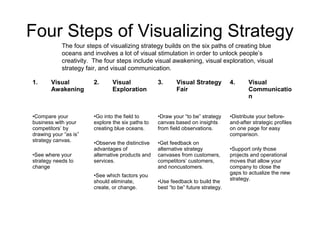
The four steps of visualizing strategy builds on the six paths of creating blue 
oceans and involves a lot of visual stimulation in order to unlock people’s 
creativity. The four steps include visual awakening, visual exploration, visual 
strategy fair, and visual communication. 
1. Visual 
Awakening 
2. Visual 
Exploration 
3. Visual Strategy 
Fair 
4. Visual 
Communicatio 
n 
•Compare your 
business with your 
competitors’ by 
drawing your “as is” 
strategy canvas. 
•See where your 
strategy needs to 
change 
•Go into the field to 
explore the six paths to 
creating blue oceans. 
•Observe the distinctive 
advantages of 
alternative products and 
services. 
•See which factors you 
should eliminate, 
create, or change. 
•Draw your “to be” strategy 
canvas based on insights 
from field observations. 
•Get feedback on 
alternative strategy 
canvases from customers, 
competitors’ customers, 
and noncustomers. 
•Use feedback to build the 
best “to be” future strategy. 
•Distribute your before-and- 
after strategic profiles 
on one page for easy 
comparison. 
•Support only those 
projects and operational 
moves that allow your 
company to close the 
gaps to actualize the new 
strategy.
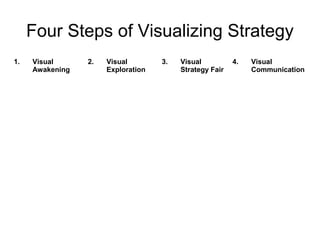
Four Steps of Visualizing Strategy 
1. Visual 
Awakening 
2. Visual 
Exploration 
3. Visual 
Strategy Fair 
4. Visual 
Communication
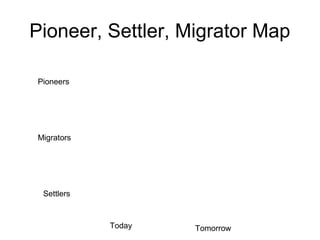
Pioneer, Settler, Migrator Map 
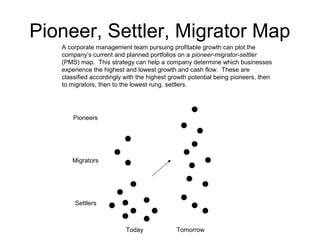
A corporate management team pursuing profitable growth can plot the 
company’s current and planned portfolios on a pioneer-migrator-settler 
(PMS) map. This strategy can help a company determine which businesses 
experience the highest and lowest growth and cash flow. These are 
classified accordingly with the highest growth potential being pioneers, then 
to migrators, then to the lowest rung, settlers. 
Pioneers 
Migrators 
Settlers 
Today Tomorrow
Pioneer, Settler, Migrator Map 
Pioneers 
Migrators 
Settlers 
Today Tomorrow
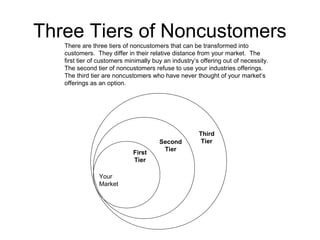
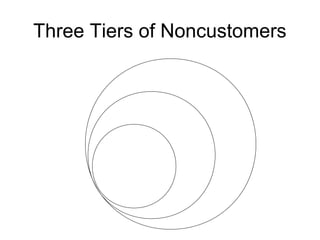
Three Tiers of Noncustomers 
There are three tiers of noncustomers that can be transformed into 
customers. They differ in their relative distance from your market. The 
first tier of customers minimally buy an industry’s offering out of necessity. 
The second tier of noncustomers refuse to use your industries offerings. 
The third tier are noncustomers who have never thought of your market’s 
offerings as an option. 
Your 
Market 
First 
Tier 
Second 
Tier 
Third 
Tier
Three Tiers of Noncustomers
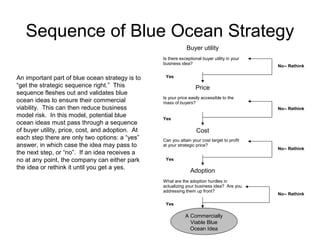
Sequence of Blue Ocean Strategy 
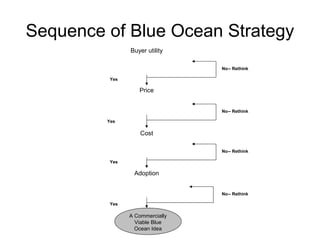
An important part of blue ocean strategy is to 
“get the strategic sequence right.” This 
sequence fleshes out and validates blue 
ocean ideas to ensure their commercial 
viability. This can then reduce business 
model risk. In this model, potential blue 
ocean ideas must pass through a sequence 
of buyer utility, price, cost, and adoption. At 
each step there are only two options: a “yes” 
answer, in which case the idea may pass to 
the next step, or “no”. If an idea receives a 
no at any point, the company can either park 
the idea or rethink it until you get a yes. 
Buyer utility 
Is there exceptional buyer utility in your 
business idea? 
Price 
Is your price easily accessible to the 
mass of buyers? 
Cost 
Can you attain your cost target to profit 
at your strategic price? 
Adoption 
Yes 
What are the adoption hurdles in 
actualizing your business idea? Are you 
addressing them up front? 
A Commercially 
Viable Blue 
Ocean Idea 
No-- Rethink 
Yes 
Yes 
Yes 
No-- Rethink 
No-- Rethink 
No-- Rethink
Sequence of Blue Ocean Strategy 
Buyer utility 
Price 
Cost 
Adoption 
A Commercially 
Viable Blue 
Ocean Idea 
No-- Rethink 
Yes 
Yes 
Yes 
Yes 
No-- Rethink 
No-- Rethink 
No-- Rethink
Buyer Utility Map 
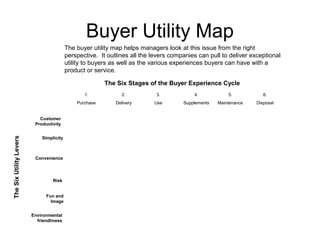
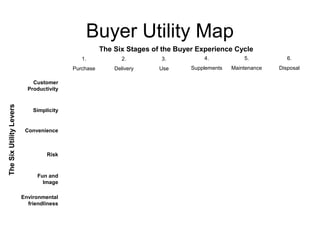
The buyer utility map helps managers look at this issue from the right 
perspective. It outlines all the levers companies can pull to deliver exceptional 
utility to buyers as well as the various experiences buyers can have with a 
product or service. 
1. 
Purchase 
2. 
Delivery 
3. 
Use 
4. 
Supplements 
5. 
Maintenance 
6. 
Disposal 
Customer 
Productivity 
Simplicity 
Convenience 
Risk 
Fun and 
Image 
Environmental 
friendliness 
The Six Stages of the Buyer Experience Cycle 
The Six Utility Levers
Buyer Utility Map 
1. 
Purchase 
2. 
Delivery 
3. 
Use 
4. 
Supplements 
5. 
Maintenance 
6. 
Disposal 
Customer 
Productivity 
Simplicity 
Convenience 
Risk 
Fun and 
Image 
Environmental 
friendliness 
The Six Stages of the Buyer Experience Cycle 
The Six Utility Levers
Buyer Experience Cycle 
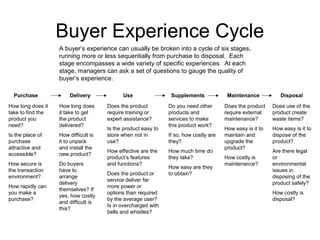
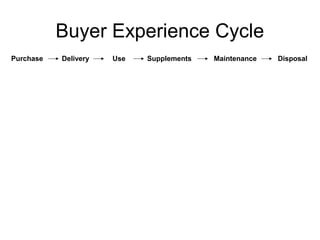
A buyer’s experience can usually be broken into a cycle of six stages, 
running more or less sequentially from purchase to disposal. Each 
stage encompasses a wide variety of specific experiences. At each 
stage, managers can ask a set of questions to gauge the quality of 
buyer’s experience. 
Purchase Delivery Use Supplements Maintenance Disposal 
How long does it 
take to find the 
product you 
need? 
Is the place of 
purchase 
attractive and 
accessible? 
How secure is 
the transaction 
environment? 
How rapidly can 
you make a 
purchase? 
How long does 
it take to get 
the product 
delivered? 
How difficult is 
it to unpack 
and install the 
new product? 
Do buyers 
have to 
arrange 
delivery 
themselves? If 
yes, how costly 
and difficult is 
this? 
Does the product 
require training or 
expert assistance? 
Is the product easy to 
store when not in 
use? 
How effective are the 
product’s features 
and functions? 
Does the product or 
service deliver far 
more power or 
options than required 
by the average user? 
Is in overcharged with 
bells and whistles? 
Do you need other 
products and 
services to make 
this product work? 
If so, how costly are 
they? 
How much time do 
they take? 
How easy are they 
to obtain? 
Does the product 
require external 
maintenance? 
How easy is it to 
maintain and 
upgrade the 
product? 
How costly is 
maintenance? 
Does use of the 
product create 
waste items? 
How easy is it to 
dispose of the 
product? 
Are there legal 
or 
environmental 
issues in 
disposing of the 
product safely? 
How costly is 
disposal?
Buyer Experience Cycle 
Purchase Delivery Use Supplements Maintenance Disposal
Uncovering Blocks to Buyer Utility 
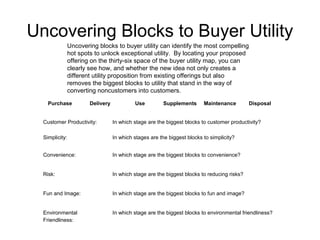
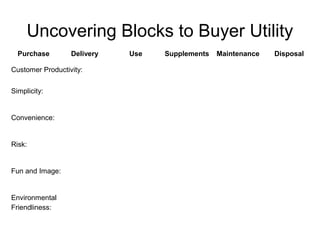
Uncovering blocks to buyer utility can identify the most compelling 
hot spots to unlock exceptional utility. By locating your proposed 
offering on the thirty-six space of the buyer utility map, you can 
clearly see how, and whether the new idea not only creates a 
different utility proposition from existing offerings but also 
removes the biggest blocks to utility that stand in the way of 
converting noncustomers into customers. 
Purchase Delivery Use Supplements Maintenance Disposal 
Customer Productivity: In which stage are the biggest blocks to customer productivity? 
Simplicity: In which stages are the biggest blocks to simplicity? 
Convenience: In which stage are the biggest blocks to convenience? 
Risk: In which stage are the biggest blocks to reducing risks? 
Fun and Image: In which stage are the biggest blocks to fun and image? 
Environmental 
Friendliness: 
In which stage are the biggest blocks to environmental friendliness?
Uncovering Blocks to Buyer Utility 
Purchase Delivery Use Supplements Maintenance Disposal 
Customer Productivity: 
Simplicity: 
Convenience: 
Risk: 
Fun and Image: 
Environmental 
Friendliness:
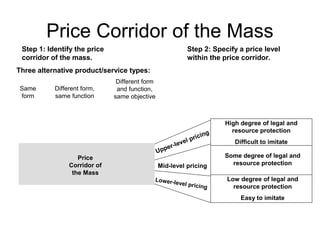
Price Corridor of the Mass 
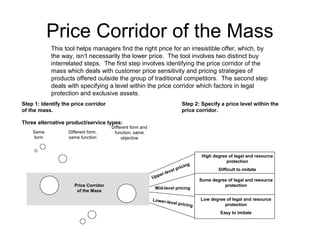
This tool helps managers find the right price for an irresistible offer, which, by 
the way, isn’t necessarily the lower price. The tool involves two distinct buy 
interrelated steps. The first step involves identifying the price corridor of the 
mass which deals with customer price sensitivity and pricing strategies of 
products offered outside the group of traditional competitors. The second step 
deals with specifying a level within the price corridor which factors in legal 
protection and exclusive assets. 
Step 1: Identify the price corridor 
of the mass. 
Step 2: Specify a price level within the 
price corridor. 
Three alternative product/service types: 
Same 
form 
Different form, 
same function 
Different form and 
function, same 
objective 
Price Corridor 
of the Mass 
High degree of legal and resource 
protection 
Difficult to imitate 
Some degree of legal and resource 
protection 
Low degree of legal and resource 
protection 
Easy to imitate 
Upper-level pricing 
Mid-level pricing 
Lower-level pricing
Price Corridor of the Mass 
Step 1: Identify the price 
corridor of the mass. 
Step 2: Specify a price level 
within the price corridor. 
Three alternative product/service types: 
Same 
form 
Different form, 
same function 
Different form 
and function, 
same objective 
Price 
Corridor of 
the Mass 
High degree of legal and 
resource protection 
Difficult to imitate 
Some degree of legal and 
resource protection 
Low degree of legal and 
resource protection 
Easy to imitate 
Upper-level pricing 
Mid-level pricing 
Lower-level pricing
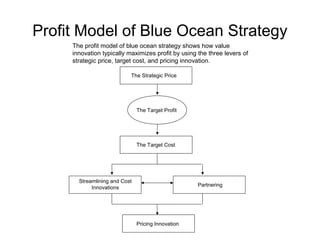
Profit Model of Blue Ocean Strategy 
The profit model of blue ocean strategy shows how value 
innovation typically maximizes profit by using the three levers of 
strategic price, target cost, and pricing innovation. 
The Strategic Price 
The Target Profit 
The Target Cost 
Streamlining and Cost 
Innovations Partnering 
Pricing Innovation
Profit Model of Blue Ocean Strategy
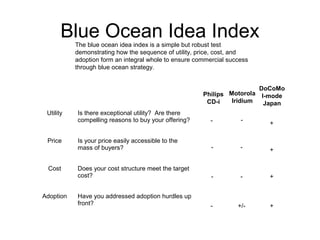
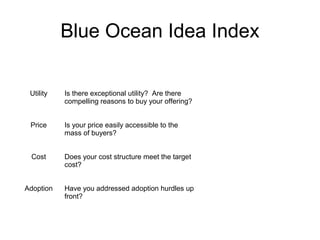
Blue Ocean Idea Index 
The blue ocean idea index is a simple but robust test 
demonstrating how the sequence of utility, price, cost, and 
adoption form an integral whole to ensure commercial success 
through blue ocean strategy. 
Utility Is there exceptional utility? Are there 
compelling reasons to buy your offering? 
Price Is your price easily accessible to the 
mass of buyers? 
Cost Does your cost structure meet the target 
cost? 
Adoption Have you addressed adoption hurdles up 
front? 
Philips 
CD-i 
Motorola 
Iridium 
DoCoMo 
I-mode 
Japan 
- - 
- 
- 
- 
- 
- 
+ 
+ 
+ 
+/- +
Blue Ocean Idea Index 
Utility Is there exceptional utility? Are there 
compelling reasons to buy your offering? 
Price Is your price easily accessible to the 
mass of buyers? 
Cost Does your cost structure meet the target 
cost? 
Adoption Have you addressed adoption hurdles up 
front?

BLUE OCEAN

  • 1.
    Facilitator: Gilbert AngelesBy: W. Chan Kim & Renee Mauborgne BSU MBA
  • 2.
    RReesseeaarrcchhiinngg tthhee hhiissttoorryyooff bblluuee oocceeaann ccrreeaattiioonn ••DDaattaa:: 115500 ssttrraatteeggiicc mmoovveess,, mmoorree tthhaann 3300 iinndduussttrriieess,, oovveerr 110000 yyeeaarrss ((11880000‐‐22000000)) ••VVaarriiaabblleess ccoonnssiiddeerreedd:: iinndduussttrriiaall,, oorrggaanniizzaattiioonnaall aanndd ssttrraatteeggiicc
  • 3.
    RReedd vveerrssuuss bblluuee Compete in existing market space Beat the competition Exploit existing demand Make the value‐cost trade‐off Align the whole system of a company’s activities with its strategic choice of differentiation or low cost Create uncontested market space Make the competition irrelevant Create and capture new demand Break the value‐cost trade‐off Align the whole system of a company’s activities in pursuit of differentiation and low cost
  • 4.
    Value Innovation Valueinnovation is created in the region where a company’s actions favorably affect both its cost structure and its value proposition to buyers. Cost savings are made by eliminating and reducing the factors an industry competes on. Buyer value is lifted by raising and creating elements the industry has never offered. Over time, costs are reduced further as scale economies kick in due to the high sales volumes that superior value generates. Costs Value Innovation Buyer Value
  • 5.
  • 6.
    Red Ocean VersusBlue Ocean Startegy In the red ocean, differentiation costs because firms compete with the same best-practice principle. Here, the strategic choices for firms are to pursue either differentiation or low cost. In the reconstructionist world, however, the strategic aim is to create new best-practice rules by breaking the existing value-cost trade-off and thereby creating blue ocean. Red Ocean Strategy Blue Ocean Strategy Compete in existing market space. Create uncontested market space. Beat the competition. Make the competition irrelevant. Exploit existing demand. Create and capture new demand. Make the value-cost trade-off. Break the value-cost trade-off. Align the whole system of a firm’s activities with its strategic choice of differentiation or low cost. Align the whole system of a firm’s activities in pursuit of differentiation and low cost.
  • 7.
    Red Ocean VersusBlue Ocean Strategy Red Ocean Strategy Blue Ocean Strategy
  • 8.
    The Six Principlesof Blue Ocean Strategy This figure highlights the six principles driving the successful formulation and execution of blue ocean strategy and the risks that these principles attenuate. Formulation Principles Risk factor each principle attenuates Reconstruct market boundaries Search risk Focus on the big picture, not the numbers Planning risk Reach beyond existing demand Scale risk Get the strategic sequence right Business model risk Evaluation principles Risk factor each principle attenuates Overcome key organizational hurdles Organizational risk Build execution into strategy Management risk
  • 9.
    The Six Principlesof Blue Ocean Strategy Formulation Principles Risk factor each principle attenuates Evaluation principles Risk factor each principle attenuates
  • 10.
    Strategy Canvas Thestrategy canvas is both a diagnostic and an action framework for building a compelling blue ocean strategy. It captures the current state of play in the known market space. This allows you to understand where the competition is currently investing, the factors the industry currently competes on in products, service, and delivery, and what customers receive from the existing competitive offerings on the market. The horizontal axis captures the range of factors the industry competes on an invests in. The vertical axis captures the offering level that buyers receive across all these key competing factors. The value curve then provides a graphic depiction of a company’s relative performance across its industry’s factors of competition. High Low Price Use of Above-the-line marketing Aging enological terminology Vineyard prestige quality and legacy Wine complexity Wine range
  • 11.
  • 12.
    Four Actions Framework+ Eliminate/Reduce/Raise/Create Grid The four actions framework offers an technique that breaks the trade-off between differentiation and low cost and to create a new value curve. It answers the four key questions of what industry takes for granted and needs to be eliminated; what factors need to be reduced below industry standards; what factors need to be raised above industry standards; and what should be created that the industry has never offered. Reduce Which factors should be reduced well below industry standards? The eliminate-reduce-raise-create grid pushes companies not only to ask all four questions in the four actions framework but also to act on all four to create a new value curve. By driving companies to fill in the grid with the actions of eliminating, reducing, raising, and creating, the grid provides four immediate benefits: it pushes them to simultaneously pursue differentiation and low costs; identifies companies who are only raising and creating thereby raising costs; makes it easier for managers to understand and comply; and it drives companies to scrutinize every factor the industry competes on. Eliminate Enological terminology and distinctions Aging qualities Above-the-line marketing Raise Price versus budget wines Retail Store involvement Reduce Wine complexity Wine range Vineyard prestige Create Easy drinking Ease of selection Fun and adventure A New Value Curve Eliminate Create Raise Which factors should be created that the industry has never offered? Which factors should be raised well above the industry’s standard? Which of the factors that the industry takes for granted should be eliminated?
  • 13.
    Four Actions Framework+ Eliminate/Reduce/Raise/Create Grid Four Actions Framework Reduce Eliminate Create A New Value Curve Raise Eliminate Raise Reduce Create The Eliminate-Reduce-Raise-Create Grid
  • 14.
    Four Steps ofVisualizing Strategy The four steps of visualizing strategy builds on the six paths of creating blue oceans and involves a lot of visual stimulation in order to unlock people’s creativity. The four steps include visual awakening, visual exploration, visual strategy fair, and visual communication. 1. Visual Awakening 2. Visual Exploration 3. Visual Strategy Fair 4. Visual Communicatio n •Compare your business with your competitors’ by drawing your “as is” strategy canvas. •See where your strategy needs to change •Go into the field to explore the six paths to creating blue oceans. •Observe the distinctive advantages of alternative products and services. •See which factors you should eliminate, create, or change. •Draw your “to be” strategy canvas based on insights from field observations. •Get feedback on alternative strategy canvases from customers, competitors’ customers, and noncustomers. •Use feedback to build the best “to be” future strategy. •Distribute your before-and- after strategic profiles on one page for easy comparison. •Support only those projects and operational moves that allow your company to close the gaps to actualize the new strategy.
  • 15.
    Four Steps ofVisualizing Strategy 1. Visual Awakening 2. Visual Exploration 3. Visual Strategy Fair 4. Visual Communication
  • 16.
    Pioneer, Settler, MigratorMap A corporate management team pursuing profitable growth can plot the company’s current and planned portfolios on a pioneer-migrator-settler (PMS) map. This strategy can help a company determine which businesses experience the highest and lowest growth and cash flow. These are classified accordingly with the highest growth potential being pioneers, then to migrators, then to the lowest rung, settlers. Pioneers Migrators Settlers Today Tomorrow
  • 17.
    Pioneer, Settler, MigratorMap Pioneers Migrators Settlers Today Tomorrow
  • 18.
    Three Tiers ofNoncustomers There are three tiers of noncustomers that can be transformed into customers. They differ in their relative distance from your market. The first tier of customers minimally buy an industry’s offering out of necessity. The second tier of noncustomers refuse to use your industries offerings. The third tier are noncustomers who have never thought of your market’s offerings as an option. Your Market First Tier Second Tier Third Tier
  • 19.
    Three Tiers ofNoncustomers
  • 20.
    Sequence of BlueOcean Strategy An important part of blue ocean strategy is to “get the strategic sequence right.” This sequence fleshes out and validates blue ocean ideas to ensure their commercial viability. This can then reduce business model risk. In this model, potential blue ocean ideas must pass through a sequence of buyer utility, price, cost, and adoption. At each step there are only two options: a “yes” answer, in which case the idea may pass to the next step, or “no”. If an idea receives a no at any point, the company can either park the idea or rethink it until you get a yes. Buyer utility Is there exceptional buyer utility in your business idea? Price Is your price easily accessible to the mass of buyers? Cost Can you attain your cost target to profit at your strategic price? Adoption Yes What are the adoption hurdles in actualizing your business idea? Are you addressing them up front? A Commercially Viable Blue Ocean Idea No-- Rethink Yes Yes Yes No-- Rethink No-- Rethink No-- Rethink
  • 21.
    Sequence of BlueOcean Strategy Buyer utility Price Cost Adoption A Commercially Viable Blue Ocean Idea No-- Rethink Yes Yes Yes Yes No-- Rethink No-- Rethink No-- Rethink
  • 22.
    Buyer Utility Map The buyer utility map helps managers look at this issue from the right perspective. It outlines all the levers companies can pull to deliver exceptional utility to buyers as well as the various experiences buyers can have with a product or service. 1. Purchase 2. Delivery 3. Use 4. Supplements 5. Maintenance 6. Disposal Customer Productivity Simplicity Convenience Risk Fun and Image Environmental friendliness The Six Stages of the Buyer Experience Cycle The Six Utility Levers
  • 23.
    Buyer Utility Map 1. Purchase 2. Delivery 3. Use 4. Supplements 5. Maintenance 6. Disposal Customer Productivity Simplicity Convenience Risk Fun and Image Environmental friendliness The Six Stages of the Buyer Experience Cycle The Six Utility Levers
  • 24.
    Buyer Experience Cycle A buyer’s experience can usually be broken into a cycle of six stages, running more or less sequentially from purchase to disposal. Each stage encompasses a wide variety of specific experiences. At each stage, managers can ask a set of questions to gauge the quality of buyer’s experience. Purchase Delivery Use Supplements Maintenance Disposal How long does it take to find the product you need? Is the place of purchase attractive and accessible? How secure is the transaction environment? How rapidly can you make a purchase? How long does it take to get the product delivered? How difficult is it to unpack and install the new product? Do buyers have to arrange delivery themselves? If yes, how costly and difficult is this? Does the product require training or expert assistance? Is the product easy to store when not in use? How effective are the product’s features and functions? Does the product or service deliver far more power or options than required by the average user? Is in overcharged with bells and whistles? Do you need other products and services to make this product work? If so, how costly are they? How much time do they take? How easy are they to obtain? Does the product require external maintenance? How easy is it to maintain and upgrade the product? How costly is maintenance? Does use of the product create waste items? How easy is it to dispose of the product? Are there legal or environmental issues in disposing of the product safely? How costly is disposal?
  • 25.
    Buyer Experience Cycle Purchase Delivery Use Supplements Maintenance Disposal
  • 26.
    Uncovering Blocks toBuyer Utility Uncovering blocks to buyer utility can identify the most compelling hot spots to unlock exceptional utility. By locating your proposed offering on the thirty-six space of the buyer utility map, you can clearly see how, and whether the new idea not only creates a different utility proposition from existing offerings but also removes the biggest blocks to utility that stand in the way of converting noncustomers into customers. Purchase Delivery Use Supplements Maintenance Disposal Customer Productivity: In which stage are the biggest blocks to customer productivity? Simplicity: In which stages are the biggest blocks to simplicity? Convenience: In which stage are the biggest blocks to convenience? Risk: In which stage are the biggest blocks to reducing risks? Fun and Image: In which stage are the biggest blocks to fun and image? Environmental Friendliness: In which stage are the biggest blocks to environmental friendliness?
  • 27.
    Uncovering Blocks toBuyer Utility Purchase Delivery Use Supplements Maintenance Disposal Customer Productivity: Simplicity: Convenience: Risk: Fun and Image: Environmental Friendliness:
  • 28.
    Price Corridor ofthe Mass This tool helps managers find the right price for an irresistible offer, which, by the way, isn’t necessarily the lower price. The tool involves two distinct buy interrelated steps. The first step involves identifying the price corridor of the mass which deals with customer price sensitivity and pricing strategies of products offered outside the group of traditional competitors. The second step deals with specifying a level within the price corridor which factors in legal protection and exclusive assets. Step 1: Identify the price corridor of the mass. Step 2: Specify a price level within the price corridor. Three alternative product/service types: Same form Different form, same function Different form and function, same objective Price Corridor of the Mass High degree of legal and resource protection Difficult to imitate Some degree of legal and resource protection Low degree of legal and resource protection Easy to imitate Upper-level pricing Mid-level pricing Lower-level pricing
  • 29.
    Price Corridor ofthe Mass Step 1: Identify the price corridor of the mass. Step 2: Specify a price level within the price corridor. Three alternative product/service types: Same form Different form, same function Different form and function, same objective Price Corridor of the Mass High degree of legal and resource protection Difficult to imitate Some degree of legal and resource protection Low degree of legal and resource protection Easy to imitate Upper-level pricing Mid-level pricing Lower-level pricing
  • 30.
    Profit Model ofBlue Ocean Strategy The profit model of blue ocean strategy shows how value innovation typically maximizes profit by using the three levers of strategic price, target cost, and pricing innovation. The Strategic Price The Target Profit The Target Cost Streamlining and Cost Innovations Partnering Pricing Innovation
  • 31.
    Profit Model ofBlue Ocean Strategy
  • 32.
    Blue Ocean IdeaIndex The blue ocean idea index is a simple but robust test demonstrating how the sequence of utility, price, cost, and adoption form an integral whole to ensure commercial success through blue ocean strategy. Utility Is there exceptional utility? Are there compelling reasons to buy your offering? Price Is your price easily accessible to the mass of buyers? Cost Does your cost structure meet the target cost? Adoption Have you addressed adoption hurdles up front? Philips CD-i Motorola Iridium DoCoMo I-mode Japan - - - - - - - + + + +/- +
  • 33.
    Blue Ocean IdeaIndex Utility Is there exceptional utility? Are there compelling reasons to buy your offering? Price Is your price easily accessible to the mass of buyers? Cost Does your cost structure meet the target cost? Adoption Have you addressed adoption hurdles up front?