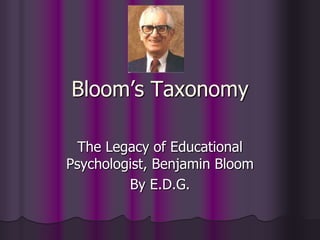
Bloom’s Taxonomy
The Legacy of Educational
Psychologist, Benjamin Bloom
By E.D.G.
The Three Domains of Thought
 Cognitive Domain
 Personal intellect; what we know, how we
organize ideas and thoughts
 Affective Domain
 Emotions, interests, attitude, attention,
awareness
 Psychomotor Domain
 Motor and physical skills
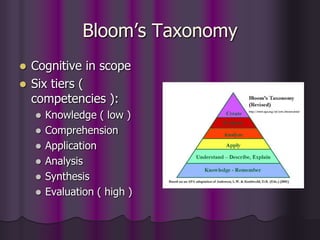
Bloom’s Taxonomy
 Cognitive in scope
 Six tiers (
competencies ):
 Knowledge ( low )
 Comprehension
 Application
 Analysis
 Synthesis
 Evaluation ( high )
Tier I: Knowledge
 The learner can recall
basic information
 Regarded as the
lowest and least
effective
 Action Words:
Arrange, Recall,
Define, Match, Name,
Describe, etc.
 Example Question
 What is the S.I. unit
for mechanical force?
 Action Word: RECALL
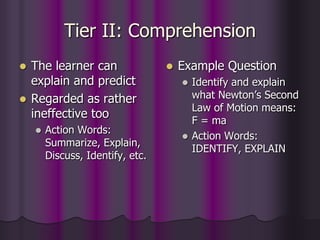
Tier II: Comprehension
 The learner can
explain and predict
 Regarded as rather
ineffective too
 Action Words:
Summarize, Explain,
Discuss, Identify, etc.
 Example Question
 Identify and explain
what Newton’s Second
Law of Motion means:
F = ma
 Action Words:
IDENTIFY, EXPLAIN
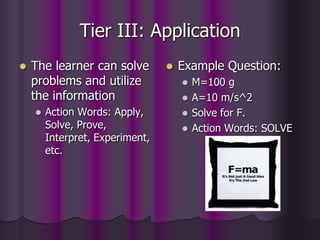
Tier III: Application
 The learner can solve
problems and utilize
the information
 Action Words: Apply,
Solve, Prove,
Interpret, Experiment,
etc.
 Example Question:
 M=100 g
 A=10 m/s^2
 Solve for F.
 Action Words: SOLVE
Tier IV: Analysis
 The learner can see
patterns, organize
parts, and recognize
hidden meanings.
 Action Words: Analyze,
Compare, Contrast,
Examine, Test, etc.
 Example Question:
 Test sin(2x) =
2sin(x)cos(x). Verify
those values are
equal.
 Action Words: TEST
Tier V: Synthesis
 The learner can use
previous knowledge
to create new ones
and relate ideas from
several disciplines.
 Techne ( applied
knowledge )
 Action Words:
Develop, Design,
Invent, Theorize,
Create, etc.
 Example Question:
 Derive the Euler-
Lagrange Equation
from d’Alembert’s
principle.
 Action Word: DERIVE
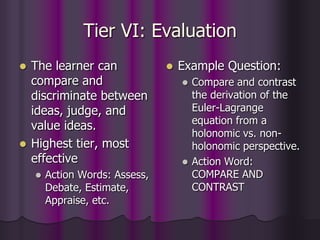
Tier VI: Evaluation
 The learner can
compare and
discriminate between
ideas, judge, and
value ideas.
 Highest tier, most
effective
 Action Words: Assess,
Debate, Estimate,
Appraise, etc.
 Example Question:
 Compare and contrast
the derivation of the
Euler-Lagrange
equation from a
holonomic vs. non-
holonomic perspective.
 Action Word:
COMPARE AND
CONTRAST
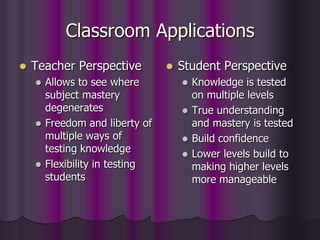
Classroom Applications
 Teacher Perspective
 Allows to see where
subject mastery
degenerates
 Freedom and liberty of
multiple ways of
testing knowledge
 Flexibility in testing
students
 Student Perspective
 Knowledge is tested
on multiple levels
 True understanding
and mastery is tested
 Build confidence
 Lower levels build to
making higher levels
more manageable
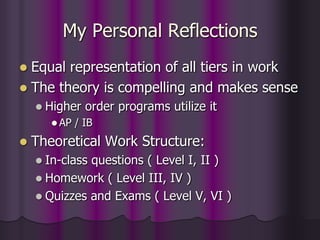
My Personal Reflections
 Equal representation of all tiers in work
 The theory is compelling and makes sense
 Higher order programs utilize it
 AP / IB
 Theoretical Work Structure:
 In-class questions ( Level I, II )
 Homework ( Level III, IV )
 Quizzes and Exams ( Level V, VI )
Bibliography
 Gunter, Gunter, & Shelly. (2012).
Teachers Discovering Computers
Integrating Technology in a Connected
World. Boston: CENGAGE Learning
 Epltt.coe.uga.edu ( Bloom’s Portrait )
 Chatt.hdsb.ca ( Taxonomy Pyramid )

Bloom's taxonomy

  • 1.
    Bloom’s Taxonomy The Legacyof Educational Psychologist, Benjamin Bloom By E.D.G.
  • 2.
    The Three Domainsof Thought  Cognitive Domain  Personal intellect; what we know, how we organize ideas and thoughts  Affective Domain  Emotions, interests, attitude, attention, awareness  Psychomotor Domain  Motor and physical skills
  • 3.
    Bloom’s Taxonomy  Cognitivein scope  Six tiers ( competencies ):  Knowledge ( low )  Comprehension  Application  Analysis  Synthesis  Evaluation ( high )
  • 4.
    Tier I: Knowledge The learner can recall basic information  Regarded as the lowest and least effective  Action Words: Arrange, Recall, Define, Match, Name, Describe, etc.  Example Question  What is the S.I. unit for mechanical force?  Action Word: RECALL
  • 5.
    Tier II: Comprehension The learner can explain and predict  Regarded as rather ineffective too  Action Words: Summarize, Explain, Discuss, Identify, etc.  Example Question  Identify and explain what Newton’s Second Law of Motion means: F = ma  Action Words: IDENTIFY, EXPLAIN
  • 6.
    Tier III: Application The learner can solve problems and utilize the information  Action Words: Apply, Solve, Prove, Interpret, Experiment, etc.  Example Question:  M=100 g  A=10 m/s^2  Solve for F.  Action Words: SOLVE
  • 7.
    Tier IV: Analysis The learner can see patterns, organize parts, and recognize hidden meanings.  Action Words: Analyze, Compare, Contrast, Examine, Test, etc.  Example Question:  Test sin(2x) = 2sin(x)cos(x). Verify those values are equal.  Action Words: TEST
  • 8.
    Tier V: Synthesis The learner can use previous knowledge to create new ones and relate ideas from several disciplines.  Techne ( applied knowledge )  Action Words: Develop, Design, Invent, Theorize, Create, etc.  Example Question:  Derive the Euler- Lagrange Equation from d’Alembert’s principle.  Action Word: DERIVE
  • 9.
    Tier VI: Evaluation The learner can compare and discriminate between ideas, judge, and value ideas.  Highest tier, most effective  Action Words: Assess, Debate, Estimate, Appraise, etc.  Example Question:  Compare and contrast the derivation of the Euler-Lagrange equation from a holonomic vs. non- holonomic perspective.  Action Word: COMPARE AND CONTRAST
  • 10.
    Classroom Applications  TeacherPerspective  Allows to see where subject mastery degenerates  Freedom and liberty of multiple ways of testing knowledge  Flexibility in testing students  Student Perspective  Knowledge is tested on multiple levels  True understanding and mastery is tested  Build confidence  Lower levels build to making higher levels more manageable
  • 11.
    My Personal Reflections Equal representation of all tiers in work  The theory is compelling and makes sense  Higher order programs utilize it  AP / IB  Theoretical Work Structure:  In-class questions ( Level I, II )  Homework ( Level III, IV )  Quizzes and Exams ( Level V, VI )
  • 12.
    Bibliography  Gunter, Gunter,& Shelly. (2012). Teachers Discovering Computers Integrating Technology in a Connected World. Boston: CENGAGE Learning  Epltt.coe.uga.edu ( Bloom’s Portrait )  Chatt.hdsb.ca ( Taxonomy Pyramid )