Blockchain Technology
Week 10
Unit IV – CAP Theorem, Byzantines General Problem
Ferdin Joe John Joseph, PhD
Faculty of Information Technology
Thai-Nichi Institute of Technology, Bangkok
Venue: D603
Week 10 – Unit IV
Agenda
• CAP Theorem
• Byzantines General Problem
Faculty of Information Technology, Thai-Nichi Institute of
Technology
2
Hyper Encryption Standards
Features
• Symmetrical
• Key length of 57,000 to 200,000 bits
• No delimitation in number system
• Insensitive to factorize
• No semantics in cipher
Faculty of Information Technology, Thai-Nichi Institute of
Technology
4
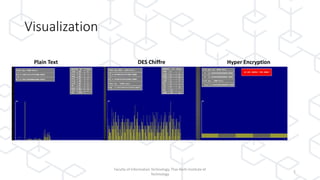
Visualization
Faculty of Information Technology, Thai-Nichi Institute of
Technology
5
Plain Text DES Chiffre Hyper Encryption
Availability
Faculty of Information Technology, Thai-Nichi Institute of
Technology
6
Highly Confidential
and Patented
Applications
• All applications of Banking
• Defense Technologies
• Telecommunication
• Health
• Plagiarism Protection
• Satellite Communication
Faculty of Information Technology, Thai-Nichi Institute of
Technology
7
CAP Theorem
CAP Theorem
• Also known as Brewer’s Theorem
• Named after Computer Scientist Erik Brewer in 2002
Faculty of Information Technology, Thai-Nichi Institute of
Technology
9
Theorem
• A distributed database can provide any two out of the three
gurantees only among those stated below.
1. Consistency: Every read receives the most recent write or an error
2. Availability: Every request receives a (non-error) response –
without the guarantee that it contains the most recent write
3. Partition tolerance: The system continues to operate despite an
arbitrary number of messages being dropped (or delayed) by the
network between nodes
Faculty of Information Technology, Thai-Nichi Institute of
Technology
10
Faculty of Information Technology, Thai-Nichi Institute of
Technology
11
CAP Expanded
Faculty of Information Technology, Thai-Nichi Institute of
Technology
12
C: Consistency – At any given time, all nodes in the network have
exactly the same (most recent) value.
CAP Expanded
• A: Availability – Every request to the network receives a response,
though without any guarantee that returned data is the most recent.
Faculty of Information Technology, Thai-Nichi Institute of
Technology
13
CAP Expanded
• P: Partition tolerance – The network continues to operate, even if an
arbitrary number of nodes are failing.
Faculty of Information Technology, Thai-Nichi Institute of
Technology
14
CAP Theorem Applied
• Due to the nature of distributed data stores (such as blockchain),
Partition tolerance is a given fact; there will always be
failing/unreachable nodes in the network (not least because of the
unstable nature of the internet). CAP Theorem states that one has to
choose between C (Consistency) or A (Availability) when in the
presence of P (Partition):
Faculty of Information Technology, Thai-Nichi Institute of
Technology
15
Availability + Partition Tolerance
• Every request to the network receives a response, even if the
network cannot guarantee it is up to date due to network partitioning
(failing nodes).
• Choosing Availability over Consistency for a world-wide distributed
system will make it highly available, but its data will be out of date for
99.99% of the time. Furthermore, no-one will be able to guarantee
that the data returned is in fact the most recent.
Faculty of Information Technology, Thai-Nichi Institute of
Technology
16
Availability + Partition Tolerance
Faculty of Information Technology, Thai-Nichi Institute of
Technology
17
Consistency + Partition Tolerance
• The system will return an error or a time-out if particular information
cannot be guaranteed to be up to date due to network partitioning
(failing nodes).
• Choosing Consistency over Availability for a world-wide distributed
system will make it highly accurate, but it will most likely be
unavailable for 99.99% of the time.
Faculty of Information Technology, Thai-Nichi Institute of
Technology
18
Consistency + Partition Tolerance
Faculty of Information Technology, Thai-Nichi Institute of
Technology
19
Does Blockchain Violate CAP Theorem ?
• NO
• Those interested in blockchain, opt for AP (Availability + Partition) +
Strong/Eventual Consistency.
• This doesn’t mean Consistency used to the fullest.
Faculty of Information Technology, Thai-Nichi Institute of
Technology
20
Byzantine Generals Problem
Byzantine General
Faculty of Information Technology, Thai-Nichi Institute of
Technology
22
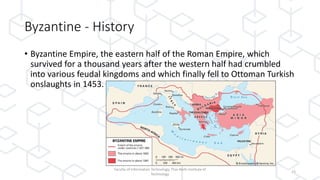
Byzantine - History
• Byzantine Empire, the eastern half of the Roman Empire, which
survived for a thousand years after the western half had crumbled
into various feudal kingdoms and which finally fell to Ottoman Turkish
onslaughts in 1453.
Faculty of Information Technology, Thai-Nichi Institute of
Technology
23
Scenario
• Imagine that the grand Eastern Roman empire aka Byzantine empire
has decided to capture a city.
• The Byzantine army has completely encircled the city. The army has
many divisions and each division has a general.
• The generals communicate between each as well as between all
lieutenants within their division only through messengers.
Faculty of Information Technology, Thai-Nichi Institute of
Technology
24
Attack Process
Faculty of Information Technology, Thai-Nichi Institute of
Technology
25
Faculty of Information Technology, Thai-Nichi Institute of
Technology
26
Commander
Lieutenant 1 Lieutenant 2
“attack”“attack”
“He said ‘retreat’”
Lieutenant 2 is corrupt and consensus cannot be reached.
Faculty of Information Technology, Thai-Nichi Institute of
Technology
27
Commander
Lieutenant 1 Lieutenant 2
“retreat”“attack”
“He said ‘retreat’”
Commander is corrupt and consensus cannot be reached.
Faculty of Information Technology, Thai-Nichi Institute of
Technology
28
Commander
Lieutenant 1 Lieutenant 2 Lieutenant 3
“attack” “attack” “attack”
“attack” “retreat”
Faculty of Information Technology, Thai-Nichi Institute of
Technology
29
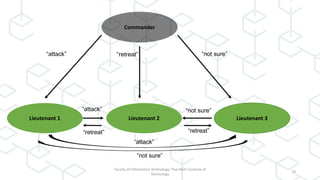
Commander
Lieutenant 1 Lieutenant 2 Lieutenant 3
“attack” “retreat” “not sure”
“attack” “not sure”
“retreat” “retreat”
“attack”
“not sure”
How it applies to Blockchain
• Consensus Mechanism as it follows distributed mechanism
• In blockchain network, there is no commander
• Each node becomes a lieutenant and fall under equal hierarchy
Faculty of Information Technology, Thai-Nichi Institute of
Technology
30
How it applies to Blockchain
• All participating nodes have to agree upon every message that is
transmitted between the nodes.
• If a group of nodes is corrupt or the message that they transmit is
corrupt then still the network as a whole should not be affected by it
and should resist this ‘Attack’.
• In short, the network in its entirety has to agree upon every message
transmitted in the network. This agreement is called as consensus.
Faculty of Information Technology, Thai-Nichi Institute of
Technology
31
Practical Byzantine Fault Tolerance (PBFT)
• Faster
• Handle n Byzantine faults in a system with 3n+1 nodes
Faculty of Information Technology, Thai-Nichi Institute of
Technology
32
PBFT Process
Request Preprepare Prepare Commit Reply
Faculty of Information Technology, Thai-Nichi Institute of
Technology
33
PBFT by example
Faculty of Information Technology, Thai-Nichi Institute of
Technology
34
Client Alpha
Bravo
Delta
Charlie
PBFT REQUEST
Faculty of Information Technology, Thai-Nichi Institute of
Technology
35
Client Alpha
Bravo
Delta
Charlie
PBFT REQUEST
Faculty of Information Technology, Thai-Nichi Institute of
Technology
36
Client Alpha
Bravo
Delta
Charlie
PBFT PRE PREPARE
Faculty of Information Technology, Thai-Nichi Institute of
Technology
37
Client Alpha
Bravo
Delta
Charlie
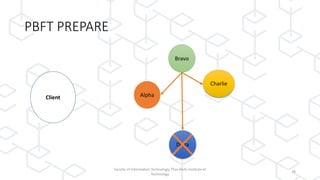
PBFT PREPARE
Faculty of Information Technology, Thai-Nichi Institute of
Technology
38
Client Alpha
Bravo
Delta
Charlie
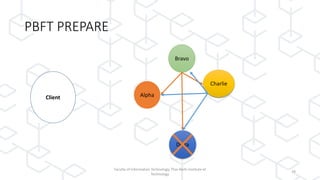
PBFT PREPARE
Faculty of Information Technology, Thai-Nichi Institute of
Technology
39
Client Alpha
Bravo
Delta
Charlie
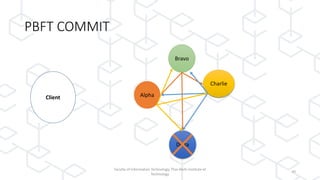
PBFT COMMIT
Faculty of Information Technology, Thai-Nichi Institute of
Technology
40
Client Alpha
Bravo
Delta
Charlie
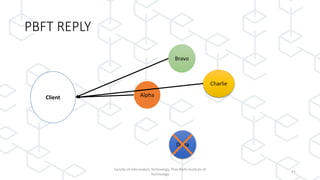
PBFT REPLY
Faculty of Information Technology, Thai-Nichi Institute of
Technology
41
Client Alpha
Bravo
Delta
Charlie
PBFT
Request Preprepare Prepare Commit Reply
Faculty of Information Technology, Thai-Nichi Institute of
Technology
42
Client
Alpha
Bravo
Delta
Charlie
PBFT
Request Preprepare Prepare Commit Reply
Faculty of Information Technology, Thai-Nichi Institute of
Technology
43
Client
Alpha
Bravo
Delta
Charlie
PBFT
Request Preprepare Prepare Commit Reply
Faculty of Information Technology, Thai-Nichi Institute of
Technology
44
Client
Alpha
Bravo
Delta
Charlie
PBFT
Request Preprepare Prepare Commit Reply
Faculty of Information Technology, Thai-Nichi Institute of
Technology
45
Client
Alpha
Bravo
Delta
Charlie
PBFT
Request Preprepare Prepare Commit Reply
Faculty of Information Technology, Thai-Nichi Institute of
Technology
46
Client
Alpha
Bravo
Delta
Charlie
Next Week
• Peer to Peer Networking
• Distributed Computing
Faculty of Information Technology, Thai-Nichi Institute of
Technology
47

Blockchain Technology - Week 10 - CAP Teorem, Byzantines General Problem

  • 1.
    Blockchain Technology Week 10 UnitIV – CAP Theorem, Byzantines General Problem Ferdin Joe John Joseph, PhD Faculty of Information Technology Thai-Nichi Institute of Technology, Bangkok Venue: D603
  • 2.
    Week 10 –Unit IV Agenda • CAP Theorem • Byzantines General Problem Faculty of Information Technology, Thai-Nichi Institute of Technology 2
  • 3.
  • 4.
    Features • Symmetrical • Keylength of 57,000 to 200,000 bits • No delimitation in number system • Insensitive to factorize • No semantics in cipher Faculty of Information Technology, Thai-Nichi Institute of Technology 4
  • 5.
    Visualization Faculty of InformationTechnology, Thai-Nichi Institute of Technology 5 Plain Text DES Chiffre Hyper Encryption
  • 6.
    Availability Faculty of InformationTechnology, Thai-Nichi Institute of Technology 6 Highly Confidential and Patented
  • 7.
    Applications • All applicationsof Banking • Defense Technologies • Telecommunication • Health • Plagiarism Protection • Satellite Communication Faculty of Information Technology, Thai-Nichi Institute of Technology 7
  • 8.
  • 9.
    CAP Theorem • Alsoknown as Brewer’s Theorem • Named after Computer Scientist Erik Brewer in 2002 Faculty of Information Technology, Thai-Nichi Institute of Technology 9
  • 10.
    Theorem • A distributeddatabase can provide any two out of the three gurantees only among those stated below. 1. Consistency: Every read receives the most recent write or an error 2. Availability: Every request receives a (non-error) response – without the guarantee that it contains the most recent write 3. Partition tolerance: The system continues to operate despite an arbitrary number of messages being dropped (or delayed) by the network between nodes Faculty of Information Technology, Thai-Nichi Institute of Technology 10
  • 11.
    Faculty of InformationTechnology, Thai-Nichi Institute of Technology 11
  • 12.
    CAP Expanded Faculty ofInformation Technology, Thai-Nichi Institute of Technology 12 C: Consistency – At any given time, all nodes in the network have exactly the same (most recent) value.
  • 13.
    CAP Expanded • A:Availability – Every request to the network receives a response, though without any guarantee that returned data is the most recent. Faculty of Information Technology, Thai-Nichi Institute of Technology 13
  • 14.
    CAP Expanded • P:Partition tolerance – The network continues to operate, even if an arbitrary number of nodes are failing. Faculty of Information Technology, Thai-Nichi Institute of Technology 14
  • 15.
    CAP Theorem Applied •Due to the nature of distributed data stores (such as blockchain), Partition tolerance is a given fact; there will always be failing/unreachable nodes in the network (not least because of the unstable nature of the internet). CAP Theorem states that one has to choose between C (Consistency) or A (Availability) when in the presence of P (Partition): Faculty of Information Technology, Thai-Nichi Institute of Technology 15
  • 16.
    Availability + PartitionTolerance • Every request to the network receives a response, even if the network cannot guarantee it is up to date due to network partitioning (failing nodes). • Choosing Availability over Consistency for a world-wide distributed system will make it highly available, but its data will be out of date for 99.99% of the time. Furthermore, no-one will be able to guarantee that the data returned is in fact the most recent. Faculty of Information Technology, Thai-Nichi Institute of Technology 16
  • 17.
    Availability + PartitionTolerance Faculty of Information Technology, Thai-Nichi Institute of Technology 17
  • 18.
    Consistency + PartitionTolerance • The system will return an error or a time-out if particular information cannot be guaranteed to be up to date due to network partitioning (failing nodes). • Choosing Consistency over Availability for a world-wide distributed system will make it highly accurate, but it will most likely be unavailable for 99.99% of the time. Faculty of Information Technology, Thai-Nichi Institute of Technology 18
  • 19.
    Consistency + PartitionTolerance Faculty of Information Technology, Thai-Nichi Institute of Technology 19
  • 20.
    Does Blockchain ViolateCAP Theorem ? • NO • Those interested in blockchain, opt for AP (Availability + Partition) + Strong/Eventual Consistency. • This doesn’t mean Consistency used to the fullest. Faculty of Information Technology, Thai-Nichi Institute of Technology 20
  • 21.
  • 22.
    Byzantine General Faculty ofInformation Technology, Thai-Nichi Institute of Technology 22
  • 23.
    Byzantine - History •Byzantine Empire, the eastern half of the Roman Empire, which survived for a thousand years after the western half had crumbled into various feudal kingdoms and which finally fell to Ottoman Turkish onslaughts in 1453. Faculty of Information Technology, Thai-Nichi Institute of Technology 23
  • 24.
    Scenario • Imagine thatthe grand Eastern Roman empire aka Byzantine empire has decided to capture a city. • The Byzantine army has completely encircled the city. The army has many divisions and each division has a general. • The generals communicate between each as well as between all lieutenants within their division only through messengers. Faculty of Information Technology, Thai-Nichi Institute of Technology 24
  • 25.
    Attack Process Faculty ofInformation Technology, Thai-Nichi Institute of Technology 25
  • 26.
    Faculty of InformationTechnology, Thai-Nichi Institute of Technology 26 Commander Lieutenant 1 Lieutenant 2 “attack”“attack” “He said ‘retreat’” Lieutenant 2 is corrupt and consensus cannot be reached.
  • 27.
    Faculty of InformationTechnology, Thai-Nichi Institute of Technology 27 Commander Lieutenant 1 Lieutenant 2 “retreat”“attack” “He said ‘retreat’” Commander is corrupt and consensus cannot be reached.
  • 28.
    Faculty of InformationTechnology, Thai-Nichi Institute of Technology 28 Commander Lieutenant 1 Lieutenant 2 Lieutenant 3 “attack” “attack” “attack” “attack” “retreat”
  • 29.
    Faculty of InformationTechnology, Thai-Nichi Institute of Technology 29 Commander Lieutenant 1 Lieutenant 2 Lieutenant 3 “attack” “retreat” “not sure” “attack” “not sure” “retreat” “retreat” “attack” “not sure”
  • 30.
    How it appliesto Blockchain • Consensus Mechanism as it follows distributed mechanism • In blockchain network, there is no commander • Each node becomes a lieutenant and fall under equal hierarchy Faculty of Information Technology, Thai-Nichi Institute of Technology 30
  • 31.
    How it appliesto Blockchain • All participating nodes have to agree upon every message that is transmitted between the nodes. • If a group of nodes is corrupt or the message that they transmit is corrupt then still the network as a whole should not be affected by it and should resist this ‘Attack’. • In short, the network in its entirety has to agree upon every message transmitted in the network. This agreement is called as consensus. Faculty of Information Technology, Thai-Nichi Institute of Technology 31
  • 32.
    Practical Byzantine FaultTolerance (PBFT) • Faster • Handle n Byzantine faults in a system with 3n+1 nodes Faculty of Information Technology, Thai-Nichi Institute of Technology 32
  • 33.
    PBFT Process Request PrepreparePrepare Commit Reply Faculty of Information Technology, Thai-Nichi Institute of Technology 33
  • 34.
    PBFT by example Facultyof Information Technology, Thai-Nichi Institute of Technology 34 Client Alpha Bravo Delta Charlie
  • 35.
    PBFT REQUEST Faculty ofInformation Technology, Thai-Nichi Institute of Technology 35 Client Alpha Bravo Delta Charlie
  • 36.
    PBFT REQUEST Faculty ofInformation Technology, Thai-Nichi Institute of Technology 36 Client Alpha Bravo Delta Charlie
  • 37.
    PBFT PRE PREPARE Facultyof Information Technology, Thai-Nichi Institute of Technology 37 Client Alpha Bravo Delta Charlie
  • 38.
    PBFT PREPARE Faculty ofInformation Technology, Thai-Nichi Institute of Technology 38 Client Alpha Bravo Delta Charlie
  • 39.
    PBFT PREPARE Faculty ofInformation Technology, Thai-Nichi Institute of Technology 39 Client Alpha Bravo Delta Charlie
  • 40.
    PBFT COMMIT Faculty ofInformation Technology, Thai-Nichi Institute of Technology 40 Client Alpha Bravo Delta Charlie
  • 41.
    PBFT REPLY Faculty ofInformation Technology, Thai-Nichi Institute of Technology 41 Client Alpha Bravo Delta Charlie
  • 42.
    PBFT Request Preprepare PrepareCommit Reply Faculty of Information Technology, Thai-Nichi Institute of Technology 42 Client Alpha Bravo Delta Charlie
  • 43.
    PBFT Request Preprepare PrepareCommit Reply Faculty of Information Technology, Thai-Nichi Institute of Technology 43 Client Alpha Bravo Delta Charlie
  • 44.
    PBFT Request Preprepare PrepareCommit Reply Faculty of Information Technology, Thai-Nichi Institute of Technology 44 Client Alpha Bravo Delta Charlie
  • 45.
    PBFT Request Preprepare PrepareCommit Reply Faculty of Information Technology, Thai-Nichi Institute of Technology 45 Client Alpha Bravo Delta Charlie
  • 46.
    PBFT Request Preprepare PrepareCommit Reply Faculty of Information Technology, Thai-Nichi Institute of Technology 46 Client Alpha Bravo Delta Charlie
  • 47.
    Next Week • Peerto Peer Networking • Distributed Computing Faculty of Information Technology, Thai-Nichi Institute of Technology 47