© 2016 IBM Corporation
Making Blockchain Real for
Business


Explained
1
V2.09 19 Jan 16
https://ibm.box.com/BlockExp
© 2016 IBM Corporation 2
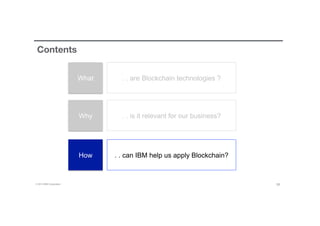
Contents
What
Why
How
. . are Blockchain technologies ?
. . is it relevant for our business?
. . can IBM help us apply Blockchain?
© 2016 IBM Corporation 3
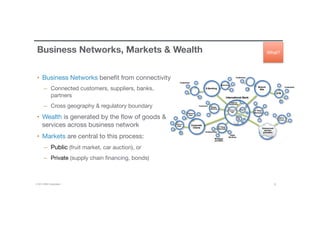
Business Networks, Markets & Wealth
•  Business Networks benefit from connectivity
–  Connected customers, suppliers, banks,
partners 
–  Cross geography & regulatory boundary
•  Wealth is generated by the flow of goods &
services across business network
•  Markets are central to this process:
–  Public (fruit market, car auction), or
–  Private (supply chain financing, bonds)
What?
© 2016 IBM Corporation 4
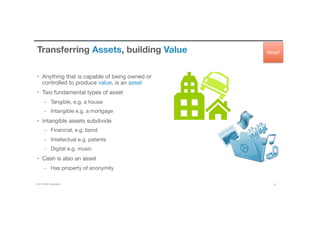
Transferring Assets, building Value
•  Anything that is capable of being owned or
controlled to produce value, is an asset  
•  Two fundamental types of asset
–  Tangible, e.g. a house
–  Intangible e.g. a mortgage 
•  Intangible assets subdivide
–  Financial, e.g. bond
–  Intellectual e.g. patents
–  Digital e.g. music
•  Cash is also an asset
–  Has property of anonymity 
What?
© 2016 IBM Corporation 5
Ledgers are Important
•  Ledger [1] is THE system of
record for a business
–  records asset transfer between
participants.
•  Business will have multiple
ledgers for multiple business
networks in which they
participate.
[1] The principal book (or computer file) for recording and
totaling financial transactions by account type, with debits and
credits in separate columns and a beginning monetary
balance and ending monetary balance for each account.
What?
© 2016 IBM Corporation 6
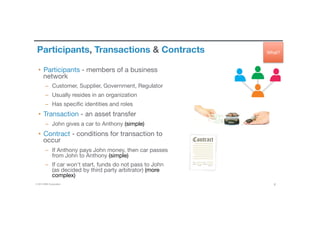
Participants, Transactions & Contracts
•  Participants - members of a business
network
–  Customer, Supplier, Government, Regulator
–  Usually resides in an organization
–  Has specific identities and roles
•  Transaction - an asset transfer
–  John gives a car to Anthony (simple)
•  Contract - conditions for transaction to
occur
–  If Anthony pays John money, then car passes
from John to Anthony (simple)
–  If car won't start, funds do not pass to John
(as decided by third party arbitrator) (more
complex)
What?
© 2016 IBM Corporation 7
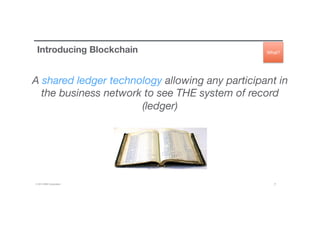
Introducing Blockchain
A shared ledger technology allowing any participant in
the business network to see THE system of record
(ledger)

What?
© 2016 IBM Corporation 8
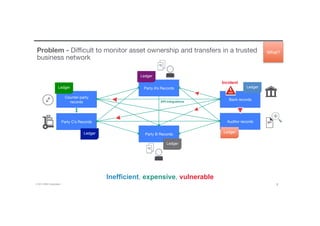
Problem - Difficult to monitor asset ownership and transfers in a trusted 
business network


Counter-party
records
Bank records
Party C’s Records
 Auditor records
Party B Records
Party A’s Records
API-integrations
Incident
What?
Inefficient, expensive, vulnerable
Ledger
Ledger
Ledger
Ledger
Ledger
Ledger
© 2016 IBM Corporation 9
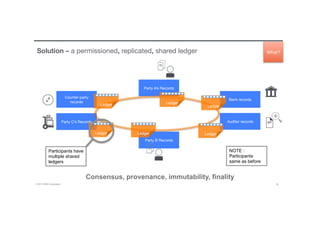
Solution – a permissioned, replicated, shared ledger
Counter-party
records
Bank records
Party C’s Records
 Auditor records
Party B Records
Party A’s Records
What?
Consensus, provenance, immutability, finality
Ledger
Ledger
Ledger
Ledger
Ledger
Ledger
Participants have
multiple shared
ledgers
NOTE :
Participants
same as before
© 2016 IBM Corporation 10
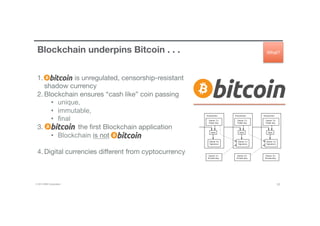
Blockchain underpins Bitcoin . . .
1.  is unregulated, censorship-resistant
shadow currency
2. Blockchain ensures “cash like” coin passing 
•  unique,
•  immutable,
•  final
3. Bitcoin is the first Blockchain application
•  Blockchain is not
4. Digital currencies different from cyptocurrency
What?
© 2016 IBM Corporation 11
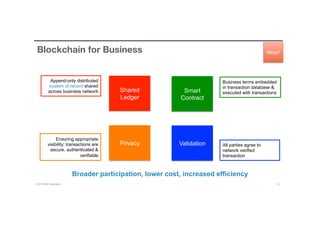
Blockchain for Business
Smart
Contract
Privacy
Shared
Ledger
Validation
Ensuring appropriate
visibility; transactions are
secure, authenticated &
verifiable
Business terms embedded
in transaction database &
executed with transactions
All parties agree to
network verified
transaction
Append-only distributed
system of record shared
across business network
Broader participation, lower cost, increased efficiency
What?
© 2016 IBM Corporation 12
Shared Ledger
•  Records all transactions across
business network
•  Shared between participants
•  Participants have own copy through
replication
•  Permissioned, so participants see
only appropriate transactions
•  THE shared system of record
What?
© 2016 IBM Corporation 13
Smart Contract
•  Business rules implied by the
contract . . 
•  . . embedded in the Blockchain & 
•  executed with the transaction
•  Verifiable, signed
•  Encoded in programming language
•  Example:
–  Defines contractual conditions under
which corporate Bond transfer
occurs
What?
© 2016 IBM Corporation 14
Privacy
•  Ledger is shared, but participants require
privacy
•  Participants need:
–  Transactions to be private
–  Identity not linked to a transaction
•  Transactions need to be authenticated
•  Cryptography central to these processes
What?
© 2016 IBM Corporation 15
Validation
•  Transaction verification & commitment
•  When participants are anonymous 
–  Commitment is expensive
–  Bitcoin cryptographic mining provides verification
for anonymous participants but at significant
compute cost (proof of work)
•  When participants are known & trusted 
–  Commitment possible at low cost
•  Multiple alternatives
–  proof of stake where fraudulent transactions cost
validators (e.g. transaction bond)
–  multi-signature (e.g. 3 out of 5 participants agree)
•  Industrial Blockchain needs “pluggable”
consensus
What?
© 2016 IBM Corporation 16
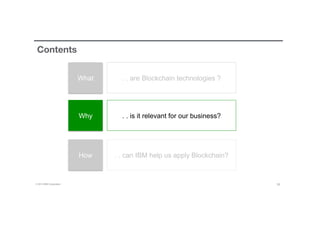
Contents
What
Why
How
. . are Blockchain technologies ?
. . is it relevant for our business?
. . can IBM help us apply Blockchain?
© 2016 IBM Corporation 17
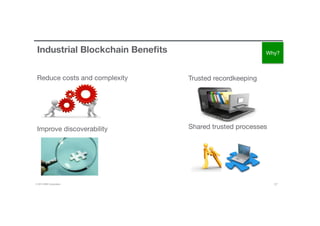
Industrial Blockchain Benefits
Reduce costs and complexity


Improve discoverability
Why?
Trusted recordkeeping


Shared trusted processes
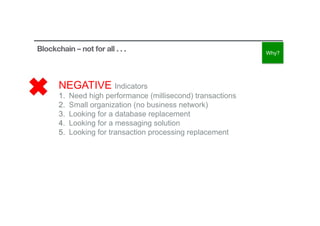
Blockchain – not for all . . .
NEGATIVE Indicators
1.  Need high performance (millisecond) transactions
2.  Small organization (no business network)
3.  Looking for a database replacement
4.  Looking for a messaging solution
5.  Looking for transaction processing replacement
Why?
© 2016 IBM Corporation 19
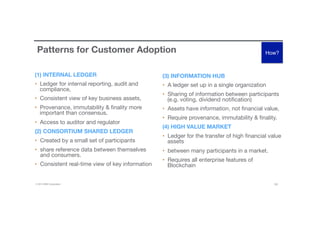
Patterns for Customer Adoption
(1) INTERNAL LEDGER
•  Ledger for internal reporting, audit and
compliance, 
•  Consistent view of key business assets,
•  Provenance, immutability & finality more
important than consensus. 
•  Access to auditor and regulator
(2) CONSORTIUM SHARED LEDGER
•  Created by a small set of participants
•  share reference data between themselves
and consumers. 
•  Consistent real-time view of key information
(3) INFORMATION HUB
•  A ledger set up in a single organization 
•  Sharing of information between participants
(e.g. voting, dividend notification)
•  Assets have information, not financial value, 
•  Require provenance, immutability & finality.
(4) HIGH VALUE MARKET
•  Ledger for the transfer of high financial value
assets 
•  between many participants in a market. 
•  Requires all enterprise features of
Blockchain 
How?
© 2016 IBM Corporation 20
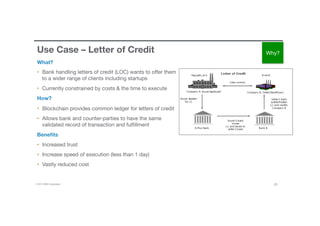
Use Case – Letter of Credit
What?
•  Bank handling letters of credit (LOC) wants to offer them
to a wider range of clients including startups 
•  Currently constrained by costs & the time to execute
How?
•  Blockchain provides common ledger for letters of credit
•  Allows bank and counter-parties to have the same
validated record of transaction and fulfillment
Benefits
•  Increased trust
•  Increase speed of execution (less than 1 day)
•  Vastly reduced cost
Why?
© 2016 IBM Corporation 21
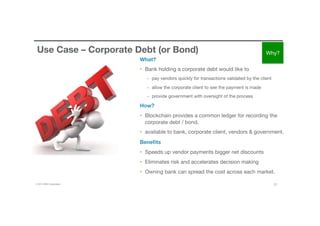
Use Case – Corporate Debt (or Bond)
What?
•  Bank holding a corporate debt would like to 
–  pay vendors quickly for transactions validated by the client 
–  allow the corporate client to see the payment is made 
–  provide government with oversight of the process
How?
•  Blockchain provides a common ledger for recording the
corporate debt / bond, 
•  available to bank, corporate client, vendors & government.
Benefits
•  Speeds up vendor payments bigger net discounts
•  Eliminates risk and accelerates decision making
•  Owning bank can spread the cost across each market.
Why?
© 2016 IBM Corporation 22
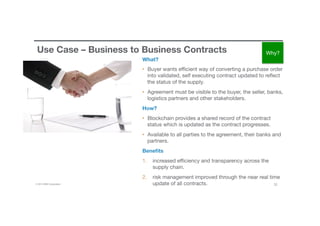
Use Case – Business to Business Contracts
What?
•  Buyer wants efficient way of converting a purchase order
into validated, self executing contract updated to reflect
the status of the supply.  
•  Agreement must be visible to the buyer, the seller, banks,
logistics partners and other stakeholders.
How?
•  Blockchain provides a shared record of the contract
status which is updated as the contract progresses.  
•  Available to all parties to the agreement, their banks and
partners.
Benefits
1.  increased efficiency and transparency across the
supply chain.
2.  risk management improved through the near real time
update of all contracts.
Why?
© 2016 IBM Corporation 23
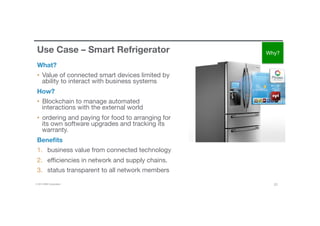
Use Case – Smart Refrigerator 
What?
•  Value of connected smart devices limited by
ability to interact with business systems
How?
•  Blockchain to manage automated
interactions with the external world
•  ordering and paying for food to arranging for
its own software upgrades and tracking its
warranty.  
Benefits
1.  business value from connected technology
2.  efficiencies in network and supply chains.
3.  status transparent to all network members
Why?
© 2016 IBM Corporation 24
Use Case – Open, Trusted Supply Chain
What?
•  Consumers demanding transparency on where and
how their products are made. 
•  EU requires more information about corporate
supply chains, with penalties for non-compliance. 
How?
•  Blockchain enable safe digital transfer of property
across the end to end supply chain. 
Benefits
1.  verifiable, preventing any party from altering 
2.  efficiencies through greater transparency
3.  consumers can make informed purchases
4.  governments get reliable information
Why?
© 2016 IBM Corporation 25
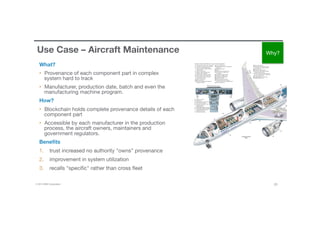
Use Case – Aircraft Maintenance
What?
•  Provenance of each component part in complex
system hard to track
•  Manufacturer, production date, batch and even the
manufacturing machine program.
How?
•  Blockchain holds complete provenance details of each
component part
•  Accessible by each manufacturer in the production
process, the aircraft owners, maintainers and
government regulators. 
Benefits
1.  trust increased no authority "owns” provenance 
2.  improvement in system utilization 
3.  recalls "specific" rather than cross fleet
Why?
© 2016 IBM Corporation 26
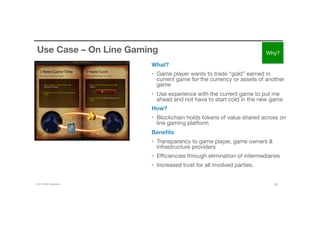
Use Case – On Line Gaming
What?
•  Game player wants to trade “gold” earned in
current game for the currency or assets of another
game 
•  Use experience with the current game to put me
ahead and not have to start cold in the new game
How?
•  Blockchain holds tokens of value shared across on
line gaming platform
Benefits
•  Transparency to game player, game owners &
infrastructure providers
•  Efficiencies through elimination of intermediaries
•  Increased trust for all involved parties.
Why?
© 2016 IBM Corporation 27
Other Potential Use Cases include . . 
•  Securities
–  Post-trade settlement
–  Derivative contracts
–  Securities issuance
–  Collateral management
•  Trade Finance
–  Bill of Lading
–  Cross-currency payment
•  Syndicated Loans
•  Intra-bank settlement
•  Retail Banking
–  Cross border remittances
–  Mortgage verification
–  Mortgage contracts (smart contract)
•  Public Records
–  Real estate records 
–  Vehicle registrations
–  Business license and ownership records
Why?
© 2016 IBM Corporation 28
Contents
What
Why
How
. . are Blockchain technologies ?
. . is it relevant for our business?
. . can IBM help us apply Blockchain?
© 2016 IBM Corporation
Hyperledger Project
29
§  Linux Foundation - announced 17th December 2015
§  New open ledger project to transform the way business
transactions are conducted around the world
§  Project members understand that an open source, collaborative
development strategy supporting multiple players in multiple
industries is required
Enable adoption of shared ledger technology at a pace and depth not
achievable by any one company or industry
How?
© 2016 IBM Corporation
Hyperledger Project Members [1]
30
[1] At 17th December 2015
How?
© 2016 IBM Corporation
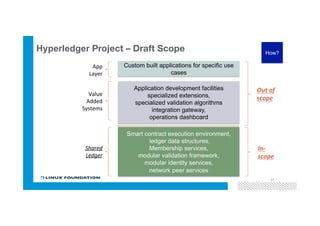
Hyperledger Project – Draft Scope
31
Smart contract execution environment,
ledger data structures,
Membership services,
modular validation framework,
modular identity services,
network peer services
Application development facilities
specialized extensions,
specialized validation algorithms
integration gateway,
operations dashboard
Custom built applications for specific use
cases
App	
Layer	
Shared	
Ledger	
Value	
Added	
Systems	
In-
scope	
Out	of	
scope	
How?
© 2016 IBM Corporation 32
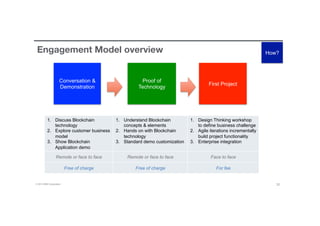
Engagement Model overview
1.  Discuss Blockchain
technology
2.  Explore customer business
model
3.  Show Blockchain
Application demo
1.  Understand Blockchain
concepts & elements
2.  Hands on with Blockchain
technology
3.  Standard demo customization
1.  Design Thinking workshop
to define business challenge
2.  Agile iterations incrementally
build project functionality
3.  Enterprise integration
Remote or face to face Remote or face to face Face to face
Free of charge Free of charge For fee
Conversation &
Demonstration
Proof of
Technology
First Project
How?
© 2016 IBM Corporation 33
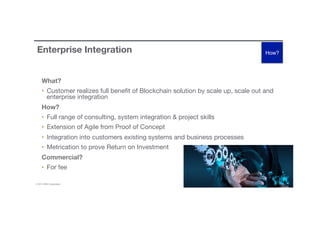
Enterprise Integration
What?
•  Customer realizes full benefit of Blockchain solution by scale up, scale out and
enterprise integration
How?
•  Full range of consulting, system integration & project skills
•  Extension of Agile from Proof of Concept
•  Integration into customers existing systems and business processes
•  Metrication to prove Return on Investment 
Commercial?
•  For fee
How?
© 2016 IBM Corporation 34
Summary
1.  Blockchain is a shared, replicated ledger technology
2.  IBM supports an open standards, open source, open
governance Blockchain
3.  Blockchain can open up business networks by taking out
cost, improving efficiencies and increase accessibility
4.  Blockchain addresses an exciting and topical set of business
challenges, which cross every industry
5.  Linux Foundation Hyperledger project developing open
source, open standards shared ledger technology
6.  IBM has an easy to access, proven and incremental
engagement model giving customers the confidence to get
started NOW
©2016 IBM Corporation
Thank You!

Making Blockchain Real for Business Explained - ibm

  • 1.
    © 2016 IBMCorporation Making Blockchain Real for Business
 
 Explained 1 V2.09 19 Jan 16 https://ibm.box.com/BlockExp
  • 2.
    © 2016 IBMCorporation 2 Contents What Why How . . are Blockchain technologies ? . . is it relevant for our business? . . can IBM help us apply Blockchain?
  • 3.
    © 2016 IBMCorporation 3 Business Networks, Markets & Wealth •  Business Networks benefit from connectivity –  Connected customers, suppliers, banks, partners –  Cross geography & regulatory boundary •  Wealth is generated by the flow of goods & services across business network •  Markets are central to this process: –  Public (fruit market, car auction), or –  Private (supply chain financing, bonds) What?
  • 4.
    © 2016 IBMCorporation 4 Transferring Assets, building Value •  Anything that is capable of being owned or controlled to produce value, is an asset   •  Two fundamental types of asset –  Tangible, e.g. a house –  Intangible e.g. a mortgage  •  Intangible assets subdivide –  Financial, e.g. bond –  Intellectual e.g. patents –  Digital e.g. music •  Cash is also an asset –  Has property of anonymity What?
  • 5.
    © 2016 IBMCorporation 5 Ledgers are Important •  Ledger [1] is THE system of record for a business –  records asset transfer between participants. •  Business will have multiple ledgers for multiple business networks in which they participate. [1] The principal book (or computer file) for recording and totaling financial transactions by account type, with debits and credits in separate columns and a beginning monetary balance and ending monetary balance for each account. What?
  • 6.
    © 2016 IBMCorporation 6 Participants, Transactions & Contracts •  Participants - members of a business network –  Customer, Supplier, Government, Regulator –  Usually resides in an organization –  Has specific identities and roles •  Transaction - an asset transfer –  John gives a car to Anthony (simple) •  Contract - conditions for transaction to occur –  If Anthony pays John money, then car passes from John to Anthony (simple) –  If car won't start, funds do not pass to John (as decided by third party arbitrator) (more complex) What?
  • 7.
    © 2016 IBMCorporation 7 Introducing Blockchain A shared ledger technology allowing any participant in the business network to see THE system of record (ledger) What?
  • 8.
    © 2016 IBMCorporation 8 Problem - Difficult to monitor asset ownership and transfers in a trusted  business network
 Counter-party records Bank records Party C’s Records Auditor records Party B Records Party A’s Records API-integrations Incident What? Inefficient, expensive, vulnerable Ledger Ledger Ledger Ledger Ledger Ledger
  • 9.
    © 2016 IBMCorporation 9 Solution – a permissioned, replicated, shared ledger Counter-party records Bank records Party C’s Records Auditor records Party B Records Party A’s Records What? Consensus, provenance, immutability, finality Ledger Ledger Ledger Ledger Ledger Ledger Participants have multiple shared ledgers NOTE : Participants same as before
  • 10.
    © 2016 IBMCorporation 10 Blockchain underpins Bitcoin . . . 1.  is unregulated, censorship-resistant shadow currency 2. Blockchain ensures “cash like” coin passing •  unique, •  immutable, •  final 3. Bitcoin is the first Blockchain application •  Blockchain is not 4. Digital currencies different from cyptocurrency What?
  • 11.
    © 2016 IBMCorporation 11 Blockchain for Business Smart Contract Privacy Shared Ledger Validation Ensuring appropriate visibility; transactions are secure, authenticated & verifiable Business terms embedded in transaction database & executed with transactions All parties agree to network verified transaction Append-only distributed system of record shared across business network Broader participation, lower cost, increased efficiency What?
  • 12.
    © 2016 IBMCorporation 12 Shared Ledger •  Records all transactions across business network •  Shared between participants •  Participants have own copy through replication •  Permissioned, so participants see only appropriate transactions •  THE shared system of record What?
  • 13.
    © 2016 IBMCorporation 13 Smart Contract •  Business rules implied by the contract . . •  . . embedded in the Blockchain & •  executed with the transaction •  Verifiable, signed •  Encoded in programming language •  Example: –  Defines contractual conditions under which corporate Bond transfer occurs What?
  • 14.
    © 2016 IBMCorporation 14 Privacy •  Ledger is shared, but participants require privacy •  Participants need: –  Transactions to be private –  Identity not linked to a transaction •  Transactions need to be authenticated •  Cryptography central to these processes What?
  • 15.
    © 2016 IBMCorporation 15 Validation •  Transaction verification & commitment •  When participants are anonymous –  Commitment is expensive –  Bitcoin cryptographic mining provides verification for anonymous participants but at significant compute cost (proof of work) •  When participants are known & trusted –  Commitment possible at low cost •  Multiple alternatives –  proof of stake where fraudulent transactions cost validators (e.g. transaction bond) –  multi-signature (e.g. 3 out of 5 participants agree) •  Industrial Blockchain needs “pluggable” consensus What?
  • 16.
    © 2016 IBMCorporation 16 Contents What Why How . . are Blockchain technologies ? . . is it relevant for our business? . . can IBM help us apply Blockchain?
  • 17.
    © 2016 IBMCorporation 17 Industrial Blockchain Benefits Reduce costs and complexity Improve discoverability Why? Trusted recordkeeping Shared trusted processes
  • 18.
    Blockchain – notfor all . . . NEGATIVE Indicators 1.  Need high performance (millisecond) transactions 2.  Small organization (no business network) 3.  Looking for a database replacement 4.  Looking for a messaging solution 5.  Looking for transaction processing replacement Why?
  • 19.
    © 2016 IBMCorporation 19 Patterns for Customer Adoption (1) INTERNAL LEDGER •  Ledger for internal reporting, audit and compliance, •  Consistent view of key business assets, •  Provenance, immutability & finality more important than consensus. •  Access to auditor and regulator (2) CONSORTIUM SHARED LEDGER •  Created by a small set of participants •  share reference data between themselves and consumers. •  Consistent real-time view of key information (3) INFORMATION HUB •  A ledger set up in a single organization •  Sharing of information between participants (e.g. voting, dividend notification) •  Assets have information, not financial value, •  Require provenance, immutability & finality. (4) HIGH VALUE MARKET •  Ledger for the transfer of high financial value assets •  between many participants in a market. •  Requires all enterprise features of Blockchain How?
  • 20.
    © 2016 IBMCorporation 20 Use Case – Letter of Credit What? •  Bank handling letters of credit (LOC) wants to offer them to a wider range of clients including startups •  Currently constrained by costs & the time to execute How? •  Blockchain provides common ledger for letters of credit •  Allows bank and counter-parties to have the same validated record of transaction and fulfillment Benefits •  Increased trust •  Increase speed of execution (less than 1 day) •  Vastly reduced cost Why?
  • 21.
    © 2016 IBMCorporation 21 Use Case – Corporate Debt (or Bond) What? •  Bank holding a corporate debt would like to –  pay vendors quickly for transactions validated by the client –  allow the corporate client to see the payment is made –  provide government with oversight of the process How? •  Blockchain provides a common ledger for recording the corporate debt / bond, •  available to bank, corporate client, vendors & government. Benefits •  Speeds up vendor payments bigger net discounts •  Eliminates risk and accelerates decision making •  Owning bank can spread the cost across each market. Why?
  • 22.
    © 2016 IBMCorporation 22 Use Case – Business to Business Contracts What? •  Buyer wants efficient way of converting a purchase order into validated, self executing contract updated to reflect the status of the supply.   •  Agreement must be visible to the buyer, the seller, banks, logistics partners and other stakeholders. How? •  Blockchain provides a shared record of the contract status which is updated as the contract progresses.   •  Available to all parties to the agreement, their banks and partners. Benefits 1.  increased efficiency and transparency across the supply chain. 2.  risk management improved through the near real time update of all contracts. Why?
  • 23.
    © 2016 IBMCorporation 23 Use Case – Smart Refrigerator What? •  Value of connected smart devices limited by ability to interact with business systems How? •  Blockchain to manage automated interactions with the external world •  ordering and paying for food to arranging for its own software upgrades and tracking its warranty.   Benefits 1.  business value from connected technology 2.  efficiencies in network and supply chains. 3.  status transparent to all network members Why?
  • 24.
    © 2016 IBMCorporation 24 Use Case – Open, Trusted Supply Chain What? •  Consumers demanding transparency on where and how their products are made. •  EU requires more information about corporate supply chains, with penalties for non-compliance. How? •  Blockchain enable safe digital transfer of property across the end to end supply chain.  Benefits 1.  verifiable, preventing any party from altering 2.  efficiencies through greater transparency 3.  consumers can make informed purchases 4.  governments get reliable information Why?
  • 25.
    © 2016 IBMCorporation 25 Use Case – Aircraft Maintenance What? •  Provenance of each component part in complex system hard to track •  Manufacturer, production date, batch and even the manufacturing machine program. How? •  Blockchain holds complete provenance details of each component part •  Accessible by each manufacturer in the production process, the aircraft owners, maintainers and government regulators.  Benefits 1.  trust increased no authority "owns” provenance 2.  improvement in system utilization 3.  recalls "specific" rather than cross fleet Why?
  • 26.
    © 2016 IBMCorporation 26 Use Case – On Line Gaming What? •  Game player wants to trade “gold” earned in current game for the currency or assets of another game •  Use experience with the current game to put me ahead and not have to start cold in the new game How? •  Blockchain holds tokens of value shared across on line gaming platform Benefits •  Transparency to game player, game owners & infrastructure providers •  Efficiencies through elimination of intermediaries •  Increased trust for all involved parties. Why?
  • 27.
    © 2016 IBMCorporation 27 Other Potential Use Cases include . . •  Securities –  Post-trade settlement –  Derivative contracts –  Securities issuance –  Collateral management •  Trade Finance –  Bill of Lading –  Cross-currency payment •  Syndicated Loans •  Intra-bank settlement •  Retail Banking –  Cross border remittances –  Mortgage verification –  Mortgage contracts (smart contract) •  Public Records –  Real estate records –  Vehicle registrations –  Business license and ownership records Why?
  • 28.
    © 2016 IBMCorporation 28 Contents What Why How . . are Blockchain technologies ? . . is it relevant for our business? . . can IBM help us apply Blockchain?
  • 29.
    © 2016 IBMCorporation Hyperledger Project 29 §  Linux Foundation - announced 17th December 2015 §  New open ledger project to transform the way business transactions are conducted around the world §  Project members understand that an open source, collaborative development strategy supporting multiple players in multiple industries is required Enable adoption of shared ledger technology at a pace and depth not achievable by any one company or industry How?
  • 30.
    © 2016 IBMCorporation Hyperledger Project Members [1] 30 [1] At 17th December 2015 How?
  • 31.
    © 2016 IBMCorporation Hyperledger Project – Draft Scope 31 Smart contract execution environment, ledger data structures, Membership services, modular validation framework, modular identity services, network peer services Application development facilities specialized extensions, specialized validation algorithms integration gateway, operations dashboard Custom built applications for specific use cases App Layer Shared Ledger Value Added Systems In- scope Out of scope How?
  • 32.
    © 2016 IBMCorporation 32 Engagement Model overview 1.  Discuss Blockchain technology 2.  Explore customer business model 3.  Show Blockchain Application demo 1.  Understand Blockchain concepts & elements 2.  Hands on with Blockchain technology 3.  Standard demo customization 1.  Design Thinking workshop to define business challenge 2.  Agile iterations incrementally build project functionality 3.  Enterprise integration Remote or face to face Remote or face to face Face to face Free of charge Free of charge For fee Conversation & Demonstration Proof of Technology First Project How?
  • 33.
    © 2016 IBMCorporation 33 Enterprise Integration What? •  Customer realizes full benefit of Blockchain solution by scale up, scale out and enterprise integration How? •  Full range of consulting, system integration & project skills •  Extension of Agile from Proof of Concept •  Integration into customers existing systems and business processes •  Metrication to prove Return on Investment Commercial? •  For fee How?
  • 34.
    © 2016 IBMCorporation 34 Summary 1.  Blockchain is a shared, replicated ledger technology 2.  IBM supports an open standards, open source, open governance Blockchain 3.  Blockchain can open up business networks by taking out cost, improving efficiencies and increase accessibility 4.  Blockchain addresses an exciting and topical set of business challenges, which cross every industry 5.  Linux Foundation Hyperledger project developing open source, open standards shared ledger technology 6.  IBM has an easy to access, proven and incremental engagement model giving customers the confidence to get started NOW
  • 35.