Bahaa Farouk
Chief Transformation Officer, Suez Canal Bank
Leveraging AI to Enhance Cybersecurity
1
Acknowledgement
2
In advance, appreciating the judge board of speakers/topics selection especially Professor Dr. Bahaa Hassan,
Chairman and Founder Arab Security Conference it is an honor to participate and deliver such professional
experience session in its 8th
edition, 2024.
Further, it is an honor to be here for the third time in row among cybersecurity experts across the globe.
Agenda
3
• AI in Cybersecurity, in nutshell
• Benefits of Applying AI in Cybersecurity
• AI Uses Cases in Cybersecurity
• Detailed Use Cases
• Deep Learning in Threat Detection
• ML in SDLC Secure Code Scanning
• Future Readiness, Recommendations
• References
• ddd
4
Scan to participate in
opening survey.
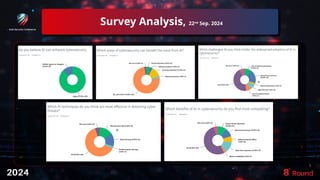
Survey Analysis, 22nd
Sep. 2024
5
6
The Impact of Artificial Intelligent in Improving Cybersecurity
AI in Cybersecurity, in nutshell?
AI in Cybersecurity, in nutshell
7
• Cyber threats evolve in complexity and frequency,
• Traditional cybersecurity measures struggle to keep pace,
• Artificial Intelligent offers a paradigm shift enabling proactive threat detection
and adaptive response strategies.
Debate!
There are some concerns of replying on AI in Cybersecurity.
AI in Cybersecurity, in nutshell
8
Debate!
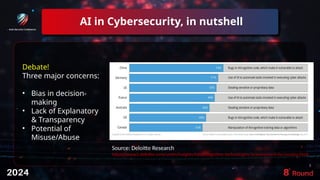
Three major concerns:
• Bias in decision-
making
• Lack of Explanatory
& Transparency
• Potential of
Misuse/Abuse
Source: Deloitte Research
https://www2.deloitte.com/us/en/insights/focus/cognitive-technologies/ai-investment-by-country.html
9
The Impact of Artificial Intelligent in Improving Cybersecurity
Benefits?
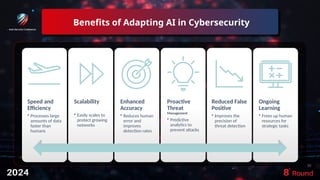
Benefits of Adapting AI in Cybersecurity
10
Speed and
Efficiency
• Processes large
amounts of data
faster than
humans
Scalability
• Easily scales to
protect growing
networks
Enhanced
Accuracy
• Reduces human
error and
improves
detection rates
Proactive
Threat
Management
• Predictive
analytics to
prevent attacks
Reduced False
Positive
• Improves the
precision of
threat detection
Ongoing
Learning
• Frees up human
resources for
strategic tasks
11
The Impact of Artificial Intelligent in Improving Cybersecurity
AI Use Cases in Cybersecurity
AI Use Cases In Cybersecurity
12
Use
Cases
Threat
Detection
Fraud
Prevention
Automated
Incident
Response
Phishing
Detection
Behavioral
Analytics
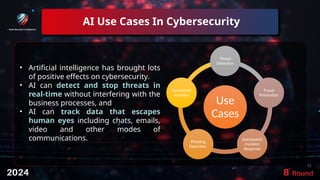
• Artificial intelligence has brought lots
of positive effects on cybersecurity.
• AI can detect and stop threats in
real-time without interfering with the
business processes, and
• AI can track data that escapes
human eyes including chats, emails,
video and other modes of
communications.
AI Use Cases In Cybersecurity
Threat Detection
13
Use
Cases
Threat
Detection
Fraud
Prevention
Automated
Incident
Response
Phishing
Detection
Behavioral
Analytics
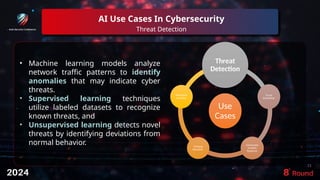
• Machine learning models analyze
network traffic patterns to identify
anomalies that may indicate cyber
threats.
• Supervised learning techniques
utilize labeled datasets to recognize
known threats, and
• Unsupervised learning detects novel
threats by identifying deviations from
normal behavior.
AI Use Cases In Cybersecurity
Fraud Prevention
14
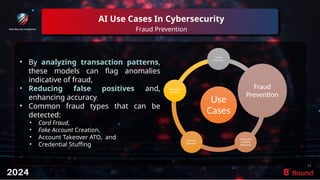
• By analyzing transaction patterns,
these models can flag anomalies
indicative of fraud,
• Reducing false positives and,
enhancing accuracy.
• Common fraud types that can be
detected:
• Card Fraud,
• Fake Account Creation,
• Account Takeover ATO, and
• Credential Stuffing
Use
Cases
Threat
Detection
Fraud
Prevention
Automated
Incident
Response
Phishing
Detection
Behavioral
Analytics
AI Use Cases In Cybersecurity
15
Use
Cases
Threat
Detection
Fraud
Prevention
Automated
Incident
Response
Phishing
Detection
Behavioral
Analytics
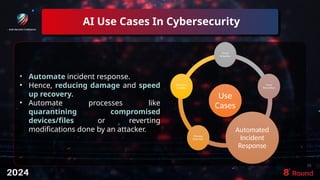
• Automate incident response.
• Hence, reducing damage and speed
up recovery.
• Automate processes like
quarantining compromised
devices/files or reverting
modifications done by an attacker.
AI Use Cases In Cybersecurity
16
Use
Cases
Threat
Detection
Fraud
Prevention
Automated
Incident
Response
Phishing
Detection
Behavioral
Analytics
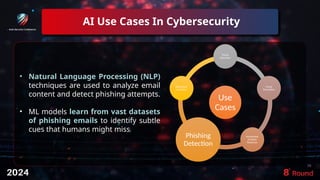
• Natural Language Processing (NLP)
techniques are used to analyze email
content and detect phishing attempts.
• ML models learn from vast datasets
of phishing emails to identify subtle
cues that humans might miss.
AI Use Cases In Cybersecurity
17
Use
Cases
Threat
Detection
Fraud
Prevention
Automated
Incident
Response
Phishing
Detection
Behavioral
Analytics
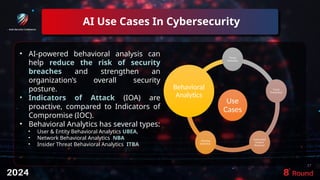
• AI-powered behavioral analysis can
help reduce the risk of security
breaches and strengthen an
organization’s overall security
posture.
• Indicators of Attack (IOA) are
proactive, compared to Indicators of
Compromise (IOC).
• Behavioral Analytics has several types:
• User & Entity Behavioral Analytics UBEA,
• Network Behavioral Analytics NBA
• Insider Threat Behavioral Analytics ITBA
18
The Impact of Artificial Intelligent in Improving
Cybersecurity
Detailed Use Cases: Deep Learning in Threat Detection
Deep Learning in Threat Detection
19
• A revolution in network technology has been ushered in by Software Defined
Networking (SDN), which makes it possible to control the network from a central location
and provides an overview of the network’s security
• Deep learning (DL) and machine learning (ML) have been implemented in SDN-based
Network Intrusion Detection System (NIDS) to overcome the security issues within a
network.
• Deep learning, a subset of ML, excels in processing Unstructured data, such as images
and text.
• Both Convolutional Neural Networks (CNNs) and Recurrent Neural Networks (RNNs)
are particularly effective in identifying complex patterns within cybersecurity datasets.
Deep Learning in Threat Detection
20
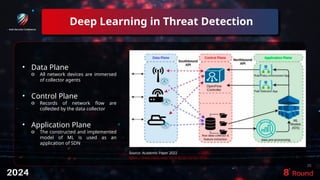
• Data Plane
⊖ All network devices are immersed
of collector agents
• Control Plane
⊖ Records of network flow are
collected by the data collector
• Application Plane
⊖ The constructed and implemented
model of ML is used as an
application of SDN
Source: Academic Paper 2022
https://www.mdpi.com/1424-8220/22/20/7896
21
The Impact of Artificial Intelligent in Improving
Cybersecurity
Detailed Use Cases: ML in SDLC Secure Code Scanning
ML in SDLC Secure Code Scanning
22
• Integrating ML into the SDLC enhances secure code scanning by identifying
vulnerabilities early in the development process.
• ML models assess code quality and flag potential security issues, enabling
developers to address them promptly.
• ML models can suggest fixes to identified issues.
ML in SDLC Secure Code Scanning
23
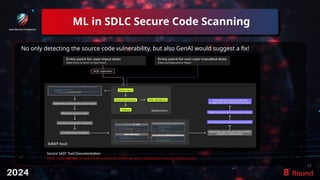
No only detecting the source code vulnerability, but also GenAI would suggest a fix!
Source SAST Tool Documentation
https://github.blog/ai-and-ml/llms/how-ai-enhances-static-application-security-testing-sast/
24
The Impact of Artificial Intelligent in Improving
Cybersecurity
Future Readiness?
Adapting AI in Cybersecurity
Concerns
25
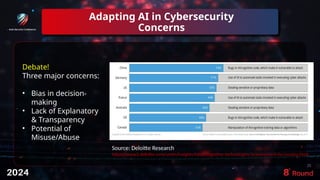
Debate!
Three major concerns:
• Bias in decision-
making
• Lack of Explanatory
& Transparency
• Potential of
Misuse/Abuse
Source: Deloitte Research
https://www2.deloitte.com/us/en/insights/focus/cognitive-technologies/ai-investment-by-country.html
Future Readiness?
26
1. Invest in Training: Equip security teams with the necessary skills to develop
and maintain ML models.
2. Prioritize Data Security: Ensure data used for training is secure and
representative of actual threat landscapes.
3. Foster Collaboration: Encourage collaboration between data scientists and
security experts to enhance model development.
4. Adopt a Proactive Approach: Use ML to anticipate and mitigate potential
threats before they manifest.
5. Continuously Evaluate Models: Regularly review and update ML models to
maintain their effectiveness against evolving threats.
References
27
Academic Research Papers/Books
• Ahmed N, Ngadi Ab, Sharif JM, Hussain S, Uddin M, Rathore MS, Iqbal J, Abdelhaq M, Alsaqour R, Ullah SS, et al. Network Threat Detection Using Machine/Deep Learning in
SDN-Based Platforms: A Comprehensive Analysis of State-of-the-Art Solutions, Discussion, Challenges, and Future Research Direction. Sensors. 2022; 22(20):7896
• Alghamdi A and Barsoum (2024). A Comprehensive IDs to Detect Botnet Attacks Using Machine Learning Techniques2024 IEEE 3rd International Conference on Computing
and Machine Intelligence (ICMI)10.1109/ICMI60790.2024.10585846(1-6)
• Buczak, A. L., & Guven, E. (2015). A survey of data mining and machine learning methods for cyber security intrusion detection. IEEE Communications Surveys & Tutorials.
• Chio, C., & Freeman, D.. Machine Learning and Security: Protecting Systems with Data and Algorithms. O'Reilly Media.
• Lippmann, R. P., et al. Evaluating intrusion detection systems: The 1998 DARPA off-line intrusion detection evaluation. DARPA Information Survivability Conference and
Exposition.
• Saxe, J., & Berlin, K.. Deep neural network-based malware detection using two-dimensional binary program features. 10th International Conference on Malicious and
Unwanted Software.
• Shah, S. A., & Issac, B.. Performance comparison of intrusion detection systems and application of machine learning to Snort system. Future Generation Computer Systems.
Others
• https://www2.deloitte.com/us/en/insights/focus/cognitive-technologies/ai-investment-by-country.html
• https://github.blog/ai-and-ml/llms/how-ai-enhances-static-application-security-testing-sast/
• ddd
28

Leveraging Machine Learning to Enhance Cybersecurity v2.pptx

  • 1.
    Bahaa Farouk Chief TransformationOfficer, Suez Canal Bank Leveraging AI to Enhance Cybersecurity 1
  • 2.
    Acknowledgement 2 In advance, appreciatingthe judge board of speakers/topics selection especially Professor Dr. Bahaa Hassan, Chairman and Founder Arab Security Conference it is an honor to participate and deliver such professional experience session in its 8th edition, 2024. Further, it is an honor to be here for the third time in row among cybersecurity experts across the globe.
  • 3.
    Agenda 3 • AI inCybersecurity, in nutshell • Benefits of Applying AI in Cybersecurity • AI Uses Cases in Cybersecurity • Detailed Use Cases • Deep Learning in Threat Detection • ML in SDLC Secure Code Scanning • Future Readiness, Recommendations • References • ddd
  • 4.
    4 Scan to participatein opening survey.
  • 5.
  • 6.
    6 The Impact ofArtificial Intelligent in Improving Cybersecurity AI in Cybersecurity, in nutshell?
  • 7.
    AI in Cybersecurity,in nutshell 7 • Cyber threats evolve in complexity and frequency, • Traditional cybersecurity measures struggle to keep pace, • Artificial Intelligent offers a paradigm shift enabling proactive threat detection and adaptive response strategies. Debate! There are some concerns of replying on AI in Cybersecurity.
  • 8.
    AI in Cybersecurity,in nutshell 8 Debate! Three major concerns: • Bias in decision- making • Lack of Explanatory & Transparency • Potential of Misuse/Abuse Source: Deloitte Research https://www2.deloitte.com/us/en/insights/focus/cognitive-technologies/ai-investment-by-country.html
  • 9.
    9 The Impact ofArtificial Intelligent in Improving Cybersecurity Benefits?
  • 10.
    Benefits of AdaptingAI in Cybersecurity 10 Speed and Efficiency • Processes large amounts of data faster than humans Scalability • Easily scales to protect growing networks Enhanced Accuracy • Reduces human error and improves detection rates Proactive Threat Management • Predictive analytics to prevent attacks Reduced False Positive • Improves the precision of threat detection Ongoing Learning • Frees up human resources for strategic tasks
  • 11.
    11 The Impact ofArtificial Intelligent in Improving Cybersecurity AI Use Cases in Cybersecurity
  • 12.
    AI Use CasesIn Cybersecurity 12 Use Cases Threat Detection Fraud Prevention Automated Incident Response Phishing Detection Behavioral Analytics • Artificial intelligence has brought lots of positive effects on cybersecurity. • AI can detect and stop threats in real-time without interfering with the business processes, and • AI can track data that escapes human eyes including chats, emails, video and other modes of communications.
  • 13.
    AI Use CasesIn Cybersecurity Threat Detection 13 Use Cases Threat Detection Fraud Prevention Automated Incident Response Phishing Detection Behavioral Analytics • Machine learning models analyze network traffic patterns to identify anomalies that may indicate cyber threats. • Supervised learning techniques utilize labeled datasets to recognize known threats, and • Unsupervised learning detects novel threats by identifying deviations from normal behavior.
  • 14.
    AI Use CasesIn Cybersecurity Fraud Prevention 14 • By analyzing transaction patterns, these models can flag anomalies indicative of fraud, • Reducing false positives and, enhancing accuracy. • Common fraud types that can be detected: • Card Fraud, • Fake Account Creation, • Account Takeover ATO, and • Credential Stuffing Use Cases Threat Detection Fraud Prevention Automated Incident Response Phishing Detection Behavioral Analytics
  • 15.
    AI Use CasesIn Cybersecurity 15 Use Cases Threat Detection Fraud Prevention Automated Incident Response Phishing Detection Behavioral Analytics • Automate incident response. • Hence, reducing damage and speed up recovery. • Automate processes like quarantining compromised devices/files or reverting modifications done by an attacker.
  • 16.
    AI Use CasesIn Cybersecurity 16 Use Cases Threat Detection Fraud Prevention Automated Incident Response Phishing Detection Behavioral Analytics • Natural Language Processing (NLP) techniques are used to analyze email content and detect phishing attempts. • ML models learn from vast datasets of phishing emails to identify subtle cues that humans might miss.
  • 17.
    AI Use CasesIn Cybersecurity 17 Use Cases Threat Detection Fraud Prevention Automated Incident Response Phishing Detection Behavioral Analytics • AI-powered behavioral analysis can help reduce the risk of security breaches and strengthen an organization’s overall security posture. • Indicators of Attack (IOA) are proactive, compared to Indicators of Compromise (IOC). • Behavioral Analytics has several types: • User & Entity Behavioral Analytics UBEA, • Network Behavioral Analytics NBA • Insider Threat Behavioral Analytics ITBA
  • 18.
    18 The Impact ofArtificial Intelligent in Improving Cybersecurity Detailed Use Cases: Deep Learning in Threat Detection
  • 19.
    Deep Learning inThreat Detection 19 • A revolution in network technology has been ushered in by Software Defined Networking (SDN), which makes it possible to control the network from a central location and provides an overview of the network’s security • Deep learning (DL) and machine learning (ML) have been implemented in SDN-based Network Intrusion Detection System (NIDS) to overcome the security issues within a network. • Deep learning, a subset of ML, excels in processing Unstructured data, such as images and text. • Both Convolutional Neural Networks (CNNs) and Recurrent Neural Networks (RNNs) are particularly effective in identifying complex patterns within cybersecurity datasets.
  • 20.
    Deep Learning inThreat Detection 20 • Data Plane ⊖ All network devices are immersed of collector agents • Control Plane ⊖ Records of network flow are collected by the data collector • Application Plane ⊖ The constructed and implemented model of ML is used as an application of SDN Source: Academic Paper 2022 https://www.mdpi.com/1424-8220/22/20/7896
  • 21.
    21 The Impact ofArtificial Intelligent in Improving Cybersecurity Detailed Use Cases: ML in SDLC Secure Code Scanning
  • 22.
    ML in SDLCSecure Code Scanning 22 • Integrating ML into the SDLC enhances secure code scanning by identifying vulnerabilities early in the development process. • ML models assess code quality and flag potential security issues, enabling developers to address them promptly. • ML models can suggest fixes to identified issues.
  • 23.
    ML in SDLCSecure Code Scanning 23 No only detecting the source code vulnerability, but also GenAI would suggest a fix! Source SAST Tool Documentation https://github.blog/ai-and-ml/llms/how-ai-enhances-static-application-security-testing-sast/
  • 24.
    24 The Impact ofArtificial Intelligent in Improving Cybersecurity Future Readiness?
  • 25.
    Adapting AI inCybersecurity Concerns 25 Debate! Three major concerns: • Bias in decision- making • Lack of Explanatory & Transparency • Potential of Misuse/Abuse Source: Deloitte Research https://www2.deloitte.com/us/en/insights/focus/cognitive-technologies/ai-investment-by-country.html
  • 26.
    Future Readiness? 26 1. Investin Training: Equip security teams with the necessary skills to develop and maintain ML models. 2. Prioritize Data Security: Ensure data used for training is secure and representative of actual threat landscapes. 3. Foster Collaboration: Encourage collaboration between data scientists and security experts to enhance model development. 4. Adopt a Proactive Approach: Use ML to anticipate and mitigate potential threats before they manifest. 5. Continuously Evaluate Models: Regularly review and update ML models to maintain their effectiveness against evolving threats.
  • 27.
    References 27 Academic Research Papers/Books •Ahmed N, Ngadi Ab, Sharif JM, Hussain S, Uddin M, Rathore MS, Iqbal J, Abdelhaq M, Alsaqour R, Ullah SS, et al. Network Threat Detection Using Machine/Deep Learning in SDN-Based Platforms: A Comprehensive Analysis of State-of-the-Art Solutions, Discussion, Challenges, and Future Research Direction. Sensors. 2022; 22(20):7896 • Alghamdi A and Barsoum (2024). A Comprehensive IDs to Detect Botnet Attacks Using Machine Learning Techniques2024 IEEE 3rd International Conference on Computing and Machine Intelligence (ICMI)10.1109/ICMI60790.2024.10585846(1-6) • Buczak, A. L., & Guven, E. (2015). A survey of data mining and machine learning methods for cyber security intrusion detection. IEEE Communications Surveys & Tutorials. • Chio, C., & Freeman, D.. Machine Learning and Security: Protecting Systems with Data and Algorithms. O'Reilly Media. • Lippmann, R. P., et al. Evaluating intrusion detection systems: The 1998 DARPA off-line intrusion detection evaluation. DARPA Information Survivability Conference and Exposition. • Saxe, J., & Berlin, K.. Deep neural network-based malware detection using two-dimensional binary program features. 10th International Conference on Malicious and Unwanted Software. • Shah, S. A., & Issac, B.. Performance comparison of intrusion detection systems and application of machine learning to Snort system. Future Generation Computer Systems. Others • https://www2.deloitte.com/us/en/insights/focus/cognitive-technologies/ai-investment-by-country.html • https://github.blog/ai-and-ml/llms/how-ai-enhances-static-application-security-testing-sast/ • ddd
  • 28.