Blockchain Based Decentralized Cloud Storage
*
Dhruv Doshi
1
and Prof. Satvik Khara
2
1*dhru.edu.doshi@gmail.com
1- 2
Silver Oak College Of Engineering and Technology
2svkhara@gmail.com
Abstract. A prototype of a multi-user system for access control to data sets
stored in a malicious cloud environment is presented. Cloud storage like
any other environment needs the ability to securely shared information. The
approach here is to provide access control over the data stored in the cloud
without provider participation. The main tool of the access control
mechanism is a ciphertext-policy attribute-based encryption scheme with
dynamic attributes and advanced encryption algorithms. Using a based
decentralized ledger, our system provides an immutable log of all
meaningful security events, such as key generation, access policy
assignments, changes or revocations, and access requests. We propose a set
of protocols to ensure the privacy of operations requiring secret or private
keys. Only hash codes are transferred through the ledger. The prototype of
the system is implemented using smart contracts and tested on the
platform..
Keywords: Cloud storage, attribute-based access control, ciphertext-policy
attribute-based encryption, ethereum based contracts.
1 Introduction
Today, the requirement of each cloud user is not the same as it used to be, some
users need better storage capacity, some need lower storage with better plans
hence this paper is the complete solution of unique cloud storage which is
completely decentralized to provide utmost transparency. The major security
problem with the existing system is that it is unidirectional, hence the user can
only rent the storage from the big service providers. Instead of that one can
develop an ecosystem in which some users could put their unused resources on
rent and others could rent them.
Initially, a huge chunk of the amount in buying the resources is not invested to
start extreme servers at one point and pile up all the user data in a single space.
This would reasonably reduce the security of the system and also this huge
investment upfront, so to get this thing up a better solution based on Blockchain
2
Technology along with ERC-20 token based on Ethereum for payment systems is
presented.
2 Existing systems(Centralized Cloud)
2.1 The vulnerability of Existing Cloud Systems
Currently, most of the cloud systems which are being used are Centralized Cloud
System in which a lot of resources are at a single place on which consumers can
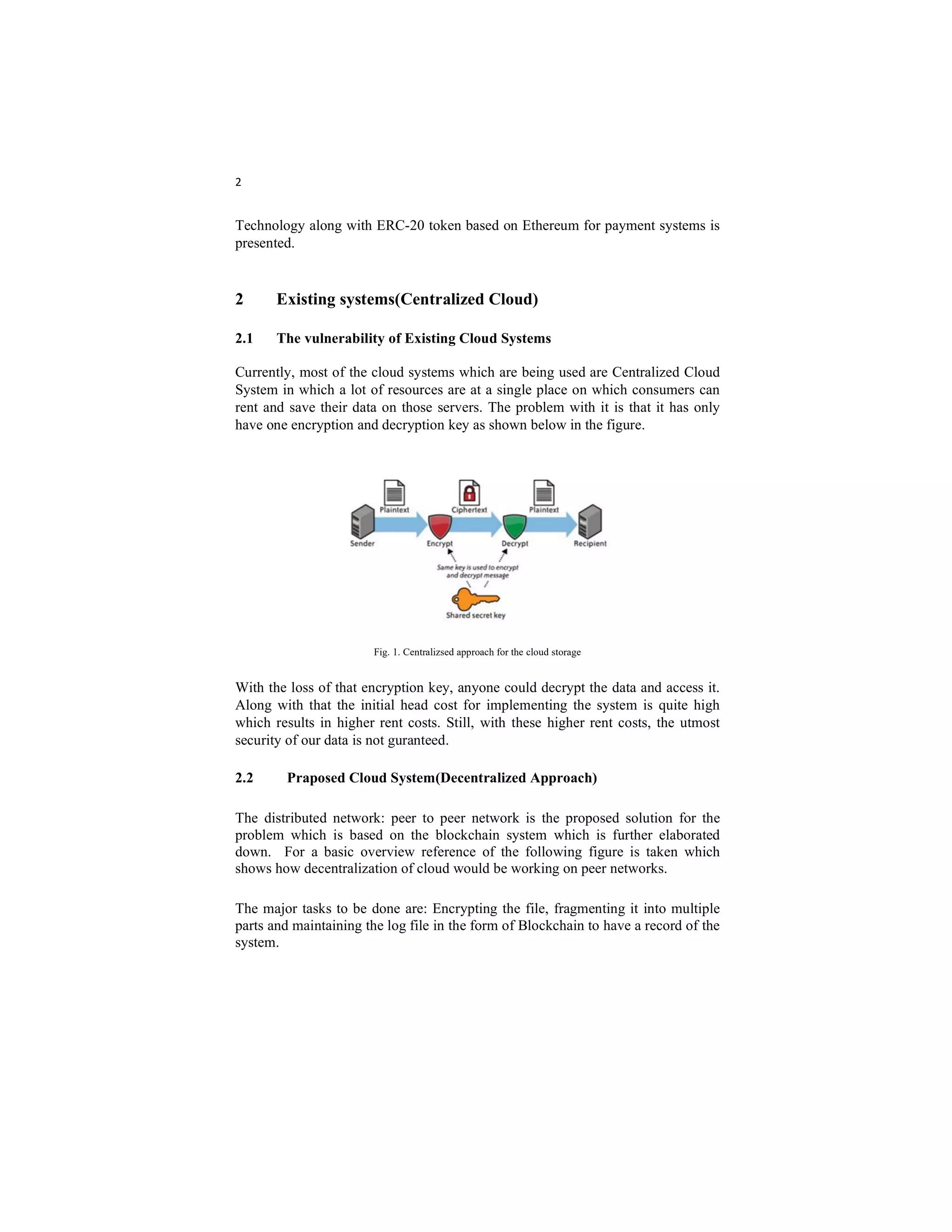
rent and save their data on those servers. The problem with it is that it has only
have one encryption and decryption key as shown below in the figure.
Fig. 1. Centralizsed approach for the cloud storage
With the loss of that encryption key, anyone could decrypt the data and access it.
Along with that the initial head cost for implementing the system is quite high
which results in higher rent costs. Still, with these higher rent costs, the utmost
security of our data is not guranteed.
2.2 Praposed Cloud System(Decentralized Approach)
The distributed network: peer to peer network is the proposed solution for the
problem which is based on the blockchain system which is further elaborated
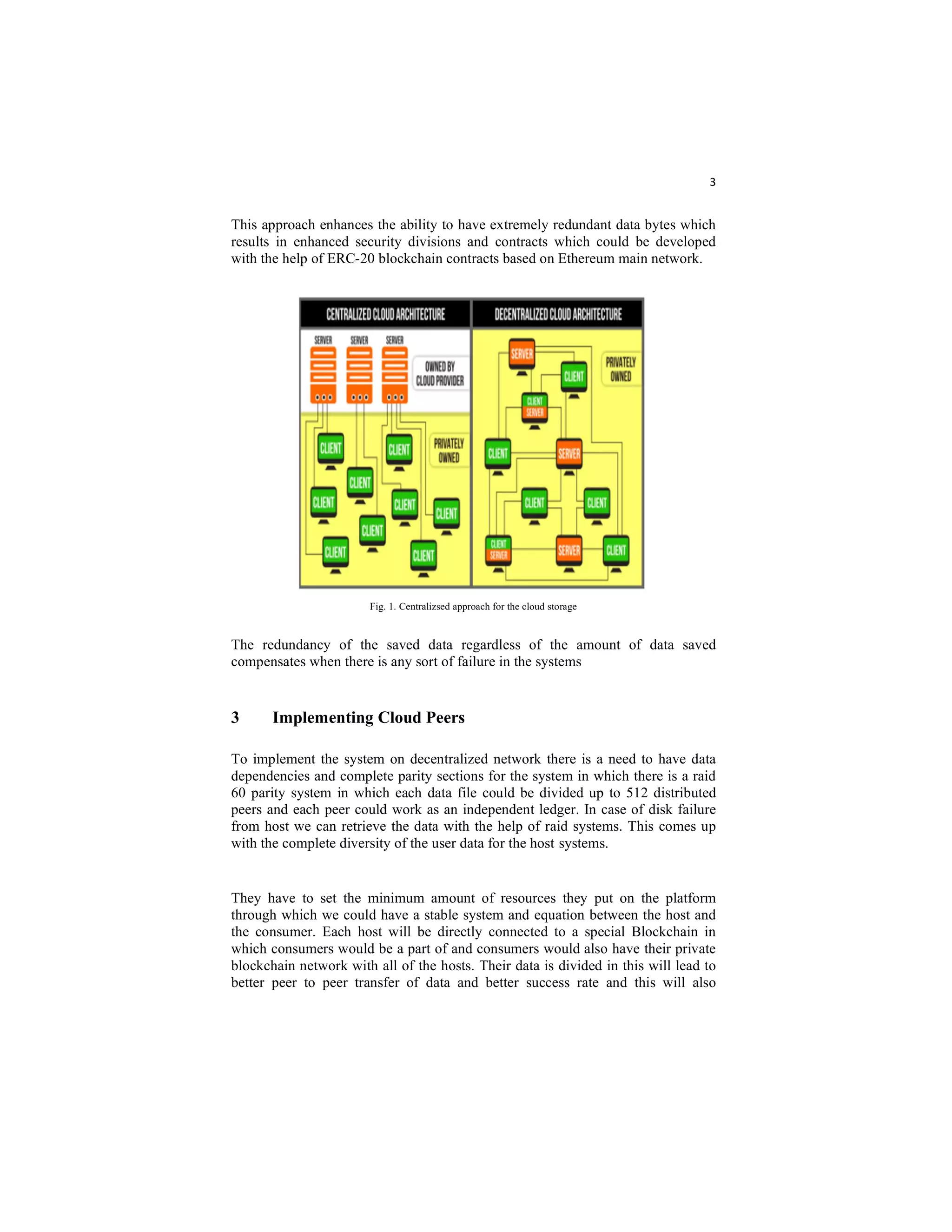
down. For a basic overview reference of the following figure is taken which
shows how decentralization of cloud would be working on peer networks.
The major tasks to be done are: Encrypting the file, fragmenting it into multiple
parts and maintaining the log file in the form of Blockchain to have a record of the
system.
3
This approach enhances the ability to have extremely redundant data bytes which
results in enhanced security divisions and contracts which could be developed
with the help of ERC-20 blockchain contracts based on Ethereum main network.
Fig. 1. Centralizsed approach for the cloud storage
The redundancy of the saved data regardless of the amount of data saved
compensates when there is any sort of failure in the systems
3 Implementing Cloud Peers
To implement the system on decentralized network there is a need to have data
dependencies and complete parity sections for the system in which there is a raid
60 parity system in which each data file could be divided up to 512 distributed
peers and each peer could work as an independent ledger. In case of disk failure
from host we can retrieve the data with the help of raid systems. This comes up
with the complete diversity of the user data for the host systems.
They have to set the minimum amount of resources they put on the platform
through which we could have a stable system and equation between the host and
the consumer. Each host will be directly connected to a special Blockchain in
which consumers would be a part of and consumers would also have their private
blockchain network with all of the hosts. Their data is divided in this will lead to
better peer to peer transfer of data and better success rate and this will also
4
enhance the speed of the transaction of the data in the blockchain systems. For the
development of this blockchain, we need to work on the hashing algorithms to
make dual passkeys to authenticate the host and consumer and this will also lead
us to no cross-connection and perfect ledger.
4 Encryption
4.1 Encryption Overview
Blockchain is completely about Encryption and the biggest key you can make with
the fastest response time so for this system we need to have dual encryption and
decryption system with 4 keys in which we will have one module encryption for
our platform to the host platform keys and other set of keys for the user of the
system to have his privacy furthermore for the blockchain cryptocurrency which
we are going to develop we will be using specially made algorithms which would
be based on SHA512 level encoded private keys and public keys,these are the best
possible algorithms which would be designed on the top of predefined encryption
algorithms in python hashlib libraries and with a bit of modification on those
algorithms we can have drastic upstream in performance. For the development of
the two-way encryption, metamask key method is the best method to have a secret
sequence of random words which would be the backup if the private key gets lost.
Whole secret key would be saved in different hardware of the users system itself
and at the time of loss we can generate the system bypass key with the help of the
master key software which needs to check all of the combinations possible from
the user code of CPU and GPU along with the cryptographic hash code given by
the platform. Logically to bypass this algorithm we have to make a total of
512**512 which is logically infinite and if we combine the total power of all top
500 supercomputers still it will take more than 320 million years, so logically we
can't get into the blockchain.
4.2 Encryption Module
To develop customized algorithms we need to deal with a lot of complex
mathematical solutions instead of that we can just deploy our algorithm on top of
the SHA512 algorithm which is defined in the hashlib library of python3. We just
need to import the sha512 algorithm and update the chip size of the algorithm and
along with that, the alphabet consideration to 37 instead of 26 there will be a usage
of numbers along with alphabets and the whole system and functions could be
inherited as itself. To develop a signature and public key for new users the
algorithms which is used is RSA which is defined in a crypto package under
Public key PKCS1_v1_5 algorithm will be used from Crypto package under
Signature these algorithms are capable of completely generating 512 string length
5
public key and signatures. The complete algorithm will be working on back end
systems with database checking for the database systems we will be using Google
Datalabs and BigQuery systems which is one of the fastest for the blockchain
systems.
5 Payment
5.1 Payment Systems
Here as the host is letting us use his resources we need to pay them for that dual-
mode payment system would be implemented in which each host is potentially a
miner, To run the ecosystem we have created one cryptocurrency DCS Coin this
will be deployed individually on another Blockchain with the same private and
public keys so that both cloud authentication and Cryptocurrency authentication
would be same which would make system lot more lightweight. For the
development of the complete new coin, we came up with python code on the back
end. For another payment gateway we came up with ERC-20 tokens on Ethereum
network these are the mini ethereum coins which are worth the same as ethereum
and we can also trade them for the development of ERC-20 contract ,Truffle
Framework is implemented and on truffle framework we use Ganache to define
some user for the scripting language we came up with Solidity with compiler
pragma 0.4.23, executable on a remix engine. For inter-platform transactions, we
came up with payment gateways that are in use, we are just taking them as they
are. Each time any host mines a coin some defined percentage of that transaction
is carried forward to that host blockchain account and now that could be reverted
into Ethereum coins. To maintain the flow of the coin in the ecosystem the major
platform can change the rates of the gas price per transaction of the data uploading
and download. This is how the ecosystem and the market of the coin would be
controlled.
5.2 Payment Module
It will be defined at the extreme point of Data Transfer while uploading and
downloading and prices will differ depending on the available maximum
bandwidth to upload and download the data instead of putting a barrier on the
amount of the data here we just give unlimited storage access to the consumer and
let them pay for the faster download and upload speeds technically to put large
chunks of data on same peer network they need to have higher bandwidth speeds.
The whole payment module system will be dependent on Blockchain systems in
which the host has a different contract with the platform and the user will have
different contracts with the platform. Just for example uploading 1Tb file on the
peer network with the free basic speed of 128Kb/s user have to wait for 218 years
which is logically impossible, for that user have to get into the premium plans and
get the higher bandwidths.
6
6 Performance Boost
For a system to pile up data in a single centralized server it puts up a hell of a lot
of strain on it which result in limited bandwidth compare to this multiple ledgers
which work as servers with comparatively low resource power works more
efficiently and generates more bandwidth capacity for the whole system for an
example just think to upload 1Tb file on the existing cloud storage with 50Mbps
speed would take 2 days whereas putting that 1Tb file divided into 500 pieces and
upload it with same 50Mbps bandwidth will take just 5minites and 43Seconds this
shows the drastic performance boost we still need to add 1-2 minutes of
performance gap for the allocation of the host and the consumers.
7 Conclusion
The major problem with an existing cloud service provider is the mediator and
centralized system which could be solved by including blockchain and having
peer to peer decentralized systems and implementing specialized cryptocurrency
for payments module and specialized algorithms for encryption and decryption of
the data and generation of the public and private keys. After the implementation of
the complete ecosystem of hosts(miners) and consumers, we can manipulate the
cryptocurrency for the flow of coins in the ecosystem.
References
1. Daniel Drescher Blockchain Basics: A Non-Technical Introduction in 25 Steps (2017)
2. Roger Wattenhofer Distributed Ledger Technology-blockchain (2016)
3. Alan T. Norman Blockchain Technology Explained: The Ultimate Beginner's
Guide(2017)
4. Andreas Antonopoulos Mastering Ethereum: Building Smart Contracts and
Dapps(2018)
5. Chris Dannen Introducing Ethereum and Solidity: Foundations of Cryptocurrency and
Blockchain Programming for Beginners(2017)
6. Kevin Werbach The Blockchain and the New Architecture of Trust(2018)
7. John tromp Cuckoo Cycle: A memory bound graph-theoretic proof-of-work
8. Bela Gipp, Norman Meuschke, Andre Germant Decentralized Trusted Timestamping
using the Crypto Currency Bitcoin

Blockchain Based Decentralized Cloud System

  • 1.
    Blockchain Based DecentralizedCloud Storage * Dhruv Doshi 1 and Prof. Satvik Khara 2 1*dhru.edu.doshi@gmail.com 1- 2 Silver Oak College Of Engineering and Technology 2svkhara@gmail.com Abstract. A prototype of a multi-user system for access control to data sets stored in a malicious cloud environment is presented. Cloud storage like any other environment needs the ability to securely shared information. The approach here is to provide access control over the data stored in the cloud without provider participation. The main tool of the access control mechanism is a ciphertext-policy attribute-based encryption scheme with dynamic attributes and advanced encryption algorithms. Using a based decentralized ledger, our system provides an immutable log of all meaningful security events, such as key generation, access policy assignments, changes or revocations, and access requests. We propose a set of protocols to ensure the privacy of operations requiring secret or private keys. Only hash codes are transferred through the ledger. The prototype of the system is implemented using smart contracts and tested on the platform.. Keywords: Cloud storage, attribute-based access control, ciphertext-policy attribute-based encryption, ethereum based contracts. 1 Introduction Today, the requirement of each cloud user is not the same as it used to be, some users need better storage capacity, some need lower storage with better plans hence this paper is the complete solution of unique cloud storage which is completely decentralized to provide utmost transparency. The major security problem with the existing system is that it is unidirectional, hence the user can only rent the storage from the big service providers. Instead of that one can develop an ecosystem in which some users could put their unused resources on rent and others could rent them. Initially, a huge chunk of the amount in buying the resources is not invested to start extreme servers at one point and pile up all the user data in a single space. This would reasonably reduce the security of the system and also this huge investment upfront, so to get this thing up a better solution based on Blockchain
  • 2.
    2 Technology along withERC-20 token based on Ethereum for payment systems is presented. 2 Existing systems(Centralized Cloud) 2.1 The vulnerability of Existing Cloud Systems Currently, most of the cloud systems which are being used are Centralized Cloud System in which a lot of resources are at a single place on which consumers can rent and save their data on those servers. The problem with it is that it has only have one encryption and decryption key as shown below in the figure. Fig. 1. Centralizsed approach for the cloud storage With the loss of that encryption key, anyone could decrypt the data and access it. Along with that the initial head cost for implementing the system is quite high which results in higher rent costs. Still, with these higher rent costs, the utmost security of our data is not guranteed. 2.2 Praposed Cloud System(Decentralized Approach) The distributed network: peer to peer network is the proposed solution for the problem which is based on the blockchain system which is further elaborated down. For a basic overview reference of the following figure is taken which shows how decentralization of cloud would be working on peer networks. The major tasks to be done are: Encrypting the file, fragmenting it into multiple parts and maintaining the log file in the form of Blockchain to have a record of the system.
  • 3.
    3 This approach enhancesthe ability to have extremely redundant data bytes which results in enhanced security divisions and contracts which could be developed with the help of ERC-20 blockchain contracts based on Ethereum main network. Fig. 1. Centralizsed approach for the cloud storage The redundancy of the saved data regardless of the amount of data saved compensates when there is any sort of failure in the systems 3 Implementing Cloud Peers To implement the system on decentralized network there is a need to have data dependencies and complete parity sections for the system in which there is a raid 60 parity system in which each data file could be divided up to 512 distributed peers and each peer could work as an independent ledger. In case of disk failure from host we can retrieve the data with the help of raid systems. This comes up with the complete diversity of the user data for the host systems. They have to set the minimum amount of resources they put on the platform through which we could have a stable system and equation between the host and the consumer. Each host will be directly connected to a special Blockchain in which consumers would be a part of and consumers would also have their private blockchain network with all of the hosts. Their data is divided in this will lead to better peer to peer transfer of data and better success rate and this will also
  • 4.
    4 enhance the speedof the transaction of the data in the blockchain systems. For the development of this blockchain, we need to work on the hashing algorithms to make dual passkeys to authenticate the host and consumer and this will also lead us to no cross-connection and perfect ledger. 4 Encryption 4.1 Encryption Overview Blockchain is completely about Encryption and the biggest key you can make with the fastest response time so for this system we need to have dual encryption and decryption system with 4 keys in which we will have one module encryption for our platform to the host platform keys and other set of keys for the user of the system to have his privacy furthermore for the blockchain cryptocurrency which we are going to develop we will be using specially made algorithms which would be based on SHA512 level encoded private keys and public keys,these are the best possible algorithms which would be designed on the top of predefined encryption algorithms in python hashlib libraries and with a bit of modification on those algorithms we can have drastic upstream in performance. For the development of the two-way encryption, metamask key method is the best method to have a secret sequence of random words which would be the backup if the private key gets lost. Whole secret key would be saved in different hardware of the users system itself and at the time of loss we can generate the system bypass key with the help of the master key software which needs to check all of the combinations possible from the user code of CPU and GPU along with the cryptographic hash code given by the platform. Logically to bypass this algorithm we have to make a total of 512**512 which is logically infinite and if we combine the total power of all top 500 supercomputers still it will take more than 320 million years, so logically we can't get into the blockchain. 4.2 Encryption Module To develop customized algorithms we need to deal with a lot of complex mathematical solutions instead of that we can just deploy our algorithm on top of the SHA512 algorithm which is defined in the hashlib library of python3. We just need to import the sha512 algorithm and update the chip size of the algorithm and along with that, the alphabet consideration to 37 instead of 26 there will be a usage of numbers along with alphabets and the whole system and functions could be inherited as itself. To develop a signature and public key for new users the algorithms which is used is RSA which is defined in a crypto package under Public key PKCS1_v1_5 algorithm will be used from Crypto package under Signature these algorithms are capable of completely generating 512 string length
  • 5.
    5 public key andsignatures. The complete algorithm will be working on back end systems with database checking for the database systems we will be using Google Datalabs and BigQuery systems which is one of the fastest for the blockchain systems. 5 Payment 5.1 Payment Systems Here as the host is letting us use his resources we need to pay them for that dual- mode payment system would be implemented in which each host is potentially a miner, To run the ecosystem we have created one cryptocurrency DCS Coin this will be deployed individually on another Blockchain with the same private and public keys so that both cloud authentication and Cryptocurrency authentication would be same which would make system lot more lightweight. For the development of the complete new coin, we came up with python code on the back end. For another payment gateway we came up with ERC-20 tokens on Ethereum network these are the mini ethereum coins which are worth the same as ethereum and we can also trade them for the development of ERC-20 contract ,Truffle Framework is implemented and on truffle framework we use Ganache to define some user for the scripting language we came up with Solidity with compiler pragma 0.4.23, executable on a remix engine. For inter-platform transactions, we came up with payment gateways that are in use, we are just taking them as they are. Each time any host mines a coin some defined percentage of that transaction is carried forward to that host blockchain account and now that could be reverted into Ethereum coins. To maintain the flow of the coin in the ecosystem the major platform can change the rates of the gas price per transaction of the data uploading and download. This is how the ecosystem and the market of the coin would be controlled. 5.2 Payment Module It will be defined at the extreme point of Data Transfer while uploading and downloading and prices will differ depending on the available maximum bandwidth to upload and download the data instead of putting a barrier on the amount of the data here we just give unlimited storage access to the consumer and let them pay for the faster download and upload speeds technically to put large chunks of data on same peer network they need to have higher bandwidth speeds. The whole payment module system will be dependent on Blockchain systems in which the host has a different contract with the platform and the user will have different contracts with the platform. Just for example uploading 1Tb file on the peer network with the free basic speed of 128Kb/s user have to wait for 218 years which is logically impossible, for that user have to get into the premium plans and get the higher bandwidths.
  • 6.
    6 6 Performance Boost Fora system to pile up data in a single centralized server it puts up a hell of a lot of strain on it which result in limited bandwidth compare to this multiple ledgers which work as servers with comparatively low resource power works more efficiently and generates more bandwidth capacity for the whole system for an example just think to upload 1Tb file on the existing cloud storage with 50Mbps speed would take 2 days whereas putting that 1Tb file divided into 500 pieces and upload it with same 50Mbps bandwidth will take just 5minites and 43Seconds this shows the drastic performance boost we still need to add 1-2 minutes of performance gap for the allocation of the host and the consumers. 7 Conclusion The major problem with an existing cloud service provider is the mediator and centralized system which could be solved by including blockchain and having peer to peer decentralized systems and implementing specialized cryptocurrency for payments module and specialized algorithms for encryption and decryption of the data and generation of the public and private keys. After the implementation of the complete ecosystem of hosts(miners) and consumers, we can manipulate the cryptocurrency for the flow of coins in the ecosystem. References 1. Daniel Drescher Blockchain Basics: A Non-Technical Introduction in 25 Steps (2017) 2. Roger Wattenhofer Distributed Ledger Technology-blockchain (2016) 3. Alan T. Norman Blockchain Technology Explained: The Ultimate Beginner's Guide(2017) 4. Andreas Antonopoulos Mastering Ethereum: Building Smart Contracts and Dapps(2018) 5. Chris Dannen Introducing Ethereum and Solidity: Foundations of Cryptocurrency and Blockchain Programming for Beginners(2017) 6. Kevin Werbach The Blockchain and the New Architecture of Trust(2018) 7. John tromp Cuckoo Cycle: A memory bound graph-theoretic proof-of-work 8. Bela Gipp, Norman Meuschke, Andre Germant Decentralized Trusted Timestamping using the Crypto Currency Bitcoin