R A 1 7 1 1 0 0 4 0 1 0 2 5 3
Z A I D S H A R I F F – S E M I N A R 2
BLOCKCHAIN
AN INTRODUCTION
THE INTERNET ENABLES MANY
THINGS BUT…
• No mechanism to reliably establish trust
without a Third Party
• Third Parties are typically Governments
and Businesses that invade our privacy
for Security and Profit
• Single points of failure are insecure and
cybercrime flourishes
• Types of Cybercrime: Spammers, Identity
Thieves, Phishers, Zombie Farmers,
Cyberbullies, Hackers, Ransomware, etc.
ESTABLISHING TRUST HAS BEEN A
PERSISTENT PROBLEM…
• Cryptography introduced in the early
1980s to help secure data
• Fails because of Third Party involvement
and users have to divulge personal
information
• DigiCash (1993~1998) attempts to solve
trust with “eCash” which enables secure,
anonymous online payments
THEN IN 2008 A WHITE PAPER IS
PUBLISHED…
• Establishes a protocol for secure peer-to-
peer value transfer using cryptography
• “Satoshi Nakamoto” authored the protocol
to support the cryptocurrency Bitcoin: the
Bitcoin Blockchain
• Decentralized database that stores a registry
of assets and transactions across a p2p
network
• Eliminates role of Trusted Third Parties (TTP)
by using distributed computations to ensure
integrity
TODAY THE BLOCKCHAIN IS
CHANGING THE WORLD.
• 2017 has been a landmark year (again?) for
Blockchain
• No one knows what will become of bitcoin.
It is mostly unregulated, but some countries like
Japan, China and Australia have begun weighing
regulations. Governments are concerned about
taxation and their lack of control over the currency.
• Japan recognizes Bitcoin as legal tender
THE BLOCKCHAIN USES THREE OLD
TECHNOLOGIES…
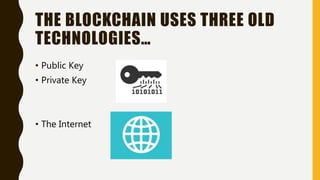
• Public Key
• Private Key
• The Internet
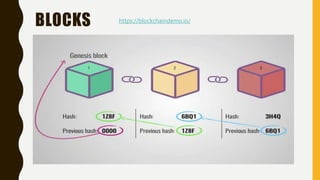
BLOCKS https://blockchaindemo.io/
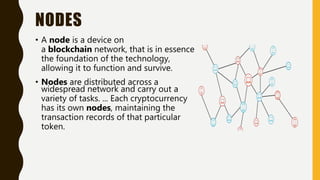
NODES
• A node is a device on
a blockchain network, that is in essence
the foundation of the technology,
allowing it to function and survive.
• Nodes are distributed across a
widespread network and carry out a
variety of tasks. ... Each cryptocurrency
has its own nodes, maintaining the
transaction records of that particular
token.
HYPERLEDGER
• Hyperledger is an open source collaborative effort created
to advance cross-industry blockchain technologies. It is a
global collaboration, hosted by The Linux Foundation,
including leaders in finance, banking, IoT, supply chain,
manufacturing and technology.
ETHEREUM
• Ethereum is a global, decentralized platform for money and
new kinds of applications. On Ethereum, you can write code
that controls money, and build applications accessible
anywhere in the world.
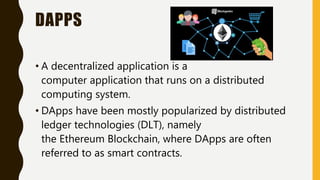
DAPPS
• A decentralized application is a
computer application that runs on a distributed
computing system.
• DApps have been mostly popularized by distributed
ledger technologies (DLT), namely
the Ethereum Blockchain, where DApps are often
referred to as smart contracts.
Blockchain Introduction

Blockchain Introduction

  • 1.
    R A 17 1 1 0 0 4 0 1 0 2 5 3 Z A I D S H A R I F F – S E M I N A R 2 BLOCKCHAIN AN INTRODUCTION
  • 3.
    THE INTERNET ENABLESMANY THINGS BUT… • No mechanism to reliably establish trust without a Third Party • Third Parties are typically Governments and Businesses that invade our privacy for Security and Profit • Single points of failure are insecure and cybercrime flourishes • Types of Cybercrime: Spammers, Identity Thieves, Phishers, Zombie Farmers, Cyberbullies, Hackers, Ransomware, etc.
  • 4.
    ESTABLISHING TRUST HASBEEN A PERSISTENT PROBLEM… • Cryptography introduced in the early 1980s to help secure data • Fails because of Third Party involvement and users have to divulge personal information • DigiCash (1993~1998) attempts to solve trust with “eCash” which enables secure, anonymous online payments
  • 5.
    THEN IN 2008A WHITE PAPER IS PUBLISHED… • Establishes a protocol for secure peer-to- peer value transfer using cryptography • “Satoshi Nakamoto” authored the protocol to support the cryptocurrency Bitcoin: the Bitcoin Blockchain • Decentralized database that stores a registry of assets and transactions across a p2p network • Eliminates role of Trusted Third Parties (TTP) by using distributed computations to ensure integrity
  • 6.
    TODAY THE BLOCKCHAINIS CHANGING THE WORLD. • 2017 has been a landmark year (again?) for Blockchain • No one knows what will become of bitcoin. It is mostly unregulated, but some countries like Japan, China and Australia have begun weighing regulations. Governments are concerned about taxation and their lack of control over the currency. • Japan recognizes Bitcoin as legal tender
  • 7.
    THE BLOCKCHAIN USESTHREE OLD TECHNOLOGIES… • Public Key • Private Key • The Internet
  • 8.
  • 9.
    NODES • A nodeis a device on a blockchain network, that is in essence the foundation of the technology, allowing it to function and survive. • Nodes are distributed across a widespread network and carry out a variety of tasks. ... Each cryptocurrency has its own nodes, maintaining the transaction records of that particular token.
  • 10.
    HYPERLEDGER • Hyperledger isan open source collaborative effort created to advance cross-industry blockchain technologies. It is a global collaboration, hosted by The Linux Foundation, including leaders in finance, banking, IoT, supply chain, manufacturing and technology.
  • 11.
    ETHEREUM • Ethereum isa global, decentralized platform for money and new kinds of applications. On Ethereum, you can write code that controls money, and build applications accessible anywhere in the world.
  • 12.
    DAPPS • A decentralizedapplication is a computer application that runs on a distributed computing system. • DApps have been mostly popularized by distributed ledger technologies (DLT), namely the Ethereum Blockchain, where DApps are often referred to as smart contracts.