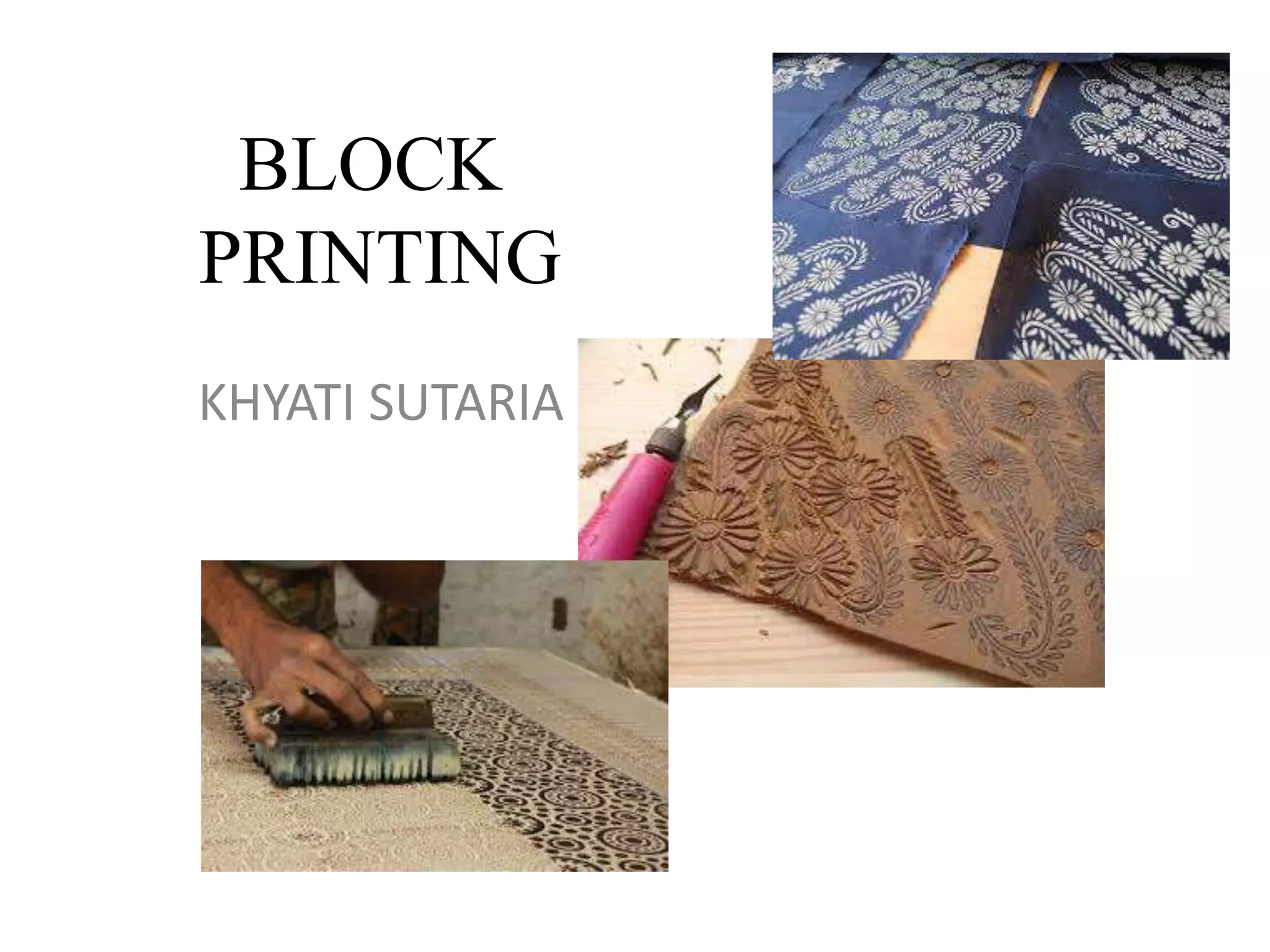
BLOCK
PRINTING
KHYATI SUTARIA
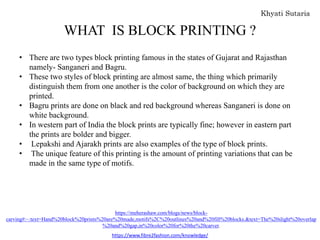
WHAT IS BLOCK PRINTING ?
• There are two types block printing famous in the states of Gujarat and Rajasthan
namely- Sanganeri and Bagru.
• These two styles of block printing are almost same, the thing which primarily
distinguish them from one another is the color of background on which they are
printed.
• Bagru prints are done on black and red background whereas Sanganeri is done on
white background.
• In western part of India the block prints are typically fine; however in eastern part
the prints are bolder and bigger.
• Lepakshi and Ajarakh prints are also examples of the type of block prints.
• The unique feature of this printing is the amount of printing variations that can be
made in the same type of motifs.
https://www.fibre2fashion.com/knowledge/
https://meherashaw.com/blogs/news/block-
carving#:~:text=Hand%20block%20prints%20are%20made,motifs%2C%20outlines%20and%20fill%20blocks.&text=The%20slight%20overlap
%20and%20gap,in%20color%20for%20the%20carver.
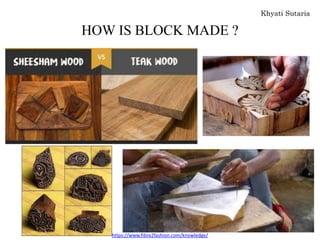
HOW IS BLOCK MADE ?
https://www.fibre2fashion.com/knowledge/
STYLES USED FOR BLOCK PRINTING
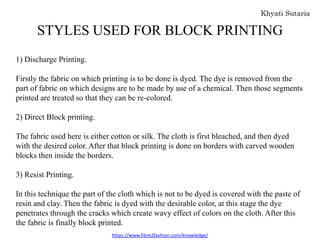
1) Discharge Printing.
Firstly the fabric on which printing is to be done is dyed. The dye is removed from the
part of fabric on which designs are to be made by use of a chemical. Then those segments
printed are treated so that they can be re-colored.
2) Direct Block printing.
The fabric used here is either cotton or silk. The cloth is first bleached, and then dyed
with the desired color. After that block printing is done on borders with carved wooden
blocks then inside the borders.
3) Resist Printing.
In this technique the part of the cloth which is not to be dyed is covered with the paste of
resin and clay. Then the fabric is dyed with the desirable color, at this stage the dye
penetrates through the cracks which create wavy effect of colors on the cloth. After this
the fabric is finally block printed.
https://www.fibre2fashion.com/knowledge/
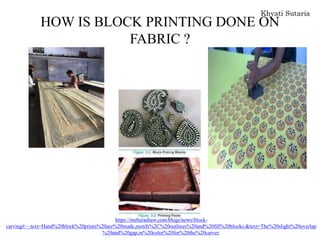
HOW IS BLOCK PRINTING DONE ON
FABRIC ?
https://meherashaw.com/blogs/news/block-
carving#:~:text=Hand%20block%20prints%20are%20made,motifs%2C%20outlines%20and%20fill%20blocks.&text=The%20slight%20overlap
%20and%20gap,in%20color%20for%20the%20carver.
AFTER TREATMENT FOR BLOCK
PRINTING
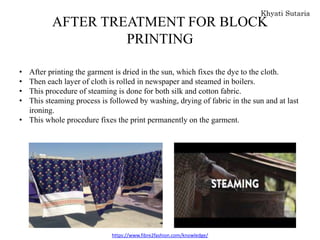
• After printing the garment is dried in the sun, which fixes the dye to the cloth.
• Then each layer of cloth is rolled in newspaper and steamed in boilers.
• This procedure of steaming is done for both silk and cotton fabric.
• This steaming process is followed by washing, drying of fabric in the sun and at last
ironing.
• This whole procedure fixes the print permanently on the garment.
https://www.fibre2fashion.com/knowledge/
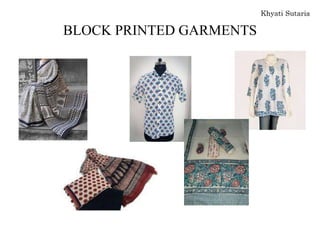
BLOCK PRINTED GARMENTS
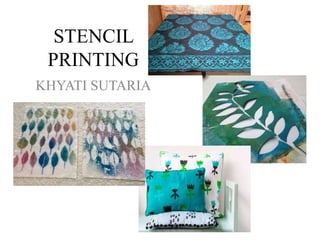
STENCIL
PRINTING
KHYATI SUTARIA
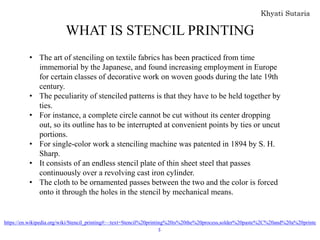
WHAT IS STENCIL PRINTING
• The art of stenciling on textile fabrics has been practiced from time
immemorial by the Japanese, and found increasing employment in Europe
for certain classes of decorative work on woven goods during the late 19th
century.
• The peculiarity of stenciled patterns is that they have to be held together by
ties.
• For instance, a complete circle cannot be cut without its center dropping
out, so its outline has to be interrupted at convenient points by ties or uncut
portions.
• For single-color work a stenciling machine was patented in 1894 by S. H.
Sharp.
• It consists of an endless stencil plate of thin sheet steel that passes
continuously over a revolving cast iron cylinder.
• The cloth to be ornamented passes between the two and the color is forced
onto it through the holes in the stencil by mechanical means.
https://en.wikipedia.org/wiki/Stencil_printing#:~:text=Stencil%20printing%20is%20the%20process,solder%20paste%2C%20and%20a%20printe
r.
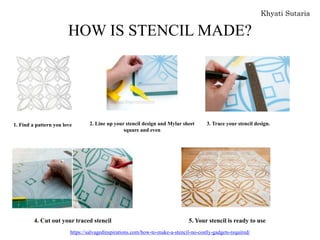
HOW IS STENCIL MADE?
1. Find a pattern you love 2. Line up your stencil design and Mylar sheet
square and even
3. Trace your stencil design.
4. Cut out your traced stencil 5. Your stencil is ready to use
https://salvagedinspirations.com/how-to-make-a-stencil-no-costly-gadgets-required/
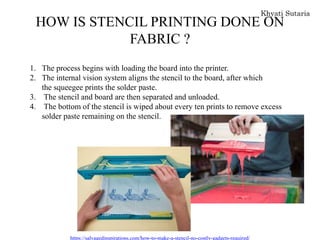
HOW IS STENCIL PRINTING DONE ON
FABRIC ?
1. The process begins with loading the board into the printer.
2. The internal vision system aligns the stencil to the board, after which
the squeegee prints the solder paste.
3. The stencil and board are then separated and unloaded.
4. The bottom of the stencil is wiped about every ten prints to remove excess
solder paste remaining on the stencil.
https://salvagedinspirations.com/how-to-make-a-stencil-no-costly-gadgets-required/
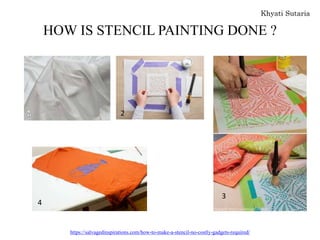
HOW IS STENCIL PAINTING DONE ?
2
3
4
https://salvagedinspirations.com/how-to-make-a-stencil-no-costly-gadgets-required/
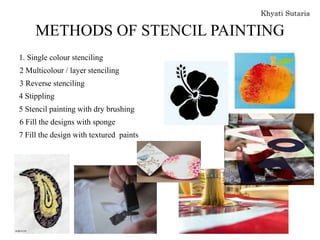
1. Single colour stenciling
2 Multicolour / layer stenciling
3 Reverse stenciling
4 Stippling
METHODS OF STENCIL PAINTING
5 Stencil painting with dry brushing
6 Fill the designs with sponge
7 Fill the design with textured paints
PRECAUTIONS TO TAKE WHILE USING
THE STENCILS FOR PAINTING.
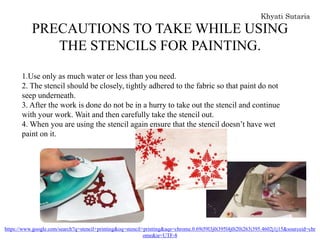
1.Use only as much water or less than you need.
2. The stencil should be closely, tightly adhered to the fabric so that paint do not
seep underneath.
3. After the work is done do not be in a hurry to take out the stencil and continue
with your work. Wait and then carefully take the stencil out.
4. When you are using the stencil again ensure that the stencil doesn’t have wet
paint on it.
https://www.google.com/search?q=stencil+printing&oq=stencil+printing&aqs=chrome.0.69i59l3j0i395l4j0i20i263i395.4602j1j15&sourceid=chr
ome&ie=UTF-8
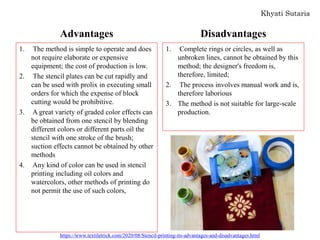
Advantages
1. The method is simple to operate and does
not require elaborate or expensive
equipment; the cost of production is low.
2. The stencil plates can be cut rapidly and
can be used with prolix in executing small
orders for which the expense of block
cutting would be prohibitive.
3. A great variety of graded color effects can
be obtained from one stencil by blending
different colors or different parts oil the
stencil with one stroke of the brush;
suction effects cannot be obtained by other
methods
4. Any kind of color can be used in stencil
printing including oil colors and
watercolors, other methods of printing do
not permit the use of such colors,
Disadvantages
1. Complete rings or circles, as well as
unbroken lines, cannot be obtained by this
method; the designer's freedom is,
therefore, limited;
2. The process involves manual work and is,
therefore laborious
3. The method is not suitable for large-scale
production.
https://www.textiletrick.com/2020/08/Stencil-printing-its-advantages-and-disadvantages.html

Block and stencil

  • 1.
  • 2.
    WHAT IS BLOCKPRINTING ? • There are two types block printing famous in the states of Gujarat and Rajasthan namely- Sanganeri and Bagru. • These two styles of block printing are almost same, the thing which primarily distinguish them from one another is the color of background on which they are printed. • Bagru prints are done on black and red background whereas Sanganeri is done on white background. • In western part of India the block prints are typically fine; however in eastern part the prints are bolder and bigger. • Lepakshi and Ajarakh prints are also examples of the type of block prints. • The unique feature of this printing is the amount of printing variations that can be made in the same type of motifs. https://www.fibre2fashion.com/knowledge/ https://meherashaw.com/blogs/news/block- carving#:~:text=Hand%20block%20prints%20are%20made,motifs%2C%20outlines%20and%20fill%20blocks.&text=The%20slight%20overlap %20and%20gap,in%20color%20for%20the%20carver.
  • 3.
    HOW IS BLOCKMADE ? https://www.fibre2fashion.com/knowledge/
  • 4.
    STYLES USED FORBLOCK PRINTING 1) Discharge Printing. Firstly the fabric on which printing is to be done is dyed. The dye is removed from the part of fabric on which designs are to be made by use of a chemical. Then those segments printed are treated so that they can be re-colored. 2) Direct Block printing. The fabric used here is either cotton or silk. The cloth is first bleached, and then dyed with the desired color. After that block printing is done on borders with carved wooden blocks then inside the borders. 3) Resist Printing. In this technique the part of the cloth which is not to be dyed is covered with the paste of resin and clay. Then the fabric is dyed with the desirable color, at this stage the dye penetrates through the cracks which create wavy effect of colors on the cloth. After this the fabric is finally block printed. https://www.fibre2fashion.com/knowledge/
  • 5.
    HOW IS BLOCKPRINTING DONE ON FABRIC ? https://meherashaw.com/blogs/news/block- carving#:~:text=Hand%20block%20prints%20are%20made,motifs%2C%20outlines%20and%20fill%20blocks.&text=The%20slight%20overlap %20and%20gap,in%20color%20for%20the%20carver.
  • 6.
    AFTER TREATMENT FORBLOCK PRINTING • After printing the garment is dried in the sun, which fixes the dye to the cloth. • Then each layer of cloth is rolled in newspaper and steamed in boilers. • This procedure of steaming is done for both silk and cotton fabric. • This steaming process is followed by washing, drying of fabric in the sun and at last ironing. • This whole procedure fixes the print permanently on the garment. https://www.fibre2fashion.com/knowledge/
  • 7.
  • 8.
  • 9.
    WHAT IS STENCILPRINTING • The art of stenciling on textile fabrics has been practiced from time immemorial by the Japanese, and found increasing employment in Europe for certain classes of decorative work on woven goods during the late 19th century. • The peculiarity of stenciled patterns is that they have to be held together by ties. • For instance, a complete circle cannot be cut without its center dropping out, so its outline has to be interrupted at convenient points by ties or uncut portions. • For single-color work a stenciling machine was patented in 1894 by S. H. Sharp. • It consists of an endless stencil plate of thin sheet steel that passes continuously over a revolving cast iron cylinder. • The cloth to be ornamented passes between the two and the color is forced onto it through the holes in the stencil by mechanical means. https://en.wikipedia.org/wiki/Stencil_printing#:~:text=Stencil%20printing%20is%20the%20process,solder%20paste%2C%20and%20a%20printe r.
  • 10.
    HOW IS STENCILMADE? 1. Find a pattern you love 2. Line up your stencil design and Mylar sheet square and even 3. Trace your stencil design. 4. Cut out your traced stencil 5. Your stencil is ready to use https://salvagedinspirations.com/how-to-make-a-stencil-no-costly-gadgets-required/
  • 11.
    HOW IS STENCILPRINTING DONE ON FABRIC ? 1. The process begins with loading the board into the printer. 2. The internal vision system aligns the stencil to the board, after which the squeegee prints the solder paste. 3. The stencil and board are then separated and unloaded. 4. The bottom of the stencil is wiped about every ten prints to remove excess solder paste remaining on the stencil. https://salvagedinspirations.com/how-to-make-a-stencil-no-costly-gadgets-required/
  • 12.
    HOW IS STENCILPAINTING DONE ? 2 3 4 https://salvagedinspirations.com/how-to-make-a-stencil-no-costly-gadgets-required/
  • 13.
    1. Single colourstenciling 2 Multicolour / layer stenciling 3 Reverse stenciling 4 Stippling METHODS OF STENCIL PAINTING 5 Stencil painting with dry brushing 6 Fill the designs with sponge 7 Fill the design with textured paints
  • 14.
    PRECAUTIONS TO TAKEWHILE USING THE STENCILS FOR PAINTING. 1.Use only as much water or less than you need. 2. The stencil should be closely, tightly adhered to the fabric so that paint do not seep underneath. 3. After the work is done do not be in a hurry to take out the stencil and continue with your work. Wait and then carefully take the stencil out. 4. When you are using the stencil again ensure that the stencil doesn’t have wet paint on it. https://www.google.com/search?q=stencil+printing&oq=stencil+printing&aqs=chrome.0.69i59l3j0i395l4j0i20i263i395.4602j1j15&sourceid=chr ome&ie=UTF-8
  • 15.
    Advantages 1. The methodis simple to operate and does not require elaborate or expensive equipment; the cost of production is low. 2. The stencil plates can be cut rapidly and can be used with prolix in executing small orders for which the expense of block cutting would be prohibitive. 3. A great variety of graded color effects can be obtained from one stencil by blending different colors or different parts oil the stencil with one stroke of the brush; suction effects cannot be obtained by other methods 4. Any kind of color can be used in stencil printing including oil colors and watercolors, other methods of printing do not permit the use of such colors, Disadvantages 1. Complete rings or circles, as well as unbroken lines, cannot be obtained by this method; the designer's freedom is, therefore, limited; 2. The process involves manual work and is, therefore laborious 3. The method is not suitable for large-scale production. https://www.textiletrick.com/2020/08/Stencil-printing-its-advantages-and-disadvantages.html