Digital Agenda for Europe Supporting Innovation   Bror Salmelin Advisor to the DG European Commission [email_address]
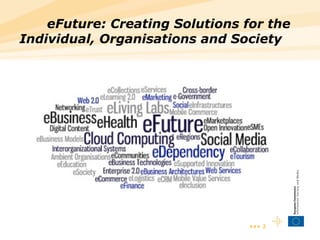
eFuture: Creating Solutions for the Individual, Organisations and Society 
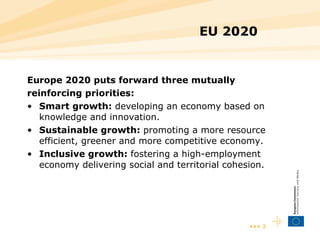
EU 2020 Europe 2020 puts forward three mutually reinforcing priorities:  Smart growth:  developing an economy based on knowledge and innovation.   Sustainable growth:  promoting a more resource efficient, greener and more competitive economy.  Inclusive growth:  fostering a high-employment economy delivering social and territorial cohesion.
 
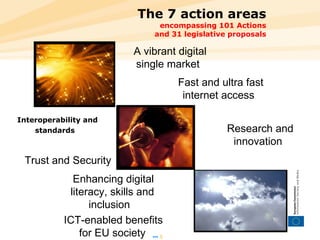
The 7 action areas encompassing 101 Actions and 31 legislative proposals Interoperability and standards   •••   A vibrant digital single market   Trust and Security   Research and innovation   Enhancing digital literacy, skills and inclusion  ICT-enabled benefits for EU society Fast and ultra fast internet access
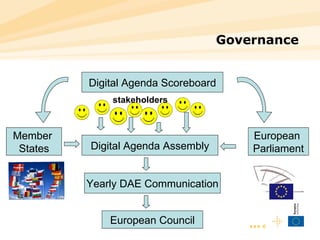
Governance European Council Digital Agenda Assembly Digital Agenda Scoreboard Member  States European  Parliament Yearly DAE Communication stakeholders
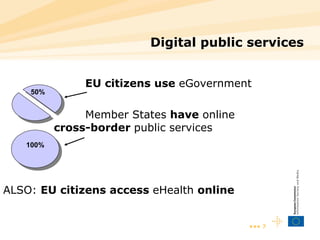
Digital public services   EU citizens use  eGovernment   Member States  have  online      cross-border  public services ALSO:  EU citizens access  eHealth  online 50%   100%
 
Máire Geoghegan-Quinn:  "more and smarter" investment in both public and private research and development to make the leap from 2% to the 3% of GDP target; more research cooperation within the EU and internationally; better use of research results, including through a stronger intellectual property regime; adapting education systems to business innovation needs; more encouragement for innovative and fast-growing SMEs; a stronger focus on innovation tackling global challenges such as climate change, energy, food security and health; and last but not least, closing the gender gap in science careers, so as to make the most of all our talents.
Innovation? Make things happen! Science based linear innovation is NOT mainstream anymore! User-centric innovation  Open innovation Systemic innovation Experimental mash-up Require  Environments with courage Funding with courage Processes with courage (curiosity, exploration) Is Europe a good place to merge these? Values, ways of doing business, links cross-border? Technology infrastructure? Leadership?
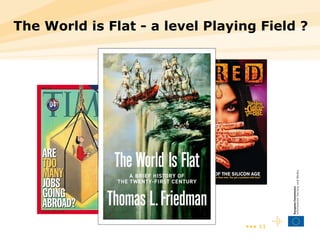
The World is Flat - a level Playing Field ?
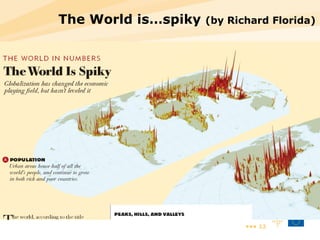
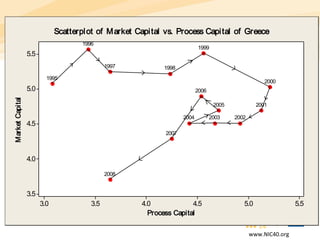
The World is…spiky  (by Richard Florida)
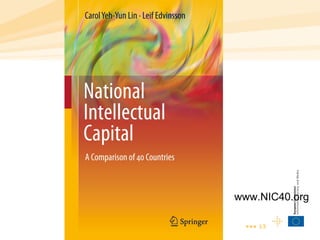
www.NIC40.org
www.NIC40.org
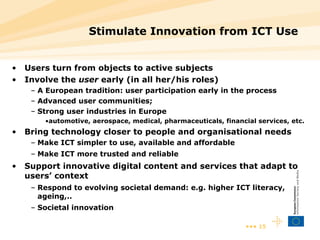
Stimulate Innovation from ICT Use Users turn from objects to active subjects Involve the  user  early (in all her/his roles) A European tradition: user participation early in the process Advanced user communities;  Strong user industries in Europe  automotive, aerospace, medical, pharmaceuticals, financial services, etc. Bring technology closer to people and organisational needs Make ICT simpler to use, available and affordable Make ICT more trusted and reliable Support innovative digital content and services that adapt to users’ context Respond to evolving societal demand: e.g. higher ICT literacy, ageing,..  Societal innovation
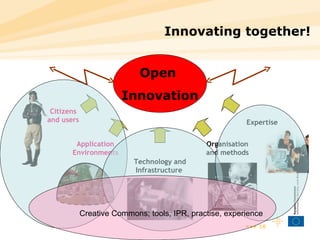
Innovating together! Open  Innovation Citizens and users Application Environments Technology and Infrastructure  Organisation and methods Expertise Creative Commons; tools, IPR, practise, experience
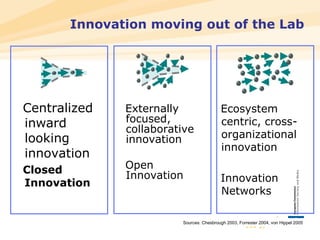
Innovation moving out of the Lab Centralized inward looking innovation Closed Innovation Ecosystem centric, cross-organizational innovation  Innovation Networks   Sources: Chesbrough 2003, Forrester 2004, von Hippel 2005 Externally focused, collaborative innovation  Open Innovation
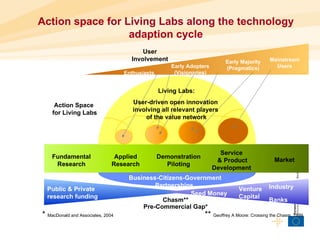
Action space for Living Labs along the technology adaption cycle Action Space  for Living Labs User Involvement Enthusiasts Early Adopters (Visionaries) Mainstream Users Public & Private research funding Seed Money Venture Capital Industry Banks Pre-Commercial Gap* Chasm** *  MacDonald and Associates, 2004 **  Geoffrey A Moore: Crossing the Chasm, 1999 Fundamental Research Applied Research Demonstration Piloting Service  & Product Development Market Living Labs: User-driven open innovation  involving all relevant players  of the value network Business-Citizens-Government Partnerships  Early Majority (Pragmatics)
 
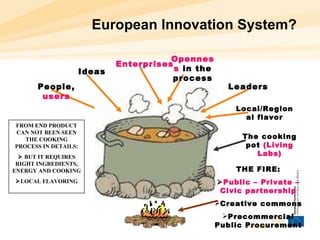
European Innovation System? FROM END PRODUCT CAN NOT BEEN SEEN THE COOKING PROCESS IN DETAILS:    BUT IT REQUIRES RIGHT INGREDIENTS, ENERGY AND COOKING  LOCAL FLAVORING People,  users Ideas Enterprises Openness  in the process Local/Regional flavor Leaders The cooking pot  (Living Labs) THE FIRE:  Public – Private – Civic partnership Creative commons Precommercial Public Procurement
 
More Information FP7:  http://ec.europa.eu/fp7/ict www.openinnovation-platform.eu D G Information Society and Media:  Directorate H; ICT addressing Societal Challenges [email_address]

Bled 2011 keynote

  • 1.
    Digital Agenda forEurope Supporting Innovation Bror Salmelin Advisor to the DG European Commission [email_address]
  • 2.
    eFuture: Creating Solutionsfor the Individual, Organisations and Society 
  • 3.
    EU 2020 Europe2020 puts forward three mutually reinforcing priorities: Smart growth: developing an economy based on knowledge and innovation. Sustainable growth: promoting a more resource efficient, greener and more competitive economy. Inclusive growth: fostering a high-employment economy delivering social and territorial cohesion.
  • 4.
  • 5.
    The 7 actionareas encompassing 101 Actions and 31 legislative proposals Interoperability and standards ••• A vibrant digital single market Trust and Security Research and innovation Enhancing digital literacy, skills and inclusion ICT-enabled benefits for EU society Fast and ultra fast internet access
  • 6.
    Governance European CouncilDigital Agenda Assembly Digital Agenda Scoreboard Member States European Parliament Yearly DAE Communication stakeholders
  • 7.
    Digital public services EU citizens use eGovernment Member States have online cross-border public services ALSO: EU citizens access eHealth online 50% 100%
  • 8.
  • 9.
    Máire Geoghegan-Quinn: "more and smarter" investment in both public and private research and development to make the leap from 2% to the 3% of GDP target; more research cooperation within the EU and internationally; better use of research results, including through a stronger intellectual property regime; adapting education systems to business innovation needs; more encouragement for innovative and fast-growing SMEs; a stronger focus on innovation tackling global challenges such as climate change, energy, food security and health; and last but not least, closing the gender gap in science careers, so as to make the most of all our talents.
  • 10.
    Innovation? Make thingshappen! Science based linear innovation is NOT mainstream anymore! User-centric innovation Open innovation Systemic innovation Experimental mash-up Require Environments with courage Funding with courage Processes with courage (curiosity, exploration) Is Europe a good place to merge these? Values, ways of doing business, links cross-border? Technology infrastructure? Leadership?
  • 11.
    The World isFlat - a level Playing Field ?
  • 12.
    The World is…spiky (by Richard Florida)
  • 13.
  • 14.
  • 15.
    Stimulate Innovation fromICT Use Users turn from objects to active subjects Involve the user early (in all her/his roles) A European tradition: user participation early in the process Advanced user communities; Strong user industries in Europe automotive, aerospace, medical, pharmaceuticals, financial services, etc. Bring technology closer to people and organisational needs Make ICT simpler to use, available and affordable Make ICT more trusted and reliable Support innovative digital content and services that adapt to users’ context Respond to evolving societal demand: e.g. higher ICT literacy, ageing,.. Societal innovation
  • 16.
    Innovating together! Open Innovation Citizens and users Application Environments Technology and Infrastructure Organisation and methods Expertise Creative Commons; tools, IPR, practise, experience
  • 17.
    Innovation moving outof the Lab Centralized inward looking innovation Closed Innovation Ecosystem centric, cross-organizational innovation Innovation Networks Sources: Chesbrough 2003, Forrester 2004, von Hippel 2005 Externally focused, collaborative innovation Open Innovation
  • 18.
    Action space forLiving Labs along the technology adaption cycle Action Space for Living Labs User Involvement Enthusiasts Early Adopters (Visionaries) Mainstream Users Public & Private research funding Seed Money Venture Capital Industry Banks Pre-Commercial Gap* Chasm** * MacDonald and Associates, 2004 ** Geoffrey A Moore: Crossing the Chasm, 1999 Fundamental Research Applied Research Demonstration Piloting Service & Product Development Market Living Labs: User-driven open innovation involving all relevant players of the value network Business-Citizens-Government Partnerships Early Majority (Pragmatics)
  • 19.
  • 20.
    European Innovation System?FROM END PRODUCT CAN NOT BEEN SEEN THE COOKING PROCESS IN DETAILS:  BUT IT REQUIRES RIGHT INGREDIENTS, ENERGY AND COOKING  LOCAL FLAVORING People, users Ideas Enterprises Openness in the process Local/Regional flavor Leaders The cooking pot (Living Labs) THE FIRE:  Public – Private – Civic partnership Creative commons Precommercial Public Procurement
  • 21.
  • 22.
    More Information FP7: http://ec.europa.eu/fp7/ict www.openinnovation-platform.eu D G Information Society and Media: Directorate H; ICT addressing Societal Challenges [email_address]

Editor's Notes

  • #18 Definition and characteristics of networked innovation, examples per page or at the end of trends Science and Engineering skills and external funding mechanisms are abundant Innovations are valuable mostly as components on standard platforms used by many players. Knowledge is shared with business partners