Open Aid Partnership
Innovations Labs
World Bank Institute
IATI Steering Committee
Paris, March 13, 2013
Why Open Aid and Why Maps Matter?
1. To enable visualization and accessibility of aid
information
2. To advance transparency in line with IATI
standards
3. To enable citizens and stakeholders to provide
direct feedback on project results
4. To improve efficiency of increasingly scarce aid
resources
OAP Objectives
1. Improve Aid Transparency: increase
transparency on aid flows and public
service delivery
2. Enhance Results: Better target, monitor,
and coordinate aid flows within countries
3. Establish Feedback Loop: Empower
citizens and CSOs to provide direct
feedback on project outcomes
Increase Aid Transparency and Citizen Engagement for Better Results
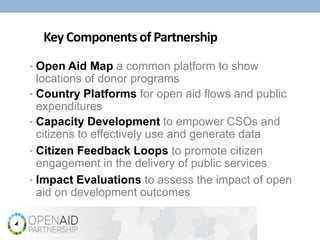
Key Componentsof Partnership
• Open Aid Map a common platform to show
locations of donor programs
• Country Platforms for open aid flows and public
expenditures
• Capacity Development to empower CSOs and
citizens to effectively use and generate data
• Citizen Feedback Loops to promote citizen
engagement in the delivery of public services
• Impact Evaluations to assess the impact of open
aid on development outcomes
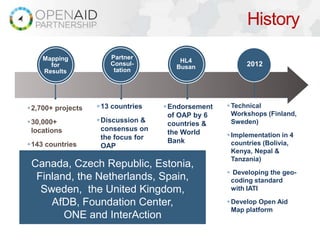
2,700+ projects
30,000+
locations
143 countries
13 countries
Discussion &
consensus on
the focus for
OAP
Endorsement
of OAP by 6
countries &
the World
Bank
Partner
Consul-
tation
Technical
Workshops (Finland,
Sweden)
Implementation in 4
countries (Bolivia,
Kenya, Nepal &
Tanzania)
 Developing the geo-
coding standard
with IATI
Develop Open Aid
Map platform
HL4
Busan
Canada, Czech Republic, Estonia,
Finland, the Netherlands, Spain,
Sweden, the United Kingdom,
AfDB, Foundation Center,
ONE and InterAction
2012
Mapping
for
Results
History
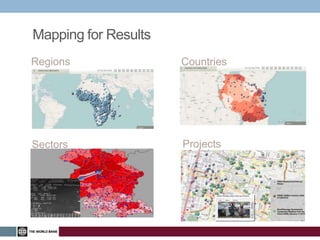
Regions Countries
Sectors Projects
Mapping for Results
maps.worldbank.org
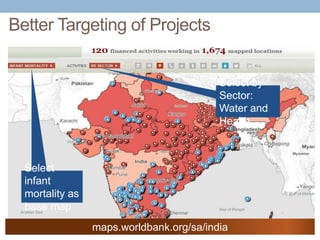
Better Targeting of Projects
Select
infant
mortality as
base map
Select by
Sector:
Water and
Health
maps.worldbank.org/sa/india
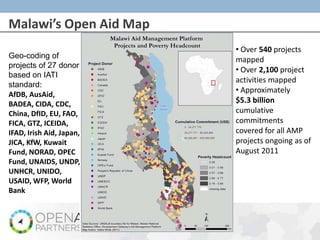
• Over 540 projects
mapped
• Over 2,100 project
activities mapped
• Approximately
$5.3 billion
cumulative
commitments
covered for all AMP
projects ongoing as of
August 2011
2.0
Geo-coding
Open
Aid Map
Malawi’s Open Aid Map
Geo-coding of
projects of 27 donors
based on IATI
standard:
AfDB, AusAid,
BADEA, CIDA, CDC,
China, DfID, EU, FAO,
FICA, GTZ, ICEIDA,
IFAD, Irish Aid, Japan,
JICA, KfW, Kuwait
Fund, NORAD, OPEC
Fund, UNAIDS, UNDP,
UNHCR, UNIDO,
USAID, WFP, World
Bank
Aid
Management
Platform
(AMP)
Sub-national
geographic
location
information
Geo-coding
Open Aid Map
AMP 2.0AMP
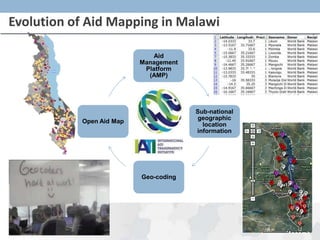
Evolution of Aid Mapping in Malawi
AMP 2.0AMP Geo-coding
Open
Aid Map
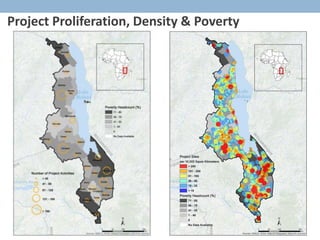
Project Proliferation, Density & Poverty
AMP 2.0AMP Geo-coding
Open
Aid Map
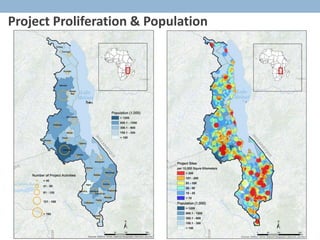
Project Proliferation & Population
AMP 2.0AMP Geo-coding
Open
Aid Map
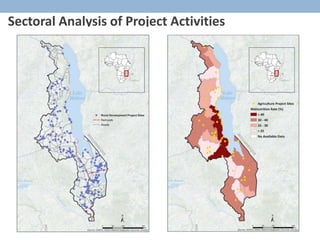
Sectoral Analysis of Project Activities
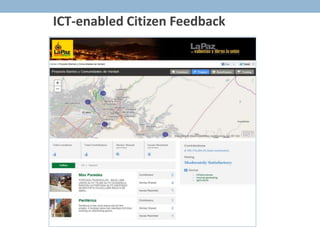
ICT-enabled Citizen Feedback
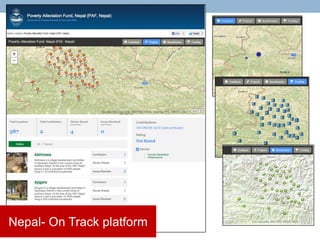
Nepal- On Track platform
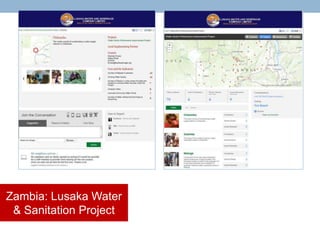
Zambia: Lusaka Water
& Sanitation Project
Initiatives
Partners
Next Steps
1. Broader endorsement by
donors and other partners
2. Build upon existing IATI
standards with geo-standards
3. Leverage as communications
tools to promote transparency
agenda
AMP 2.0AMP
Open
Aid Map
Implementation Partners:
Steve Davenport,
Christian Peratsakis,
Josh Powell
Aleem Walji
Director
Innovations Labs,
awalji@worldbank.org
Bjorn-Soren Gigler,
bgigler@worldbgank.org
Johannes Kiess,
Jkiess@worldbank.org
Contact Information
Mike Findley, Kate Weaver,
Justin Baker, Sam Barrett,
Sarah McDuff
EXTRA Slides
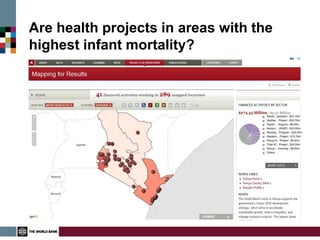
Are health projects in areas with the
highest infant mortality?
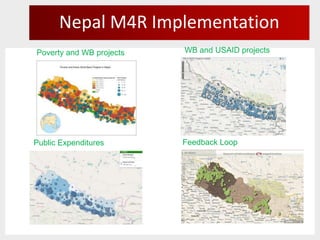
Poverty and WB projects WB and USAID projects
Public Expenditures Feedback Loop
Nepal M4R Implementation
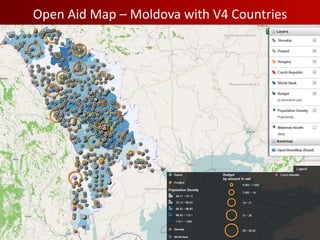
Open Aid Map – Moldova with V4 Countries

Opening up Aid for enhanced Aid Transparency

  • 1.
    Open Aid Partnership InnovationsLabs World Bank Institute IATI Steering Committee Paris, March 13, 2013
  • 2.
    Why Open Aidand Why Maps Matter? 1. To enable visualization and accessibility of aid information 2. To advance transparency in line with IATI standards 3. To enable citizens and stakeholders to provide direct feedback on project results 4. To improve efficiency of increasingly scarce aid resources
  • 3.
    OAP Objectives 1. ImproveAid Transparency: increase transparency on aid flows and public service delivery 2. Enhance Results: Better target, monitor, and coordinate aid flows within countries 3. Establish Feedback Loop: Empower citizens and CSOs to provide direct feedback on project outcomes Increase Aid Transparency and Citizen Engagement for Better Results
  • 4.
    Key Componentsof Partnership •Open Aid Map a common platform to show locations of donor programs • Country Platforms for open aid flows and public expenditures • Capacity Development to empower CSOs and citizens to effectively use and generate data • Citizen Feedback Loops to promote citizen engagement in the delivery of public services • Impact Evaluations to assess the impact of open aid on development outcomes
  • 5.
    2,700+ projects 30,000+ locations 143 countries 13countries Discussion & consensus on the focus for OAP Endorsement of OAP by 6 countries & the World Bank Partner Consul- tation Technical Workshops (Finland, Sweden) Implementation in 4 countries (Bolivia, Kenya, Nepal & Tanzania)  Developing the geo- coding standard with IATI Develop Open Aid Map platform HL4 Busan Canada, Czech Republic, Estonia, Finland, the Netherlands, Spain, Sweden, the United Kingdom, AfDB, Foundation Center, ONE and InterAction 2012 Mapping for Results History
  • 6.
    Regions Countries Sectors Projects Mappingfor Results maps.worldbank.org
  • 7.
    Better Targeting ofProjects Select infant mortality as base map Select by Sector: Water and Health maps.worldbank.org/sa/india
  • 8.
    • Over 540projects mapped • Over 2,100 project activities mapped • Approximately $5.3 billion cumulative commitments covered for all AMP projects ongoing as of August 2011 2.0 Geo-coding Open Aid Map Malawi’s Open Aid Map Geo-coding of projects of 27 donors based on IATI standard: AfDB, AusAid, BADEA, CIDA, CDC, China, DfID, EU, FAO, FICA, GTZ, ICEIDA, IFAD, Irish Aid, Japan, JICA, KfW, Kuwait Fund, NORAD, OPEC Fund, UNAIDS, UNDP, UNHCR, UNIDO, USAID, WFP, World Bank
  • 9.
  • 10.
    AMP 2.0AMP Geo-coding Open AidMap Project Proliferation, Density & Poverty
  • 11.
    AMP 2.0AMP Geo-coding Open AidMap Project Proliferation & Population
  • 12.
    AMP 2.0AMP Geo-coding Open AidMap Sectoral Analysis of Project Activities
  • 13.
  • 14.
  • 15.
    Zambia: Lusaka Water &Sanitation Project
  • 16.
    Initiatives Partners Next Steps 1. Broaderendorsement by donors and other partners 2. Build upon existing IATI standards with geo-standards 3. Leverage as communications tools to promote transparency agenda
  • 17.
    AMP 2.0AMP Open Aid Map ImplementationPartners: Steve Davenport, Christian Peratsakis, Josh Powell Aleem Walji Director Innovations Labs, awalji@worldbank.org Bjorn-Soren Gigler, bgigler@worldbgank.org Johannes Kiess, Jkiess@worldbank.org Contact Information Mike Findley, Kate Weaver, Justin Baker, Sam Barrett, Sarah McDuff
  • 18.
  • 19.
    Are health projectsin areas with the highest infant mortality?
  • 20.
    Poverty and WBprojects WB and USAID projects Public Expenditures Feedback Loop Nepal M4R Implementation
  • 21.
    Open Aid Map– Moldova with V4 Countries

Editor's Notes

  • #3 1. It is important to understand the distribution of aid flows within a country in order to better target aid, however research on the distribution of aid has almost exclusively been conducted at the cross-country level. This is in large part due to the lack of data available on sub-national locations. By providing this information, this would enable decision-makers to know how to more effectively allocate development resources at the sub-national level. This will enable better targeting of aid efforts once underserved regions are more easily identified. 2. Understanding the precise location of development activities allows governments, donors and citizens to monitor progress and outcomes, and would encourage those at the local level to provide feedback on development projects in their area. 3. Enabling donors to see where other donor projects are located allows them to avoid duplicating efforts in the same region and increases the efficiency of development resources. 4. The volume of information provided by donors can make it difficult to make sense of the data. Being able to visualize the locations of all development activities on a map can enhance understanding of patterns in aid allocation. Making this information easier to understand will increase accessibility and use of the data among a wide group of stakeholders. 5. The IATI encourages development organizations to make information the “Who, Where, and How” of development projects publicly available and easy to use and understand. Crucial to this is the Where- geographical information on where organizations are operating within countries. This information allows governments, citizens and donors to gain a more comprehensive picture of donor activities within countries, thus enabling better decision-making.
  • #8 This slides shows in the background infant mortality rates at the sub-national level in India. The Map shows thee location of WB-financed projects in the Water and Health sectorskey issues: 1) Are we targeting the areas with the largest needs?--- lagging States agenda 2) Muli-sectoral Analysis- Are we coordinating between sectors- Important Synergies between Health and Water, map however shows that water and health projects are concentrated in different States.