ENVIRONMENTAL
   LITERACY FOR
ADMINISTRATORS AND
    EDUCATORS
        ***


  Author: Partha Das Sharma, E.mail: sharmapd1@gmail.com
      Website: http://saferenvironment.wordpress.com
Environmental Issues
The Top Ten :
  How bad is the damage to ecosystems?
  Is the Earth overpopulated?
  Are we running out of Energy Resources?
  Can we feed ourselves, sustainably?
  What’s the “truth” about climate change?
  Why are we so wasteful?
  Are we poisoning our air?
  Ditto for our water
  Are we causing the extinction of species?
  What can you do to help?
              http://saferenvironment.wordpress.com   2
A Conceptual Framework

The ultimate goal of environmental
education is to produce individuals who
exhibit the “4 A’s.”
    Awareness
    Appreciation
    Advocacy
    Activism


             http://saferenvironment.wordpress.com   3
Founding Principles


Everything is connected to everything else.
  We depend on the environment for all of our food, water, energy, shelter, and
  economic resources.

There is no such thing as a free lunch.
  There is an environmental cost whenever we extract resources from the Earth.

Our lives on Earth must be sustainable.
  We can’t spend Earth’s capital. We need to learn how to live only on the interest.


                        http://saferenvironment.wordpress.com                          4
How bad is damage to ecosystems?


Deforestation and other habitat destruction
is the number one human impact on the
planet.
    Reduces oxygen production by plants
    Reduces available habitat for organisms
    Increases rates of erosion and soil damage
    Increases rates of extinction of species


               http://saferenvironment.wordpress.com   5
Is the Earth overpopulated?

The answer depends on how you define
overpopulated, but most scientists
believe that the Earth has reached or is
very near to the limit that is
sustainable.

In other words, the impacts of a human population of 7 Billion or
more will harm the processes and resources of the planet to the
point where we will not be able to depend on them indefinitely.


                  http://saferenvironment.wordpress.com             6
7
What can we learn from the graph?

  It is only in the last 200 years that human
  population exploded!!
       Modern medicine is the main cause
       Closely followed by modern agriculture


  Human population is projected to level off at
  about 12 to 14 Billion??

  Fertility rates are expected to decrease.
       People are already making the choice to have fewer children. (the
       Demographic Transition)


                     http://saferenvironment.wordpress.com                 8
Can Earth Support 12 Billion
           People?


Yes, but only IF we reduce our use of non-renewable
                                      non-
resources and switch to renewable ones whenever we
can.
Resource consumption is a more important way to
gauge population impact than simply the size.
Number x consumption = impact (or footprint)


               http://saferenvironment.wordpress.com   9
Are we running out of Energy
        Resources?

In the short term, not really, but in the
long term, yes.
    Despite recent price increases in oil, we still have
    substantial reserves left.
    Our current fossil fuels are non-renewable. They will run
                                 non-
    out in 50 to 200 years.

If we switch to renewable energy (solar,
wind power and other types) we will
never run out.

               http://saferenvironment.wordpress.com            10
Energy Use in the Global Economy


Oil = 39%; Coal = 27%; Gas = 23%; Nuclear = 7%; Hydro =
3%; Others = 1%

Industrial = 38%;
Residential and Commercial = 36%; Transportation = 26%


                   http://saferenvironment.wordpress.com   11
What can we learn from the data?


  We are addicted to fossil fuels!

  What we do in our industry and homes is
  more important than what we do in our cars.

  We are not making use of renewable energy
  sources.

                http://saferenvironment.wordpress.com   12
Can we feed ourselves, Sustainably?


 That’s a hard one to judge. The cost of
 food is skyrocketing and the
 environmental impacts of raising food are
 going up as well.

  Can we feed a future population of 12 B
 using the same means?

 Answer would be ‘No’.
             http://saferenvironment.wordpress.com   13
Good News and Bad News

World food production
tripled since 1950.                      Population growth rate is
                                         faster than “food growth.”
Overall food prices fell.
                                         Food prices are rising now.
World grain supplies were
at near record highs                     Per capita grain supplies
because of technological                 are falling at 1% per year.
innovations.                             2 billion people in the world
Diets in MDCs are at an                  are undernourished.
all-time caloric high.
all-                                     Damage to soils and
Per acre production is                   pollution are increasing.
very high.
                 http://saferenvironment.wordpress.com             14
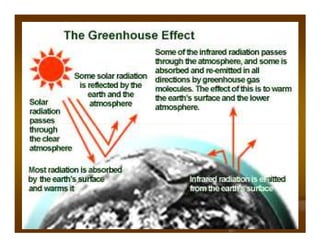
What’s the “truth” about climate
            change?

  Global Warming is real.

  Estimates of its likely impacts vary
  widely:
    Best case: mild - moderate warming
    Worst case scenarios see oceans rising to
    inundate large areas of coastlines, severe
    disruptions in weather and climate, and mass
    extinction.

               http://saferenvironment.wordpress.com   15
16
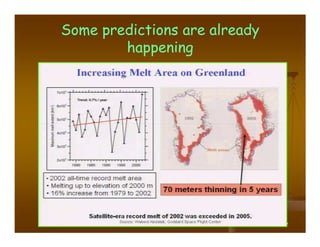
Some predictions are already
        happening


                               17
Why are we so wasteful?

Affluent societies treat waste as something
to throw away.
Less affluent societies reuse every last bit
they can.
Our culture of consumerism is what fuels
our wasteful ways.
Some scientists call this ‘Throwaway
Culture’.


             http://saferenvironment.wordpress.com   18
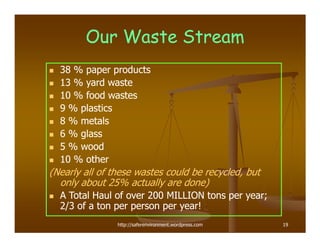
Our Waste Stream
  38 % paper products
  13 % yard waste
  10 % food wastes
  9 % plastics
  8 % metals
  6 % glass
  5 % wood
  10 % other
(Nearly all of these wastes could be recycled, but
  only about 25% actually are done)
  A Total Haul of over 200 MILLION tons per year;
  2/3 of a ton per person per year!
                http://saferenvironment.wordpress.com   19
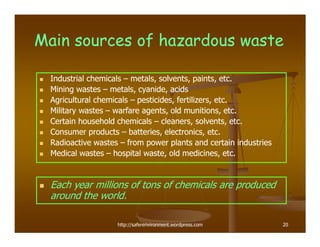
Main sources of hazardous waste

  Industrial chemicals – metals, solvents, paints, etc.
  Mining wastes – metals, cyanide, acids
  Agricultural chemicals – pesticides, fertilizers, etc.
  Military wastes – warfare agents, old munitions, etc.
  Certain household chemicals – cleaners, solvents, etc.
  Consumer products – batteries, electronics, etc.
  Radioactive wastes – from power plants and certain industries
  Medical wastes – hospital waste, old medicines, etc.


  Each year millions of tons of chemicals are produced
  around the world.

                    http://saferenvironment.wordpress.com         20
Are we poisoning our air?


Air pollution, especially in cities of
developing countries, is getting worse.

This is largely due to burning of coal
and other fuels for electricity production
and industry and the burning of oil for
transportation.


           http://saferenvironment.wordpress.com   21
Sources of Air Pollution

Natural – volcanoes, terpenes from conifers, etc.
Anthropogenic – since the industrial revolution

     Combustion of fossil fuels
     Industrial processes
     Agricultural processes
     Mining and Nuclear Power Generation
     Homes and businesses


             http://saferenvironment.wordpress.com   22
Major Categories of Air Pollution


  Global Climate Change – carbon
  Acid Rain – nonmetallic oxides
  Ozone Depletion – CFCs
  Smog – VOCs, oxides, particulates
  Indoor Air Pollution – VOCs, etc.


            http://saferenvironment.wordpress.com   23
Are We Poisoning our water?

Most of the Global rivers are polluted
due to the presence of fecal coliform
bacteria and other contaminants.
Similar problem rivers exist on every
continent.
Water is life.
If we poison our water, we poison
ourselves.


           http://saferenvironment.wordpress.com   24
The Major Categories of Pollutants
  Disease-
  Disease-causing organisms : infectious agents
  Inorganic chemicals : salts, acids, metals
  Synthetic organic compounds : pesticides, etc.
  Fertilizers : agricultural runoff
  Sediments : sand, silt and clay from erosion
  Oxygen-
  Oxygen-demanding wastes : sewage and manure
  Radioactive wastes : natural or man-made
                                  man-
  Thermal pollution : heat from power plants, etc.

                   http://saferenvironment.wordpress.com   25
Are we causing the extinction of
           species?

  Throughout geologic time the Earth
  has experienced five mass extinctions
  due to drastic climate change, meteor
  impacts, and rampant volcanism.
  Now, Scientists consider the impacts
  of humans to be the start of a sixth
  mass extinction.


            http://saferenvironment.wordpress.com   26
Can’t We All Get Along?

Some of the things that humans do
disrupt other organisms’ lives.
  Habitat destruction
  Over-
  Over-fishing, excess hunting
  Environmental pollution
  Introduction of non-native species
                  non-
  Climate change
  Commercial exploitation

            http://saferenvironment.wordpress.com   27
Intrinsic / Extrinsic Value of
          Biodiversity

Intrinsic – everything has a right to exist of its
own accord.

Extrinsic – we derive food, medicines and many
other products from wild things. Biodiversity
adds beauty and interest to our lives.
Biodiversity keeps the world’s natural processes
going.

                http://saferenvironment.wordpress.com   28
What can YOU do about all this?

  Consume less of EVERYTHING
  Reduce your FOOTPRINT
  SPEAK for the trees
  Learn and CARE about the earth
  Make a DIFFERENCE
  Don’t WASTE what you were given


          http://saferenvironment.wordpress.com   29
Some specifics
Drive less – Drive smart to get better
mileage
Raise your thermostat
Switch to fluorescent bulbs
Try a vegetarian diet
Install a solar water heater
Insulate your home
Plant a butterfly garden
Recycle everything you can
Be careful with chemicals at home and at
work
          http://saferenvironment.wordpress.com   30

Environmental Literacy for Administrators and Educators - Environmental Issues

  • 1.
    ENVIRONMENTAL LITERACY FOR ADMINISTRATORS AND EDUCATORS *** Author: Partha Das Sharma, E.mail: sharmapd1@gmail.com Website: http://saferenvironment.wordpress.com
  • 2.
    Environmental Issues The TopTen : How bad is the damage to ecosystems? Is the Earth overpopulated? Are we running out of Energy Resources? Can we feed ourselves, sustainably? What’s the “truth” about climate change? Why are we so wasteful? Are we poisoning our air? Ditto for our water Are we causing the extinction of species? What can you do to help? http://saferenvironment.wordpress.com 2
  • 3.
    A Conceptual Framework Theultimate goal of environmental education is to produce individuals who exhibit the “4 A’s.” Awareness Appreciation Advocacy Activism http://saferenvironment.wordpress.com 3
  • 4.
    Founding Principles Everything isconnected to everything else. We depend on the environment for all of our food, water, energy, shelter, and economic resources. There is no such thing as a free lunch. There is an environmental cost whenever we extract resources from the Earth. Our lives on Earth must be sustainable. We can’t spend Earth’s capital. We need to learn how to live only on the interest. http://saferenvironment.wordpress.com 4
  • 5.
    How bad isdamage to ecosystems? Deforestation and other habitat destruction is the number one human impact on the planet. Reduces oxygen production by plants Reduces available habitat for organisms Increases rates of erosion and soil damage Increases rates of extinction of species http://saferenvironment.wordpress.com 5
  • 6.
    Is the Earthoverpopulated? The answer depends on how you define overpopulated, but most scientists believe that the Earth has reached or is very near to the limit that is sustainable. In other words, the impacts of a human population of 7 Billion or more will harm the processes and resources of the planet to the point where we will not be able to depend on them indefinitely. http://saferenvironment.wordpress.com 6
  • 7.
  • 8.
    What can welearn from the graph? It is only in the last 200 years that human population exploded!! Modern medicine is the main cause Closely followed by modern agriculture Human population is projected to level off at about 12 to 14 Billion?? Fertility rates are expected to decrease. People are already making the choice to have fewer children. (the Demographic Transition) http://saferenvironment.wordpress.com 8
  • 9.
    Can Earth Support12 Billion People? Yes, but only IF we reduce our use of non-renewable non- resources and switch to renewable ones whenever we can. Resource consumption is a more important way to gauge population impact than simply the size. Number x consumption = impact (or footprint) http://saferenvironment.wordpress.com 9
  • 10.
    Are we runningout of Energy Resources? In the short term, not really, but in the long term, yes. Despite recent price increases in oil, we still have substantial reserves left. Our current fossil fuels are non-renewable. They will run non- out in 50 to 200 years. If we switch to renewable energy (solar, wind power and other types) we will never run out. http://saferenvironment.wordpress.com 10
  • 11.
    Energy Use inthe Global Economy Oil = 39%; Coal = 27%; Gas = 23%; Nuclear = 7%; Hydro = 3%; Others = 1% Industrial = 38%; Residential and Commercial = 36%; Transportation = 26% http://saferenvironment.wordpress.com 11
  • 12.
    What can welearn from the data? We are addicted to fossil fuels! What we do in our industry and homes is more important than what we do in our cars. We are not making use of renewable energy sources. http://saferenvironment.wordpress.com 12
  • 13.
    Can we feedourselves, Sustainably? That’s a hard one to judge. The cost of food is skyrocketing and the environmental impacts of raising food are going up as well. Can we feed a future population of 12 B using the same means? Answer would be ‘No’. http://saferenvironment.wordpress.com 13
  • 14.
    Good News andBad News World food production tripled since 1950. Population growth rate is faster than “food growth.” Overall food prices fell. Food prices are rising now. World grain supplies were at near record highs Per capita grain supplies because of technological are falling at 1% per year. innovations. 2 billion people in the world Diets in MDCs are at an are undernourished. all-time caloric high. all- Damage to soils and Per acre production is pollution are increasing. very high. http://saferenvironment.wordpress.com 14
  • 15.
    What’s the “truth”about climate change? Global Warming is real. Estimates of its likely impacts vary widely: Best case: mild - moderate warming Worst case scenarios see oceans rising to inundate large areas of coastlines, severe disruptions in weather and climate, and mass extinction. http://saferenvironment.wordpress.com 15
  • 16.
  • 17.
    Some predictions arealready happening 17
  • 18.
    Why are weso wasteful? Affluent societies treat waste as something to throw away. Less affluent societies reuse every last bit they can. Our culture of consumerism is what fuels our wasteful ways. Some scientists call this ‘Throwaway Culture’. http://saferenvironment.wordpress.com 18
  • 19.
    Our Waste Stream 38 % paper products 13 % yard waste 10 % food wastes 9 % plastics 8 % metals 6 % glass 5 % wood 10 % other (Nearly all of these wastes could be recycled, but only about 25% actually are done) A Total Haul of over 200 MILLION tons per year; 2/3 of a ton per person per year! http://saferenvironment.wordpress.com 19
  • 20.
    Main sources ofhazardous waste Industrial chemicals – metals, solvents, paints, etc. Mining wastes – metals, cyanide, acids Agricultural chemicals – pesticides, fertilizers, etc. Military wastes – warfare agents, old munitions, etc. Certain household chemicals – cleaners, solvents, etc. Consumer products – batteries, electronics, etc. Radioactive wastes – from power plants and certain industries Medical wastes – hospital waste, old medicines, etc. Each year millions of tons of chemicals are produced around the world. http://saferenvironment.wordpress.com 20
  • 21.
    Are we poisoningour air? Air pollution, especially in cities of developing countries, is getting worse. This is largely due to burning of coal and other fuels for electricity production and industry and the burning of oil for transportation. http://saferenvironment.wordpress.com 21
  • 22.
    Sources of AirPollution Natural – volcanoes, terpenes from conifers, etc. Anthropogenic – since the industrial revolution Combustion of fossil fuels Industrial processes Agricultural processes Mining and Nuclear Power Generation Homes and businesses http://saferenvironment.wordpress.com 22
  • 23.
    Major Categories ofAir Pollution Global Climate Change – carbon Acid Rain – nonmetallic oxides Ozone Depletion – CFCs Smog – VOCs, oxides, particulates Indoor Air Pollution – VOCs, etc. http://saferenvironment.wordpress.com 23
  • 24.
    Are We Poisoningour water? Most of the Global rivers are polluted due to the presence of fecal coliform bacteria and other contaminants. Similar problem rivers exist on every continent. Water is life. If we poison our water, we poison ourselves. http://saferenvironment.wordpress.com 24
  • 25.
    The Major Categoriesof Pollutants Disease- Disease-causing organisms : infectious agents Inorganic chemicals : salts, acids, metals Synthetic organic compounds : pesticides, etc. Fertilizers : agricultural runoff Sediments : sand, silt and clay from erosion Oxygen- Oxygen-demanding wastes : sewage and manure Radioactive wastes : natural or man-made man- Thermal pollution : heat from power plants, etc. http://saferenvironment.wordpress.com 25
  • 26.
    Are we causingthe extinction of species? Throughout geologic time the Earth has experienced five mass extinctions due to drastic climate change, meteor impacts, and rampant volcanism. Now, Scientists consider the impacts of humans to be the start of a sixth mass extinction. http://saferenvironment.wordpress.com 26
  • 27.
    Can’t We AllGet Along? Some of the things that humans do disrupt other organisms’ lives. Habitat destruction Over- Over-fishing, excess hunting Environmental pollution Introduction of non-native species non- Climate change Commercial exploitation http://saferenvironment.wordpress.com 27
  • 28.
    Intrinsic / ExtrinsicValue of Biodiversity Intrinsic – everything has a right to exist of its own accord. Extrinsic – we derive food, medicines and many other products from wild things. Biodiversity adds beauty and interest to our lives. Biodiversity keeps the world’s natural processes going. http://saferenvironment.wordpress.com 28
  • 29.
    What can YOUdo about all this? Consume less of EVERYTHING Reduce your FOOTPRINT SPEAK for the trees Learn and CARE about the earth Make a DIFFERENCE Don’t WASTE what you were given http://saferenvironment.wordpress.com 29
  • 30.
    Some specifics Drive less– Drive smart to get better mileage Raise your thermostat Switch to fluorescent bulbs Try a vegetarian diet Install a solar water heater Insulate your home Plant a butterfly garden Recycle everything you can Be careful with chemicals at home and at work http://saferenvironment.wordpress.com 30