National Digital Forum
November 20, 2018
@tararobertson
blah blah blah:
diversity and inclusion
Thank you to:
Carolyn Arthur Vanessa Kwan Elaine Miller Amber Dawn
Safia Noble Eli Manning Carmen Suchy Sam Bradd
Devra Polack Stuart Yeates Chris Cormack Larissa Shapiro
Sarah Hunt Lisa Sloniowski Denise Gammal Alison Macrina
Annette DeFaveri Anne Olsen Francis Kayiwa Jess Mitchell
Gwen Bird Baharak Yousefi Christina Harlow Amy Buckland
Beth Davis Shirley Lew Mark Matienzo Jane Schmidt
Lia Friedman Emily Drabinski Chanelle Gallant Fiona Fieldsend
http://bit.ly/tara-ndf
Here’s the links I’m going to reference:
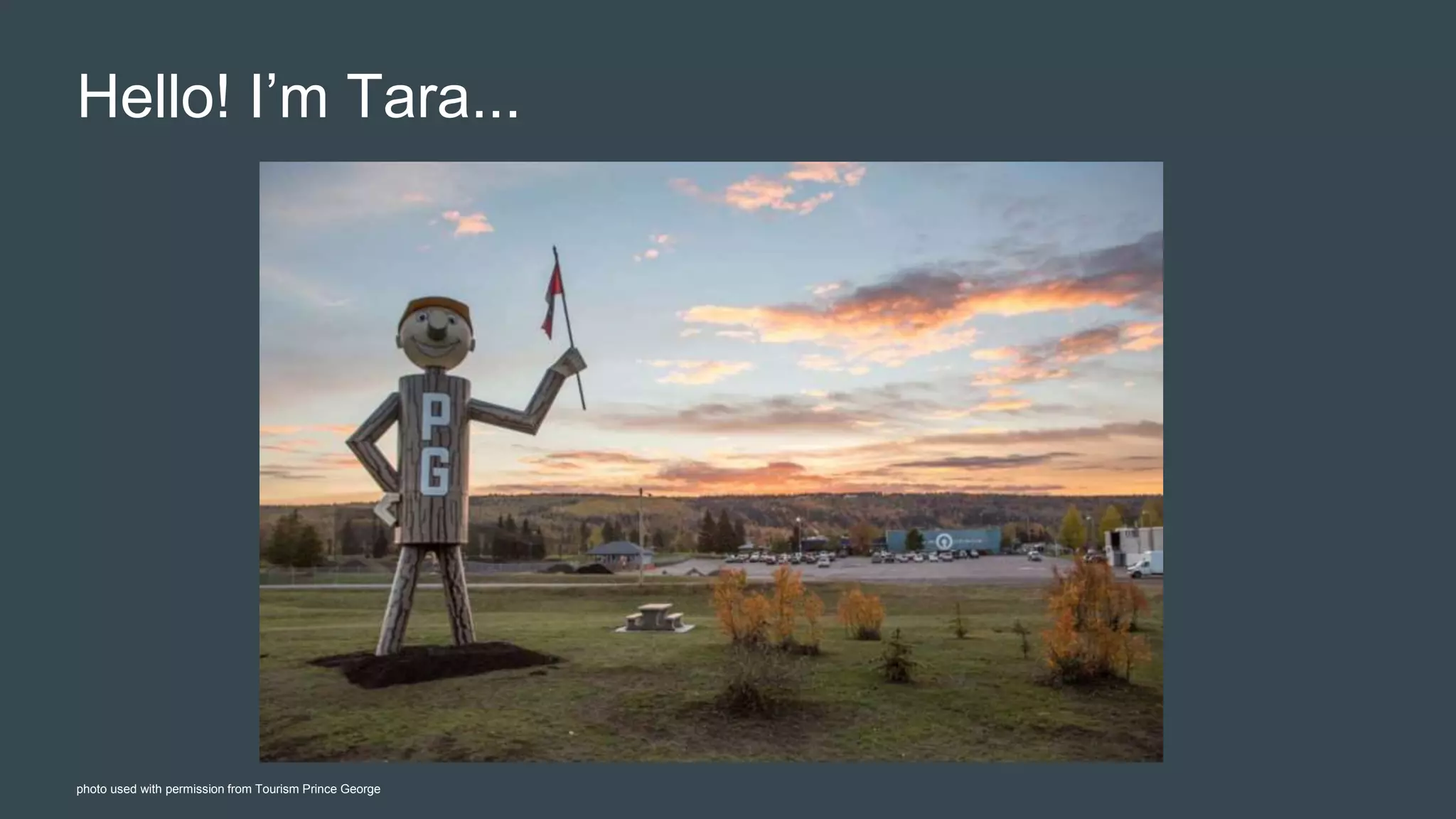
Hello! I’m Tara...
photo used with permission from Tourism Prince George
My home
Mozilla!
Whose voices are missing?
How do we include these
voices?
How diversity makes us smarter
photo from www.wocintechchat.com
Find someone you
haven’t worked with yet
and share your ideas.
Think quietly and write
down your idea.
What is something that someone has done to
make you feel included?
Think (1 min) Pair (2 min)
Add your ideas to this doc:
bit.ly/NDF-2018
In a group of 4 share
your ideas and pick one
to share with the whole
group.
Share (4 min)
DIVERSITY
is the mix of people
Neurodiversity
Employee/Volunteer
Introvert/Extrovert
Sexual Orientation
Culture
National Origin
Religion
LGBTQAI+
Style
Native Language
Socio-Economic Background
Age
Geography MoFo/MoCo
Experience
Appearance
Time Zone
Perspective
Office/Remote
Race/Ethnicity
EducationGender
Family Status
Technical/Non-Technical
Expertise
Ability
Role/Level
Source: Dimensions of diversity that matter to Mozillians from 20 D&I focus groups, 2015-16.
INCLUSION
is getting the mix to work
“…respect for opinions, voices,
backgrounds and orientations.”
“…to proactively invite diverse
people to participate fully and
actively in our organization.”
“...how each
of us wants to
be treated.”
“…making sure nobody
feels they are sitting on
the outside.”
“…the people who
are here stay here.”
“…how receptive [people are]
to your questions and how
you solve problems.”“...an organization and teams that
are effective working together with
different kinds of people.”
Source: Select quotations from 20 D&I focus groups, 2015-16.
“Mozilla’s mission is to build the Internet as
a global public resource, open and
accessible to all. ‘Open and accessible to
all’ implies a deep commitment to
inclusion, and to building inclusive
practices. As part of this commitment we
describe a set of ‘behaviors of inclusion’
that we aspire to. These are set out in
Mozilla’s Community Participation
Guidelines.”
Mitchell Baker, Chairwoman
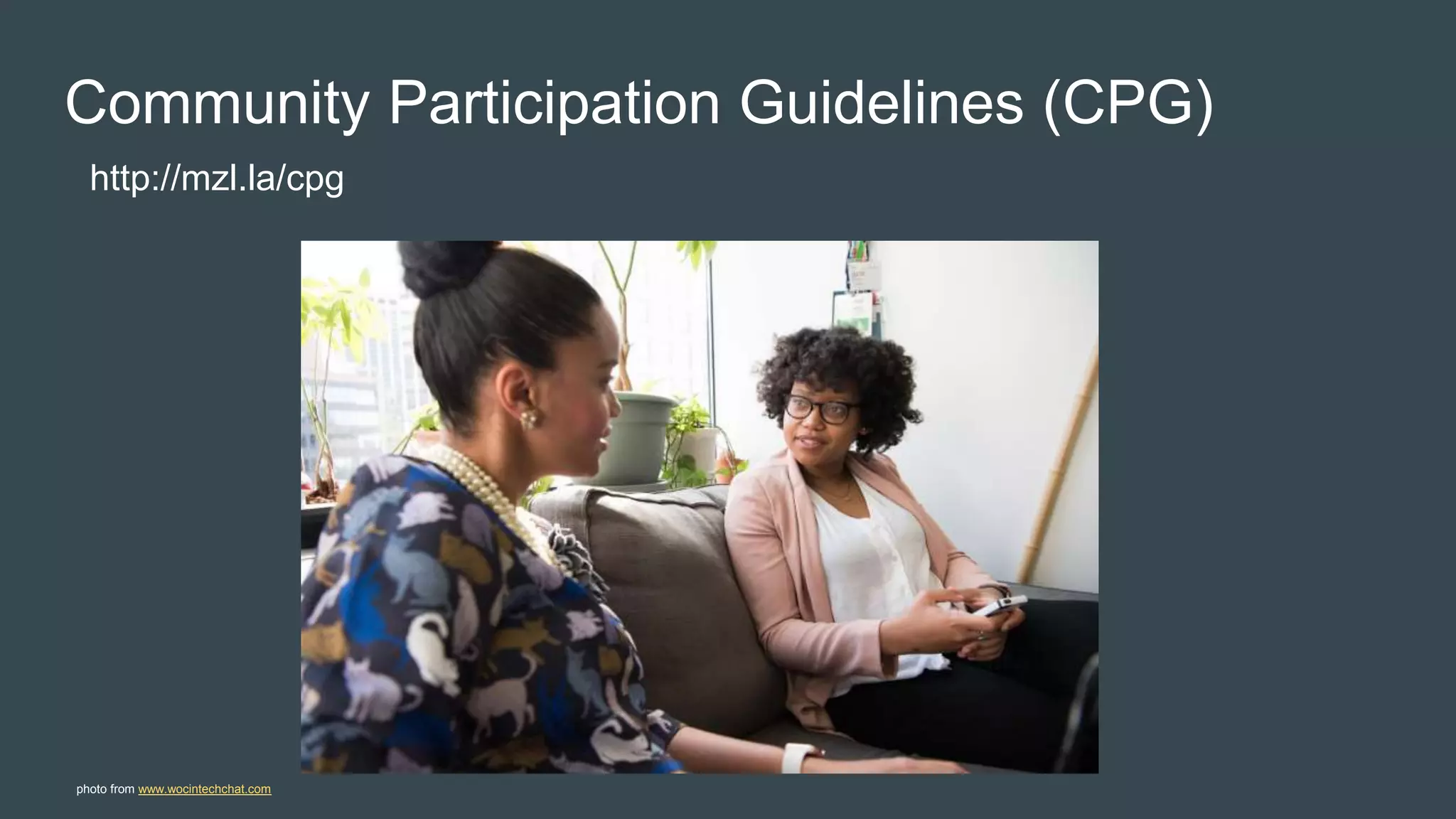
Community Participation Guidelines (CPG)
http://mzl.la/cpg
photo from www.wocintechchat.com
No rockstars. No ninjas.
Open source is “startlingly white and male”
photo from https://flic.kr/p/9hu7yA
Debiasing hiring
photo from https://flic.kr/p/aMeBa8
https://blog.mozilla.org/inclusion/2018/10/02/words-matter-moving-beyond-meritocracy/
Meritocracy
photo credit: https://flic.kr/p/aLeBxF
“We are sharing our results to date to be
transparent and hold ourselves accountable to
our global community as we strive to build a more
diverse and inclusive organization that reflects
the people we serve. We aim to create a working
environment where everyone can thrive and do
their best work. We are not where we want to be,
and have a lot more to do.”
Chris Beard, CEO Mozilla Corporation
Librarianship: startlingly white
91
%academic librarians in
Canada are white
??
%no demographic data
88
%librarians in the US are
white
Should the
MLIS/MLS be a
requirement for all
librarian jobs?
No.
Developing a culture of consent
Consent and digitization ethics
photo credit: https://flic.kr/p/kAT3Ws
Anonymous model
When I heard all the issues of the magazine are
being digitized, my heart sank. I meant this work to
be for my community and now I’m being objectified
in a way that I have no control over. People can cut
up my body and make a collage. My professional
and personal life can be high jacked. These are
uses I never intended and still don’t want.
Inclusive event planning
25
All Hands
photo from https://flic.kr/p/pMhPcq
San Francisco All Hands - Lauren’s talk
27
What is the most important
thing in the world?
It is the people, it is
the people, it is the
people.
Thank you!

blah, blah, blah: diversity and inclusion

  • 1.
    National Digital Forum November20, 2018 @tararobertson blah blah blah: diversity and inclusion
  • 2.
    Thank you to: CarolynArthur Vanessa Kwan Elaine Miller Amber Dawn Safia Noble Eli Manning Carmen Suchy Sam Bradd Devra Polack Stuart Yeates Chris Cormack Larissa Shapiro Sarah Hunt Lisa Sloniowski Denise Gammal Alison Macrina Annette DeFaveri Anne Olsen Francis Kayiwa Jess Mitchell Gwen Bird Baharak Yousefi Christina Harlow Amy Buckland Beth Davis Shirley Lew Mark Matienzo Jane Schmidt Lia Friedman Emily Drabinski Chanelle Gallant Fiona Fieldsend
  • 3.
  • 4.
    Hello! I’m Tara... photoused with permission from Tourism Prince George
  • 5.
  • 6.
  • 7.
    Whose voices aremissing? How do we include these voices?
  • 8.
    How diversity makesus smarter photo from www.wocintechchat.com
  • 9.
    Find someone you haven’tworked with yet and share your ideas. Think quietly and write down your idea. What is something that someone has done to make you feel included? Think (1 min) Pair (2 min)
  • 10.
    Add your ideasto this doc: bit.ly/NDF-2018 In a group of 4 share your ideas and pick one to share with the whole group. Share (4 min)
  • 11.
    DIVERSITY is the mixof people Neurodiversity Employee/Volunteer Introvert/Extrovert Sexual Orientation Culture National Origin Religion LGBTQAI+ Style Native Language Socio-Economic Background Age Geography MoFo/MoCo Experience Appearance Time Zone Perspective Office/Remote Race/Ethnicity EducationGender Family Status Technical/Non-Technical Expertise Ability Role/Level Source: Dimensions of diversity that matter to Mozillians from 20 D&I focus groups, 2015-16.
  • 12.
    INCLUSION is getting themix to work “…respect for opinions, voices, backgrounds and orientations.” “…to proactively invite diverse people to participate fully and actively in our organization.” “...how each of us wants to be treated.” “…making sure nobody feels they are sitting on the outside.” “…the people who are here stay here.” “…how receptive [people are] to your questions and how you solve problems.”“...an organization and teams that are effective working together with different kinds of people.” Source: Select quotations from 20 D&I focus groups, 2015-16.
  • 13.
    “Mozilla’s mission isto build the Internet as a global public resource, open and accessible to all. ‘Open and accessible to all’ implies a deep commitment to inclusion, and to building inclusive practices. As part of this commitment we describe a set of ‘behaviors of inclusion’ that we aspire to. These are set out in Mozilla’s Community Participation Guidelines.” Mitchell Baker, Chairwoman
  • 14.
    Community Participation Guidelines(CPG) http://mzl.la/cpg photo from www.wocintechchat.com
  • 15.
    No rockstars. Noninjas. Open source is “startlingly white and male” photo from https://flic.kr/p/9hu7yA
  • 16.
    Debiasing hiring photo fromhttps://flic.kr/p/aMeBa8
  • 17.
  • 18.
    “We are sharingour results to date to be transparent and hold ourselves accountable to our global community as we strive to build a more diverse and inclusive organization that reflects the people we serve. We aim to create a working environment where everyone can thrive and do their best work. We are not where we want to be, and have a lot more to do.” Chris Beard, CEO Mozilla Corporation
  • 19.
    Librarianship: startlingly white 91 %academiclibrarians in Canada are white ?? %no demographic data 88 %librarians in the US are white
  • 20.
    Should the MLIS/MLS bea requirement for all librarian jobs? No.
  • 21.
  • 22.
    Consent and digitizationethics photo credit: https://flic.kr/p/kAT3Ws
  • 23.
    Anonymous model When Iheard all the issues of the magazine are being digitized, my heart sank. I meant this work to be for my community and now I’m being objectified in a way that I have no control over. People can cut up my body and make a collage. My professional and personal life can be high jacked. These are uses I never intended and still don’t want.
  • 24.
  • 25.
  • 26.
    All Hands photo fromhttps://flic.kr/p/pMhPcq
  • 27.
    San Francisco AllHands - Lauren’s talk 27
  • 28.
    What is themost important thing in the world? It is the people, it is the people, it is the people.
  • 29.

Editor's Notes

  • #2 Kia ora koutou Ngā mihi nui ki ngā tangata whenua o tēnei rohe. Ko Tara Robertson ahau, nō Vancouver ahau. Tēnā koutou katoa. I am so excited and delighted to be invited here. I arrived from Canada about 10 days ago and this whole trip has been full of wonderful and serendipitous connections. It’s been amazing to reconnect with old friends and colleagues. I appreciate all the hospitality that has been extended to me and my wife--thank you so much Fiona and the rest of the organizing committee. We feel really welcomed and taken care of. Finding the right title is something that I’m not very good at. I’m going to mostly talk about my work at Mozilla but I’m going to take some detours and blah blah blah.
  • #3 I’m one of those annoying extroverts who needs to think out loud. I appreciate the generosity that all of these people have extended me. These people are friends, colleagues, comrades, librarians, sex worker activists, academics, feminists, queers and artists. I want to acknowledge and thank all of these people up front as extended feminist citation practice. I’m standing on the shoulders of these giants.
  • #5 I was born in Vancouver and grew up in a logging town called Prince George. Prince George is 800km north of Vancouver, at the junction of the Nechako and Fraser rivers. It is on the traditional territory of the Lheidli T'enneh, which means the people of where the two rivers flow together. Growing up most towns in a 10 hour drive in any direction didn’t have any McDonald’s and Prince George, population 75,000, had 4. This is Mr. PG, the town mascot. 8m tall, originally made of wood, he rotted and the replacement is built to last out of fibreglass and sheet metal. My mom is Japanese-Canadian and my dad is white, of Scottish and Irish ancestry. I’ve lived in 7 different countries including Scotland and Japan--partly to learn about the world but I think I was also looking for a sense of belonging and home. Being mixed race and queer means I’ve spent most of my life feeling like I don’t belong and that I don’t fit. This has also given me a first hand, personal view of group dynamics--I see things that many people in the majority groups do not. In 2009, I moved here with the intent to spend a year in Wellington. I’m grateful that Courtney Johnston hired me on contract, to work on the National Library’s website. To be honest, I was a bit crap. I was trying to figure out a bunch of things in my life and wasn’t the greatest employee. I made some colossal errors, including taking the website down 3 times. I had planned to stay here for a year, but got homesick after 6 months during a cold and wet Wellington winter. The silver lining of feeling homesick was that I finally realized where my home was.
  • #6 Vancouver has been my home for 15 years. The Pacific Ocean and the mountains feel like a giant hug. Old friendships and community connections also root me in Vancouver. Google Maps says it takes approximately 17 hours to fly here from there. Before Mozilla I was a librarian for 12 years working mostly in post-secondary institutions. I was drawn to libraries because I’d volunteered in activist and feminist libraries and care deeply about access to information. People often ask me about my odd career path from libraries to doing diversity and inclusion work in the tech sector. I was active in the library technology community where I led some work to make our conferences safer and more inclusive. For the last 5 years of my librarian career I managed an accessibility organization that served students with print disabilities by format shifting their textbooks into a digital formats that they could use. I’m still very passionate about accessibility and universal design. I love that the NDF organizers care about accessibility and communication access. The interpreter Tania and I also know each other from 16 years ago when we lived in Hokkaido, Japan. It feels really special to have her interpreting my words in to NZ sign language. I’ve been at Mozilla just over a year. As the Diversity and Inclusion Strategic Partner I’m the data person on our team. I’ve been building out our infrastructure so we can measure progress on diversity metrics. I partner with different parts of the oganization on specific strategies for cultural inclusion. I’ve led projects on trans inclusion and continue to advocate for accessibility.
  • #7 Mozilla has 1200 staff and 10,000 volunteer community members worldwide. Our mission is to ensure the Internet is a global public resource, open and accessible to all. The way we do this is with open source products, like the Firefox web browser. If you’re not using Firefox I suggest you give it a try as we relaunched Firefox Quantum last fall. It’s fast and we don’t do bad things with your data. Mozilla is a company that has one shareholder, the not-for-profit Mozilla Foundation. The Mozilla Foundation does awesome work on policy, publishes the Internet Health Report, host MozFest in London, and offers fellowships to 26 technologists, activists, and scientists from more than 10 countries, including New Zealand. This year our Fellows include: A neuroscientist building open-source laboratory hardware. An artist and maker who is looking to make weird projects that can only really live on the decentralized web, and to build tools and tutorials to help other people make even better, weirder things and Sam Muirhead, here in Wellington. Sam is working on an open source approach to the creation and adaptation of illustrations, comics, and animation. The aim is to support international activist networks running digital campaigns in diverse cultural contexts — enabling local chapters to speak with their own creative voice, while building solidarity and sharing resources across the network. I got to meet this cohort of Fellows in Toronto and they are one of the most interesting groups of people I’ve ever met. I’m so excited about the change that they’re making in the world.
  • #8 These are two questions that have guided my work. In most social situations, I think it’s always interesting to observe: Who is in the room? Who is at the table? Who speaks a lot? Who has social capital? Who feels welcome? Whose ideas are respected and centered by default? I think even more interesting is to note: Who is missing? Who is sitting on the margins? Who doesn’t feel welcome? Who has to fight to have their viewpoints heard and respected?
  • #9 For groups that value innovation and new ideas, diversity is key. There’s plenty of social science research that demonstrates this but one of my favourite articles is by Dr. Katherine Phillips, Professor of Leadership and Ethics and Senior Vice Dean at Columbia Business School. Her article “How Diversity Makes Us Smarter” in Scientific American is an accessible summary of some of the key research in this area. Phillips says that when we’re around people like us, whether it’s people who are the same race, gender, have the same political viewpoints as us, it leads us to think we all hold the same information and share the same perspective. When we hear dissent from someone who is different from us, it provokes more thought than when it comes from someone who looks like us. Diversity jolts us into cognitive action in ways that homogeneity does not. Simply by being in the presence of someone who is not like you, you will be more diligent and open-minded. You will work harder on explaining your rationale and anticipating alternatives than you would have otherwise. There’s a couple of other important points in Dr. Phillips’ article. While diverse groups performed better than homogeneous groups they also had more conflict and enjoyed working together less. As someone works in D&I this means that as we build more diverse teams we also need to also build people’s skills on understanding unconscious bias, giving and receiving feedback and communicating when there’s conflict. Mozilla’s mission is to ensure the Internet is a global public resource, open and accessible to all--how can we do that if we don’t have everyone at the table building the tools to do this? It’s not just about diversity, people need to feel that they can bring their whole selves to the table and that difference will be accepted and valued. This is the inclusion piece.
  • #10 So, I want you to think about something that someone did to make you feel included. The example you think about can be from work, social, school, family. I’m going to give you 1 minute to quietly think about this and to write your answer down. OK, great! I want you to get into groups of two and share what you wrote down. You have 2 minutes. Go!
  • #11 OK, I’m going to change the question slightly now. The question is: What can we do to make this community even more inclusive? I want you to get into groups of 4, discuss this question and write down your group’s ideas in the Google Doc at bit.ly/NDF-2018 You have 4 minutes. Go! (This is what participants had to say: https://docs.google.com/document/d/1c9HdgfncASU-C22kQwEiq5bGyaoOK2NUNIVOqQJtLBg/edit# )
  • #12 At the start of our D&I journey at Mozilla we did 20 focus groups with Mozillians. We heard about many diversity dimensions in our findings and they have shaped the way we define diversity. Diversity is all the things that make us who we are…it is our specific, unique, beautiful mix of people. In the top right hand corner there’s MoFo and MoCo. MoCo is our internal shorthand for the Mozilla Corporation. Internally we call people who work for the Foundation MoFos.
  • #13 And then, what is inclusion? We Mozillians believe inclusion is getting our specific mix of people to work well together, to invite voices forward, to speak boldly but respectfully, and listen intently. Inclusion is about how each of us wants to be treated.
  • #14 This is a quote from Mitchell Baker, our Chairwoman. Mozilla’s mission is to build the Internet as a global public resource, open and accessible to all. ‘Open and accessible to all’ implies a deep commitment to inclusion, and to building inclusive practices. As part of this commitment we describe a set of ‘behaviors of inclusion’ that we aspire to. These are set out in Mozilla’s Community Participation Guidelines.
  • #15 The CPG is the Code of Conduct at Mozilla. It outlines both behaviours we want to see and behaviours that are unacceptable. The following behaviors are expected of all Mozillians: Be Respectful Value each other’s ideas, styles and viewpoints. We may not always agree, but disagreement is no excuse for poor manners. Be open to different possibilities and to being wrong. Be kind in all interactions and communications, especially when debating the merits of different options. Be aware of your impact and how intense interactions may be affecting people. Be direct, constructive and positive. Take responsibility for your impact and your mistakes – if someone says they have been harmed through your words or actions, listen carefully, apologize sincerely, and correct the behavior going forward. Be Direct but Professional We are likely to have some discussions about if and when criticism is respectful and when it’s not. We must be able to speak directly when we disagree and when we think we need to improve. We cannot withhold hard truths. Doing so respectfully is hard, doing so when others don’t seem to be listening is harder, and hearing such comments when one is the recipient can be even harder still. We need to be honest and direct, as well as respectful. I love that this is written in plain English. Recently I found myself dragging my feet on having a hard conversation with someone I care about at work. When I was practicing for this talk I heard myself saying “We cannot withhold hard truths. We need to be honest and direct, as well as respectful.” This was the nudge I needed to have this conversation. Looking back I wished I’d had this conversation about a month before I worked up the courage to do so. The CPG also outlines behaviours that are not tolerated. These include: violence threats of violence personal attacks derogatory language disruptive behaviour (like heckling speakers) and unwelcome sexual attention or physical contact. “This includes touching a person without permission, including sensitive areas such as their hair, pregnant stomach, mobility device (wheelchair, scooter, etc) or tattoos. This also includes physically blocking or intimidating another person. Physical contact or simulated physical contact (such as emojis like “kiss”) without affirmative consent is not acceptable.” I love that the CPG includes these concrete examples--some of them I hadn’t thought about before. The CPG also includes information about consequences of unacceptable behaviours and information on how to report. It is open licensed under a CC Attribution Sharealike license. The work we all do has a ripple effect in the world. Mozillians in Brazil used our CPG as the base of their open letter to a JS conference to call out a transphobic incident. And a couple of weeks ago the SQLite community adopted our CPG as their code of conduct.
  • #16 In an article in Wired titled “Diversity in Open Source Is Even Worse Than in Tech Overall” Klint Finley writes: “even though users of the open source software present in countless products and services are now as diverse as the internet itself, the open source development community remains startlingly white and male—even by the tech industry's dismal standards.” I had a lot of imposter syndrome throughout the application process for Mozilla. I was just a librarian at a college in Canada that no one had heard of. Who did I think I was applying to work for Mozilla? There were 3 sentences in the job posting that made me apply: “You demonstrate a history of working in a collaborative and open manner—whether that be in open source projects or simply openly discussing projects and questions. You should apply even if you don’t feel that your credentials are a 100% match with the position description. We are looking for relevant skills and experience, not a checklist that exactly matches the position itself.” Of course this was by design. Knowing that open source skews white and male, requiring open source experience would limit the people who would choose to apply, and likely some excellent candidates would self select out. The key experience is open collaboration, not open source experience. We also use a tool called Text.io to make sure that our job postings use balanced language. Thankfully we don’t post job ads for code ninjas and rockstar developers anymore.
  • #17 In the 1970s, top orchestras in the US were only 5% women. At that time there were lots of reasons given for this including: “women have smaller techniques than men,” “women more temperamental and more likely to demand special attention or treatment,” and that “the more women, the poorer the sound.” Zubin Mehta, conductor of the Los Angeles Symphony from 1964 to 1978 and of the New York Philharmonic from 1978 to 1990, is credited with saying, “I just don’t think women should be in an orchestra.” (Goldin and Rouse, p 719) By 2000, orchestras were up to almost 30% women. Part of the reason for the change was the introduction of “blind auditions”, where the musicians literally auditioned behind a curtain so that the panel couldn’t see them. They were only assessing candidates based on how they sounded. They found that even with the curtain that there were other telltale signs, like the click clack of women's high heels. They either added a carpet or got women to take their shoes off and had a man make clomp clomp clomp noises with his shoes. Now most US orchestras are 40-50% women, though there are very few women who are conductors or who play in the brass section. At Mozilla our version of the blind audition is a tool called Hackerrank. This enables hiring managers to evaluate candidates based on their code, not their name, perceived gender or race, or the university that they graduated from. We started using Hackerrank to select candidates for our internships. There was more than 4x improvement in first two years of HackerRank, we went from: From 2 women to 13 women From 7 colleges to 27 colleges + 1 code academy 61% of the 2017 cohort were women and/or People of Color
  • #18 I’ve been involved in open source projects for more than 10 years. When I first got involved I really bought into the idea of a meritocracy, which means those with merit rise to the top. Merit is based on your contributions, talent and achievements, and not on your job title, the company you work for, or the university you graduated from. I now see that meritocracy has a tonne of bias baked into it. We come with different privilege, access to resources, tools, and technology. It’s not a level playing field. Last month Mozilla stopped using meritocracy as a way to describe our governance and leadership structures. This was a big deal. Emma Irwin, our D&I community lead writes “From the beginning of this journey to a more inclusive organization, we have been thinking about the words we use as important carriers of our intended culture and the culture we wish to see in the broader movements we participate in.” Mitchell says: I personally long for a word that conveys a person’s ability to demonstrate competence and expertise and commitment separate from job title, or college degree, or management hierarchy, and to be evaluated fairly by one’s peers. I long for a word that makes it clear that each individual who shares our mission is welcome, and valued, and will get a fair deal at Mozilla – that they will be recognized and celebrated for their contributions without regard to other factors. Sadly, “meritocracy” is not that word. Maybe it once was, or could have been. But not today. The challenge is not to retain a word that has become tainted. The challenge is to build teams and culture and systems that are truly inclusive. This is where we focus.”
  • #19 In April we did our first ever external diversity disclosure. This is voluntary and we’ve joined about 30 tech companies that have published high level demographic data. As of the end of last year women’s made up 24% of Mozilla overall, 33% in leadership, 13% in tech roles. Underrepresented minorities (Black, Latinx, Indigenous folks) in the US made up 7% of Mozilla overall, 0% in leadership, 6% in tech roles. Our CEO Chris Beard said: “We are not where we want to be, and have a lot more to do.” I appreciate this intellectual honesty and transparency. I’m excited for us to publish the 2018 update so we can share our progress.
  • #20 We know that librarianship is a female dominated profession, but there’s not much data about the racial makeup of librarians in Canada, NZ and the US. In Canada there was one study done by the Canadian Association of Professional Academic Librarians of, not surprisingly academic librarians. They collected 1730 names and email addresses by looking at college and university websites. Of the 1730 people they contacted, they received 904 responses. 91% of respondents were white. Only 2% of respondents identified as Indigenous--First Nations, Metis or Inuit. Being in a community of librarians I’m often a lazy researcher. I’ll do a quick search for something then reach out to someone I know who is more expert in the topic than me. When Fiona asked if I had any questions about the NZ context I asked her my demographic question. She in turn used the same methodology and reached out to LIANZA, Te Rōpū Whakahau and RNANZ. No one was aware of demographic research that had been done in this area. According to ALA’s Diversity Counts report in 2009-10, 88% of credentialed librarians in the US are white. Thanks to Barbara Chawner who pointed me to this report. According to ALISE: Library and Information Science Education Statistical Report in 2015, 79% of students at ALA accredited universities in the US are white. This means that the pipeline for future librarians is only slightly more diverse than the workforce. The sparse or non-existing data tells a story by what’s missing. We measure what we care about. I hope that our library associations or researchers will take on this important work. We need to know what our baseline is and we need to be able to track change over time.
  • #21 If we go back to the arguments around diversity and innovation, working to make our workplaces more diverse is something that libraries must do to survive and be relevant. There’s additional arguments about reflecting the diversity of our user groups and society. Also--it’s the right thing to do. Seeing the lack of racial diversity in the library school student data, which is our pipeline, we need to to rethink the MLIS/MLS as a requirement for all librarian jobs. We need to articulate the core competencies for what is important in libraries now and broaden our view of whose qualifications are relevant. We need to recruit from a more diverse pool of candidates. I’m not talking about lowering the bar, rather being more critical of what libraries need, which might raise the bar. We need to stop talking about cultural fit on our hiring committees. Culture fit means that we’re perpetuating a monoculture of people who look just like us and think just like us--this isn’t what we need to be relevant now, or in the future. In addition to rethinking our hiring pool, we need to build in additional scaffolding so that people of colour can imagine a future for themselves in libraries, where there’s mentorship and a promotion path is clear. As diversity and inclusion are intertwined we need to work to change the culture of libraries so that people of colour can bring their full selves to work and that that difference would be valued. This will mean some hard and necessary conversations about our culture and whiteness.
  • #22 I’m going to shift gears and talk about consent now. code4lib is a library technology conference and community where I feel at home. In 2015 I proposed that we ask speakers for permission to livestream their talks and that we use coloured lanyards as a visual shorthand to communicate people’s desire to be in photos online. Red meant absolutely no photos, green meant photos are fine, and yellow meant you needed to ask. Some of the initial comments from men who had been in the community longer than me bummed me out. Some of those comments included: “This needs to be opt out, not opt in.” “I enjoy taking candid photos of people at the conference and no one seems to mind.” “My old Hippy soul cringes at unnecessary paperwork. A consent form means nothing. Situations change. Even a well-intended agreement sometimes needs to be reneged on.” I was able to get enough support to get this off the ground. Another woman of colour, Ranti Junus, helped me pull together a consent form and we did the work of talking to all of the speakers. Thankfully things have changed a lot and this is now standard practice at code4lib and many other conferences have followed suit.
  • #23 Consent is something that’s really important to me as a feminist. I want to take a quick detour and share a personal story. In Spring 2016 I came out in my professional life as former sex worker. I know what it’s like to have content about myself online that I didn’t consent to. In my case, it’s a newspaper article that appeared in a major Canadian newspaper that identifies me as a sex worker and a librarian. For most of my career I’d been terrified that my employer or my colleagues would find this out. We live in a judgmental society where there are many negative stereotypes about sex workers. I was worried that this would undermine my professional reputation. I think that we would all agree that open access to information is a good thing. If you remember, this is the reason I became a librarian. However, over the last couple of years I’ve come to realize that this isn’t an absolute and that there are some times where it’s not appropriate or ethical for information to be open to all. In 2016 I learned that Reveal Digital, a nonprofit that works with libraries, digitized On Our Backs, a lesbian porn magazine that ran from 1984-2004. For a brief moment I was really excited — porn that was nostalgic for me was online! Then I quickly thought about friends who appeared in this magazine before the internet existed. I was worried that this kind of exposure could be personally or professionally harmful for them. There are ethical issues with digitizing collections like this. Consenting to a porn shoot that would be in a queer magazine with a limited print run is a different thing to consenting to have your porn shoot be available online. For a year I kept digging and researching this topic—I visited Cornell University’s Rare Book and Manuscripts Collection and found the contributor contracts, learned a lot more about US copyright law, and most importantly I talked to queer women who modeled for On Our Backs about their thoughts and feelings about this.
  • #24 This is a quote from one of the models from an email to me. She writes: “People can cut up my body and make a collage. My professional and personal life can be high jacked. These are uses I never intended and still don’t want.” I was successful in getting this collection taken down from Reveal Digital’s collection by publicly questioning the ethics of digitization projects like this and amplifying the voices of models who appeared in On Our Backs. There are other culturally sensitive materials that should not be wholly digitized and made available through open access. When I was researching this topic, Stewart Yates pointed me to NZ Electronic Text Centre’s community consultation and report on digitizing the book Moko: or Maori Tattooing that was published in 1896.
  • #25 OK! Back to red lanyards! When I came to Mozilla I was delighted to see that we had a way to opt out of photos, even during work events. Here’s a bit from a blog post from Brianna Mark, our Senior Event Planner: Like many of the people who use Firefox, our employees value being able to choose — with clarity and confidence — what information they share with whom. One of the ways we look out for this, when hosting our All Hands events, is by offering our attendees the choice of a white or red lanyard. White lanyards mean you are okay being photographed. A red one means you are not. Wearing a name badge is required during our events so a colored lanyard is a very visible way to communicate a preference without having to say a word. It also makes it easy to spot and remove any photographs that may have been taken by mistake. Our event team typically hands out about 50 red lanyards per event. For some, having their image show up online is a real security threat (think stalking). For others, keeping their image off line is simply preferred. Truth is, why an employee, or a member of their family who might be attending one of our social events, might select a red lanyard over a white is less important than offering people the choice. Like with our work, Mozilla’s values don’t necessarily tell us what to do but rather remind us of how we should do it. Making red lanyards available to our employees and their families as part of our semi-annual events is a small but tangible manifestation of just what we mean.
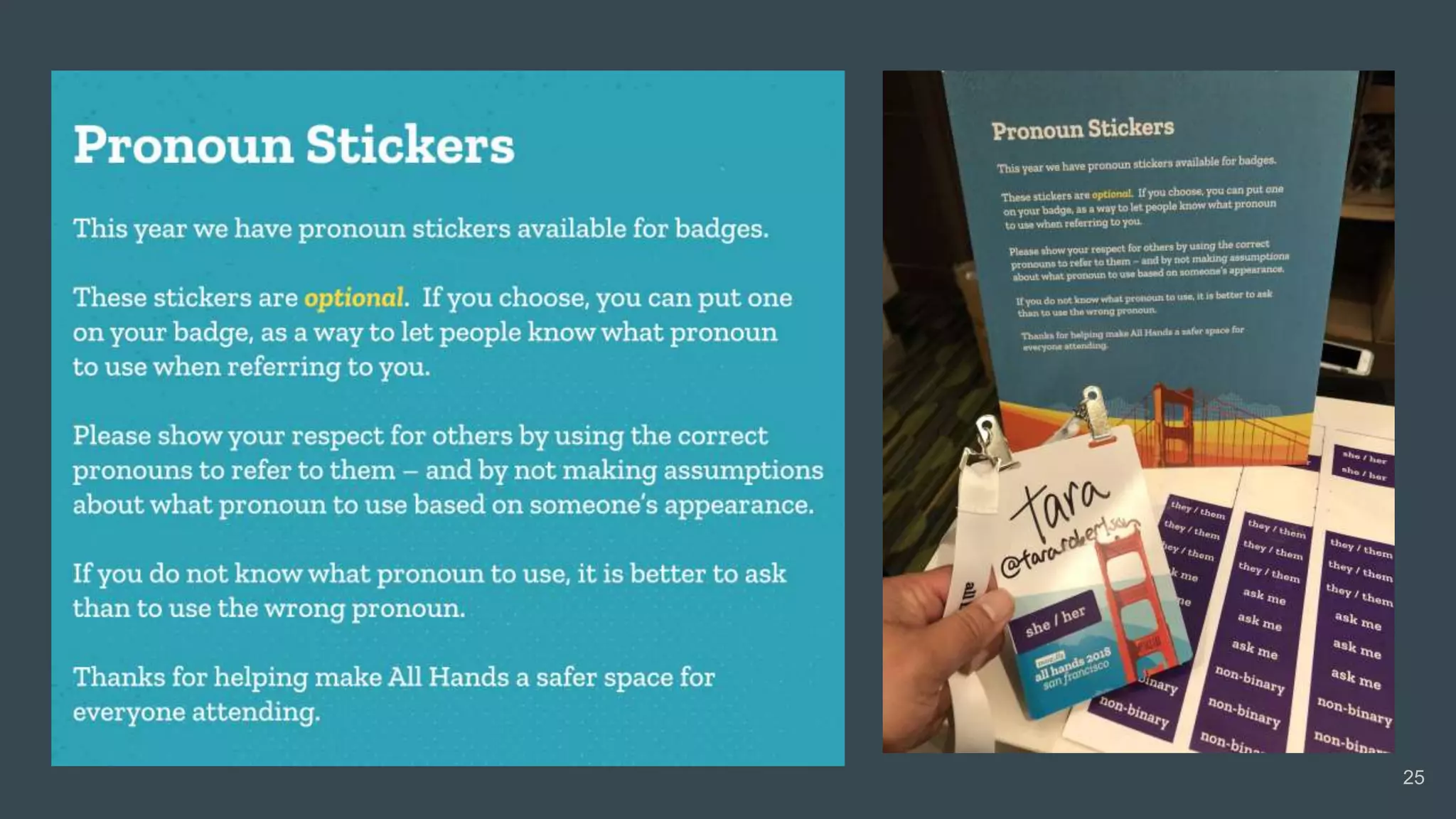
  • #26 I love how we keep iterating on our culture. At our last All Hands Brianna added pronoun stickers for people to add to their name badges. I like this is something we can all do to make our culture more inclusive. This is another example of how our actions creates ripples in the world. After seeing this photo on social media, a labour union adopted this idea for their conference..
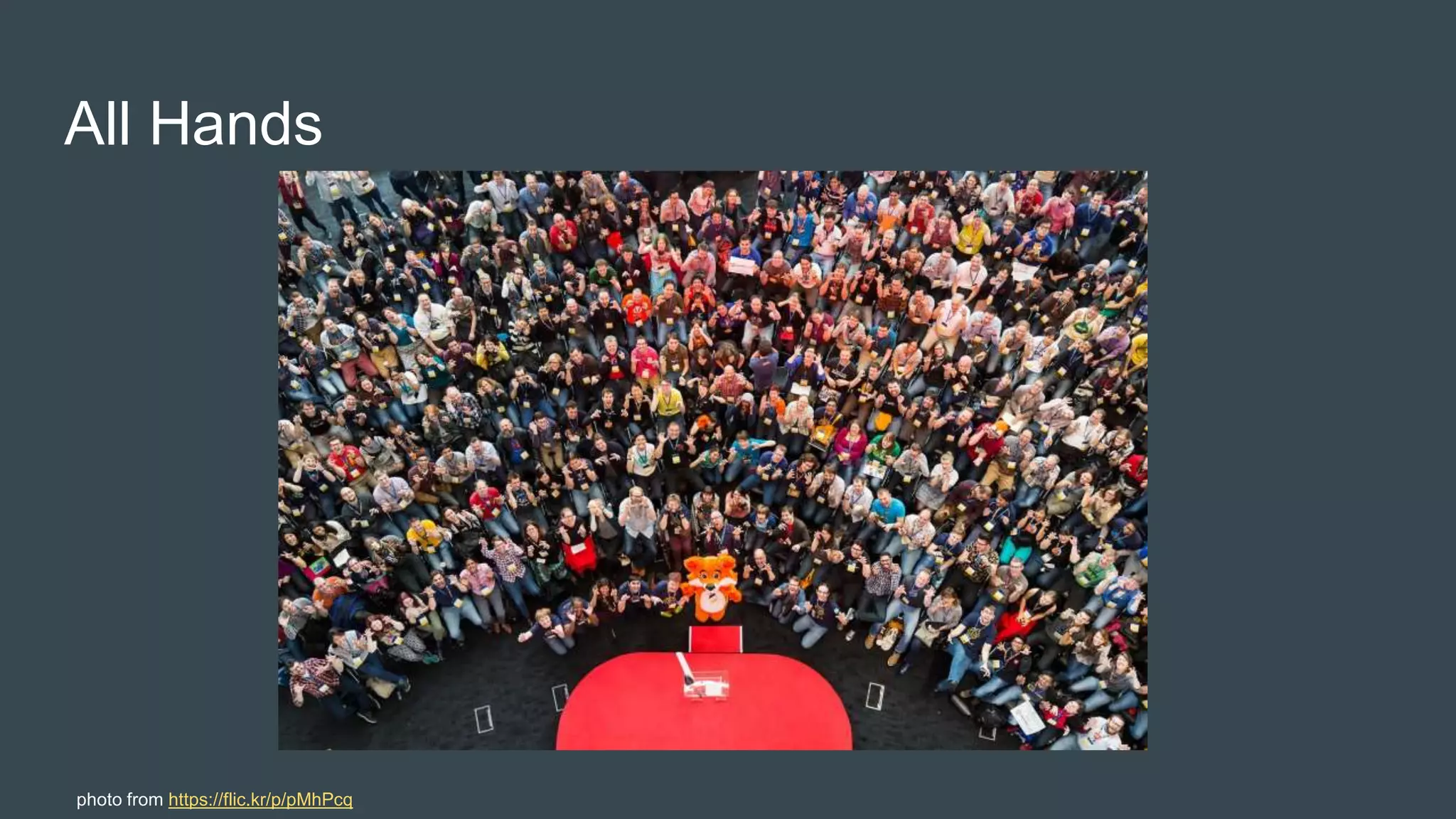
  • #27 So, I’ve mentioned All Hands a few times now. All Hands is our twice yearly meeting where we all come together in person. Mozilla staff are in 16 countries and 40% of our workforce is remote. All Hands is critical part of building the connective tissue that allows us to work well together the rest of the year. The week after I get home to Canada, I’m heading to Orlando for our next All Hands. This past summer All Hands was in SF. The big event is the plenary session where our senior execs talk about where we’re at and where we’re going. Imagine 1200 of us in this giant hotel ballroom.
  • #28 In between each of the executive presentations, regular staff were interspersed reading thank you emails from our users and sharing other short snippets. This was the short snippet between the Chief Marketing Officer and the Chief People Officer. PLAY VIDEO Lauren moved me to tears--and I wasn’t the only one in the audience who was crying. I have deep admiration for her courage. There was also an amazing feeling in the room. After the loud cheers I could feel people’s careful attention in how they were leaning forward and listening with care and attention. I wrote guidelines to support staff who are transitioning their gender at work. Initially I intended for it to be a simple list of places where one would need to update usernames and gender markers, but it became more comprehensive to give context to understanding gender more broadly, for managers to understand their responsibilities, and for all staff to understand how they can make Mozilla a more welcoming and inclusive place. I heard from managers that they wanted to do the right thing and were worried they might make a mistake and hurt someone. So, I organized some training to help our staff level up their knowledge and comfort in being inclusive of trans and non-binary colleagues. 180 people RSVPed to attend the sessions, and over the recordings have been viewed 300 times. Mozillians care and want to learn more and do better.
  • #29 As of yesterday morning I didn’t have an ending to this talk and was starting to get a bit worried. Fiona organized two tours for us at the National Library. Michael had a question about Māori worldviews. Just then Bella, a Māori elder, was walking by. She was very generous with her time and explained some things about her culture. One of the things she said stuck in my head and heart, and I realized it was the thread that ties this whole talk together. What is the most important thing in the world? He tāngata, he tāngata, he tāngata It is the people, it is the people, it is the people