CAPITOLO 4
Giorno per giorno
Day By Day
Percorso 1
Le attività di tutti i giorni
The activities of the day
Ancona , La Marche
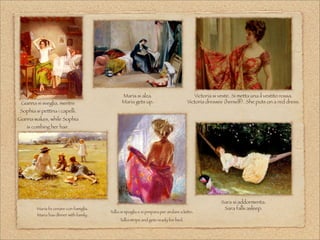
Gianna si sveglia, mentre
Sophia si pettina i capelli.
Gianna wakes, while Sophia
is combing her hair.
Maria si alza.
Maria gets up.
Victoria si veste. Si metta una il vestito rossa.
Victoria dresses (herself). She puts on a red dress.
Sara si addormenta.
Sara falls asleep.
Tullia si spoglia e si prepara per andare a letto.
Tullia strips and gets ready for bed.
Maria fa cenare con famiglia. 
Maria has dinner with family.
Vocabolario
Le attività di tutti i giorni
avere un appuntamento
cenare
divertirsi
fare la spesa
farsi il bagno
pettinarsi (i capelli)
pranzare
riposarsi
truccarsi
to have an appointment, to have a date
to have dinner
to have a good time
to go grocery shopping
to take a bath
to comb one’s hair
to have lunch
to rest
to put on make up
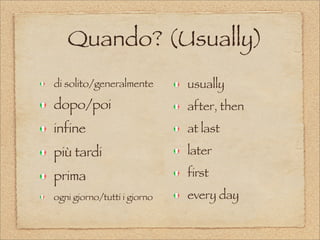
Quando? (Usually)
di solito/generalmente
dopo/poi
infine
più tardi
prima
ogni giorno/tutti i giorno
usually
after, then
at last
later
first
every day
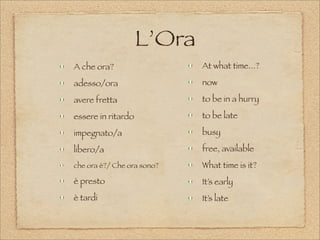
L’Ora
A che ora?
adesso/ora
avere fretta
essere in ritardo
impegnato/a
libero/a
che ora è?/ Che ora sono?
è presto
è tardi
At what time...?
now
to be in a hurry
to be late
busy
free, available
What time is it?
It’s early
It’s late
Cosi si dice
Telling Time
To ask...
To ask what time it is say: che ora è?/ Che ora sono?
Response: è l’una e cinque-It’s five after one. OR:
sonno le due meno venti- It’s twenty to two.
To indicate time use: è, l’una, mezzogiorno, mezzanotte.
Use the plural sono le with other times greater than one
Midnight
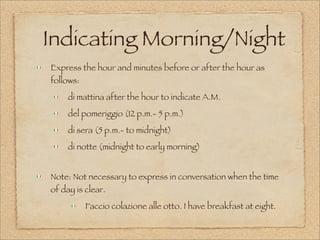
Indicating Morning/Night
Express the hour and minutes before or after the hour as
follows:
di mattina after the hour to indicate A.M.
del pomeriggio (12 p.m.- 5 p.m.)
di sera (5 p.m.- to midnight)
di notte (midnight to early morning)
Note: Not necessary to express in conversation when the time
of day is clear.
Faccio colazione alle otto. I have breakfast at eight.
To find...
To find out when something occurs ask: A che ora? (At what
time)
Response: Use a, all’, alle + the hour.
- A che ora comincia la lezione? A mezzogiorno?
-No, comincia all’una e finisce alle due.
At what time the lesson begins? At noon?
No, it begins at one and finishes at two.
4.2- Che ora è ?
Sono le dicidue meno un quarto
Sono le cinque e mezzo/mezza Sono le otto e ventidue.
Sono le otto e diciotto
Sono le undici e dici
Sono le dici e un quarto
In Practica
Pisa,
4.3 Che Significa
1. fare colazione (D)
2. pranzare (A)
3. Essere impegnato/a (E)
4. fare la spesa (B)
5. avere fretta (F)
6. cenare (C)
a. mangiare a mezzogiorno
b.comprare cose da mangiare
c. mangiare la sera
d. mangiare la mattina
e. avere molte cose da fare
f. avere poco tempo
Match each expression with the definition
4.4 L’intruso
avere fretta, cenare, essere impegnato
farsi il bagno, farsi la doccia, fare colazione
svegliarsi, addormentarsi, pranzare
vestirsi, divertirsi, mettersi
lavarsi, leggere le mail, prepararsi
Select words that don’t belong
Verbs- fare
dello sport
trekking
una passeggiata
vela
to do sports
to go hiking
to take a walk
to sail
verbs- giocare
a baseball
a basket
a carte
a football
a golf
pattinare
prendere il sole
sciare
uscire
venire
to play baseball
to play basketball
to play cards
to play football
to play golf
to skate
to sunbathe
to ski
to go out
to come
Che temp fa?
E (appost) nuvoloso
C’e nebbia
Tira vento/ C’e
vento
avare caldo
avere freddo
It’s cloudy
It’s foggy
It’s Windy
to be hot
to be cold
Dialogue
Paolo- Susanna, che fai stasera? Ido esco con Giorgio. Vieni?
Susanna-No, non vengo. Stasera vado a letto presto, perche domani, se tanti mesi in casa!
Perche non vieni anche tu? O vai alla partita?
Paolo- Certo che vengo anch’io! A che ora andiamo?
Susanna- Prestissimo!
Paolo-Vengono anche Marco e Angela?
Susanna- No, sono a sciare. Pensa, in primavera!
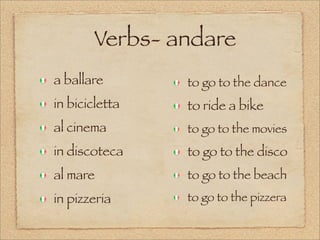
Verbs- andare
a ballare
in bicicletta
al cinema
in discoteca
al mare
in pizzeria
to go to the dance
to ride a bike
to go to the movies
to go to the disco
to go to the beach
to go to the pizzera
Reflexive Action
Reflexive Action
person acting= person affected
subject and object are the same person
Reflexive Pronoun
Reflexive Pronoun
Agrees with subject of the verb in person
and number
Verbs can be used in reflexive and non-
reflexive way- determined by object of the
verb
Optional in English, required in Italian (see ex.2)
Reflexive verbs conjugate like other
verbs- pronoun in front (see ex.3)
Lo sai che? 24-hour clock
Use a 24-hour clock
Train,bus,plane, movie and theater schedules
are expressed in 24 hour time
Ex. Reflexive Pronoun
Tom si veste.
Tom dresses himself.
* note- 3rd person singular and plural forms share the same pronoun
subject reflexive pronoun
Tom veste la donna
Tom dresses the woman.
reflexive pronoun vs.
non-reflexive
* note- subject and object are different
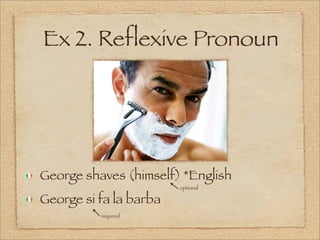
Ex 2. Reflexive Pronoun
George shaves (himself) *English
George si fa la barba
required
optional
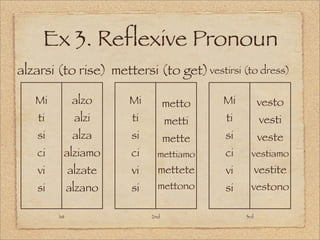
Ex 3. Reflexive Pronoun
alzarsi (to rise)
Mi
ti
si
ci
vi
si
alzo
alzi
alza
alziamo
alzate
alzano
Mi
ti
si
ci
vi
si
metto
metti
mette
mettiamo
mettete
mettono
Mi
ti
si
ci
vi
si
vesto
vesti
veste
vestiamo
vestite
vestono
mettersi (to get)vestirsi (to dress)
1st 2nd 3rd
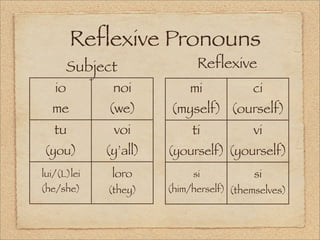
Reflexive Pronouns
mi
(myself)
ci
(ourself)
ti
(yourself)
)
vi
(yourself)
si
(him/herself)
si
(themselves)
Reflexive
io
me
noi
(we)
tu
(you)
voi
(y’all)
lui/(L)lei
(he/she)
loro
(they)
Subject
Irregular Verbs
Irregular Verbs
Must be memorized
often involves changes to the stem
may use different endings
stem of infinitive used in noi and voi forms
Venire- to come
stem of infinitive used in noi and voi
-io and -loro forms add a -g before the endings
tu and lui/lei change -e into -ie before the endings
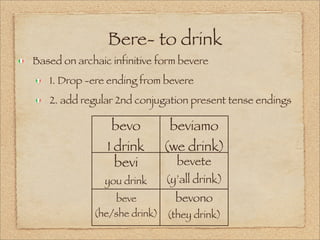
Bere- to drink
Based on archaic infinitive form bevere
1. Drop -ere ending from bevere
2. add regular 2nd conjugation present tense endings
bevo
I drink
beviamo
(we drink)
bevi
you drink
bevete
(y’all drink)
beve
(he/she drink)
bevono
(they drink)
Grammatica- andare, venire, e uscire
vado
(I go)
andiamo
(we go)
Vai
(You go)
andate
(ya’ll go)
Va
(He/she it) Goes
vanno
(they go)
Andare (to go)
Uscire (to go out)
vengo
(I come)
veniamo
(we come)
vieni
(You come)
venite
(ya’ll come)
viene
(he/she comes)
vengono
(they come)
esco
(I go out)
usciamo
(we go out)
Esci
(you go out)
uscite
(ya’ll go out)
Esce
(He/she it) Goes out
escono
(they go out)
venire (to come)
Idiomatic phrases with Avere
FOODS
del, dello, dell’, della
Used with something cut and measured
but not countable
Follows same pattern as definite article
Quantity- the partitive article
some + singular noun expressing an
uncountable quantity=
del, dello, dell’, della
Used with something cut and measured
but not countable
Follows same pattern as definite article
Del, dello,dell’, della
Bevo del caffè
I drink the coffee
Mangio della torta
I eat the cake
Percorso III
Le stagioni e il tempo
Le Marche
Facts
Prosperous/Peaceful region
Stretches from Apennine Mountains to Adriatic Sea
Few visitors to the inland areas
Beaches, countryside and Medieval/Renaissance
towns with artistic treasures
populated by farmers and artisians
Industries: footwear industry Todds and Hogan;
naval industry in Ancona and Fano; paper
production in Fabriano
Urbino
small renaissance city- enclosed within its walls is the
Palace Ducale.
Federico da Montefeltro, Lord of the City from
1444-1482, built the Palace.

Italian-Chapter 4

  • 1.
    CAPITOLO 4 Giorno pergiorno Day By Day
  • 2.
    Percorso 1 Le attivitàdi tutti i giorni The activities of the day Ancona , La Marche
  • 3.
    Gianna si sveglia,mentre Sophia si pettina i capelli. Gianna wakes, while Sophia is combing her hair. Maria si alza. Maria gets up. Victoria si veste. Si metta una il vestito rossa. Victoria dresses (herself). She puts on a red dress. Sara si addormenta. Sara falls asleep. Tullia si spoglia e si prepara per andare a letto. Tullia strips and gets ready for bed. Maria fa cenare con famiglia.  Maria has dinner with family.
  • 4.
  • 5.
    Le attività ditutti i giorni avere un appuntamento cenare divertirsi fare la spesa farsi il bagno pettinarsi (i capelli) pranzare riposarsi truccarsi to have an appointment, to have a date to have dinner to have a good time to go grocery shopping to take a bath to comb one’s hair to have lunch to rest to put on make up
  • 6.
    Quando? (Usually) di solito/generalmente dopo/poi infine piùtardi prima ogni giorno/tutti i giorno usually after, then at last later first every day
  • 7.
    L’Ora A che ora? adesso/ora averefretta essere in ritardo impegnato/a libero/a che ora è?/ Che ora sono? è presto è tardi At what time...? now to be in a hurry to be late busy free, available What time is it? It’s early It’s late
  • 8.
  • 9.
    To ask... To askwhat time it is say: che ora è?/ Che ora sono? Response: è l’una e cinque-It’s five after one. OR: sonno le due meno venti- It’s twenty to two. To indicate time use: è, l’una, mezzogiorno, mezzanotte. Use the plural sono le with other times greater than one Midnight
  • 10.
    Indicating Morning/Night Express thehour and minutes before or after the hour as follows: di mattina after the hour to indicate A.M. del pomeriggio (12 p.m.- 5 p.m.) di sera (5 p.m.- to midnight) di notte (midnight to early morning) Note: Not necessary to express in conversation when the time of day is clear. Faccio colazione alle otto. I have breakfast at eight.
  • 11.
    To find... To findout when something occurs ask: A che ora? (At what time) Response: Use a, all’, alle + the hour. - A che ora comincia la lezione? A mezzogiorno? -No, comincia all’una e finisce alle due. At what time the lesson begins? At noon? No, it begins at one and finishes at two.
  • 12.
    4.2- Che oraè ? Sono le dicidue meno un quarto Sono le cinque e mezzo/mezza Sono le otto e ventidue. Sono le otto e diciotto Sono le undici e dici Sono le dici e un quarto
  • 13.
  • 14.
    4.3 Che Significa 1.fare colazione (D) 2. pranzare (A) 3. Essere impegnato/a (E) 4. fare la spesa (B) 5. avere fretta (F) 6. cenare (C) a. mangiare a mezzogiorno b.comprare cose da mangiare c. mangiare la sera d. mangiare la mattina e. avere molte cose da fare f. avere poco tempo Match each expression with the definition
  • 15.
    4.4 L’intruso avere fretta,cenare, essere impegnato farsi il bagno, farsi la doccia, fare colazione svegliarsi, addormentarsi, pranzare vestirsi, divertirsi, mettersi lavarsi, leggere le mail, prepararsi Select words that don’t belong
  • 16.
    Verbs- fare dello sport trekking unapasseggiata vela to do sports to go hiking to take a walk to sail
  • 17.
    verbs- giocare a baseball abasket a carte a football a golf pattinare prendere il sole sciare uscire venire to play baseball to play basketball to play cards to play football to play golf to skate to sunbathe to ski to go out to come
  • 18.
    Che temp fa? E(appost) nuvoloso C’e nebbia Tira vento/ C’e vento avare caldo avere freddo It’s cloudy It’s foggy It’s Windy to be hot to be cold
  • 19.
    Dialogue Paolo- Susanna, chefai stasera? Ido esco con Giorgio. Vieni? Susanna-No, non vengo. Stasera vado a letto presto, perche domani, se tanti mesi in casa! Perche non vieni anche tu? O vai alla partita? Paolo- Certo che vengo anch’io! A che ora andiamo? Susanna- Prestissimo! Paolo-Vengono anche Marco e Angela? Susanna- No, sono a sciare. Pensa, in primavera!
  • 20.
    Verbs- andare a ballare inbicicletta al cinema in discoteca al mare in pizzeria to go to the dance to ride a bike to go to the movies to go to the disco to go to the beach to go to the pizzera
  • 21.
    Reflexive Action Reflexive Action personacting= person affected subject and object are the same person
  • 22.
    Reflexive Pronoun Reflexive Pronoun Agreeswith subject of the verb in person and number Verbs can be used in reflexive and non- reflexive way- determined by object of the verb Optional in English, required in Italian (see ex.2) Reflexive verbs conjugate like other verbs- pronoun in front (see ex.3)
  • 23.
    Lo sai che?24-hour clock Use a 24-hour clock Train,bus,plane, movie and theater schedules are expressed in 24 hour time
  • 24.
    Ex. Reflexive Pronoun Tomsi veste. Tom dresses himself. * note- 3rd person singular and plural forms share the same pronoun subject reflexive pronoun Tom veste la donna Tom dresses the woman. reflexive pronoun vs. non-reflexive * note- subject and object are different
  • 25.
    Ex 2. ReflexivePronoun George shaves (himself) *English George si fa la barba required optional
  • 26.
    Ex 3. ReflexivePronoun alzarsi (to rise) Mi ti si ci vi si alzo alzi alza alziamo alzate alzano Mi ti si ci vi si metto metti mette mettiamo mettete mettono Mi ti si ci vi si vesto vesti veste vestiamo vestite vestono mettersi (to get)vestirsi (to dress) 1st 2nd 3rd
  • 27.
  • 28.
  • 29.
    Irregular Verbs Must bememorized often involves changes to the stem may use different endings stem of infinitive used in noi and voi forms
  • 30.
    Venire- to come stemof infinitive used in noi and voi -io and -loro forms add a -g before the endings tu and lui/lei change -e into -ie before the endings
  • 31.
    Bere- to drink Basedon archaic infinitive form bevere 1. Drop -ere ending from bevere 2. add regular 2nd conjugation present tense endings bevo I drink beviamo (we drink) bevi you drink bevete (y’all drink) beve (he/she drink) bevono (they drink)
  • 32.
    Grammatica- andare, venire,e uscire vado (I go) andiamo (we go) Vai (You go) andate (ya’ll go) Va (He/she it) Goes vanno (they go) Andare (to go) Uscire (to go out) vengo (I come) veniamo (we come) vieni (You come) venite (ya’ll come) viene (he/she comes) vengono (they come) esco (I go out) usciamo (we go out) Esci (you go out) uscite (ya’ll go out) Esce (He/she it) Goes out escono (they go out) venire (to come)
  • 33.
  • 34.
    FOODS del, dello, dell’,della Used with something cut and measured but not countable Follows same pattern as definite article
  • 35.
    Quantity- the partitivearticle some + singular noun expressing an uncountable quantity= del, dello, dell’, della Used with something cut and measured but not countable Follows same pattern as definite article
  • 36.
    Del, dello,dell’, della Bevodel caffè I drink the coffee Mangio della torta I eat the cake
  • 37.
  • 39.
  • 40.
    Facts Prosperous/Peaceful region Stretches fromApennine Mountains to Adriatic Sea Few visitors to the inland areas Beaches, countryside and Medieval/Renaissance towns with artistic treasures populated by farmers and artisians Industries: footwear industry Todds and Hogan; naval industry in Ancona and Fano; paper production in Fabriano
  • 41.
    Urbino small renaissance city-enclosed within its walls is the Palace Ducale. Federico da Montefeltro, Lord of the City from 1444-1482, built the Palace.